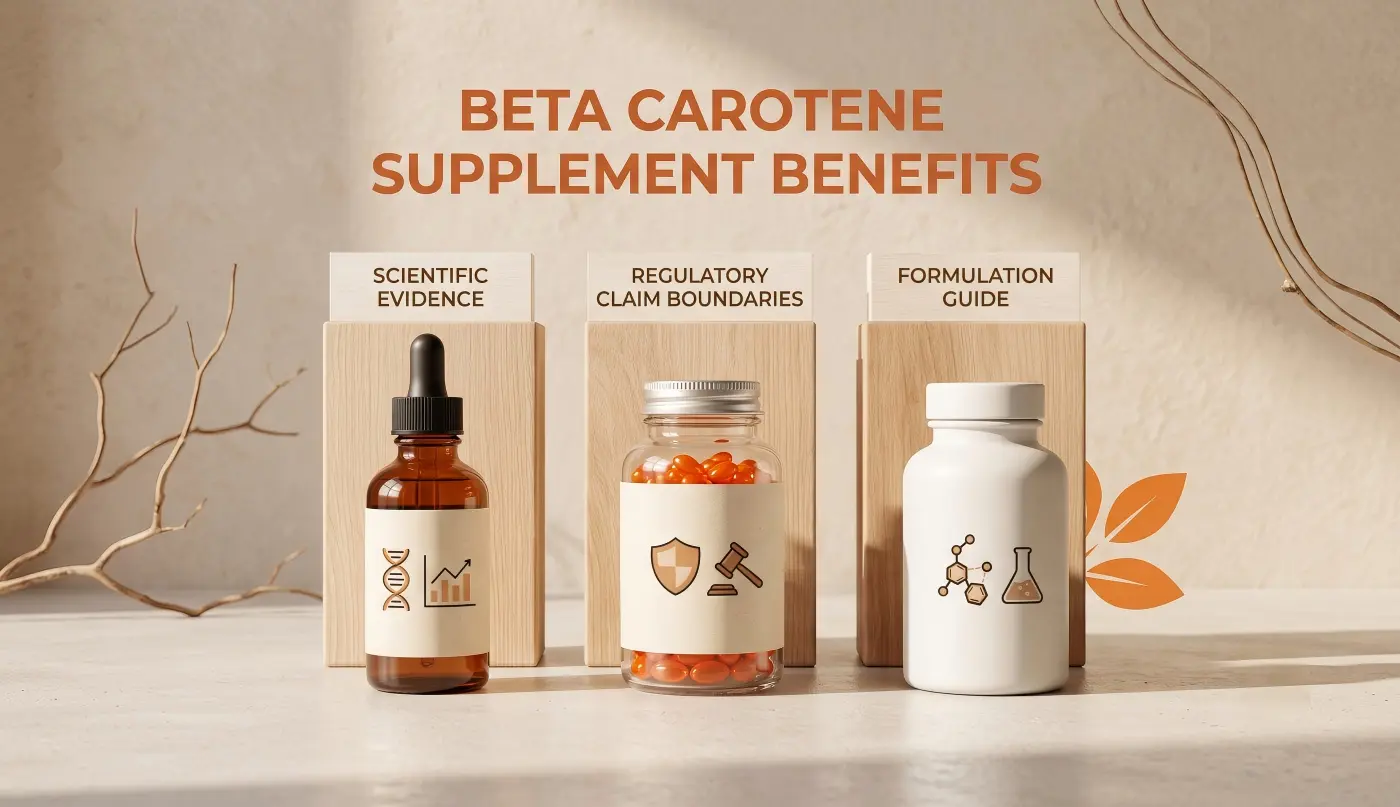
Direct answer: The strongest, most defensible benefit of beta carotene in dietary supplements is its role as a provitamin A source that supports vitamin A–dependent functions—especially vision, immune function, and maintenance of skin and mucous membranes—when used at nutritional doses. Antioxidant activity is biologically plausible and commonly used in structure/function positioning, but disease-prevention claims (cancer, macular degeneration treatment, cardiovascular disease prevention) are not supported by major RCTs and are high-risk under U.S. and EU labeling frameworks. High-dose supplements (about 20–30 mg/day) increased lung cancer risk in smokers and some high-risk groups; brands should avoid megadose antioxidant positioning in those populations.[1][6][14]
Beta-carotene is one of the most established carotenoids used in dietary supplements, yet it is also among the most misunderstood. Decades of research support its role as a provitamin A source and antioxidant, but not every commonly marketed benefit is backed by the same level of evidence. Certain populations—particularly current smokers—require special consideration when formulating high-dose products. Conversion efficiency also varies genetically via BCMO1 polymorphisms, which affects how R&D should design vitamin A strategies.[20][21]
This guide is written for brand owners, product managers, R&D formulators, and procurement teams. It is designed as an evidence review, claim-boundary tool, and OEM formulation/procurement manual—not a consumer wellness listicle.
Looking for OEM manufacturing?
See beta carotene supplement manufacturing and natural beta carotene options.
1. TL;DR for Procurement & Product Teams
- Evidence hierarchy first: Vitamin A source = strong; vision/immune via vitamin A = strong to moderate–strong; antioxidant/skin = qualified; cancer prevention = not supported.
- Claim boundaries: Structure/function yes; disease prevention/treatment no.[14][15][16]
- High-dose caution populations: Current smokers, heavy former smokers, asbestos-exposed adults.[6][7][9]
- BCMO1 reality: Conversion is highly variable; poor-converter phenotypes are common enough to justify mixed-carotenoid or low-dose retinol hybrid strategies in some SKUs.[20][21]
- Natural vs. synthetic: Label appeal vs. cost/assay control—delivery form still decides stability.
- Dual commercial value: Nutrient + natural yellow–orange colorant.[17][18]
- OEM differentiators: Application-specific grades, oxidation control, HPLC isomer profiling, stability data, and regulatory documentation.
2. Clinical Evidence Overview
Before listing benefits, brands should answer one question: How strong is the human evidence—and what claim class does that support?
Clinical Evidence Summary
| Health outcomes | Human evidence | Strength of evidence | Common regulatory position |
|---|---|---|---|
| Vitamin A/provitamin A sources | Extensive physiology + DRI framework | Strong | Widely accepted nutrient function |
| Vision support (via vitamin A) | Strong mechanistic + nutrient–function opinions | High | Structure/function (US); authorized vitamin A claim pathway (EU) |
| Immune function (via vitamin A) | Moderate–strong nutrient–function evidence | Moderate–Strong | Structure/function; EU vitamin A immune wording pathway |
| Antioxidant activity | Mechanistic + mixed clinical translation | Moderate | Qualified structure/function; avoid disease endpoints |
| Skin / mucous membrane support | Supported via vitamin A; direct BC photoprotection more limited | Limited–Moderate / Emerging for standalone BC claims | Qualified |
| General nutrient adequacy | Practical + nutritional | Moderate–Strong | Acceptable when dose and RAE math are honest |
| Cardiovascular disease prevention | Major RCTs largely negative/null | Not supported for prevention | Not recommended as disease claim |
| Cancer prevention | Inconsistent; harm signal in high-risk high-dose trials | Not supported | Not recommended |
| Treat/reverse macular degeneration | AREDS2 shifted away from beta carotene for smokers | Not appropriate as disease claim | Not recommended |
Evidence hierarchy used here: human RCTs and authoritative nutrient reviews (NIH ODS, IOM/DRI, EFSA) over observational fruit/vegetable associations. Food carotenoid epidemiology is not treated as equivalent to isolated high-dose supplemental beta carotene outcomes.[1][2][3][4][7][9][10][11]
How procurement should use this table
- Build the primary claim only from Strong / High rows.
- Use Moderate rows only with qualified wording and substantiation files.
- Keep Not Supported rows out of labels, ads, influencer scripts, and Amazon bullets.
- Separate eye health AMD stories (lutein/zeaxanthin) from vitamin A vision stories.
3. What Is Beta Carotene? (Procurement View)
Provitamin A carotenoid
Beta-carotene is a fat-soluble carotenoid and the most important dietary provitamin A carotenoid. The body converts it to retinal and then retinol via intestinal BCMO1 (β-carotene 15,15′-monooxygenase). Conversion efficiency varies by genetics, diet matrix, dose, and vitamin A status.[1][2][20]
Key U.S. labeling conversion references:[1]
| Source | Approximate equivalence |
|---|---|
| Supplemental beta carotene | 2 mcg = 1 mcg RAE |
| Dietary beta carotene | 12 mcg = 1 mcg RAE |
| Preformed retinol | 1 mcg = 1 mcg RAE |
Procurement implication: an oil softgel delivering isolated beta carotene is not nutritionally equivalent milligram-for-milligram to carrots. Oil-based supplemental forms typically have higher bioavailability than raw plant matrices.
BCMO1 gene polymorphisms and the “poor converter” problem
Industry briefs often assume linear conversion: more beta carotene → more vitamin A. Human data show otherwise.
- Conversion of beta carotene into vitamin A is highly variable; literature has long noted low-responder / poor-converter phenotypes in a substantial share of healthy individuals (commonly discussed in the range up to about 45% in intervention contexts).[20][21]
- Two common BCMO1 coding SNPs—R267S (rs12934922) and A379V (rs7501331)—reduce catalytic activity. The combined 267S + 379V mutant showed about 57% lower activity in vitro; carriers showed markedly reduced retinyl palmitate:β-carotene response ratios in human testing (about −69% for combined carriers in the Leung study).[20]
- Additional upstream BCMO1-region SNPs also influence conversion efficiency, with allele frequencies differing by ethnicity.[21]
Formulation implication for R&D (high commercial value):
| Strategy | When it helps | Caution |
|---|---|---|
| Mixed carotenoids (alpha- + beta-carotene / natural Dunaliella complexes) | Broaden provitamin A profile and clean-label story | Assay storytelling more complex |
| Beta carotene + micro-dose retinyl palmitate/retinyl acetate | Improve vitamin A reliability for poor converters | Retinol UL, pregnancy labeling, and smoker/asbestos stacking rules |
| Keep beta carotene nutritional (not megadose) | Aligns with safety evidence | Do not “fix” poor conversion by pushing 20–30 mg/day |
| Pair with dietary-fat guidance/oil softgel delivery | Supports absorption | Still does not erase genetic conversion limits |
This is one of the clearest ways an OEM partner demonstrates real formulation engineering rather than commodity assay matching. Explore hybrid builds under multivitamin supplements and natural beta carotene.
Antioxidant mechanism—what to say and what not to overclaim
Beta carotene can quench singlet oxygen and participate in radical-scavenging chemistry. That supports cautious antioxidant positioning. It does not justify megadose disease-prevention antioxidant marketing after ATBC, CARET, and related outcomes.[7][9][12][13]
Commercial forms buyers actually compare
| Source/form | Procurement focus |
|---|---|
| Dunaliella salina (natural) | Clean-label, natural color, mixed carotenoids |
| Synthetic all-trans beta carotene | Cost, assay consistency, tinctorial strength |
| Oil suspension (≈20–30%) | Softgels |
| Beadlets | Tablets / hard capsules |
| CWD / microencapsulated powders | Gummies, powders, beverages |
See also beta carotene powder supplier and tablets & capsules manufacturing.
4. Which Benefits Are Supported?
Vitamin A contribution
Clearest benefit: conversion to vitamin A activity required for visual pigment cycling, epithelial integrity, and immune cell function. The Food and Nutrition Board has not set a UL for beta carotene, but advises against supplements for the general population except as a provitamin A source to help prevent deficiency.[1][2]
Formulation opportunity: Use defined RAE contribution in multivitamins, plant-based formulas, and children’s systems—not megadose “antioxidant therapy.”
Eye health/vision support
Vitamin A (retinal) is required for rhodopsin and dark adaptation. That supports vision-related structure/function language when vitamin A contribution is real.[1][3]
Beta carotene is not:
- A stand-in for lutein/zeaxanthin macular formulas
- A treatment for age-related macular degeneration
- Automatically appropriate for smoker-targeted eye vitamins
Original AREDS used 15 mg beta carotene; AREDS2 replaced it with lutein 10 mg + zeaxanthin 2 mg. NEI advises current/former smokers to prefer AREDS2.[11]
Prefer lutein and eye antioxidants as macular heroes; keep beta carotene as supporting provitamin A where appropriate.
Immune support
EFSA has established vitamin A relationships with normal immune function.[3][5] Avoid “prevents infections/treats colds” disease drift.
Skin health
Maintenance of normal skin and mucous membranes is a recognized vitamin A function.[3] Standalone beta-carotene UV/oxidative claim packages are more constrained under EFSA Article 13 assessments for beta carotene as such.[4]
Formulation opportunity: Skin antioxidants, astaxanthin, and beta carotene + lycopene stacks with cautious wording.
Antioxidant support
Mechanistic support is real; hard clinical disease-prevention translation is not.[12][13] Position inside antioxidant / natural antioxidant blends at disciplined doses.
5. Why Manufacturers Choose Beta Carotene Instead of Preformed Vitamin A
Many briefs still ask: “Why not just use retinyl palmitate?”
| Decision factors | Beta carotene advantage | Preformed vitamin A (retinol esters) note |
|---|---|---|
| Physiological conversion | Body regulates conversion; lower classic hypervitaminosis A risk profile vs excess retinol | Direct activity; UL applies to preformed vitamin A |
| Consumer acceptance | Plant-based / “from carrots/algae” story | Animal-origin perception in some markets |
| Clean label | Dual nutrient + natural color | Color contribution limited |
| Multiple dosage forms | Oil, beadlets, CWD powders, gummies | Also versatile, but less color utility |
| Natural color | Yellow–orange functional pigment[17][18] | Not a colorant strategy |
| Pregnancy / excess-retinol sensitivity | Often preferred as vitamin A contributor in conservative designs | Requires tighter UL and labeling control |
| Poor converters (BCMO1) | May under-deliver RAE in some genotypes | More reliable vitamin A delivery—hybrid designs may be optimal[20][21] |
OEM takeaway: Beta carotene is frequently chosen for safer physiological conversion narrative + clean-label color + plant-based positioning. Hybrid systems remain valid when conversion reliability is a design priority—without recreating CARET-style high-dose beta carotene + high retinol stacks in smoker-sensitive SKUs.[9]
6. Benefits That Are Frequently Overstated
Cancer prevention — do not claim
ATBC (20 mg/day in male smokers) and CARET (30 mg/day + retinyl palmitate in smokers/asbestos-exposed adults) reported increased lung cancer risk signals; Physicians’ Health Study found no cancer/CVD prevention benefit in a largely nonsmoking cohort.[7][8][9][10]
Anti-aging — usually overstated
Prefer skin-maintenance language over chronological aging reversal. Longevity actives (fisetin, spermidine, urolithin A) need their own evidence files.
Heart health — limited as prevention
Do not lead with cardiovascular disease prevention claims.[10]
“More antioxidant = better”
Failed/harmful megadose trials reframed the category toward dose discipline and delivery quality.[13]
7. Who Should Not Use High-Dose Beta Carotene?
This is a YMYL section most OEM pages avoid. It should not be avoided.
Safety considerations for brand positioning
High-dose beta-carotene supplementation may not be appropriate for every population.
Clinical studies reported increased lung cancer risk among smokers and individuals with significant asbestos exposure receiving high-dose supplemental beta carotene (alone or with retinol).[7][9] EFSA (2024) advises that smokers should avoid beta-carotene-containing food supplements and that general-population supplemental use should focus on meeting vitamin A needs rather than open-ended megadose antioxidant use.[6]
Practical population guide for formulators
| Population | High-dose beta carotene stance | Formulation note |
|---|---|---|
| Current smokers | Avoid high-dose supplements | Prefer lutein/zeaxanthin eye systems; no CARET-style stacks |
| Heavy former smokers | Caution; medical context matters | Default to smoker-sensitive design unless counsel directs otherwise |
| Asbestos-exposed adults | Avoid high-dose regimens | Document exclusion in product risk review |
| Healthy nonsmokers | Low–moderate nutritional doses generally discussed | Keep total stack modest |
| Pregnancy | Beta carotene often preferred over highly-preformed retinol | Still controls total vitamin A activity |
| Multi-product stackers | Recalculate total daily intake | Softgel + multi + eye vitamin stacking is a common failure mode |
Product positioning and dosage recommendations should always align with current scientific evidence, local regulations, and the intended consumer population. Full dosage and AREDS detail: beta carotene supplement safety.
8. What Claims Can Supplement Brands Make?
Under U.S. DSHEA, structure/function, nutrient-deficiency, and general well-being claims may be used if truthful, not misleading, and substantiated. Disease treatment/prevention claims are not permitted for dietary supplements (absent drug approval). FDA expects competent and reliable scientific evidence for section 403(r)(6) claims.[14][15][16]
Claim boundary table
| Claim | Appropriate? | Why |
|---|---|---|
| Supports healthy vision | ✅ | Vitamin A physiology; keep non-disease |
| Supports vitamin A intake | ✅ | Core nutrient function |
| Supports/helps maintain immune health | ✅ | Vitamin A–related S/F; avoid infection-treatment implications |
| Antioxidant support / helps protect cells from oxidative stress | ✅ Qualified | Mechanistic support; no disease endpoints |
| Supports skin health | ✅ Qualified | Prefer vitamin A maintenance framing |
| Prevents blindness | ❌ | Disease claim |
| Prevents cancer | ❌ | Disease claim + contradictory RCT evidence in key groups |
| Treats vitamin A deficiency | ❌ | Disease treatment framing |
| Treats macular degeneration | ❌ | Disease claim; AREDS2 changed formula logic |
| Prevents heart disease | ❌ | Disease claim; prevention not established |
| Replaces sunscreen / prevents skin cancer | ❌ | Drug-like / disease territory |
Why FDA and EFSA frameworks matter
- FDA (US): Structure/function claims require substantiation and must not imply disease treatment/prevention.[14][15][16]
- EFSA / EU: Authorized wording often runs through vitamin A, not open-ended “beta carotene prevents X.” Vitamin A relationships for vision, immune function, and skin/mucous membranes are established; several beta-carotene-specific Article 13 packages were not.[3][4]
- Brand risk: Over-claiming destroys EEAT, invites enforcement, and creates retailer rejection.
Claim-development checklist
- Anchor the primary claim in vitamin A contribution.
- Keep dose outside smoker high-risk megadose territory.
- Separate AMD eye claims (lutein/zeaxanthin) from vitamin A vision claims.
- Hold substantiation files before artwork lock.
- Align disclaimers and notification rules with market of sale.
Need a claim map for your SKU?
Request our FDA/EFSA structure–function comparison worksheet through the OEM project intake on the beta carotene manufacturing page linked in the introduction.⇒
9. Global Regulatory Overview
Regulatory status is not identical across markets. Procurement should confirm the finished-product classification (supplement vs. fortified food vs. complementary medicine) before locking claims and specs.
| Market | Typical product framing | Operational note for beta carotene projects |
|---|---|---|
| USA | Dietary supplement/color additive | DSHEA S/F claims;[14][15] color use under 21 CFR 73.95[17][18] |
| EU | Food supplement/food additive (E160a) | Prefer authorized vitamin A claim pathways; EFSA 2024 smoker caution[3][6] |
| China | Health food/fortificant/colorant pathways differ | Separate GB rules for fortification vs coloring (below) |
| Australia | Food vs. TGA complementary medicine interface | Presentation, dose form, and indications can push product into ARTG listed medicines[22] |
| Japan | Food with function claims/food additive frameworks vary by category | Confirm additive vs nutrient positioning case-by-case |
| GCC / Middle East | Food supplement import + Halal often required | Halal documentation and local registration timelines matter |
Dose/caution benchmarks brands commonly operationalize
| References | Practical takeaway |
|---|---|
| ATBC / CARET | Harm signals around 20–30 mg/day supplemental regimens in high-risk groups[7][9] |
| EFSA 2024 | Smokers should avoid beta-carotene food supplements; no general UL established for beta carotene; use should target vitamin A needs[6] |
| NIH ODS / IOM | No UL for beta carotene; supplements not advised for general population except as provitamin A source[1][2] |
| Brand conservative design (nonsmoker multis) | Many commercial builds stay in low-to-moderate mg nutritional ranges; smoker-sensitive eye SKUs often keep beta carotene very low or omit it |
Exact finished-product limits depend on jurisdiction, product class, and local counsel review.
China market notes (GB context)
For China-facing OEM/export projects, beta carotene may appear under different legal roles:
- Nutrient fortificant pathway: GB 14880 framework lists beta-carotene among permitted fortificant sources for specified food categories with category-specific use ranges (example historically cited: solid beverages 3–6 mg/kg as beta-carotene fortification range in GB 14880-2012 appendix context).[23]
- Colorant pathway: GB 2760 controls beta-carotene as a food colorant (CNS 08.010 / INS 160a) with category-specific maximums (example historically cited: certain protein solid beverages up to 2.0 g/kg, with dilution-factor rules for solid beverages).[24]
- Chinese DRIs: Vitamin A reference intakes are expressed as RAE; beta carotene contributes via conversion factors used in national DRI methodology. Project teams should map finished-product RAE against the latest Chinese DRI revision and product standard—not against a single global number.
- Version control: Always verify the current GB 14880 / GB 2760 editions and announcements for the exact food category before artwork and dossier lock (GB 2760-2024 updates include category-specific removals such as distilled spirits uses).
China and multi-market dossiers are where weak suppliers fail. Ask for category-mapped fortificant vs colorant documentation early.⇒
10. Raw Material Selection Decision Guide
Natural vs. synthetic procurement matrix
| Consideration | Natural (Dunaliella / plant-derived) | Synthetic |
|---|---|---|
| Label appeal | Excellent | Moderate |
| Cost | Higher | Lower |
| Color intensity / tinctorial control | Moderate (warm natural hue) | High / highly controllable |
| Assay consistency | Good; often mixed carotenoids | Excellent all-trans focus possible |
| Stability potential | Good with protection | Excellent with protection |
| Consumer preference | High (clean-label / plant-based) | Moderate |
| HPLC isomer story | Cis + all-trans fingerprint often used in natural authenticity narratives | Predominantly all-trans profiles common |
| Best fit | Premium, children’s, beauty, natural color SKUs | Cost-sensitive multis, industrial color strength |
Procurement takeaway: Choose natural when brand equity depends on clean-label and natural color storytelling. Choose synthetic when cost and assay predictability dominate. In both cases, specify delivery form + stability package, not only “% beta carotene.”
Grade/dosage-form matching
| Grade | Typical use |
|---|---|
| Oil suspension ≈20–30% | Softgels, oil blends |
| Beadlets | Tablets, hard capsules |
| CWD / microencapsulated 1–10% (and higher custom) | Gummies, powders, sachets, some beverages |
| High-assay concentrate | Intermediate compounding |
11. Formulator’s OEM Selection Matrix
Use this as a one-page decision tool for brand briefs.
| Target SKU path | Suggested grade | Dosage Form | Synergy Ideas | Pitfall Guide |
|---|---|---|---|---|
| Vegan antioxidant gummy | 1% or 10% CWD microencapsulated powder (natural Dunaliella) | Gummies | Vitamin C + zinc; optional lycopene | Control cook temp (often target <105°C process window), manage acidulant load, validate color fade |
| Cost-efficient eye softgel | 20% or 30% oil suspension | Softgels | Lutein + Zeaxanthin + DHA | For smoker-sensitive SKUs keep beta carotene very low (commonly <2 mg) or omit |
| Clean-label children’s multi | Natural beadlets | Tablets / hard capsules | Mixed carotenoids | Replace FD&C Yellow 5/6 where shade allows; confirm compression survival |
| Beauty softgel | Oil suspension or protected beadlets | Softgels | Astaxanthin/beta carotene–lycopene | Avoid anti-aging disease claims; moderate dose |
| Instant powder/stick pack | High-quality CWD grade | Powders | Fruits & greens bases | Cold-water dispersibility, sedimentation, oiling-off |
| Plant-forward multi with conversion insurance | Natural BC ± micro-dose retinol ester | Capsules/tablets | Mixed carotenoids | Stay far from CARET-style high dual dosing; map RAE + UL |
Building one of these SKUs now?
Share your target dose, market, and dosage form—our team can recommend grade, overage, and packaging. Use the manufacturing CTA in the introduction to start the brief.⇒
12. Application Pitfalls by Dosage Form
Generic advice (“use microcapsules for gummies”) is not enough for R&D. These are the failure modes that create returns and failed stability pulls.
Gummies
- pH/acidulants: Citric and other acids can accelerate color shift of natural beta carotene systems.
- Thermal load: Extended cook/deposit heat drives assay and hue loss.
- Water activity & packaging: High Aw + oxygen ingress = fade and potency drift.
- Mitigation: CWD microcapsules, antioxidant systems, shorter thermal exposure, opaque packs, and real gummy-matrix stability—not only raw-material COA.
Powders / solid beverages (CWD)
- Cold-water dispersibility speed vs. clumping.
- Sedimentation after standing.
- Oiling off when encapsulation integrity is weak.
- Mitigation: Specify reconstitution test methods, particle-size targets, and emulsion integrity checks; validate in the actual flavor/acid system.
Hard capsules/tablets
- Flow (Carr’s Index / Hausner ratio): Poor flow creates weight variation.
- Direct-compression beadlets: Must survive compression without oil bleeding / bead rupture.
- Friability and content uniformity: Broken beads create mottling and assay scatter.
- Mitigation: Request DC-grade beadlet compression data, lubricant compatibility, and trial press runs before artwork lock.
Softgels
Usually the most forgiving lipid home—but fill-material peroxide value, headspace oxygen, and shell opacity still decide 24-month outcomes.
Fighting gummy fade or powder oiling-off?
Request CWD microcapsule samples and matrix-matched stability concepts through the beta carotene powder supplier page.⇒
13. Beyond Health Benefits: Beta Carotene as a Functional Natural Colorant
Beta carotene is both an active and a functional natural colorant—a key reason clean-label brands keep it on the brief.
Dual functionality
- Nutrition: provitamin A contribution
- Appearance: yellow-to-orange consumer-recognized hue
Under U.S. rules, β-carotene is listed as a color additive exempt from certification for coloring foods generally under GMP, from natural or synthetic preparation.[17][18] EU food-additive code: E160a.
| Product category | Why beta carotene is used |
|---|---|
| Gummies | Natural orange color + vitamin A story |
| Softgels | Oil-compatible color + nutrient delivery |
| Multivitamins | Nutrient + appearance uniformity |
| Children’s formulas | Familiar natural shade |
| Beauty/skin antioxidants | Warm hue + vitamin A adjacent positioning |
| Beverages/emulsions | Natural yellow–orange when properly dispersed |
Connects commercially to natural food ingredients, fruit antioxidants, botanical powder, and standard extracts.
14. Stability & Shelf-Life Engineering
QC lists are not enough. Procurement wants to know why a grade survives 24 months.
Factors affecting stability
- Oxygen
- UV / visible light
- Moisture/water activity
- Heat
- Metal ions / pro-oxidants
- Acidic matrices and high shear (process stress)
How OEM engineering responds
| Stressor | Engineering control |
|---|---|
| Oxygen | Microencapsulation, antioxidant systems, nitrogen flush, low-permeability packs |
| Light | Amber/opaque bottles, cartons, light-protected bulk handling |
| Heat | Process temperature mapping (gummy cook, drying, tableting) |
| Moisture | Aw control, desiccants, blister barriers |
| Metals | Raw-material hygiene, chelator strategy where appropriate |
| Mechanical stress | DC-grade beadlets with verified compression survival |
Stability program buyers should require
- Accelerated stability (temperature/humidity stress appropriate to dosage form)
- Long-term/real-time stability aligned to labeled shelf life
- Assay + color endpoints (dual-function SKUs fail on fade even when assay is borderline)
- Packaging comparability (bottle vs blister vs sachet)
- Matrix-matched pilots (gummy/powder/softgel—not raw material only)
Need accelerated + real-time protocol design for your pack?
Ask for a stability outline with grade recommendation when you submit the OEM brief.⇒
15. Typical Testing Specifications
Hard specs create EEAT. Soft promises do not.
Typical COA / release panel (project-dependent)
| Parameter | Why it matters |
|---|---|
| Identity | Confirm carotenoid identity (UV-Vis / HPLC as specified) |
| Assay/potency | Label claim and overage justification |
| Isomer profile (HPLC) | Natural Dunaliella vs synthetic all-trans fingerprinting; authenticity and process control |
| Heavy metals (Pb, As, Cd, Hg as required) | Market compliance and retailer scorecards |
| Microbiology | USP/EP or market-equivalent limits |
| Residual solvents | Critical for solvent-extracted natural grades; align to USP/EP residual solvent expectations |
| Pesticides | Especially plant/algae natural routes |
| Particle size/bulk density | Powder flow, capsule fill, beverage dispersion |
| LOD / moisture | Stability and compression behavior |
| Color value / tinctorial strength | Dual-function color SKUs |
| Peroxide/oxidation markers (oil systems) | Softgel fill quality |
Natural vs. synthetic QC emphasis
- Natural (Dunaliella): isomer fingerprint, pesticide panel, extraction-route solvent residuals (supercritical CO₂ routes often preferred when solvent burden must be minimized; solvent routes require tighter residual controls).
- Synthetic: all-trans purity, assay precision, heavy metals, residual process impurities per specification.
Related analytical culture also supports active compounds and lipid ingredients programs.
16. Manufacturing Process Overview
Procurement teams often ask for the factory path in one view:
Raw Material Qualification → Incoming QC → Formula Development → Pilot Batch → Commercial Production → Finished Product Testing → QA Release → Stability Monitoring
| Stage | What “good” looks like |
|---|---|
| Raw material qualification | Source, grade, isomer/assay targets, supplier audit trail |
| Incoming QC | Identity, assay, microbes, metals, solvents as applicable |
| Formula development | Dose, synergy, claim map, overage, pack hypothesis |
| Pilot batch | Process stress check (compression, cook, fill) |
| Commercial production | Controlled light/oxygen/hold times |
| Finished testing | Label claim + sensory/color where relevant |
| Release | Batch record + COA + traceability |
| Post-release | Stability pulls and change control |
Supported dosage-form lines include softgels, hard capsules, tablets, gummies, powders/granules, and liquids.
17. Supplier Qualification Checklist
Almost no OEM content pages publish this. Buyers should.
Questions to ask your beta carotene supplier/contract manufacturer
- Is the beta carotene naturally sourced or synthetic—and can you document origin?
- Which analytical methods verify potency (HPLC vs. spectrophotometric), and is isomer profiling available?
- Are matrix-matched stability studies available for softgel/gummy/tablet/powder?
- Is accelerated stability testing performed, and against which pack formats?
- Are heavy metals, microbes, pesticides, and residual solvents routinely monitored?
- Can the supplier support US/EU/China/Australia/GCC documentation packs?
- Which dosage forms are truly compatible with the quoted specification (not theoretically compatible)?
- Do beadlets have direct-compression survival data?
- Do CWD grades have cold-water dispersion, sedimentation, and oiling-off data?
- Can R&D support claim-boundary review and RAE label math—including BCMO1-aware hybrid options?
- What is the sample policy, MOQ, lead time, and change-control process?
- Will you provide a controlled overage rationale tied to real stability—not guesswork?
If a supplier cannot answer these, they are selling assay percentage—not a manufacturable ingredient system.
18. Procurement FAQ
Is natural beta carotene better than synthetic?
Not automatically clinically superior. Natural wins on clean-label and color storytelling; synthetic often wins on cost and assay consistency. Stability depends on the delivery system and packaging. Prefer natural grades when the brand story depends on clean-label positioning.
What dosage is commonly used?
Many multivitamin/beauty formulas use low-to-moderate milligram amounts for vitamin A contribution. Historic research megadoses (20–30 mg/day) are a different risk class—especially for smokers.[6][7][9] Population-specific limits are covered in the companion safety section linked above.
Can beta carotene be combined with lutein?
Yes. Keep roles clear: lutein/zeaxanthin for macular positioning; beta carotene for provitamin A/color. Smoker-sensitive eye SKUs should limit or omit high-dose beta carotene.[11]
Is it suitable for gummies and softgels?
Yes—with the right grade. Gummies require CWD/microcapsules and thermal/pH control; softgels usually use oil suspensions.
What documentation should an OEM provide?
Spec sheet, COA, method information, metals/micro/solvents as relevant, stability support, origin/natural-color substantiation, and market claim review support.
19. Developing a Beta Carotene Supplement?
Whether you are launching a vision-support formula, antioxidant blend, multivitamin, children’s gummy, or beauty softgel, selecting beta carotene involves more than choosing an assay value. Evidence strength, claim boundaries, BCMO1-aware vitamin A strategy, grade selection, oxidation control, packaging, and multi-market documentation all influence long-term product success.
Our OEM and private-label services support formulation development, ingredient sourcing, quality testing, regulatory documentation, pilot production, and commercial-scale manufacturing.
Conversion-focused next steps
- Request samples of oil suspension, beadlet, or CWD grades matched to your dosage form.
- Request a stability concept (accelerated + long-term outline) for your target pack.
- Request the B2B brief pack (claim-boundary worksheet + grade selection one-pager) via the manufacturing CTA in the introduction.
Related pathways (unique links not repeated above)
- Tablets & capsules manufacturing
- Lycopene supplements
- Liquids
- Natural food ingredients · Fruits & greens powder · Active compounds
20. Key Takeaways
- Lead with the Clinical Evidence Overview—not a benefit laundry list.
- Enforce claim boundaries; never sell cancer prevention.
- Treat high-dose smoker/asbestos risk as a formulation constraint.
- Design for BCMO1 variability with mixed carotenoids or careful hybrid vitamin A strategies when needed.
- Select grades by application pitfalls, not brochure %.
- Engineer stability and packaging as part of the benefit promise.
- Qualify suppliers with a hard checklist, then convert via samples + stability + claim docs.
21. Editorial Process
This article prioritizes:
- NIH ODS and National Eye Institute materials
- EFSA opinions on vitamin A/beta carotene/upper levels
- FDA dietary supplement claim and color-additive frameworks
- Landmark human trials (ATBC, CARET, Physicians’ Health Study, AREDS/AREDS2)
- BCMO1 human genetics literature
- IOM/DRI carotenoid evaluations and major market regulatory references (EU, China GB context, Australia TGA interface)
Content is reviewed by the KS Supplements R&D Team, with research collaboration context involving Northwest University. Educational B2B reference only—not clinical care or jurisdiction-specific legal advice.
22. References
- NIH Office of Dietary Supplements. Vitamin A and Carotenoids — Health Professional Fact Sheet. https://ods.od.nih.gov/factsheets/VitaminA-HealthProfessional/
- Institute of Medicine. β-Carotene and Other Carotenoids. In: Dietary Reference Intakes for Vitamin C, Vitamin E, Selenium, and Carotenoids. https://www.ncbi.nlm.nih.gov/books/NBK225469/
- EFSA NDA Panel. Scientific Opinion on vitamin A–related health claims. EFSA Journal. 2009;7(9):1221. https://doi.org/10.2903/j.efsa.2009.1221
- EFSA NDA Panel. Scientific Opinion on beta-carotene–related Article 13 claims. EFSA Journal. 2011;9(4):2021. https://doi.org/10.2903/j.efsa.2011.2021
- EFSA NDA Panel. Vitamin A and immune system development/function in infants and young children. EFSA Journal. 2013;11(10):3334. https://doi.org/10.2903/j.efsa.2013.3334
- EFSA NDA Panel. Tolerable upper intake level for preformed vitamin A and β-carotene. EFSA Journal. 2024;22(5):8814. https://doi.org/10.2903/j.efsa.2024.8814
- The Alpha-Tocopherol, Beta Carotene Cancer Prevention Study Group. N Engl J Med. 1994;330:1029-1035. https://www.nejm.org/doi/full/10.1056/NEJM199404143301501
- National Cancer Institute. ATBC Study. https://atbcstudy.cancer.gov/
- Omenn GS, et al. CARET. N Engl J Med. 1996;334:1150-1155. https://www.nejm.org/doi/full/10.1056/NEJM199605023341802
- Hennekens CH, et al. Physicians’ Health Study beta carotene results. N Engl J Med. 1996;334:1145-1149. https://www.nejm.org/doi/full/10.1056/NEJM199605023341801
- National Eye Institute. AREDS/AREDS2 overview. https://www.nei.nih.gov/eye-health-information/clinical-trials/age-related-eye-disease-studies-aredsareds2/about-areds-and-areds2
- National Cancer Institute. Antioxidants and Cancer Prevention. https://www.cancer.gov/about-cancer/causes-prevention/risk/diet/antioxidants-fact-sheet
- NCCIH. Antioxidant Supplements: What You Need to Know. https://www.nccih.nih.gov/health/antioxidant-supplements-what-you-need-to-know
- U.S. FDA. Substantiation for Dietary Supplement Claims Under Section 403(r)(6). https://www.fda.gov/regulatory-information/search-fda-guidance-documents/guidance-industry-substantiation-dietary-supplement-claims-made-under-section-403r-6-federal-food
- U.S. FDA. Structure/Function Claims. https://www.fda.gov/food/food-labeling-nutrition/structurefunction-claims
- U.S. FDA. FDA 101: Dietary Supplements. https://www.fda.gov/consumers/consumer-updates/fda-101-dietary-supplements
- 21 CFR 73.95 — β-Carotene. https://www.ecfr.gov/current/title-21/section-73.95
- FDA Color Additive Status List: β-carotene. https://www.hfpappexternal.fda.gov/scripts/fdcc/index.cfm?id=BetaCarotene&set=ColorAdditives
- Linus Pauling Institute. Carotenoids. https://lpi.oregonstate.edu/mic/dietary-factors/phytochemicals/carotenoids
- Leung WC, et al. BCMO1 polymorphisms alter β-carotene metabolism. FASEB J. 2009;23:1041-1053. https://doi.org/10.1096/fj.08-121962
- Lietz G, et al. SNPs upstream of BCMO1 influence provitamin A conversion efficiency. J Nutr. 2012. https://pubmed.ncbi.nlm.nih.gov/22113863/
- Therapeutic Goods Administration (TGA). Listed / complementary medicines guidance. https://www.tga.gov.au/products/medicines/listed-medicines/overview/listed-medicines
- GB 14880-2012. National Food Safety Standard — Standard for the Use of Nutritional Fortification Substances in Foods (and subsequent announcements). Official CN standards channel / project counsel verification required for category limits.
- GB 2760 (current applicable edition, including GB 2760-2024 updates). National Food Safety Standard — Standard for Use of Food Additives; β-carotene as colorant (CNS 08.010 / INS 160a). Verify category limits in the edition effective for the product launch date.
23. About the Author
KS Supplements R&D Team
Collaborating institution: Northwest University
Prepared for educational and B2B formulation/procurement reference use. Prioritizes human clinical trials, regulatory opinions, and manufacturing reality—no invented clinician authorship. For project support, use the manufacturing CTA in the introduction.