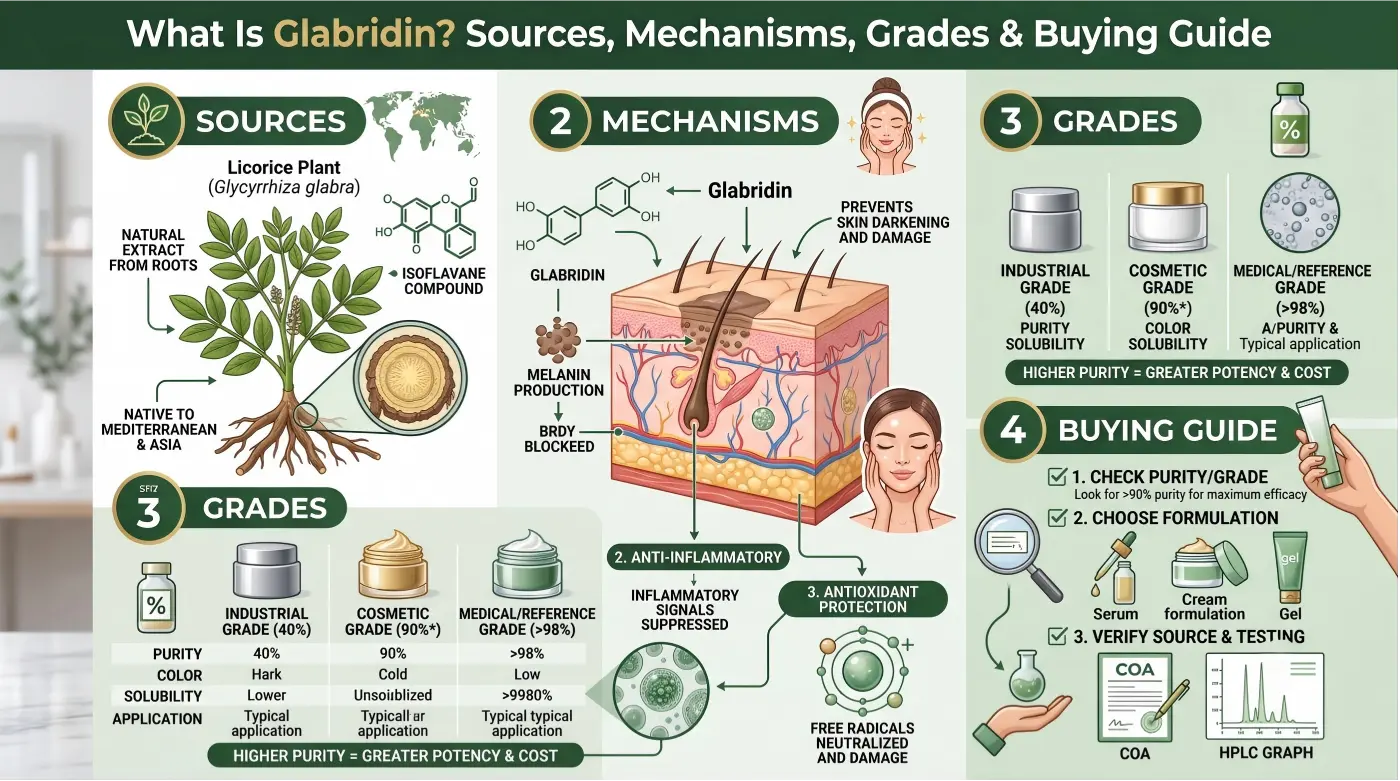
Disclaimer: Educational content for professionals and informed buyers. Not medical advice. Cosmetic and dietary-supplement claims must follow destination-market rules. Preclinical findings (metabolic, neuro, cardiac models) are not disease-treatment evidence. Persistent pigmentation disorders require clinician evaluation.
TL;DR
Glabridin is the most commercially valuable flavonoid marker isolated from licorice root (Glycyrrhiza glabra). Brands specify it for:
- Skin brightening / tone-evening cosmetics
- Tyrosinase-related pathway research support
- Anti-inflammatory and antioxidant positioning
- Beauty-from-within supplement concepts
Available commercial families: oil-soluble HPLC grades (commonly 10% · 90% · 95% · 98%, plus mid-assay options such as 40% on project request) and water-soluble/delivery-modified grades for aqueous systems.
Start here if you are buying: Glabridin Ingredient Manufacturer
Quick Facts Card
Item | Detail |
|---|---|
| Botanical source | Glycyrrhiza glabra root / rhizome |
| CAS | 59870-68-7 |
| Formula / MW | C₂₀H₂₀O₄ · 324.37 |
| Chemical class | Prenylated isoflavan (flavonoid polyphenol) |
| Native solubility | Lipophilic / oil-dispersible |
| Typical cosmetic use window | Often discussed around low % leave-on levels (grade- and chassis-dependent; follow TDS + CPSR) |
| Typical oral project framing | mg-level standardized extract servings (regulatory review required) |
| Main applications | Cosmetics · beauty supplements · selected functional concepts |
| Commercial grades | 10% / 90% / 95% / 98% (+ water-soluble options) |
Identity baseline: chemical registry summary for glabridin (CAS 59870-68-7) [1].
Why Brands Care About Glabridin Now
Searchers usually want a decision, not only a definition:
- Is it safer/more launchable than hydroquinone in cosmetics?
- Which purity should we buy?
- Oil-soluble or water-soluble?
- Can it pair with niacinamide/vitamin C?
- Does it belong in oral beauty SKUs?
Market pressure comes from clean beauty, K-beauty tone care, nutricosmetics, and global formulas that cannot rely on restricted bleaching drugs. For regulatory and clinical positioning versus classic depigmenters, see Glabridin vs. Hydroquinone. For inside-out versus leave-on strategy design, see Oral vs. Topical Skin Brightening Ingredients.
What Is Glabridin? (Definition for Buyers)
Glabridin is a single marker compound—not the same thing as “licorice extract.”
Licorice extracts may contain glycyrrhizin, liquiritin, polysaccharides, and only trace glabridin unless standardized. Buying “licorice extract” for a glabridin brief is a classic procurement failure. Full identity contrast: Glabridin vs Glycyrrhizin.
Chemical identity (scan box)
- CAS 59870-68-7
- Prenylated isoflavan with phenolic OH groups important to activity discussions
- UNII / registry identifiers used in dossier work (confirm on your TDS)
Botanical source
Species | Glabridin relevance |
|---|---|
| G. glabra | Primary commercial source; typically cited around 0.1%–0.3% dry root content [2][3] |
| G. uralensis | Different flavonoid profile; not a default substitute |
| G. inflata | Often licochalcone-A–forward; glabridin usually not the hero marker |
Key takeaway: Specify Glycyrrhiza glabra + HPLC glabridin assay on every RFQ.
Where Is Glabridin Found in the Plant Extract?
Glabridin concentrates in the lipophilic fraction of licorice root. It is generally not delivered by:
- Unextracted whole-root powder as a reliable high-assay source
- Glycyrrhizin-rich water extracts meant for sweetener / saponin stories
Commercial production therefore uses extraction + purification + HPLC standardization.
How Is Glabridin Produced?
Verified G. glabra root
        ↓
Extraction (ethanol / selective solvent / scCO2 + co-solvent)
        ↓
Enrichment / resin & chromatography steps
        ↓
Optional crystallization for high-purity grades
        ↓
HPLC standardization (10% / 90% / 95% / 98%)
        ↓
Optional delivery modification → water-soluble grade
        ↓
COA release + packaging (light/oxygen protection)
Why high-purity glabridin costs so much
- Native root assay is low (often cited near 0.1%–0.3%) [2][3]
- Large biomass input per kg of high-purity output
- Multi-step purification and crystallization losses
- HPLC identity/assay + residual solvent/metals / micro release costs
- Light/oxidation-sensitive handling and specialty packaging
This is why comparing only price/kg misleads—use cost-per-active thinking in the Glabridin 10% vs 90% vs 98% grade guide.
Impurity discussion (buyer-relevant)
Ask COAs to address, as applicable:
- Residual related flavonoids (process-dependent)
- Glycyrrhizin residues (especially on lower-assay extracts)
- Residual solvents using ICH Q3C-oriented diligence [8]
- Heavy metals / elemental impurities diligence
- Moisture/appearance drift between lots
How Does Glabridin Work?
Pigmentation pathway (visual flow)
UV / inflammatory triggers
        ↓
Tyrosine
        ↓
Tyrosinase
        ↓
Melanin formation ↑
        ↓
Visible uneven tone / hyperpigmentation appearance
        ↓
Glabridin research focus: tyrosinase-related inhibition
+ antioxidant / anti-inflammatory support themes
Mechanism map (multi-pathway)
Glabridin
 ├─ Antioxidant themes → ROS / lipid oxidation discussions ↓
 ├─ Anti-inflammatory themes → NF-κB / MAPK research models ↓
 ├─ Melanogenesis themes → tyrosinase-related activity ↓
 └─ Metabolic research themes → AMPK / energy-pathway animal data
         ↓
Strongest commercial translation today:
cosmetic brightening + soothing / antioxidant positioning
(+ selective beauty-from-within projects)
Evidence snapshot by theme
Theme | What research discusses | Evidence posture |
|---|---|---|
| Tyrosinase/brightening | Potent in-vitro inhibition; animal UV pigmentation models; limited human cosmetic pilots [2] | Strongest commercial lane |
| Antioxidant | ROS scavenging/lipid oxidation models [3][4][6] | Strong preclinical |
| Anti-inflammatory | NF-κB / MAPK / cytokine model systems [2][3][4] | Strong preclinical; human still developing |
| Metabolic (AMPK) | Obese rodent models [5] | Animal-level; not a human weight-loss claim base |
| Broader systemic models | Diverse reviews exist [4] | Mostly experimental—do not convert to disease ads |
Key takeaways — mechanisms
- Tyrosinase-related activity is the core cosmetic story
- Antioxidant + soothing themes support sensitive brightening chassis
- AMPK/systemic disease-adjacent models stay preclinical
- Always label evidence type in marketing decks
Pharmacokinetics (ADME) — What R&D Asks
Human ADME data for isolated glabridin remain limited relative to its cosmetic popularity [3][4]. Directional points buyers should expect suppliers to discuss honestly:
ADME theme | Practical note |
|---|---|
| Absorption | Native molecule is lipophilic; oral bioavailability is often described as limited without delivery design |
| Distribution | Tissue distribution data are sparse; do not assume strong CNS delivery |
| Metabolism | Phase-II pathways (e.g., glucuronidation themes) are discussed for related phenolics—confirm for your grade [4] |
| Excretion | Not a plug-and-play clinical PK package for most cosmetic raw materials |
| Topical delivery | Vehicle and encapsulation dominate practical “availability” more than brochure LogP quotes |
Buyer implication: For oral projects, treat delivery form and realistic dose as engineering problems. For topicals, invest in vehicle + stability, not only assay %.
Safety Profile
Independent section for YMYL search intent (“Is glabridin safe?”).
What is reasonably established for cosmetic use contexts
- Widely used as a cosmetic active when quality-controlled
- Generally positioned as lower irritation than classic hydroquinone regimens in cosmetic narratives
- Still requires formula-level safety assessment (e.g., CPSR / PIF under EU cosmetic frameworks) [10][11]
Caution topics to review with toxicology/regulatory counsel
Topic | Practical stance |
|---|---|
| Irritation/sensitization | Patch-test finished goods; request supplier dermal safety package for the exact grade |
| Phototoxicity/photoallergy | Ask for available test summaries |
| Estrogenic/endocrine discussion in literature | Review if marketing to sensitive populations; avoid overclaim [3][4] |
| Blood pressure/glycyrrhizin confusion | High-purity glabridin ≠ glycyrrhizin, but verify residues on lower grades |
| Pregnancy/breastfeeding | Do not self-authorize actives; clinician advice |
| Oral high-dose use | Human oral safety packages are thinner than cosmetic use history—proceed with formal assessment |
| Drug interactions | More relevant for oral supplements than leave-on cosmetics |
Who should use/avoid (consumer + brand education)
Often considered for: tone-evening cosmetics, sensitive-leaning brightening routines, beauty-from-within stacks with conservative claims.
Seek clinician guidance for: diagnosed melasma, pregnancy, complex medication regimens, significant hepatic/renal disease (especially oral actives).
Key takeaway: “Plant-derived” does not equal risk-free. Quality + dose + route + claims decide safety posture.
Clinical Evidence Summary (Human-Facing)
Honest hierarchy beats vague “clinically proven” language.
Evidence type | Glabridin status | How to communicate |
|---|---|---|
| In vitro potency | Strong for tyrosinase-related models [2][3] | OK for mechanism education |
| Animal UV / inflammation models | Supportive [2] | Supportive, not human proof |
| Human cosmetic studies | Limited; sometimes combination formulas / pilots | Use cautious appearance language |
| Large head-to-head vs hydroquinone monotherapy | Not the typical evidence base | Do not imply equal medical potency |
Does Glabridin Work? How Long Does It Take?
Does it work? For cosmetic tone-evening goals, glabridin is a credible active with strong mechanistic rationale and practical brand adoption [2][3]. It is not a guaranteed medical melasma cure.
How long? Appearance changes, if any, are typically discussed over sustained routines (often weeks), with SPF non-negotiable. No universal day-count guarantee.
Can Glabridin Replace Hydroquinone?
Cosmetics / global leave-on brightening: often yes as a category strategy.
Medical melasma therapy: usually no as unsupervised substitution.
(See the dedicated comparison page linked earlier in this article.)
Glabridin vs. Other Brightening Actives
Comparison | One-line buyer answer |
|---|---|
| vs. Glycyrrhizin | Different molecule; not interchangeable |
| vs. Hydroquinone | HQ stronger medically; glabridin stronger for cosmetic access |
| vs. Kojic acid | Both cosmetic brighteners; stability/irritation profiles differ |
| vs. Alpha-arbutin | Both tyrosinase-related; arbutin more water-routine friendly |
| vs. Niacinamide | Complementary more often than competitive |
| vs. Tranexamic acid | Different pathway emphasis; often combined in cosmetics |
Can Glabridin Be Combined With Vitamin C/Niacinamide?
Niacinamide: Excellent everyday pairing for tone + barrier stories.
Vitamin C: Popular, but validate pH, oxidation, and irritation in the real chassis.
Ceramide/panthenol: Strong for sensitive brightening.
Astaxanthin (oral): Common inside-out architecture with Astaxanthin Supplements and the oral-vs-topical strategy page linked earlier.
For process and chassis detail, see the Glabridin Formulation Guide.
Oil-Soluble vs Water-Soluble Glabridin
Native glabridin is oil-soluble. “Water-soluble glabridin” is usually a delivery-modified SKU (cyclodextrin/liposome/nanoemulsion/supramolecular systems)—not a new plant molecule. Full selection logic: Water-Soluble vs Oil-Soluble Glabridin.
Need | Prefer |
|---|---|
| Creams, oils, balms | Oil-soluble grades |
| Essences, clear gels, mists | Water-soluble grades |
Stability Chemistry (Beyond “Avoid Heat and Light”)
Stressor | What happens in practice | Controls |
|---|---|---|
| Oxidation | Phenolic degradation/potency drift | Antioxidants, low headspace O₂, nitrogen flush |
| Light / UV | Accelerated photodegradation | Amber/opaque pack, secondary carton |
| Heat × time | Assay loss in cook/hold or hot mix | Add in cool-down; map T×t |
| pH extremes | Faster degradation outside validated window | Hold finished pH in tested range |
| Metals | Catalyze oxidation | Chelator strategy where justified |
| Moisture (esp. modified grades) | Clumping / Aw risk | Barrier packs, RH control |
Packaging defaults for serums: airless + opaque. Stability study design principles follow ICH Q1A(R2) thinking adapted to project SOPs [7].
Formulation Decision Tree
What are you making?
│
├── Water serum / essence / mist / gel
│     └── Water-soluble glabridin
│           └── Confirm carrier tech (cyclodextrin / liposome / etc.)
│
├── Cream / lotion emulsion
│     └── Oil-soluble 90%+ (or 10%/40% if cost/fill allows)
│
├── Anhydrous oil / balm
│     └── Oil-soluble high assay
│
├── Oral beauty capsule / softgel
│     └── Grade by fill + regulatory path; softgel helps lipophiles
│
└── Unsure
      └── Lock format first, then use the grade comparison guide linked earlier
Application Selection Matrix
Application | Recommended form/grade family | Processing note | Pack hint |
|---|---|---|---|
| Premium water serum | Water-soluble | Cold/low-heat addition | Airless opaque |
| Brightening cream | Oil-soluble 90%+ | Oil-phase pre-disperse | Opaque jar/pump |
| Facial mist | Water-soluble | Clarity + spray tests | UV-protective bottle |
| Anhydrous balm | Oil-soluble 90%+ | Lipid dissolve | Light-protective |
| Beauty softgel | High-assay oil-soluble | Antioxidant oil system | Blister / bottle per stability |
| Stick pack drink concept | Water-soluble | Dispersibility + Aw | Barrier laminate |
Use levels: follow supplier TDS + market safety assessment—do not copy competitor % blindly.
Typical Specifications (High-Purity Powder Example)
Directional industry targets for 90%–98% grades (confirm on your TDS):
Parameter | Typical target idea | Method family |
|---|---|---|
| Appearance | White to off-white powder | Visual |
| Assay | Grade minimum by HPLC | HPLC-UV |
| LOD | Low single-digit % max | Gravimetric |
| Heavy metals | Market-limit based | ICP-MS |
| Microbiology | USP/EP style limits | Compendial micro |
| Residual solvents | ICH Q3C-oriented [8] | GC-HS |
| Shelf life | Often ~24 months unopened | Stability program |
Global Regulatory Matrix (Planning Aid)
Verify before launch—classification depends on claims and presentation [9][10][11].
Region | Cosmetics posture (typical) | Supplement/food posture (typical) |
|---|---|---|
| USA | Cosmetic ingredient use with labeling/safety duties | Oral use may raise NDI / DSHEA questions depending on history and claims |
| EU | Cosmetic Regulation framework; CPSR required | Isolated marker may trigger novel-food analysis even if licorice has food history |
| China | Cosmetic raw-material compliance under CSAR ecosystem | Health-food pathways are claim- and dossier-sensitive |
| Japan | Cosmetic standards; quasi-drug whitening actives are a separate bar | FFC / other food claim systems need substantiation discipline |
| Australia | Cosmetic vs therapeutic goods split | Complementary medicine scheduling may apply by presentation |
| ASEAN | Country-by-country notification | Local supplement rules vary |
Claims firewall: do not mix drug bleaching claims into cosmetic glabridin SKUs.
Novel-food note: Do not assert a specific EFSA “Glabridin novel food opinion” unless the exact opinion ID is confirmed in the live register for your dossier. Treat status as case-by-case.
Market Trends (Commercial Context)
- Tone care and clean brightening remain durable in K-beauty and global indie beauty
- Hydroquinone restrictions push formulators toward botanical markers such as glabridin
- Nutricosmetics / beauty-from-within create dual oral+topical brand systems
- Delivery-tech water-soluble grades unlock essences and sprays
OEM bridge: Beauty Supplements
Delivery Technologies & Patent Awareness
Brands increasingly ask about:
- Cyclodextrin inclusion
- Liposomes / nanoemulsions
- Microencapsulation
- Supramolecular systems
Procurement note: Some delivery approaches may intersect patent landscapes. Freedom-to-operate review belongs with IP counsel—not a TDS footnote.
How to Choose a High-Quality Glabridin Ingredient
Condensed hub checklist:
- Confirm G. glabra + HPLC glabridin identity (not generic licorice)
- Lock format → then lock grade / water-soluble vs oil-soluble
- Demand method-transparent assay + multi-lot COAs
- Review residual solvents, metals, micro, glycyrrhizin residues
- Request stability + packaging guidance for your chassis
- Pilot before scale; confirm OEM capacity if you need finished goods
Full procurement playbook: How to Choose a Glabridin Supplier
Supplier qualification extras for brand owners
Audit theme | Ask |
|---|---|
| Capacity | Sample → pilot → commercial ladder |
| Consistency | 3 recent COAs + trend notes |
| MOQ / lead time | Flexible path vs drum-only traps |
| OEM / ODM | Capsules, softgels, topicals support |
| Change control | Process/site change notification |
| Private label | Pack + claim boundary support |
How to Read a Glabridin COA / How to Test Purity
Minimum COA literacy
- Correct CAS/product name/grade
- HPLC assay % with method reference
- Appearance matches grade expectations (brown 10% vs white 90%+)
- Residual solvents present for purified grades
- Metals + micro within agreed limits
- Retest/expiry date aligned to storage statement
Gold-standard purity test: HPLC with UV detection against a qualified reference approach—not nonspecific UV-only “purity.”
Frequently Asked Questions
Is glabridin the same as licorice extract? No. Glabridin is a single HPLC-standardized marker; licorice extract is a complex mixture (see the glycyrrhizin comparison page linked earlier).
Is glabridin water soluble? Native form is not. Use delivery-modified grades for water systems (see the water-soluble vs oil-soluble guide linked earlier).
What percentage/purity is best? Depends on format and fill/color needs—not “highest always” (see the grade guide linked earlier).
Is 98% always better than 90%? No. 98% wins tight fill / low-color constraints; 90% often wins total value.
Can glabridin replace hydroquinone? For many cosmetics, as a strategy—yes. For medical melasma care—usually no without a clinician (see the hydroquinone comparison linked earlier).
Can sensitive skin use glabridin? Often a preferred cosmetic brightener class versus harsher options; still patch-test finished formulas.
Can pregnant women use glabridin? Ask a clinician. Do not self-authorize actives in pregnancy.
Can I combine glabridin with niacinamide or vitamin C? Niacinamide: commonly yes. Vitamin C: yes with stability/irritation validation.
Does glabridin help melasma or PIH? It may support cosmetic appearance of uneven tone. Persistent pigment disorders need dermatology care.
How long does glabridin take to work? Think sustained routines, not overnight transformation. Pair with SPF.
Can glabridin be used in supplements? Yes in commercial practice, with regulatory and safety assessment by market. Oral human data are more limited than cosmetic use history.
Does high-purity glabridin contain glycyrrhizin? Typically negligible if properly purified; verify on COA for lower grades.
Why is glabridin expensive? Low native abundance + purification + analytics + handling controls.
What is the CAS number? 59870-68-7 [1].
How should it be stored? Cool, dry, light-protected, tightly sealed; follow grade-specific TDS.
Key Takeaways
Decision | Practical answer |
|---|---|
| What it is | HPLC-standardized licorice flavonoid marker (not generic licorice extract) |
| Best-proven commercial lane | Cosmetic brightening + antioxidant/soothing support |
| Grade choice | Format first, then 10% / 90%+ / water-soluble |
| vs. hydroquinone | Different regulatory and potency roles |
| vs. glycyrrhizin | Different chemistry entirely |
| Buy on | Assay method, consistency, delivery disclosure, stability—not price/kg alone |
References
- National Library of Medicine / NCBI. PubChem Compound Summary for CID 124052, Glabridin. https://pubchem.ncbi.nlm.nih.gov/compound/124052
- Yokota T, Nishio H, Kubota Y, Mizoguchi M. The inhibitory effect of glabridin from licorice extracts on melanogenesis and inflammation. Pigment Cell Res. 1998;11(6):355–361. https://pubmed.ncbi.nlm.nih.gov/9870547/
- Simmler C, Pauli GF, Chen SN. Phytochemistry and Biological Properties of Glabridin. Planta Med. 2013;79(10):819–829. https://pmc.ncbi.nlm.nih.gov/articles/PMC3795865/
- Zhang J, et al. Review on the Diverse Biological Effects of Glabridin. https://pmc.ncbi.nlm.nih.gov/articles/PMC9840373/
- Ahn J, et al. AMPK activation with glabridin ameliorates adiposity and lipid dysregulation in obesity. PLoS ONE. 2012;7(10):e47152. https://pmc.ncbi.nlm.nih.gov/articles/PMC3371239/
- Kang MR, et al. Cardiovascular protective effect of glabridin: Implications in LDL oxidation and inflammation. Int Immunopharmacol. 2015. https://pubmed.ncbi.nlm.nih.gov/26526087/
- International Council for Harmonisation (ICH). Q1A(R2) Stability Testing of New Drug Substances and Products. https://database.ich.org/sites/default/files/Q1A%28R2%29%20Guideline.pdf
- International Council for Harmonisation (ICH). Q3C(R9) Impurities: Guideline for Residual Solvents. https://database.ich.org/sites/default/files/ICH_Q3C%28R9%29_Guideline_MinorRevision_2024_2024_Approved.pdf
- U.S. FDA. Cosmetics guidance and regulation overview. https://www.fda.gov/cosmetics
- European Commission. CosIng database. https://ec.europa.eu/growth/tools-databases/cosing/
- EU Cosmetics Regulation (EC) No 1223/2009 (consolidated text). https://eur-lex.europa.eu/legal-content/EN/TXT/?uri=CELEX:02009R1223-20240601
Reference integrity notes: Disease-adjacent animal findings are cited only as research context, not as approved health claims. Novel-food status should be confirmed case-by-case in the live regulator register for your dossier.