Introduction
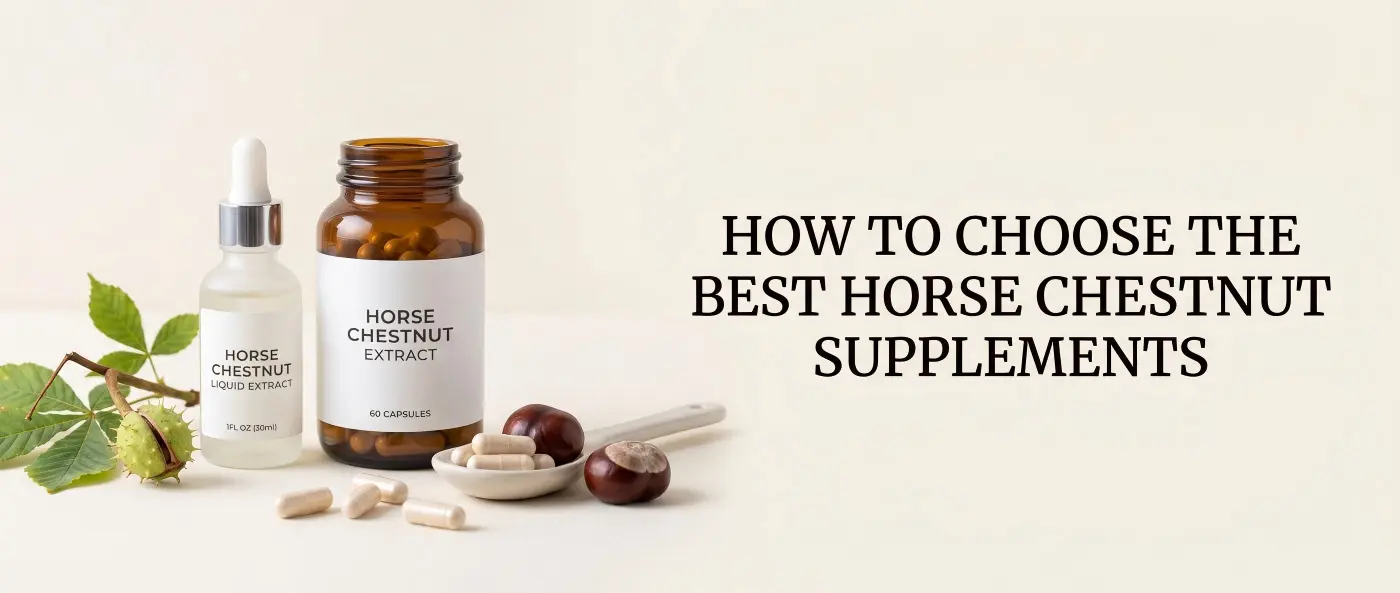
If you’re looking for the best horse chestnut supplement, don’t judge products by brand name or capsule size alone. The most important indicators are standardized aescin content (16–20%), verified botanical identity, esculin-free processing, third-party testing, and transparent manufacturing practices. This buyer’s guide breaks down exactly what to look for, what to avoid, and how to separate marketing hype from clinical evidence.
Quick Answer: The best horse chestnut supplement is a seed extract standardized to 16–20% aescin, confirmed esculin-free by HPLC, third-party tested by an ISO 17025-accredited lab, and manufactured in a cGMP-certified facility. Milligram count and extract ratio alone are misleading without verified active compound content.
This guide is written for three audiences: health-conscious consumers comparing finished products, brand owners evaluating raw material suppliers, and procurement professionals vetting OEM manufacturing partners. Every recommendation is backed by peer-reviewed clinical trials, FDA regulations, and authoritative health databases.
By the end of this article, you will know how to read a supplement label like a quality control specialist, identify red flags that disqualify a product, and ask the right questions before placing an order or adding a bottle to your cart.
1. What Is a Horse Chestnut Supplement?
Horse chestnut (Aesculus hippocastanum L.) is a deciduous tree native to the Balkan Peninsula. Its seeds have been used in traditional medicine for centuries, but modern supplements rely on standardized seed extracts—not raw powder—to deliver consistent therapeutic effects.
Seed vs. Extract: Why the Distinction Matters
Raw horse chestnut seeds contain esculin, a toxic glycoside that can cause nausea, vomiting, and neurological symptoms. Properly processed seed extracts remove esculin and concentrate aescin—the active saponin fraction responsible for venotonic, anti-inflammatory, and vascular-protective effects. According to the National Center for Complementary and Integrative Health (NCCIH), horse chestnut seed extract standardized to 16–20% aescin is the most commonly used and clinically studied form.
What Is Aescin?
Aescin is a mixture of triterpene saponins, primarily β-aescin. It reduces capillary permeability, improves venous tone, and inhibits the enzymatic breakdown of proteoglycans in vessel walls. These mechanisms make it the primary active compound for chronic venous insufficiency (CVI) and related circulatory symptoms.
2. What Makes the Best Horse Chestnut Supplement?
A high-quality horse chestnut supplement is defined by objective, measurable criteria—not by brand name, packaging, or marketing claims. Here are the seven pillars of quality.
2.1 Why Aescin Percentage Matters More Than Extract Ratio
A common misconception in the supplement industry is that a higher extract ratio automatically means a stronger product. You will see labels boasting “50:1,” “100:1,” or even “200:1” ratios. These numbers describe the weight relationship between raw plant material and finished extract, but they say nothing about the concentration of the active compound.
An extract labeled “100:1” could contain 5% aescin or 25% aescin—you cannot know without analytical testing. Conversely, a 4:1 extract standardized to 20% aescin delivers a precisely known amount of the active compound in every batch. For clinical consistency and formulation accuracy, standardization to aescin percentage is the only reliable metric.
2.2 Why Milligrams Can Be Misleading
A 500 mg horse chestnut capsule is not automatically better than a 250 mg capsule. The critical question is: 500 mg of what? Here is a side-by-side comparison that illustrates why milligram count alone is insufficient:
| Product A | Product B | Winner? |
| Horse Chestnut 500 mg (Raw Powder) | Horse Chestnut Extract 250 mg (Standardized to 20% Aescin) | |
| Aescin per serving: Unknown (possibly <5 mg) | Aescin per serving: 50 mg (250 mg × 20%) | Product B |
| Esculin status: Unknown | Esculin status: Tested & removed | Product B |
| Batch consistency: Unpredictable | Batch consistency: Verified by HPLC | Product B |
| Clinical evidence: None | Clinical evidence: 17 RCTs support efficacy | Product B |
Product A contains twice the milligram weight but delivers a fraction of the therapeutic value. When evaluating supplements, always calculate the actual aescin content: multiply the extract weight by the standardization percentage. This simple calculation protects you from overpaying for under-dosed products.
2.3 Why Clinical Standardization Matters (16–20% Aescin)
The 16–20% aescin range is not arbitrary. It reflects the concentration used in the majority of randomized controlled trials (RCTs) that demonstrated statistically significant improvements in chronic venous insufficiency. The landmark 2012 Cochrane review analyzed 17 RCTs and found that extracts within this standardization range consistently reduced leg pain and edema compared to placebo.
Why not 40% or 50%? While higher percentages might seem desirable, there is no clinical trial evidence demonstrating superior efficacy or safety at concentrations above 20%. In fact, excessively high aescin concentrations may increase the risk of gastrointestinal irritation without proportional therapeutic benefit. The 16–20% range represents the optimal balance between efficacy, safety, and manufacturing feasibility.
2.4 Botanical Authentication: Confirming Aesculus hippocastanum
Botanical identity verification prevents adulteration and substitution. The correct therapeutic species is Aesculus hippocastanum L. It must not be confused with Ohio buckeye (Aesculus glabra) or California buckeye (Aesculus californica), which have different chemical profiles and lack the clinical evidence base of true horse chestnut.
Under FDA 21 CFR Part 111, manufacturers must conduct identity testing on every lot of botanical raw material using scientifically valid methods such as HPLC fingerprinting, HPTLC, or DNA barcoding. A reputable supplier should provide documentation confirming species identity before the material enters production.
2.5 Esculin-Free Processing: A Non-Negotiable Safety Requirement
Raw horse chestnut seeds, leaves, bark, and flowers contain esculin—a toxic glycoside classified as poisonous by poison control centers. Ingestion can cause vomiting, diarrhea, muscle twitching, paralysis, and circulatory collapse. A published case report documented a 46-year-old male who developed atrial fibrillation after accidental ingestion of raw horse chestnut seeds.
Commercial extraction must completely remove esculin. A quality manufacturer provides Certificates of Analysis (CoA) confirming “esculin not detected” by HPLC or LC-MS/MS. If a supplier cannot produce this documentation, the material is not safe for human consumption.
2.6 Third-Party Testing: Objective Verification Beyond Marketing
In-house testing is necessary but insufficient for full credibility. Independent, ISO 17025-accredited laboratory testing should verify:
• Identity: HPLC or HPTLC fingerprinting confirming Aesculus hippocastanum
• Potency: Aescin content matching label claim (±5% tolerance)
• Purity: Heavy metals (Pb, As, Cd, Hg) by ICP-MS
• Microbiology: Total aerobic count, yeast, mold, E. coli, Salmonella
• Safety: Pesticide residues and residual solvents (for solvent-based extracts)
Third-party testing demonstrates a commitment to transparency that goes beyond FDA regulatory minimums.
2.7 Transparent Labeling: What a Quality Label Must Include
A trustworthy label leaves no ambiguity. It should clearly state:
• Botanical name: Aesculus hippocastanum L.
• Plant part: Seed extract (not “powder” or “herb”)
• Standardization: “Standardized to X% Aescin”
• Serving size: Per-capsule and per-day amounts
• Extraction method: e.g., ethanol/water or supercritical CO₂
• Country of origin: Geographic source of raw material
• Certifications: cGMP, NSF, ISO 9001, or equivalent
Labels that only list “Horse Chestnut 500 mg” without standardization details are red flags.
3. Horse Chestnut Supplement Benefits
Horse chestnut seed extract is one of the most clinically validated botanical venotonics. Here are the four best-supported benefits:
3.1 Chronic Venous Insufficiency (CVI)
A 2012 Cochrane review of 17 RCTs concluded that standardized HCSE is an efficacious short-term treatment for CVI. Meta-analysis showed a weighted mean reduction in lower leg volume of 32.1 mL versus placebo, with significant improvements in leg pain.
3.2 Leg Edema and Heaviness
Clinical trials demonstrate that aescin reduces objective measures of edema—including leg volume and ankle circumference—by inhibiting capillary permeability and improving venous tone. Effects are typically measurable within 2–4 weeks.
3.3 Microvascular and Circulatory Support
By strengthening capillary walls and reducing fluid leakage into surrounding tissues, aescin supports healthy microcirculation in the lower extremities. This mechanism is particularly relevant for individuals who stand or sit for extended periods.
3.4 Hemorrhoid Symptom Support
Horse chestnut has been traditionally used for hemorrhoids—essentially varicose veins of the rectal area. While specific hemorrhoid RCTs are fewer than CVI studies, the underlying venotonic mechanism is physiologically consistent and supported by traditional use records.
4. How to Read a Horse Chestnut Supplement Label
Label literacy separates informed buyers from marketing victims. Below is a direct comparison of what a high-quality label looks like versus a low-quality one.
| ✅ Good Label | ❌ Poor Label |
| Aesculus hippocastanum L. Seed Extract Standardized to 20% Aescin 300 mg per capsule Esculin-free (CoA available) Batch No. HC-2026-047 Third-party tested by [ISO 17025 Lab] | Horse Chestnut 500 mg [No other information] |
| Clear serving size: 1 capsule twice daily Total daily aescin: 60 mg | Serving size: 1 capsule Daily intake: unclear |
| Manufactured in cGMP-certified facility Country of origin: Bulgaria | No manufacturing certifications No origin information |
| Certificate of Analysis available Heavy metals: Pass Microbiology: Pass | No CoA mentioned No purity testing claims |
Google’s Search Quality Evaluator Guidelines reward content with high “Information Gain”—content that teaches readers something genuinely useful. Understanding how to decode supplement labels qualifies as high-information-gain content because it empowers buyers to make evidence-based decisions rather than relying on marketing claims.
5. Common Mistakes & Red Flags When Choosing Horse Chestnut Supplements
5.1 Common Mistakes
- Choosing based only on milligrams: A 600 mg non-standardized powder may contain negligible aescin.
- Ignoring aescin standardization: Without it, potency varies unpredictably between batches.
- Confusing powder with extract: Raw powder is not concentrated, not standardized, and may retain toxins.
- Overlooking third-party testing: In-house testing alone is insufficient for credibility.
- Buying without traceability: No documented chain-of-custody means no verification of origin or quality.
5.2 Red Flags That Should Disqualify a Product
These red flags are strong indicators of a substandard or potentially unsafe product. This section is optimized for Google Featured Snippet potential.
- ❌ Does not mention aescin percentage anywhere on the label or marketing materials.
- ❌ Does not specify “seed extract”—uses vague terms like “horse chestnut herb” or “whole plant.”
- ❌ No standardization claim (e.g., “Standardized to 20% Aescin”).
- ❌ No third-party testing or CoA available upon request.
- ❌ Uses a “proprietary blend” that obscures the actual amount of horse chestnut extract.
- ❌ Marketed as “100% natural” or “raw” without acknowledging esculin toxicity.
- ❌ Extract ratio (e.g., “100:1”) is presented as the primary quality metric without aescin verification.
- ❌ No botanical name (Aesculus hippocastanum L.) on the label.
- ❌ Manufacturer refuses to provide batch-specific testing documentation.
- ❌ No cGMP, NSF, or ISO manufacturing certifications listed.
If you encounter three or more of these red flags, the product is likely a commoditized powder masquerading as a clinical-grade extract. Move on.
6. Horse Chestnut vs. Similar Circulatory Ingredients
The venotonic supplement category includes several well-studied botanicals and flavonoids. Understanding their relative strengths helps you select the right ingredient—or combination—for specific formulations.
| Ingredients | Key Actives | Primary Mechanism | Best For |
| Horse Chestnut | Aescin | Reduces capillary permeability; improves venous tone; anti-inflammatory | CVI, leg edema, varicose veins, hemorrhoids—most evidence-rich botanical venotonic. |
| Grape Seed Extract | OPCs | Antioxidant; strengthens capillary walls | General vascular support; antioxidant-focused formulas. |
| Butcher’s Broom | Ruscogenins | Venotonic; lymphatic drainage | Heavy legs; venous stasis; often combined with HCSE. |
| Diosmin (MPFF) | Diosmin + Hesperidin | Improves lymphatic drainage; anti-inflammatory | Chronic venous disease (prescription-grade in EU). |
| Gotu Kola | Asiaticoside | Collagen synthesis; wound healing | Venous ulceration; skin repair; microcirculation. |
Which Ingredient Is Best for Your Goal?
Use this decision guide to match the right ingredient to the primary objective:
• Heavy legs and visible varicose veins → Horse Chestnut (strongest clinical evidence)
• General antioxidant and vascular protection → Grape Seed Extract
• Lymphatic congestion and venous stasis → Butcher’s Broom (often stacked with HCSE)
• Post-thrombotic syndrome or severe CVI → Diosmin (prescription-grade in Europe)
• Venous ulceration or skin repair → Gotu Kola (complementary to HCSE)
• Comprehensive circulatory support → Combination formula: Horse Chestnut + Grape Seed + Butcher’s Broom
7. Are Horse Chestnut Supplements Safe?
7.1 Standardized Extract Safety Profile
When properly processed to remove esculin, horse chestnut seed extract is generally safe for short-term use. The 2012 Cochrane review reported that adverse events across 17 RCTs were “mild and infrequent,” including gastrointestinal discomfort, dizziness, nausea, headache, and pruritus. No serious adverse events were documented.
7.2 Esculin Toxicity: A Critical Warning
Raw horse chestnut seeds, leaves, bark, and flowers are poisonous. Esculin ingestion can cause vomiting, diarrhea, muscle twitching, weakness, paralysis, and circulatory collapse. A documented case involved a 46-year-old male who developed atrial fibrillation after eating raw seeds mistaken for edible chestnuts. This is why commercial extraction and toxin removal are non-negotiable.
7.3 Drug Interactions
Horse chestnut may interact with the following medications:
• Blood thinners (warfarin, clopidogrel, aspirin): May increase bleeding risk due to antiplatelet effects.
• Diabetes medications: May lower blood sugar; monitor glucose levels.
• NSAIDs: May reduce absorption.
• Lithium: Potential diuretic effect may alter lithium clearance.
Consult a healthcare provider before combining with prescription medications.
7.4 Contraindications
Avoid or use with extreme caution if you have:
• Kidney or liver disease
• Bleeding disorders or history of venous thromboembolism
• Pregnancy or breastfeeding (NCCIH advises avoidance due to insufficient safety data)
• Known allergy to Aesculus species
8. Horse Chestnut Supplement Buying Checklist
Use this checklist before purchasing raw materials or finished products. Every box should be ticked for a product to qualify as clinical-grade.
- ☐ Standardized to 16–20% aescin (verified by HPLC)
- ☐ Botanical name confirmed as Aesculus hippocastanum L.
- ☐ Plant part specified as seed extract (not powder or herb)
- ☐ Esculin-free status confirmed by CoA (HPLC or LC-MS/MS)
- ☐ Third-party tested by ISO 17025-accredited laboratory
- ☐ Heavy metals, microbes, and pesticide residues all pass
- ☐ Serving size clearly states daily aescin intake in milligrams
- ☐ No proprietary blend obscuring extract quantity
- ☐ cGMP-certified manufacturing facility (FDA 21 CFR Part 111)
- ☐ Batch-specific Certificate of Analysis available upon request
- ☐ Raw material traceability documented (country of origin, harvest date)
- ☐ Stability testing data available for shelf-life claims
If a supplier cannot provide documentation for items 1–5, the material is not suitable for a premium supplement formulation. Items 6–12 separate professional-grade suppliers from commodity traders.
9. Common Marketing Claims vs. Scientific Evidence
The supplement industry is filled with claims that sound scientific but collapse under scrutiny.
| Marketing Claim | What the Evidence Actually Says |
| Higher milligrams = better product | Only true if the product is standardized to aescin. A 500 mg raw powder can be clinically inferior to a 250 mg 20% extract. |
| 100:1 extract is the strongest available | Extract ratio describes weight reduction, not active compound concentration. Without aescin verification, the ratio is meaningless. |
| “Natural” or “raw” means safe | Raw horse chestnut seeds contain toxic esculin. Safety depends on processing and toxin removal, not naturalness. |
| All horse chestnut extracts are essentially the same | Extraction methods, standardization levels, and quality control vary dramatically between suppliers. |
| Brand reputation guarantees quality | Manufacturing controls, analytical testing, and documentation matter more than brand name. A reputable brand can still source inferior material. |
| Higher aescin % (e.g., 40–50%) is more effective | No clinical trials support superiority above 20%. The 16–20% range is the evidence-based sweet spot for efficacy and safety. |
| Proprietary blends protect trade secrets | Proprietary blends obscure actual dosages, making it impossible to verify aescin intake per serving. |
| If it passes FDA inspection, it must be high quality | FDA cGMP compliance is a baseline legal requirement, not a premium quality mark. Many compliant products still lack third-party testing. |
This table serves two purposes: it educates the reader and builds trust by demonstrating that this guide is not aligned with any specific brand, but with objective scientific standards. It also creates a natural transition: because marketing claims are unreliable, the only way to ensure quality is to select manufacturers with verified analytical capabilities and transparent documentation.
10. Frequently Asked Questions (FAQ)
What is the best horse chestnut supplement?
The best supplement is a seed extract standardized to 16–20% aescin, confirmed esculin-free, third-party tested, and manufactured under cGMP. Brand name is secondary to these objective quality markers.
What should I look for in a horse chestnut supplement?
Look for standardized aescin content, esculin-free confirmation, botanical authentication as Aesculus hippocastanum L., third-party CoA, and transparent labeling with no proprietary blends.
Is a higher mg always better?
No. Calculate actual aescin content (extract weight × standardization %). A 250 mg 20% extract delivers 50 mg aescin; a 500 mg non-standardized powder may deliver <5 mg.
What percentage of aescin is best?
The 16–20% range is the most clinically validated, supported by 17 RCTs in the Cochrane review. No evidence supports superiority above 20%.
Is horse chestnut safe for daily use?
Standardized, esculin-free extracts are generally safe for short-term daily use (up to 12 weeks). Long-term data beyond 12 weeks is limited. Consult a healthcare provider for extended use.
Can horse chestnut improve circulation?
It improves venous return and reduces capillary permeability in the lower extremities. It is not a general circulatory stimulant but specifically targets venous insufficiency and edema.
What is the difference between horse chestnut powder and extract?
Powder is raw, dried, ground seed with no concentration or standardization. Extract is concentrated and standardized to aescin, with esculin removed. Only extracts have robust clinical evidence.
How long does it take to work?
Clinical trials report measurable improvements in leg pain and edema within 2–4 weeks, with continued benefits over 8–12 weeks.
Which horse chestnut supplement is most researched?
The most researched form is standardized horse chestnut seed extract (Aesculus hippocastanum L.) containing 16–20% aescin, as evaluated in the 2012 Cochrane systematic review.
Is 20% aescin better than 10%?
The 16–20% range aligns with the majority of clinical trials demonstrating efficacy. While 10% may still provide some benefit, 20% offers the strongest evidence base and is the industry standard for clinical-grade extracts.
Should I choose capsules or tablets?
Both can be effective if the extract is standardized. Capsules may offer better protection for sensitive compounds, while tablets allow for higher compression and coating. The delivery format matters less than the extract quality inside.
Can horse chestnut be taken with grape seed extract?
Yes. There are no known negative interactions, and the combination may offer synergistic vascular support. However, consult a healthcare provider if you are on blood-thinning medications.
What is the difference between escin and horse chestnut extract?
Escin (also spelled aescin) is the active compound within horse chestnut extract. The extract is the whole material; escin is the specific saponin fraction responsible for the therapeutic effects. Standardization refers to the escin percentage.
How do I verify supplement quality?
Request a third-party Certificate of Analysis (CoA) from an ISO 17025-accredited lab. Verify aescin content, esculin absence, heavy metals, and microbial limits. Cross-check the botanical name and manufacturing certifications.
11. Conclusion
Summary: The Five Pillars of Quality
The best horse chestnut supplement is not determined by brand recognition or marketing budget. It is defined by five objective pillars:
1. Standardized extract with 16–20% aescin, verified by HPLC.
2. Confirmed esculin-free status, ensuring safety.
3. Botanical authentication as Aesculus hippocastanum L.
4. Third-party testing for potency, purity, and contaminants.
5. Manufacturing under FDA cGMP (21 CFR Part 111) with complete batch traceability.
Any product that fails on pillars 1 or 2 should be disqualified immediately. Pillars 3–5 separate clinical-grade suppliers from commoditized vendors.
Your Buying Checklist
Before you buy—whether one bottle or one metric ton of raw material—run through this final checklist:
• Calculate the actual aescin content per serving.
• Verify esculin-free status with a current CoA.
• Confirm the botanical name and plant part.
• Demand third-party testing from an ISO 17025 lab.
• Review manufacturing certifications and batch records.
• Ignore extract ratios unless accompanied by aescin verification.
• Treat proprietary blends as red flags for obscured dosing.
• Remember: marketing claims are not evidence. Documentation is.
Final Thought
The supplement market is flooded with commoditized powders, under-standardized extracts, and vague labels. Differentiation comes from verifiable quality—and that starts at the manufacturing level. Whether you are formulating a new circulation support product or expanding your botanical portfolio, the principles in this guide will help you make decisions based on science, not slogans.
Looking for a Reliable Horse Chestnut Supplement Manufacturer?
Whether you’re launching a new circulation support product or expanding your botanical supplement portfolio, selecting a manufacturing partner with expertise in standardized botanical extracts, quality control, and regulatory documentation is just as important as choosing the right ingredient. Explore our Horse Chestnut Supplement OEM & Private Label Manufacturing Solutions to learn more about production capabilities, quality standards, and customization services.
Related Linking Strategy:
• Horse Chestnut Extract Benefits
• Horse Chestnut Supplement OEM Page
References & Authoritative Sources
All factual claims in this article are supported by the following authoritative, publicly accessible sources:
- NCCIH (NIH). “Horse Chestnut.” National Center for Complementary and Integrative Health.
https://www.nccih.nih.gov/health/horse-chestnut - Pittler MH, Ernst E. “Horse chestnut seed extract for chronic venous insufficiency.” Cochrane Database of Systematic Reviews 2012, Issue 11. Art. No.: CD003230.
https://www.cochranelibrary.com/cdsr/doi/10.1002/14651858.CD003230.pub4/full - Suter A, et al. “Treatment of patients with venous insufficiency with fresh plant horse chestnut seed extract: a review of 5 clinical studies.” Advances in Therapy. 2006;23(1):179-190.
https://link.springer.com/article/10.1007/BF02850359 - “Poisoning due to consumption of horse chestnut seed.”
https://pmc.ncbi.nlm.nih.gov/articles/PMC8743676/ - Missouri Poison Center. “Horse Chestnut.”
https://missouripoisoncenter.org/is-this-a-poison/horse-chestnut/ - org (National Capital Poison Center). “Horse chestnuts are toxic.”
https://www.poison.org/articles/horse-chestnuts-are-toxic-214 - “Horse Chestnut – Uses, Side Effects, and More.”
https://www.webmd.com/vitamins-supplements/horse-chestnut - Mostafa RE, et al. “Therapeutic applications of natural products in the management of venous diseases: a comprehensive review.” ResearchGate. 2025.
https://www.researchgate.net/publication/389782623 - “Current Good Manufacturing Practice (CGMP) Regulations: 21 CFR Part 111.”
https://www.fda.gov/food/dietary-supplements-guidance-documents-regulatory-information - “Dietary Supplement Current Good Manufacturing Practices (CGMPs).”
https://www.fda.gov/food/dietary-supplements-guidance-documents-regulatory-information