
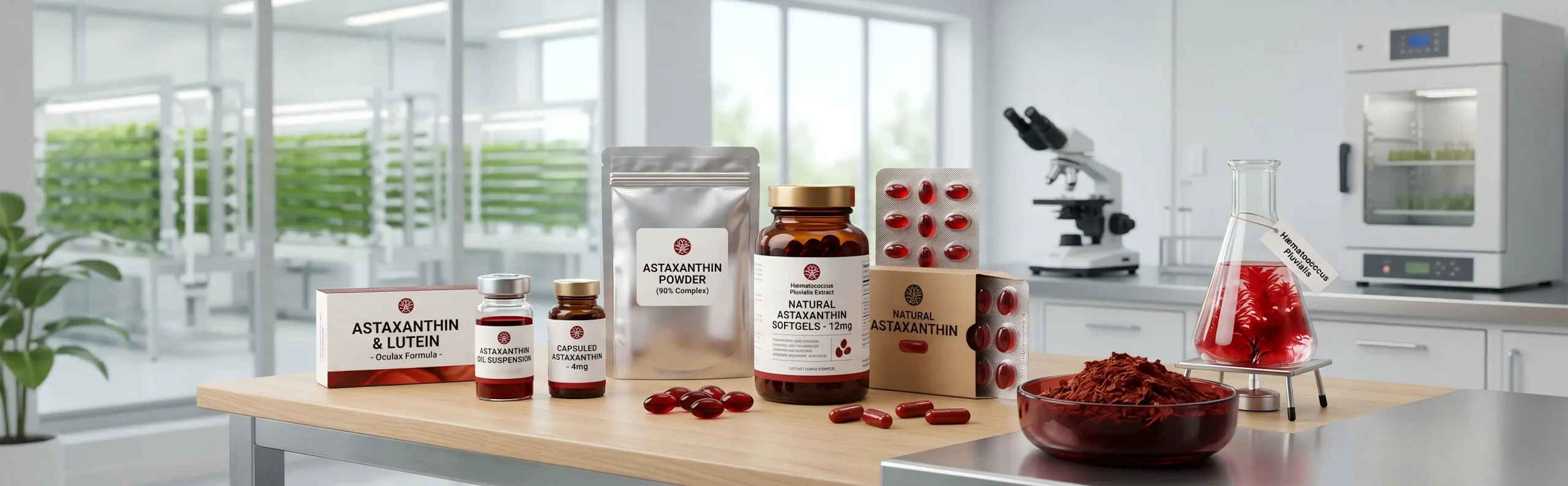
1. What Is Natural Astaxanthin?
Natural Astaxanthin is a premium carotenoid ingredient primarily sourced from Haematococcus pluvialis microalgae and widely used in dietary supplements targeting beauty, eye health, healthy aging, sports nutrition, and antioxidant wellness markets.
For supplement brands, astaxanthin offers a rare combination of strong consumer awareness, premium product positioning, and broad formulation flexibility across multiple health categories.
Today, natural astaxanthin is one of the most commercially successful microalgae-derived ingredients in the global supplement industry and is commonly incorporated into softgels, capsules, gummies, powders, functional beverages, and beauty nutrition products.
Why Supplement Brands Choose Natural Astaxanthin
Natural Astaxanthin allows brands to develop products for multiple high-growth supplement categories using a single core ingredient.
Primary Market Applications
| Application Category | Market Demand |
| Beauty From Within | Very High |
| Eye Health | Very High |
| Healthy Aging | Very High |
| Sports Recovery | High |
| Cognitive Wellness | Growing |
| Cardiovascular Wellness | Growing |
Key Commercial Advantages
- Strong consumer recognition
- Premium ingredient positioning
- Suitable for beauty, eye health, and longevity formulations
- Compatible with multiple delivery systems
- Supports vegan and plant-based product development
- Frequently featured in premium retail supplement brands
- Natural & Clean Label Appeal
2. Available Astaxanthin Specifications & Delivery Systems
| Specification | Typical Applications |
| 1% | Tablets, Gummies, Functional Foods |
| 2% | Capsules, Tablets, Daily Wellness Products |
| 2.5% | Beauty Supplements, Gummies |
| 3% | Premium Capsules |
| 5% | High-Potency Supplements |
Recommended For
- Capsules
- Tablets
- Powder Blends
- Functional Nutrition Products
| Specification | Typical Applications |
| 5% | Softgels |
| 10% | High-Strength Softgels |
| Astaxanthin Oleoresin | Customized Oil-Based Formulations |
Recommended For
- Softgel Manufacturing
- Liquid Supplements
- Oil-Based Nutritional Products
Softgels remain the most commercially successful astaxanthin format due to the oil-soluble nature of astaxanthin and strong consumer preference within the premium supplement market.
Available Specifications
- 1% Astaxanthin CWS Powder
- 2% Astaxanthin CWS Powder
- 2.5% Astaxanthin CWS Powder
What Is Microencapsulated Astaxanthin?
Microencapsulation technology protects astaxanthin within a specialized coating system designed to improve stability against heat, oxygen, moisture, and light exposure.
Compared with conventional powders, microencapsulated astaxanthin offers improved dispersibility and enhanced processing performance in complex formulations.
Recommended Applications
- Gummies
- Functional Beverages
- Stick Packs
- Sachets
- Nutrition Powders
- Functional Foods
Key Benefits
- Improved stability
- Better color retention
- Enhanced shelf life
- Improved water dispersibility
- Suitable for beverage applications
Available Specifications
- 1% Astaxanthin Beadlets
- 2% Astaxanthin Beadlets
- 2.5% Astaxanthin Beadlets
What Are Astaxanthin Beadlets?
Astaxanthin beadlets are free-flowing microgranules produced through advanced encapsulation technology. The active ingredient is embedded within a protective matrix, providing superior flowability, blend uniformity, and manufacturing stability.
Compared with conventional powders, beadlets are often preferred for large-scale production and formulations requiring precise ingredient distribution.
Recommended Applications
- Gummies
- Tablets
- Premixes
- Functional Foods
- Nutritional Powders
- Direct Compression Systems
Key Benefits
- Excellent flowability
- Reduced dust generation
- Improved blending uniformity
- Superior storage stability
- Better manufacturing efficiency
3. How to Select the Right Astaxanthin Format
| Product Type | Recommended Format |
| Softgels | Astaxanthin Oil Suspension |
| Capsules | Astaxanthin Powder |
| Tablets | Astaxanthin Powder or Beadlets |
| Gummies | Microencapsulated Powder or Beadlets |
| Functional Beverages | Microencapsulated Powder |
| Powder Sachets | Microencapsulated Powder |
| Premixes | Beadlets |
| High-Potency Formulas | 5%-10% Powder or Oil |
| Mass-Market Supplements | 1%-3% Powder |
Selecting the optimal astaxanthin specification depends on the intended dosage, finished dosage form, manufacturing process, target consumer group, and product positioning strategy.
4. Consumer Purchase Drivers
Why Consumers Buy Astaxanthin Supplements
Analysis of consumer reviews, online discussions, and retail supplement trends suggests that astaxanthin products are commonly purchased for:
- Skin appearance and beauty support
- Screen-related eye wellness
- Daily antioxidant supplementation
- Healthy aging routines
- Active lifestyle support
- Exercise recovery support
- Premium wellness positioning
- Plant-based nutrition preferences
Common Consumer Pain Points
Consumers increasingly seek:
- Beauty-from-within solutions
- Eye support for prolonged screen exposure
- Natural alternatives to synthetic antioxidants
- Daily healthy aging supplements
- Multi-benefit wellness products
- Convenient premium supplement formats
5. Common Product Claims
- Beauty From Within
- Skin Hydration Support
- Skin Appearance Support
- Daily Beauty Nutrition
- Vision Wellness Support
- Digital Lifestyle Support
- Screen-Time Wellness
- Eye Nutrition Support
- Cellular Wellness
- Daily Antioxidant Support
- Active Aging Support
- Healthy Longevity Positioning
- Active Lifestyle Support
- Exercise Recovery Support
- Daily Performance Nutrition
6. Best-Selling Astaxanthin Formulation Concepts
Astaxanthin + Marine Collagen + Hyaluronic Acid + Ceramides + Vitamin C
Popular Positioning
- Beauty Nutrition
- Skin Hydration
- Beauty From Within
- Daily Skin Support
Astaxanthin + Lutein + Zeaxanthin + Bilberry Extract + Vitamin A
Popular Positioning
- Eye Health
- Vision Nutrition
- Screen-Time Support
- Daily Eye Wellness
Astaxanthin + CoQ10 + PQQ + Resveratrol
Popular Positioning
- Cellular Wellness
- Active Aging
- Daily Longevity Support
- Antioxidant Protection
Astaxanthin + CoQ10 + Magnesium + Beet Root Extract
Popular Positioning
- Exercise Recovery
- Active Lifestyle Nutrition
- Endurance Support
- Performance Wellness
Astaxanthin + DHA + Citicoline + Lion’s Mane Mushroom
Popular Positioning
- Brain Health
- Cognitive Wellness
- Mental Performance
- Daily Cognitive Support
7. Common Dosage Ranges
| Daily Serving Range | Typical Positioning |
| 2 mg | Daily Wellness |
| 4 mg | Maintenance Support |
| 6 mg | Beauty & Eye Health |
| 8 mg | Premium Antioxidant |
| 10 mg | Healthy Aging |
| 12 mg | High-Strength Formula |
| 24 mg | Advanced Formulations |
Most mainstream retail products fall within the 4–12 mg range per serving.
Dosage selection should be determined according to formulation objectives, regional regulations, target consumers, and product positioning.
8. Astaxanthin Formulation Challenges & Solutions
Consumer reviews on retail platforms frequently mention issues such as fading color, unpleasant odor development, inconsistent product appearance, and concerns regarding product freshness.
For supplement brands, stability management is not only a quality issue but also a critical factor influencing customer satisfaction, repeat purchases, and long-term brand reputation.
Common Issue
Astaxanthin is highly sensitive to oxygen exposure.
Improper processing or packaging may result in:
- Reduced potency
- Color degradation
- Shortened shelf life
- Inconsistent product appearance
Recommended Solutions
- Use nitrogen-protected manufacturing processes
- Select oxygen-barrier packaging materials
- Utilize microencapsulated astaxanthin systems
- Incorporate complementary antioxidant systems where appropriate
Common Issue
Gummy manufacturing involves heat, moisture, and extended processing times that may negatively affect ingredient stability.
Recommended Solutions
- Use microencapsulated astaxanthin powder
- Optimize production temperatures
- Conduct stability validation studies
- Select protective packaging formats
Best Ingredient Option
Microencapsulated Astaxanthin Powder
Common Issue
Standard astaxanthin powders have limited water dispersibility.
This may result in:
- Sedimentation
- Poor appearance
- Uneven ingredient distribution
Recommended Solutions
- Use water-dispersible astaxanthin systems
- Utilize microencapsulation technology
- Optimize beverage formulation parameters
Best Ingredient Option
Water-Dispersible Microencapsulated Astaxanthin
Common Issue
Selecting the wrong astaxanthin format may affect fill uniformity and manufacturing efficiency.
Recommended Solutions
- Utilize astaxanthin oil suspension
- Select appropriate carrier oils
- Validate compatibility with softgel systems
Best Ingredient Option
Astaxanthin Oil Suspension
Common Issue
Natural astaxanthin may exhibit slight variations due to agricultural and biological source factors.
Recommended Solutions
- Source from qualified suppliers
- Standardize raw material specifications
- Implement batch-to-batch quality verification programs
Common Issue
Exposure to heat, light, oxygen, and humidity can accelerate degradation.
Recommended Solutions
- Use protective packaging
- Conduct accelerated and real-time stability studies
- Select high-stability ingredient systems
- Maintain appropriate storage conditions
9. Future Astaxanthin Innovation Opportunities
As consumer preferences continue to evolve beyond traditional antioxidant supplements, astaxanthin is increasingly being incorporated into next-generation wellness concepts focused on cellular health, healthy aging, cognitive performance, and metabolic wellness.
For supplement brands seeking product differentiation and premium positioning, the following formulation trends represent emerging opportunities within the global dietary supplement market.
Mitochondrial health has become one of the fastest-growing categories within healthy aging and active lifestyle nutrition. Consumers are increasingly looking for products that support daily energy production, cellular vitality, and long-term wellness.
Popular Ingredient Combinations
- Astaxanthin + CoQ10 + PQQ
- Astaxanthin + CoQ10 + Acetyl-L-Carnitine
- Astaxanthin + PQQ + Magnesium
Popular Positioning
- Cellular Energy Support
- Mitochondrial Wellness
- Daily Vitality
- Active Aging
The longevity supplement market continues to expand as consumers seek proactive approaches to healthy aging and long-term wellness.
Astaxanthin is increasingly combined with advanced healthy aging ingredients to create premium formulations targeting cellular maintenance and age-related wellness support.
Popular Ingredient Combinations
- Astaxanthin + Urolithin A
- Astaxanthin + Spermidine
- Astaxanthin + Resveratrol
- Astaxanthin + NMN Alternatives
Popular Positioning
- Healthy Aging
- Longevity Nutrition
- Cellular Wellness
- Daily Longevity Support
Modern brain health products are evolving beyond short-term focus and memory support toward long-term cognitive wellness and healthy brain aging.
Popular Ingredient Combinations
- Astaxanthin + Citicoline + Lion’s Mane
- Astaxanthin + DHA + Phosphatidylserine
- Astaxanthin + Ergothioneine + Citicoline
Popular Positioning
- Cognitive Wellness
- Brain Performance
- Healthy Brain Aging
- Mental Vitality
Beauty supplements are increasingly moving from traditional beauty positioning toward long-term skin wellness and healthy aging concepts.
Popular Ingredient Combinations
- Astaxanthin + Ceramides + Hyaluronic Acid
- Astaxanthin + Marine Collagen + Vitamin C
- Astaxanthin + Spermidine + Ceramides
- Astaxanthin + Ergothioneine + Collagen
Popular Positioning
- Beauty From Within
- Skin Longevity
- Skin Hydration Support
- Healthy Skin Aging
Growing screen exposure has increased consumer interest in products that support both eye wellness and overall digital lifestyle health.
Popular Ingredient Combinations
- Astaxanthin + Lutein + Zeaxanthin
- Astaxanthin + Bilberry Extract + Vitamin A
- Astaxanthin + Lutein + Ceramides
Popular Positioning
- Eye Wellness
- Screen-Time Support
- Digital Lifestyle Nutrition
- Vision Health Support
Metabolic health has become a major focus area within preventive wellness and healthy aging categories. Astaxanthin is increasingly incorporated into formulations targeting active lifestyle consumers.
Popular Ingredient Combinations
- Astaxanthin + Berberine
- Astaxanthin + Curcumin
- Astaxanthin + CoQ10 + Magnesium
- Astaxanthin + Green Tea Extract
Popular Positioning
- Metabolic Wellness
- Active Lifestyle Support
- Daily Energy Support
- Healthy Weight Management
Emerging astaxanthin applications provide opportunities for brands to move beyond traditional antioxidant positioning and develop differentiated products aligned with evolving consumer interests.
By combining astaxanthin with advanced ingredients targeting mitochondrial health, longevity, cognitive wellness, beauty aging, and metabolic support, supplement brands can create premium formulations designed for both current market demand and future category growth.
KS Nutripharma supports custom astaxanthin formulation development across beauty, healthy aging, cognitive wellness, eye health, sports nutrition, and next-generation longevity supplement categories. OEM, ODM, and private label manufacturing services are available for softgels, capsules, gummies, powders, and liquid supplement formats.
Yes. Astaxanthin can be supplied as powder, oil suspension, oleoresin, or finished supplement formats.
Astaxanthin is fat-soluble, making softgels a popular delivery format for ingredient stability and formulation convenience.
Yes. Astaxanthin is frequently formulated alongside collagen, hyaluronic acid, and vitamin C in beauty-support products.
Microalgae-derived astaxanthin can be incorporated into vegan supplement formulations when paired with appropriate excipients and delivery systems.
Natural astaxanthin is typically sourced from Haematococcus pluvialis microalgae, while synthetic astaxanthin is produced through chemical synthesis and is commonly used in animal feed applications.
Most commercial supplements provide between 4 mg and 12 mg per serving.
Yes. Astaxanthin is a fat-soluble carotenoid and is commonly delivered through oil-based softgel formulations.
Yes. Astaxanthin can be incorporated into gummy formulations when supported by suitable formulation technologies and stability systems.
Popular combinations include collagen, hyaluronic acid, lutein, zeaxanthin, CoQ10, PQQ, resveratrol, DHA, and citicoline.
Astaxanthin can be produced through different manufacturing routes, resulting in significant differences in source materials, composition, and market positioning.
| Comparison | Natural Astaxanthin | Synthetic Astaxanthin |
| Source | Haematococcus pluvialis microalgae | Chemical synthesis |
| Market Application | Dietary Supplements | Primarily Aquaculture Feed |
| Consumer Perception | Premium & Natural | Industrial |
| Labeling Appeal | Strong | Limited |
| Vegan Positioning | Yes | Varies |
| Supplement Market Acceptance | High | Low |
Why Most Supplement Brands Choose Natural Astaxanthin
Natural astaxanthin has become the preferred choice for dietary supplement formulations due to its natural source, clean-label positioning, and strong consumer recognition within beauty, eye health, and healthy aging categories.
This preference aligns with growing demand for plant-based, sustainable, and naturally sourced nutritional ingredients.
Astaxanthin offers several advantages for supplement companies seeking premium product positioning:
Strong Consumer Awareness
Astaxanthin has established recognition across beauty, eye health, healthy aging, and antioxidant supplement markets.
Multiple Market Opportunities
One ingredient can support multiple product concepts:
- Beauty Supplements
- Eye Health Products
- Healthy Aging Formulas
- Sports Nutrition
- Brain Health Products
Premium Pricing Potential
Astaxanthin-based products are commonly positioned within premium supplement categories, supporting higher retail pricing and stronger brand differentiation.
Excellent Combination Flexibility
Astaxanthin combines well with:
- Collagen
- Lutein
- Zeaxanthin
- CoQ10
- PQQ
- Resveratrol
- DHA
allowing brands to develop diverse product portfolios from a single core ingredient platform.
KS Nutripharma supports bulk astaxanthin ingredient supply, custom formulation development, private label manufacturing, and OEM/ODM production across softgel, capsule, tablet, gummy, powder, and liquid supplement formats for global dietary supplement brands.