Author: KSNutripharma® Formulation Science Team
Reviewed by: KSNutripharma® Regulatory Affairs Team
Who this guide is for: Supplement brand owners, formulators, R&D teams, and procurement managers deciding on an astaxanthin serving strength for a new or reformulated product. This is not a personal dosage recommendation for consumers.
TL;DR: Most commercial astaxanthin products use 4-12 mg per day. The right strength depends on target positioning, the human evidence behind that positioning, ingredient concentration, dosage form, and regulatory limits in the target market – not on which number sounds the strongest on a label. Jump to: Quick Answer | Dosage vs. Ingredient Weight | 4 mg | 6 mg | 8 mg | 12 mg | 24 mg | Cost | Stability | Selection Framework | FAQ
Astaxanthin dosage is not simply a consumer question. For supplement brands, the selected serving strength affects ingredient concentration, fill weight, capsule count, production cost, label clarity, stability, packaging, regulatory review, and the amount of evidence needed to support product positioning.
Commercial astaxanthin supplements commonly provide between 4 mg and 12 mg per daily serving. Higher-strength products, including 20 mg and 24 mg servings, also exist, but a higher number does not automatically create a better or more effective product.
The appropriate strength depends on five core factors:
- The target consumer and product positioning
- The human evidence relevant to that positioning
- The astaxanthin source and ingredient concentration
- The selected dosage form and serving count
- Safety and regulatory requirements in the target market
Medical and Regulatory Notice: This article is intended for supplement brands, formulators, and procurement teams. It does not provide individualized dosage advice and is not a substitute for consultation with a qualified regulatory, medical, or quality-assurance professional. Clinical-study doses are not universal recommendations, and a dose used in research is not automatically authorized for commercial sale or for every population, including children and adolescents. Always confirm permitted serving levels, labeling, and claims with the regulatory requirements of each target market before manufacturing or selling a product.
Quick Answer: What Astaxanthin Dosage Should a Brand Choose?
For product-development purposes:
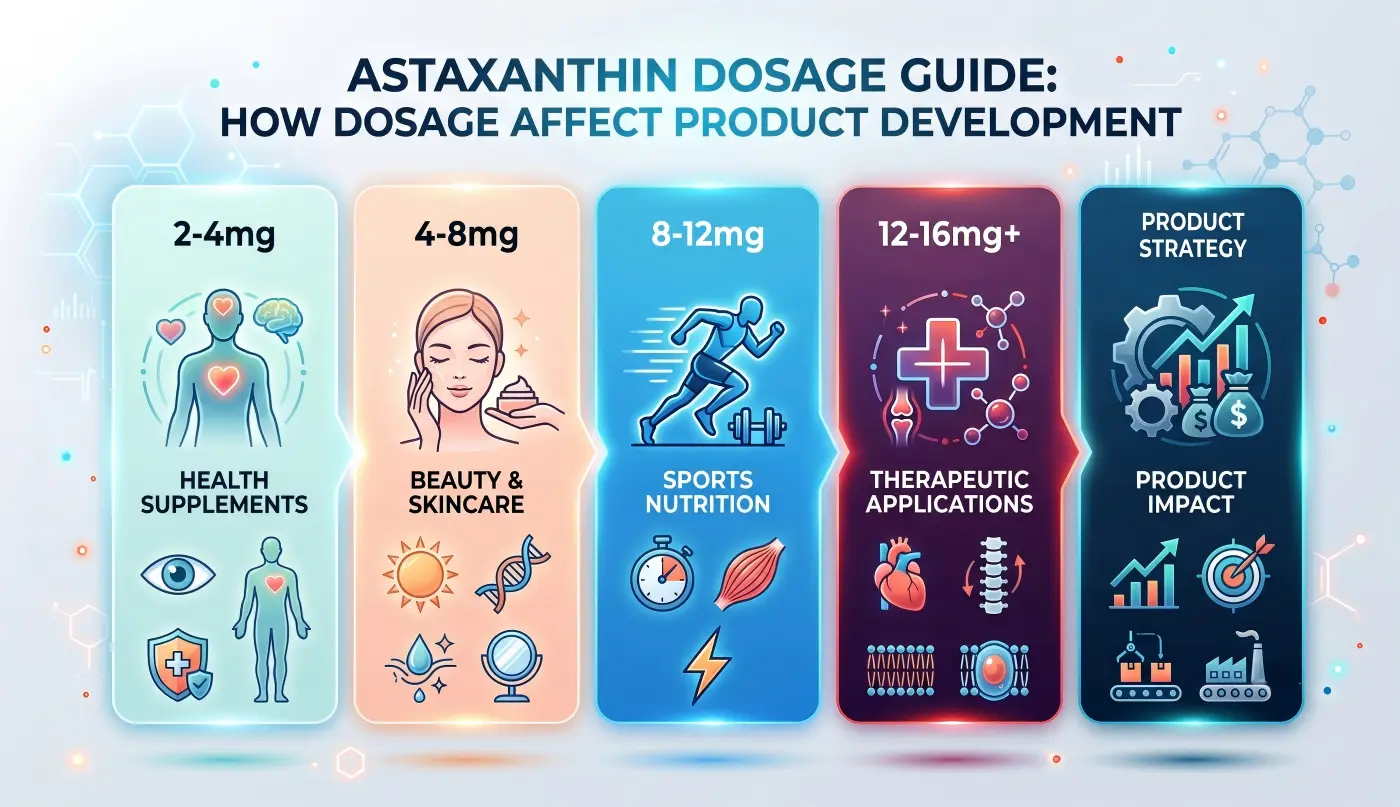
- 4 mg is suitable for entry-level daily wellness and beauty concepts supported by lower-dose human studies.
- 6 mg has been used in skin, safety, and multi-carotenoid research and fits many standard softgel products.
- 8 mg provides a mid-to-premium position and matches the adult intake evaluated in EFSA’s 2020 safety opinion. This assessment applies to adults only; it does not support use in children’s products.
- 12 mg supports high-strength positioning and has been used in several human trials, but it requires more careful regulatory, formulation, and label review.
- 24 mg is a specialized high-dose position supported by limited, population-specific research. It should not be treated as a default daily wellness strength.
The correct choice is the lowest technically and commercially appropriate serving supported by the intended product brief.
Astaxanthin Dose Is Not the Same as Astaxanthin Ingredient Weight
One of the most common sources of confusion in marketplace reviews and online discussions is the difference between active astaxanthin and the total weight of an astaxanthin preparation.
A product providing 12 mg of active astaxanthin does not necessarily contain only 12 mg of physical material.
Commercial ingredients may be standardized to:
- 1% astaxanthin
- 2% astaxanthin
- 5% astaxanthin
- 5% astaxanthin
- 10% astaxanthin
The remaining material may include algal biomass, carrier oil, starch, encapsulation materials, antioxidants, emulsifiers, or other approved excipients.
The basic calculation is:
Required ingredient mass = target active astaxanthin / ingredient concentration
For example, 5% astaxanthin means that each gram of preparation contains approximately 50 mg of active astaxanthin.
Ingredient Mass Required at Different Concentrations
| Target active amount | 1% preparation | 2% preparation | 5% preparation | 10% preparation |
| 4 mg | 400 mg | 200 mg | 80 mg | 40 mg |
| 6 mg | 600 mg | 300 mg | 120 mg | 60 mg |
| 8 mg | 800 mg | 400 mg | 160 mg | 80 mg |
| 12 mg | 1,200 mg | 600 mg | 240 mg | 120 mg |
| 24 mg | 2,400 mg | 1,200 mg | 480 mg | 240 mg |
These are theoretical calculations before adding carrier oil, processing aids, antioxidants, capsule-shell displacement, manufacturing overage, or other active ingredients.
Actual calculations must use the supplier’s tested assay rather than the nominal concentration alone.
What Does a 4 mg Astaxanthin Product Represent?
A 4 mg astaxanthin supplement can support an accessible daily-wellness or beauty-from-within position. It also allows more formula space for complementary ingredients.
A randomized, double-blind, placebo-controlled trial involving 23 healthy Japanese participants evaluated 4 mg of oral astaxanthin daily for 10 weeks. The study reported differences in selected measurements related to UV-induced skin deterioration and moisture loss compared with placebo.
The study was small and should not be interpreted as proof that 4 mg prevents sun damage or replaces sunscreen. It does demonstrate that 4 mg is a clinically studied amount relevant to skin-oriented product development.
Commercial Advantages of 4 mg
- Lower active-ingredient cost per serving
- Easier use in small softgels
- More space for lutein, zeaxanthin, vitamin E, or other actives
- Suitable for entry-level or mass-market positioning
- Lower total ingredient mass when concentrated inputs are used
- Easier transition from single-ingredient to combination formulas
Commercial Limitations of 4 mg
- May appear weak next to 10 mg or 12 mg competitors
- Requires clear positioning rather than “high potency” language
- Consumers may incorrectly assume that a higher number always provides greater value
- The evidence for one use cannot automatically support unrelated claims
A 4 mg product should compete through source quality, formulation, substantiation, stability, and consumer experience, not through exaggerated strength comparisons.
What Does a 6 mg Astaxanthin Product Represent?
A 6 mg serving fits between entry-level and premium positioning. It has been used in human safety and skin studies and is also practical for combination formulas.
A randomized, double-blind, placebo-controlled safety trial gave 35 healthy adults either astaxanthin-rich Haematococcus pluvialis extract or placebo for eight weeks. The active group received 6 mg of astaxanthin per day. Researchers monitored blood pressure, blood chemistry, a comprehensive metabolic panel, and blood counts and did not identify clinically important safety differences.
A systematic review of skin studies noted that several trials evaluated servings in the 3-6 mg range, although the authors emphasized that many studies were small and commercially funded.
Commercial Advantage of 6 mg
- Clinically studied in healthy adults
- Suitable for skin and general antioxidant positioning
- Can fit in one softgel when a suitable concentration is used
- Leaves formula space for complementary ingredients
- Creates a measurable distinction from basic 4 mg products
- Can be divided into two 3 mg units if the product concept requires multiple daily servings
Formulation Example
A 6 mg target using:
- 2% astaxanthin requires approximately 300 mg of ingredient preparation.
- 5% astaxanthin requires approximately 120 mg.
- 10% astaxanthin requires approximately 60 mg.
If the formula also contains an oil carrier, tocopherols, and another lipid-soluble active, the manufacturer must calculate total fill weight and confirm suspension uniformity.
What Does an 8 mg Astaxanthin Product Represent?
An 8 mg serving is a strong mid-range option for premium antioxidant, active-lifestyle, beauty, and eye wellness products.
Human studies have used 8 mg in several contexts. For example, a randomized crossover study provided runners with 8 mg of algae-derived astaxanthin per day for four weeks. The supplement did not reduce every measured exercise-induced inflammatory response, but it was associated with differences in selected immune-related plasma proteins during recovery.
Another randomized trial evaluated 8 mg daily for eight weeks in middle-aged adults. The overall cognitive test results did not show significant differences between astaxanthin and placebo, although a subgroup finding was reported. The authors stated that no safety problems were identified based on the parameters tested.
These mixed findings illustrate an important product-development principle: matching a clinical dose does not guarantee a benefit claim.
EFSA’s 8 mg Adult Safety Assessment
The European Food Safety Authority assessed an intake of 8 mg astaxanthin per day from food supplements together with estimated background dietary exposure.
EFSA concluded that the combined intake was safe for adults under the conditions assessed. However:
- Adolescents aged 14 to under 18 could reach the acceptable daily intake.
- Children under 14 could exceed the acceptable daily intake.
- EFSA’s conclusion was population- and exposure-specific.
Therefore, 8 mg should not automatically be used in children’s products or described as a universal regulatory limit.
Commercial Advantages of 8 mg
- Premium but not extreme label strength
- Alignment with EFSA’s assessed adult supplemental intake
- Practical as one softgel with concentrated oil suspension
- Suitable for combination products
- Stronger shelf presence than 4 mg or 6 mg products
- Can be offered as one 8 mg unit or two 4 mg units
Commercial Limitations of 8 mg
- May require age restrictions in some markets
- Higher cost than a 4 mg product
- Greater need for stability overage and end-of-shelf-life verification
- More difficult to fit into low-concentration powder capsules
- May offer no meaningful advantage if the positioning is supported only by lower-dose research
What Does a 12 mg Astaxanthin Product Represent?
Astaxanthin 12 mg is one of the most visible high-strength positions in online marketplaces. It is attractive because one daily serving can be marketed as premium or extra strength.
Several human trials have used 12 mg, but results vary by population and outcome.
A randomized crossover trial involving 12 recreationally trained male cyclists evaluated 12 mg per day for seven days. The researchers reported a mean improvement of 51 seconds in a 40-kilometer cycling time trial, equivalent to approximately 1.2%, together with differences in fat oxidation during the final stage.
This was a small, short study in trained men. It does not establish that every 12 mg supplement improves exercise performance.
Another randomized trial provided 12 mg daily to 22 male participants for 30 days. The study reported selected recovery-related differences but no improvement in VO2max or heat tolerance.
A one-year randomized controlled trial in 61 renal transplant recipients found no significant benefit of 12 mg per day for the primary measures of arterial stiffness, oxidative stress, or inflammation.
The evidence therefore does not support claims that 12 mg is universally more effective than 4 mg, 6 mg, or 8 mg.
Is 12 mg of Astaxanthin Too Much?
There is no universal answer.
A safety review covering 87 human studies reported no identified safety concerns with natural astaxanthin in the studies examined, including 35 studies using at least 12 mg per day. However, EFSA’s adult assessment concerned 8 mg per day from supplements with estimated dietary exposure.6
For B2B product development, the correct conclusion is:
- 12 mg has been studied in humans.
- 12 mg is commercially available.
- 12 mg is not automatically appropriate in every market.
- 12 mg is not necessarily more effective.
- Product-specific and market-specific safety reviews are still required.
Capsule Count for a 12 mg Serving
Whether 12 mg fits in one softgel depends on the input concentration and total formula.
Using theoretical values:
- A 2% preparation requires 600 mg before additional carrier.
- A 5% preparation requires 240 mg.
- A 10% preparation requires 120 mg.
A high-concentration oil suspension may support a small single-unit softgel. A lower-concentration preparation may require a larger softgel or two units per serving.
Brands should not hide a two-softgel serving behind a prominent “12 mg” front-label claim. The Supplement Facts panel and directions should clearly distinguish:
- Amount per softgel
- Serving size
- Amount per serving
- Servings per container
What Does a 24 mg Astaxanthin Product Represent?
A 24 mg product occupies a niche high-dose position. It should not be treated as the logical next step after 12 mg.
A small study involving 24 nursing-home residents aged 67-94 evaluated 24 mg of astaxanthin per day for 16 weeks. Thirteen participants received astaxanthin and 11 received placebo. The study reported differences in walking distance, lactate, and oxidative-stress measurements but no significant between-group difference in muscle mass or strength.
This study does not establish 24 mg as an optimal general-wellness dosage because:
- The sample was very small.
- The population was highly specific.
- The intervention lasted 16 weeks.
- The outcomes were related to walking capacity in older adults.
- The result has not established superiority over lower doses.
Commercial Challenges of 24 mg
- Higher raw-material cost
- Greater regulatory complexity
- More difficult single-unit delivery
- Increased risk of consumer confusion
- Greater importance of warning language
- Higher stability-overage cost
- More demanding shelf-life assay requirements
- Limited evidence for routine daily-wellness positioning
A 24 mg serving will commonly be easier to deliver as two 12 mg units than one very large softgel. However, the correct design depends on ingredient concentration and total fill composition.
Does a Higher Astaxanthin Dosage Mean Better Results?
No. Current research does not establish a simple linear relationship in which doubling the dose doubles the benefit.
Different studies use different:
- Astaxanthin sources
- Concentrations and carriers
- Populations
- Durations
- Outcomes
- Background diets
- Combination ingredients
- Analytical methods
A 4 mg skin study and a 12 mg cycling study cannot be used to conclude that 12 mg provides three times the skin benefit of 4 mg. They tested different questions in different populations.
For an evidence-led product, brands should match the serving level to the closest relevant human research rather than selecting the largest marketable number.
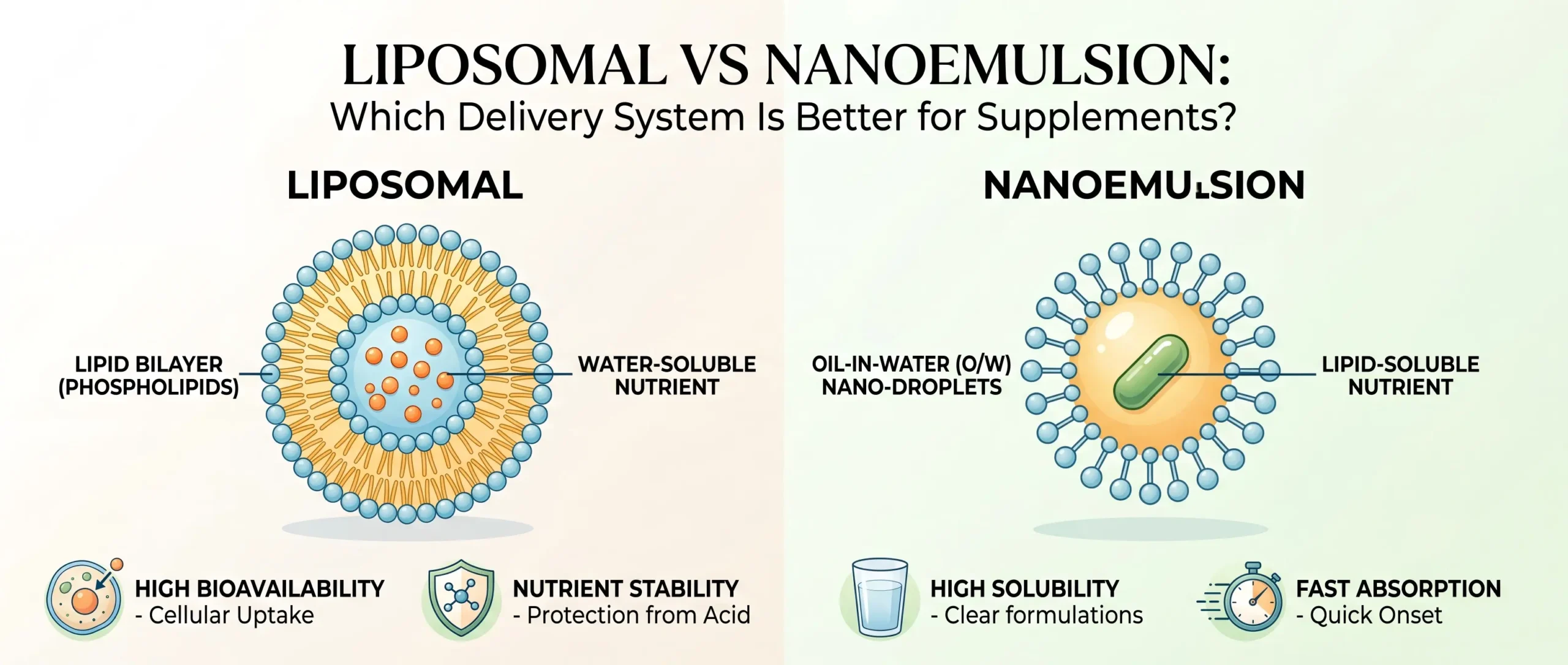
Why Delivery Format Can Matter as Much as Milligrams
Astaxanthin is highly lipophilic and has low inherent oral bioavailability.
A human pharmacokinetic study compared lipid-based astaxanthin formulations with a reference supplement. The tested lipid formulations produced approximately 1.7 to 3.7 times the bioavailability of the reference formulation.
A more recent crossover study compared a micellar preparation with standard astaxanthin. Both supplied 8 mg of active astaxanthin, but the micellar formulation reached a higher reported maximum plasma concentration and reached that concentration sooner.
These studies show why front-label milligrams alone do not fully describe a product.
Two products may both state “8 mg astaxanthin,” yet differ in:
- Ingredient source
- Ester profile
- Carrier system
- Particle size
- Dispersion
- Release characteristics
- Stability
- Measured absorption
A formulation technology should not be described as “more bioavailable” unless that claim is supported by appropriate comparative evidence for the specific commercial ingredient.
How Dosage Affects Softgels, Capsules, Gummies, and Powders
Oil-Based Softgels
Softgels are commonly used because astaxanthin is lipid-soluble and can be supplied as an oil suspension.
They support:
- One-unit daily servings
- Concentrated astaxanthin inputs
- Oil-phase combinations with vitamin E, CoQ10, or omega-3
- Reduced exposure to environmental oxygen when properly manufactured
- Premium product positioning
Challenges include shell compatibility, oil oxidation, leakage, heat exposure during shipping, and consumer preferences regarding gelatin.
Hard Capsules
Hard capsules can use standardized powder, beadlets, or microencapsulated astaxanthin.
They are useful for:
- Vegan capsule positioning
- Combination powders
- Lower production complexity
- Products that do not require a softgel line
A 12 mg active target using a 2% powder would theoretically require 600 mg of astaxanthin preparation before other ingredients. This can make a single-capsule product impractical.
Gummies
Gummies usually require microencapsulated or protected astaxanthin because manufacturing introduces heat, moisture, oxygen, and extended processing time.
Higher active servings can create:
- Darker color
- Increased ingredient cost
- Flavor challenges
- Greater assay variation
- Larger gummy count
- Higher stability loss
A 12 mg gummy claim may require multiple gummies or a high-concentration protected ingredient.
Powders and Beverages
Standard astaxanthin powder is not naturally water-soluble. Beverages and drink powders generally require a water-dispersible or emulsified system.
The label amount should refer to active astaxanthin, not the total weight of the encapsulated beadlet or premix.
KSNutripharma supports astaxanthin softgel, capsule, gummy, and powder manufacturing with multiple ingredient concentrations and delivery systems.
How Dosage Affects Product Cost
The cheapest astaxanthin input per kilogram may not produce the lowest finished-product cost.
A complete cost model should include:
Ingredient cost per bottle = preparation weight per serving x servings per bottle x cost per unit weight
Brands must then add:
- Carrier oil or excipients
- Capsule or softgel shell
- Manufacturing loss
- Validated overage
- Filling and packaging
- Analytical testing
- Stability testing
- Freight and temperature exposure
- Yield loss
- Rejected or leaking units
Hypothetical Cost Comparison
Assume two ingredients:
- Ingredient A: 2% astaxanthin at a lower price per kilogram
- Ingredient B: 10% astaxanthin at a higher price per kilogram
For a 12 mg active serving:
- Ingredient A requires approximately 600 mg.
- Ingredient B requires approximately 120 mg.
Ingredient B can cost more per kilogram but still reduce:
- Fill weight
- Capsule size
- Units per serving
- Packaging volume
- Freight weight
- Formula-space limitations
The cost comparison should be based on delivered active astaxanthin per finished serving, not raw-material price per kilogram alone.
How to Calculate a Stability Overage
Astaxanthin may degrade when exposed to heat, oxygen, and light.
A storage study of astaxanthin-containing shrimp oil found that degradation and lipid oxidation increased with higher temperatures. Light, oxygen availability, and temperature all increased degradation during storage.
An overage may be needed to ensure that the product still meets its label claim at the end of shelf life. It must be based on actual stability data and applicable regulations, not an arbitrary percentage.
A simplified theoretical calculation is:
Required initial active = label claim / expected retained fraction
If a formulation is expected to retain 92% of its active content:
12 mg / 0.92 = 13.04 mg initial theoretical target
This does not mean every 12 mg product should contain 13.04 mg. The final specification must consider:
- Raw-material assay
- Manufacturing variability
- Analytical-method variability
- Release specification
- Shelf-life specification
- Regulatory tolerance
- Packaging
- Real-time and accelerated stability results
Excessive overage can create safety and compliance concerns, particularly for high-dose products.
What Reddit and Marketplace Debates Reveal
Reddit discussions and marketplace reviews are not clinical evidence. They are useful as qualitative signals about consumer confusion, expectations, and product-quality failures. Observations below reflect publicly visible discussion patterns as of July 2026 and may change over time.
Recurring controversies include:
“Should I Buy 4 mg or 12 mg?”
Consumers frequently assume 12 mg must be three times as effective as 4 mg. Human evidence does not support that conclusion across all outcomes.
Brand response: Explain why the selected serving matches the product concept and supporting evidence.
“Is the Number Active Astaxanthin or Algae Extract?”
Consumers may not understand the difference between 12 mg of active astaxanthin and 12 mg of algal material.
Brand response: State the active astaxanthin amount, source, concentration, and serving size clearly.
“Should Astaxanthin Be Taken With Fat?”
The question reflects legitimate formulation concerns because astaxanthin is lipid-soluble. Human pharmacokinetic research indicates that lipid-based formulations can increase absorption.12
Brand response: Use an appropriate carrier and provide substantiated directions rather than relying on consumers to correct a poorly designed formula.
“Will a Higher Dose Change Skin Color?”
Online anecdotes sometimes connect carotenoid supplements with tanning, orange skin, or red skin. These reports are uncontrolled and often involve multiple carotenoids.
Brand response: Do not market astaxanthin as a tanning pill or skin-color modifier without adequate evidence and regulatory review.
“Why Is a 12 mg Softgel So Small?”
A small capsule does not prove under-dosing. A 10% preparation requires only about 120 mg to provide 12 mg of active astaxanthin.
However, consumer skepticism is reasonable when source, concentration, assay, and third-party testing are not disclosed.
Brand response: Provide traceable specifications and lot-level testing rather than asking consumers to infer potency from capsule size or color.
What One-Star Marketplace Reviews Reveal
One-star reviews should not be used to determine clinical efficacy. They can reveal preventable quality and communication failures. The themes below reflect general, aggregated patterns observed across publicly available listings for astaxanthin supplements as of July 2026, rather than any single named product.
Common complaint themes include:
- No noticeable effect
- Suspicion that the product contains less than the label claim
- Unclear raw-material origin
- A 12 mg serving requiring two softgels
- Unexpected carrier oils
- Rancid or unpleasant odor
- Hard, stuck, or leaking softgels
- Heat-damaged products
- Incomplete country-of-origin disclosure
- Delayed company responses to adverse-event complaints
These complaints do not prove that every reported defect was caused by the manufacturer. They identify areas that should be controlled during product development.
Manufacturing Responses to Review Risk
- Verify active astaxanthin by a validated assay.
- Retain representative samples from each lot.
- State milligrams per unit and per serving.
- Disclose carrier oil and capsule-shell composition.
- Use oxygen- and light-protective packaging.
- Conduct shipping and temperature-excursion studies.
- Validate softgel seam strength and leakage resistance.
- Include clear storage instructions.
- Establish a complaint and adverse-event process.
- Avoid claims that create immediate, unrealistic expectations.
“Did nothing” reviews are partly an expectation-management problem. Astaxanthin should not be promoted with guaranteed timelines or dramatic before-and-after promises.
Label Requirements Brands Should Clarify
A consumer should be able to answer the following questions from the label:
- How much active astaxanthin is in one unit?
- How many units make one serving?
- What is the astaxanthin source?
- Is the product an oil, powder, beadlet, or extract?
- What carrier oil is used?
- Is the capsule gelatin or plant-based?
- How many daily servings are recommended?
- How many servings are in the container?
- What warnings apply?
- How should the product be stored?
In the United States, there is no established Daily Value for astaxanthin. The Supplement Facts panel should identify the amount per serving and use the appropriate symbol indicating that a Daily Value has not been established.
Claims must be truthful, nonmisleading, and supported. The FDA distinguishes permitted structure/function claims from disease claims and requires applicable disclaimers and notifications.
B2B Astaxanthin Dosage Selection Framework
Choose 4 mg When:
- The product is entry-level or mass-market.
- Formula space is needed for complementary ingredients.
- The evidence relevant to the positioning uses a lower dose.
- Cost per serving is highly sensitive.
- A small daily unit is preferred.
Choose 6 mg When:
- The brand wants a clinically recognizable mid-range position.
- The concept focuses on beauty or daily wellness.
- One-unit delivery is required.
- The formula includes other active ingredients.
Choose 8 mg When:
- The product targets premium adult wellness.
- The target-market regulatory review supports the serving.
- The formula requires stronger label differentiation.
- A one-unit softgel remains technically feasible.
Choose 12 mg When:
- High-strength positioning is commercially justified.
- Relevant human evidence supports the intended use.
- The target market permits the formula.
- The brand can substantiate a single- or two-unit serving.
- Stability and assay controls can support the label claim.
Choose 24 mg When:
- The product serves a specialized, evidence-defined position.
- Population-specific evidence is relevant.
- Regulatory and safety reviewers approve the serving.
- The brand accepts higher cost and more complex labeling.
- The strength is not being selected solely to win a marketplace comparison.
Frequently Asked Questions
What is the most common astaxanthin dosage in supplements?
Commercial products commonly provide 4-12 mg per daily serving. This market range is not a universal recommendation.
Is 4 mg of astaxanthin enough for a supplement?
Four milligrams is a clinically studied serving used in skin-related research. Its suitability depends on the intended product position and target market.
Is 12 mg of astaxanthin too much?
Twelve milligrams has been used in human trials, but it is not automatically appropriate for every population or market. EFSA’s adult assessment evaluated 8 mg per day from supplements with estimated dietary exposure.
Is 24 mg astaxanthin better than 12 mg?
No reliable evidence establishes that 24 mg is generally better than 12 mg. A 24 mg serving has been studied in a small, specific older population, but it should not be treated as a default wellness dose.
Can 12 mg of astaxanthin fit in one softgel?
Yes, if a sufficiently concentrated preparation and compatible fill system are used. A lower-concentration input may require a larger softgel or two units.
Why do some 12 mg products require two capsules?
The serving may be divided to reduce individual capsule size, accommodate other ingredients, improve swallowing, or use a lower-concentration preparation.
Does a small softgel mean the dose is inaccurate?
No. A concentrated 10% preparation theoretically requires only 120 mg of ingredient to provide 12 mg of active astaxanthin. Potency should be verified by assay, not capsule size.
Does astaxanthin need an oil carrier?
Astaxanthin is lipid-soluble, and human pharmacokinetic studies show that lipid-based formulations can improve bioavailability. The exact carrier should be selected through formulation and compatibility assessment.
How much overage should an astaxanthin product contain?
There is no universal overage. It must be established through assay variability, process capability, packaging, accelerated stability, and real-time stability data.
Which astaxanthin dosage has the best product economics?
The answer depends on ingredient concentration, cost per active milligram, capsule count, fill weight, testing, packaging, and positioning. A lower-priced ingredient per kilogram may produce a more expensive finished product if much more material is required.
Develop the Right Astaxanthin Strength With KSNutripharma
Selecting an astaxanthin dosage requires alignment between evidence, market position, ingredient specification, fill weight, unit count, cost, label language, stability, and regulatory requirements.
KSNutripharma provides custom natural astaxanthin supplement manufacturing across softgels, capsules, tablets, gummies, powders, and liquid systems, backed by documented quality certifications and lot-level testing (GMP, ISO, and COA documentation available on request).
Brands can also integrate astaxanthin into antioxidant supplement formulations or customized eye health supplements.
Contact KSNutripharma with your target market, desired active amount, ingredient combination, dosage form, servings per bottle, packaging, and estimated order volume for a formulation-feasibility assessment.
How This Guide Was Verified
Every clinical claim in this guide is linked to a peer-reviewed, PubMed-indexed human study, or to an official regulatory source (the European Food Safety Authority or the U.S. Food and Drug Administration). Marketplace and forum observations are explicitly identified as qualitative, non-clinical signals and are not used to support efficacy or safety claims. This guide will be reviewed periodically as new clinical and regulatory data becomes available.
References and Data Sources
- “The Protective Role of Astaxanthin for UV-Induced Skin Deterioration in Healthy People – A Randomized, Double-Blind, Placebo-Controlled Trial.” https://pubmed.ncbi.nlm.nih.gov/29941810/
- “Safety of an Astaxanthin-Rich Haematococcus pluvialisAlgal Extract: A Randomized Clinical Trial.” https://pubmed.ncbi.nlm.nih.gov/12804020/
- “Effects of Astaxanthin Supplementation on Skin Health: A Systematic Review of Clinical Studies.” https://pubmed.ncbi.nlm.nih.gov/32202443/
- “Astaxanthin Supplementation Counters Exercise-Induced Decreases in Immune-Related Plasma Proteins.”https://pubmed.ncbi.nlm.nih.gov/37025615/
- “Effect of Astaxanthin-Rich Extract Derived From Paracoccus carotinifacienson Cognitive Function in Middle-Aged and Older Individuals.” https://pubmed.ncbi.nlm.nih.gov/29610561/
- European Food Safety Authority. “Safety of Astaxanthin for Its Use as a Novel Food in Food Supplements.” EFSA Journal 2020;18(2):5993. https://doi.org/10.2903/j.efsa.2020.5993
- “The Effect of Astaxanthin Supplementation on Performance and Fat Oxidation During a 40 km Cycling Time Trial.” https://pubmed.ncbi.nlm.nih.gov/32660833/
- “Astaxanthin Improves Aerobic Exercise Recovery Without Affecting Heat Tolerance in Humans.” https://pubmed.ncbi.nlm.nih.gov/33344941/
- “Astaxanthin Has No Effect on Arterial Stiffness, Oxidative Stress, or Inflammation in Renal Transplant Recipients: The XANTHIN Trial.” https://pubmed.ncbi.nlm.nih.gov/26675778/
- “Astaxanthin: How Much Is Too Much? A Safety Review.” https://pubmed.ncbi.nlm.nih.gov/31788888/
- “Impacts of Astaxanthin Supplementation on Walking Capacity by Reducing Oxidative Stress in Nursing Home Residents.” https://pubmed.ncbi.nlm.nih.gov/36294075/
- “Oral Bioavailability of the Antioxidant Astaxanthin in Humans Is Enhanced by Incorporation of Lipid-Based Formulations.” https://pubmed.ncbi.nlm.nih.gov/12885395/
- “Comparative Pharmacokinetic Study of Standard Astaxanthin and Its Micellar Formulation in Healthy Male Volunteers.” https://pubmed.ncbi.nlm.nih.gov/38748358/
- International Aquatic Research (Springer). “Astaxanthin Degradation and Lipid Oxidation of Pacific White Shrimp Oil: Kinetics Study and Stability as Affected by Storage Conditions.” https://doi.org/10.1007/s40071-015-0120-z
- S. Food and Drug Administration. “Structure/Function Claims.” https://www.fda.gov/food/nutrition-food-labeling-and-critical-foods/structurefunction-claims
Marketplace Observation Sources
Marketplace reviews are qualitative customer reports, not verified clinical or laboratory evidence. Links were current as of July 2026 and are subject to change or removal by the listing platform.
- Amazon customer reviews: NutriGold Astaxanthin 4 mg Softgels https://us.amazon.com/NutriGold-Astaxanthin-Vegan-Liquid-Capsules/dp/B006S44THW
- Amazon customer reviews: Astaxanthin 12 mg Softgels https://www.amazon.com/Astaxanthin-12mg-120-Softgels-Antioxidant/dp/B0FYQPWMLY
- Amazon customer reviews: Beyond Longevity Astaxanthin 12 mg https://www.amazon.com/Pure-Astaxanthin-Vegan-Softgel-Gelatin/dp/B0FXXXPYSK