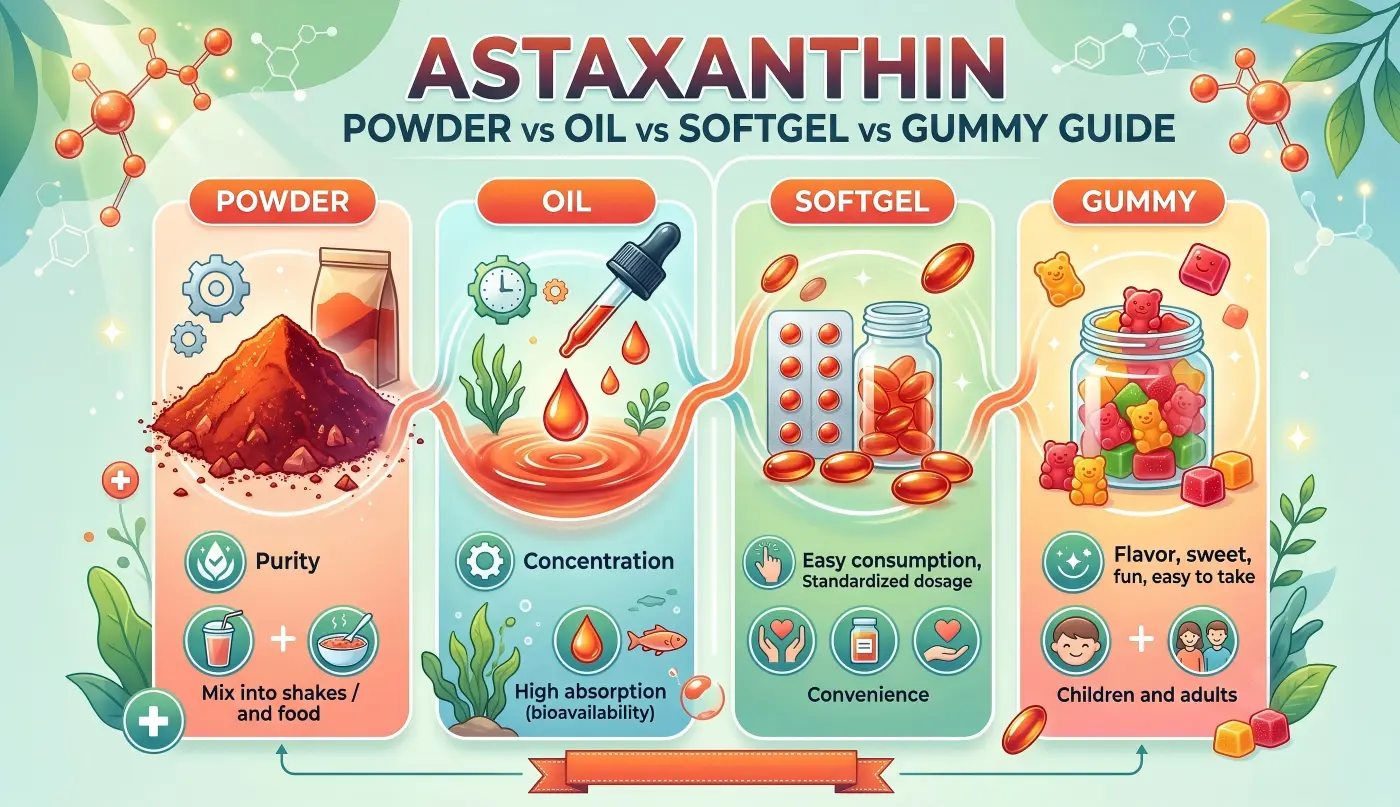
The Astaxanthin format selection is a manufacturing decision, not simply a preference about how the finished product looks.
Astaxanthin is lipid-soluble, strongly colored, and sensitive to oxygen, light, and heat. An astaxanthin oil suspension may work well in softgels, while standardized powders, beadlets, and microencapsulated cold-water-dispersible systems make capsules, tablets, gummies, and drink powders more practical.
For supplement brands, the best format depends on:
- Targeted astaxanthin dosage
- Finished dosage form
- Ingredient concentration
- Formula space
- Manufacturing temperature
- Water and oxygen exposure
- Target shelf life
- Packaging requirements
- Consumer experience
- Cost and minimum order quantity
This B2B guide compares astaxanthin powder, astaxanthin oil, softgels, capsules, gummies, and water-dispersible systems from a formulation and manufacturing perspective.
Regulatory Notice: The suitability and permitted use level of an astaxanthin ingredient must be evaluated for the intended product, population, claims, and target market. A technically feasible formula is not automatically regulatory-compliant in every country.
Disclaimer: This guide is intended for supplement brands, formulators, and manufacturers evaluating astaxanthin ingredient formats. It provides general technical and regulatory information only and does not constitute medical, legal, or regulatory advice. Consult qualified regulatory affairs and quality assurance professionals before finalizing a product formula, label, or health claim.
Table of Contents
- Quick Answer: Which Astaxanthin Format Should You Choose?
- Why Does Astaxanthin Format Matter?
- What Is Astaxanthin Oil?
- Is Astaxanthin With MCT Oil Better?
- Why Are Softgels Commonly Used for Astaxanthin?
- What Is Astaxanthin Powder?
- When Should You Use Standardized Astaxanthin Powder?
- What Are Astaxanthin Beadlets?
- What Is Microencapsulated Astaxanthin?
- Is Cold-Water-Dispersible Astaxanthin Truly Water-Soluble?
- Can Astaxanthin Be Used in Gummies?
- Format Comparison for B2B Product Development
- How Does Format Affect Cost and MOQ?
- Which Packaging Protects Astaxanthin?
- What Should an Astaxanthin Stability Program Test?
- Astaxanthin Format Decision Tree
- Frequently Asked Questions
- Develop Your Astaxanthin Product With KSNutripharma
- References
Quick Answer: Which Astaxanthin Format Should You Choose?
- Choose astaxanthin oil in softgels for a compact lipid-based product, particularly at higher active strengths.
- Choose standardized astaxanthin powder in capsules for a dry formula or a multi-ingredient capsule product.
- Choose microencapsulated astaxanthin powder or beadlets when greater protection from oxygen, moisture, light, and processing stress is required.
- Choose a cold-water-dispersible astaxanthin powder for drink mixes, gels, shots, or selected gummies.
- Choose astaxanthin gummies when consumer experience is the priority and the project can support additional formulation, process, and stability work.
- Avoid adding a standard oil suspension directly to a water-based product without a validated dispersion or emulsification system.
The finished dosage form should normally be selected first. The manufacturer can then identify the appropriate astaxanthin input for that format.
Why Does Astaxanthin Format Matter?
Astaxanthin contains a long conjugated molecular structure. This structure is responsible for its intense red color, but it also makes the ingredient susceptible to degradation and isomerization under adverse conditions.
A 2024 stability study reported significant astaxanthin degradation when solutions were exposed to temperatures above 60 degrees C or prolonged ultraviolet exposure. Under the tested conditions, degradation exceeded 20% after sufficient thermal or UV stress.[1]
A separate storage study of astaxanthin-containing oil found that light, oxygen availability, and increasing temperature all accelerated astaxanthin degradation and lipid oxidation.[2]
These findings do not mean every finished astaxanthin product will fail above a specific temperature. Stability depends on the ingredient matrix, exposure time, carrier, antioxidants, water activity, packaging, and manufacturing process.
They do establish that a manufacturer should control:
- Ingredient exposure time
- Processing temperature
- Oxygen incorporation
- Light exposure
- Moisture
- Carrier-oil oxidation
- Finished-product packaging
- Distribution temperature
- End-of-shelf-life potency
Selecting a protected ingredient format reduces risk, but it does not replace finished-product stability testing.
What Is Astaxanthin Oil?
Astaxanthin oil is generally an astaxanthin-rich extract or oleoresin dispersed or standardized in a food-grade lipid carrier.
Natural astaxanthin used in premium human supplements commonly originates from Haematococcus pluvialis microalgae. After cultivation and harvesting, astaxanthin-rich material can be extracted and standardized into an oil-based ingredient.
Depending on the supplier, the carrier may include:
- Olive oil
- Sunflower oil
- Safflower oil
- Medium-chain triglycerides
- Other permitted vegetable oils
- Naturally occurring algal lipids
Ingredient concentrations vary. A product specification might provide 5%, 10%, or another standardized amount of active astaxanthin. The brand should verify concentration from the specification and certificate of analysis rather than assuming all astaxanthin oils are equivalent.
Advantages of Astaxanthin Oil
- High active-dose density
- Natural compatibility with lipid-based formulations
- Practical for compact softgels
- Easier combination with other oil-soluble ingredients
- Reduced powder-dust and airborne-pigment handling
- Potential absorption advantages from an appropriate lipid system
A human pharmacokinetic study found that several lipid-based formulations produced 1.7 to 3.7 times the astaxanthin bioavailability of the reference formulation tested.[3]
This finding supports the importance of delivery format, but it does not prove that every oil carrier or commercial softgel provides the same improvement.
Limitations of Astaxanthin Oil
- Unsuitable for direct addition to most dry powder blends
- Poor natural dispersibility in water
- Potential separation in improperly designed suspensions
- Carrier-oil oxidation risk
- Softgel shell compatibility must be confirmed
- May complicate vegan or allergen-free positioning
- Leakage and heat-related softgel damage can occur during distribution
The carrier oil should be disclosed and evaluated for oxidation, flavor, allergen requirements, target-market acceptance, and label positioning.
Is Astaxanthin With MCT Oil Better?
Astaxanthin with MCT oil is a popular commercial format because MCT oil is neutral in flavor, relatively easy to formulate, and familiar to supplement consumers.
However, “with MCT oil” does not by itself establish:
- Superior absorption
- Longer shelf life
- Better clinical efficacy
- Greater astaxanthin purity
- Better oxidative stability
- A more accurate label claim
Carrier selection should be based on evidence for the actual formula. A manufacturer should examine:
- Astaxanthin solubility or suspension behavior
- Carrier-oil peroxide value
- Compatibility with other actives
- Antioxidant system
- Softgel-shell compatibility
- Low-temperature behavior
- Accelerated stability
- Real-time stability
If a brand makes a comparative bioavailability claim, the claim should be supported by evidence for the specific ingredient or formulation, not by general research on unrelated lipid systems.
Why Are Softgels Commonly Used for Astaxanthin?
Astaxanthin softgels are frequently selected because they can contain an astaxanthin oil suspension in a sealed, convenient unit.
Softgels are particularly suitable for:
- Single-ingredient astaxanthin products
- Higher-strength 8 mg or 12 mg servings
- Astaxanthin with CoQ10
- Astaxanthin with vitamin E
- Astaxanthin with omega-3 oils
- Premium antioxidant formulations
- Once-daily product positioning
Softgel Dose-Density Example
The amount of ingredient preparation required depends on its standardized concentration.
For a 12 mg active astaxanthin target:
- A 2% preparation requires approximately 600 mg.
- A 5% preparation requires approximately 240 mg.
- A 10% preparation requires approximately 120 mg.
These values exclude carrier oil, antioxidants, processing overage, and other ingredients.
A concentrated oil can therefore make a one-softgel serving easier to achieve. A low-concentration preparation may require a larger softgel or two units per serving.
For a complete serving-strength comparison, see the KSNutripharma astaxanthin dosage guide.
Critical Softgel Process Controls
An astaxanthin softgel project should evaluate:
- Fill-material homogeneity
- Astaxanthin assay before encapsulation
- Oxygen exposure during mixing
- Mixing time and shear
- Fill viscosity
- Shell-to-fill compatibility
- Seam integrity
- Leakage rate
- Shell moisture
- Capsule sticking or clumping
- Disintegration
- Finished-product assay
- Heat exposure during shipping
If astaxanthin remains suspended rather than fully dissolved, the manufacturing process must maintain uniform distribution so that units filled near the beginning and end of a batch meet the same specification.
Gelatin or Vegan Softgel?
Traditional gelatin softgels generally offer established processing performance and broad ingredient compatibility.
Plant-based softgel systems may support:
- Vegan claims
- Vegetarian positioning
- Religious certification requirements
- Differentiation in premium markets
However, a plant-based shell is not automatically more stable. Shell formulation, fill chemistry, humidity sensitivity, sealing behavior, and production capability must all be validated.
What Is Astaxanthin Powder?
“Astaxanthin powder” can describe several technically different materials:
- Dried Haematococcus pluvialisbiomass
- Standardized dry astaxanthin extract
- Oil adsorbed onto a powder carrier
- Spray-dried microencapsulated powder
- Protected beadlets
- Cold-water-dispersible powder
- A finished premix containing astaxanthin and excipients
These materials are not interchangeable.
A sourcing specification should identify:
- Biological source
- Active astaxanthin concentration
- Extraction method
- Carrier and wall materials
- Astaxanthin ester profile
- Particle-size distribution
- Bulk density
- Moisture content
- Water activity
- Dispersibility
- Assay method
- Storage requirements
- Shelf life
The brand should also confirm whether the label amount refers to active astaxanthin or total ingredient-preparation weight.
When Should You Use Standardized Astaxanthin Powder?
Standardized powder is a practical option for astaxanthin capsules and selected tablets.
It is most appropriate when:
- The rest of the formula is dry
- The serving contains multiple powder ingredients
- A hard capsule is preferred
- Vegan capsule positioning is required
- The target dosage is compatible with available capsule space
- The powder has adequate protection and flow properties
Advantages of Astaxanthin Powder
- Compatible with hard capsules
- Easier addition to dry premixes
- Supports vegan HPMC capsule products
- Can be combined with vitamins, minerals, and botanical powders
- Usually simpler to handle than free oil in a dry production area
- May be supplied as a protected or microencapsulated system
Limitations of Astaxanthin Powder
- Lower dose density than concentrated oil may be encountered
- Fine red pigment can create cross-contamination risk
- Flow and content uniformity require evaluation
- Some powders remain poorly dispersible in water
- Moisture can compromise certain encapsulation systems
- Powder may contain substantial carrier material
- High-dose formulas may require multiple capsules
Capsule-Space Example
If a 2% powder is used:
- 4 mg active astaxanthin requires approximately 200 mg of preparation.
- 8 mg requires approximately 400 mg.
- 12 mg requires approximately 600 mg.
A 12 mg target could consume most or all available fill space in a standard capsule before any complementary ingredient is added.
A more concentrated powder or beadlet can reduce fill weight, but its cost per kilogram may be higher. The correct comparison is cost per finished active serving, not raw-material price alone.
What Are Astaxanthin Beadlets?
Beadlets are small, protected particles in which astaxanthin is incorporated into or coated with a stabilizing matrix.
Depending on the technology, beadlets may improve:
- Oxygen protection
- Light protection
- Powder flow
- Ingredient handling
- Blend uniformity
- Taste and odor masking
- Compatibility with tablets
- Stability during dry processing
Beadlets may contain starches, carbohydrates, proteins, gums, antioxidants, or other permitted wall materials.
The complete composition matters for brands making claims such as:
- Sugar-free
- Starch-free
- Soy-free
- Gelatin-free
- Vegan
- Allergen-free
- Non-GMO
A natural astaxanthin source does not mean that every carrier or encapsulation material automatically satisfies the same positioning.
What Is Microencapsulated Astaxanthin?
Microencapsulation surrounds or disperses astaxanthin within a protective wall system.
A review published in Marine Drugs explains that astaxanthin’s use in food systems is limited by its sensitivity to high temperatures, acidic pH, oxygen, and light, together with low water solubility and possible sensory effects. The review identified micro- and nanoencapsulation as strategies to improve stability, dispersibility, and technological functionality.[4]
In one food-grade Pickering-emulsion study, spray-dried astaxanthin powders achieved encapsulation efficiency above 90% under the reported conditions. A reconstituted formulation achieved approximately 80% bioaccessibility in the study’s in vitro model.[5]
These results demonstrate the potential of encapsulation technology. They should not be generalized to every commercial microencapsulated ingredient.
Microencapsulated Powder Can Be Useful For:
- Gummies
- Sachets
- Drink powders
- Tablets
- Hard capsules
- Nutrition powders
- Functional foods
- Selected water-based applications
The supplier should provide data relevant to the intended process, not only a general statement that the ingredient is “stable.”
Is Cold-Water-Dispersible Astaxanthin Truly Water-Soluble?
Astaxanthin is naturally lipid-soluble and poorly soluble in water.
Cold-water-dispersible astaxanthin, often described as CWS astaxanthin, uses emulsification or encapsulation technology to distribute small astaxanthin-containing particles through an aqueous system.
Some commercial suppliers describe their CWS ingredients as water-soluble. Technically, many systems form a dispersion or emulsion rather than a true molecular solution.
This distinction affects:
- Beverage clarity
- Sedimentation
- Ring formation
- Foam
- Color uniformity
- Reconstitution time
- Mouthfeel
- Compatibility with minerals
- Stability after mixing
A brand developing a beverage or drink powder should request application data covering:
- Target pH
- Water temperature
- Mixing energy
- Dispersion time
- Sedimentation
- Turbidity
- Color stability
- Light exposure
- Open-container stability
- Packaging compatibility
A CWS powder that performs well in plain water may not behave identically in an acidic beverage containing electrolytes, protein, minerals, sweeteners, and flavor oils.
Can Astaxanthin Be Used in Gummies?
Yes, but astaxanthin gummies require more process control than a simple dry capsule.
Gummy manufacturing can expose astaxanthin to:
- Heat
- Water
- Acidic pH
- Open-air mixing
- Depositing delays
- Curing airflow
- Packaging headspace
- Humidity
- Distribution temperature
Research on astaxanthin solutions reported significant degradation under prolonged temperatures above 60 degrees C.[1] This does not establish a universal maximum gummy-processing temperature, because protected commercial ingredients may perform differently.
It does mean that a gummy project should control both temperature and exposure time.
Astaxanthin Gummy Development Controls
- Use an ingredient intended for gummy processing.
- Confirm the supplier’s thermal-stability data.
- Add astaxanthin at a validated process stage.
- Minimize warm-mass holding time.
- Control mixing and oxygen incorporation.
- Confirm uniformity during the depositing run.
- Evaluate pigment carryover during equipment cleaning.
- Test potency after production and curing.
- Conduct stability testing in final packaging.
- Monitor color, texture, flavor, moisture, and assay.
Pectin or Gelatin Gummies?
Neither matrix is automatically superior.
The decision depends on:
- Processing temperature
- Target pH
- Setting mechanism
- Water activity
- Ingredient compatibility
- Vegan requirements
- Texture target
- Manufacturing-line capability
A red color is expected from astaxanthin, but color intensity alone cannot verify potency. Color can change because of pH, oxidation, matrix interactions, or ingredient distribution.
Format Comparison for B2B Product Development
| Format | Best-fit products | Main advantages | Main risks |
| Astaxanthin oil | Softgels and oil liquids | High dose density and lipid compatibility | Oxidation, leakage and poor water dispersibility |
| Standardized powder | Capsules and tablets | Dry blending and multi-active formulas | Fill weight, flow and moisture sensitivity |
| Microencapsulated powder | Capsules, tablets, gummies and powders | Improved protection and handling | More carrier material and higher input cost |
| Beadlets | Capsules and tablets | Flow, stability and taste masking | Compression damage and carrier-label considerations |
| CWS powder | Drink powders, gels and beverages | Aqueous dispersion and broad format options | Turbidity, sedimentation and pH sensitivity |
| Astaxanthin softgels | Premium lipid-based supplements | Compact units and strong market familiarity | Shell compatibility and heat-related damage |
| Astaxanthin gummies | Consumer-friendly supplements | Taste, convenience and differentiation | Heat, oxygen, moisture and multi-unit servings |
Actual performance depends on the specific ingredient, formula, process, and packaging.
How Does Format Affect Cost and MOQ?
The lowest-priced raw material does not always produce the lowest finished-product cost.
The total cost should include:
- Cost per active milligram
- Ingredient concentration
- Required overage
- Number of units per serving
- Encapsulation or gummy conversion cost
- Packaging
- Analytical testing
- Stability testing
- Production loss
- Cleaning and pigment-control requirements
- Freight and storage
For example, a microencapsulated CWS powder may cost more than a standard oil input, but it may be the only practical choice for a drink mix.
Similarly, concentrated astaxanthin oil can reduce softgel fill weight and unit count, potentially offsetting a higher price per kilogram.
MOQ is also format-dependent. A product using an existing stock softgel size and standard bottle may require less customization than a proprietary gummy shape, flavor, color, and pouch.
Brands should request quotations based on the complete commercial specification:
- Active astaxanthin per serving
- Ingredient source
- Finished format
- Units per serving
- Bottle or pouch count
- Packaging type
- Testing requirements
- Certifications
- Annual forecast
Which Packaging Protects Astaxanthin?
Packaging should protect the product from the actual risks created by its format.
For Softgels
Consider:
- Opaque HDPE or PET bottles
- Induction seals
- Controlled headspace
- Oxygen absorbers where validated
- Appropriate bottle count and fill volume
- Secondary cartons for additional light protection
- Heat-aware distribution planning
For Capsules and Beadlets
Consider:
- Moisture-barrier bottles or blisters
- Desiccants where compatible
- Light-resistant packaging
- Tight closure systems
- Protection from humid storage environments
For Gummies
Consider:
- Moisture and oxygen barriers
- Low-headspace packaging
- Light protection
- Heat-resistant distribution strategy
- Desiccants only after compatibility testing
- Texture and migration testing
For Drink Powders
Consider:
- Individually sealed foil-laminate sachets
- Moisture-barrier tubs
- Oxygen control
- Protection from repeated opening
- Clear post-reconstitution instructions
USP guidance states that proper packaging and storage conditions should be derived and documented from stability studies. USP also provides container-performance methods addressing moisture vapor transmission and light transmission.[6]
Packaging selection should therefore be verified through the finished-product stability program, not chosen solely from supplier descriptions.
What Should an Astaxanthin Stability Program Test?
A defensible program should evaluate the market-ready formula in the final container-closure system.
Relevant attributes include:
- Astaxanthin assay
- Degradation trend
- Unit-to-unit uniformity
- Oil peroxide value where applicable
- Capsule leakage
- Softgel seam integrity
- Disintegration
- Moisture or water activity
- Gummy texture
- Powder flow and caking
- Beverage dispersibility
- Sedimentation
- Color
- Odor
- Microbiology
- Packaging integrity
FDA dietary supplement cGMP requirements under 21 CFR Part 111 require manufacturers to establish production and process controls that ensure supplement quality and that products are packaged and labeled according to the master manufacturing record.[7]
If a shelf-life or best-by date is used, the brand should maintain appropriate data supporting that date and the labeled storage conditions.
Astaxanthin Format Decision Tree
Use the following sequence when preparing a manufacturing brief.
Step 1: What Finished Product Do You Want?
- Softgel: begin with astaxanthin oil.
- Hard capsule: begin with powder or beadlets.
- Tablet: investigate protected powder or compression-compatible beadlets.
- Gummy: evaluate microencapsulated or CWS powder.
- Drink powder: evaluate CWS or emulsified powder.
- Liquid beverage: require a validated aqueous dispersion system.
Step 2: What Is the Active Serving?
Higher active amounts increase input mass unless a more concentrated ingredient is used.
Confirm whether the target is:
- Amount per unit
- Amount per serving
- Amount per daily serving
Step 3: What Else Is in the Formula?
Oil-soluble ingredients favor lipid systems. Large dry ingredients may favor capsules, tablets, or powders. Mixed formulas may require separate delivery units.
Step 4: What Consumer Experience Is Required?
Decide whether priorities include:
- One-unit serving
- Vegan certification
- No aftertaste
- Small capsule size
- Sugar-free gummy
- Clear beverage
- No sediment
- Portable sachet
Step 5: What Shelf Life and Market Conditions Apply?
A product distributed in hot, humid climates needs a different packaging and testing strategy from a product held in controlled refrigerated conditions.
Step 6: What Evidence Does the Supplier Provide?
Request:
- Specification
- Certificate of analysis
- Ingredient stability
- Application guidance
- Analytical method
- Safety and regulatory documentation
- Allergen statement
- Non-GMO statement
- Manufacturing certifications
- Traceability information
Step 7: Can the Finished Product Be Validated?
Do not approve the format until the manufacturer has evaluated feasibility, pilot-batch performance, testing, packaging, and stability.
Frequently Asked Questions
Is astaxanthin oil-soluble?
Yes. Astaxanthin is naturally lipophilic and is commonly supplied in oil-based extracts or suspensions for softgel manufacturing.
Can astaxanthin powder go into capsules?
Yes. Standardized powders, protected beadlets, and microencapsulated astaxanthin are commonly used in hard capsules. Required fill weight depends on active concentration.
Can astaxanthin oil go into a hard capsule?
Free oil generally requires specialized liquid-filled hard-capsule technology and shell-compatibility testing. Conventional powder filling is not suitable for unmodified oil.
Are astaxanthin softgels better than capsules?
Not universally. Softgels favor lipid-based, high-dose-density products. Hard capsules favor dry, vegan, and multi-ingredient formulas. The best format depends on the product brief.
Can astaxanthin be used in gummies?
Yes, provided the ingredient and process are designed to control heat, oxygen, moisture, dispersion, and shelf-life degradation.
Does astaxanthin dissolve in water?
Unmodified astaxanthin has very low water solubility. CWS and microencapsulated systems can produce an aqueous dispersion, but beverage clarity and sedimentation must be tested.
Is astaxanthin with MCT oil better absorbed?
Astaxanthin absorption can be improved through lipid-based delivery, but an MCT-oil claim alone does not prove that a particular finished product has superior bioavailability.
What is the best astaxanthin format for 12 mg?
A concentrated oil softgel is often the most space-efficient option. A high-concentration powder may also work in a capsule. Gummies or beverages usually require protected, dispersible ingredients and may need multiple units.
Does microencapsulation guarantee stability?
No. It can improve protection, but the finished formula still requires process controls, suitable packaging, and stability testing.
Does a deeper red color mean higher astaxanthin potency?
Not reliably. Color intensity can be affected by pH, oxidation, ingredient concentration, and matrix interactions. Potency should be confirmed by laboratory assay, not visual color alone.
How long do astaxanthin softgels and gummies last?
Shelf life depends on the ingredient input, antioxidant system, packaging, and storage temperature. Well-protected softgels commonly target longer shelf life, while gummies typically require additional stability testing due to moisture and heat exposure during processing. Any specific shelf-life claim should be supported by real-time stability data in the finished package.
Develop Your Astaxanthin Product With KSNutripharma
KS Nutripharma supports custom astaxanthin supplement manufacturing using oil suspensions, standardized powders, beadlets, and cold-water-dispersible systems.
Available product-development options include:
- Astaxanthin softgels
- Hard capsules
- Tablets
- Gummies
- Powder sachets
- Multi-ingredient antioxidant formulas
- Custom bottle, blister, pouch, and carton packaging
Astaxanthin can also be incorporated into broader antioxidant supplement formulations.
Send KSNutripharma your target dosage form, active astaxanthin amount, ingredient combination, target market, packaging preference, and estimated order quantity. Our formulation team can assess ingredient format, fill weight, serving count, manufacturing feasibility, and stability requirements.
References
- Zhou X, et al. “Evaluation of Astaxanthin Stability Under Varying Temperatures and Ultraviolet Irradiation Durations Based on Raman Spectroscopy.” Food Chemistry: X. https://pmc.ncbi.nlm.nih.gov/articles/PMC11582459/
- Pacheco-Aguilar R, et al. “Astaxanthin Degradation and Lipid Oxidation of Pacific White Shrimp Oil: Kinetics Study and Stability as Affected by Storage Conditions.” https://doi.org/10.1007/s40071-015-0120-z
- Odeberg JM, et al. “Oral Bioavailability of the Antioxidant Astaxanthin in Humans Is Enhanced by Incorporation of Lipid-Based Formulations.” https://pubmed.ncbi.nlm.nih.gov/12885395/
- Martinez-Alvarez O, et al. “Recent Advances in Astaxanthin Micro/Nanoencapsulation to Improve Its Stability and Functionality as a Food Ingredient.” Marine Drugs. https://doi.org/10.3390/md18080406
- Morales EA, et al. “Food-Grade Pickering Emulsion as a Novel Astaxanthin Encapsulation System for Making Powder-Based Products: Evaluation of Astaxanthin Stability During Processing, Storage, and Its Bioaccessibility.” https://www.sciencedirect.com/science/article/abs/pii/S0963996920302696
- United States Pharmacopeia. “Submission Guideline for Non-Botanical Dietary Supplements.” https://www.usp.org/sites/default/files/usp/document/get-involved/submission-guidelines/non-botanical-ds-guideline.pdf
U.S. Food and Drug Administration. “Current Good Manufacturing Practice in Manufacturing, Packaging, Labeling, or Holding Operations for Dietary Supplements.” https://www.fda.gov/regulatory-information/search-fda-guidance-documents/small-entity-compliance-guide-current-good-manufacturing-practice-manufacturing-packaging-labeling