Reviewed by KS Nutripharma Director of R&D (PhD, Food Science
19+ years nutraceutical development) | Updated September 2026
Introduction
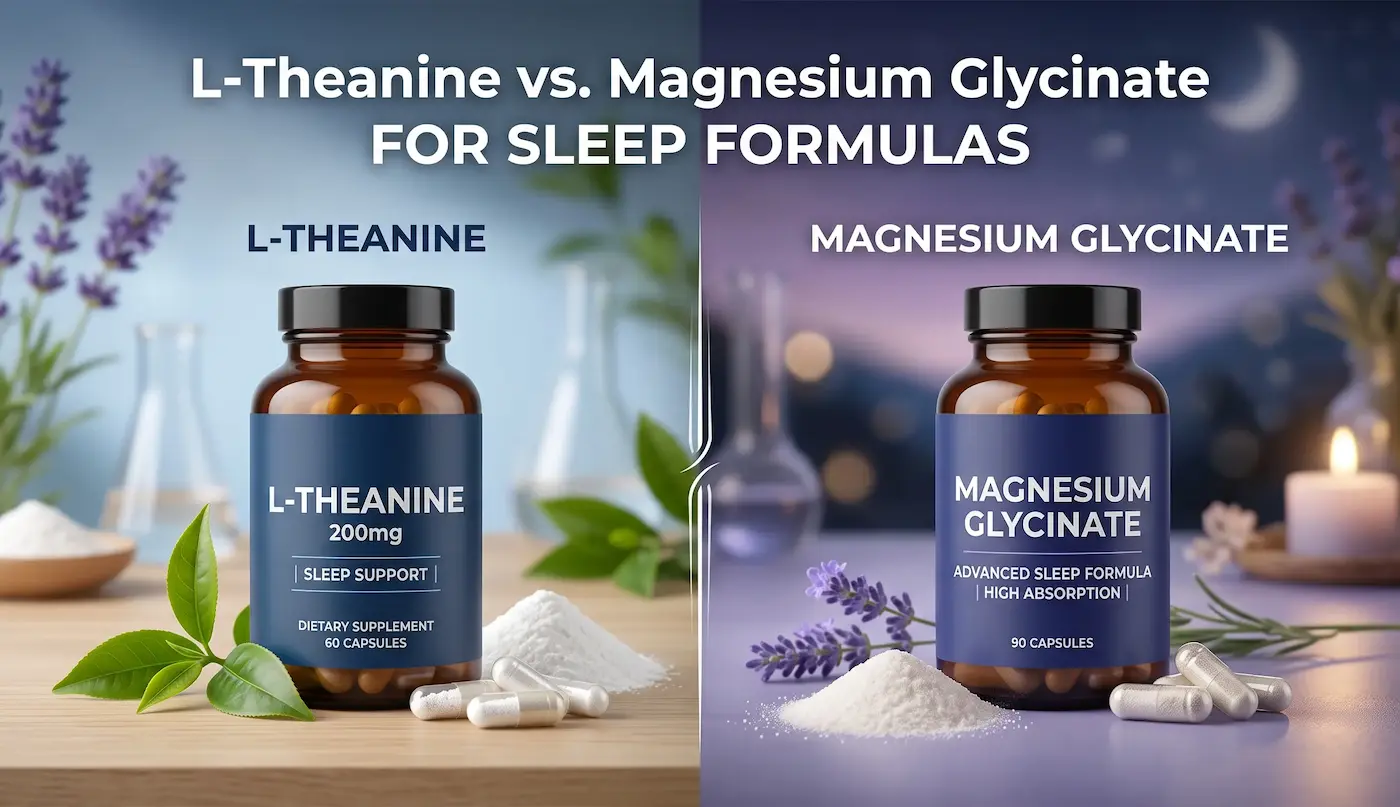
L-theanine vs magnesium glycinate is a difference of job, not a contest for one better sleep active. L-theanine is a low-bulk amino acid used when the SKU is built around evening relaxation. [1][2] Magnesium glycinate is a magnesium source specified by elemental magnesium and raw-material identity, used when the SKU is built around a nighttime mineral. [3] If you are designing a sleep support supplement, the development choice is a theanine-led formula, a magnesium-led formula, or a combination unit. They are not substitutes.
Theanine is usually the simpler active to specify. Magnesium glycinate needs the elemental target, the supplier assay, and a finished-unit capacity check. If the product concept calls for both, evaluate the combination as a fill-capacity and specification problem, not as adding two names to one formula.
L-Theanine vs Magnesium Glycinate: What’s the Difference?
L-Theanine | Magnesium glycinate | |
|---|---|---|
| Ingredient type | Amino acid [1][2] | Magnesium chelate [3] |
| Main specification | L-theanine mg + purity assay | Elemental Mg + source + assay |
| Formula role | Evening-relaxation positioning | Nighttime mineral positioning |
| Fill burden | Usually lower | Usually higher |
| Capsule impact | Usually modest | Can set capsule count |
| Best suited to | Theanine-led formulas | Magnesium-led formulas |
| Can they combine? | Yes, as a planned dual-active SKU | Yes, as a planned dual-active SKU |
| Main RFQ risk | Unnamed assay or “theanine blend” | Salt weight treated as elemental Mg |
Which formula does each fit? A relaxation-led line specifies L-theanine first. A mineral-led line specifies magnesium glycinate by source and elemental milligrams. A dual-ingredient story specifies both — and then checks whether one capsule can carry the mineral fill.
What the Evidence Does — and Does Not — Establish
L-theanine has been studied in relation to relaxation and stress; some of that literature also reports sleep-related outcomes, and those studies remain limited. [2] Magnesium is an essential mineral with form-specific absorption and gastrointestinal profiles. That is not equivalent to a formulation-specific sleep claim for magnesium glycinate. [3]
A manufacturing specification should not automatically become a finished-label efficacy claim. Structure/function language stays with brand-owner counsel.
How L-Theanine and Magnesium Glycinate Are Specified
L-Theanine: assay and active weight
A theanine quote should state milligrams of L-theanine and a purity assay, and name the actual raw material rather than a generic “theanine blend.” [1][2] Branded grades print only with a license the brand owner holds. A 100–200 mg band, if used, is a formulation-comparison reference only — not a recommended intake.
Magnesium glycinate: salt identity and elemental magnesium
A magnesium quote should state the source, chelate identity, and elemental milligrams — not salt weight alone. [3] “500 mg glycinate” is not 500 mg magnesium. For U.S.-style Supplement Facts, the declared amount is elemental magnesium; the manufacturing specification should still name the source and assay basis. [3]
“Magnesium glycinate” and “magnesium bisglycinate” are often used interchangeably in commerce, but two drums are not equivalent solely because both say “glycinate.” Trade-name mapping sits on the glycinate naming guide. A magnesium-only bottle is quoted as a finished magnesium unit.
If the commercial specification requires a defined chelate identity — for example a fully reacted material rather than a buffered or oxide-containing blend — that requirement belongs on the raw-material line. It is a specification distinction, not an efficacy ranking.
Can L-Theanine and Magnesium Glycinate Be Used Together?
They can share one finished sleep-support unit. If both actives appear on that unit, specify both on the bill of materials and on the Supplement Facts basis before artwork is approved. Whether they fit one capsule is a fill-capacity question, not a yes from the two names.
Three Formula Paths for an OEM Sleep SKU
Formula path | Best fit | Main specification risk | Main manufacturing issue |
|---|---|---|---|
| Theanine-led | Relaxation-led SKU | Theanine assay / unnamed blend | Low fill burden |
| Magnesium-led | Mineral-led SKU | Elemental Mg basis | Higher fill; capsule count |
| Combination | Dual-active SKU | Both active bases named | Capsule capacity after the mineral fill |
Theanine-led
Use when: The product line is evening calm without a mineral-bulk story.
Specify: L-theanine identity and assay.
Trade-off: No elemental-magnesium line. A “plus magnesium” footnote without salt and elemental yield makes quotes incomparable.
Default format: Capsule. Gummy only if the finished piece still carries the assay after the cook.
Magnesium-led
Use when: The product is a nighttime magnesium unit.
Specify: Source, chelate identity, and elemental target.
Trade-off: Salt bulk often forces two capsules or a tablet.
Default format: Capsule or tablet. Stick when the serving is a drink with other gram-level powders.
Combination
Use when: The lineup already sells “theanine + magnesium,” or the brief names both actives on one panel.
Specify: Theanine assay plus magnesium source, chelate identity, and elemental target.
Trade-off: Theanine is compact. The elemental magnesium target from a glycinate source usually sets the fill.
Default format: Capsule. Tablet when the mineral wins the weight.
Why Capsule Capacity Can Change the Formula
In OEM feasibility reviews, the elemental magnesium target is checked against the selected raw material’s COA, elemental assay, bulk density, and intended capsule fill before the final capsule count is locked.
Required raw-material weight ≈ target elemental magnesium ÷ elemental-magnesium assay.
For example, if the selected raw material COA specifies 14% elemental magnesium, a 100 mg elemental target requires roughly 714 mg of that raw material before overage, theanine, or other components. That is a math example from one COA, not a catalog dose and not an assay guarantee for every glycinate grade. Materials with a lower elemental percentage need more salt weight for the same elemental target.
A size-00 capsule is only a first feasibility reference. Combining a compact theanine milligram with that mineral fill often exceeds one shell. The project then moves to two capsules or a tablet — or the elemental target is lowered. Write the capsule count you will accept before artwork.
What to Put in the RFQ
Step | L-Theanine | Magnesium glycinate |
|---|---|---|
| 1. Identity | L-theanine | Glycinate or bisglycinate, plus the actual grade |
| 2. Active basis | mg L-theanine | Elemental magnesium mg |
| 3. Raw material | Assay / purity | Chelate identity + elemental assay |
| 4. Fill impact | Low | Higher — see the back-calculation above |
| 5. Finished format | Capsule or gummy | Capsule, tablet, or powder / stick |
| 6. COA / testing | Identity, assay, metals, micro, method | Identity, elemental Mg, metals, micro, method |
| 7. Destination market | Country class; claim file stays with the brand owner | Same, plus whether a mineral-only artwork is required |
| 8. Quote comparison | Active mg + assay + COA | Elemental Mg + source + assay + COA |
The finished pair, when both actives are locked on one unit, is the L-theanine + magnesium SKU.
For an OEM quote, send the target active amounts, raw-material basis, format, capsule count, and destination market. KS Nutripharma can review the specification and return a manufacturing-feasibility assessment.
Send a theanine and magnesium specification
Why Two “500 mg Magnesium Glycinate” Quotes May Not Be Equivalent
Cost per gram of salt is not cost per milligram of magnesium. [3]
A “500 mg magnesium glycinate” line can mean 500 mg of salt, 500 mg elemental magnesium, or an undeclared mix of the two. Two COAs that both say “glycinate” still diverge when the elemental percentages differ, when one material is a buffered blend and the other a defined chelate, or when the methods are not the same. Line up identity, elemental milligrams, assay basis, and the COA method before the prices are compared.
FAQ
Which is better for sleep, L-theanine or magnesium glycinate?
Neither is a default “better” sleep active. For product development: choose L-theanine when the SKU is evening relaxation; choose magnesium glycinate when the SKU is a nighttime mineral; choose both when the panel must carry the two names and the fill still works. Suitability for a particular person is a separate health question.
Can you take L-theanine and magnesium glycinate together?
They can be formulated in the same sleep-support product. They do different jobs. One unit or two SKUs is a fill-capacity and artwork decision.
Does magnesium glycinate contain L-theanine?
No. Magnesium glycinate is a magnesium source. L-theanine is an amino acid. Glycine in the chelate is not L-theanine.
Is magnesium glycinate the same as bisglycinate?
The names are often used interchangeably in commerce, but the supplier specification should still identify the actual raw material and its elemental magnesium content.
What is the difference between magnesium glycinate weight and elemental magnesium?
Magnesium glycinate weight is the mass of the magnesium-containing raw material. Elemental magnesium is the magnesium contribution declared for the finished product. [3] The two values are not interchangeable and should be specified separately in an OEM brief.
Why do some sleep-support formulas use magnesium glycinate instead of oxide?
Oxide and citrate are different specifications, with different elemental contributions and market positioning. [3] Nighttime lines that already shop “glycinate” will not accept a silent oxide swap on the same label.
Can L-theanine and magnesium glycinate be in the same capsule?
Sometimes. Fit depends on the elemental magnesium target, the selected COA assay, bulk density, and excipients. A size-00 shell is only a first check.
What if I only want one ingredient to test the market?
Name the primary active. A magnesium test SKU needs salt identity and an elemental target. A theanine-led test SKU needs identity and assay. Adding the second active later is a new bill of materials and usually new artwork.
Related Sleep Product Lines
- L-Theanine Supplements
- Magnesium Bisglycinate Manufacturer
- L-Theanine + Magnesium Supplement Manufacturer
Technical and Regulatory References
- National Center for Biotechnology Information. L-Theanine. PubChem CID 439378.
- Türközü D, Şanlier N. L-theanine, unique amino acid of tea, and its metabolism, health effects, and safety. Crit Rev Food Sci Nutr. 2017;57(8):1681-1687. PubMed · DOI Review discusses relaxation-related research and notes that sleep-quality studies are limited.
- National Institutes of Health, Office of Dietary Supplements. Magnesium — Health Professional Fact Sheet.
Disclaimer: Wholesale / brand manufacturing and product-development reference only. Not intended to diagnose, treat, cure, or prevent any disease. Dietary supplements are not drugs. Structure/function language, ingredient status, and product classification vary by country. Brand owners remain responsible for finished-label compliance with local counsel. KS Nutripharma provides manufacturing feasibility and documentation support — not legal approval. Milligram figures and formula examples are development references, not recommended intakes or catalog guarantees.