Disclaimer: This article is for B2B ingredient education, procurement, and product-development guidance. It does not diagnose, treat, cure, or prevent any disease. Structure/function language must be adapted to applicable regulatory requirements in each target market.
Introduction
If you are comparing magnesium bisglycinate and magnesium glycinate for a private-label or OEM launch, the real question is not which synonym sounds better on a sales sheet. It is whether the material you buy can support label math, GI-tolerance storytelling, capsule count, and audit-ready documentation. For brands evaluating magnesium bisglycinate supplements manufacturing options, this guide explains how the two names relate chemically, how fully reacted and buffered grades differ commercially, and what procurement and formulation teams should verify before locking a SKU.
Brand buyers usually need clear answers to four questions:
- Are magnesium glycinate and magnesium bisglycinate the same ingredient?
- Why do elemental magnesium percentages vary so widely on COAs?
- What does buffered vs. fully reacted change for labeling, cost, and consumer experience?
- How do you verify that a chelated material is not mainly a physical blend with magnesium oxide?
Why This Comparison Matters for Supplement Brands
Demand is rising in sleep, stress and emotional wellness, women’s wellness, and sports recovery. At the same time, marketplace confusion between magnesium glycinate and magnesium bisglycinate is increasing. Ingredient terminology directly affects:
Decision area | Why terminology matters |
|---|---|
| Formulation feasibility | Elemental % drives capsule count, gummy dose load, and powder serving size |
| Regulatory labeling | Source naming, buffered oxide disclosure, and retailer audit readiness |
| Cost structure | Cost per mg elemental Mg vs. cost of premium positioning |
| Product positioning | Commodity mineral vs. premium chelated sleep / calm hero |
Quick Procurement Comparison: Fully Reacted vs. Buffered vs. Oxide
Metrics | Fully Reacted Bisglycinate | Buffered Bisglycinate (with MgO) | Magnesium Oxide (Dry Blend) |
|---|---|---|---|
| Elemental Mg % | ~10%–14% (lower) | ~18%–30%+ (mid–high) | ~60% (very high) |
| Capsule load for ~200 mg elemental Mg | Often 2–3 capsules | Often 1–2 capsules | Often 1 capsule |
| GI tolerance narrative | Excellent for premium gentle positioning | Medium (depends on MgO contribution) | Weaker (higher laxative association) |
| Labeling/audit risk | Low when analytics support true chelate | High if MgO is undisclosed | Low as commodity inorganic salt |
| Cost per mg elemental Mg | Higher | Moderate | Very low |
| Best SKU fit | Premium sleep / stress hero | Value / high-dose efficiency twin | Basic low-price mineral SKUs |
Procurement takeaway: do not compare these materials on cost per kg alone. Compare cost per mg elemental magnesium, then add capsule-shell cost, expected return or complaint risk, and whether your packaging story can support the claim.
For evening stack planning with L-theanine, see also the L-Theanine + Magnesium private label formula page.
What Is Magnesium Glycinate?
Definition and Chemical Structure
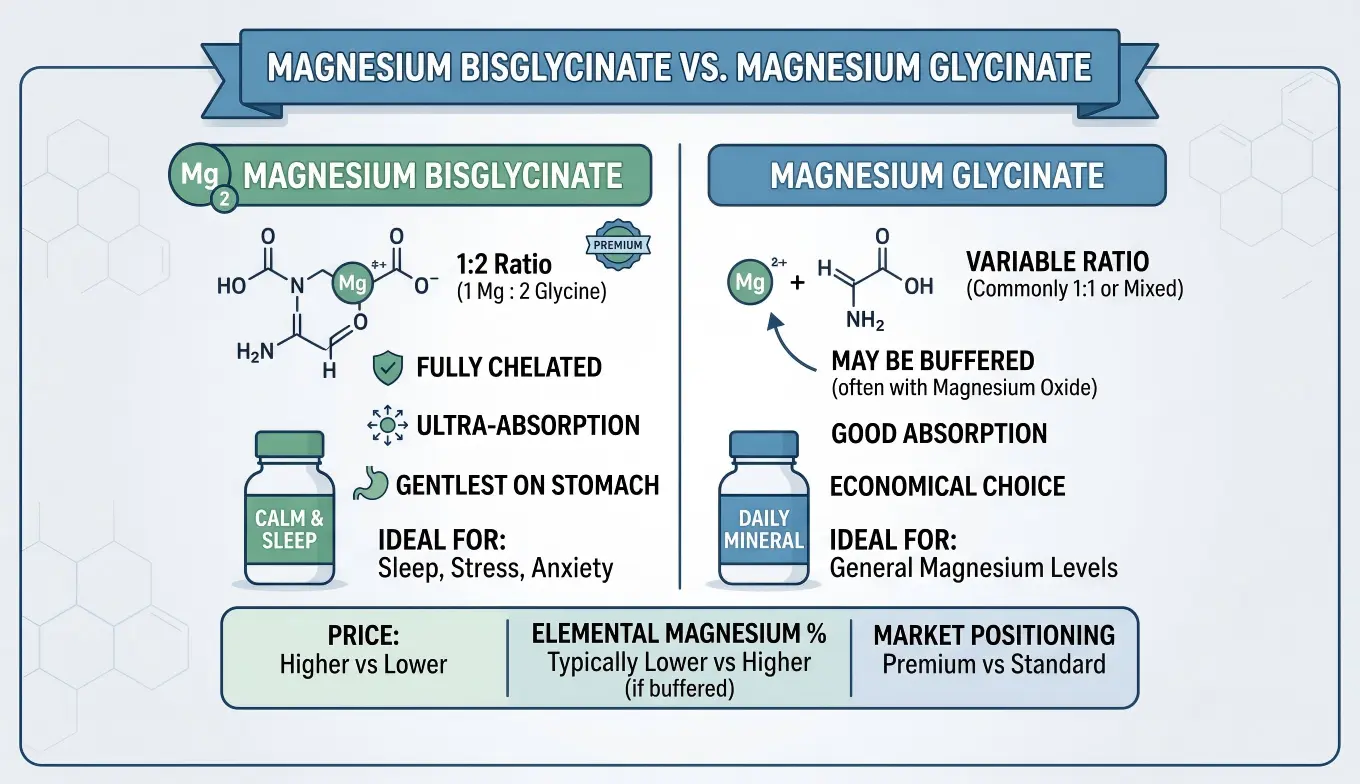
In commercial supplement language, magnesium glycinate typically refers to magnesium bound to the amino acid glycine. The intended structure is a magnesium–glycine chelate, often described as a 1:2 magnesium-to-glycine relationship when fully chelated.
Chemically, the more specific name for that 1:2 chelate is magnesium bisglycinate (also called magnesium diglycinate). In trade practice, however, magnesium glycinate functions as a broad commercial umbrella. It may describe:
- Fully reacted magnesium bisglycinate chelate
- Partially chelated systems
- Buffered complexes containing additional inorganic magnesium sources (commonly magnesium oxide)
- Proprietary blends marketed under glycine-chelate naming
For OEM documentation, treat glycinate as a category label, not as analytical proof of full chelation.
Commercial Forms Available on the Market
Magnesium Glycinate Complex
A general trade description that may include chelated magnesium glycinate plus free glycine, processing aids, or other magnesium salts. Useful as a mid-tier ingredient when price and elemental yield matter more than strict, fully reacted storytelling.
Buffered Magnesium Glycinate
Often engineered to increase elemental magnesium percentage and reduce serving size or cost by combining a glycinate fraction with a higher-elemental inorganic source (frequently magnesium oxide). Strong for cost-optimized formulas; weaker for premium gentle chelate positioning if oxide contribution is material and undisclosed.
Fully Reacted Chelated Magnesium Glycinate
Material intended to represent a completed chelation reaction with a defined Mg: glycine relationship and lower reliance on physical blending with oxide. This is the specification lane most brands want when they lead with true chelate, GI comfort, and premium sleep or stress messaging.
Typical Elemental Magnesium Content
Commercial type (illustrative) | Typical elemental Mg range | Procurement Note |
|---|---|---|
| Fully reacted bisglycinate-type | ~10–14% | Lower elemental %; higher compound weight per dose |
| Mid-range glycinate complexes | ~12–20% | Confirm composition breakdown |
| Buffered / high-elemental systems | ~18–30%+ | Often includes non-glycinate Mg sources |
Critical labeling rule: 1,000 mg magnesium glycinate / bisglycinate is not equal to 1,000 mg elemental magnesium. Supplement Facts panels should declare elemental magnesium, with the source named according to market rules.
Advantages and Limitations
Advantages:
- Broad supplier availability and familiar consumer search language (magnesium glycinate)
- Flexible cost architecture across buffered and fully reacted grades
- Strong fit for sleep, stress, women’s, and daily magnesium SKUs
Limitations:
- Naming alone does not guarantee full chelation
- Wide elemental-Mg variability complicates dose math and COGS comparison
- Buffered systems may weaken premium GI-tolerance storytelling if oxide is significant
- Requires stronger QA diligence than single-salt commodity minerals
What Is Magnesium Bisglycinate?
Definition of True Magnesium Bisglycinate
Magnesium bisglycinate is the more chemically specific name for magnesium chelated with two glycine ligands (Mg:glycine ≈ 1:2). In B2B procurement, this term is increasingly used when brands want to signal a defined chelate structure, not merely a glycine-associated magnesium blend.
Related trade synonyms on supplier sheets:
- Magnesium bisglycinate
- Magnesium diglycinate
- Magnesium bisglycinate chelate
- Fully reacted magnesium glycinate (when supported by process and analytics)
Why Bis Indicates a Fully Chelated Structure
The prefix bis- (and the synonym di-) indicates two glycine molecules associated with one magnesium ion. That stoichiometry is the chemical rationale behind premium amino-acid chelate positioning.
However, name is not certificate. A product can be labeled bisglycinate while still containing:
- Incomplete reaction products
- Free glycine
- Residual or intentionally added magnesium oxide
- Physical blends designed to hit a target elemental percentage
Purchasing decisions should rest on reaction completeness, analytical evidence, and composition disclosure, not the presence of bis in the trade name.
Fully Reacted vs. Partial Chelation
Attribute | Fully reacted | Partial/buffered systems |
|---|---|---|
| Intended chelation | High / defined | Variable |
| Oxide contribution | Typically minimized / disclosed if present | Often used to raise elemental % |
| Premium story fit | Strong | Medium to weak |
| Elemental Mg % | Usually lower | Usually higher |
| Dose volume | Larger compound weight | Smaller compound weight |
| Cost per serving (same elemental target) | Higher | Lower |
For private-label brands selling gentle, highly absorbable magnesium, fully reacted material is usually the safer brand-risk choice. For value twin SKUs or high-elemental capsule efficiency, buffered systems can be commercially rational if labeling and retailer documentation remain accurate.
Typical Specifications and Elemental Magnesium Range
Commercial fully reacted magnesium bisglycinate materials commonly fall around approximately 10–14% elemental magnesium, depending on hydration state, residual free glycine, and supplier process. Always confirm:
- Elemental magnesium assay method and result
- Moisture / loss on drying
- Identity tests
- Heavy metals (Pb, As, Cd, Hg)
- Microbiology
- Fully reacted vs. buffered statement
- Any branded chelate trademark requirements, if applicable
Related manufacturing context: Magnesium Bisglycinate Supplements Manufacturing.
Magnesium Glycinate vs. Magnesium Bisglycinate: Are They Actually Different?
In most commercial supplement contexts, magnesium glycinate, magnesium bisglycinate, and magnesium diglycinate are used as near-synonymous trade names for magnesium chelated with glycine.
The practical difference is not two unrelated minerals. The practical difference is specificity and quality control:
- Glycinate = broader commercial category
- Bisglycinate = more specific structural claim (1:2 chelate), often used for premium positioning
Two COAs can both say glycinate / bisglycinate and still describe materials with very different chelation completeness, oxide content, elemental yield, and finished-product behavior.
Chemical Comparison Table
Parameter | Magnesium Glycinate | Magnesium Bisglycinate |
|---|---|---|
| Terminology | Broad commercial term | Specific chemical structure claim |
| Chelation ratio | Variable | Intended Mg:Gly = 1:2 |
| Chelation degree | Partial or full | Usually marketed as fully chelated |
| Elemental Mg (typical commercial range) | ~12–30% (form-dependent) | ~10–14% (fully reacted lane) |
| Market position | Mainstream / flexible | Premium / specification-led |
| Label risk if poorly specified | Higher (umbrella naming) | Lower only if analytics match the name |
Why Ingredient Names Cause Market Confusion
- Different supplier naming conventions: one factory’s glycinate is another’s bisglycinate chelate.
- Marketing terminology versus analytical specifications: front-of-pack language can outrun COA detail.
- Ingredient branding effects: branded chelates and proprietary complexes raise education burden and documentation requirements.
Buyer rule: compare materials on composition, analytics, and elemental math, not synonym preference alone.
Regulatory and Labeling Considerations
United States
In the U.S., magnesium compounds used in dietary supplements must be handled as dietary ingredients with truthful labeling. Practical checkpoints:
- Identity and source naming on Supplement Facts / ingredient statements should match the purchased specification
- Elemental magnesium should be declared correctly; compound weight should not mislead consumers about mineral content
- Manufacturing should comply with dietary supplement CGMP (21 CFR Part 111)
- Structure/function claims require substantiation and appropriate disclaimer language where required
- If marketing language implies a pure chelate story, buffered oxide content creates claim/label consistency risk
GRAS/food-additive status for specific magnesium salts and uses should be confirmed for the intended application and jurisdiction.
European Union
In the EU, mineral substances used in food supplements are governed by permitted mineral-source lists and related legislation. Magnesium bisglycinate is among the mineral forms listed under EU food-supplement source amendments (see Commission Regulation (EC) No 1170/2009 amending Directive 2002/46/EC).[14][15] Brand teams should confirm:
- Whether the specific magnesium source is permitted for food supplements in the target market
- How the mineral is named on-pack
- Whether EFSA-authorized magnesium health claims will be used, and under which conditions of use[11][12][13][16]
Glycinate vs. bisglycinate naming should be aligned with the authorized or declared source identity in your dossier.
Label Compliance Risks
Common audit and marketplace failure modes:
- Buffered products containing MgO marketed as if they were 100% amino-acid chelate, without adequate disclosure
- Elemental magnesium ambiguity: advertising compound milligrams as if they were elemental milligrams
- Amazon/retailer audit gaps: missing COA details, incomplete heavy-metal panels, or inconsistent identity language
- International dossier mismatch: U.S. synonym accepted commercially but EU source naming not aligned
Does Magnesium Bisglycinate Have Better Absorption?
Bioavailability Compared with Magnesium Oxide
Magnesium oxide is inexpensive and high in elemental magnesium percentage, but it is widely regarded as a lower-bioavailability, lower-tolerance option for many premium consumer use cases. That commercial reality is why brands migrate sleep and stress heroes toward chelated glycine forms.
Authoritative nutrient background is summarized by the NIH Office of Dietary Supplements Magnesium Fact Sheet for Health Professionals.[1][2]
| Form | Commercial absorption narrative | GI comfort narrative | Best commercial use |
|---|---|---|---|
| Magnesium oxide | Low / commodity | Often weak | Cost, buffering, high elemental % |
| Magnesium citrate | Moderate / familiar | Dose-dependent | Digestion-oriented / value powders |
| Magnesium bisglycinate | High / premium chelate | Generally strong positioning | Sleep, stress, women’s, daily premium Mg |
Evidence Supporting Chelated Magnesium Forms
Chelated magnesium forms are commercially preferred because amino-acid chelation is intended to improve mineral stability and gastrointestinal handling characteristics relative to poorly soluble inorganic salts. Literature on magnesium salts shows that form matters for solubility, tolerability, and fractional absorption, though effect sizes and study designs vary.[3][4][5][6]
A specialized diglycinate (bisglycinate) comparison versus magnesium oxide in patients with ileal resection reported better absorption in the most absorption-impaired subgroup and better tolerance overall, supporting a commercial rationale for chelated glycine forms in sensitive GI contexts—while still not proving universal superiority in every healthy population.[6]
A 2025 randomized, placebo-controlled trial of magnesium bisglycinate (250 mg elemental magnesium/day) in adults reporting poor sleep found a modest but statistically significant improvement in Insomnia Severity Index scores versus placebo (small effect size). This supports sleep-category commercial interest, not disease-treatment claims.[7]
For brand communication:
- Prefer comparative formulation rationale over absolute disease or superiority medical claims
- Cite authoritative nutrient references (NIH ODS) for magnesium’s established nutritional roles[1]
- Keep clinical language proportionate to the strength of available human data on the specific salt and dose you use
- In the EU, authorized magnesium health-claim wording (for example, contribution to normal psychological function and normal functioning of the nervous system) must follow EFSA / EU Register conditions of use[11][12][13][16]
Limitations of Existing Human Studies
- Many magnesium studies use different salts, doses, populations, and endpoints
- Better absorbed is not a blank check for every bisglycinate SKU on the market
- Product matrices, co-ingredients, and individual magnesium status all influence outcomes
- Supplier process quality can make two bisglycinate materials behave differently
Analytical verification and finished-product experience (reviews, GI complaint rates, repurchase) matter as much as ingredient category selection.
GI Tolerance and Consumer Compliance Advantages
A major commercial reason brands switch to bisglycinate is consumer compliance: shoppers abandon magnesium products that cause digestive discomfort.
Tolerance still depends on:
- Elemental dose per serving
- Whether the system is buffered with oxide
- Formula matrix and co-ingredients
- Individual sensitivity
If creative promises gentle or easy on the stomach, an oxide-heavy buffered system creates brand risk even if the front label says glycinate or bisglycinate.
Buffered vs. Fully Reacted Magnesium Bisglycinate
Buffered Magnesium Bisglycinate
Advantages:
- Higher elemental magnesium percentage
- Smaller serving size / fewer capsules for the same elemental target
- Lower formulation cost per mg elemental magnesium
Disadvantages:
- Reduced premium true chelate positioning
- Potentially lower overall chelation ratio
- Higher scrutiny in retailer, Amazon, and practitioner channels if oxide is material
Best fit: value twin SKUs, high-dose convenience formulas, and cost-sensitive mass retail architectures when disclosure and documentation are clean.
Fully Reacted Magnesium Bisglycinate
Advantages:
- Stronger premium ingredient positioning
- Better stomach-tolerance perception for sleep/stress brands
- Higher marketing and education value
- Cleaner alignment with amino acid chelate storytelling
Disadvantages:
- Lower elemental magnesium percentage
- Larger dosage volume / more capsules or powder grams
- Higher production cost for the same elemental target
Best fit: premium sleep, stress, women’s wellness, practitioner-adjacent, and subscription brands where perceived quality and GI comfort protect AOV and reviews.
Cost per mg of Elemental Magnesium Comparison
Parameter | Buffered | Fully Reacted |
|---|---|---|
| Elemental Mg % | Higher | Lower |
| Cost per serving (same elemental target) | Lower | Higher |
| Capsule count | Lower | Higher |
| Premium positioning | Medium | High |
| Claim/story risk | Higher if oxide undisclosed | Lower when analytics support the name |
| Best commercial role | Value/efficiency SKU | Hero Premium SKU |
Compare cost per mg elemental magnesium, not cost per kg of raw material alone. Then overlay capsule count, premium price architecture, and expected return or complaint risk.
How to Verify True Magnesium Bisglycinate Quality
Procurement QA Four-Step Method
Step 1: Check Elemental Mg % on the COA
Review the COA elemental magnesium assay first.
- Fully reacted commercial bisglycinate materials commonly fall around ~10–14% elemental Mg
- If a supplier labels a material as 100% magnesium bisglycinate while elemental Mg is above ~14–15%, the input is highly likely to include inorganic magnesium (often MgO) as a buffer or blend
Step 2: Request a Supplier Statement on Fully Reacted vs. Buffered
Require a written supplier statement that answers:
- Is the material fully reacted?
- Is magnesium oxide added?
- If yes, what approximate share of elemental magnesium comes from MgO?
Without this disclosure, brands face elevated Amazon and retailer audit risk from hidden buffering.
Step 3: Compare FTIR and XRD Spectra
- FTIR: look for spectral support consistent with metal–ligand (Mg–glycine) coordination versus a simple physical mixture of inorganic salt plus free glycine
- XRD: check for crystalline signatures associated with unreacted MgO or other inorganic phases that should be absent or disclosed in a true fully reacted chelate
FTIR/XRD are supportive evidence, not a standalone certificate of 100% chelation. They are still far stronger than marketing PDFs with no spectra.
Step 4: Run a Lab Solubility / Turbidity Screen
Under matched concentration, pH, temperature, and agitation:
- Fully reacted materials often produce a relatively clearer solution
- High-MgO buffered systems more often show turbidity or sediment
Solubility depends on particle size, pH, temperature, agitation, and concentration. Use it as a triage screen, never as the sole identification method.
QA warning: never select magnesium only by cost per kg. Calculate cost per mg of elemental magnesium, then include multi-capsule shell cost, packaging bulk, and expected return or complaint risk in true COGS.
Supplier Documentation Checklist
Document/data | Why it matters |
|---|---|
| COA (identity, assay, contaminants) | Baseline release and lot control |
| Elemental magnesium specification | Dose math and label accuracy |
| Fully reacted vs. buffered statement | Positioning and claim risk |
| Composition breakdown (incl. MgO if present) | Prevents silent buffering |
| Chelation percentage/process description | Separates reaction from blend |
| FTIR reports | Analytical support for chelation identity |
| XRD reports (where relevant) | Detects inorganic phases / blends |
| Heavy metal testing (Pb, As, Cd, Hg) | Retailer / Amazon / export readiness |
| Microbiology | CGMP and finished-goods risk control |
| Stability/compatibility data | Capsule, gummy, powder feasibility |
| Third-party analytical reports | Independent verification for audits |
| Channel-required panels (allergen, residual solvents, pesticides) | Market-specific dossier needs |
If a supplier cannot answer whether magnesium oxide is added with a clear yes/no and approximate contribution, treat the material as commercially undefined, not as a premium chelate.
Manufacturing Challenges and Formulation Considerations
Low Elemental Magnesium Creates Formulation Constraints
Example target: 200 mg elemental magnesium.
Depending on elemental percentage, this may require:
- Large capsule size
- Multiple capsules per serving
- Powder / stick-pack formats instead of a single elegant capsule
- Lower elemental targets in gummies (commonly ~30–100 mg elemental per piece or per serving, format-dependent)
200 mg elemental magnesium bisglycinate in one tiny capsule is often unrealistic unless the material is buffered or the brand accepts trade-offs.
Dosage-Form Feasibility: Challenges and Solutions
Capsules
- Challenges: low bulk density, poor flowability, and low elemental % increase capsule count and slow high-speed encapsulation.
- Practical solutions: wet granulation/particle engineering to improve flow and bulk density; validated blend uniformity; a transparent 2 capsules/day serving for fully reacted ~200 mg elemental sleep/stress heroes is usually more credible than forcing a one-capsule claim.
- Factory planning reference at KS Nutripharma: up to 5,000,000 capsules/day; typical capsule MOQ 5,000 units; lead time 4–6 weeks.
Tablets
- Challenges: chelated magnesium powders often show high elastic recovery; direct compression can lead to capping, low hardness, or friability failures.
- Practical solutions: prefer DC-grade magnesium bisglycinate / glycinate with an optimized binder/lubricant system; confirm compressibility data before artwork lock.
- Factory planning reference: tablet capacity 12+ million tablets/day; typical tablet MOQ 10,000 units; lead time 4–6 weeks.
Gummies
- Challenges: elemental magnesium dose load is limited (often roughly 30–50 mg elemental per gummy in many commercial builds), and glycine chemistry can affect gel structure and flavor.
- Practical solutions: taste-masking and acid-system control; realistic per-piece dose design for kids calm or adult sleep-support gummies; moisture and texture engineering for shelf life.
- Factory planning reference: up to 2,000,000 gummies/day; typical gummy MOQ 10,000 units; lead time 6–8 weeks.
Stick Packs and Functional Beverage Powders
- Challenges: dissolution speed and solution clarity matter, especially for bedtime drink concepts. Buffered high-MgO systems may look cloudy.
- Practical solutions: micronized / instant-dissolve fully reacted options where sensory requires clarity; fruit-powder flavor systems to mask mineral aftertaste; moisture-barrier packaging.
- Factory planning reference: powder MOQ from 2,000 units; stick packs / sachets typical MOQ 10,000 units; lead time 5–7 weeks (powders often 3–5 weeks).
Capsule Size Challenges
Elemental Mg dose (target) | Potential Capacity Requirements (illustrative) |
|---|---|
| 100 mg | Often 1 capsule (form-dependent) |
| 200 mg | Often 2 capsules |
| 300 mg | Often 2–3 capsules |
Actual fill capacity depends on elemental %, bulk density, excipients, capsule shell type (gelatin vs. HPMC), and whether the formula includes L-theanine, botanicals, or other actives.
For stack feasibility with theanine, see L-Theanine + Magnesium Private Label Formula and L-Theanine Supplements.
Taste Masking Considerations
Especially important for:
- Gummies: dose load, metallic/mineral notes, and glycine sweetness interactions
- Stick packs: dissolution clarity expectations vs. buffered turbidity
- Functional beverages: acid system, flavor architecture, and stability
Which Magnesium Form Is Better for Different Product Categories?
Sleep Supplements
Preferred form: fully reacted magnesium bisglycinate / glycinate.
Formula example (commercial benchmark):
Ingredients | Typical directional dose |
|---|---|
| Magnesium Bisglycinate | ~200 mg elemental Mg |
| L-Theanine | 100–200 mg |
| Apigenin | ~50 mg (optional) |
| Vitamin B6 (P5P) | 5–10 mg |
| Optional melatonin | 1–3 mg where permitted |
Related: L-Theanine + Magnesium Formula · Cognitive & Mental Health
Stress and Mood Products
Preferred form: fully reacted bisglycinate as the mineral core.
Ingredients | Typical directional dose |
|---|---|
| Magnesium Bisglycinate | ~200 mg elemental Mg |
| Ashwagandha (e.g., KSM-66-type or equivalent) | ~300 mg |
| Saffron extract | ~28–30 mg |
| Vitamin B6 | 5–10 mg |
Related: Ashwagandha Supplements · Saffron Supplement Manufacturer
Women’s Wellness Products
Preferred form: bisglycinate for daily comfort and premium women’s positioning.
Ingredients | Typical directional dose |
|---|---|
| Magnesium Bisglycinate | ~200–250 mg elemental Mg |
| Vitamin B6 | ~10 mg |
| Saffron extract | ~28 mg |
| Vitamin D3 | market-dependent |
Related: Women’s Wellness Supplements · Beauty Supplements
Sports Recovery Products
Preferred form: bisglycinate for gentle daily recovery; citrate or malate may appear in complexes or daytime active SKUs.
Ingredients | Typical directional dose |
|---|---|
| Magnesium Bisglycinate | ~200 mg elemental Mg |
| Potassium citrate | ~150 mg (elemental K target as specified) |
| Taurine | ~500 mg |
| Coconut water powder | ~500 mg |
Powders and stick packs usually outperform multi-capsule servings in this lane.
Magnesium Bisglycinate vs. Other Premium Magnesium Forms
Magnesium L-Threonate
Best for: cognitive support / brain-health positioning.
Limitations: very high cost; lower elemental magnesium efficiency; heavier education burden; gummy feasibility often constrained.
Commercial tip: use bisglycinate as the calm/sleep foundation and add threonate only when cognition is a primary SKU job. Related: Focus Supplements · Cognitive & Mental Health
Magnesium Malate
Best for: energy support, muscle comfort, daytime active-lifestyle formulas.
Role vs. bisglycinate: malate for day/active; bisglycinate for night/calm. Triple-magnesium complexes often include both.
Magnesium Citrate
Best for: digestion-adjacent mineral products and familiar drink-mix systems.
Limitations: higher laxative potential at elevated doses; weaker premium sleep/chelate story than bisglycinate for many brands.
Why Bisglycinate Remains the Leading Choice for Sleep and Relaxation
- Gentle GI profile narrative
- Strong consumer awareness around magnesium glycinate for sleep
- Premium positioning without threonate-level COGS
- Broad formulation flexibility across capsules, powders, stick packs, and dose-permitting gummies
- Excellent compatibility with L-theanine, lemon balm, apigenin, tart cherry, saffron, and ashwagandha stacks
Market Trends Driving Magnesium Bisglycinate Demand
Growth of Sleep Supplements
Sleep remains one of the most commercially durable wellness categories. Brands are expanding beyond melatonin-only SKUs into melatonin-free or melatonin-optional stacks where magnesium plus L-theanine is now a mainstream architecture.
Women’s Wellness Expansion
Women’s search behavior around magnesium for PMS, cycle comfort, menopause-adjacent wellness, and evening calm is creating specialized SKUs. See Women’s Wellness Supplements.
Functional Beverage Opportunities
Bedtime drink mixes, beauty-sleep powders, and stick-pack evening rituals are pulling magnesium out of the capsule aisle. This increases demand for sensory-capable bisglycinate systems and clear buffered-vs.-fully-reacted decisions.
Premium Mineral Trend
Shoppers are upgrading away from poorly tolerated oxide-led products. High-absorption and gentle magnesium are now conversion language, not niche practitioner jargon.
Increasing Demand for Chelated Minerals
Chelated minerals support cleaner premium storytelling and higher AOV. The market’s next maturity stage is verification: brands and auditors increasingly ask for proof of chelation, not only chelate vocabulary.
Questions Every Brand Should Ask a Magnesium Supplier
- Is the ingredient fully reacted?
- Is magnesium oxide added? If yes, at what approximate contribution?
- What is the actual chelation percentage/process definition you use?
- What analytical methods verify chelation (FTIR, XRD, others)?
- What is the elemental magnesium specification and assay method?
- Is DC-grade material available for tablets?
- Can you provide stability and compatibility data for my target format?
- What capsule size/capsule count is required for my target elemental dose?
- Are there regulatory source or naming restrictions in my target market (US, EU, etc.)?
- Can you support OEM customization across capsules, gummies, stick packs, and powders?
OEM and Private Label Formulation Opportunities
Sleep Formula
Magnesium bisglycinate (~200 mg elemental) + L-theanine (200 mg) ± apigenin/lemon balm / low-dose melatonin. Best formats: capsules, bedtime stick packs. Twin SKU path: L-Theanine + Magnesium Formula.
Women’s Relaxation Formula
Magnesium bisglycinate (~200–250 mg elemental) + B6 + saffron (± D3). Best formats: capsules, gummies. Related: Women’s Wellness · Saffron Manufacturer.
Stress Formula
Magnesium bisglycinate + ashwagandha + optional saffron / B6. Best formats: capsules, gummies. Related: Ashwagandha Supplements.
Kids Calm Gummies
Lower elemental magnesium targets with pediatric-appropriate design controls, flavor systems, and market-specific compliance review. Confirm age-grading, labeling, and permitted ingredients per destination market before development.
Functional Beverage Formula
Magnesium bisglycinate + glycine + tart cherry ± L-theanine for bedtime drink mixes. Decide early: fully reacted clarity expectations vs. buffered efficiency.
High-Strength Magnesium Capsule Formula
Target 200–300 mg elemental magnesium with transparent capsule-count communication. Choose buffered only if the brand architecture and disclosure strategy support it. Otherwise accept 2-capsule servings as the premium fully reacted standard.
Frequently Asked Questions
Is magnesium glycinate the same as magnesium bisglycinate?
In commercial use, they are often treated as near-synonyms for magnesium chelated with glycine. Bisglycinate is the more specific structural term (intended 1:2 Mg:glycine chelate). Purchasing decisions should still verify fully reacted vs. buffered status, elemental magnesium, and analytical support.
Which one is better absorbed?
Chelated glycine forms are generally positioned as higher-quality absorption and tolerance options than magnesium oxide for premium sleep/stress SKUs. Between glycinate and bisglycinate trade names, absorption depends more on true chelation quality and dose form than on which synonym appears on the sales sheet.
Why is magnesium bisglycinate more expensive?
Fully reacted bisglycinate typically delivers lower elemental magnesium percentage, so more compound weight is required per elemental milligram. Manufacturing a true chelate also costs more than blending high-elemental inorganic salts.
How can I identify fake or weakly chelated magnesium?
Ask for composition disclosure (including any MgO), elemental assay, fully reacted vs. buffered statements, and analytical support such as FTIR/XRD where available. Use solubility only as a secondary screen.
Why do some magnesium glycinate products contain magnesium oxide?
Oxide is commonly used to buffer or raise elemental magnesium percentage, reduce capsule count, and lower cost. That can be a valid value-SKU strategy when disclosed accurately. It becomes a problem when products are marketed as pure premium chelates without matching documentation.
How many capsules are required to deliver 200 mg magnesium?
Often two capsules for fully reacted bisglycinate systems, depending on elemental %, density, excipients, and capsule size. Buffered materials may reduce capsule count. Always calculate from elemental magnesium assay, not compound weight marketing figures.
Which form is best for sleep supplements?
For most premium sleep launches, fully reacted magnesium bisglycinate / glycinate is the default mineral core, especially in stacks with L-theanine and evening botanicals. See L-Theanine + Magnesium Private Label Formula.
Conclusion
Magnesium glycinate and magnesium bisglycinate are closely related commercial terms. Winning purchasing and formulation decisions should be based on:
- Degree of chelation (fully reacted vs. partial/buffered)
- Analytical verification methods (COA + FTIR/XRD/composition disclosure where relevant)
- Regulatory labeling requirements in each target market
- Cost per mg elemental magnesium, not cost per kg alone
- Manufacturing feasibility (capsule count, flow, DC grade, gummy/beverage sensory)
- Product positioning strategy (premium hero vs. efficiency twin SKU)
Brands that only compare ingredient synonyms keep losing margin to unclear specifications. Brands that compare chelation quality, elemental math, and format feasibility build magnesium lines that defend price, pass audits, and convert in sleep, stress, and women’s wellness.
For magnesium bisglycinate supplements manufacturing, related planning pages include:
- L-Theanine + Magnesium Private Label Formula
- L-Theanine Supplements
- Ashwagandha Supplements
- Saffron Supplement Manufacturer
- Women’s Wellness Supplements
- Cognitive and Mental Health Supplements
- Focus Supplements
- Beauty Supplements
About KS Nutripharma
This article was prepared by the KS Nutripharma formulation team for B2B brand, procurement, and product-development readers. KS Nutripharma is a nutraceutical OEM / private-label manufacturer supporting magnesium bisglycinate programs across capsules, tablets, gummies, powders, and stick packs.
Public manufacturing profile:
Metric | Specifications |
|---|---|
| Experience | 19+ years (since 2007) |
| Production bases | 5 facilities |
| Facility footprint | 81,000+ m² |
| Production lines | 12 automated lines |
| Annual capacity | 5,000+ tons |
| Capsules | 5,000,000+ / day |
| Gummies | 2,000,000+ / day |
| Softgels | 2,000,000+ / day |
| Tablets | 12+ million / day |
| R&D | 2 dedicated R&D centers |
| Workforce | 260+ professionals |
| Brand portfolio | 500+ brand partners; 4,000+ products manufactured |
| Markets | 60+ Export regions/countries |
| Certifications | FDA-registered · cGMP · ISO 9001 · ISO 22000 · HACCP · FSSC 22000 · Halal · Kosher · Non-GMO · Vegan options |
Typical dosage-form planning terms:
Form | MOQ (units) | Lead Time |
|---|---|---|
| Capsules | 5,000 | 4–6 weeks |
| Tablets | 10,000 | 4–6 weeks |
| Gummies | 10,000 | 6–8 weeks |
| Powders | 2,000 | 3–5 weeks |
| Stick Packs / Sachets | 10,000 | 5–7 weeks |
| Liquids / RTDs | 5,000 | 6–8 weeks |
| Softgels | 10,000 | 6–8 weeks |
Sampling typically 7–15 days; pilot batches 3–5 weeks. Confirm certificate package, testing scope, and lead time by project.
References
- National Institutes of Health, Office of Dietary Supplements (ODS). Magnesium — Fact Sheet for Health Professionals. https://ods.od.nih.gov/factsheets/Magnesium-HealthProfessional/
- National Institutes of Health, Office of Dietary Supplements (ODS). Magnesium — Fact Sheet for Consumers. https://ods.od.nih.gov/factsheets/Magnesium-Consumer/
- Schuchardt JP, Hahn A. Intestinal absorption and factors influencing bioavailability of magnesium—an update. Curr Nutr Food Sci. 2017;13(4):260-278. doi:10.2174/1573401313666170427162740. PMC: https://pmc.ncbi.nlm.nih.gov/articles/PMC5652077/
- Coudray C, Rambeau M, Feillet-Coudray C, et al. Study of magnesium bioavailability from ten organic and inorganic Mg salts in Mg-depleted rats using a stable isotope approach. Magnes Res. 2005;18(4):215-223. PMID: 16548135. https://pubmed.ncbi.nlm.nih.gov/16548135/
- Walker AF, Marakis G, Christie S, Byng M. Mg citrate found more bioavailable than other Mg preparations in a randomised, double-blind study. Magnes Res. 2003;16(3):183-191. PMID: 14596323. https://pubmed.ncbi.nlm.nih.gov/14596323/
- Schuette SA, Lashner BA, Janghorbani M. Bioavailability of magnesium diglycinate vs magnesium oxide in patients with ileal resection. JPEN J Parenter Enteral Nutr. 1994;18(5):430-435. doi:10.1177/0148607194018005430. PMID: 7815675. https://pubmed.ncbi.nlm.nih.gov/7815675/
- Schuster J, et al. Magnesium bisglycinate supplementation in healthy adults reporting poor sleep: a randomized, placebo-controlled trial. Nat Sci Sleep. 2025;17:2027-2040. doi:10.2147/NSS.S524348. PMID: 40918053. https://pubmed.ncbi.nlm.nih.gov/40918053/ · PMC: https://pmc.ncbi.nlm.nih.gov/articles/PMC12412596/
- U.S. Food and Drug Administration (FDA). Dietary Supplements. https://www.fda.gov/food/dietary-supplements
- U.S. Food and Drug Administration (FDA). Current Good Manufacturing Practice in Manufacturing, Packaging, Labeling, or Holding Operations for Dietary Supplements (21 CFR Part 111). https://www.ecfr.gov/current/title-21/chapter-I/subchapter-B/part-111
- U.S. Food and Drug Administration (FDA). Structure/Function Claims. https://www.fda.gov/food/food-labeling-nutrition/structurefunction-claims
- European Food Safety Authority (EFSA) NDA Panel. Scientific Opinion on the substantiation of health claims related to magnesium and electrolyte balance, energy-yielding metabolism, neurotransmission and muscle contraction, etc. EFSA Journal. 2009;7(9):1216. doi:10.2903/j.efsa.2009.1216. https://efsa.onlinelibrary.wiley.com/doi/10.2903/j.efsa.2009.1216
- European Food Safety Authority (EFSA) NDA Panel. Scientific Opinion on the substantiation of health claims related to magnesium and reduction of tiredness and fatigue, contribution to normal psychological functions, etc. EFSA Journal. 2010;8(10):1807. doi:10.2903/j.efsa.2010.1807. https://efsa.onlinelibrary.wiley.com/doi/10.2903/j.efsa.2010.1807
- European Commission. EU Register of Nutrition and Health Claims. https://food.ec.europa.eu/food-safety/labelling-and-nutrition/nutrition-and-health-claims/eu-register-health-claims_en
- Commission Regulation (EC) No 1170/2009 of 30 November 2009 amending Directive 2002/46/EC as regards the lists of vitamins and minerals and their forms that can be added to foods, including food supplements (includes magnesium bisglycinate among permitted mineral forms). https://eur-lex.europa.eu/eli/reg/2009/1170/oj · HTML: https://eur-lex.europa.eu/legal-content/EN/TXT/?uri=CELEX:32009R1170
- Directive 2002/46/EC of the European Parliament and of the Council of 10 June 2002 on the approximation of the laws of the Member States relating to food supplements. Consolidated text example: https://eur-lex.europa.eu/legal-content/EN/TXT/?uri=CELEX:02002L0046-20150402
- Commission Regulation (EU) No 432/2012 of 16 May 2012 establishing a list of permitted health claims made on foods, other than those referring to the reduction of disease risk and to children’s development and health. https://eur-lex.europa.eu/legal-content/EN/TXT/?uri=CELEX:32012R0432
- Institute of Medicine (US) Standing Committee on the Scientific Evaluation of Dietary Reference Intakes. Dietary Reference Intakes for Calcium, Phosphorus, Magnesium, Vitamin D, and Fluoride. Washington, DC: National Academies Press; 1997. https://nap.nationalacademies.org/catalog/5776/dietary-reference-intakes-for-calcium-phosphorus-magnesium-vitamin-d-and-fluoride · NCBI Bookshelf: https://www.ncbi.nlm.nih.gov/books/NBK109825/
- National Center for Complementary and Integrative Health (NCCIH). Dietary and Herbal Supplements. https://www.nccih.nih.gov/health/dietary-and-herbal-supplements
- U.S. National Library of Medicine / PubChem. Magnesium (element overview and compound records portal). https://pubchem.ncbi.nlm.nih.gov/element/Magnesium
- European Commission / EUR-Lex. Regulation (EC) No 1924/2006 of the European Parliament and of the Council of 20 December 2006 on nutrition and health claims made on foods. https://eur-lex.europa.eu/legal-content/EN/TXT/?uri=CELEX:32006R1924