Summary at a Glance
TL;DR Summary — What you need to know in 30 seconds:
- Highly bioavailable chelated magnesium form
- Most commonly positioned for: Sleep support, Stress management, Muscle recovery, Women’s wellness
- Better gastrointestinal tolerance than magnesium oxide and citrate
- Particularly suitable for premium supplements, gummies, sachets, and functional powders
Disease-treatment claims remain prohibited in most jurisdictions. Current scientific evidence is strongest for sleep quality support, nervous system support, and magnesium deficiency correction.
Finished sleep units that use this mineral as one row are developed on sleep support supplements.
At-a-Glance Executive Summary
| Perspective | What You Care About | Key Takeaway |
| Formulators | Best positioning for SKU | Sleep & stress (highest consumer search intent) |
| Consumer demand trajectory | Very high — 34% CAGR in product launches (Innova 2019-2024) | |
| GI tolerance profile | Excellent — premium positioning advantage over oxide | |
| Consumers | Typical effective dosage | 100–350 mg elemental Mg per day |
| How much compound weight? | ~1,800–2,000 mg bisglycinate = ~250 mg elemental Mg | |
| Premium pricing potential | High — consumers pay 2-3x over oxide for chelated forms | |
| Formulators | Suitable dosage forms | Capsules, gummies, stick packs, functional powders |
| Main regulatory risk | Overstated health claims — structure-function only |
Why Magnesium Bisglycinate Is One of the Fastest Growing Magnesium Ingredients
Consumer Demand Is Moving Toward Premium Magnesium Forms
The global magnesium supplements market was valued at USD 4.69 billion in 2025 and is projected to reach USD 8.94 billion by 2034, growing at a CAGR of 7.43% [8].
Within this broader market, magnesium bisglycinate powder alone reached USD 540 million in 2024 and is projected to grow at a 7.2% CAGR, reaching USD 1,017 million by 2033 [9].
Innova Market Insights data shows magnesium bisglycinate product launches grew at a 34% CAGR from 2019-2024, significantly outperforming the 5% CAGR for general magnesium products.
Bar chart showing global magnesium supplement market growth trajectory 2024-2034, with bisglycinate segment highlighted in contrasting color. Suggested source: Create using data from Custom Market Insights [8] and Accio market reports [9].
Why Older Magnesium Forms Are Losing Share
- Poor absorption — Magnesium oxide has documented bioavailability as low as 4% in some assessments, with most of the mineral passing through the digestive tract unabsorbed.
- Digestive discomfort — Oxide and high-dose citrate forms are associated with laxative effects and GI distress, driving consumer abandonment.
- High dosage requirements — Non-chelated forms require larger serving sizes to deliver equivalent elemental magnesium, creating formulation and swallowing challenges.
- Consumer education increasing — Shoppers now actively search for “elemental magnesium,” “fully reacted chelate,” and “buffered vs. non-buffered” distinctions.
What Is Magnesium Bisglycinate?
Understanding Amino Acid Chelation
Structure
Magnesium bisglycinate consists of one magnesium ion (Mg2+) bound to two glycine molecules through coordinate covalent bonds. The term “bis-” (or “di-“) indicates this 1:2 magnesium-to-glycine stoichiometric relationship. This chelated structure distinguishes it from simple magnesium salts like oxide or citrate, where magnesium exists as an ionic compound rather than a coordinated complex.
Why Chelation Matters
- Better mineral stability — The chelate ring structure protects magnesium from precipitation and interaction with dietary inhibitors like phytates and oxalates in the intestinal lumen.
- Reduced competition with dietary inhibitors — Unlike ionic magnesium forms, the amino acid chelate is absorbed via dipeptide transporters (PEPT1), bypassing the competitive mineral transport pathway.
- Improved tolerability — The chelated structure prevents direct exposure of the GI mucosa to free magnesium ions, significantly reducing osmotic laxative effects.
Magnesium Glycinate vs. Magnesium Bisglycinate
In commercial supplement contexts, “magnesium glycinate,” “magnesium bisglycinate,” and “magnesium diglycinate” are used as near-synonymous trade names for magnesium chelated with glycine. Both “bis-” and “di-” indicate the same 1:2 magnesium-to-glycine relationship. For a detailed comparison of these two terms, see our dedicated guide: Magnesium Bisglycinate vs. Magnesium Glycinate. However, label and specification sheets should always confirm the exact raw material identity, elemental magnesium content, and whether the material is fully reacted or buffered.
For OEM documentation, do not rely on marketing synonyms alone. Confirm:
- Chemical identity and CAS / supplier specification
- Elemental magnesium percentage
- Fully reacted vs. buffered status
- Residual free glycine / oxide content where relevant
- Heavy metals and microbiology
How to Identify High-Quality Magnesium Bisglycinate
Not Every Product Labeled “Magnesium Glycinate” Is the Same
A 2022 investigation by NOW Foods tested numerous supplements marketed as “magnesium bisglycinate” on Amazon. The findings were alarming: none of the tested products outside of their own were fully chelated magnesium bisglycinate. Most contained inferior forms such as magnesium oxide, and 25% did not even contain the stated amounts of those inferior forms. Without analytical validation, consumers and formulators cannot know what they are actually getting.
Procurement Red Flags & Buyer Checklist
5 Questions Every Buyer Must Ask Their Supplier:
- Is the ingredient fully reacted? (Request FTIR / HPLC verification)
- What is the exact elemental magnesium percentage per gram?
- Is Albion TRAACS equivalent quality provided, or is this a generic buffered blend?
- Is chelation verification available with batch-specific COA?
- Are heavy metal reports (lead, arsenic, cadmium, mercury) available per batch?
Supply Chain Red Flags: Extremely low prices | Abnormally high elemental magnesium claims (likely buffered with oxide) | Missing chelation documentation | Supplier refuses to provide FTIR or HPLC data
What Does Magnesium Actually Do in the Body?
Nervous System Regulation
Magnesium acts as a natural calcium channel blocker at the cellular level, regulating neuronal excitability. It modulates NMDA receptor activity and supports GABAergic neurotransmission — the primary inhibitory pathway in the central nervous system. The NIH Office of Dietary Supplements confirms that magnesium is required for proper nerve function, and deficiency is associated with neuromuscular symptoms including muscle cramps and tremors [6].
ATP Production
As a cofactor in over 300 enzymatic reactions (with at least 600 magnesium-dependent reactions now identified), magnesium is essential for ATP synthesis. ATP must bind to magnesium to form Mg-ATP, the biologically active form of cellular energy. Without adequate magnesium, mitochondrial energy production is compromised, affecting every cell in the body.
Muscle Function
Magnesium regulates calcium influx into muscle cells, controlling contraction and relaxation cycles. It is required for proper muscle contraction, and the European Food Safety Authority (EFSA) has authorized the claim that “magnesium contributes to normal muscle function” under Regulation (EC) No 1924/2006 [7].
Electrolyte Balance
Magnesium works in concert with sodium, potassium, and calcium to maintain cellular membrane potential and fluid balance. EFSA has authorized the claim that “magnesium contributes to electrolyte balance” [7].
Bone Metabolism
Approximately 50-60% of total body magnesium is stored in bone, where it contributes to bone mineral density and crystal formation. The NIH ODS notes that magnesium is involved in bone development and maintenance. EFSA has authorized the claim that “magnesium contributes to the maintenance of normal bones” [7].
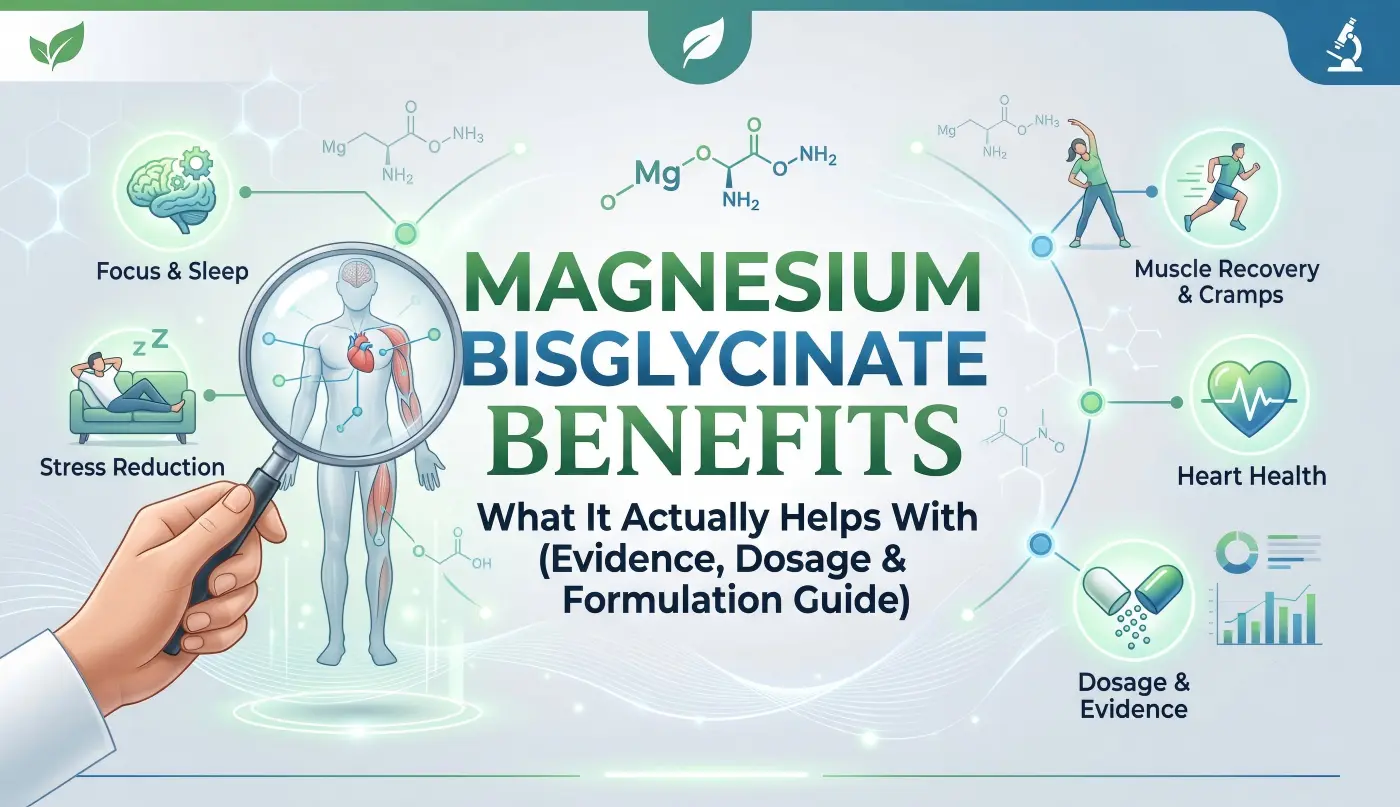
Magnesium Bisglycinate Benefits: What It Actually Helps With
Sleep Support
Evidence Summary:
- Clinical support: Moderate to Strong
- Permitted structure/function positioning: Supports relaxation | Helps maintain healthy sleep quality | Supports normal nervous system function relevant to evening calm
- Prohibited claims: Treats insomnia | Cures sleep disorders
Clinical Gold Standard: A landmark 2025 randomized controlled trial by Schuster et al., published in Nature and Science of Sleep (PMID: 40918053) [1], enrolled 155 healthy adults with self-reported poor sleep quality. After 28 days of supplementation with 250 mg elemental magnesium from bisglycinate — equivalent to approximately 1,800–2,000 mg of the bisglycinate compound — the magnesium group showed significantly greater reduction in Insomnia Severity Index (ISI) scores compared to placebo. This was the first RCT to isolate the bisglycinate form specifically for sleep outcomes.
A 2024 systematic review in Cureus examined all available clinical trials on magnesium for sleep and anxiety, finding that 5 out of 8 sleep-related studies reported improvements in sleep quality parameters, with higher doses appearing more effective [1, 2]. For brands developing sleep support supplements, this formulation stack represents the most commercially validated approach.
Suggested Formulation Stack:
- Magnesium Bisglycinate (250 mg elemental)
- L-Theanine (100-200 mg)
- Melatonin (0.5-3 mg, where permitted)
- Saffron Extract (affron or equivalent, 15-30 mg)
Stress & Emotional Wellness
Evidence & Regulatory Positioning:
- Evidence Level: Moderate (Boyle et al. 2017, Nutrients — 18 trials reviewed) [3]
- Regulatory Risk: High if overstated
- Avoid: Treats anxiety | Reduces anxiety disorder | Cures depression
- Prefer: Supports emotional wellbeing | Helps maintain a healthy stress response | Supports normal psychological function
A systematic review by Boyle et al. (2017) in Nutrients examined 18 trials and found beneficial but variable effects of magnesium supplementation on subjective anxiety and stress measures [3]. A large comparative trial showed that the combination of magnesium and vitamin B6 reduced perceived stress scores more strongly than magnesium alone in subjects with severe stress [2]. The glycine component of bisglycinate provides additional support as an inhibitory neurotransmitter.
Muscle Recovery
Positioning: Active lifestyle, sports recovery, electrolyte products. A 2024 systematic review in Nutrients (Tarsitano et al., PMID: 38970118) found evidence for reduced muscle soreness post-exercise, particularly in resistance-trained individuals using glycinate or citrate forms. EFSA has authorized the claim that “magnesium contributes to normal muscle function” [7].
Women’s Wellness
Potential applications include PMS support and menopause wellness positioning. A 2022 randomized, double-blind, placebo-controlled trial found that magnesium supplementation improved sleep quality in women with PCOS specifically. Avoid disease claims; use structure-function language only.
Bone Health
Supportive role only. EFSA has authorized “magnesium contributes to the maintenance of normal bones” [7]. Avoid positioning as osteoporosis treatment or bone disease prevention.
Energy Metabolism
Position around cellular energy production and fatigue support from nutritional insufficiency. EFSA has authorized “magnesium contributes to normal energy-yielding metabolism” and “magnesium contributes to a reduction of tiredness and fatigue” [7].
Which Benefits Have the Strongest Scientific Support?
| Benefit | Human Data Strength | Regulatory Claim Risk |
| Sleep | Moderate-Strong (Schuster 2025 RCT) [1] | Low |
| Stress support | Moderate (Boyle 2017 review) [3] | Medium |
| Muscle function | Strong (EFSA authorized) [7] | Low |
| Bone support | Strong (EFSA authorized) [7] | Low |
| Women’s wellness | Emerging (PCOS sleep trial) | Medium |
| Energy metabolism | Strong (EFSA authorized) [7] | Low |
Clinical Evidence vs. Regulatory Claims
Scientific Literature Does Not Automatically Equal Allowed Claims
This distinction is critical for YMYL (Your Money or Your Life) content and product compliance. A published clinical trial demonstrating an effect does not mean that effect can be communicated on a product label or in marketing materials.
Compliance Warning: Dietary supplements cannot claim to treat, cure, or prevent disease. All health claims must comply with FDA DSHEA (US), EFSA Regulation 1924/2006 (EU), or TGA Permitted Indications (Australia). Brands should consult qualified regulatory counsel before finalizing product claims.
| Region | Allowed Claims Framework |
| FDA DSHEA (United States) | Structure-function claims only. Mandatory disclaimer: “This statement has not been evaluated by the FDA. This product is not intended to diagnose, treat, cure, or prevent any disease.” |
| EFSA (European Union) | Very restrictive. Only pre-authorized claims under Regulation (EC) No 1924/2006 may be used. Disease claims prohibited. |
| Australia TGA | Intermediate. Permitted indications list includes specific low-level health claims. Higher claims require registration as medicine. |
Examples of Safe Positioning
- Supports relaxation
- Supports muscle function
- Helps maintain healthy sleep quality
- Supports normal energy-yielding metabolism
Prohibited: Treats insomnia, reduces anxiety disorder, cures depression, prevents osteoporosis
How Much Magnesium Bisglycinate Should You Take?
Elemental Magnesium Calculator:
- 2,000 mg magnesium bisglycinate (compound weight) ≈ 280 mg elemental magnesium (typical yield)
- The exact conversion depends on the specific chelate grade and whether the material is fully reacted or buffered.
- Schuster 2025 RCT used 250 mg elemental Mg = ~1,800–2,000 mg bisglycinate compound [1]
| Goal | Typical Daily Intake (Elemental Mg) |
| General wellness | 100-200 mg |
| Sleep support | 200-350 mg |
| Recovery / active lifestyle | 200-400 mg |
Best Time to Take & Nutrient Interaction Rules
Practical Usage Guidelines:
- Optimal Timing for Sleep & Calm: Ingest 30 to 60 minutes before bed. Glycine’s core-body-temperature-lowering effect aligns with natural circadian sleep onset.
- Spacing from High-Dose Minerals: While bisglycinate’s dipeptide channel reduces mineral competition, taking it separately from very high doses of Calcium (>250 mg) or Iron optimizes peak intestinal uptake.
- Coffee & Alcohol Interactions: Caffeine and alcohol act as mild renal magnesium-wasting agents; ensure your supplement is taken at least 1 hour apart from morning coffee for maximum retention.
Important: The NIH Office of Dietary Supplements sets the upper limit for supplemental magnesium at 350 mg/day for adults. Total intake from all sources should not exceed safe levels. Consult a healthcare provider before starting supplementation, especially if you have kidney disease or are taking medications [6].
Magnesium Bisglycinate vs. Other Magnesium Forms
- Magnesium Bisglycinate vs. Oxide: Bisglycinate offers superior GI tolerance and premium positioning; oxide is a commodity form with poor absorption and high laxative association.
- Magnesium Bisglycinate vs. Citrate: Citrate is familiar and relatively well-absorbed but lacks the chelated amino-acid narrative. Bisglycinate is preferred for evening relaxation and premium sleep positioning.
- Magnesium Bisglycinate vs. L-Threonate: Threonate is positioned for cognitive support / brain health at ultra-premium price points, often targeting memory and focus positioning. Bisglycinate is the default for sleep, stress, and broad daily magnesium use.
- Magnesium Bisglycinate vs. Malate: Malate is frequently used in daytime energy and active-lifestyle concepts. Bisglycinate is more often reserved for PM, calm, and sleep-adjacent SKUs.
Formulation & Manufacturing Considerations
Which Dosage Forms Work Best?
| Format | Manufacturing Difficulty |
| Capsules | Easy — Best for premium clinical positioning and multi-ingredient stacks |
| Tablets | Medium — Cost-efficient for high-volume retail |
| Gummies | High — Fastest-growing format; dosage load and taste masking are key constraints |
| Powder Sticks | Medium — Ideal for sleep beverages and recovery electrolytes |
| Functional Beverages | High — Emerging for tart cherry + magnesium sleep drinks |
Common Formulation Challenges
- High hygroscopicity — Magnesium bisglycinate is moisture-sensitive; requires desiccant packaging and controlled storage.
- Mineral flavor masking — Metallic taste can be challenging in gummies and drink mixes; requires flavor system expertise.
- Compression difficulties — High-dose tablet formulations may require specialized excipients and compression parameters.
- High dosage loading issues — Achieving meaningful elemental magnesium per serving while keeping capsule count or gummy size reasonable.
R&D Breakthrough: Solving the Magnesium Gummy Dilemma
Formulating magnesium bisglycinate into functional gummies presents a classic technical challenge: low elemental yield requires high powder loading, which often causes a gritty mouthfeel and weak gel structure. To achieve 100–200 mg elemental Mg per gummy serving without compromising texture, KS Nutripharma employs proprietary formulation strategies:
Technical Solutions:
- Use Micro-Granulated / Directly Compressible (DC) Grades: Prevents pre-gelation moisture absorption and reduces particle size.
- Optimize pH & Pectin Buffering: Keep slurry pH between 3.2–3.6 to preserve gelling power and prevent syneresis.
- Dual Hydrocolloid Systems: Combining Pectin with High-Acyl Gellan Gum creates a smooth network that encapsulates mineral particles, masking metallic notes and eliminating sandiness.
- Moisture Barrier Packaging: Individual foil-wrapped gummies or nitrogen-flushed bottles with desiccant inserts extend shelf life beyond 24 months.
Popular Commercial Formulas
- Sleep Gummies: Magnesium bisglycinate + L-theanine + melatonin (where permitted) + natural flavor system. For brands looking to develop this exact stack, see our L-Theanine + Magnesium supplement manufacturing page.
- Women’s Wellness Capsules: Magnesium bisglycinate + B6 + vitamin D3 + saffron extract.This combination also supports mood, stress relief, and anxiety relief positioning for women’s wellness brands.
- Relaxation Powder Sachets: Magnesium bisglycinate + glycine + tart cherry + natural sleep botanicals
- Recovery Drink Mixes: Magnesium bisglycinate + potassium + taurine + coconut water powder + electrolytes. This format is ideal for energy and sports recovery positioning.
Who Should Consider Magnesium Bisglycinate?
- Adults under chronic stress
- Consumers with self-reported poor sleep quality
- Athletes and active individuals seeking recovery support
- Older adults (magnesium absorption declines with age)
- Consumers with GI sensitivity who cannot tolerate oxide or high-dose citrate
Frequently Asked Questions
Is magnesium bisglycinate the same as magnesium glycinate?
In most commercial contexts, yes. Both terms refer to magnesium chelated with glycine. “Bis-” and “di-” both indicate a 1:2 magnesium-to-glycine relationship. For a detailed chemical and commercial comparison, see our guide on Magnesium Bisglycinate vs. Magnesium Glycinate. However, always verify the exact specification sheet for elemental magnesium content and fully reacted vs. buffered status.
How long does magnesium bisglycinate take to work?
The Schuster 2025 RCT measured significant improvements in sleep quality after 28 days of daily use [1]. Most practitioners recommend consistent daily use for 4-8 weeks before evaluating effects. Individual response varies based on baseline magnesium status.
Why do some products contain more elemental magnesium?
Some products use “buffered” magnesium glycinate, which includes additional magnesium sources (often magnesium oxide) to raise the elemental magnesium percentage. While this increases the mineral content on paper, it may compromise the GI tolerance and “true chelate” benefits that consumers expect from a premium bisglycinate product.
What is fully reacted magnesium bisglycinate?
Fully reacted means the magnesium has been chemically bonded to glycine through the chelation process, forming a true chelate complex. This is verified through analytical methods such as FTIR spectroscopy. Buffered products may contain unreacted magnesium oxide mixed with glycine, which does not provide the same absorption and tolerance profile.
Can I take magnesium bisglycinate with calcium or other minerals?
While bisglycinate’s dipeptide transport pathway (PEPT1) reduces direct mineral competition, high-dose calcium (>250 mg) or iron supplements can still interfere with overall magnesium absorption. For optimal results, space magnesium intake at least 2 hours apart from high-dose calcium or iron supplements.
Should I take magnesium bisglycinate with coffee?
Caffeine acts as a mild renal magnesium-wasting agent. For maximum retention, take your magnesium supplement at least 1 hour apart from morning coffee. Evening dosing (30-60 minutes before bed) is ideal for sleep-support formulas and naturally avoids coffee interaction.
Looking to Launch Magnesium Sleep or Stress Supplements?
OEM Services Include:
- Capsules (hard and vegetarian)
- Gummies (functional and botanical — including proprietary anti-sandiness formulation)
- Stick packs and powder sachets
- Functional powders and drink mixes
- Custom formulation development with R&D support
- Global compliance support (FDA, EFSA, TGA, etc.)
Scientific References
- [1] Schuster J, et al. Magnesium Bisglycinate Supplementation in Healthy Adults Reporting Poor Sleep. Nature and Science of Sleep. 2025. PMID: 40918053.
- [2] Rawji A, et al. The Role of Magnesium in Sleep Health: A Systematic Review. Cureus. 2024. PMCID: PMC11901550.
- [3] Boyle NB, et al. The Effects of Magnesium Supplementation on Subjective Anxiety and Stress. Nutrients. 2017;9(5):429.
- [4] Abbasi B, et al. The Effect of Magnesium Supplementation on Primary Insomnia in Elderly. J Res Med Sci. 2012;17(12):1161-1169.
- [5] Zhang W, et al. Global Dietary Magnesium Deficiency: Prevalence, Underlying Causes, Health Consequences, and Strategic Solutions. Int J Vitam Nutr Res. 2025.
- [6] NIH Office of Dietary Supplements. Magnesium: Fact Sheet for Health Professionals. https://ods.od.nih.gov/factsheets/Magnesium-HealthProfessional/
- [7] European Food Safety Authority. EU Register of Nutrition and Health Claims. https://ec.europa.eu/food/safety/labelling_nutrition/claims/register/public/?event=register.home
- [8] Custom Market Insights. Global Magnesium Supplements Market 2025-2034. https://www.custommarketinsights.com/report/magnesium-supplements-market/
- [9] Accio. Trends of Magnesium Bisglycinate in 2026. https://www.accio.com/business/trends-of-magnesium-bisglycinate
- [10] Albion Minerals / Balchem. TRAACS – The Real Amino Acid Chelate System. https://balchem.com/hnh/mn/albion-minerals/traacs/
About the Author & Editorial Team
Written by: KS Nutripharma Editorial Team
Disclosure: KS Nutripharma is a contract manufacturer of dietary supplements. This article is intended for informational and educational purposes only and does not constitute medical advice.
Medical Disclaimer: This content is for informational purposes only and is not intended as a substitute for professional medical advice, diagnosis, or treatment. Always seek the advice of your physician or other qualified health provider with any questions you may have regarding a medical condition. Never disregard professional medical advice or delay in seeking it because of something you have read on this website.
Claim Compliance Disclaimer: This article discusses structure-function claims permitted under FDA DSHEA and EFSA-authorized health claims. Disease treatment claims are not permitted for dietary supplements in most jurisdictions. Brands should consult qualified regulatory counsel before finalizing product claims.
About KS Nutripharma®
KS Nutripharma is a professional supplement contract manufacturer specializing in plant-based ingredients and dietary supplements. Since 2007, we have provided custom products to over 500 nutraceutical brands and distributors worldwide across 60+ export markets. Our integrated manufacturing facilities span 81,000+ m2 with 12 automated production lines, 2 dedicated R&D centers, and 260+ professionals. We are certified cGMP, HACCP, FSSC22000, ISO9001, ISO22000, Halal, and Kosher.
Learn more about our magnesium bisglycinate manufacturing capabilities:
Main Website: https://kssupplements.com/
About Us: https://kssupplements.com/about-us/
Manufacturing Capacity: https://kssupplements.com/manufacturing-capacity/