Introduction
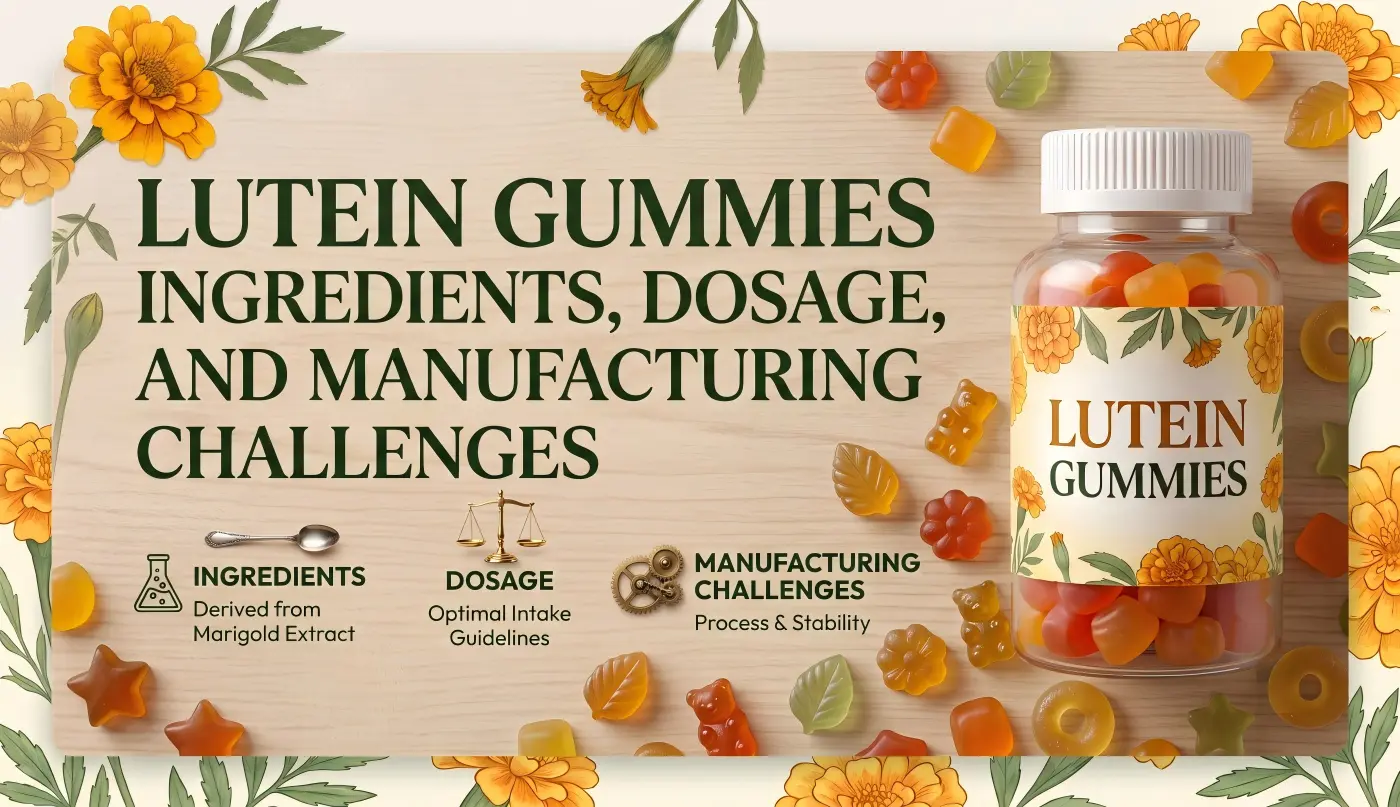
Lutein gummies are chewable dietary supplements that deliver a standardized dose of lutein — most often extracted from marigold (Tagetes erecta) — in a flavored gummy base instead of a capsule or softgel. They are among the fastest-growing formats in eye-health nutrition, and also one of the most technically demanding to manufacture.
The reason is chemistry. Lutein is a fat-soluble carotenoid with very limited water solubility, and it is sensitive to heat, light, oxygen, acidic conditions and moisture. A gummy, meanwhile, is a hot, water-based, mildly acidic system that is cooked, deposited and dried. Ordinary lutein oil suspensions and unprotected lutein powders are therefore not automatically suitable for gummy production: without the right ingredient format and process controls, the active can degrade, separate or distribute unevenly, leaving some pieces over dose and others under dose.
A successful lutein gummy — whether a single-lutein product or combined lutein and zeaxanthin gummies — has to solve five problems at once: ingredient selection, dispersion, dose uniformity, taste and shelf life. This guide explains how formulators and brands approach each of them, from CWS powders and beadlets to pectin bases, stability testing, packaging and OEM minimum order quantities.
| Disclaimer: This article provides general product-development information and is not medical advice. Lutein gummies should not be promoted as products that diagnose, treat, cure or prevent eye diseases. |
What Are Lutein Gummies?
Basic Product Definition
A lutein gummy is a chewable dietary supplement that contains a declared amount of standardized lutein per gummy or per serving. The simplest products contain lutein alone; most market products combine it with complementary actives such as zeaxanthin, astaxanthin, bilberry extract, saffron or vitamins. The gummy base can be built on gelatin or pectin, and the formula can be designed as a conventional sugared gummy, a low-sugar version or a no-added-sugar product.
Why Brands Choose Gummies
For consumers, gummies remove the biggest complaint about eye-health supplements: swallowing large softgels. They taste pleasant, feel like a small daily treat rather than a pill, and fit naturally into lifestyle positioning such as screen-heavy routines and everyday eye nutrition. For brands, the format offers wide design freedom — flavors, shapes, colors and coatings can all be customized to build a recognizable product.
The format also has real limitations. The cost per unit dose is usually higher than a standard capsule; the active load per piece is limited by taste and texture; the hot, moist process is chemically harsher than filling a capsule; and packaging and stability requirements are stricter. Finally, because gummies taste like candy, consumers may eat more than the suggested serving, so clear labeling and responsible packaging design matter.
What Can Lutein Gummies Be Used For?
Lutein and Eye Health
Lutein and zeaxanthin are carotenoids that accumulate in the macular region of the retina, where they form part of the macular pigment. Lutein also has antioxidant properties. These characteristics explain why lutein gummies for eyes have become a popular daily-nutrition format. It is important to remember that the gummy is only a delivery format: putting lutein into a gummy does not add to — or subtract from — the underlying scientific evidence for the ingredient itself.
Compliant structure/function language for this category includes:
- Supports eye health
- Supports normal visual function
- Helps maintain macular pigment
- Provides antioxidant support
- Supports daily eye nutrition
Evidence Boundaries
Much of the public awareness of lutein comes from the AREDS2 study. AREDS2 evaluated one specific multi-ingredient formula in a defined population of people with age-related macular degeneration — it was not a study of ordinary lutein gummies, and adding 10 mg lutein plus 2 mg zeaxanthin to a gummy does not make that gummy an AREDS2 product. By the same logic, studies performed on capsules or tablets cannot be cited as proof that a gummy delivers the same effect. Every claim must match the actual ingredient form, dose, dosage format and evidence behind the finished product.
Claims Lutein Gummies Should Not Make
Because they imply disease treatment or prevention, the following claims must be avoided:
- Treats macular degeneration
- Prevents cataracts
- Reverses vision loss
- Cures dry eyes
- Repairs retinal damage
- Eliminates eye floaters
- Protects eyes from all screen damage
A fine-print disclaimer cannot repair advertising that is itself a disease claim.
What Type of Lutein Is Best for Gummies?
Why Standard Lutein Powder Can Be Challenging
Standard lutein powder is only sparingly dispersible in water. In a gummy syrup, it can wet out poorly and distribute unevenly, showing up as colored specks, sedimentation, or local hot-spots of concentration from one piece to the next. Lutein is also strongly pigmented — yellow to orange — so an unprotected powder can streak the batch, and the unprotected active is more exposed to heat, light and oxygen during processing. None of this means standard powder cannot be used; it means it requires more formulation work and more process validation than protected formats.
Oil-Suspension Lutein
Oil suspensions are the format of choice for softgels, oil-based products and emulsified systems. In a gummy they are harder to handle: the oil phase needs an emulsification system, it can interfere with the gel network, and it can create an oily mouthfeel, surface oiling or a cloudy appearance. Achieving uniform active distribution is also more difficult. A manufacturer with mature emulsification technology can still use oil suspensions successfully — but only after formulation and stability validation.
CWS Microencapsulated Lutein Powder
CWS usually stands for cold-water-dispersible: a microencapsulated powder engineered so its particles disperse through a water phase. It does not mean the lutein is dissolved at a molecular level, and describing these powders as water-soluble is inaccurate. For gummies, CWS powders are usually the friendliest format: they wet out and disperse more evenly in the syrup, the capsule wall reduces direct contact with oxygen and light, and color and dose are easier to control than with standard powder.
Before approving a CWS grade, confirm the following with the supplier:
- Lutein assay (actual active content)
- Microcapsule wall material
- Carriers and excipients
- Allergens and GMO status
- Sugar or starch sources
- Particle size
- Recommended pH range
- Maximum processing temperature
Lutein Beadlets
Beadlets are granular, microencapsulated ingredients designed to protect the active during processing and storage. Specifications vary widely between suppliers — particle size, carriers and assay are not interchangeable. Beadlets offer good oxidative and light protection, clearly defined potency, and can be used across gummies, tablets and capsules while limiting direct contact between the active and other ingredients. Their challenges are sensory and physical: large particles can feel gritty, may remain visible as specks in a translucent gummy, and can settle if dispersion is inadequate. Always confirm that a beadlet grade is explicitly suitable for gummy processing.
CWS Powder vs. Beadlets
The two formats behave differently across the dimensions that matter in gummy production:
| Dimension | CWS Microencapsulated Powder | Lutein Beadlets |
| Water-phase dispersion | Designed to disperse in the syrup phase | Granules can settle if mixing is insufficient |
| Particle size | Fine powder | Larger granules; varies by supplier |
| Mouthfeel | Generally smooth | Grittiness possible with large particles |
| Visible specks | Low risk | Possible in translucent gummies |
| pH tolerance | Defined range per grade — verify against recipe | Defined range per grade — verify against recipe |
| Oxidation and light protection | Good — microcapsule wall | Good — dense granule matrix |
| Dose control | Clear assay, easy to scale | Clear assay, easy to scale |
| Finished-product testing | Assay in the actual gummy matrix | Assay in the actual gummy matrix |
| Cost | Above standard powder | Above standard powder; varies by potency |
Neither format is universally best. The appropriate ingredient format depends on the gummy process, target dosage, pH, sensory requirements, processing temperature and desired shelf life. An experienced partner can help match the ingredient format to your process before the first pilot batch — talk to our team about lutein supplement manufacturing
How Much Lutein Should a Gummy Contain?
Common Market Specifications
Market products are commonly built around a few familiar specifications: 5 mg lutein per serving, 10 mg per serving, 20 mg per serving, or 10 mg lutein plus 2 mg zeaxanthin. These are market conventions, not universal personal recommendations, and a higher number on the label does not mean a better product. Two labeling disciplines matter here. First, per-gummy and per-serving values are different things: a product that delivers 10 mg in a two-gummy serving contains 5 mg per piece, and the label must not present the serving value as the per-gummy value. Second, the label must state clearly how many gummies make one serving.
One-Gummy vs. Two-Gummy Serving
A one-gummy serving is convenient, stretches a bottle across more days and is easy for consumers to understand — but it concentrates the full active load, and often the flavor challenge, into a single, sometimes larger piece. A two-gummy serving splits the actives across two pieces, keeps each gummy smaller and usually improves the eating experience — at the cost of more sugar and calories per day, more pieces per bottle, and the risk that a consumer eats only one piece and receives half the intended dose.
Lutein and Zeaxanthin Gummies
Lutein zeaxanthin gummies built around 10 mg lutein and 2 mg zeaxanthin are among the most familiar combinations on the market. That 5:1 ratio is well recognized, but it should not be presented as the best ratio for every population. For lutein and zeaxanthin gummies, both actives need the same discipline: verified ingredient specifications, stability data, and finished-product testing of each carotenoid individually — not just calculations based on how much raw material was added to the kettle.
Potency Calculations and Manufacturing Loss
Carotenoid ingredients are rarely 100% active: common specifications are 5%, 10% or 20% lutein by weight, with the remainder made up of wall materials and carriers. Recipe calculations must be based on the actual tested assay of each lot, with allowance for ingredient moisture, batch-to-batch assay variation and process losses. If an overage is used to compensate for processing or shelf-life decline, it must be supported by stability or process data — never added arbitrarily just to pass testing. The labeled potency must remain supportable for the entire claimed shelf life.
Pectin vs. Gelatin Lutein Gummies
Gelatin Gummies
Gelatin produces the classic elastic, bouncy chew consumers know from confectionery. The process is mature and forgiving, and gelatin is compatible with many flavor systems. Because gelatin is animal-derived, it suits products that do not need a vegan or vegetarian position and brands that want a traditional gummy texture. Points to check include the animal source, religious certification needs such as Halal or Kosher, texture drift when products are shipped or stored hot, and target-market label preferences.
Pectin Gummies
Pectin is plant-derived, which makes it the default for vegan, vegetarian, plant-based and clean-label products. Pectin systems gel through a controlled balance of soluble solids, acidity and setting conditions, and they generally set faster than gelatin. That speed has a price: the window for adding and dispersing the active is shorter, pH and temperature control are tighter, and a fast-setting batch can trap an unevenly mixed active. Different pectin types cannot share one set of process parameters, so each recipe needs its own validated settings.
Selection Criteria
Choose the base with the whole project in view:
- Target consumer and brand positioning
- Vegan, vegetarian, Halal or Kosher requirements
- Destination country and its labeling rules
- Desired texture and eating experience
- The lutein ingredient format selected
- Acidity and flavor profile
- Available production process
- Storage and shipping temperatures
- Target shelf life
- Cost and minimum order quantity
Color, Odor, and Flavor Challenges
Natural Color of Lutein
Lutein is intrinsically yellow to orange, and the higher the dose, the stronger its influence on the finished color. Batch variation and processing can shift the shade, so fighting the ingredient’s natural color to force a crystal-clear or pale gummy is usually wasted effort. It is easier to design with it: orange, lemon, mango, peach and passion fruit concepts harmonize naturally with lutein’s hue — though every concept still needs physical samples, not just paper approval.
Flavor Masking
A lutein gummy may need to mask the vegetal note of the carotenoid itself, the taste of microcapsule wall materials, the flavor of zeaxanthin or companion botanicals, and the bitterness or metallic notes of added vitamins and minerals. The usual toolkit is a fruit profile that matches the natural color, a well-managed acid-sugar balance, an optimized sweetener system, restrained use of strongly flavored botanical extracts, and confirmation through bench trials and sensory testing.
Sugar-Free Formulations
No added sugar does not mean carbohydrate-free, and polyols can affect taste, texture and digestive tolerance. Definitions of sugar-free and no added sugar differ between countries, and the sweeteners, polyols, and fibers used in their place can change water activity and shelf life. Avoid disease-adjacent positioning such as diabetic-friendly until the regulatory review of the target market is complete.
Manufacturing Process and Critical Control Points
Exact time-temperature parameters are factory-specific and proprietary, but every lutein gummy line follows the same control logic.
Step 1 — Gummy Base Preparation
The syrup and the gelling system — pectin or gelatin — are prepared and cooked. Soluble solids, temperature and moisture must be controlled so the base is fully dissolved and homogeneous before anything else.
Step 2 — Cooling to the Active-Addition Window
Because lutein is heat-sensitive, the cooked mass is cooled toward the addition window before the active goes in, minimizing the time the carotenoid spends at high temperature. The correct addition temperature comes from the ingredient supplier’s guidance and the factory’s own validation — there is no single temperature that suits every lutein ingredient.
Step 3 — Active Ingredient Dispersion
The active is pre-dispersed and added under controlled mixing: long enough and strong enough to distribute it without lumps, but gentle enough to avoid whipping in air or mechanically damaging microcapsule structures.
Step 4 — Flavor, Acid and Color Addition
Acid shifts pH, which can affect both active stability and pectin setting; addition order influences mixing uniformity; added colors interact with lutein’s own hue; and flavor must be judged in the finished gummy, not only in the syrup.
Step 5 — Depositing and Molding
During depositing, the line controls piece weight, depositing temperature and uniformity across the mold — and watches for active settling in the hopper while the batch waits to be deposited.
Step 6 — Setting, Drying or Conditioning
The gummies are set and conditioned to their final texture. Checks include texture, moisture, water activity, sticking, shrinkage and piece-weight drift.
Step 7 — Coating and Packaging
Oil coating, wax coating, sugar sanding, or acid sanding finishes the piece. Each option must be evaluated for its effect on oxygen and moisture migration, packaging compatibility, sticking between pieces, and the declared piece weight.
How to Ensure Active Ingredient Uniformity
Why Uniformity Is Difficult
Dose-uniformity failures usually trace back to a few causes: lutein particles agglomerating; beadlets settling out; insufficient mixing time after the active is added; long hold times before depositing, so the first and last gummies of a batch differ; piece-weight variation; and active left clinging to equipment surfaces.
Formula and Process Controls
Controls include selecting a particle size suited to the process, a standardized pre-dispersion procedure, validated mixing speed and time, limits on pre-depositing hold time, control of batch temperature and viscosity, and sampling at defined production stages.
Sampling Plan
A sampling plan should cover the beginning, middle and end of the batch, different depositing heads and different points in the packaging run. The plan belongs to the quality department and should be built on risk and statistical principles — not convenience.
Finished Product Verification
Finished-product verification covers lutein content, zeaxanthin content, piece weight, per-serving content, appearance, moisture or water activity, microbiology, heavy metals and any other labeled actives. Under FDA dietary supplement CGMP, products must meet established specifications for identity, purity, strength and composition — the quantity of raw material added to the batch is not, by itself, evidence of finished-product content.
Heat, Light, and Oxidation Stability
Heat Exposure
Cooking and depositing expose lutein to heat, and the risk scales with temperature and exposure time together. Microencapsulation improves robustness but does not make degradation impossible — verify with process data and finished-product assay, not assumptions.
Light Exposure
Light can attack the ingredient during raw-material storage, open production steps, retail display in transparent packaging, and in the consumer’s home after opening. Countermeasures include protected storage, minimal open exposure time, light-blocking packaging, and a light-stability evaluation of the packed product.
Oxygen Exposure
Oxygen arrives via air whipped in during mixing, headspace in the bottle, permeable packaging materials and repeated opening by the consumer. Countermeasures include mixing that minimizes air incorporation, high-barrier packaging, and — where testing justifies it — nitrogen flushing or oxygen absorbers. The count per bottle should match how quickly the product will realistically be consumed.
Moisture and Water Activity
Moisture governs texture, sticking and microbial stability, and water activity describes the available water better than total moisture content. There is no universal water-activity target that fits every lutein gummy — each formula must establish and verify its own specification.
Packaging and Shelf-Life Strategy
Bottle Packaging
HDPE and PET bottles, in opaque or light-resistant versions, are the default. Evaluate oxygen transmission, moisture barrier, light protection, closure seal integrity, in-use stability after opening, and sticking during transport.
Blister or Unit-Dose Packaging
Blisters and single-serve formats end the repeated open-close cycle, protect each piece individually and make daily portions obvious — at higher packaging cost, with gummy size sometimes constraining blister design, and with the barrier performance of the film still to be confirmed.
Desiccants and Oxygen Control
Desiccants, oxygen absorbers and nitrogen flushing should be adopted based on product testing, and weighed against child-ingestion risk, headspace constraints and labeling rules.
Shelf-Life Testing
A shelf-life program should track lutein and zeaxanthin content, appearance and color, flavor, texture, sticking, moisture or water activity, microbiology and package integrity — using accelerated and real-time stability studies plus packaging compatibility testing. One compliance point brands often miss: the FDA does not require expiration dating on every dietary supplement, but if the label states a shelf life or expiration date, it must be backed by data. A 24-month claim cannot simply be borrowed from similar products.
Quality Testing for Lutein Gummies
Raw Material Testing
Incoming ingredients should be covered by identity testing, lutein assay, zeaxanthin assay, microbiology, heavy metals, residual solvents, pesticide residues, allergen review and confirmation of carrier composition.
In-Process Controls
During production, the line monitors temperature, pH, Brix or soluble solids, viscosity, deposited weight, appearance, and mixing and holding times.
Finished Product Testing
The released product is verified for lutein potency, zeaxanthin potency, serving-size verification, weight variation, microbiology, heavy metals, water activity or moisture, texture, stability and packaging integrity.
Analytical Method Challenges
A gummy is a complex matrix of sugars, gelling agents and acids that can interfere with carotenoid extraction and measurement. Methods must be validated on the actual finished-product matrix and must be scientifically sound, and the laboratory must handle carotenoid samples with protection from light and oxygen.
How Brands Can Customize Lutein Gummies
Active Ingredient Options
The active system can be built around lutein alone or in combination: lutein plus zeaxanthin, lutein plus zeaxanthin and astaxanthin, lutein with bilberry, lutein with saffron, or lutein with vitamins and minerals.
Gummy Base Options
The base can be pectin or gelatin, and the formula can be positioned as vegan, sugar-free, low-sugar, naturally flavored or naturally colored — provided each claim matches the definition used in the destination country.
Flavor and Shape Options
Popular directions include orange, lemon, mango, peach and mixed berry, produced in standard molds or in custom shapes. Custom tooling normally affects cost, lead time and minimum order quantity.
Packaging Options
Products can be packed in bottles, pouches, blisters, cartons or individual sachets, depending on the stability strategy and the market.
Label and Market Options
Support typically covers private-label design, Supplement Facts panels, multilingual labels, US-market documentation, EU or UK review, and Halal, Kosher or Vegan requirements. Certifications should only be used when the factory and the product genuinely qualify — something a full-service partner manages end-to-end for private label lutein supplements
Lutein Gummy OEM Minimum Order Quantity
Why There Is No Universal MOQ
MOQ is an output of the project, not a fixed number. It moves with the choice of stock or custom formula, pectin or gelatin base, piece weight, count per bottle, bottle format, label or carton, standard or custom mold, raw-material minimum purchase quantities, testing requirements and destination-market documentation. Be cautious with any fixed MOQ that a factory cannot sustain over the long term.
Stock Formula vs Custom Formula
A stock formula usually means shorter development, a relatively lower MOQ and more complete sample and stability documentation — with limited room for differentiation. A custom formula gives full control over actives and dosage, but requires sampling rounds, may need additional testing and stability studies, and normally carries a higher MOQ and a longer timeline.
Information Needed for an Accurate Quote
To quote accurately, your manufacturing partner will ask for:
- Target country
- Target lutein content per serving
- Whether zeaxanthin is included
- Gummies per daily serving
- Pectin or gelatin base
- Sugared, low-sugar or sugar-free
- Flavor and shape preferences
- Count per bottle
- Packaging format
- Estimated first order quantity
- Target launch date
How to Choose a Lutein Gummy Manufacturer
Before committing, verify that the manufacturer:
- Operates a dietary supplement CGMP system
- Has real experience with carotenoid gummies
- Can handle CWS microencapsulated powders and beadlets
- Tests finished-product lutein content
- Verifies batch-to-batch and within-batch uniformity
- Controls water activity and runs stability programs
- Provides packaging compatibility evaluation
- Supplies raw-material traceability documentation
- Supports regulatory review for the target country
- Maintains change-control and deviation procedures
- Issues a certificate of analysis for every batch
Treat the following as red flags:
- Guaranteeing label potency from input quantities alone
- Never testing finished-product lutein content
- Promising a fixed shelf life without stability data
- Claiming one set of process parameters suits every formula
- Being unable to state ingredient assay and carriers
- Using disease-treatment claims to help customers sell
Frequently Asked Questions About Lutein Gummies
What are lutein gummies?
Lutein gummies are chewable dietary supplements that contain a standardized amount of lutein — typically from marigold extract — delivered in a gelatin- or pectin-based gummy rather than a capsule or softgel.
Are lutein gummies good for the eyes?
Lutein is associated with normal eye nutrition and helps maintain macular pigment, but gummies cannot treat eye diseases, and no supplement can guarantee an improvement in vision.
How much lutein should be in a gummy?
Common market specifications include 5 mg, 10 mg or 20 mg lutein per serving, or 10 mg lutein plus 2 mg zeaxanthin. These are product specifications, not personal medical dosing advice.
Can lutein and zeaxanthin be made into gummies?
Yes. The key is choosing ingredient formats suited to a water-based, heated process, then verifying stability and dose uniformity in the finished product.
Are CWS lutein powders truly water-soluble?
Water-dispersible is the more accurate description. The powder disperses through the water phase without the lutein dissolving at a molecular level — confirm details in the supplier’s technical documentation.
Are pectin lutein gummies vegan?
Pectin itself is plant-derived, but whether the finished product can be called vegan depends on every other ingredient and processing aid in the formula.
Do lutein gummies require refrigeration?
It depends on the specific formula, packaging and stability data — there is no single answer that applies to all products.
How long is the shelf life of lutein gummies?
Shelf life must be supported by stability testing on the actual formula and packaging; it cannot be set by industry habit alone.
What is the MOQ for private-label lutein gummies?
It depends on the formula, mold, packaging, testing requirements and raw-material purchase quantities, and should be quoted project by project.
Can a brand customize flavor, dosage and packaging?
Yes — but deeper customization increases cost, minimum order quantity and time to market.
Developing a Stable, Consumer-Friendly Lutein Gummy
The core challenge of lutein gummies is not adding a powder to syrup — it is engineering the product so the active survives and stays evenly distributed. Ingredient format drives dispersion and stability, and CWS microencapsulated powders or gummy-suitable beadlets are generally a better fit than unprotected powders. Uniformity, heat exposure, oxidation, and shelf life must be verified with data, not assumed. Pectin and gelatin should be chosen against brand positioning and process reality, and every health claim must match the evidence behind the actual formula. Get those decisions right, and lutein gummies become stable, consumer-friendly products that can carry a brand for years.
Planning a private-label lutein gummy? Share your target dosage, supporting ingredients, gummy base, flavor, packaging, destination market and estimated order quantity. Our formulation team can evaluate ingredient formats and prepare a customized manufacturing proposal — start with custom lutein gummies
| Discuss Your Lutein Gummy Formula | Request an OEM Quote | Start a Private Label Project |
References and Further Reading
- FDA — Dietary Supplements (CGMP guidance and Q&A)
- NIH Office of Dietary Supplements — Vitamin A and Carotenoids
- FTC — Health Products Compliance Guidance
- PubMed — Lutein microencapsulation and storage-stability research
Scientific sources support the health and stability information in this article. Process parameters, shelf life and product potency for any specific project must be supported by actual ingredient and finished-product test data.