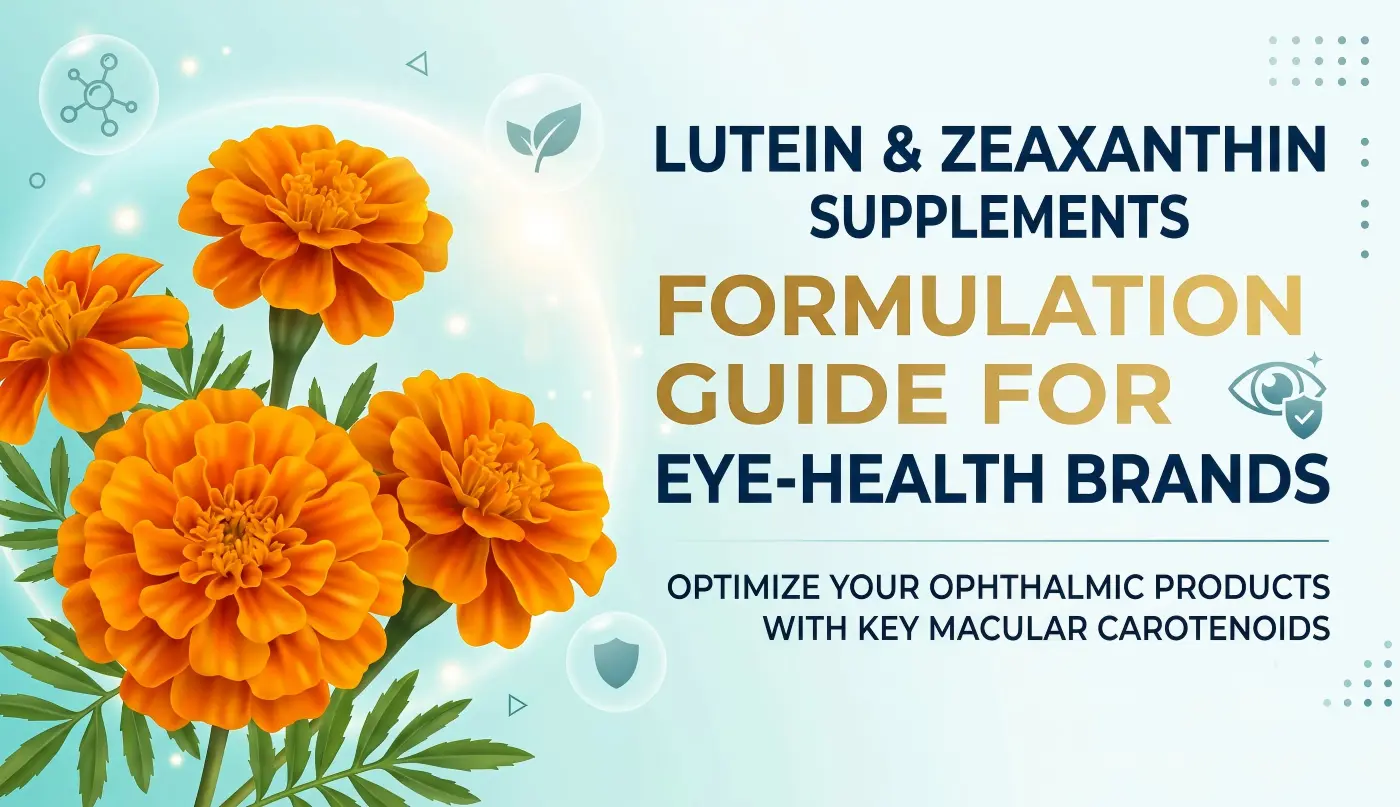
Learn how to select ingredient forms, determine optimal ratios, improve stability, and develop market-ready eye health supplements — written by the formulation team at a cGMP-certified OEM manufacturer.
Quick Navigation
- 🟢 10:2 Ratio Explained
- 🟢 Free Lutein vs. Lutein Ester
- 🟢 Gummies vs. Softgels
- 🟢 Stability & Packaging
- 🟢 Regulatory Considerations
- 🟢 OEM Development Checklist
Quick Summary
✔ Most commercial eye health products use 10 mg lutein + 2 mg zeaxanthin — the ratio evaluated in the AREDS2 clinical trial. [1]
✔ Free lutein generally provides higher bioavailability, while lutein ester offers better processing stability. They are not interchangeable milligram-for-milligram.
✔ Oxygen and light are the primary causes of carotenoid degradation — protection strategy starts at ingredient selection, not packaging.
✔ Softgels remain the dominant dosage form, but gummies are the fastest-growing format and require microencapsulated ingredient forms.
OEM / ODM Manufacturing Snapshot
| ✓ OEM / ODM & Private Label | Available — custom formula, dosage, ratio, and packaging |
| ✓ MOQ | Low-MOQ trial orders supported (insert exact MOQ by dosage form) |
| ✓ Lead Time | (insert standard lead time, e.g., X–X weeks after formula confirmation) |
| ✓ Certifications | cGMP-certified manufacturing; 7 international certifications |
| ✓ Dosage Forms & Daily Capacity | Softgels 2M+/day · Hard Capsules 5M+/day · Tablets 12M+/day · Gummies 2M+/day |
| ✓ Request a Quote | → Get a Custom Formulation Proposal |
KS Nutripharma has manufactured lutein-based products since 2007 and operates its own GAP marigold cultivation bases — from flower to finished dosage form.
Quick Takeaways
- The 10:2 ratio is the market anchor.10 mg lutein + 2 mg zeaxanthin is the most recognized combination in eye health supplements, validated by large-scale clinical research and consumer familiarity. [1][2]
- Ingredient form determines the dosage form — not the other way around.Oil suspensions suit softgels; CWS microencapsulated powders are required for gummies; beadlets survive tablet compression.
- Ester ≠ free.A 20% lutein ester material delivers roughly 10% free lutein equivalent. Misreading this is the most common label-claim error we see in OEM projects.
- Stability is won or lost in formulation.Oxygen, UV light, heat, and moisture degrade carotenoids; microencapsulation, antioxidant systems, and nitrogen flushing are your first line of defense.
- Documentation wins B2B deals.A complete supplier dossier (COA, stability data, heavy metals, pesticides, residual solvents) shortens procurement cycles and regulatory review.
Why Lutein and Zeaxanthin Supplements Are Growing
Consumer interest in eye health supplements has grown steadily over the past decade. Increased screen time from computers, smartphones, and digital devices has driven awareness of visual comfort and long-term eye nutrition. At the same time, the healthy aging demographic continues to expand, with older consumers seeking products that support their vision as part of an active lifestyle.
Lutein and zeaxanthin have become central ingredients in this category. These two carotenoids are frequently combined in dietary supplements targeting eye health, and their use has expanded well beyond traditional multivitamins. Today, brands formulate lutein and zeaxanthin supplements in multiple delivery formats, including softgels, tablets, hard capsules, and gummies, to meet diverse consumer preferences.
For supplement brands, developing a successful lutein zeaxanthin supplement requires more than selecting a dosage. Ingredient form, stability, delivery format, packaging, and target-market regulations must all be considered. This guide provides a practical overview for product developers, procurement teams, and brand managers evaluating lutein and zeaxanthin supplement manufacturing options.
The 10:2 Ratio Explained
Why 10 mg Lutein + 2 mg Zeaxanthin Became the Standard
The combination of 10 mg lutein with 2 mg zeaxanthin is the most widely used formulation ratio in eye health supplements. This 5:1 proportion was evaluated in the Age-Related Eye Disease Study 2 (AREDS2), a large randomized clinical trial sponsored by the U.S. National Eye Institute that tested lutein and zeaxanthin — with and without omega-3 fatty acids — in more than 4,000 participants at risk of age-related macular degeneration. [1] Secondary analyses further examined the role of lutein/zeaxanthin within the AREDS2 formulation. [2]
It is important to note that AREDS2 was conducted in a specific population group, and its results should not be extrapolated as a universal recommendation for all consumers. Brands should also avoid describing 10:2 as the “optimal” or “best” dose for all populations — individual needs and regulatory frameworks vary by country.
Higher-Strength Formulas (20 mg + 4 mg)
Some brands choose higher-potency formulas, such as 20 mg lutein combined with 4 mg zeaxanthin, maintaining the same 5:1 ratio. Higher-strength products may appeal to consumers seeking maximum-strength positioning or those directed by healthcare providers. When formulating at higher potencies, developers must consider the impact on capsule or tablet size, cost per unit, and label space for full Supplement Facts disclosure.
Also distinguish between per-serving and per-capsule labeling: a two-capsule serving of 10 mg lutein each delivers 20 mg per serving but is marketed differently from a single-capsule 20 mg product. These decisions affect packaging, consumer perception, and competitive positioning.
Common Market Specifications by Region
| Market | Common Ratio | Typical Format | Notes |
| United States | 10:2 | Softgels, capsules | AREDS2-driven consumer recognition [1] |
| Europe | 10:2 / 20:4 | Capsules, tablets | EFSA claim framework applies — see Regulatory Overview [6] |
| China | 10:2 | Capsules, tablets | Blue-hat registration pathway for health foods |
| Australia | 10:2 | Capsules, softgels | TGA listed-medicine framework [7] |
How Brands Should Select a Ratio
Selecting a lutein-to-zeaxanthin ratio involves the target consumer demographic, product positioning, daily serving size, target retail price, raw material specifications, and destination-country regulations. The final ratio should be confirmed through regulatory review, formulation testing, and the brand’s intended positioning — not by search volume alone. Working with an experienced manufacturer early in development helps identify feasible ratios that meet both marketing and technical requirements.
Ingredient Forms: Sources, Formats, and Specifications
Marigold Extract as the Primary Lutein Source
Marigold flower extract (Tagetes erecta) is the predominant commercial source of lutein for dietary supplements. [3] Finished raw materials are labeled by lutein assay percentage — the actual lutein content, not total extract weight. When sourcing, procurement teams should verify whether the supplier quotes lutein content on a free or ester basis, as this directly affects dosage calculations and label claims.
From Flower to Finished Product
Marigold Flower (GAP cultivation)
↓
Extraction
↓
Oleoresin
↓
Saponification
↓
Free Lutein
↓
Microencapsulation / Beadlets / Oil Suspension
↓
Finished Dosage Forms (Softgel · Capsule · Tablet · Gummy)
KS Nutripharma controls this chain in-house: our first lutein monomer extraction line launched in 2007, and we operate GAP-certified marigold cultivation bases to secure raw material consistency.
Available Ingredient Formats
| Format | Description | Best Suited For |
| Oil Suspension | Lutein/zeaxanthin dispersed in oil | Softgels, oil-based products |
| Standard Powder | Dry powder form | Tablets, capsules, premixes |
| CWS Microencapsulated | Cold-water-dispersible powder | Gummies, beverages, powders |
| Beadlets | Microencapsulated spherical granules | Tablets, capsules, gummies |
Zeaxanthin follows the same logic: oil suspensions for softgels, CWS microencapsulated powder for gummies and beverages. Each format carries different handling requirements, stability profiles, and cost implications that must be evaluated at the formulation stage.
How to Select Lutein Ingredients by Application
| Application | Recommended Form | Why |
| Softgel | Free lutein oil suspension | Direct fill; fat-soluble matrix supports absorption |
| Gummies | Encapsulated beadlets / CWS powder | Survives heating and mixing; even dispersion |
| Tablets | Dry lutein ester powder / beadlets | Withstands compression heat and pressure |
| Powder sticks | Microencapsulated form | Dispersibility, oxidation protection, taste masking |
What Are Lutein and Zeaxanthin?
What Is Lutein?
Lutein is a carotenoid belonging to the xanthophyll family. In commercial supplement production, lutein is most commonly derived from marigold flower extract (Tagetes erecta). The ingredient is available in two primary forms: free lutein and lutein ester. Free lutein refers to the unesterified form, while lutein ester requires enzymatic hydrolysis in the body before absorption.
As a fat-soluble compound, lutein is typically used in formulations that support eye health, healthy aging, and antioxidant nutrition. It appears as an orange-yellow powder or oil suspension depending on the raw material specification. When selecting lutein for a product, formulators must distinguish between the extract concentration and the actual lutein content, as these values differ and affect label claims.
What Is Zeaxanthin?
Zeaxanthin is also a xanthophyll carotenoid and is structurally similar to lutein. It frequently appears alongside lutein in eye health formulations. Commercial zeaxanthin is available in several forms, including standard powder, cold-water-dispersible (CWS) microencapsulated powder, beadlets, and oil suspension.
The choice of zeaxanthin format depends on the intended dosage form and processing conditions. For example, CWS microencapsulated powder is better suited for gummies and beverages, while oil suspensions are typically used in softgel formulations. Each format has different handling requirements, stability profiles, and cost implications that must be evaluated during the formulation stage.
Why Are They Commonly Combined?
Lutein and zeaxanthin are often combined in the same eye health product because they complement each other structurally and functionally. Together, they allow brands to position a product as a more complete carotenoid-based eye supplement. This combination also aligns with consumer expectations, as many buyers looking for eye health products specifically search for formulas containing both ingredients.
Beyond the lutein-zeaxanthin base, formulators can add complementary ingredients such as bilberry extract, astaxanthin, zinc, vitamins A, C, and E, or omega-3 fatty acids to create differentiated products. However, all label claims must comply with applicable regulations. In the United States, for example, structure-function claims such as “supports eye health” are permitted, while disease treatment claims such as “treats macular degeneration” or “restores vision” are not allowed under DSHEA regulations.
Lutein vs. Zeaxanthin: What Is the Difference?
Ingredient Characteristics
Although lutein and zeaxanthin share the same carotenoid family, they differ in several important ways relevant to product development. Both are derived from plant sources, with lutein primarily sourced from marigold extract and zeaxanthin available from similar botanical sources or as purified single-ingredient material.
Both compounds are fat-soluble and contribute yellow-orange coloration to finished products. In terms of stability, both are sensitive to oxygen, light, and heat, though the degree of sensitivity may vary depending on the specific raw material format used. Commercial specifications for each ingredient include different assay levels, particle sizes, and processing characteristics that must be reviewed before formulation.
Role in Product Formulation
In most supplement formulations, lutein serves as the primary active ingredient, with zeaxanthin added as a complementary component. The specific amounts of each depend on product positioning, target market regulations, and the desired ratio. It is important to note that ingredient levels should not be determined solely by search volume or consumer awareness. Instead, formulation decisions should be based on regulatory compliance, scientific references, target audience needs, and manufacturing feasibility.
Can a Formula Contain Only Lutein?
Yes, single-ingredient lutein products can be developed and are commercially viable. A lutein-only formula typically offers simpler labeling, easier cost control, and a more straightforward regulatory pathway. However, lutein and zeaxanthin supplements that include both carotenoids allow for broader positioning as comprehensive eye health products and often appeal to consumers seeking multi-ingredient formulas. The choice between single-ingredient and combination products should align with the brand’s target market, price positioning, and differentiation strategy.
Free Lutein vs. Lutein Ester
Free lutein and lutein ester are not interchangeable on a milligram-for-milligram basis. Lutein ester carries fatty-acid groups that increase its molecular weight — roughly twice that of free lutein — so more milligrams of ester material are required to deliver the same amount of active lutein. [3][8]
| Dimension | Free Lutein | Lutein Ester |
| Absorption | Absorbed directly; generally higher bioavailability | Requires enzymatic hydrolysis before absorption |
| Active content | ~100% of stated lutein weight | Roughly 50–56% free lutein equivalent by weight |
| Processing stability | More oxidation-sensitive | Better heat/processing tolerance |
| Typical use | Softgels, premium positioning | Tablets, cost-sensitive formulas |
Lutein Ester Conversion Table
| Lutein Ester Input | Approx. Free Lutein Equivalent |
| 20% ester material | ~10% free lutein |
| 40 mg lutein ester | ~20 mg free lutein |
| 80 mg lutein ester | ~40 mg free lutein |
Conversion is approximate and depends on the fatty-acid profile of the specific ester material. Always confirm the assay method (HPLC) and the supplier’s conversion basis before finalizing label claims.
Before selecting an ingredient form, confirm the testing method used for assay verification and how the manufacturer converts between free and ester forms for labeling. Misconversion is one of the most frequent causes of under-dosed products we encounter in reformulation projects.
Choosing the Right Dosage Form
Lutein and Zeaxanthin Softgels
Softgel capsules are a popular choice for lutein and zeaxanthin supplements because they accommodate oil-soluble ingredients effectively. Oil-based lutein suspensions can be filled directly into softgel shells, and the format allows for easy combination with other lipid-soluble nutrients such as astaxanthin, vitamin E, or omega-3 fatty acids. Softgels also offer an upscale appearance that supports premium product positioning.
Manufacturing considerations for softgels include controlling sedimentation during filling, minimizing oxidation of sensitive ingredients, ensuring fill uniformity, and selecting capsule shell color and opacity to provide light protection. Appropriate antioxidant systems and oxygen-barrier packaging should be used to support shelf stability.
Tablets
Tablets allow for high active-ingredient loading and can incorporate multiple complementary ingredients such as zinc, vitamin C, and plant extracts in a single unit. However, the compression process generates heat and pressure that can stress sensitive carotenoids. For this reason, tablet formulations of lutein and zeaxanthin should use microencapsulated powders or beadlets that offer improved processing stability.
Hard Capsules
Hard capsules offer flexibility in product development and are well-suited to powder and beadlet forms of lutein and zeaxanthin. Both gelatin and vegetarian (HPMC) capsule shells are available, allowing brands to address different consumer preferences. Hard capsules are also suitable for smaller batch sizes, making them a practical choice for brands testing new products or entering niche markets. Powder flow characteristics and fill weight uniformity require careful attention during encapsulation.
Lutein and Zeaxanthin Gummies
Gummy supplements have gained significant market share due to their high consumer acceptability, particularly among younger demographics, families, and digital device users. Formulating lutein and zeaxanthin gummies requires CWS microencapsulated powder or gummy-compatible beadlets that can withstand the heating and mixing stages of gummy production.
Key formulation challenges include managing color and flavor masking, ensuring even dispersion of active ingredients, controlling water activity for microbial stability, and conducting appropriate shelf-life testing. Gummy manufacturing typically requires higher minimum order quantities and longer development timelines compared to capsules.
Which Format Should a Brand Choose?
| Decision Factor | Softgel | Tablet | Hard Capsule | Gummy |
| Active loading | High (oil-based) | Highest | Medium | Lower |
| Development timeline | Medium | Medium | Shortest | Longest |
| Typical MOQ | Medium | Medium | Lowest | Highest |
| Consumer experience | Premium, easy swallow | Familiar | Clean-label appeal | Highest compliance |
| Stability protection | Excellent (sealed, opaque) | Good (with beadlets) | Moderate | Requires microencapsulation |
The optimal format depends on target demographics, retail price, active loading, packaging, and time-to-market goals. (Daily production capacity at KS Nutripharma: softgels 2M+, capsules 5M+, tablets 12M+, gummies 2M+ — see the OEM snapshot above.)
Formulation Opportunities Beyond Lutein and Zeaxanthin
Lutein + Zeaxanthin + Bilberry
Adding bilberry extract creates a botanical-focused eye health formula with strong appeal in European markets and among consumers interested in antioxidant-rich plant extracts. Bilberry has a long history of use in traditional eye health products and complements the carotenoid positioning.
Lutein + Zeaxanthin + Astaxanthin
Astaxanthin is a powerful carotenoid that supports the formulation narrative of a comprehensive carotenoid blend for modern, screen-intensive lifestyles. This combination is well-suited to premium softgel or multi-compartment capsule formats and appeals to consumers seeking high-end eye support products.
Lutein + Zeaxanthin + Zinc and Vitamins
Minerals and vitamins such as zinc, vitamin C, vitamin E, and vitamin A are frequently added to eye health formulas. Each nutrient requires separate regulatory and dosage review. Minerals in particular can affect tablet compression characteristics and may increase the physical size of tablets or the number of capsules required per serving.
Lutein + Zeaxanthin + Omega-3
Combining lutein and zeaxanthin with omega-3 fatty acids in a softgel format allows brands to position a product for both eye and cognitive health. This combination requires careful attention to lipid oxidation prevention, appropriate antioxidant systems, and oxygen-resistant packaging to maintain product quality throughout the shelf life.
Stability Challenges in Lutein Zeaxanthin Supplements
Lutein and zeaxanthin are polyunsaturated carotenoids, and their conjugated double-bond structure makes them vulnerable to oxidative degradation, photo-isomerization, and heat. [8][9]
Stability Risk Matrix
| Factor | Risk Level | Primary Effect | Mitigation |
| Oxygen | 🔴 High | Oxidative degradation, potency loss | Nitrogen flushing, oxygen-barrier packaging, antioxidants |
| UV / Light | 🔴 High | Photo-degradation, isomerization | Opaque/amber packaging, colored softgel shells |
| Heat | 🟡 Medium | Accelerated breakdown during processing & storage | Beadlets for tablets/gummies, controlled process temps |
| Moisture | 🟡 Medium | Powder instability, water-activity issues in gummies | Desiccants, aw control, humidity-controlled production |
Ingredient Protection Technologies
- Microencapsulation— a protective barrier around the active; the standard solution for gummies, powders, and tablets.
- Beadlet technology— physical protection plus improved flow and handling.
- Oil suspension systems— carotenoids dispersed in a stable lipid matrix for softgels.
- Antioxidant systems— mixed tocopherols or rosemary extract slow oxidative degradation.
- Nitrogen-protected production— minimizes oxygen exposure during mixing and filling.
Manufacturing Controls
Effective controls include light-protected raw material storage, temperature and humidity management throughout production, minimized open-processing time, blend-uniformity testing, finished-product potency verification (HPLC), and accelerated plus long-term stability studies under ICH-style conditions.
Claims about improved bioavailability should only be made when supported by ingredient-specific clinical data.
Packaging Solutions
Recommended Packaging Guide
| Dosage Form | Preferred Packaging | Protection Focus |
| Softgels | Aluminum bottle or amber PET + induction seal | Light + oxygen |
| Gummies | HDPE bottle, opaque, desiccant | Light + moisture |
| Tablets / Capsules | Aluminum-aluminum blister or amber bottle | Light + oxygen + moisture |
| Powder sticks | Stick packs with oxygen absorbers | Oxygen + moisture |
The optimal configuration should be confirmed by stability testing, dosage-form characteristics, and market-specific consumer preferences — not chosen on unit cost alone.
OEM Case Study: Solving Potency Loss in a 20 mg Lutein Gummy
Real formulation problems rarely appear in ingredient datasheets. Here is a typical project pattern from our carotenoid development work.
The Challenge
A North American brand approached us to develop a 20 mg lutein gummy. Their initial prototype — built on a standard lutein ester powder — showed two failure modes during pilot testing:
- Color migration: uneven orange speckling across the gummy mass
- Potency loss exceeding 15%after initial stability screening
The Solution
Our formulation team rebuilt the product around three changes:
- Encapsulated free-lutein beadlets instead of ester powder — better heat tolerance and dispersion during the cooking stage
- An oxygen-barrier bottle replacing the original standard HDPE packaging
- Nitrogen flushing at the filling stage to reduce headspace oxygen
The Result
After 6 months of accelerated stability testing, potency retention met specification:
| Item | Initial | 6 Months (Accelerated) |
| Lutein | 20 mg | 18.7 mg |
| Zeaxanthin | 4 mg | 3.8 mg |
Takeaway for brands: in gummy formats, ingredient format selection and packaging are one decision, not two. The beadlet premium was offset by avoided reformulation cost and a shelf-life claim the brand could defend. (For the full development workflow, see OEM Manufacturing Process below.)
OEM Manufacturing Process
- Product Brief— target market and demographic, preferred dosage form, lutein/zeaxanthin content, complementary ingredients, packaging preferences, cost parameters, projected volumes.
- Ingredient & Formula Selection— format evaluation against the dosage form, compatibility assessment, preliminary costing, serving-size and label configuration, initial regulatory review.
- Sampling & Prototype— lab samples for color/appearance confirmation, flavor validation (gummies), capsule or tablet size verification, first stability observations.
- Testing & Documentation— raw material dossier review, finished-product specifications, testing protocol, packaging compatibility, compliant label materials.
- Packaging Design— bottles, blisters, sachets, cartons; balancing protection, convenience, cost, and shelf presence.
- Pilot & Mass Production— documented batch records, process controls, in-process testing, release testing, shipping documentation.
- Reorder & Line Expansion— new strengths, capsule-to-gummy conversion, premium multi-ingredient versions, label adaptation for additional countries.
Regulatory Overview: US, EU, and Global Markets
Regulatory requirements for lutein and zeaxanthin supplements vary significantly by market. Determine target sales countries before finalizing formulations — dosages, permitted claims, and documentation differ by jurisdiction.
United States — DSHEA & Structure/Function Claims
Dietary supplements are regulated under the Dietary Supplement Health and Education Act (DSHEA). [5] Structure/function claims such as “supports eye health” or “helps maintain healthy vision” are permitted with the standard FDA disclaimer, while disease claims (“treats macular degeneration,” “restores vision”) are prohibited. [4] The Supplement Facts panel must distinguish lutein from lutein ester and state potency per serving clearly.
European Union — EFSA Claim Framework
Health claims in the EU must appear in the EU Register of Nutrition and Health Claims. [6] Lutein’s EFSA-evaluated claim history is restrictive, so EU-bound products require careful claim-language review and, in some member states, notification procedures. Novel-food status of specific ingredient forms should also be confirmed.
Australia — TGA Listed Medicines
Supplements are regulated as listed medicines under the TGA framework, using permissible ingredients from the TGA’s determination and permitted indications. [7]
Quality Testing & Labeling Essentials
A comprehensive quality program includes identity verification of raw materials, lutein/zeaxanthin potency assay by HPLC, microbiological testing, heavy-metals screening, disintegration/dissolution testing, weight-variation checks, moisture or water-activity measurement, stability monitoring, and packaging-compatibility evaluation. Labels must state potency per serving, use proper ingredient nomenclature, and include the caution statements required by the destination market.
How to Select a Lutein Supplement Manufacturer
Choosing the right manufacturing partner is critical for long-term success in the eye health supplement category. An experienced lutein supplement manufacturer should demonstrate several core competencies that go beyond basic production capacity.
When evaluating potential partners, brands should verify whether the manufacturer maintains appropriate quality systems and production certifications, has documented experience with lutein-containing products, supports multiple dosage forms (softgels, tablets, capsules, and gummies), provides both raw material and finished product testing, offers stability and packaging evaluation services, accommodates small-batch or trial orders for market testing, has capability for custom formula development, can supply export and regulatory documentation, and maintains confidentiality of client formulas and business information. selection should prioritize technical capability and quality systems over price alone. lutein supplement manufacturer
Supplier Documentation Checklist
Before qualifying a lutein or zeaxanthin ingredient supplier, request the complete dossier:
- ☐ Specification Sheet
- ☐ Certificate of Analysis (COA)
- ☐ Heavy Metal Report
- ☐ Pesticide Residue Report
- ☐ Residual Solvent Report
- ☐ Stability Data (accelerated + long-term)
- ☐ Allergen Statement
- ☐ GMO / Non-GMO Statement
- ☐ Technical Data Sheet (TDS)
- ☐ Production Flow Chart
- ☐ Origin documentation (botanical source & country)
A supplier who cannot produce this dossier within days — not weeks — will slow down your regulatory submissions, audits, and customer inquiries downstream.
Lutein Ingredient Supplier Qualification Checklist
A printable, audit-ready version of the checklist above, plus:
- ✔ COA requirements and what to verify on each line
- ✔ Stability data requirements by dosage form
- ✔ Global compliance considerations (US / EU / AU / CN)
- ✔ Packaging recommendations for carotenoid products
Custom Lutein and Zeaxanthin Supplement Options
Brands can develop based on their preferred dosage, delivery format, supporting ingredients, packaging, and target market. The following customization options are typically available through OEM manufacturing partners: custom lutein and zeaxanthin supplements
- Lutein dosage (from low-strength to high-potency formulations)
- Zeaxanthin dosage and lutein-to-zeaxanthin ratio
- Free lutein or lutein ester selection
- Softgel, capsule, tablet, or gummy format
- Additional active ingredients for differentiated positioning
- Vegetarian or gelatin capsule options
- Sugar-free gummy formulations
- Bottle, blister, or sachet packaging
- Private-label design and branding
- Target-market regulatory documentation
Each customization choice affects the development timeline, minimum order quantity, unit cost, and regulatory requirements. Brands should discuss their full requirements with the manufacturer during the initial consultation to receive accurate proposals and timelines.
Frequently Asked Questions
What is the difference between lutein and lutein ester? Free lutein is the unesterified form absorbed directly by the body. Lutein ester carries fatty-acid groups, has roughly twice the molecular weight, and must be hydrolyzed before absorption — so it delivers only about half as much active lutein per milligram. Ester forms offer better processing stability and lower cost. See the conversion table.
Why is the 10:2 ratio commonly used? 10 mg lutein + 2 mg zeaxanthin was the combination evaluated in the AREDS2 randomized clinical trial, and it has since become the most recognized commercial ratio in the U.S. market. [1][2] It is a market anchor, not a universal optimal dose — final ratios should reflect positioning, audience, and target-market regulations. See Section: The 10:2 Ratio.
Can lutein be formulated into gummies? Yes — but only with heat-tolerant formats such as CWS microencapsulated powder or gummy-compatible beadlets. Formulators must also manage flavor masking, color stability, dispersion, and water activity. See our gummy case study.
How stable are lutein and zeaxanthin? Both are sensitive to oxygen, UV light, heat, and moisture. [8][9] With appropriate protection — microencapsulation, antioxidant systems, nitrogen flushing, and barrier packaging — 24-month shelf lives are routinely achievable. See the Stability Risk Matrix.
What documents should ingredient suppliers provide? At minimum: specification sheet, COA, heavy metals, pesticides, residual solvents, stability data, allergen and GMO statements, TDS, flow chart, and origin documentation. Full list: Supplier Documentation Checklist.
What packaging is recommended for carotenoid supplements? Softgels: aluminum or amber bottles. Gummies: opaque HDPE with desiccant. Powders: stick packs with oxygen absorbers. Blister formats offer the strongest unit-dose protection. Details: Packaging Guide.
Which dosage forms are most popular in North America? Softgels remain the dominant format for eye health, with capsules second. Gummies are the fastest-growing format, particularly with younger demographics. See the format comparison table.
Can lutein be combined with omega-3 ingredients? Yes — softgels combining lutein/zeaxanthin with fish or algae oil are well established (the AREDS2 trial also tested this combination [1]). The formulation requires antioxidant systems and oxygen-barrier packaging to control lipid oxidation.
What claims are permitted under DSHEA? Structure/function claims (“supports eye health”) with the FDA disclaimer. Disease treatment or prevention claims are prohibited. [4][5] See Regulatory Overview.
What is the shelf life of lutein supplements? Typically 24 months with correct ingredient protection and packaging, verified by accelerated and real-time stability studies. Shelf life is formulation-specific and must be established by testing, not assumed.
Softgels vs. gummies for lutein — which should a new brand choose? Softgels: faster development, higher loading, premium positioning. Gummies: broader consumer appeal and compliance, but higher MOQs, longer development, and mandatory microencapsulated ingredients. Many brands launch softgels first, then add a gummy line extension. See Section 6.
What MOQ and lead time apply to custom lutein supplements? MOQ and lead time vary by dosage form and customization complexity; low-MOQ trial orders are available for market testing. Request a quote with your target dosage, format, and destination market for an exact proposal.
Develop Your Lutein and Zeaxanthin Supplement
Developing a successful lutein and zeaxanthin supplement requires more than selecting an ingredient dosage. Brands must carefully evaluate raw material form, dosage format, stability protection, quality testing protocols, packaging configuration, and regulatory compliance for each target market. A comprehensive approach to product development reduces risk, accelerates time to market, and supports long-term consumer satisfaction.
Working with an experienced OEM manufacturing partner streamlines this process by providing technical guidance, quality assurance, and regulatory support throughout the product lifecycle.
Planning to launch a lutein and zeaxanthin supplement? Tell us your target dosage, dosage form, supporting ingredients, packaging requirements, and destination market. Our formulation team can help evaluate ingredient options and develop a customized manufacturing proposal. to get started. Explore our lutein supplement manufacturing services
References
- Age-Related Eye Disease Study 2 (AREDS2) Research Group. Lutein + Zeaxanthin and Omega-3 Fatty Acids for Age-Related Macular Degeneration: The AREDS2 Randomized Clinical Trial. JAMA. 2013;309(19):2005-2015. doi:10.1001/jama.2013.4997
- Age-Related Eye Disease Study 2 (AREDS2) Research Group. Secondary Analyses of the Effects of Lutein/Zeaxanthin on Age-Related Macular Degeneration Progression: AREDS2 Report No. 3. JAMA Ophthalmol. 2014;132(2):142-149. doi:10.1001/jamaophthalmol.2013.7376
- NIH Office of Dietary Supplements. Lutein and Zeaxanthin — Fact Sheet for Health Professionals. https://ods.od.nih.gov/factsheets/LuteinandZeaxanthin-HealthProfessional/
- S. Food and Drug Administration. Structure/Function Claims. https://www.fda.gov/food/food-labeling-nutrition/structurefunction-claims
- S. Food and Drug Administration. Dietary Supplement Health and Education Act of 1994 (DSHEA). https://www.fda.gov/food/dietary-supplement-products-ingredients/dietary-supplement-health-and-education-act-dshea
- European Commission. EU Register of Nutrition and Health Claims. https://ec.europa.eu/food/safety/labelling-and-nutrition/nutrition-and-health-claims/eu-register-health-claims_en
- Therapeutic Goods Administration (Australia). Listed Medicines Guidance. https://www.tga.gov.au/
- Khachik F. Distribution and metabolism of dietary carotenoids in humans as a criterion for development of nutritional supplements. Pure Appl Chem. 2006;78(8):1551-1557.
- Boon CS, McClements DJ, Weiss J, Decker EA. Factors influencing the chemical stability of carotenoids in foods. Crit Rev Food Sci Nutr. 2010;50(6):515-532.
- Krinsky NI, Landrum JT, Bone RA. Biologic mechanisms of the protective role of lutein and zeaxanthin in the eye. Annu Rev Nutr. 2003;23:171-201.
- Ma L, Lin XM. Effects of lutein and zeaxanthin on aspects of eye health. J Sci Food Agric. 2010;90(1):2-12.
- Ranard KM, Jeon S, Mohn ES, Griffiths JC, Johnson EJ, Erdman JW Jr. Dietary guidance for lutein: consideration for intake recommendations is scientifically supported. Eur J Nutr. 2017;56(Suppl 3):37-42.
- Jia YP, Sun L, Yu HS, et al. The pharmacological effects of lutein and zeaxanthin on visual disorders and cognition diseases. Molecules. 2017;22(4):610.
- Age-Related Eye Disease Study Research Group. A randomized, placebo-controlled, clinical trial of high-dose supplementation with vitamins C and E, beta carotene, and zinc for age-related macular degeneration and vision loss: AREDS Report No. 8. Arch Ophthalmol. 2001;119(10):1417-1436.
- Stringham JM, Stringham NT. Serum and retinal responses to three different doses of macular carotenoids over 12 weeks of supplementation. Exp Eye Res. 2016;151:1-8.