Introduction: Is More Lutein Always Better?
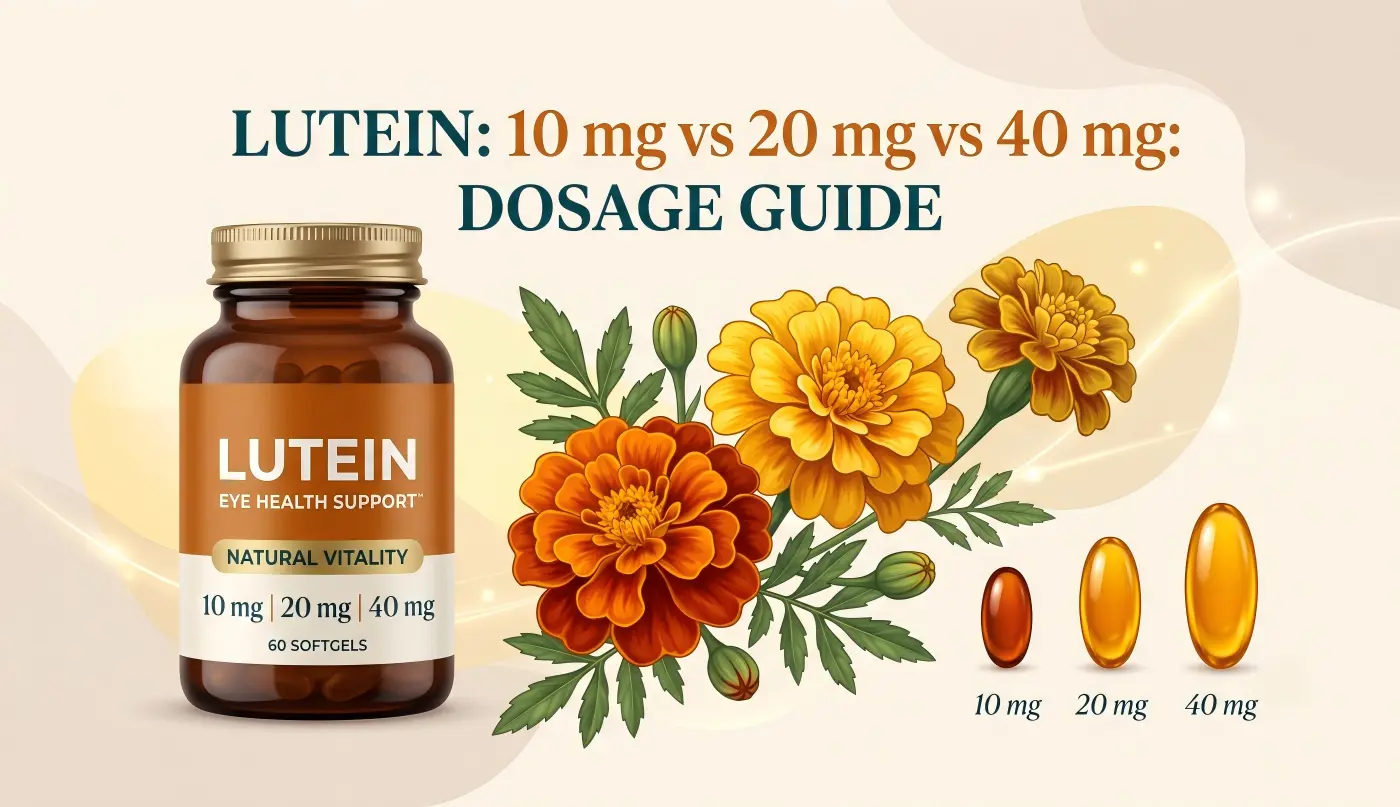
Lutein products are commonly sold at 10 mg, 20 mg, and 40 mg per serving. A shopper comparing a 20 mg softgel with a 10 mg gummy may assume that the larger number is automatically the better product. For a brand owner or formulator, the decision is more complex.
These strengths serve different commercial and formulation purposes. A higher labeled amount does not automatically produce proportionally greater absorption, macular-pigment response, or visual outcomes. In the United States, lutein has no Recommended Dietary Allowance (RDA), no FDA Daily Value (DV), and no established Tolerable Upper Intake Level (UL).
The AREDS2 clinical trial included 10 mg lutein and 2 mg zeaxanthin as part of a specific multi-nutrient formula studied in a defined population. It was not a universal daily recommendation for healthy consumers.
Selecting a lutein strength therefore requires a combined review of evidence, intended consumer, dosage form, ingredient specification, cost, label design, and target-market requirements.
This article addresses formulation and product-development decisions. It does not provide an individual medical dosage recommendation.
How Much Lutein per Day Is Recommended?
No Universal Official Daily Recommendation
No single official daily amount applies to every consumer. In the United States:
- Lutein does not have a Recommended Dietary Allowance.
- Lutein does not have an FDA Daily Value.
- Lutein does not have a unified Tolerable Upper Intake Level set by the Food and Nutrition Board.
A 10 mg, 20 mg, or 40 mg product should therefore not be described as an “FDA-recommended” or “officially recommended” lutein dose.
Study Dosage Is Not a General Recommendation
Research doses are selected for a particular question, formula, and participant group. A trial that uses 10 mg does not establish 10 mg as the correct amount for every product or person.
Likewise, a 20 mg or 40 mg formula is not automatically two or four times as effective. Research used to support a claim should match the ingredient form, amount, dosage format, finished formula, and intended population as closely as possible.
Consider Total Intake
Lutein is also consumed in foods such as dark leafy greens, corn, and egg yolks. Total intake includes food and every supplement a consumer takes.
A multivitamin, a dedicated eye-health formula, and a carotenoid blend may all contribute lutein. Directions for use and consumer education should account for this real-world stacking behavior.
When Professional Advice Matters
People with a diagnosed eye condition, people already using an AREDS2-type product, people taking multiple supplements, pregnant or breastfeeding people, children, and people receiving medical treatment should consult a qualified healthcare professional before choosing or changing a supplement regimen.
Understanding “Per Capsule,” “Per Serving,” and “Per Day”
The most common source of dosage confusion is that these three values are not interchangeable.
Lutein Per Unit
“Per capsule,” “per softgel,” “per tablet,” or “per gummy” identifies the amount in one physical unit.
For example, a capsule may contain 10 mg lutein. If the directions call for two capsules each day, the daily amount is 20 mg.
Lutein Per Serving
The Supplement Facts panel declares the amount per labeled serving. Two products can both deliver 20 mg per serving while using different formats:
- Serving Size: 1 capsule — Lutein: 20 mg per serving
- Serving Size: 2 gummies — Lutein: 20 mg per serving, or 10 mg per gummy
Lutein Per Day
The actual daily total depends on:
- The amount in each unit
- Units per serving
- Servings used per day
- Concurrent lutein-containing products
Labeling Controls to Build Into the Specification
- Keep the front-panel amount consistent with the Supplement Facts panel and directions for use.
- Make the serving size easy to find; do not make a two-unit serving look like a per-capsule claim.
- Declare active lutein content, not merely the input weight of a raw-material blend.
- Do not treat lutein ester weight as identical to free lutein without documented conversion and assay support.
- State the ingredient source accurately and retain the technical documentation used for the declaration.
In the United States, the Supplement Facts panel must identify serving size and declare the amount of each listed dietary ingredient per serving. The final format and declaration basis should be reviewed by qualified regulatory personnel for the sales market.
Lutein 10 mg: Foundational Daily-Nutrition Positioning
Why It Is Familiar
Ten milligrams is widely recognized because AREDS2 included 10 mg lutein plus 2 mg zeaxanthin.
The number alone does not make a product an AREDS2 product. AREDS2 also included vitamin C, vitamin E, zinc, and copper, and it was studied in a defined population.
A standalone 10 mg lutein product should not imply that it is equivalent to the study formula or can use disease-related AREDS2 language.
Best-Fit Positioning
A 10 mg format can fit:
- Daily eye-nutrition products
- Entry-level SKUs
- Lutein-and-zeaxanthin combinations
- Multivitamins with added lutein
- Digital-lifestyle nutrition lines
Claims such as “approved dose,” “guaranteed effective dose,” “prevents macular degeneration,” or “clinically proven for everyone” should be avoided.
Formulation Advantages
At this level, formulators usually have more room for zeaxanthin, vitamins, minerals, or botanical extracts.
Ten milligrams can work in a capsule, softgel, tablet, gummy, or powder format and often supports mass-market price points. The lower active load can simplify unit size, color management, and cost control.
Limitations
A 10 mg product may offer less shelf differentiation when the brand strategy centers on high potency. Complex co-formulas can still face size limits.
Any reference to AREDS2 must be reviewed against the complete formula, population, and permitted claims—not just the lutein amount.
Lutein 20 mg: A Recognizable Upgrade Tier
Why Brands Choose It
Lutein 20 mg creates a visible step up from 10 mg, works well as a standalone SKU, and can support a premium daily eye-nutrition position.
It also creates a straightforward product ladder:
- Entry SKU: Lutein 10 mg
- Upgrade SKU: Lutein 20 mg
Whether terms such as “high strength” are acceptable depends on the country, category, competitive context, and supporting substantiation.
Dosage-Form Options
A 20 mg serving may be delivered in:
- An oil-based softgel
- A powder or beadlet hard capsule
- A tablet
- A two-gummy serving
- A sachet or stick pack
The most practical option depends on ingredient potency and the rest of the formula.
Raw-Material Calculation Example
The amount of input material is not the same as the label claim.
For illustration, before allowing for assay variation, processing loss, and overage:
- A 10% lutein ingredient requires about 200 mg of input material to deliver 20 mg lutein.
- A 20% lutein ingredient requires about 100 mg.
- A 5% lutein ingredient requires about 400 mg.
Production calculations must use the batch-specific assay, moisture, carrier content, stability data, and a scientifically justified overage policy.
Commercial Trade-Offs
The 20 mg tier provides strong label visibility and an easy-to-explain premium position.
It also increases raw-material spend, may increase capsule or gummy load, and can make color, oxidation, and stability management more important.
Structure/function claims still require substantiation relevant to the finished product. A larger label number is not substantiation by itself.
Lutein 40 mg: High-Strength, Higher-Complexity Formulation
Why 40 mg Products Exist
A 40 mg formula is usually a market-positioning choice. It can differentiate a single-ingredient line, create a specialty or premium SKU, and compete on specification-led e-commerce listings.
These commercial reasons must not be converted into a claim that 40 mg has stronger clinical effects.
Is Lutein 40 mg Better Than 20 mg?
Not on milligrams alone.
Higher intake does not guarantee proportionally higher absorption, macular-pigment response, or visual outcomes. The evidence must be evaluated for the actual dose, population, ingredient form, and finished formula.
For product development, 20 mg versus 40 mg is first a positioning and engineering decision, not a simple “better versus worse” conclusion.
Formulation Impact
A 40 mg serving consumes more fill volume and may require:
- A larger capsule
- A multi-capsule daily serving
- A higher-potency ingredient
- More gummies per serving
- More intensive color and flavor management
- Stronger oxidation and stability controls
With a 10% ingredient, 40 mg active lutein theoretically requires about 400 mg of raw material before excipients and process allowances.
Safety and Regulatory Review
No U.S. UL does not mean that a high-dose formula is automatically suitable for every person or market.
EFSA has established an Acceptable Daily Intake of 1 mg/kg body weight per day for specified high-purity lutein preparations derived from Tagetes erecta. That assessment applies to defined specifications and is not a general recommended dose for all lutein supplements.
Review total dietary and supplemental exposure, ingredient identity, dosage, intended population, and local regulatory requirements before launch.
Lutein 10 mg vs 20 mg vs 40 mg at a Glance
| Factor | 10 mg | 20 mg | 40 mg |
| Typical positioning | Foundational daily nutrition | Upgrade-tier or premium daily nutrition | High-strength or specialized SKU |
| Common dosage forms | Capsule, softgel, gummy | Softgel, capsule, tablet, two-gummy serving | Large capsule, softgel, or multi-unit serving |
| Room for co-ingredients | High | Moderate | Limited |
| Relative cost | Lower | Moderate | Higher |
| Label recognition | High, especially the 10 + 2 pairing | Strong upgrade-tier recognition | High-specification visibility |
| Main risk | Misusing AREDS2 messaging | Implying double the amount equals double the effect | Weak dose justification, format burden, and regulatory review |
The preferred strength is the lowest amount that is commercially viable, scientifically defensible, suitable for the dosage form, and compliant in the intended market.
Lutein and Zeaxanthin Combinations
10 mg Lutein + 2 mg Zeaxanthin
This 5:1 ratio is the most familiar market pairing because it matches the carotenoid amounts in AREDS2.
A 10 + 2 product is still not the complete AREDS2 formula and should not borrow the trial’s disease-related language.
20 mg Lutein + 4 mg Zeaxanthin
Doubling both ingredients preserves the ratio and is a reasonable design example for an upgrade tier.
It is not a universal industry standard, and it does not establish that the formula is twice as effective as 10 + 2.
Confirm the zeaxanthin source, assay, regulatory status, and evidence base for each target market.
40 mg Lutein With Zeaxanthin
At this level, total carotenoid load, capsule size, serving-unit count, price, stability, and label readability become central development constraints.
The ratio is only one design parameter. Two formulas can have the same ratio but very different absolute amounts, ingredient forms, and product performance.
Select a Strength by Consumer and Product Positioning
General Daily Eye Nutrition
A 10 mg formula, including a 10 mg lutein plus 2 mg zeaxanthin option, can offer a familiar and accessible foundation for the general adult market.
Digital Lifestyle
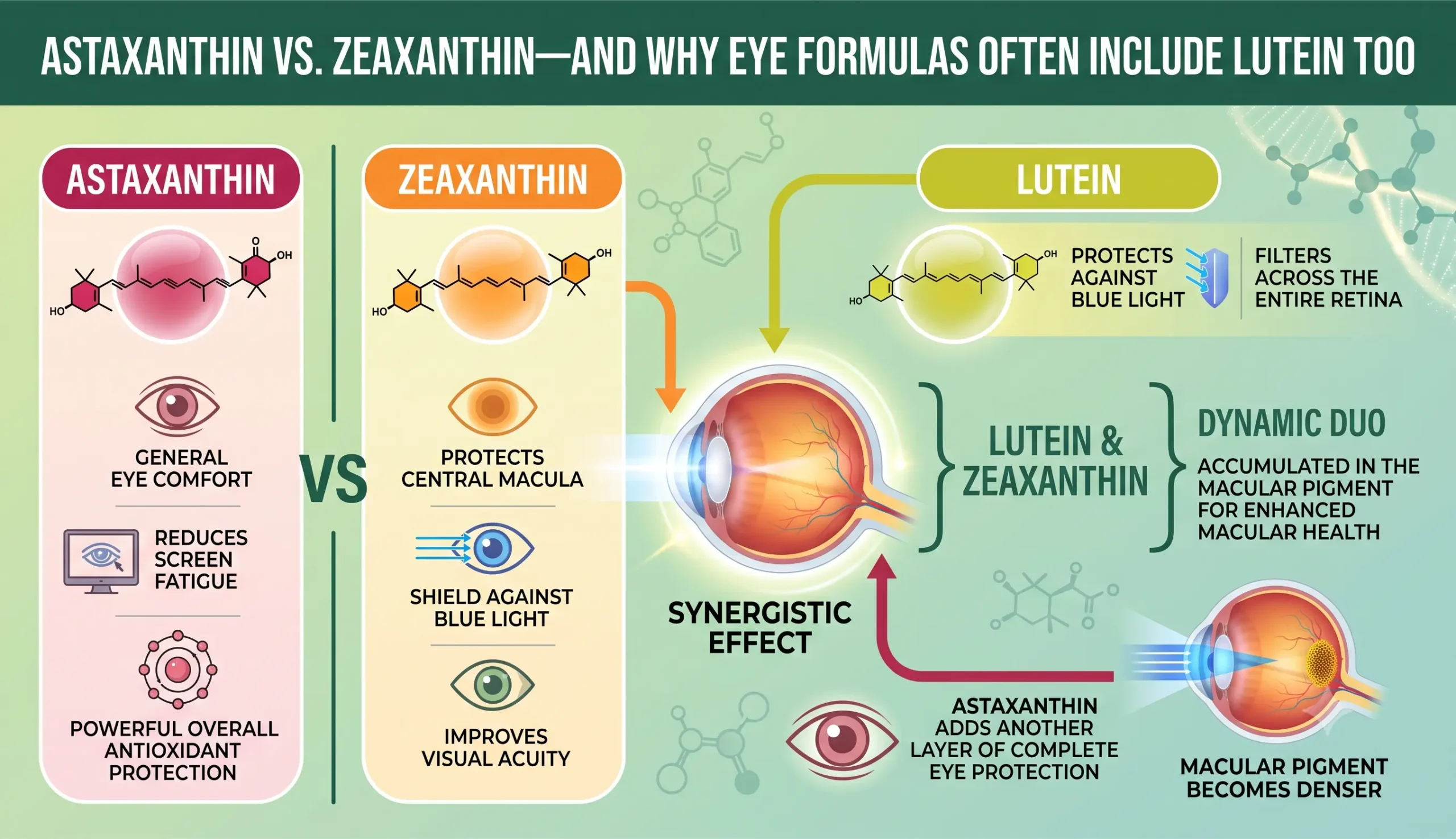
A 10 mg or 20 mg product, sometimes formulated with zeaxanthin, astaxanthin, or bilberry, can fit screen-oriented lifestyle positioning.
Match the amount and messaging to the supporting evidence. Do not imply treatment of digital eye strain or prevention of screen-related damage.
Healthy Aging
A 10 + 2 combination or a 20 mg product may fit a healthy-aging line.
Avoid claims that a supplement prevents age-related macular degeneration, stops vision loss, or prevents cataracts.
Premium High-Strength Positioning
A 20 mg or 40 mg standalone lutein product or carotenoid complex may anchor a premium range when the brand can explain the format, ingredient quality, and value without relying on a “more is always better” message.
Professional-Channel Products
Products designed around AREDS2-type formulas or diagnosed populations need medical and regulatory review, a clearly defined intended population, and appropriately cautious copy.
A general consumer blog should not encourage self-selection for a diagnosed condition.
How Dosage Changes the Dosage Form
Softgels
- Softgels suit oil suspensions and can pair lutein with other fat-soluble ingredients.
- All three strengths are possible, but higher loads increase fill volume and require control of sedimentation and oxidation. A lutein softgel manufacturing partner can advise on practical fill limits for the selected shell size.
Hard Capsules
- Capsules work well with powders and beadlets.
- Ten milligrams normally leaves substantial space for co-ingredients. Twenty milligrams has a more noticeable volume impact. Forty milligrams may require higher-potency material or multiple daily units.
Tablets
- Tablets can support multi-ingredient eye-nutrition formulas, especially when vitamins and minerals are included.
- Evaluate active load, compression force, final tablet size, disintegration, and the integrity of any protective microencapsulation.
Gummies
- A 10 mg amount can be delivered in one gummy or a two-gummy serving. Twenty milligrams commonly requires two gummies.
- At 40 mg, individual gummy size or the daily count may become commercially unattractive. Consider sugar and calorie load, color, flavor, heat stability, and content uniformity.
Powders and Stick Packs
- These formats can accommodate higher active loads and additional nutrients, but require work on dispersibility, flavor masking, color control, and oxidation stability.
Cost Drivers Beyond the Milligram Number
Raw-Material Specification
Cost depends on:
- Potency
- Free lutein versus lutein esters
- Oil suspension versus powder or beadlet
- Branded versus generic supply
- Origin
- Quality documentation
The same labeled amount can have very different input costs.
Formula and Packaging
Higher strengths can increase:
- Active-material cost
- Antioxidant-protection requirements
- Unit size
- Packaging dimensions
- Stability-testing needs
- Working capital tied up in each batch
Testing and Risk
Every strength requires suitable identity, assay, content-uniformity, microbiological, heavy-metal, and stability controls.
A higher dose does not necessarily double each testing fee, but it can increase the value at risk if a batch fails.
Unit Economics
Model:
- Cost per unit
- Cost per daily serving
- Days of use per bottle
- Target retail price
- Channel margin
- Expected repurchase cycle
The lowest cost per milligram is not always the best business case.
Labeling and Claims Checklist
- Declare active lutein content accurately and reconcile per-unit, per-serving, and directions-for-use values.
- Do not create a %DV for lutein; in the United States, no Daily Value has been established.
- Use “amount per serving” or “common market strength,” rather than “official recommended dose” or “FDA-recommended dosage.”
- Support every structure/function claim with competent and reliable evidence appropriate to the claim and the finished product.
- Do not make disease claims, including statements that the product prevents AMD, treats cataracts, reverses vision loss, cures dry eyes, or prevents retinal disease.
- Obtain legal and regulatory review for the label, website copy, and advertising in every intended market.
Building a Multi-SKU Lutein Line
Good-Better-Best Architecture
One practical ladder is:
- Good: Lutein 10 mg
- Better: Lutein 20 mg plus zeaxanthin
- Best: Lutein 20 mg plus zeaxanthin and differentiated supporting ingredients such as astaxanthin or bilberry
Don’t let 40 mg alone define “best.” Formula quality, dosage form, substantiation, and consumer experience create more durable differentiation.
Lifestyle, Format, and Channel Architecture
The line can alternatively be organized around:
- Daily Eye Nutrition
- Screening Wellness
- Healthy Aging
- Premium Carotenoid Complex
A 10 mg gummy, a 20 mg capsule, a 20 mg softgel, and a multi-ingredient tablet can serve different preferences.
Align SKU specifications to retail, e-commerce, professional, subscription, and pack-size requirements.
Avoid Cannibalization
Each SKU should have a distinct consumer, format, supporting-ingredient profile, price band, or pack cycle.
If two products differ only by milligrams, shoppers may not understand the price difference. An experienced lutein supplement manufacturer can help map the architecture before tooling begins.
OEM Formula Development Process
Step 1: Define the Market
Confirm the target country, target consumer, sales channel, target retail price, competitive set, and projected volume.
Step 2: Select the Strength
Choose 10 mg, 20 mg, or 40 mg based on evidence, positioning, format, daily unit count, raw-material potency, cost, and market requirements.
Step 3: Select Supporting Ingredients
Evaluate zeaxanthin, astaxanthin, bilberry, saffron, vitamins, minerals, or omega-3, with compatibility and claim substantiation in mind.
Step 4: Prototype and Test
Confirm unit size, color, appearance, units per serving, content uniformity, and preliminary stability.
Step 5: Review Label and Claims
Verify serving size, amount per serving, front-panel dose statement, directions, structure/function claims, required disclaimers, and country-specific requirements.
Step 6: Scale and Substantiate Shelf Life
Complete process validation, finished-product testing, packaging selection, accelerated and real-time stability programs, and shelf-life substantiation.
Working with an OEM partner experienced in private label lutein formulas can shorten the path from concept to a manufacturable and compliant product.
Frequently Asked Questions
How Much Lutein Per Day Should a Person Take?
There is no single official dose for everyone. Diet, product formula, health status, total supplemental intake, and professional advice all matter.
Is Lutein 20 mg a High Dose?
It is commonly marketed as a step above a foundational 10 mg product. Whether “high strength” is appropriate depends on market context, evidence, and substantiation.
Is Lutein 40 mg Better Than 20 mg?
Not by amount alone. Benefits do not automatically scale with milligrams, so the appropriate choice is a formulation and positioning decision supported by evidence.
What Is the Difference Between Lutein 10 mg and 20 mg?
The main differences are amount per serving, cost, dosage-form load, space for co-ingredients, and market positioning.
Can a Product Contain 40 mg in One Capsule?
Possibly, depending on ingredient potency, capsule size, fill system, and other ingredients. Some products will require a large capsule or multiple daily units.
What Is a Common Lutein and Zeaxanthin Dosage?
Ten milligrams lutein plus 2 mg zeaxanthin is a familiar market combination, but it is not a universal recommendation for every person.
Is 10 mg Lutein the Same as AREDS2?
No. AREDS2 was a specific multi-ingredient formula containing vitamins, minerals, lutein, and zeaxanthin. A standalone 10 mg product is not an AREDS2 formula.
Does Lutein Have an FDA Daily Value?
No. There is no established U.S. Daily Value for lutein.
Choose a Strength Based on Evidence and Product Strategy
Ten, 20, and 40 mg each have a role: foundational daily nutrition, an upgrade tier, and a high-strength specialty SKU.
A larger number does not establish a stronger effect. Brands should distinguish per-unit, per-serving, and per-day amounts; calculate from active content rather than raw-material weight; treat the lutein-to-zeaxanthin ratio as one design input; and complete scientific, regulatory, and stability review for every SKU.
Planning a 10 mg, 20 mg, or 40 mg formula? Share your target market, dosage form, supporting ingredients, serving size, packaging, and estimated order quantity. The custom lutein supplements team at KSNutripharma can help evaluate a practical formula and provide options for lutein and zeaxanthin supplements.
KSNutripharma — OEM & Private Label Available
- MOQ:3,000–5,000 units (varies by dosage form and packaging)
- Lead Time: 3–4 weeks after order confirmation
- Certifications: GMP · ISO 22000 · HACCP
- Dosage Forms: Softgels, Capsules, Tablets, Gummies, Stick Packs
- Daily Capacity: Softgels 3 million · Capsules 2 million · Gummies 1 million units/day
- Request a Quote: Share your formula brief for a tailored proposal within 24 hours
Discuss Your Lutein Formula • Request an OEM Quote • Compare Dosage Form Options
Related Resources
- Lutein Ester vs. Free Lutein: How to Choose for Your Formula
- Eye Health Supplement Formulation Guide
Lutein Gummies: Ingredients, Dosage and Manufacturing Challenges
Lutein and Zeaxanthin Supplements Formulation Guide for Eye-Health Brands
References:
- National Eye Institute: AREDS/AREDS2 research and formula information
- NIH Office of Dietary Supplements: nutrient recommendations and dietary-supplement information
- S. FDA: Dietary Supplement Labeling Guide and Supplement Facts requirements
- EFSA: re-evaluation of lutein and related safety opinions
- S. Federal Trade Commission: Health Products Compliance Guidance
Educational content only. This material is intended for product-development and general information purposes and is not medical advice. Claims, labeling, and ingredient compliance must be reviewed for each finished product and sales market.