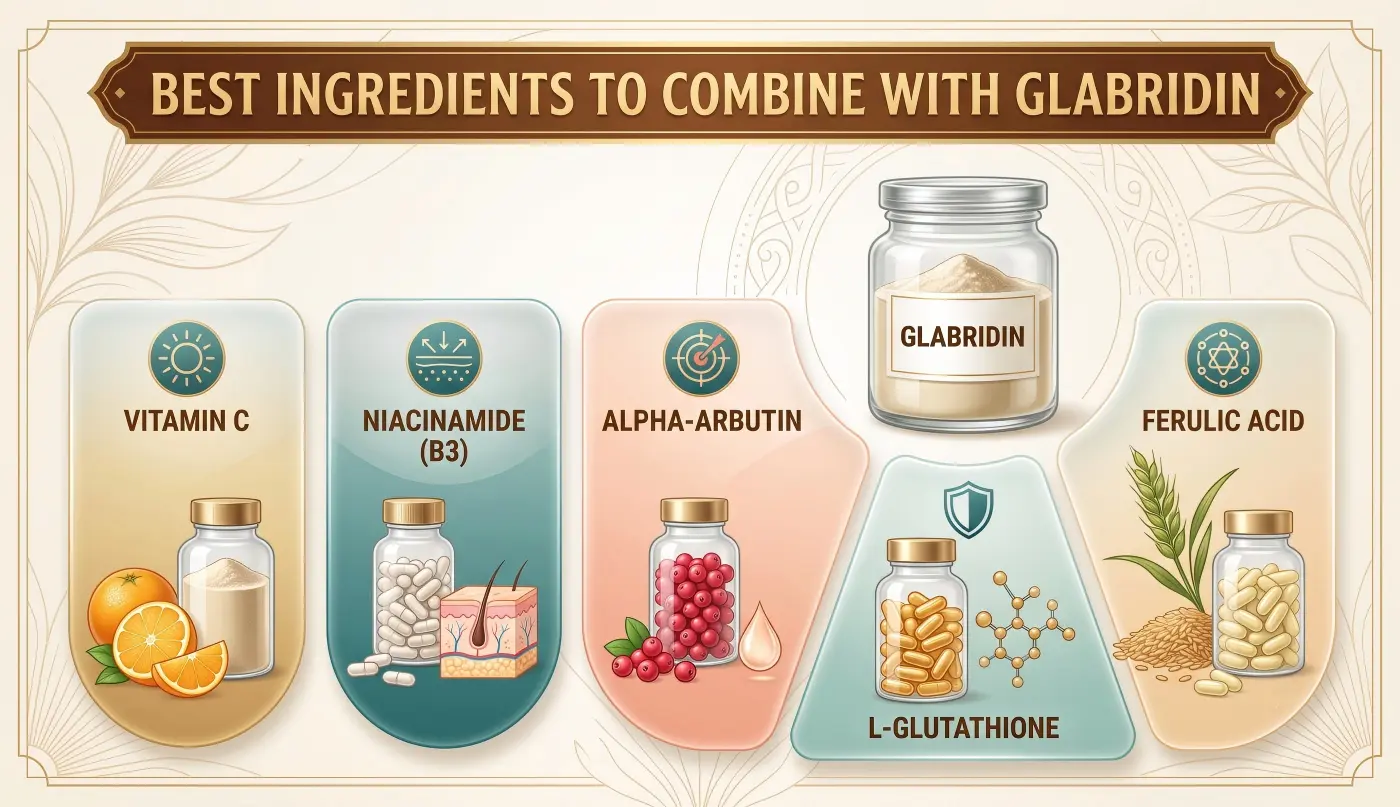
1. Quick Answer: Decision Matrix by Goal
| Goal | Best starting combination | Why this pairing wins commercially |
|---|---|---|
| Reduce melanin-production pressure (cosmetic) | Glabridin + Vitamin C + Niacinamide | Triple-pathway coverage (tyrosinase + antioxidant + melanosome transfer) with wide formulary flexibility |
| Support appearance of uneven tone/spots | Glabridin + Tranexamic acid (topical cosmetic rules permitting) | Complementary tone-evening narrative; strong claim architecture where legally viable |
| Antioxidant / photoaging-support stack | Glabridin + Astaxanthin | Lipid-phase antioxidant synergy; excellent softgel story |
| Oral beauty brightening narrative | Glabridin + Glutathione (+ Vitamin C) | High consumer search volume; redox + melanogenesis dual positioning |
| Anti-inflammatory brightening story | Glabridin + Resveratrol | Premium positioning; appeals to inflammaging-aware consumers |
| UV-lifestyle oral support | Glabridin + Polypodium leucotomos (+ SPF education) | Photoprotection-adjunct research tradition; summer SKU anchor |
| Barrier repair while brightening | Glabridin + Ceramides | Reduces irritation-driven PIH risk; sensitive-skin launch enabler |
| Anti-aging brightening oral platform | Glabridin + Collagen peptides | Platform builder for powders/gummies/kits; high repeat-purchase potential |
2. Top 10 Best Glabridin Combinations (Ranked)
#1 — Glabridin + Niacinamide
Why it ranks high: Different pathway themes + high formulary practicality.
- Niacinamide is stable across a wide pH window (pH 5.0–7.0), making it forgiving when paired with glabridin emulsions.
- The pair tolerates moderate heat, which simplifies emulsion manufacturing.
- Watch point: Niacinamide purity matters. Low-grade niacinamide can contain residual nicotinic acid, which potentiates flushing and irritation—especially problematic for PIH-prone skin types.
#2 — Glabridin + Vitamin C
Why it ranks high: Antioxidant + brightening complementarity (validate pH/oxidation).
- Ascorbic acid is the stability project. In our OEM telemetry, 60% of “failed” vitamin C + glabridin serums trace back to packaging oxidation, not formula chemistry.
- Best practice: Airless opaque pumps, nitrogen blanketing during fill, and pH 3.0–3.5 for ascorbic acid stability. If using magnesium ascorbyl phosphate (MAP) or ascorbyl glucoside, pH flexibility improves but potency per unit weight drops.
- Color masking: Glabridin + oxidized vitamin C can produce amber-to-brown drift. Specify color batch limits in your QC protocol.
#3 — Glabridin + Topical TXA
Why it ranks high: Strong complementary story where cosmetic rules allow.
- Regulatory boundary is the #1 failure mode. In several jurisdictions, TXA is prescription-only or restricted in cosmetic concentrations. Verify local cosmetic vs. drug classification before concepting.
- TXA is water-soluble and heat-stable, making it easy to incorporate in the water phase.
- Pairing with glabridin in an emulsion requires attention to electrolyte load if using ionic emulsifiers.
#4 — Glabridin + Ceramides
Why it ranks high: Barrier-first reduces irritation-driven darkening risk.
- This pairing is our most requested “sensitive skin” launch concept. It allows brands to enter the brightening category with a “barrier-safe” narrative.
- Ceramide complexes often require lamellar phase engineering (liquid crystal structures) for bioavailability—do not simply stir them in.
- Cost note: High-purity ceramide NP is expensive. A 1:3:1 ratio (ceramide:cholesterol:free fatty acid) is often more cost-effective than ceramide alone.
#5 — Glabridin + Astaxanthin
Why it ranks high: Photoaging-support oral narrative.
- Astaxanthin is oxygen- and light-sensitive. Softgel encapsulation with nitrogen flush and opaque banding is standard.
- Color impact: Astaxanthin + glabridin in a gummy or powder will produce a salmon-to-orange hue. Plan color masking or embrace it as a “natural” positioning.
- Astaxanthin has a strong photoaging-support literature base but limited direct “skin brightening” human RCTs. Keep claims disciplined: “supports skin exposed to oxidative stress.”
#6 — Glabridin + Glutathione
Why it ranks high: High search + inside-out antioxidant positioning (claims must stay honest).
- Bioavailability is the project. Plain glutathione has poor oral stability and absorption. Liposomal, S-acetyl-L-glutathione (SALG), or sublingual forms are preferred for beauty positioning. See Liposomal Glutathione Supplements.
- Glutathione oxidizes rapidly in moist environments. Powder sticks need single-serve sachets with low MVTR (moisture vapor transmission rate) film.
- Claim discipline: Human data on glutathione for “skin whitening” are heterogeneous. Market it as “antioxidant support for healthy-looking skin.”
#7 — Glabridin + Resveratrol
Why it ranks high: Luxury positioning; stability is the project.
- Resveratrol is notoriously unstable—light, oxygen, and pH >7 destroy it rapidly. Microencapsulation or cyclodextrin complexation is often required.
- Color shift: Resveratrol + glabridin can produce pink-to-brown oxidation products. Opaque packaging is mandatory.
- This pairing commands premium pricing but requires higher COGS and stability investment.
#8 — Glabridin + Alpha-Arbutin
Why it ranks high: Dual tyrosinase-related lane—dose carefully.
- Irritation stacking risk. Two tyrosinase inhibitors + no barrier support = higher probability of sensitization. Always pair with ceramides or panthenol in the same formula.
- Alpha-arbutin has regulatory scrutiny in some markets (EU concentration limits, hydroquinone impurity concerns). Verify COA for hydroquinone content (< ppm limits).
- Water-soluble; add to water phase.
#9 — Glabridin + Hyaluronic Acid (HA)
Why it ranks high: Supports radiant appearance chassis.
- HA molecular weight matters. High-MW HA (1.0–1.5 MDa) films the surface; low-MW HA (50–130 kDa) penetrates deeper. Multi-weight blends are standard for “hydration + brightening” serums.
- HA is pH- and heat-tolerant, making it the easiest partner in this list.
- Cost efficiency: HA is inexpensive per unit. It allows you to build volume in a serum while keeping the glabridin contribution precise.
#10 — Glabridin + Collagen Peptides
Why it ranks high: Platform builder for powders/gummies/kits.
- Collagen peptides are highly hygroscopic. Powder sticks need silica desiccant inserts and low-MVTR packaging.
- Taste masking: Collagen has a mild umami/savory note. In gummies, this conflicts with glabridin’s slight licorice-bitter character. Flavor engineering is required.
- This is a “platform” SKU—high repeat purchase, subscription-friendly.
3. Best Partner by Goal (Quick Reference)
| Goal | Best partner (with glabridin) |
|---|---|
| Sensitive skin | Ceramides |
| Faster uneven-tone appearance support (cosmetic) | Topical tranexamic acid |
| Daily maintenance | Niacinamide |
| Oral beauty | Glutathione and/or Vitamin C |
| Premium anti-aging oral | Astaxanthin |
| Barrier recovery | Ceramides |
| Dark-spot appearance cosmetics | Alpha-arbutin |
| Summer / outdoor lifestyle | Polypodium leucotomos or Astaxanthin (+ SPF) |
| Clear water essence | Water-dispersible glabridin grade + Niacinamide |
| Emulsion cream | Oil-soluble glabridin + Niacinamide + Ceramides |
4. Brightening Pathway Diagram (Where Partners Act)
UV exposure
-> ROS                              <- Vitamin C / Astaxanthin / Resveratrol support themes
-> Inflammation pressure            <- TXA / soothing agents (context-dependent)
-> MITF / melanogenesis signaling
-> Tyrosinase-related activity      <- Glabridin / Alpha-arbutin themes
-> Melanin synthesis pressure
-> Melanosome transfer narratives   <- Niacinamide themes
-> Visible uneven tone / spots
-> Barrier status modulates outcome <- Ceramides / HA / PanthenolOral platforms add systemic antioxidant / matrix-appearance support (glutathione, collagen, polypodium adjuncts)—still with SPF as the foundation.
5. Clinical Evidence Pyramid
| Evidence type | Relative strength for claim design |
|---|---|
| Meta-analysis / systematic review | Highest |
| Human RCT | Very high |
| Controlled clinical trial | High |
| Pilot / open-label human study | Moderate |
| Animal / UV pigmentation model | Lower translational |
| Cell / mechanistic study | Foundational only |
6. Partner Evidence Posture (Lane Evidence—Not Fixed-Pair RCTs)
| Partner | Typical evidence density in its own lane | Pairing confidence with glabridin* |
|---|---|---|
| Niacinamide | Very high (selected cosmetic endpoints) | 5/5 complementary rationale |
| Vitamin C | High (nutrition + topical literature vary by form) | 4/5 |
| Topical TXA | High in tone-evening / pigment-adjacent literature | 5/5 complementary rationale |
| Ceramides | High for barrier/hydration appearance | 4/5 |
| Alpha-arbutin | Moderate-high in cosmetic brightening lane | 4/5 (watch stacking irritation) |
| Astaxanthin | Moderate (photoaging-support studies, study-dependent) | 3/5 |
| Glutathione (oral) | Mixed/heterogeneous for beauty endpoints | 3/5 |
| Collagen peptides | Moderate-strong for selected peptides/doses | 3/5 platform logic |
| Resveratrol | Moderate | 3/5 |
| Polypodium | Moderate photobiology adjunct literature | 3/5 |
| Glabridin alone | Stronger mechanistic + limited human pilots[1][2][3] | Baseline |
7. What We Have Learned from Commercial Glabridin Projects
Example 1 — Packaging beats theory for vitamin C stacks
Example 2 — 98% and 10% are not interchangeable chassis decisions
Example 3 — Overloading brighteners raises irritation more than efficacy
- 1 hero brightening active
- + 2–3 supporting ingredients
- + SPF education
Example 4 — Water compatibility is a form decision, not a wish
Example 5 — The “regulatory surprise” at launch
8. Why Ingredient Combinations Matter
9. How Glabridin Works (Combination Context)
10. Principles for Selecting Synergistic Ingredients
| Principle | What good partners do |
|---|---|
| Complementary mechanisms | Hit a different step than glabridin alone |
| Different biological targets | Avoid redundant BOM cost with no new story |
| Improved stability | Do not destroy assay via pH, oxygen, or heat abuse |
| Enhanced handling/delivery | Match oil- vs water-soluble glabridin grade to chassis |
| Consumer-friendly positioning | One clear hero + 2–3 supports |
| Regulatory fit | Keep cosmetic vs supplement vs drug claim worlds separate |
11. Best Ingredients to Combine with Glabridin (Detailed Profiles)
1). Vitamin C
2). Glutathione
3). Niacinamide
4). Tranexamic Acid (topical cosmetic use)
5). Astaxanthin
6). Resveratrol
7). Ceramides
8). Collagen Peptides
9). Hyaluronic Acid
10). Alpha-Arbutin
11). Other Licorice Flavonoids
12). Polypodium Leucotomos
12. Best Glabridin Combinations by Mechanism
| Ingredient | Main mechanism theme | Oral | Topical | Best for | Evidence posture* |
|---|---|---|---|---|---|
| Vitamin C | Antioxidant / topical brightening | Yes | Yes | Overall radiance stacks | High complementary rationale |
| Glutathione | Redox/beauty antioxidant narrative | Yes | Limited | Oral beauty | Moderate (mixed beauty endpoints) |
| Niacinamide | Melanosome transfer + barrier | Limited | Yes | Sensitive daily serums | High complementary rationale |
| Tranexamic acid (topical) | Tone-evening cosmetic use | Limited | Yes | Spot / uneven-tone serums | High complementary rationale |
| Astaxanthin | Lipid antioxidant/photoaging support | Yes | Optional | Softgel platforms | Moderate |
| Resveratrol | Anti-inflammatory / aging beauty | Yes | Yes | Premium positioning | Moderate |
| Alpha-arbutin | Tyrosinase-related | — | Yes | Dark-spot cosmetics | Moderate-high in lane |
| Ceramides | Barrier repair | Yes | Yes | Sensitive brightening | High for barrier endpoints |
| Collagen peptides | Dermal appearance support | Yes | — | Beauty powders/gummies | Moderate-strong (specific peptides) |
| Polypodium | Photoprotection adjunct research | Yes | — | Sun-lifestyle oral | Moderate |
| HA | Hydration appearance | — | Yes | Serum chassis | High for hydration optics |
13. Evidence Strength Matrix (Combination Honesty)
| Combination | Human evidence on the fixed pair | Mechanistic complementarity | Overall confidence for education |
|---|---|---|---|
| Glabridin + Vitamin C | Limited direct pair trials | Strong | High |
| Glabridin + Glutathione | Limited direct | Moderate-strong story; mixed glutathione beauty data | Moderate |
| Glabridin + Niacinamide | Limited direct | Strong | High |
| Glabridin + Topical TXA | Limited direct | Strong | High |
| Glabridin + Astaxanthin | Emerging / brand-specific | Moderate | Moderate |
| Glabridin + Ceramides | Limited direct | Strong for tolerant brightening | High |
| Glabridin + Collagen | Limited direct | Platform logic strong | Moderate |
14. Who May Not Be Good Candidates
| Situation | Why caution is required |
|---|---|
| Pregnancy/breastfeeding | Do not self-select strong topical or oral actives |
| Active/diagnosed melasma | Often needs dermatology-directed care—not DIY ingredient shopping |
| Vitiligo or complex pigment disorders | Wrong tool risk; specialist care first |
| Current prescription hydroquinone users | Do not self-stack acids/retinoids/extra lighteners mid-protocol |
| Recent chemical peel/laser/microneedling | Barrier is compromised; follow clinician aftercare only |
| History of exogenous ochronosis or severe irritation | Medical history matters |
| Considering oral tranexamic acid | Oral TXA is a medicine-context decision in many markets—not a casual beauty supplement “booster” |
| Anticoagulant therapy/clotting disorders (especially if oral TXA is discussed) | Physician-only territory |
| Broken barrier, eczema flares, or active dermatitis | Calm barrier first |
15. Ingredients and Conditions That Do NOT Pair Well with Glabridin
| Poor pairing pattern | Why it fails commercially |
|---|---|
| Excessive AHA/BHA load + multiple brighteners | Barrier injury can worsen uneven tone |
| High-strength retinol stacked with acids + glabridin at launch | Irritation cascade |
| Benzoyl peroxide + unstable antioxidant brightening chassis | Oxidation/irritation stress |
| Ultra-low-pH high-% vitamin C without pack/process control | Glabridin and vitamin C both suffer; consumers sting out |
| Unvalidated copper-peptide + multi-active brightening soup | Compatibility and claim complexity often exceed benefit |
| Fragrance-heavy “whitening perfume creams” | Sensitization risk disguised as efficacy |
| Native oil-soluble glabridin forced into clear water mist | Haze/sedimentation / nozzle clog |
| Oral TXA casually added to gummy briefs | Regulatory and safety category error |
16. Manufacturing Compatibility Matrix
| Ingredients/system | Heat | pH window sensitivity | Light | Oxygen | Preferred process note |
|---|---|---|---|---|---|
| Glabridin (oil-soluble) | Medium | Formula-dependent | Moderate | Moderate | Often oil-phase; control T x time |
| Glabridin (water-dispersible) | Medium | Carrier-dependent | Moderate | Moderate | Often post-cool water phase; protect carrier |
| Vitamin C (ascorbic) | Poor-moderate | Low pH common | Poor | Poor | Cold process + opaque/airless when possible |
| Niacinamide | Excellent | Relatively wide | Excellent | Excellent | Flexible; still confirm finished pH |
| Topical TXA | Excellent | Near-neutral common | Excellent | Excellent | Water phase |
| Astaxanthin | Medium | — | Poor | Poor | Softgel oxygen control |
| Glutathione | Medium | Formula-dependent | Moderate | Moderate | Protect redox-sensitive blends |
| Alpha-arbutin | Medium | Validate | Moderate | Moderate | Water phase common |
| Ceramides | Medium | — | Moderate | Moderate | Lamellar / emulsion design |
| Collagen peptides | Medium | — | Moderate | Moderate | Powder moisture control |
| HA | Good | Validate | Good | Good | Hydration phase |
17. Stability Considerations
| Stress factor | Why combination projects fail |
|---|---|
| Heat | Assay loss in hot process/gummy cook |
| Light | Color shift and potency drift in clear packs |
| Oxygen | Vitamin C / carotenoid / phenolic oxidation |
| Metal ions | Catalyze oxidation—watch water and equipment hygiene |
| Freeze-thaw | Haze, viscosity break, sedimentation |
| Moisture / RH | Powder caking; water-soluble carrier issues |
| Packaging permeability | Invisible long-term failure mode |
| Incompatible process sequence | Destroy liposomes / add heat-labile actives too early |
18. Why Some Glabridin Combinations Fail
| Root cause | What teams usually missed |
|---|---|
| Wrong purity/grade | Color, odor, cost-per-active mismatch |
| Wrong dose contribution | Brochure % copied without assay math |
| Wrong carrier/solubility form | Water vs oil chassis ignored |
| Poor emulsification / HLB match | Incomplete incorporation |
| Hostile pH | Actives degrade or sting |
| Packaging oxidation | Clear droppers for oxygen-sensitive stacks |
| No stability protocol | Launch on “looks fine on day 1” |
| No compatibility study | Interactions discovered by customer complaints |
| Claim overreach | Drug language on cosmetic/supplement SKUs |
19. Formulator Workflow (OEM Launch Path)
Target claim (cosmetic vs supplement)
-> Target consumer and sensitivity profile
-> Delivery form (serum / cream / capsule / softgel / gummy / stick)
-> Regulation and market lock
-> Choose hero active (glabridin grade + form)
-> Select 2–3 supporting ingredients by mechanism gap
-> Dose design (assay-based; cost per mg active)
-> Process map (phase, heat, shear, order of addition)
-> Stability + compatibility pilots
-> Packaging selection
-> Claim validation / safety assessment
-> Commercial launch + change control
20. Commercial Formula Case Studies (Frameworks Only)
Formula Example 1 — Sensitive Skin Brightening Serum (concept)
| Role | Example direction |
|---|---|
| Hero | Glabridin (assay-based contribution often discussed in low-tenths % for high-assay grades—validate) |
| Support | Niacinamide (commonly ~2% class in many cosmetics—confirm local norms) |
| Barrier | Ceramide NP + Panthenol |
| Chassis | HA / glycerin system |
| Pack | Airless opaque |
Formula Example 2 — Premium Brightening Capsule / Softgel Kit (concept)
- Vitamin C
- Astaxanthin (softgel-friendly)
+/- Collagen (separate stick/capsule if fill constraints)
Formula Example 3 — Brightening Gummies (concept)
- Glabridin project (color/taste constrained—grade choice critical)
+/- Ceramide oral
+/- Zinc (where nutritionally justified)
Formula Example 4 — Uneven-Tone Serum (concept)
- Topical TXA (cosmetic rules permitting)
- Niacinamide
- HA / panthenol
21. Formulation Strategies by Format
| Format | Strategy |
|---|---|
| Premium oral brightening | Glabridin project + glutathione + vitamin C +/- astaxanthin +/- collagen |
| Brightening serum | Glabridin + niacinamide +/- TXA + HA + panthenol + airless opaque pack |
| Sensitive cream | Glabridin + ceramides + oat/bisabolol + HA—minimize multi-acid launch stacks |
| Beauty powder stick | Collagen + vitamin C +/- glabridin project + flavor system |
22. Oral vs. Topical Combination Strategies
| Goal | Oral starting stack | Topical starting stack |
|---|---|---|
| Uneven-tone appearance support | Glabridin project + Vitamin C +/- Glutathione | Glabridin + TXA / Niacinamide |
| UV-lifestyle / photoaging support | Astaxanthin or Polypodium + SPF education | Glabridin + Vitamin C serum + SPF |
| Sensitive skin | Ceramides/collagen comfort narrative | Glabridin + Ceramides + Niacinamide |
| Anti-aging brightening | Collagen + Astaxanthin | Glabridin + Resveratrol / Niacinamide |
23. 2026 Market Trends (OEM Request Patterns)
| Trend | What buyers ask for |
|---|---|
| Brightening gummies | Up—if taste/stability can be solved |
| Beauty stick packs | Up—collagen + vitamin C platforms |
| Minimalist formulas | Up—1 hero + 2–3 supports |
| Watery essences/gels | Up—needs water-dispersible glabridin literacy |
| HQ-free global cosmetics | Up—regulatory and retailer pressure |
| Microbiome-friendly brightening | Emerging positioning language |
| Personalized / quiz-led kits | Emerging DTC architecture |
| Overbuilt 15-active “whitening bombs” | Down in serious OEM briefs |
24. Regional Regulatory Matrix (Critical for Combinations)
| Region / Market | Glabridin status | TXA (topical) status | Alpha-arbutin status | Key combination constraint |
|---|---|---|---|---|
| USA (FDA) | Cosmetic / supplement ingredient | Cosmetic if <2% (claim-dependent); drug if “treats melasma” | Cosmetic; hydroquinone impurity limits apply | Separate drug/cosmetic/supplement claims strictly |
| EU (CosIng) | Listed; glabridin from licorice root | Restricted; some member states require notification | Permitted; hydroquinone release testing required | Cosmetic claims only; no medical narrative |
| China (NMPA) | Permitted in cosmetics; restricted in supplements (new food raw material rules) | Prescription drug only | Permitted in cosmetics with concentration limits | Supplement glabridin requires new food raw material registration |
| ASEAN (ACD) | Generally permitted in cosmetics | Varies by member state (e.g., Thailand allows cosmetic TXA; Singapore restricts) | Generally permitted | Must check national annexes |
| Japan | Quasi-drug or cosmetic depending on claim | Quasi-drug for whitening claims | Cosmetic with safety standards | Whitening = quasi-drug pathway |
| Korea (MFDS) | Functional cosmetic (brightening) permitted | Functional cosmetic permitted under brightening category | Functional cosmetic permitted | Brightening claims require functional cosmetic approval |
25. Cost-Efficiency & BOM Framework
| Combination | Relative COGS impact | Commercial justification |
|---|---|---|
| Glabridin + Niacinamide + HA | Low | High claim density per dollar; excellent for mass-market launch |
| Glabridin + Ceramides | Medium | Premium positioning; justifies higher retail price |
| Glabridin + Astaxanthin (softgel) | Medium-High | Justified by premium oral beauty positioning |
| Glabridin + Resveratrol | High | Ultra-premium; requires stability investment |
| Glabridin + Glutathione (liposomal) | High | Bioavailability investment; justify via unit dose storytelling |
26. Supply Chain Risk & Supplier Qualification
| Risk factor | What to audit |
|---|---|
| Carrier incompatibility | Water-dispersible glabridin may use polysorbate or PEG-based carriers that destabilize vitamin C or resveratrol |
| Solvent residue | Ethanol or acetone residues from extraction can trigger odor complaints in fragrance-free formulas |
| Heavy metal co-contamination | Botanical extracts from polluted soils may carry lead, arsenic, or cadmium—test every lot |
| Batch color variation | 98% glabridin can range from off-white to pale yellow; specify color standard (Lovibond or similar) |
| Microbial load | Low-water-activity extracts can still harbor spores; specify TAMC / TYMC |
27. Regulatory and Claims Considerations
Cosmetic claim examples
- “Helps improve the appearance of uneven skin tone”
- “Supports a brighter-looking complexion”
- “Helps reduce the appearance of dark spots”
Dietary supplement claim examples (where permitted)
- “Provides antioxidant support”
- “Supports skin exposed to oxidative stress”
- “Supports healthy-looking skin in a beauty-from-within routine”[7]
Regional reminders
- US: separate cosmetic/supplement/drug lines.[7]
- EU: Cosmetic Regulation + food claims regime; CosIng orientation for cosmetics.[8]
28. Supplier Evaluation Checklist (Glabridin for Combination Projects)
| Checkpoint | Why it matters for combinations |
|---|---|
| Raw material origin/licorice species disclosure | Glycyrrhiza glabra vs. G. uralensis—marker profiles differ |
| Extraction solvent system | Residual solvent can destabilize partner actives |
| Residual solvents | Odor and safety issue |
| Marker identity + HPLC assay method summary | Ensures you are buying glabridin, not glycyrrhizin |
| Grade purity (10% / 90% / 95% / 98% / delivery-modified) | Determines dose math and chassis compatibility |
| Batch-to-batch consistency evidence | Combination stability depends on input consistency |
| Heavy metals | Regulatory gate; also catalytic oxidation risk |
| Pesticides (botanical expectation) | Regulatory and safety requirement |
| Microbiology | Spoilage risk in low-preservative formulas |
| Allergen/GMO statements as required by customer | Market access requirement |
| Shelf life/retest period | Determines your finished goods dating |
| Packaging and storage conditions | Oxidation protection |
| MOQ /lead time/Incoterms | Supply chain planning |
| COA + TDS + SDS | Regulatory file building |
| Delivery-system disclosure if water-soluble | Compatibility with your chassis |
29. Frequently Asked Questions
What ingredient works best with glabridin?
For most daily topicals: niacinamide. For oral platforms: vitamin C +/- astaxanthin or glutathione, depending on claim discipline.
Can glabridin replace glutathione?
No as a 1:1 swap. Different evidence and route stories; often stacked orally.
Can glabridin and vitamin C be used together?
Yes. Validate pH, oxidation, and packaging topically; manage GI tolerance orally.
Is niacinamide compatible with glabridin?
Yes—usually the highest-value topical pairing.
Can glabridin be combined with topical tranexamic acid?
Yes, where cosmetic rules allow. Keep appearance claims.
Can glabridin be combined with oral tranexamic acid?
Only under clinician direction. Oral TXA is not a casual beauty-supplement booster.
Can glabridin be combined with kojic acid?
Sometimes in cosmetics—watch stability, irritation, and local limits. Kojic acid has stricter regulatory limits in some markets (e.g., Japan).
Can glabridin be combined with retinol or bakuchiol?
Yes with titration. Retinol needs more irritation management; bakuchiol is often gentler but still formula-specific. We recommend bakuchiol for “retinol-alternative” brightening serums targeting sensitive skin.
Can glabridin be used with peptides (including copper peptides)?
Often yes for standard signal peptides; copper-peptide systems need extra compatibility caution—do not assume automatic synergy. Copper ions can catalyze oxidation in vitamin C + glabridin stacks.
Can glabridin be combined with alpha-lipoic acid, EGCG, or ferulic acid?
Possible in antioxidant architectures; oxidation and color stability become the project. Ferulic acid is excellent for vitamin C stabilization but adds yellow color that compounds with glabridin’s natural hue.
Can glabridin be combined with azelaic acid or salicylic acid?
Possible, but acid load raises irritation risk—especially with multiple brighteners. If using azelaic acid 10% + glabridin, omit other acids and add ceramides.
Can glabridin be combined with exfoliating acids?
Yes only with barrier-first design. Over-exfoliation can worsen uneven tone appearance. We recommend: if acids are in the routine, glabridin should be in a separate PM product, not the same formula.
Which ingredients are best for oral beauty supplements?
Vitamin C, astaxanthin, glutathione, collagen peptides, ceramides, and selected photoprotection adjuncts—plus SPF education.
Which combinations are best for melasma concerns?
See a dermatologist for medical melasma. Cosmetic stacks may support appearance with glabridin + niacinamide +/- topical TXA and strict SPF—not as unsupervised drug replacement.
Does combining ingredients increase brightening speed?
Sometimes via complementary pathways; sometimes it only increases irritation. The best commercial results come from 1 hero + 2–3 supports + SPF, not from stacking 8 actives.
How do I choose water-soluble vs oil-soluble glabridin for combination formulas?
Match continuous phase first: clear water systems need delivery-modified grades; creams/oils often prefer oil-soluble grades. See Water-Soluble vs Oil-Soluble Glabridin.
Why do some glabridin serums discolor or lose punch?
Commonly light/oxygen exposure, hostile pH, heat abuse, or wrong grade/form for the chassis. 98% crystalline glabridin in a clear water serum will precipitate and oxidize.
Can glabridin be used after laser or peels?
Only with clinician aftercare guidance—do not self-stack actives on a compromised barrier.
What is the optimal pH for a glabridin + vitamin C serum?
For ascorbic acid: pH 2.5–3.5. For glabridin in the same formula: validate stability at this pH. If using MAP or ascorbyl glucoside, pH 5.0–6.5 is more glabridin-friendly.
How do I prevent niacinamide + glabridin from crystallizing in a serum?
Niacinamide is highly soluble; crystallization is rare. If seen, check for supersaturation (too high % in too little water) or temperature shock during cooling. Glabridin crystallization is more common—ensure complete solubilization in the correct phase.
Can I put glabridin in a retinol emulsion?
Yes, but add glabridin to the oil phase at <60°C and retinol (or encapsulated retinol) post-cool. Retinol is more heat-sensitive than glabridin.
Is glabridin stable in a cleansing oil or balm?
Oil-soluble glabridin is compatible, but rinse-off products reduce contact time. For brightening claims, leave-on products are preferred.
What is the shelf life of a glabridin + astaxanthin softgel?
With nitrogen flush, opaque banding, and mixed tocopherols: 24–36 months at 25°C. Without oxygen control: 12–18 months before astaxanthin bleaching.
Can glabridin be combined with probiotics for “microbiome brightening”?
Emerging positioning. We have seen briefs for glabridin + Lactobacillus lysates. Compatibility is generally good, but live probiotic + phenolic extract combinations require pH and viability validation. Postbiotic or lysate forms are safer for stability.
30. Key Takeaways
| If you are building… | Start with… |
|---|---|
| Daily brightening serum | Glabridin + Niacinamide (+/- topical TXA) + SPF education |
| Sensitive cream | Glabridin + Ceramides + soothing agents |
| Oral beauty capsule/softgel | Glabridin project + Vitamin C +/- Astaxanthin +/- Glutathione |
| Beauty powder stick | Collagen + Vitamin C +/- Glabridin project |
| Summer lifestyle SKU | Astaxanthin or Polypodium oral + topical antioxidant/glabridin + SPF |
| Global HQ-free cosmetic line | Glabridin + compliant cosmetic partners—not drug bleaching claims |
31. How KS Nutripharma Helps Combination Projects
- Standardized glabridin grades and delivery-modified options — 10%, 90%, 98%, and water-dispersible forms with full TDS
- Combination concepting for oral + topical beauty systems — From brief to stability-validated prototype
- Stability/packaging discussion for multi-active stacks — Accelerated stability, compatibility pre-screening, and packaging specification
- Documentation support for private-label launches — COA, regulatory statements, and claim review guidance
- Regional regulatory navigation — US, EU, China, ASEAN, Japan, Korea compliance checks