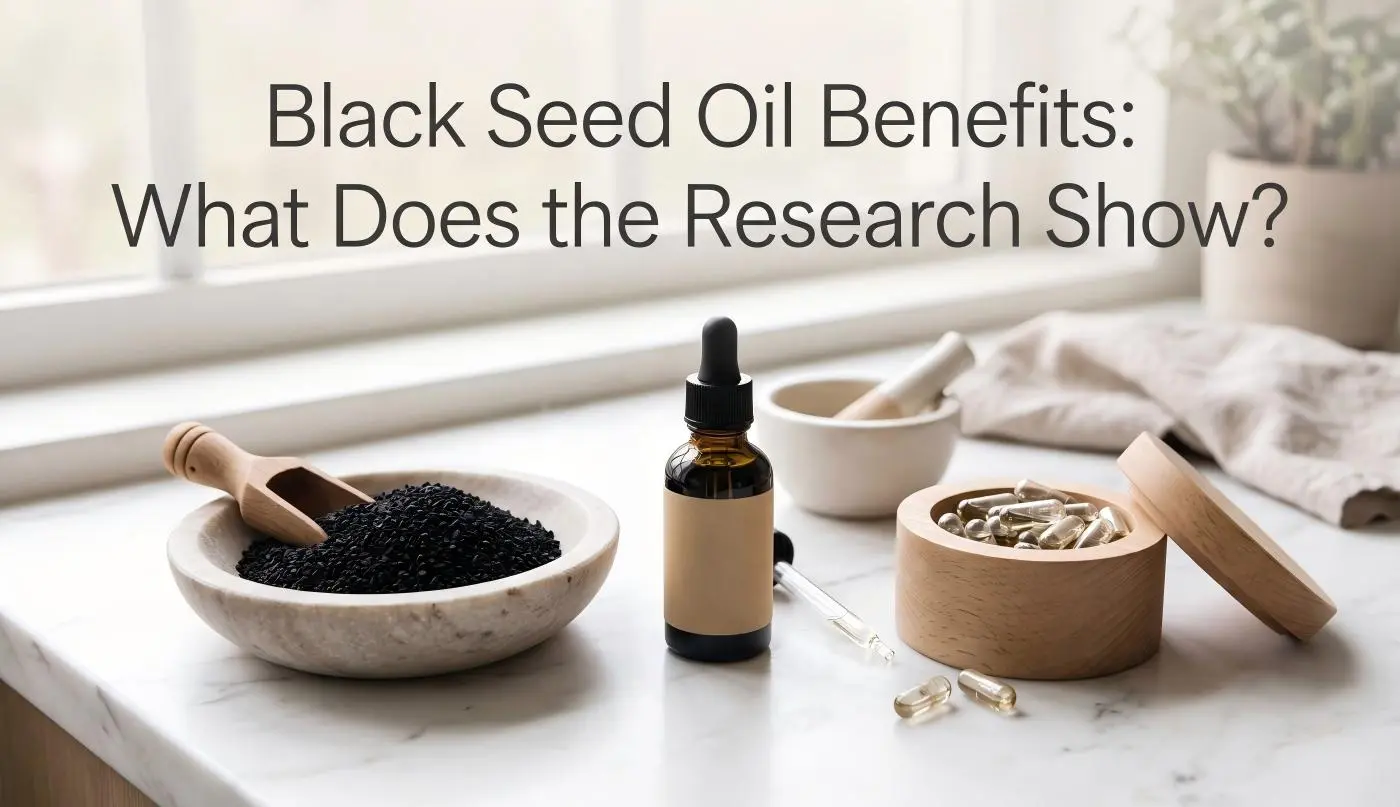
People researching black seed oil benefits usually want to know two things: what human studies have actually found, and whether the oil in a commercial supplement is comparable to the preparations used in those trials. This review maps that evidence to the specification needed for an analytically verifiable black seed oil capsules manufacturer SKU.
In practical terms, the evidence behind questions such as “what is black seed oil good for?” and “what does black seed oil do?” comes mainly from studies measuring cardiometabolic, glycemic, inflammatory, and other clinical outcomes in defined Nigella sativa preparations. These findings do not establish a universal consumer serving size or support disease-treatment claims for dietary supplements. [9][10][17]
The U.S. Food and Drug Administration treats dietary supplements as a food category, not as approved therapies. [17] An overview of 20 Nigella sativa meta-analyses graded most outcome indicators as low or very low certainty, mainly because of risk of bias, inconsistency, and imprecision. [9] Read pooled deltas as a briefing for positioning and a substantiation package, not as a finished label claim.
What Does the Human Evidence Suggest?
Human research on Nigella sativa oil suggests potential effects on several cardiometabolic and inflammatory markers, including fasting glucose, HbA1c, LDL cholesterol, blood pressure, CRP, and IL-6, although the evidence is not equally strong across outcomes. Systematic reviews have repeatedly identified substantial heterogeneity and low or very low certainty for many endpoints. [9][10]
The formulation point that follows is that “black seed oil” is not a standardized exposure. Commercial oils can differ substantially in thymoquinone content, fatty-acid profile, oxidation status, and processing history. A trial using a defined oil preparation therefore cannot automatically be mapped to every 500 mg or 1,000 mg black seed oil softgel. [7]
Research area | What human studies measured | How to interpret the evidence |
|---|---|---|
| Blood glucose / HbA1c | Fasting glucose and HbA1c in mixed adult and type 2 diabetes populations | Several meta-analyses report reductions, but heterogeneity is substantial. [11][12] |
| Lipids | LDL cholesterol, total cholesterol, triglycerides, and HDL | LDL and total cholesterol show signals in some analyses; triglycerides and HDL are less consistent. [10][11] |
| Blood pressure | Systolic and diastolic blood pressure | Included in broader cardiometabolic analyses; certainty varies by outcome. [9][10] |
| Inflammation | CRP, IL-6, and other inflammatory markers | Evidence exists but remains limited and heterogeneous. [10][13] |
| Respiratory outcomes | Allergic-rhinitis symptoms and asthma-related outcomes | Small clinical base; some analyses include heterogeneous Nigella preparations. [14][15] |
| Skin outcomes | Acne, eczema, vitiligo, and other dermatological conditions | Evidence is mainly topical and should not be transferred to oral oil products. [16] |
What Is Black Seed Oil?
Black seed oil is the expressed lipid from the seeds of Nigella sativa L. (Ranunculaceae). Kew’s Plants of the World Online treats that binomial as accepted. [1] In U.S. spice listings, FDA maps both “Caraway, black (black cumin)” and “Cumin, black (black caraway)” to Nigella sativa L., while true cumin is Cuminum cyminum L. [2] Trade names such as black cumin, kalonji, or nigella are incomplete on a purchase order. The ABC-AHP-NCNPR Botanical Adulterants Prevention Program records that nigella seed has been mixed with other Nigella species (notably N. damascena) and that nigella seed oil has been diluted with cheaper vegetable oils. [3]
USP-NF titles a named cold-pressed grade Black Cumin Seed Oil: “the oil obtained from the seeds of Nigella sativa L. (Fam. Ranunculaceae) by cold press processing.” [4] That title supports identity language, but it does not copy a default thymoquinone (TQ) window onto every drum.
The oil is a mixture. Hannan et al. summarize a fixed-oil fraction (linoleic and oleic acids as the major fatty acids) plus a smaller volatile fraction in which TQ is the most studied constituent, together with related terpenes such as thymohydroquinone, p-cymene, and carvacrol. [5] Lutterodt et al. measured six commercial cold-pressed oils at about 3.48-8.73 mg/g TQ, with a roughly two-fold spread in oxidative stability. [6] While cold pressing designates a mechanical extraction method, native TQ concentration and baseline peroxide value still depend on seed lot, processing, and storage.
Black Seed Oil Benefits: What Human Studies Measured
Blood glucose and HbA1c
Glycemic markers are among the more frequently pooled endpoints. Across broader adult samples, a 2024 update of 30 trials reported significant pooled reductions in fasting glucose and HbA1c, without a significant pooled effect on insulin or HOMA-IR, and with very high heterogeneity. [12]
In a tighter type 2 diabetes population, a 2025 meta-analysis of 16 randomized trials reported mean differences of -21.43 mg/dL fasting glucose and -0.44% HbA1c. Subgroups associated a larger fasting-glucose signal with interventions longer than 8 weeks. [11] A wider 2025 cardiometabolic review also included fasting glucose and HbA1c among pooled outcomes. [10]
Those figures are pooled estimates in named trial populations; N. sativa oil is not a substitute for prescribed diabetes care. [17] How those intervention levels relate to a labeled softgel is covered once under study amounts below.
Lipids, blood pressure, and related cardiometabolic markers
Cardiometabolic endpoints are the most often pooled set. A 2025 GRADE-assessed review in Pharmacological Research included 82 studies (79 quantitative) in 5,026 participants, with daily amounts from 200 mg to 4,600 mg and durations from 1 to 48 weeks. The authors reported statistically significant pooled changes for several cardiovascular and inflammatory markers, including blood pressure, LDL cholesterol, CRP, and IL-6, although certainty varied by outcome. They described N. sativa as a possible adjunct — not a replacement — for managing cardiovascular risk factors. [10]
In type 2 diabetes specifically, the 16-trial review reported -18.80 mg/dL total cholesterol and -19.53 mg/dL LDL cholesterol, with no significant pooled effect on triglycerides, HDL, fasting insulin, liver enzymes, or body weight. Subgroups associated larger HbA1c and LDL signals with oil form and daily amounts above 1 g. [11]
A significant pooled delta does not prove that every commercial “pure black seed oil” unit will reproduce it, and overview-level certainty for N. sativa outcomes has often been graded low or very low. [9]
Inflammation
Pooled cardiometabolic reviews include CRP and IL-6. [10] Direct oil-capsule data remain limited. A 2024 crossover randomized trial in 46 women with overweight or obesity used 2,000 mg/day of cold-pressed N. sativa oil (two 1,000 mg capsules; the authors stated TQ as 1.1% of each 1,000 mg fill, about 22 mg TQ/day) for two 8-week periods. Serum IL-1β, IL-6, and leptin fell versus placebo; insulin fell with a small effect size, which the authors cautioned against over-reading. [13] That protocol is a specification example — oil milligrams × a named TQ percentage — not a catalog SKU or a recommended intake.
Respiratory outcomes
The clinical evidence base is small. A 2024 meta-analysis of eight randomized trials reported a higher “total effective rate” for allergic rhinitis symptoms and a pooled improvement on a nasal-symptom score. Adverse events were transient and did not differ from control. The authors flagged few trials and lower design quality, and the search language used Nigella spp. rather than N. sativa alone. [14] Do not copy an allergic-rhinitis treatment claim from a mixed-species pool onto a N. sativa oil label.
A 2017 randomized, double-blind, placebo-controlled trial in adults with asthma used 500 mg N. sativa oil twice daily for 4 weeks as add-on. Asthma Control Test score improved and blood eosinophils fell versus placebo; the FEV1 change was not statistically significant. Ten participants withdrew from each arm. [15] That is adjunct research in a clinical population, not a reason to position a retail softgel as asthma treatment.
Skin outcomes: why route matters
A 2022 systematic review of 14 records on skin conditions reported a pooled odds ratio of 4.59 (95% CI 2.02-10.39). The authors’ interpretation centered on lotions and topical oil or extract, across mixed diagnoses (acne, eczema, vitiligo, and others), and called for more research. [16] Oral black seed oil capsules and a topical N. sativa preparation are different products, different exposure routes, and different evidence bases.
Why Thymoquinone(TQ) Matters in Black Seed Oil
TQ is a lipophilic constituent that is particularly associated with the volatile/oil fraction of N. sativa seeds. [5] Clinical papers often discuss TQ as the constituent of interest, but commercial oils do not share one TQ value.
Two products labeled “black seed oil” can deliver dramatically different amounts of thymoquinone. In one 2022 HPLC-UV screening study, commercial N. sativa products showed TQ concentrations ranging from 3.08 to 809.4 mg/100 g — a roughly 263-fold difference between the lowest and highest products tested. [7]
A 1,000 mg oil label does not tell you how much TQ the customer receives
Oil fill weight and TQ content are two different specification variables, so unstandardized “cold-pressed” language alone does not describe TQ exposure. The authors argued that TQ content should be declared so researchers and buyers can tell whether a product contains a meaningful amount of the marker those papers discuss. [7] Their highest oil, at 4 mL/day, delivered about 30 mg TQ; they cited literature suggesting adult TQ intakes below 48.6 mg/day as a safety discussion point, not as a KS specification. [7]
Hadad et al. described HPLC quantification of principal antioxidants in N. sativa phytopharmaceuticals as suitable for quality control of the marker substances. [8] A brochure that says “high TQ” without a named method is not comparable to a trial oil assayed at 1.1%. [8][13]
USP-NF also maintains a separate monograph title, Black Cumin Seed Thymoquinone Oil — a different named grade from ordinary Black Cumin Seed Oil, not a factory default. [18]
Identity-grade oil vs TQ-specified oil
Attribute | Identity / as-is oil | TQ-specified oil |
|---|---|---|
| What you lock | N. sativa seed oil, process, oxidation limits | The same, plus a TQ minimum or range and a named method |
| TQ as a release spec | Not necessarily a release specification | Released against the named assay |
| Batch story | TQ may vary with seed lot, processing, and storage | Controlled within the agreed range |
| When it fits | Label will show seed oil, not a TQ milligram | Supplement Facts will state TQ math |
| Testing | Identity + peroxide/acid value still required | Incoming oil and finished unit, same method |
1,000 mg oil × 2% TQ = 20 mg TQ per softgel is verifiable label math — not a dosage recommendation, and not a catalog grade. The label strategy (seed oil only, or a declared TQ yield) is what the specification has to support.
Does Oil Quality Change What the Research Can Support?
Yes. Trials that name a TQ percentage studied a defined fill, and a rancid or diluted oil is not that fill. [3][6][7]
Identity. Require Nigella sativa L., seed; “black cumin” alone is not a specification. [1][2][3]
Process. Cold pressing is the pharmacopeial description for the named USP oil grade. [4] Processing and storage conditions can influence TQ retention and oxidation parameters after pressing. [6][7]
Oxidation. Request peroxide value and acid value on the lot you will fill, and again if the oil has been held or warmed. Fatty-acid profile by gas chromatography confirms the linoleic/oleic pattern expected of this seed oil. [6] Shelf life should be established from the oil, shell, packaging, storage conditions, and stability data — not copied from a generic 24-month specification.
Packaging. Packaging should control the relevant light, oxygen, moisture, and temperature exposures. For bottled oil, opaque or amber containers may be appropriate. For softgels, evaluate shell formulation, blister or bottle barrier, headspace, and storage as part of the stability program. A clear gelatin shell does not, by itself, provide light protection. [7]
COA. Identity, named TQ method if labeled, oxidation, and safety tests (micro, metals, residual solvents as scoped) should match the grade on the PO.
Black Seed Oil vs Extract vs Seed Powder
Oil and extract share the plant, but they are not the same purchase line. If the brief is still “black seed” rather than “black seed oil,” start on the black seed supplement manufacturer decision page.
Seed oil (this article)
Choose oil when: The finished unit is a liquid-oil softgel, the protocol you are citing used oil, or the label will carry TQ math on an oil fill.
Why: TQ is lipophilic and is particularly associated with the volatile/oil fraction of the seed. [5]
What to lock: Species, process, TQ min / as-is / not specified + method, peroxide/acid value, fill weight.
Manufacturing note: Bulk oil in a two-piece dry capsule is not the default.
Dry extract
Choose extract when: You need a powder-filled capsule or tablet, a defined DER or dry marker, or you want to avoid bulk-oil handling.
Why: DER describes the raw-material-to-extract relationship; it does not establish TQ concentration unless TQ is separately specified and tested.
What to lock: DER and/or TQ % + method, carrier, moisture.
Manufacturing note: Different tooling, different COA blocks.
Milled seed powder
Choose seed powder when: Identity matters more than concentration, the label will not state a TQ milligram, and you want a whole-seed format.
Why: Whole-seed powder is neither a concentrated extract nor a standardized oil. Constituents remain in the seed matrix rather than being concentrated into a defined marker specification.
What to lock: Identity, particle size, serving mass.
Manufacturing note: Residual oil still affects the aromatic profile and fill behavior.
How Much Black Seed Oil Is Used in Human Studies?
The 82-study review spanned about 200-4,600 mg/day. [10] Three named examples that are easy to mis-copy onto artwork:
- 2,000 mg/day oil at 1.1% TQ (~22 mg TQ/day) for 8 weeks in the crossover inflammation trial. [13]
- 500 mg oil twice daily (1,000 mg/day) for 4 weeks in the asthma add-on trial. [15]
- Type 2 diabetes subgroups often discussing amounts above 1 g/day. [11]
Study amount is not a commercial serving recommendation. Those intervention levels were set for a protocol, a population, and a named preparation, and they do not transfer milligram-for-milligram onto a low-TQ oil. For a commercial softgel, specify fill weight (500 mg, 750 mg, or 1,000 mg oil are common conversations), then run TQ math if the panel will state it. Destination-market rules for botanicals stay with the brand owner and counsel. [17]
Black Seed Oil Capsules vs Softgels
Retail search uses black seed oil capsules, but liquid N. sativa oil is typically filled into one-piece softgels. Two-piece hard capsules are normally used for powders or dry extracts; a liquid fill needs a separate feasibility assessment. Vegetarian one-piece shells use starch/carrageenan (or a named plant gel), not HPMC.
A one-piece softgel meters a defined oil fill; light protection still belongs to the pack (opaque or amber bottle, or blister barrier), not to a transparent gelatin shell.
Softgel (oil default)
Best for: Metered seed oil when the shopper searched “capsules.”
Why: One-piece shell, defined fill mass, and containment of the oil’s aromatic volatiles.
What to lock: Fill, density, die, gelatin or starch/carrageenan shell, barrier pack.
Manufacturing note: Match die to measured oil density so headspace does not become a leak path.
Two-piece capsule (not the oil default)
Best for: Dry extract or seed powder.
Why: Bulk oil is the wrong default for a dry two-piece shell.
What to lock: Feasibility first if the brief forces a liquid-filled hard capsule.
Manufacturing note: If the real SKU is extract, that is not an oil-capsule quote.
What Should a Buyer Specify Before Requesting a Quote?
- Nigella sativa L., seed, oil — not a common name. [1][2]
- Identity oil or TQ-specified oil, with method if TQ is labeled. [7][8]
- Fill conversation and shell (gelatin vs starch/carrageenan).
- Destination market and whether the label will state TQ milligrams.
- The oil CoA you already have, if any.
Finished-unit MOQ and lead time depend on fill weight, shell, packaging, and testing. Those commercial terms sit on the manufacturer quote. Extract, powder, tablet, or mixed-material programs belong on the parent manufacturer path, not on an oil-only RFQ.
Ready to quote an oil fill? Request a Black Seed Oil Capsules Quote
Need oil grade and TQ math set first? Get a Spec Recommendation
Oil vs extract still open? Request a Black Seed Quote
Comparing drums? Send Your CoA for Review
Frequently Asked Questions
What are the health benefits of black seed oil?
Human research suggests that black seed oil may influence several cardiometabolic and inflammatory markers, including fasting glucose, HbA1c, LDL cholesterol, blood pressure, CRP, and IL-6. Strength and certainty vary by outcome, population, preparation, and trial design. [9][10][11][12] This does not establish disease-treatment effects. [17]
Does black seed oil contain thymoquinone?
Yes. TQ is one of the best-studied constituents of N. sativa oil, but its concentration varies substantially among commercial oils. Oil milligrams alone do not define TQ exposure. [5][7]
Is black seed oil the same as black seed extract?
No. Black seed oil is the lipid fraction obtained from Nigella sativa seeds. A dry extract is a different raw-material format, with different extraction, concentration, and specification parameters. They are not interchangeable in formulation or in evidence review.
What dose of black seed oil capsules is used in studies?
See How Much Black Seed Oil Is Used in Human Studies above. The amounts used in those trials are not a commercial serving.
Is black seed oil good for skin?
Topical N. sativa preparations appear in a mixed skin-condition review. [16] Oral oil capsules are a different exposure.
Are black seed oil capsules the same as black seed oil?
The oil is the ingredient. Capsules, in trade search, usually mean softgels of that oil. Powdered extract in a hard capsule is a different ingredient.
Does cold-pressed mean high thymoquinone?
No. Cold-pressed is a process description. Commercial TQ in one HPLC screen spanned 3.08-809.4 mg/100 g. [4][7]
Black seed or black cumin — which name should the spec use?
Use Nigella sativa L., seed. See Black Seed or Black Cumin.
What should a supplier CoA show for oil?
Identity, process, TQ with method if claimed, peroxide and acid value, and scoped safety tests. [3][6][7][8]
Related Resources
Technical and Regulatory References
- Royal Botanic Gardens, Kew. Nigella sativa L. Plants of the World Online. https://powo.science.kew.org/taxon/urn:lsid:ipni.org:names:711687-1
- U.S. Food and Drug Administration. 21 CFR 182.10 — Spices and other natural seasonings and flavorings. https://www.ecfr.gov/current/title-21/chapter-I/subchapter-B/part-182/subpart-A/section-182.10
- Orhan N. Adulteration of nigella (Nigella sativa) seed and seed oil. Botanical Adulterants Prevention Bulletin. Austin, TX: ABC-AHP-NCNPR Botanical Adulterants Prevention Program; 2022. https://doi.org/10.59520/BAPP.BAPB/VPNM5432 · PDF: https://umb.herbalgram.org/media/eumlq52p/bapp-babs-nigella-09302022-v2.pdf
- United States Pharmacopeial Convention. Black Cumin Seed Oil. USP-NF. https://doi.usp.org/USPNF/USPNF_M15915_10101_01.html
- Hannan MA, Rahman MA, Sohag AAM, et al. Black cumin (Nigella sativa L.): a comprehensive review on phytochemistry, health benefits, molecular pharmacology, and safety. Nutrients. 2021;13(6):1784. https://doi.org/10.3390/nu13061784 · https://pubmed.ncbi.nlm.nih.gov/34073784/
- Lutterodt H, Luther M, Slavin M, et al. Fatty acid profile, thymoquinone content, oxidative stability, and antioxidant properties of cold-pressed black cumin seed oils. LWT – Food Science and Technology. 2010;43(9):1409-1413. https://doi.org/10.1016/j.lwt.2010.04.009
- Khaikin E, Chrubasik-Hausmann S, Kaya S, Zimmermann BF. Screening of thymoquinone content in commercial Nigella sativa products to identify a promising and safe study medication. Nutrients. 2022;14(17):3501. https://doi.org/10.3390/nu14173501 · https://pubmed.ncbi.nlm.nih.gov/36079777/
- Hadad GM, Abdel Salam RA, Soliman RM, Mesbah MK. High-performance liquid chromatography quantification of principal antioxidants in black seed (Nigella sativa L.) phytopharmaceuticals. J AOAC Int. 2012;95(4):1043-1047. https://doi.org/10.5740/jaoacint.11-207
- Li Z, Wang Y, Xu Q, et al. Nigella sativa and health outcomes: an overview of systematic reviews and meta-analyses. Front Nutr. 2023;10:1107750. https://doi.org/10.3389/fnut.2023.1107750 · https://pmc.ncbi.nlm.nih.gov/articles/PMC10086143/
- Jafari A, Mardani H, Faghfouri AH, et al. Does Nigella sativa supplementation improve cardiovascular disease risk factors? A comprehensive GRADE-assessed systematic review and dose-response meta-analysis of 82 randomized controlled trials. Pharmacol Res. 2025;219:107882. https://doi.org/10.1016/j.phrs.2025.107882 · https://pubmed.ncbi.nlm.nih.gov/40714301/
- Karimi M, Pirzad S, Pourfaraji SMA, et al. Effects of black seed (Nigella sativa L.) on cardiometabolic indices in type 2 diabetic patients: a systematic review and meta-analysis of RCTs. Complement Ther Med. 2025;90:103174. https://doi.org/10.1016/j.ctim.2025.103174 · https://pubmed.ncbi.nlm.nih.gov/40210172/
- Falahatzadeh M, Shirvani S, Oveili E, et al. The effect of Nigella sativa supplementation on glycemic status in adults: an updated systematic review and meta-analysis of randomized controlled trials. Prostaglandins Other Lipid Mediat. 2024;174:106885. https://doi.org/10.1016/j.prostaglandins.2024.106885 · https://pubmed.ncbi.nlm.nih.gov/39181437/
- Razmpoosh E, Safi S, Mazaheri M, et al. A crossover randomized controlled trial examining the effects of black seed (Nigella sativa) supplementation on IL-1β, IL-6 and leptin, and insulin parameters in overweight and obese women. BMC Complement Med Ther. 2024;24:22. https://doi.org/10.1186/s12906-023-04226-y · https://pubmed.ncbi.nlm.nih.gov/38178093/
- He Y, Hu X, Chang L, et al. Meta-analysis of randomized controlled trials assessing the efficacy of Nigella sativa supplementation for allergic rhinitis treatment. Front Pharmacol. 2024;15:1417013. https://doi.org/10.3389/fphar.2024.1417013 · https://pubmed.ncbi.nlm.nih.gov/39372205/
- Koshak A, Wei L, Koshak E, et al. Nigella sativa supplementation improves asthma control and biomarkers: a randomized, double-blind, placebo-controlled trial. Phytother Res. 2017;31(3):403-409. https://doi.org/10.1002/ptr.5761 · https://pubmed.ncbi.nlm.nih.gov/28093815/
- Nasiri N, Ilaghi Nezhad M, Sharififar F, Khazaneha M, Najafzadeh MJ, Mohamadi N. The therapeutic effects of Nigella sativa on skin disease: a systematic review and meta-analysis of randomized controlled trials. Evid Based Complement Alternat Med. 2022;2022:7993579. https://doi.org/10.1155/2022/7993579 · https://pubmed.ncbi.nlm.nih.gov/36518853/ · https://pmc.ncbi.nlm.nih.gov/articles/PMC9744621/
- U.S. Food and Drug Administration. Dietary supplements. https://www.fda.gov/food/dietary-supplements
- United States Pharmacopeial Convention. Black Cumin Seed Thymoquinone Oil. USP-NF. https://doi.usp.org/USPNF/USPNF_M12915_30101_01.html