Disclaimer: Educational and B2B formulation reference only. Not medical advice. Not intended to diagnose, treat, cure, or prevent any disease. Finished-product claims, dosage, warnings, and labeling must follow each destination market’s regulations.
Written by KS Nutripharma Formulation Team · Reviewed by KS Nutripharma Director of R&D
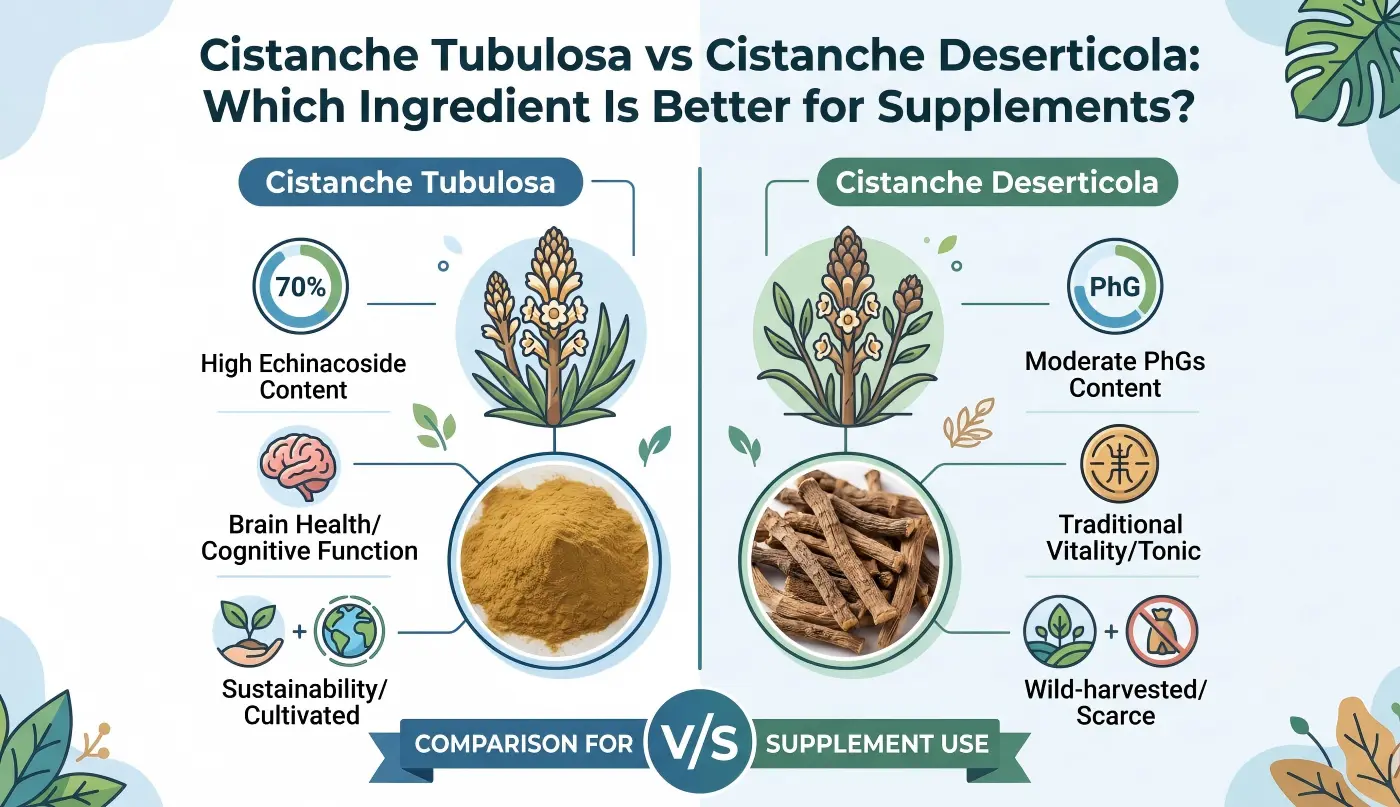
Cistanche tubulosa vs deserticola is a specification decision for supplement brands: which extract grade to lock — species, plant part, extract ratio, echinacoside/acteoside assay, and dosage-form fit — not which plant is universally “stronger.” KS Nutripharma offers OEM and private-label manufacturing with MOQ from 1,000 units, lead times from 4–6 weeks, full certifications (ISO, HACCP, GMP), and daily capacity across capsules, tablets, powders, and gummies. Once the grade is defined, finished products can move to production. Request a Cistanche extract specification or send your COA for review.
Quick Answer
Neither Cistanche tubulosa nor Cistanche deserticola is universally better. Both are authorized Cistanches Herba sources associated with phenylethanoid glycosides (PhGs) such as echinacoside and acteoside [1][5]. Chemical profiles vary by species, origin, cultivation, plant part, and processing [2][3][4][6].
Brief Type vs. Starting Point
| Project Type | Practical Starting Point |
| Scalable / cost-aware commercial SKU | C. tubulosa + locked HPLC assay |
| Premium / tradition-led botanical | C. deserticola + identity + provenance + assay |
| Marker-controlled science SKU | Either species — assay and method decide |
| Long-term lot consistency | Supplier QC system, not Latin name alone |
Tubulosa vs. Deserticola: Comparison Table
| Parameter | Cistanche Tubulosa | Cistanche Deserticola |
| Botanical name | Cistanche tubulosa | Cistanche deserticola |
| Common commercial use | Nutraceutical / functional supplements | Traditional herbal / premium nutraceutical positioning |
| Key compounds | Echinacoside, acteoside and other PhGs [1][5] | Echinacoside, acteoside and other PhGs [3][5] |
| Standardization focus | PhGs / echinacoside / acteoside | PhGs / echinacoside / acteoside |
| Supply pattern | Often easier to qualify for standardized commercial programs* | Often more provenance-sensitive; lead time and cost can rise* |
| Best fit | Scalable capsules, tablets, powders, blends | Premium / tradition-led formulas where species is part of the story |
| What to lock on the RFQ | Species + assay + extract ratio | Species + provenance + assay + extract ratio |
*Availability still depends on supplier qualification, origin, assay requirement, and batch size.
What Actually Differentiates the Two Extracts?
Species and plant part
tubulosa and C. deserticola are related but distinct. They should not be swapped on a BOM because both are sold as “Cistanche.” Species identification is part of quality control; chemical and molecular fingerprinting studies show species-level differences that matter for authenticity [2][4]. Write the Latin binomial and plant part (e.g., dried stem extract) on the specification, quote, and COA. Unqualified “Cistanche extract” is not a complete purchase description.
Phytochemical profile
Shared quality-relevant constituents include echinacoside, acteoside (verbascoside), cistanoside A, isoacteoside, other PhGs, and — depending on the brief — polysaccharides [1][5]. Relative concentrations can differ across species and samples; seasonal variation has also been reported for C. deserticola PhGs [3]. Comparative work between stems of the two species shows phytochemical profiles are not identical [6]. Do not approve a lot on the claim that one species “always has more actives.”
Echinacoside and acteoside as commercial markers
Echinacoside is the common primary HPLC marker; commercial standardized programs often scope bands such as 10%–20% (or project-customized), with method stated on the COA [1][5]. Acteoside is frequently paired as a secondary marker; listing it with method improves documentation depth. Total PhGs are useful for broader locks when the HPLC definition is clear.
In many commercial programs, C. tubulosa is the starting species for English-market standardized capsules and powders because assay grades and batch sizes are frequently easier to align — depending on supplier qualification and sourcing region. C. deserticola is often selected when species identity and traditional positioning are part of the brand brief. For either species, the assay and supporting documentation ultimately determine whether the extract fits the formula.
How to Compare Cistanche Extract Specifications
Approve materials in this order: Species → Plant part → Extract ratio → Marker → Assay method → Contaminants → Lot consistency
Ratio vs. standardization
The grades below are starting points rather than universal specifications; the final grade should be selected from assay, dose, cost, and process requirements together.
| Specifications | When it makes sense | Main risk | Confirm before quote |
| 5:1 | Cost-sensitive formulas; higher finished-product loading is acceptable | Higher fill weight / serving size | Marker content (if any) + dose math |
| 10:1 | General commercial SKU | Ratio can hide large marker variation | HPLC assay + method |
| 20:1 | Lower loading / concentrated positioning | Higher cost; density and process constraints | Marker + bulk density + fill feasibility |
| ~10% echinacoside | Standardized commercial SKU | Cost rises with assay | HPLC method + calculation basis |
| ~20% echinacoside | Higher-standardization formula | Dose/cost may become limiting; process fit changes | Finished-product label math + format constraints |
A cistanche extract 10:1 grade describes raw-material-to-extract concentration. It does not state echinacoside or total PhG content. Two “10:1” lots can be commercially different materials.
Example: two 10:1 extracts are not the same purchase
| Field | Supplier A | Supplier B |
| Species | C. tubulosa | C. tubulosa |
| Ratio | 10:1 | 10:1 |
| Echinacoside (HPLC) | 5% | 20% |
| Implication | More extract needed per serving if label needs a defined echinacoside intake | Less extract per serving may be possible; $/kg is usually higher |
If the finished product targets a defined echinacoside intake, Supplier B may reduce extract weight per serving — but raw-material cost and process behavior can still favor A or B depending on label math, capsule size, and blend design.
How to compare two Cistanche COAs
| Parameter | Supplier A | Supplier B |
| Species | C. tubulosa | C. tubulosa |
| Plant part | Not stated | Dried stem |
| Ratio | 10:1 | 10:1 |
| Echinacoside | 10% | 20% |
| Acteoside | Not stated | 2% |
| HPLC method | Not stated | Specified |
| Pesticides / metals / micro | Pass | Pass |
| Lot consistency | Unknown | 3-batch trend data |
Compare price only after the specifications are aligned. Fingerprint and assay literature on Cistanche species is one reason a single headline number without method context is a weak buying basis [2][4].
Cost per standardized active
Do not rank suppliers on $/kg alone when the brief locks a marker.
Illustrative math (examples only — not market quotes):
| Offer | Price | Echinacoside | Approx. cost per kg echinacoside |
| A | $20/kg | 10% | $200 / kg echinacoside |
| B | $35/kg | 20% | $175 / kg echinacoside |
B looks more expensive on $/kg, but can be cheaper on $/standardized active. Then check whether the higher assay still fits capsule fill weight, tablet compression, gummy loading, and MOQ cash flow. Higher marker % is not automatically the better finished-product choice.
Contaminant and identity fields still required
Before sampling or PO:
- Botanical identity aligned to the named species
- Microbiology
- Heavy metals
- Pesticides
- Residual solvents (as applicable)
- Destination-market fields as scoped
Recommended Starting Specifications
| Project Type | Starting Point |
| Cost-sensitive launch | C. tubulosa · ratio extract (often 5:1–10:1) · optional marker disclosure |
| Large-scale commercial production | C. tubulosa · 10:1 or ~10% echinacoside HPLC |
| Standardized / science-led SKU | Either species · echinacoside (and acteoside if needed) by HPLC |
| Premium botanical / tradition-led | C. deserticola · identity + provenance + assay |
| Low-dose / small capsule | Higher assay or higher ratio only after label math |
| Stack formula (e.g., Tongkat Ali / maca) | Documented assay + density data |
Still contingent on supplier qualification and batch size.
Formulation & Dosage Form Considerations
| Format | Main Cistanche Issue | What to Confirm |
| Capsule | Fill weight vs assay; blend uniformity | Assay · bulk density · capsule size · serving |
| Tablet | Compression/flow | Granulation need · assay · excipient load |
| Powder | Dispersibility/mesh | Particle size · moisture · carrier system |
| Stick pack | Bulk density/flow into sachet | Filling behavior · dose uniformity · instantization if claimed |
| Gummy | Active loading/taste/moisture | Realistic dose · organoleptics · short-stack design |
Higher-assay extracts can reduce botanical powder weight, but may raise $/kg, change blend ratios, and tighten taste or compression windows. Confirm format feasibility before locking a 20% echinacoside grade solely because it looks stronger on paper.
Common Cistanche Procurement Mistakes
- Buying by extract ratio only — 10:1 does not define marker content.
- Comparing suppliers by price/kg only — compare cost per standardized active when assay is locked.
- Accepting “Cistanche extract” without species — lock the Latin binomial and plant part.
- Reviewing the COA after PO — approve specification before quotation and sampling.
- Choosing a high-assay extract without dosage-form checks — fill weight, cost, uniformity, taste, and tablet compression can all change.
What KS Nutripharma® Check Before Approving a Cistanche Extract
For OEM projects, we do not release a Cistanche extract on a headline “10:1” ratio alone. Typical review covers:
- Botanical identity
- Plant part
- Marker assay (echinacoside / acteoside / total PhGs as scoped)
- Assay method
- Bulk density
- Particle size
- Microbiological profile
- Heavy metals and pesticide results
- Lot-to-lot consistency
- Compatibility with the target dosage form
Request a Cistanche Extract Specification
Compare Tubulosa vs Deserticola, 5:1/10:1/20:1, echinacoside / acteoside locks, and dosage-form feasibility before sampling.
Request a Cistanche COA Review
Send your current COA and target specification to flag missing fields, assay gaps, documentation risks, and formulation suitability.
From Raw Material to Finished Product
Species → Specification → Formula → Manufacturing → QC / packaging
Once the extract grade is locked, the next step is finished-product manufacturing — capsules, tablets, powders, gummies, or custom blends under private label / OEM — through a Cistanche Supplement Manufacturer.
FAQ
Is Cistanche tubulosa better than Cistanche deserticola for supplements?
No absolute winner. C. tubulosa is a common start for scalable commercial SKUs; C. deserticola is often preferred for premium / tradition-led positioning. Assay, documentation, and format fit decide more than the species name [2][4][6].
What is the difference between the two species for buyers?
They are distinct botanicals with overlapping PhG markers but non-identical chemical profiles. Treat them as separate materials on the BOM and COA [1][2][4][5].
Does Cistanche extract always contain echinacoside?
Not by default. Many Cistanche materials contain echinacoside, but content must be confirmed by species, plant part, and HPLC assay on the COA [1][5].
Is 10:1 Cistanche extract better than 5:1?
Not automatically. Ratio is not marker content. Compare HPLC assay, method, identity, contaminants, and finished-product dose math.
Should I specify echinacoside or total phenylethanoid glycosides?
Use echinacoside (often with acteoside) for marker-controlled SKUs; use total PhGs when a broader lock fits the brief. Define the HPLC method either way.
How do I verify Cistanche extract quality before ordering?
Compare species, plant part, ratio, markers, HPLC method, contaminant panel, and lot consistency — then price. Use the COA comparison table above as the template.
Can Cistanche be formulated into capsules, tablets, powders, and gummies?
Yes, when assay, density, taste, and fill constraints are checked against the format. Capsules and tablets are usually the lowest-friction commercial paths; gummies need realistic active loading.
Can a manufacturer private-label Cistanche supplements?
Yes. After the extract specification is locked, OEM / ODM / private-label programs can carry formulation through finished packaging and documentation.
Conclusion
Lock species and plant part. Decide whether you are buying a ratio grade or a marker grade. Compare COAs on method and documentation depth. Convert $/kg into cost per standardized active when assay matters. Then confirm the dosage form can carry that grade.
Request a Cistanche Extract Specification · Request a Cistanche COA Review
References
- [1] Morikawa T, Xie H, Pan Y, et al. A Review of Biologically Active Natural Products from a Desert Plant Cistanche tubulosa. Chem Pharm Bull (Tokyo). 2019. PMID: https://pubmed.ncbi.nlm.nih.gov/31257323/
- [2] Shi HM, Li X, Zhang Y, Yuan Z. Identification of Cistanche species by chemical and inter-simple sequence repeat fingerprinting. Biol Pharm Bull. 2009. PMID: https://pubmed.ncbi.nlm.nih.gov/19122297/
- [3] Cao Z, Wang Y, Zhang L, et al. Determination of phenylethanoid glycosides from Cistanche deserticola in spring and autumn with LC-MS. Zhong Yao Cai. 2004. PMID: https://pubmed.ncbi.nlm.nih.gov/15272779/
- [4] Gao Y, et al. Comparative studies of three Cistanche species based on UPLC specific chromatogram and determination of main components. Zhongguo Zhong Yao Za Zhi. 2019. PMID: https://pubmed.ncbi.nlm.nih.gov/31602949/
- [5] Wang T, Zhang X, Xie W. Herba Cistanches: Anti-aging. Aging Dis. 2017. PMC: https://pmc.ncbi.nlm.nih.gov/articles/PMC5758349/
- [6] Fan L, et al. Integrated analysis of phytochemical composition, pharmacokinetics, and network pharmacology to probe distinctions between the stems of Cistanche deserticola and C. tubulosa based on antidepressant activity. Food Funct. 2022. PMID: https://pubmed.ncbi.nlm.nih.gov/35880684/
KS Nutripharma manufactures for business clients only.