Reviewed by: KS Nutripharma R&D Director, PhD (Food Science)
Review scope: formulation calculations, dosage-form feasibility, and regulatory interpretation
Quick Answer
A 500 mg serving of ecdysterone extract does not automatically deliver 500 mg of active 20-hydroxyecdysone. The actual active dose depends on the extract assay:
• 50% extract → 250 mg active 20E
• 70% extract → 350 mg active 20E
• 90% extract → 450 mg active 20E
• 95% extract → 475 mg active 20E
• 98% extract → 490 mg active 20E
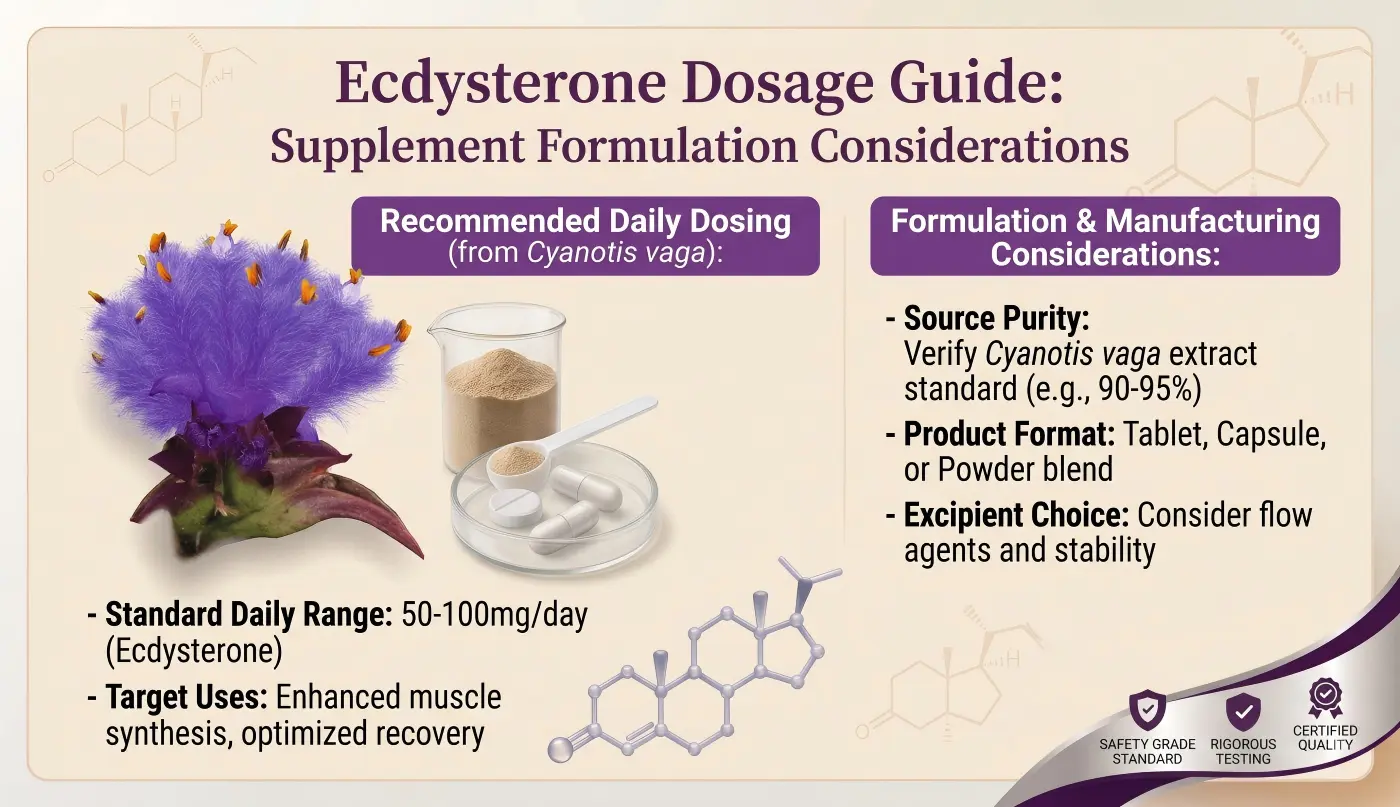
For capsule products, higher assay (90–98%) typically allows single-capsule servings at common research-informed doses (200–600 mg active). Lower assay (50–70%) often requires two or more capsules per serving. Final serving size should be determined according to the intended market, applicable regulations, product positioning, and technical feasibility.
Introduction
Dosage is not a single number—it is a chain of decisions that links research data to finished-product specifications. For supplement brands developing ecdysterone products, misunderstanding this chain leads to common formulation errors: copying a research dose directly onto a label without adjusting for extract assay, ignoring capsule fill limits, or failing to account for the difference between extract weight and active ecdysterone.
This guide is written for product development teams and procurement managers working with an ecdysterone supplement manufacturer. It explains how to translate a target active dose into raw material requirements, dosage-form constraints, and final label declarations. It is not medical dosing advice and should not be used to advise individual consumers on personal intake.
Human studies have evaluated approximately 200–800 mg/day under controlled research conditions. These doses should not be interpreted as universally appropriate consumer serving recommendations [1].
What Does “Ecdysterone Dosage” Actually Mean?
In supplement formulation, dosage involves four distinct concepts that are often conflated:
• Research dose: The active compound amount used in a clinical trial. In the Isenmann et al. (2019) study, participants received 200 mg/day or 800 mg/day of ecdysterone [1]. These figures refer to the active compound, not the extract weight.
• Active ingredient dose: The quantity of pure 20-hydroxyecdysone (CAS 5289-74-7) delivered per serving. This is what drives formulation targets.
• Extract weight: The total mass of botanical extract powder required to deliver the target active dose. Because commercial extracts are standardized to different assay levels, the extract weight can be two to four times the active dose.
• Serving size: The total mass of all ingredients—active extract plus excipients and other actives—consumed in one administration.
The most common procurement error is confusing extract weight with active dose. A brand requesting 500 mg of ecdysterone extract without specifying assay may receive material that delivers anywhere from 250 mg to 490 mg of active 20E, depending on the grade.
How Ecdysterone Assay Affects Formulation
The relationship between target active dose and required extract weight is governed by a simple formula:
Required Extract Weight (mg) = Target Active Amount (mg) ÷ Extract Assay (as decimal)
For example, to deliver 500 mg of active 20E:
• 95% extract: 500 ÷ 0.95 = 526 mg extract
• 70% extract: 500 ÷ 0.70 = 714 mg extract
• 50% extract: 500 ÷ 0.50 = 1,000 mg extract
The difference between 50% and 95% extract—474 mg per serving—directly affects capsule count, tablet size, and total formula cost.
The following table shows how much active 20E a 500 mg extract serving delivers at common assay grades:
| Extract Grade | Extract per Serving | Active 20E Delivered | Typical Capsule Fit |
| 50% | 1,000 mg | 500 mg | 2–3 size 00 capsules |
| 70% | 714 mg | 500 mg | 1–2 size 00 capsules |
| 90% | 556 mg | 500 mg | 1 size 00 capsule |
| 95% | 526 mg | 500 mg | 1 size 00 capsule |
| 98% | 510 mg | 500 mg | 1 size 00 capsule |
Common Formulation Mistakes Brands Make
In our experience, the following errors account for the majority of ecdysterone formulation redesign requests:
Mistake 1: Confusing extract weight with active dose
A brand requests 500 mg of ecdysterone per serving without specifying assay. The supplier quotes a 50% extract. The brand places the order, then discovers during label review that the active dose is only 250 mg—half the intended target. The solution is to specify the target active amount (e.g., 500 mg of 20-hydroxyecdysone) and let the supplier recommend the appropriate grade.
Mistake 2: Ignoring capsule fill capacity
During formulation evaluation, one of the most common redesign requests we receive is reducing capsule count after brands realize that lower-assay extracts exceed single-capsule capacity. A 50% extract delivering 500 mg active requires 1,000 mg of powder. Even with minimal excipients, this exceeds a size 00 capsule limit (~735 mg depending on density). The result is either a multi-capsule serving or a reformulation to a higher assay.
Mistake 3: Copying research dose directly to the label
The Isenmann trial used 800 mg/day of active ecdysterone [1]. A brand copies this onto a Supplement Facts panel without considering that its chosen 50% extract would require 1,600 mg of extract powder per day—impractical in capsule form. Research doses inform development; they do not automatically become label recommendations. Under U.S. DSHEA regulations, the serving size declared on a Supplement Facts panel must reflect the amount reasonably consumed in one sitting, not necessarily the dose used in a clinical trial [2].
Mistake 4: Overloading combination formulas
A brand adds ecdysterone to a pre-workout formula already containing 5 g creatine, 3 g citrulline, and 2 g beta-alanine. The total serving weight reaches 15 g, which is difficult to flavor, mix, and consume. In OEM projects, powder formulations are commonly selected when total serving weight exceeds approximately 3–4 g, particularly for creatine-based sports nutrition products where capsule count would become impractical.
Ecdysterone Dosage by Dosage Form
Capsules
Capsules are the most common dosage form for ecdysterone supplements. The primary constraint is fill weight per capsule. A size 00 hard gelatin capsule holds approximately 735 mg of powder depending on density; size 0 holds approximately 500 mg.
In our experience, once serving weight exceeds approximately 900 mg, capsule manufacturing often shifts from one size-00 capsule to two capsules per serving, significantly affecting label presentation and perceived convenience. An ecdysterone capsule supplement manufacturer can typically accommodate high-assay material (≥90%) in standard capsule sizes, but final selection should be confirmed from measured bulk/tapped density and the complete formulation.
Tablets
Tablets offer cost advantages at scale but require compression feasibility testing. Tablet feasibility should be evaluated during formulation trials because compression behavior depends on the extract’s particle characteristics, moisture, bulk density, and excipient system. Film coating can improve swallowability and, depending on the coating system, may provide additional protection against environmental moisture.
An ecdysterone tablet supplement manufacturer should model total tablet weight against the target active dose and extract assay before tooling selection. Standard round tablets typically range from 500 mg to 1,000 mg; larger oblong tablets can reach 1,200 mg but may be harder to swallow.
Powder
Powder formulations allow larger total serving weights and can accommodate flavor systems, sweeteners, and complementary ingredients. Taste and mouthfeel should be evaluated during development, particularly for flavored consumer-facing products. Blend uniformity testing is essential for every batch.
An ecdysterone powder supplement manufacturer can produce flavored or unflavored blends using controlled powder-mixing processes, but blend uniformity testing is essential for every batch regardless of the active ingredient.
Ecdysterone in Combination Formulas
Combination formulas are commercially attractive but require careful serving-size management. Creatine monohydrate is a high-dose active (typically 3–5 g per serving). Adding 500 mg of ecdysterone active to a 5 g creatine base produces a powder serving of 6–8 g total, which is manageable. In capsule form, this combination is impractical: 5 g of creatine alone would require approximately seven size 00 capsules.
Lower-dose actives such as ashwagandha (300–600 mg), rhodiola (200–400 mg), or betaine (1.5–2.5 g) can be combined with ecdysterone in capsule or tablet formats if the total fill weight is calculated precisely. The consumer tolerance for daily serving size is finite. Research on supplement adherence suggests that servings requiring more than three capsules or tablets per dose experience higher dropout rates. These practical limits should constrain formula design, not just active-dose targets.
How to Select an Ecdysterone Grade for Your Project
The following decision framework helps brands match assay grade to project constraints:
| Grade Range | Best For | Trade-off | Typical Use Case |
| 50–70% | Powder; cost-sensitive lines; multi-capsule acceptable | Lower per-kg cost, but higher extract weight per serving | Bulk powder blends; budget capsules |
| 90–95% | Capsules; tablets; premium positioning | Higher per-kg cost, but lower total formula weight | Single-capsule products; precise dosing |
| 98% | High-potency formulas; strict documentation markets | Highest per-kg cost; minimal matrix | EU/Canada submissions; clinical-style positioning |
Assay selection should match the dosage form and positioning, not default to the highest number. A 98% ecdysterone extract in a bulk powder product where serving size is already 15 g offers minimal practical advantage over a 90% grade. Conversely, a 50% extract in a single-capsule product is likely unworkable.
Why Different Brands Show Different Dosages?
Consumers and procurement teams often notice that one brand lists 500 mg ecdysterone per serving while another lists 1,000 mg. This discrepancy usually reflects one of three factors, not necessarily a difference in active dose:
1. Extract assay difference: The 500 mg brand may use a 95% extract (delivering 475 mg active), while the 1,000 mg brand uses a 50% extract (delivering 500 mg active). The total extract weight differs, but the active dose is nearly identical.
2. Label declaration convention: Some brands declare extract weight; others declare active content. Without reading the Supplement Facts panel carefully, it is impossible to determine which convention is being used.
3. Research dose copying: Some brands copy the 800 mg/day figure from the Isenmann trial directly onto their label without adjusting for their extract assay [1]. If they use a 50% extract, the label may show 1,600 mg of extract to deliver 800 mg active—creating the appearance of a higher dose without actually delivering more active compound.
For procurement, the relevant metric is active 20E per serving, not total extract weight. Brands should specify target active dose to their supplier or contract manufacturer, not extract weight.
Dosage vs. Labeling vs. Regulatory Requirements
A research dose is not automatically a label-recommended dose. Under U.S. DSHEA regulations, the serving size declared on a Supplement Facts panel must reflect the amount reasonably consumed in one sitting, not necessarily the dose used in a clinical trial [2]. If a trial used 800 mg/day but the brand elects to recommend 400 mg/day based on formulation constraints, the label must declare 400 mg per serving.
Structure/function claims must also be tied to the actual serving size. A claim such as supports muscle protein synthesis must be substantiated at the labeled serving dose, not at a higher research dose that the consumer does not actually take.
In the EU, ecdysterone may be subject to novel food assessment depending on the member state, which can restrict the permissible daily amount. In Canada, Natural Health Products regulations require evidence supporting the recommended dose. Brands should verify target-market regulations before finalizing serving size.
Ecdysterone Dosage Checklist for Product Development
Before requesting a formulation quote, prepare the following:
1. Target active ecdysterone per serving (mg of 20-hydroxyecdysone, not extract weight)
2. Preferred extract assay or acceptable range (%)
3. Number of capsules/tablets per serving, or scoop size for powder
4. Total serving weight target
5. Other active ingredients and their doses
6. Target market (U.S., EU, Canada, Australia, etc.)
7. Desired product positioning (premium, mass market, sports specialty)
Providing these parameters upfront allows the contract manufacturer to recommend the most efficient grade and dosage form, reducing back-and-forth and accelerating time to market.
Frequently Asked Questions
Q: Is 500 mg of ecdysterone extract the same as 500 mg of active 20E?
A: No. Extract weight and active dose are different. A 500 mg serving of 50% extract delivers 250 mg of active 20E. A 500 mg serving of 95% extract delivers 475 mg of active 20E. Always specify target active dose, not extract weight.
Q: How many capsules are needed for a typical ecdysterone dose?
A: It depends on assay and target active dose. A 500 mg active dose using 95% extract fits in one size 00 capsule. The same active dose using 50% extract requires two size 00 capsules. Final count should be confirmed from measured bulk density and complete formulation.
Q: Does higher purity always reduce capsule count?
A: Generally yes, but not linearly. A 95% extract requires roughly half the extract weight of a 50% extract for the same active dose. However, excipient requirements, flowability, and compression behavior also influence final capsule or tablet count.
Q: Why does one brand use 1,000 mg extract while another claims 500 mg?
A: This usually reflects different extract assays or label declaration conventions. A 1,000 mg serving of 50% extract and a 500 mg serving of 95% extract deliver approximately the same active dose (500 mg vs. 475 mg). The relevant metric is active 20E, not total extract weight.
Q: Can I copy the 800 mg research dose directly onto my label?
A: Not without adjusting for your extract assay and dosage form. The Isenmann trial used 800 mg of active ecdysterone [1]. If your extract is 50%, you would need 1,600 mg of extract powder—likely impractical in capsule form. Research doses inform development; they do not automatically become label recommendations.
Q: What is the difference between ecdysterone extract and 20-hydroxyecdysone?
A: An ecdysterone extract is a botanical preparation standardized to contain a percentage of 20-hydroxyecdysone. High-assay 20E (95–98%) is a higher-purity material with less botanical matrix. For formulation, the active content (20E) is what matters.
Q: How should I specify dosage to my supplier?
A: State the target active 20E per serving in milligrams, the preferred dosage form, and the target market. Let the supplier recommend the appropriate extract grade based on fill-weight constraints and cost targets.
Q: What serving size is realistic for a powder product?
A: Powder servings above 15 g can become difficult to mix and consume. In our experience, powder formulations are commonly selected when total serving weight exceeds approximately 3–4 g, particularly for creatine-based sports nutrition products where capsule count would become impractical.
From Dosage Requirements to Finished Product
Once the dosage parameters are defined, the next step is manufacturing. To evaluate manufacturing feasibility, brands can send: target active dose, preferred dosage form, target market, expected serving count, other formula ingredients, and packaging preference. Our formulation team will estimate extract grade, serving size, capsule count, manufacturing feasibility, and preliminary production cost.
KS Nutripharma provides standardized beta-ecdysterone raw material and end-to-end ecdysterone supplement manufacturing across all three primary dosage forms: ecdysterone capsule supplement manufacturer, ecdysterone tablet supplement manufacturer, and ecdysterone powder supplement manufacturer. All production runs include in-process blend uniformity testing, finished-product potency verification by HPLC, and full batch documentation.
References
- [1] Isenmann E, et al. Ecdysteroids as non-conventional anabolic agent: performance enhancement by ecdysterone supplementation in humans. Archives of Toxicology. 2019;93(7):1807-1816. https://pubmed.ncbi.nlm.nih.gov/31123801/
- [2] Institute of Medicine (US) Committee on the Framework for Evaluating the Safety of Dietary Supplements. Dietary Supplements: A Framework for Evaluating Safety. NCBI Bookshelf. https://www.ncbi.nlm.nih.gov/books/NBK216071/
- [3] FDA. Current Good Manufacturing Practice in Manufacturing, Packaging, Labeling, and Holding Operations for Dietary Supplements. 21 CFR Part 111. https://www.fda.gov/food/dietary-supplements