 Reviewed by KS Nutripharma Director of R&D (PhD, Food Science | 19+ years nutraceutical development) | Updated September 2026
Introduction
A sleep supplement formula is the finished oral unit a brand will sell for sleep support — the actives, the milligram or marker lines, and the dosage form. A “sleep blend 500 mg” request is not enough for a comparable quote: different manufacturers may interpret the same brief as different formula architectures, making the resulting quotations difficult to compare. After the architecture is named, finished units are quoted with the sleep supplement manufacturer.
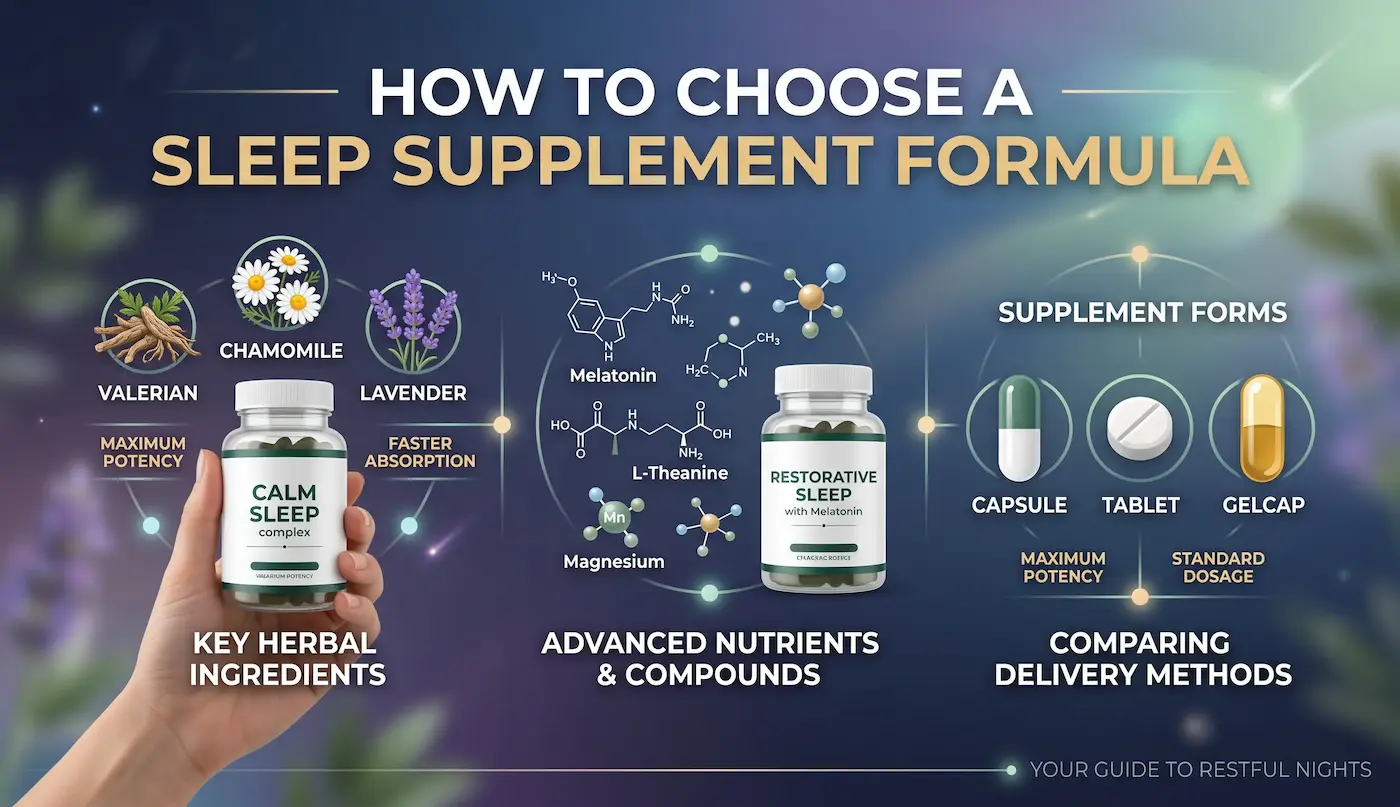
The five steps below are the order we use on a first SKU: lock the architecture, name the destination, decide private label or a specified formula, choose the format from fill and process, then send a specification package.
This guide covers finished dietary-supplement SKUs. Pharmaceutical sleep aids, OTC drug products, CBD/CBN products, and traditional decoction or tea products need a separate regulatory and manufacturing scope.
Step 1: Choose the Formula Architecture
Shopper questions (“which supplement is best for sleep”) collapse several products into one sentence. On a commercial specification they are different SKUs.
A botanical-led formula may also be melatonin-free. “Melatonin-free” is therefore a formulation constraint, not a botanical category. For a first purchase order, lock one primary formula direction before combining active systems.
Architecture | Hero on the panel | Best suited for |
|---|---|---|
| Melatonin-led | Printed melatonin milligram | Markets that allow melatonin |
| Melatonin-free amino / mineral | Theanine, magnesium, and/or glycine | Melatonin-free positioning, or destinations that will not carry melatonin |
| Botanical-led | A named herb or pair | European valerian pairs or East-Asian seed extracts |
| Combination | Melatonin plus a named amino, mineral, or herb | A later SKU when the market file allows melatonin and each companion is specified |
A melatonin bottle and a melatonin-free bottle are two products, two artworks, and two restriction lists.
Melatonin-led
Use when: The destination allows melatonin and the retail story is a melatonin sleep supplement with a printed milligram.
Specify: Immediate-release or extended-release; a named 1 / 3 / 5 / 10 mg band; capsule, or a gummy whose printed milligram is checked on the finished unit.
Market file: U.S. dietary-supplement programs that allow melatonin. [1] A U.S. 3 / 5 / 10 mg band is not an EU food-supplement default.
Trade-off: A melatonin-free brief should be specified as a separate formula direction rather than treated as a melatonin-led panel with a zero value.
Default format: Capsule. Gummies need a cook-and-assay pilot before artwork is frozen.
Melatonin-free amino / mineral
Use when: The line refuses a melatonin panel, or the destination does not treat melatonin as a routine food-supplement active.
Specify: The actives that carry the panel — often L-theanine assay, magnesium salt plus elemental milligrams, and/or gram-level glycine. Lemon balm or GABA only if the bill of materials names them.
Market file: Melatonin-avoid retail, or a member-state file that will not carry a melatonin milligram.
Trade-off: There is no circadian milligram story. Adding melatonin after the quote is a new regulatory review.
Default format: Capsule. Gram-level glycine is a powder or stick.
Botanical-led
Use when: The product is a named herb or pair — usually valerian (Valeriana officinalis) + hops (Humulus lupulus) in European retail, or Ziziphus spinosa seed (suanzaoren) in an East-Asian evening line. [5][6][7]
Specify: Latin name, plant part, marker and method. Valerenic acids for valerian; a named hops cone / strobile marker; jujuboside and/or spinosin for seed.
Market file: Can be evaluated across different market classes when each herb is properly identified and the destination-specific status is confirmed. Valerian residual-drowsiness copy still needs a country check.
Trade-off: This formula structure can be melatonin-free without becoming the amino-mineral SKU. A blend that only says “herbal 500 mg” is not a quote.
Default format: Capsule.
Combination formulas
Use when: The market file allows melatonin and the panel must also name an amino, a mineral, or a herb.
Specify: Melatonin IR or ER and the milligram band, plus each companion’s identity and assay or marker method.
Market file: Two restriction lists on one bottle.
Trade-off: Not the usual first SKU. Lock a melatonin-led or botanical-led unit first, then quote the combination as a later product.
Default format: Capsule. Gummies need finished-unit assay on every printed line that will survive the cook.
“Sleep better,” “sleep quality,” and “natural” describe product positioning; they do not by themselves define the manufacturing architecture. A melatonin-free brief may use L-theanine plus magnesium; botanical, amino-acid, and mineral combinations are also possible, depending on the market and the product direction. A “natural” brief needs a named botanical identity — it does not automatically mean theanine plus magnesium. Sleep dietary supplement and sleep support supplement generally describe the same type of finished oral supplement SKU; neither phrase by itself determines regulatory classification. [1] A request that only names magnesium still needs to say whether melatonin is in or out, or whether a named herb is the primary active.
Send destination market and product direction
What to Lock for Each Sleep Supplement Active
This table is a specification checklist, not an ingredient encyclopedia and not a recommended-intake list.
Active | Formula role | Procurement specification |
|---|---|---|
| Melatonin | Hero on a melatonin-led or combination SKU | mg per unit + IR or ER + assay; finished-unit assay if the piece is a gummy |
| L-Theanine | Amino on a melatonin-free or combination unit | Identity + purity assay + milligrams per serving; specify the actual raw material rather than a generic “theanine blend” |
| Magnesium glycinate / bisglycinate | Mineral, alone or next to theanine | Salt identity + elemental magnesium, not salt weight alone |
| Glycine | Amino when the serving is in grams | Gram amount + powder or stick format |
| Valerian | Hero or pair on a botanical-led SKU | Valeriana officinalis, plant part, extract or powder, valerenic acids by a named method [5] |
| Hops | Usual valerian companion | Humulus lupulus, cone / strobile, named marker — not a xanthohumol isolate by default [6] |
| Wild jujube seed (suanzaoren) | East-Asian botanical-led SKU | Ziziphus spinosa seed, not red-date fruit; jujuboside and/or spinosin [7] |
| Lemon balm | Named botanical companion | Latin name + plant part + marker, only if the bill of materials includes it |
| GABA | Evening amino with its own market gate | Identity + assay + whether the destination allows it — see the GABA file |
| Ashwagandha | Stress-evening companion | Withania somnifera, plant part, extract specification and withanolide assay; branded extracts only when the brand owner holds the required license |
5-HTP is a market gate, not a default companion. Oral lavender oil is the usual oil-phase exception for a softgel.
Step 2: Confirm the Destination Market
Name the class on the project request before the ingredient list is frozen: U.S. dietary supplement, [1] Canada NHP, EU food supplement plus the member state, [4] or an Australian therapeutic-goods route. The same botanical list is not automatically legal in every country. Manufacturers quote identity, assay, and format feasibility against that file. Brand-owner counsel owns the finished label. A manufacturing quote is not an EU dossier or a claim approval.
Melatonin is the usual fork. [4] 5-HTP and GABA are the next two gates. Some member-state files treat melatonin as a medicine above a local milligram. [4] Where a brand uses an EU health-claim file at all, the authorised wordings sit on 1 mg (time taken to fall asleep) and 0.5 mg (subjective jet lag) — claim-file numbers, not catalog doses. [2][3] These thresholds relate to specific authorised claims, not to a general EU-wide maximum or minimum melatonin dose.
One artwork and one milligram band will almost never clear every market file. The same melatonin unit may be suitable for one destination but require a different regulatory route or formulation decision in another. The practical pattern is to lock the first country, then assess whether a twin SKU with a different melatonin decision or botanical pair is needed.
If the request is “melatonin-free because of EU rules,” write that. If it is “melatonin-free because the assortment already has a 5 mg melatonin hero,” that is a separate-SKU decision, not a regulatory one. Those two sentences produce different companion lists. Two SKUs can launch together; shared artwork that implies the melatonin-free bottle contains melatonin creates a new regulatory file.
Step 3: Decide Between Private Label and a Specified Formula
Private label means the brand puts its artwork on a finished unit whose identity, milligram or marker lines, and format are already locked. A specified formula means the brand names those lines first — from a competitor label, a bill of materials, or a written product direction.
Private-label work is faster when the panel is already decided and the destination class is named. It is the wrong starting point when the request is still “sleep blend 500 mg.” A specified formula is the right path when the lineup needs a unique milligram band, a melatonin-avoid twin, or a named botanical pair that is not already on a locked panel.
Both routes still need the same facts: destination class, formula direction, dosage form, and identity plus assay for each active. Finished-unit quantity is quoted after format and pack are confirmed; that file sits on the manufacturing page, not here.
Step 4: Choose the Dosage Form From Fill and Process
Format follows fill weight, heat, and whether an oil phase exists. The routing below is a first-pass engineering screen, not a catalog of every SKU.
Formula characteristic | Usual first format |
|---|---|
| Low-dose melatonin band | Capsule; gummy only with finished-unit assay |
| Theanine + magnesium in one serving | Capsule; tablet when total fill weight favors it |
| Higher mineral fill weight | Tablet or multiple capsules, depending on serving size and total fill weight |
| Gram-level glycine | Powder or stick |
| Dry botanical extract (valerian, jujube seed) | Capsule |
| Oral lavender oil | Softgel |
| Flavor-led, low-load piece | Gummy after a cook-and-assay pilot |
| Actives requiring tighter heat/moisture control | Capsule or tablet first; gummy requires process and finished-unit validation |
An incoming raw-material COA is not the same as a finished-unit release result. Softgels require an appropriate oil phase; dry theanine, magnesium salts, and dry botanical extracts are generally routed through capsule, tablet, or powder formats according to fill weight and process requirements.
Step 5: Prepare the Specification Package
Need help deciding which sleep SKU fits the market? Send the target country and a competitor label. We review formulation feasibility before a comparable quote.
Brands typically put these items on the procurement package, in sentences:
- Market class, and for the EU the member state.
- Formula direction: melatonin-led, melatonin-free amino / mineral, botanical-led, or combination.
- Dosage form, and whether a gummy will use finished-unit assay.
- For each active: identity (Latin name and plant part for botanicals), assay or marker plus method, milligram or gram serving, and IR/ER if melatonin is in scope.
- One of: a bill of materials, a competitor label, or two COAs.
That package is enough to review the formula for finished-unit manufacturing. A ranked “best ingredients for sleep” list does not choose the formula direction.
Send a competitor label or BOM for feasibility
Typical first reply is within one business day on a complete brief. Project manager assigned. NDA available.
FAQ
Which sleep supplement formula should I manufacture first?
Lock one primary formula direction: melatonin-led, melatonin-free amino / mineral, or botanical-led. Combination units come after that first panel is named. Quotes then diverge when IR/ER, elemental magnesium, or the botanical marker method is missing.
Can a sleep formula be melatonin-free?
Yes. That constraint can sit on an amino-mineral unit, a botanical-led unit, or both as separate SKUs. Write why melatonin is out — destination rules versus assortment — because those two reasons produce different companion lists.
How much melatonin do brands usually specify?
Commercial U.S. panels we see most often print 1 / 3 / 5 / 10 mg plus immediate- or extended-release. Those are artwork bands, not recommended intakes. Where an EU health-claim file is in play, the authorised wordings sit on 1 mg and 0.5 mg. [2][3] Those numbers are claim-file thresholds, not a general EU-wide maximum or minimum. Member-state medicine thresholds still have to be named on the project request. [4]
Can the same sleep formula be sold in the U.S. and the EU?
Usually not as one universal artwork. Melatonin status, dosage bands, ingredient permissions, claims, and product classification can differ by destination. For EU projects, specify the member state before the formula is locked. [4]
What information should I send to a sleep supplement manufacturer?
Destination class, formula direction, format, and identity plus assay for each active. A competitor label or a bill of materials is enough to start. The item that most often makes two quotes incomparable is a milligram line with no salt, no marker method, or no IR/ER.
What botanical specifications should I provide for a sleep formula?
Latin name, plant part, extract or powder specification, marker where applicable, and assay method. For example, valerian should identify Valeriana officinalis and the relevant valerenic-acid specification rather than simply “valerian extract.” [5] The same principle applies to hops, lemon balm, and wild jujube seed (Ziziphus spinosa seed, not red-date fruit). [6][7]
Can the finished unit be vegan?
Two-piece shells can use HPMC instead of gelatin. A pectin gummy is a different cook-and-assay file from a gelatin gummy. Vegan status does not choose the formula direction, and it does not replace identity or assay.
Do I need stability testing on a custom sleep formula?
When the brief scopes it. Gummies and hygroscopic mineral or botanical fills often need a finished-unit and pack file. A supplier drum COA is not a shelf-life document. A six-month note from a sample jar is not a climate-lane file.
Is a sleep dietary supplement different from a sleep support supplement?
They generally describe the same type of finished oral supplement SKU. [1] Neither phrase determines whether the product is melatonin-led, melatonin-free, botanical-led, or classified differently in a specific market.
Related Sleep Product Lines
- L-Theanine + Magnesium Supplement Manufacturer
- Valerian Supplement Manufacturer
- Jujube Seed Supplement Manufacturer
- Lemon Balm Supplement Manufacturer
- Ashwagandha Supplements
Technical and Regulatory References
- U.S. Food and Drug Administration. Dietary Supplements. https://www.fda.gov/food/dietary-supplements
- European Commission. Commission Regulation (EU) No 432/2012 of 16 May 2012 establishing a list of permitted health claims made on foods, other than those referring to the reduction of disease risk and to children’s development and health. Authorised melatonin claims: reduction of time taken to fall asleep at 1 mg; reduction of subjective feelings of jet lag at 0.5 mg. OJ L 136, 25.5.2012. https://eur-lex.europa.eu/legal-content/EN/TXT/?uri=CELEX:32012R0432
- EFSA Panel on Dietetic Products, Nutrition and Allergies (NDA). Scientific Opinion on the substantiation of a health claim related to melatonin and reduction of sleep onset latency. EFSA Journal. 2011;9(6):2241. https://doi.org/10.2903/j.efsa.2011.2241 · https://www.efsa.europa.eu/en/efsajournal/pub/2241
- French Agency for Food, Environmental and Occupational Health & Safety (ANSES). Opinion of the French Agency for Food, Environmental and Occupational Health & Safety on the risks associated with the consumption of food supplements containing melatonin. Request No. 2016-SA-0209. Maisons-Alfort: ANSES; 2018. Documents that melatonin’s food-supplement versus medicinal status varies by member state. https://www.anses.fr/en/system/files/NUT2016SA0209EN.pdf
- Royal Botanic Gardens, Kew. Valeriana officinalis L. Plants of the World Online. https://powo.science.kew.org/taxon/urn:lsid:ipni.org:names:860012-1
- Royal Botanic Gardens, Kew. Humulus lupulus L. Plants of the World Online. https://powo.science.kew.org/taxon/urn:lsid:ipni.org:names:303502-2
- Royal Botanic Gardens, Kew. Ziziphus jujuba Mill. subsp. spinosa (Bunge) J.Y.Peng, X.Y.Li & L.Li. Plants of the World Online. Accepted name for the wild-jujube / suanzaoren taxon commonly specified in trade as Ziziphus spinosa seed. https://powo.science.kew.org/taxon/urn:lsid:ipni.org:names:2922446-4
Disclaimer: Wholesale / brand manufacturing and product-development reference only. Not intended to diagnose, treat, cure, or prevent any disease. Dietary supplements are not drugs and are not sleeping pills. Structure/function language, ingredient status, and product classification vary by country. Brand owners remain responsible for finished-label compliance with local counsel. KS Nutripharma provides manufacturing feasibility and documentation support — not legal approval. Milligram figures and formula examples are development references, not recommended intakes or catalog guarantees.