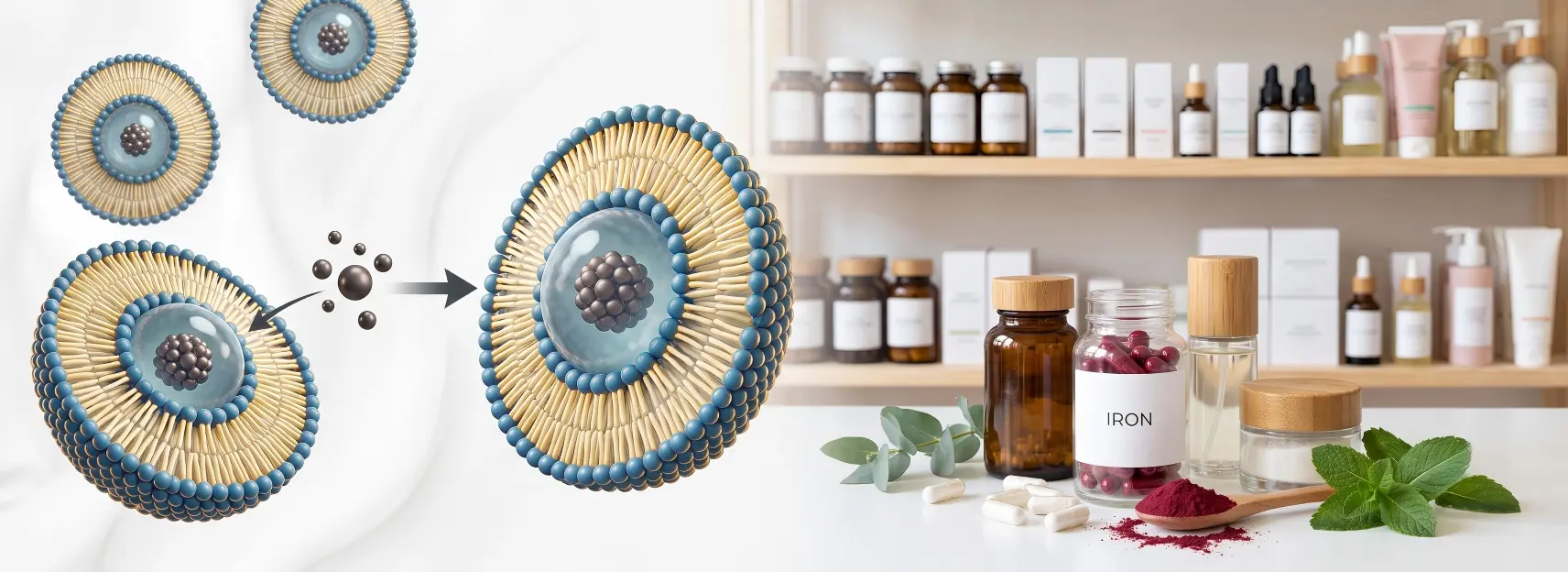
Developing a stable liposomal iron supplement requires balancing iron source, dosage form, phospholipid system, cofactors, stability, packaging, and regulatory requirements – not simply mixing iron with lecithin and vitamin C.
Why Are More Brands Launching Liposomal Iron?
Q: Why launch liposomal iron instead of another iron salt or chelate?
A: Most brand teams are not buying “higher absorption” as an abstract science claim. They are buying premium positioning, differentiation, channel fit, and tolerance perception that can support higher AOV and fewer GI-related review problems – provided the liposome system is characterized.
Brand driver | What it means commercially |
|---|---|
| Premium positioning | Compete above commodity sulfate/fumarate price bands |
| Differentiation | Escape Amazon clones that only say “gentle bisglycinate” |
| Practitioner/specialty channels | Survive technical questions about delivery systems |
| Women’s health / prenatal-adjacent trends | Match shopper demand for comfortable daily iron routines |
| Better tolerance perception | Encapsulation can limit free-iron mucosal contact vs some salts |
| Amazon / DTC premium pricing | Justify higher price with delivery-technology storytelling |
| Liquid/drop feasibility | Taste masking becomes more realistic than with raw salts |
Iron remains an essential mineral for oxygen transport and related functions; needs differ by life stage (NIH ODS). Form choice is a brand architecture decision – not a medical protocol.
Key takeaways
- Liposomal iron is primarily a brand and channel decision, then a process decision.
- Tolerance perception and format feasibility often matter more than headline milligrams.
- Without PSD/EE% proof, premium pricing is fragile.
When Is Liposomal Iron Not the Best Choice?
Q: Should every iron SKU be liposomal?
A: No. Liposomal iron is the wrong tool when price, dose realism, or process complexity will destroy margin or quality.
Situation | Better path | Why liposomal is often a poor fit |
|---|---|---|
| Budget/commodity retail | Conventional salts | Shoppers sort by mg + price; 3-6x process cost rarely recovers |
| Club/value private label | Conventional or basic chelate | Unit economics dominate |
| High-dose gummies (e.g., chasing 30 mg/piece) | Lower mg/piece design or non-gummy format | Cook stress + taste + fill make capsule-level iron unrealistic |
| First SKU with no QA bandwidth | Documented ferrous bisglycinate capsule | Chelate comfort story without vesicle analytics burden |
| Ultra-fast launch, minimal testing budget | Capsule chelate | Liposomal needs characterization + stability investment |
| RTD beverage hero as SKU-1 | Separate feasibility or different mineral strategy | Taste, regulation, and stability often exceed first-launch risk |
Best practice: If the listing must win on Sort by Price, do not force liposomal COGS into it. Keep liposomal for the hero SKU that can carry premium pricing.
Key takeaways
- “Not liposomal” can be the professional choice.
- Gummy dose fantasies and budget retail are common failure modes.
- A strong chelate capsule often beats an unproven “liposomal” quote.
Decision Matrix: If Your Goal Is… Choose…
Q: What should we pick first for SKU-1?
A: Match goal -> format -> iron core before comparing factories.
If your goal is… | Prefer | Why |
|---|---|---|
| Fastest private-label launch | Capsule + pyrophosphate or bisglycinate | Precise dosing, simpler stability, lower development cost than liquids/gummies |
| Often lowest MOQ path | Capsule | Standard lines; fewer sensory/microbial variables |
| Amazon / DTC women’s gentle iron | Capsule + liposomal bisglycinate | Comfort recognition + delivery story |
| Pediatric/flexible dosing | Drops + liposomal ferric pyrophosphate | Taste + dose precision; CRC/microbial required |
| Practitioner premium feel | Softgel | Barrier perception; watch fill and oxidation |
| Highest technology differentiation | Liposomal bisglycinate (dual verify) | Chelate identity + vesicle CQAs both required |
| Best liquid taste feasibility (often) | Liposomal pyrophosphate first | Common shortlist for drops – still pilot flavor |
| Travel/subscription | Sachet with proven redispersibility | Barrier film + drying path decide success |
| Family compliance | Gummy at realistic mg/piece | Do not force capsule-level iron into one piece |
Key takeaways
- Format before milligrams.
- Dual-story bisglycinate liposomes need dual verification.
- Gummies win compliance only with realistic dose design.
Which Dosage Form Is Best for Liposomal Iron?
Q: Which dosage form is best for liposomal iron?
A: Capsules are usually best for first launches; liquids/drops win when flexible dosing and taste are the hero job; gummies only work with realistic elemental iron per piece.
Decision tree
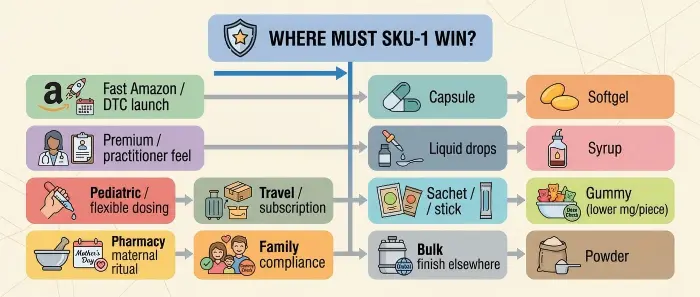
Where must SKU-1 win?
|
|-- Fast Amazon / DTC launch ---------------> Capsule
|-- Premium / practitioner feel ------------> Softgel
|-- Pediatric / flexible dosing ------------> Liquid drops
|-- Pharmacy maternal ritual ---------------> Syrup or capsule
|-- Travel / subscription ------------------> Sachet / stick
|-- Family compliance ----------------------> Gummy (lower mg/piece)
|-- Bulk / finish elsewhere ----------------> Powder
Why capsules are usually chosen first
Capsules allow precise elemental iron dosing, simpler stability management than aqueous systems, lower sensory development cost, and faster private-label commercialization than liquids or gummies. Liquids are not “worse” – they add flavor, preservative, microbial, and oxidation variables that slow launches.
Format | Best for | Why it works | Watch-outs |
|---|---|---|---|
| Capsules | First launch | Precise mg; familiar QA | Fill budget; powder moisture |
| Softgels | Premium stacks | Barrier perception | Fill volume; lipid oxidation |
| Liquid drops | Pediatric / seniors | Flexible serving | Taste, preservatives, CRC, mg/mL math |
| Syrup | Pharmacy ritual | Familiar occasion | Sugar/acid; microbes; browning |
| Sachets | Travel/subscription | Portable serving | Redispersibility; humidity |
| Gummies | Compliance | High adherence potential | Low realistic Fe/piece; cook; discoloration |
| Powder | Bulk | Downstream flexibility | Clumping; flavor; RH |
Key takeaways
- Capsules optimize speed-to-market.
- Drops optimize dosing flexibility at higher process risk.
- Gummy success = dose realism first.
Which Iron Source Should You Use in a Liposomal Formula?
Q: Ferric pyrophosphate, ferrous bisglycinate, or ferrous ascorbate – which is best?
A: There is no universal best. Match core to format, fill budget, taste risk, and COGS.
Factor | Ferric pyrophosphate | Ferrous bisglycinate | Ferrous ascorbate (optional) |
|---|---|---|---|
| Best-fit formats | Drops, syrups, sachets, capsules | Capsules, softgels, premium DTC | Projects wanting iron+C co-system |
| Approx. elemental yield | Often ~20-25% Fe (confirm COA) | Often ~18-22% Fe | Grade-dependent; often fill-hungry |
| Relative cost | Mid | High | Mid-high |
| Liquid taste | Often first shortlist | Workable with flavor design | Acid may help or hurt |
Technical rationales (why teams choose each)
Why many OEM teams choose ferric pyrophosphate for pediatric liquids
Ferric systems are widely used in gentle/fortification-adjacent liposomal concepts. Teams can often reach acceptable metallic-taste control and mid COGS without paying full bisglycinate premiums – while still requiring vesicle CQAs if marketing “liposomal.”
Why ferrous bisglycinate leads premium capsules
Iron bound to glycine can reduce free ionic iron exposure versus some inorganic salts, supporting gastrointestinal comfort positioning in some populations (Fischer et al., 2023). Inside a characterized liposome, it becomes a dual story – only if chelate identity and EE%/PSD are both proven.
Why ferrous ascorbate is optional, not default
The iron+C narrative is commercially attractive, but ascorbate increases oxidation/browning risk in liquids and humid packs. Use when the brand story needs it and pilot holds pass.
Why sunflower phospholipids increase costs
Non-GMO sunflower PC grades typically cost more than commodity soy lecithin and may need tighter process control for clean-label / allergen positioning expected by premium DTC and marketplace onboarding.
Key takeaways
- Normalize quotes on elemental Fe per serving.
- Pyrophosphate ≠ bisglycinate in fill, cost, or story.
- Sunflower is a label decision with real COGS impact.
How Much Elemental Iron Should You Use?
Q: How much elemental iron should a liposomal supplement deliver?
A: Many adult wellness SKUs discuss ~18-30 mg elemental iron per serving; women’s/prenatal-adjacent and sports bands run higher where markets allow. Pediatrics need separate age- and market-specific design. These are commercial planning bands – not medical doses.
US RDA context (total diet needs): about 8 mg/day adult men, 18 mg/day adult women, 27 mg/day pregnancy (NIH ODS).
Population / job | Elemental Fe band / serving | Why this band is common |
|---|---|---|
| Daily gentle adult | ~18-30 mg | Daily-value storytelling without extreme GI load |
| Women’s wellness | ~18-36 mg | Comfort + folate/B12 stack room |
| Prenatal-adjacent | ~18-45 mg (market-capped) | Category expectations; EU often tighter |
| Sports / active | ~25-45 mg (sometimes to ~65 mg where allowed) | Higher-intake positioning |
| Pediatric drops | Age/market-specific | Precision beats headline mg |
How to calculate elemental iron
- Lock market max and population band.
- Read elemental % from COA (compound weight ≠ elemental iron).
- Fill weight = elemental target / elemental fraction.
- Check capsule/softgel/gummy realism.
- Recalculate elemental Fe per package when changing bottle counts (CRC trigger).
- If claiming EE%, do not imply 100% of labeled iron is encapsulated unless method-supported.
Key takeaways
- Format realism caps dose before marketing does.
- Bottle-count changes can trigger CRC thresholds.
- EU max iron must be checked before US-first formulas export.
What Ingredients Can You Combine with Liposomal Iron?
Q: What can you stack with liposomal iron?
A: Vitamin C, folate, and B12 are the highest-feasibility commercial partners. Calcium, high-dose magnesium, probiotics, curcumin, and collagen often belong in companion SKUs unless fill and stability are already proven.
Ingredient | Feasibility | Technical rationale / watch-outs |
|---|---|---|
| Vitamin C | High | Supports non-heme iron absorption narratives; acid/taste stress liquids and gummies |
| Folate / 5-MTHF | High (women’s/prenatal) | Category expectation; watch labeling form rules |
| B12 / B6 | High | Cost/stability differ by form (methyl vs cyano) |
| Vitamin D3 / K2 | Medium-high | Softgel fill budget; fat-soluble stack design |
| Magnesium | Medium | Large fill weight; competing GI stories; often multi-capsule |
| Why magnesium is hard in the same capsule | – | Elemental Mg targets are high relative to capsule volume; adding meaningful Mg beside iron quickly forces larger capsules or split servings |
| Calcium | Lower same-serving | Mineral competition + huge fill; usually separate SKU |
| Zinc | Medium | Taste and mineral load |
| Curcumin | Medium-low | Color, taste, lipid load, claim complexity |
| Collagen | Medium as companion | Protein mass blows capsules |
| Probiotics | Medium-low same matrix | Moisture, heat, and iron redox stress – often separate bottle |
| Ashwagandha/melatonin/beetroot | Medium / market-dependent | Claim and sensory complexity |
Best practice: Launch lean (iron + C +/- folate/B12). Extend the line after SKU-1 proves assay, sensory, and returns data.
Key takeaways
- Lean SKU-1 beats overloaded prenatals.
- Probiotics and iron in one matrix are a common OEM trap.
- Companion SKUs often convert better than kitchen-sink formulas.
Flavor & Sensory Optimization (Drops, Liquids, Gummies)
Q: Why do liquid and gummy iron projects fail?
A: More often on taste and appearance than on assay. Encapsulation helps; it does not erase poor sweetener/acid design or oxidation on shelf.
Lever | Decision | Watch-outs |
|---|---|---|
| Flavor | Berry/citrus common masks | Validate after hold, not only day 0 |
| Sweetener | Sugar vs high-intensity by channel | Aftertaste; gummy texture |
| Acidulant | Citric/malic for brightness | Excess acid worsens metallic notes and ascorbate browning |
| Masking systems | Often needed for drops | Must not collapse vesicle integrity |
| Color | Naturals for gummies/liquids | Iron can discolor gummies over time |
Why gummies discolor
Iron redox chemistry, colorants, pH, and moisture migration can shift appearance during shelf life. Accelerated appearance checks are mandatory before artwork lock.
Best practice: Approve sensory on accelerated-hold samples, not only fresh bench samples.
Key takeaways
- Day-0 taste approval is incomplete.
- Acid is both a flavor tool and a stability risk.
- Appearance is a release-relevant attribute for gummies/liquids.
Stability & Shelf-Life Design
Q: How long is liposomal iron stable?
A: Finished products commonly plan 18-24 months, format-dependent. Aqueous liquids are more demanding and may need shorter dating or stricter storage unless data support longer.
Format | Common planning | Main failure modes |
|---|---|---|
| Capsules / softgels | Often 18-24 months | Moisture; assay drift; softgel oxidation |
| Sachets/powders | Often 18-24 months | Caking; redispersibility loss |
| Liquids/drops | Often 12-18+ months (project-specific) | Microbes; oxidation; taste/color; assay loss |
| Gummies | Often 18-24 months with caveats | Texture; discoloration; taste shift |
Require accelerated and/or real-time finished-form studies with ICH-style condition logic for export (ICH Q1A(R2)), plus transport stress for hot/humid lanes. Track assay, appearance, and (where claimed) PSD/EE% trends.
Key takeaways
- Shelf life is earned by data, not brochure defaults.
- Liquids need stricter microbial and oxidation design.
- Export climate lanes belong in the stability brief.
Packaging Selection Guide
Q: Which packaging should we choose for liposomal iron?
A: Match barrier needs to format risk, then overlay CRC/warning rules for iron.
Packaging | Best for | Why choose it | Watch-outs |
|---|---|---|---|
| HDPE bottle + induction seal | Capsules, mass retail | Cost-efficient; works with desiccant | Moderate oxygen barrier |
| CRC closure | Most iron retail SKUs | Pediatric safety / compliance | Confirm when package elemental Fe triggers special packaging |
| Alu-alu blister | Pharmacy/premium unit dose | Excellent moisture barrier | Higher unit cost |
| Aluminum laminate stick/sachet | Travel powders | Strong O2/moisture/light barrier | Seal integrity; film gauge |
| Amber Glass | Liquids/drops | Light protection; premium cues | Breakage; shipping weight |
| Opaque PET / validated plastic | Liquids at scale | Lighter than glass | Light/O2 validation required |
| Nitrogen-flushed packs | High-value oxidation-sensitive SKUs | Lowers headspace oxygen | Process control + cost |
Best practice: Design bottle count with elemental iron per package in mind so CRC thresholds are intentional, not accidental.
Key takeaways
- Barrier choice is a stability decision.
- CRC is part of iron product design, not optional artwork.
- Liquid packs must solve light + microbes + dropper accuracy together.
Liposome CQAs: What to Put in the Specification
Q: Does spray drying destroy liposomes?
A: Not necessarily. Many commercial powders are spray-dried successfully when protectants and process windows are validated and redispersibility passes. Freeze drying can improve reconstitution quality for some systems but usually costs more and runs slower – it is not automatically “better.”
CQA | Typical OEM discussion | Why it matters |
|---|---|---|
| PSD (DLS) | Often ~50-200 nm Z-average – lock per project | Vesicle-scale evidence |
| PDI | Often <=0.30 | Uniformity / scale-up |
| EE% | Often >=85% when claimed | Free vs encapsulated fraction – method required |
| Zeta (liquids) | Project-specific | Aggregation support |
| Phospholipid class | Sunflower vs soy | Label + COGS |
| Redispersibility | Pass/fail criteria | Sachet survival |
Without PSD + EE% method, “liposomal” may simply be lecithin mixed with iron.
Key takeaways
- Method beats naked EE% numbers.
- Spray-dry feasibility is proven by data, not assumed.
- Freeze-dry is a cost/quality trade-off, not a prestige requirement.
Manufacturing Scale-Up: Pilot to Commercial
Q: Will a lab liposome survive commercial scale?
A: Only if critical process parameters and CQAs are locked at pilot. Scale-up is where PSD widens, EE% drops, and taste changes appear.
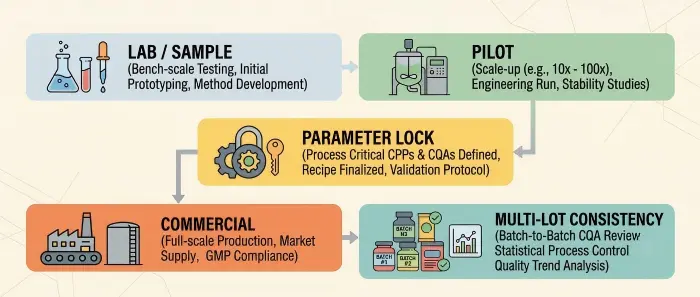
Lab / sample -> Pilot -> Parameter lock -> Commercial -> Multi-lot consistencyRisk | Why it happens | Mitigation |
|---|---|---|
| PSD widening | Shear/pressure differs at scale | Lock homogenization window; retain samples |
| EE% drop | Free iron rises after drying/scale | Same EE% method at pilot and commercial |
| Caking | RH / barrier gaps | Pack + humidity specs |
| Taste change | Oxidation over weeks | Antioxidant system + hold tests |
| Assay shortfall | No overage policy | Agree overage and release limits early |
Key takeaways
- Pilot is insurance, not optional theater.
- Same analytical methods must follow the SKU to commercial.
- Reorder consistency is part of brand protection.
Global Regulatory Snapshot for Iron Supplements
Q: Do iron rules differ by market?
A: Yes. Dose caps, warnings, packaging, and claim language are market-specific. Confirm with counsel before artwork lock.
Market | Practical brand/procurement notes |
|---|---|
| United States | Structure/function claim regime; CGMP 21 CFR Part 111; iron overdose warning for many solid oral iron supplements under 21 CFR 101.17(e); CPSC special packaging under 16 CFR 1700.14(a)(13) when package elemental iron thresholds are met |
| European Union | Food supplement mineral source lists and national practice; daily iron amounts often more constrained than typical US e-comm SKUs – confirm early; health claims under NHCR framework |
| United Kingdom | Post-Brexit supplement rules related to but not identical to EU practice – verify separately |
| Canada | NHP / product licensing pathways for many iron products; claims and dose tightly controlled vs US DSHEA-style supplements |
| Australia | Complementary medicines framework (TGA); listing/registration and claim constraints differ from US dietary supplements |
| Japan | Food with function claims / other categories have distinct notification and wording rules; do not copy US PDP language |
This snapshot is orientation – not legal advice. Always localize labels and max iron before multi-market launch.
Key takeaways
- US warning + CRC logic is non-negotiable for many iron SKUs.
- EU dose ceilings break US-first formulas at export.
- Canada/AU/JP need pathway checks, not PDP translation only.
Testing & Validation Timeline
Q: What should we test from development to annual verification?
A: Escalate from identity/feasibility to finished-form stability and reorder trending.
Stage | Recommended testing focus |
|---|---|
| Development | Iron identity/assay; phospholipid class; bench PSD/EE% method selection; sensory screens |
| Pre-pilot | Draft release spec; pack candidates; overage policy; CRC/warning checklist |
| Pilot | Full COA; PSD/PDI/EE%; sensory after accelerated hold; micro (liquids); redispersibility (powders) |
| Scale-up / first commercial | Equivalence vs pilot CQAs; finished-product COA; retain samples; ship stress if needed |
| Stability program | Accelerated + real-time on finished form; appearance/assay/(PSD/EE% if claimed) |
| Annual verification | Multi-lot trend review; method suitability; complaint/return signals; spec tightening if needed |
Key takeaways
- Pilot sensory without hold data is incomplete.
- Commercial release should mirror pilot methods.
- Annual trending catches silent process drift.
Formula Cost Drivers
Q: Why is one quote about $0.18/serving and another about $0.31?
A: Iron core, phospholipid grade, drying path, CQA tightness, format, pack, and testing scope – not mysterious factory markup alone.
Driver | Toward lower unit cost | Toward higher unit cost |
|---|---|---|
| Iron core | Pyrophosphate, moderate mg | Bisglycinate, higher mg |
| Phospholipid | Soy allowed | Non-GMO sunflower / higher PC |
| Drying | Spray-dry | Freeze-dry |
| CQAs | Wider windows | Tight EE%/PDI + third-party tests |
| Format | Capsule | Liquid / gummy |
| Pack | Standard HDPE | CRC + alu / amber / nitrogen |
| Docs | Basic COA | Multi-climate stability + retailer packs |
Ask for quote breakdowns by these drivers.
Key takeaways
- Compare cost-in-use, not only $/kg.
- Sunflower + freeze-dry + liquids stack quickly.
- Cheap uncharacterized “liposomal” is usually expensive later.
How to Evaluate a Liposomal Iron OEM Supplier
Q: How do I know supplier A is better than supplier B?
A: Demand the same document package from both. Score it. Disqualify missing EE% methods or DLS data.
Ask for | Why it matters |
|---|---|
| [ ] Iron identity + assay method | Label math |
| [ ] PSD (DLS) + target range | Vesicle-scale control |
| [ ] PDI acceptance | Uniformity |
| [ ] EE% value and method | True encapsulation vs lecithin blend |
| [ ] Release specification draft | Commercial “pass” definition |
| [ ] Accelerated / real-time stability plan | Shelf-life defense |
| [ ] Heavy metals + microbiology | Baseline QA |
| [ ] Multi-lot / 3-batch data | Process capability |
| [ ] Pilot offering | De-risk before PO |
| [ ] Commercial MOQ + lead time | Planning reality |
| [ ] Finished-product COA template | Retailer onboarding |
| [ ] Finished-form stability (your format) | Powder success != liquid success |
| [ ] Phospholipid source docs | Clean-label truth |
| [ ] CRC / warning artwork support | Launch readiness |
Full playbook: How to Choose a Liposomal Iron Manufacturer.
Key takeaways
- Same RFQ package enables real comparison.
- No EE% method = no bioavailability marketing.
- Format-specific stability is mandatory.
OEM Development Timeline: Idea to Launch
Q: How do I launch a liposomal iron supplement with an OEM?
A: Follow a staged path so characterization and packaging compliance are locked before artwork and ads spend.
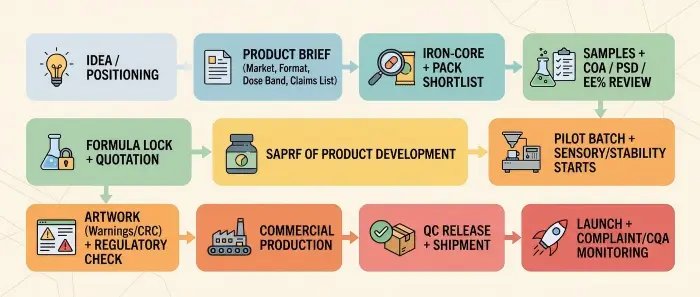
Idea / positioning
   -> Product brief (market, format, dose band, claims list)
   -> Iron-core + pack shortlist
   -> Samples + COA / PSD / EE% review
   -> Formula lock + quotation
   -> Pilot batch + sensory/stability starts
   -> Artwork (warnings/CRC) + regulatory check
   -> Commercial production
   -> QC release + shipment
   -> Launch + complaint/CQA monitoring
Stage | Typical timing (planning) | Output |
|---|---|---|
| Brief + feasibility | 1-3 days | Requirements document |
| Formula + quote | 3-7 days | Spec direction + pricing |
| Samples | 1-2 weeks | Physical + analytical review |
| Pilot | 2-3 weeks | 1-10 kg or 5k-50k units class pilots |
| Scale-up / commercial | Often 45-60 days after lock for custom liposomal | Finished goods + COA |
| Release + ship | 1-2 weeks | Export docs |
Align commercial details on the OEM pillar.
Key takeaways
- Brief quality determines quote quality.
- Artwork must wait for iron warning/CRC decisions.
- Pilot before ad spend protects margin.
Example Formulas
Case 1 – Amazon Women’s Iron
- Challenge: Escape sulfate-style GI reviews at mid-premium price.
- Decision: Capsule; ~18-30 mg elemental Fe; liposomal bisglycinate or pyrophosphate; vitamin C; optional 5-MTHF + B12; sunflower PC; CRC.
- Outcome pattern: Cleaner review narrative and clearer PDP differentiation vs commodity salts.
- Why it worked: Lean formula + characterized delivery beat overloaded stacks.
Case 2 – Pediatric Drops
- Challenge: Caregivers abandoned metallic liquids.
- Decision: Liposomal ferric pyrophosphate feasibility; flavor/preservative design; dropper calibration; amber pack; CRC; sensory after accelerated hold.
- Outcome pattern: Better adherence potential when taste survived hold testing.
- Why it worked: Process and sensory validation preceded launch claims.
Case 3 – Travel Stick Pack
- Challenge: Subscription convenience without caking returns.
- Decision: Characterized powder; redispersibility gates; barrier laminate; humid-lane ship check.
- Outcome pattern: Lower return risk when film barrier matched climate lane.
- Why it worked: Packaging treated as a critical quality control.
Case 4 – Practitioner softgel
- Challenge: Premium perception without softgel fill explosion.
- Decision: Moderate elemental band; DHA as separate SKU; oxidation-aware lipid design.
- Outcome pattern: Stable fill and clearer SKU architecture.
- Why it worked: Refused kitchen-sink prenatal softgel.
Common Formulation Mistakes
Wrong | Why it happens | Business consequence | Correct approach |
|---|---|---|---|
| Chasing high mg first | Pitch decks reward big numbers | Taste/GI complaints; ad waste | Lock format + comfort band first |
| Claiming liposomal without EE%/PSD method | Brochure language | Retailer QA failure | Put CQAs in the purchase spec |
| Overloading prenatal SKU-1 | One-bottle fantasy | Fill/stability failure | Lean core + extensions |
| Promising sunflower, buying soy | Quote chasing | Label mismatch | Specify phospholipid class in RFQ |
| Day-0 liquid flavor approval | Rushed timeline | Off-notes after weeks | Sensory after accelerated hold |
| Ignoring EU iron caps | US-first development | Export artwork redo | Confirm market max before lock |
| Skipping CRC | “Adult audience” assumption | Compliance block | Run warning + CRC checklist |
| Dose before format | Reverse workflow | Impossible gummy/drop math | Format first |
| Treating cores as equal fill | Ignoring elemental % | Capsule size explosion | Normalize elemental Fe |
| 30-ct to 90-ct without CRC math | Ops convenience | Crosses package Fe threshold | Recalculate package elemental Fe |
| Forcing liposomal into budget retail | Trend chasing | Margin failure | Use When-Not section criteria |
Claim-Safe Notes
Prefer | Avoid without dossier |
|---|---|
| Supports iron intake as part of a healthy diet | Treats / cures iron-deficiency anemia |
| Formulated for gastrointestinal comfort | “No side effects” |
| Advanced phospholipid delivery system | Unqualified “3.5x absorption for everyone” |
| Prenatal nutrition support with disclaimers | Replaces prescribed iron therapy |
FAQ
Is liposomal iron better than bisglycinate alone?
Not always. Liposomal can justify premium delivery positioning if CQAs are proven. If not, a documented bisglycinate capsule may be the better first SKU.
Can gummies deliver 30 mg iron in one piece?
Usually unrealistic without severe taste/texture trade-offs. Design lower mg/piece or choose another format.
Does spray drying destroy liposomes?
Not necessarily – validate PSD/EE%/redispersibility after drying. Do not assume success.
Why are more brands launching liposomal iron?
Premium positioning, differentiation, tolerance perception, practitioner optics, and liquid feasibility – not milligrams alone.
When should we not use liposomal iron?
Budget retail, ultra-fast low-QA launches, and high-dose gummy fantasies are common “do not” cases.
Can liposomal iron be vegan?
Yes with sunflower phospholipids and vegan dosage forms when the full formula allows.
Can sunflower lecithin replace soy?
Often yes for clean-label projects, usually at higher cost; re-validate process and stability.
Can I formulate with probiotics?
Same-matrix combinations are risky; companion SKUs are often smarter.
Can liposomal iron discolor gummies?
Yes. Run accelerated appearance checks.
How do I calculate elemental iron?
Elemental mg = compound weight x COA elemental fraction.
How much phospholipid is required?
No universal %. Require process rationale and batch data for your EE%/format targets.
Can liposomal iron be organic?
Often constrained by inputs and certification scope – confirm early.
How do I compare OEM quotations?
Normalize elemental Fe/serving, core, phospholipid class, format, EE%/PSD methods, pack, testing, MOQ, lead time.
How long is pilot production?
Samples often 1-2 weeks; pilots often 2-3 weeks after locks; commercial custom liposomal commonly ~45-60 days after lock.
What shelf life should we print?
Only what finished-form stability supports – commonly planned 18-24 months for many dry SKUs.
Does liposomal delivery remove child overdose risk?
No. Warnings and CRC rules still apply where required.
What EE% belongs in the spec?
Many OEM briefs use >=85% plus a disclosed method when encapsulation is claimed.
Which format has the lowest MOQ?
Usually capsules (often from ~5,000 units).
What packaging is best for liquids?
Amber glass or validated opaque packs plus preservative/micro design and CRC where required.
Do EU and US iron rules differ?
Yes – dose ceilings, claims frameworks, and packaging/warning details differ. Localize before artwork.
Downloads & Next Steps (Lead Magnets)
Download Iron Form / Formulation Selection Checklist
Download Liposomal Supplier Comparison Checklist
Download OEM Development Timeline (PDF)
Download Stability Planning Worksheet
Download Packaging Selection Checklist
Download Iron Specification Template
Request Cost-Driver Quote Breakdown
Request Multi-Format Sample Kit
Book Technical Review
Continue: OEM manufacturing pillar | Conventional vs chelated vs liposomal | Manufacturer playbook
References
- NIH ODS. Iron Fact Sheet for Health Professionals. https://ods.od.nih.gov/factsheets/Iron-HealthProfessional/
- Fischer JAJ, et al. Ferrous bisglycinate meta-analysis. Nutrition Reviews. 2023. https://pmc.ncbi.nlm.nih.gov/articles/PMC10331582/
- Tolkien Z, et al. Ferrous sulfate GI meta-analysis. PLoS One. 2015. https://pmc.ncbi.nlm.nih.gov/articles/PMC4312000/
- U.S. FDA. 21 CFR 101.17(e). https://www.ecfr.gov/current/title-21/chapter-I/subchapter-B/part-101/section-101.17
- U.S. CPSC. 16 CFR 1700.14(a)(13). https://www.ecfr.gov/current/title-16/chapter-II/subchapter-E/part-1700/section-1700.14
- U.S. FDA. 21 CFR Part 111. https://www.ecfr.gov/current/title-21/chapter-I/subchapter-B/part-111
- ICH Q1A(R2). https://www.ich.org/page/quality-guidelines
- EFSA NDA Panel. DRVs for iron. 2015. https://www.efsa.europa.eu/en/efsajournal/pub/4254
- WHO. Daily iron supplementation guideline. https://www.who.int/publications/i/item/9789241510196