Disclaimer: Educational B2B guidance for dietary supplement product development. Not medical advice. Not intended to diagnose, treat, cure, or prevent any disease. Follow destination-market iron warnings and child-resistant packaging rules. Channel patterns below are directional commercial observations, not guarantees of retail outcomes.
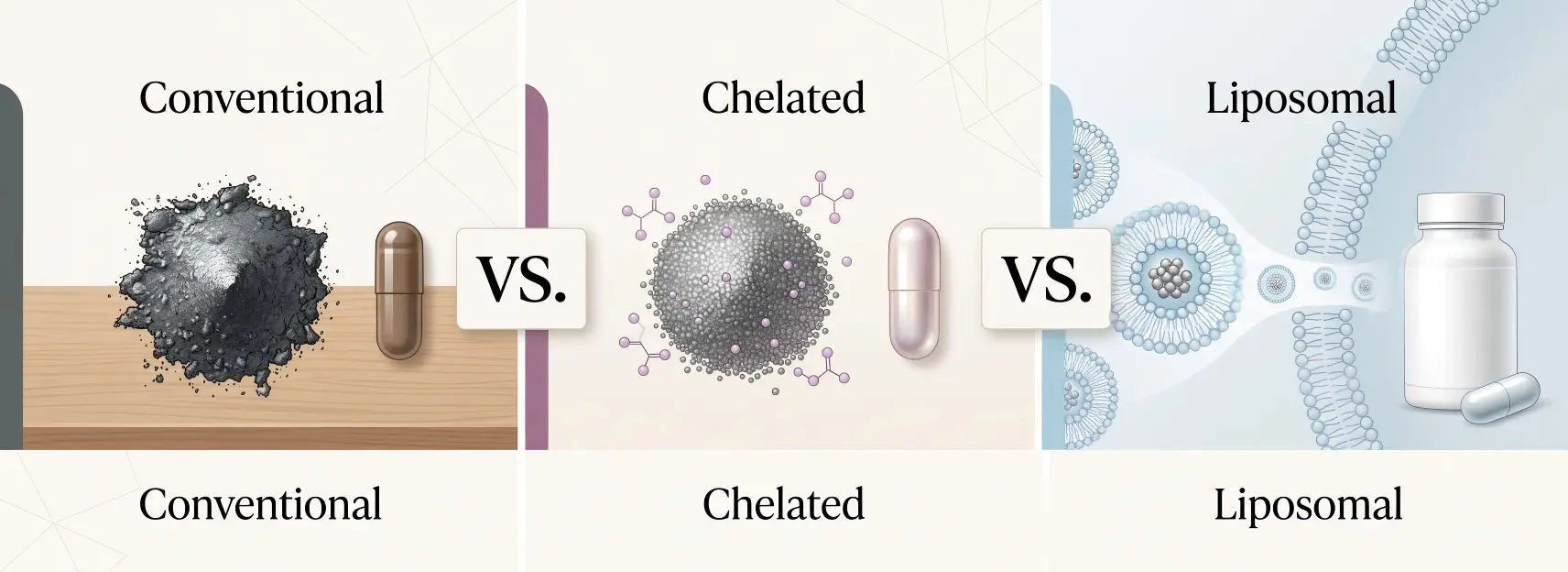
Which iron form should your brand launch – conventional iron salts, chelated iron (usually ferrous bisglycinate), or liposomal iron?
| Form | What it is | Common examples |
|---|---|---|
| Conventional | Inorganic iron salts | Ferrous sulfate, fumarate, gluconate |
| Chelated | Iron bound to amino-acid ligands | Ferrous bisglycinate |
| Liposomal | Iron in a phospholipid vesicle system | Liposomal ferric pyrophosphate, liposomal ferrous bisglycinate |
Which Iron Form Fits Your Business Model?
Q: Which iron form fits my brand type?
A: Match the form to business model and channel economics first – then refine chemistry and specs.
| Brand Type | Recommended form | Why |
|---|---|---|
| Amazon Startup | Chelated (often bisglycinate) | Best early balance of cost, review risk, and differentiation vs sulfate |
| Premium DTC | Liposomal | Technology story supports premium pricing – only with CQAs |
| Costco/club/value retail | Conventional | Lowest landed cost; shoppers sort by mg + price |
| Practitioner/Specialty | Liposomal or strong chelated | Clinical-adjacent optics and technical questioning |
| Pharmacy/mass gentle iron | Chelated | Familiar “gentle iron” language + tolerance positioning |
| Children’s brand (drops) | Liposomal pyrophosphate (common shortlist) | Taste and dosing flexibility when characterized |
| Private-label multi-tier brand | Split by line: value = conventional; core = chelated; hero = liposomal | Avoid one SKU trying to win every price band |
Best practice: Do not force liposomal COGS into a listing that can only win on Sort by Price.
Where Is Each Iron Form Winning Today?
Q: Where is each iron form commonly winning in market?
A: Patterns below are directional (“often / commonly”) – not absolute rules.
| Channel/category | Common choice | Commercial note |
|---|---|---|
| Amazon US mid-premium | Often bisglycinate (chelated) | Comfort language and review defense without full liposome analytics |
| Amazon / DTC technology-first | Increasingly liposomal | Works when price architecture and QA files support it |
| Costco / club | Commonly conventional | Unit economics dominate |
| Women’s health | Often chelated or liposomal | Comfort + daily ritual positioning |
| Prenatal-adjacent | Often chelated or liposomal | Plus folate/B12 logic; market max iron matters |
| Pediatrics (liquids/drops) | Frequently liposomal pyrophosphate shortlists | Taste and dose precision drive format more than salt familiarity |
| Practitioner | Commonly liposomal or premium chelated | Expect characterization or strong documentation |
| Pharmacy gentle iron | Often chelated | Familiarity + tolerance story |
Iron is an essential mineral; needs differ by life stage (NIH ODS). Channel fit is a brand decision – not a treatment protocol.
Brand Upgrade Roadmap
Q: Can we start simple and upgrade later?
A: Yes. Many OEM clients stage iron forms across the brand lifecycle instead of launching liposomal as SKU-1.
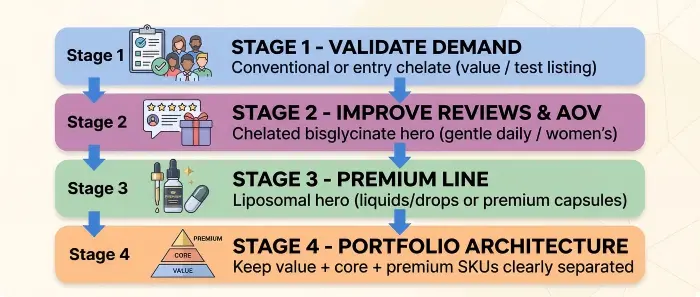
| Stage | Business job | Typical form |
|---|---|---|
| 1 | Prove category sell-through | Conventional or lean chelate |
| 2 | Reduce GI complaint risk; raise price | Chelated |
| 3 | Differentiate vs chelate clones | Liposomal (characterized) |
| 4 | Protect margin tiers | Do not mix conflicting promises on one PDP |
Can you switch from chelated to liposomal later?
Yes – treat it as a new SKU or clear reformulation with new specs, stability, and often new pack/claims review. Do not silently swap on the same ASIN without QA and listing updates.
Iron Form Scorecard
Q: How do we score the three forms for our brief?
A: Weight the rows for your business, then score. Example weights below are editable.
| Requirements | Example weight | Conventional | Chelated | Liposomal |
|---|---|---|---|---|
| Budget / landed cost | 30% | Highest | Mid | Lowest |
| Premium positioning | 20% | Lowest | Mid | Highest |
| Taste (liquids/gummies) | 15% | Weakest | Mid | Strongest when designed well |
| Speed to launch | 15% | Fastest | Fast | Slower (CQAs + stability) |
| Retail/marketplace QA burden | 20% | Lightest | Medium | Heaviest if claiming liposomal |
| Review-risk defense (GI) | (add if needed) | Weakest | Strong | Strong if characterized |
How to use: If Budget + Speed > 50% of weight, chelated or conventional usually wins. If Premium + Taste dominate and QA budget exists, liposomal becomes rational.
Procurement Risks by Iron Form
Q: What is the main procurement risk of each form?
A: Different forms fail in different ways – budget for the right risk, not only the right chemistry.
| Form | Primary risk type | What goes wrong | How buyers mitigate |
|---|---|---|---|
| Conventional | Complaint/review risk | GI discomfort and metallic taste drive refunds and ad inefficiency | Honest value positioning; avoid “gentle” overclaim |
| Chelated | Specification risk | Paying bisglycinate price for vague “amino acid iron” or buffered mismatches | Lock identity, elemental %, multi-lot COAs |
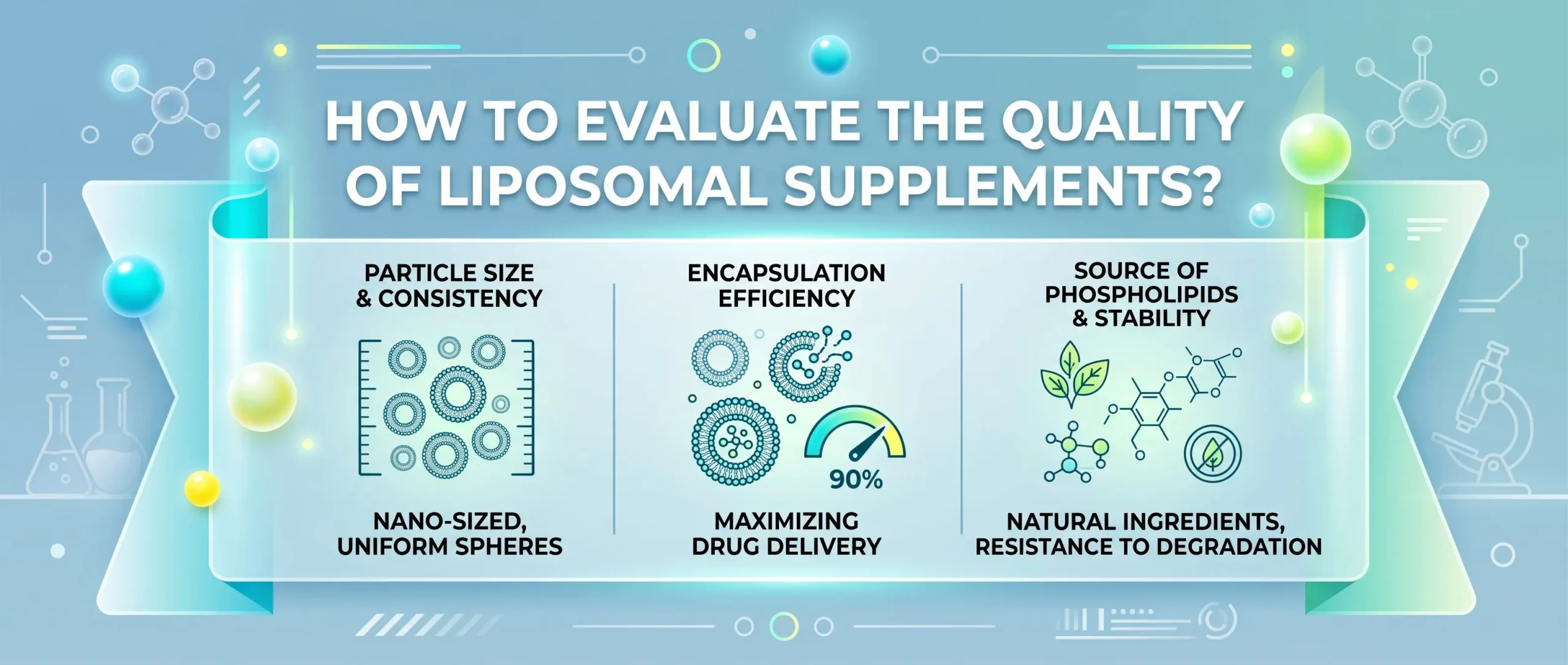
| Liposomal | Verification risk | Paying for lecithin + iron marketed as liposomes | Require DLS, EE% method, stability, multi-lot CQAs |
Secondary risks: CRC/warning misses (all forms), EU dose-cap surprises on export, and bottle-count changes that trigger package elemental-iron thresholds.
How Leading Brands Position Each Form
Q: How do market tiers usually position each form?
A: Positioning patterns (anonymized) help set PDP expectations before formula lock.
| Market posture | Typical form | Positioning pattern |
|---|---|---|
| Value brands | Conventional | High elemental mg, low price, simple Supplement Facts |
| Premium Amazon / DTC mid tier | Chelated | “Gentle,” “easy on stomach,” women’s daily rituals |
| Technology-first premium | Liposomal | Delivery system, absorption narrative, liquids/drops, practitioner optics |
| Multi-tier portfolios | All three across lines | Value / core / hero separation protects margin and trust |
Do not put technology-first liposomal promises on a sulfate value SKU – shoppers and retailers read the contradiction instantly.
Executive Comparison for Brand Buyers
| Decision factor | Conventional | Chelated | Liposomal |
|---|---|---|---|
| Typical ingredient cost multiplier* | 1x | ~1.8-2.5x | ~3-6x |
| GI comfort positioning | Weakest | Strong | Strong if characterized |
| Metallic taste risk (liquids/gummies) | Highest | Medium | Lowest when well designed |
| QC burden | Assay + micro/metals | Assay + chelate identity | Assay + PSD + PDI + EE% (+ morphology/stability) |
| Shelf-life planning | Often 24 months | Often 24 months | Often 18-24 months (format-dependent) |
| Typical MOQ* | From ~5,000 units | From ~5,000-10,000 | From ~5,000-10,000 (custom higher) |
| Lead time after lock* | Often 4-6 weeks | Often 5-8 weeks | Often 6-10 weeks / ~45-60 days custom |
| Biggest risk | Complaint/review risk | Specification risk | Verification risk |
Relative planning ranges for RFQ discussion – not a public price list.
Is liposomal iron always better?
No. If the product competes mainly on price, conventional iron often provides better ROI. If the brand differentiates through premium positioning and can fund characterization, liposomal iron may justify higher pricing. Mid-premium Amazon heroes often win first with chelated iron.
Evidence Summary
| Form | What evidence/history supports | What not to overclaim |
|---|---|---|
| Conventional | Extensive clinical/public-health history for oral salts; sulfate remains cost-efficient (NIH ODS; WHO iron guidelines) | Do not ignore GI adverse-event burden in ferrous sulfate syntheses (Tolkien et al., 2015) |
| Chelated | Growing RCT/meta-analytic support for bisglycinate tolerability and status outcomes at lower elemental doses in some populations (Fischer et al., 2023) | Not automatically liposomal; not a disease-treatment claim |
| Liposomal | Promising literature for selected oral liposomal preparations on tolerability/bioavailability in defined populations | Do not copy “Nx absorption” from another product onto your OEM formula |
Form Details with Technical Rationale
Conventional iron
Advantages: Lowest cost (1x baseline); high elemental density per dollar; simplest QC; broad regulatory familiarity.
Limitations: Weakest comfort positioning; hardest metallic taste in aqueous systems; higher complaint risk.
Ideal: Club/value private label; economy capsules.
Not recommended: PDPs promising gentle daily comfort or lead liquid/drop heroes.
Technical rationale – why metallic taste and GI complaints are common
When conventional salts dissolve, free iron ions can contact the gastrointestinal mucosa and interact with aqueous flavor systems. Free iron can also catalyze oxidation reactions that intensify metallic perception in liquids and gummies – which is why value salts struggle in flavored formats even when assay is correct (Tolkien et al., 2015 on GI events with ferrous sulfate).
Chelated iron (usually ferrous bisglycinate)
Advantages: Clear upgrade from sulfate on comfort positioning; strong consumer recognition; capsule-friendly without full liposome analytics; growing tolerability evidence.
Limitations: Not automatically best for every liquid; specification games exist; no vesicle characterization story.
Ideal: Amazon mid-premium; women’s daily; pharmacy gentle iron.
Not recommended: When retailer QA expects PSD/EE% for a liposomal claim.
Technical rationale – why tolerability can improve
Iron bound to glycine is handled differently than free ionic iron from some inorganic salts. Reduced free ionic iron exposure during gastrointestinal transit may contribute to better gastrointestinal tolerability in some populations, which is why bisglycinate became a default mid-premium “gentle iron” (Fischer et al., 2023).
Why chelated quotes sit around ~1.8-2.5x conventional
You pay for chelate manufacture, identity control, and documentation – not only “marketing gentleness.”
Liposomal iron
Advantages: Strong for liquids/drops and technology-first PDPs; taste-masking potential; premium AOV support when proven.
Limitations: Highest QC burden; shelf life often more format-sensitive (commonly 18-24 months planning); easy to overpay for non-characterized blends.
Ideal: Premium DTC; practitioner-adjacent; pediatric drops (often pyrophosphate shortlist); prenatal-adjacent heroes.
Not recommended: Budget retail heroes; launches without analytical budget.
Technical rationale – why it can feel gentler and cost 3-6x
Encapsulation can limit direct mucosal contact with free iron and support delivery-system positioning. Cost rises because phospholipid grade (especially sunflower), homogenization, drying, and PSD/EE% analytics are part of the purchase – not optional extras. That is why liposomal quotes look expensive relative to salt blends: buyers are funding process control and proof, not only iron milligrams.
Can ferrous bisglycinate be liposomal?
Yes – dual story requires dual verification (chelate identity + vesicle CQAs).
How to Verify a Genuine Liposomal Iron
Q: How do we verify “liposomal” is real?
A: Ask for documents. Without them, “liposomal” may simply be lecithin mixed with iron.
| Document/test | Why it matters |
|---|---|
| DLS particle size | Proves vesicle-scale population |
| PDI | Uniformity |
| Encapsulation efficiency (method + value) | Encapsulated vs free fraction |
| TEM / morphology (when available) | Visual support for retailer QA |
| Assay COA + Fe2+/Fe3+ declaration | Label math |
| Stability report | Shelf-life defense |
| Oxidation / lipid integrity notes | Taste and shelf behavior |
| Redispersibility (powders) | Stick-pack survival |
Deep dive: Manufacturer playbook | Formulation guide.
Supplier Capability Matrix
| Capability | Conventional | Chelated | Liposomal |
|---|---|---|---|
| Standard blend / encapsulate | Yes | Yes | Yes |
| Chelate identity control | – | Yes | Yes (if bisglycinate core) |
| High-pressure / high-shear homogenization | – | – | Yes |
| DLS particle size | – | – | Yes |
| EE% method + release limit | – | – | Yes |
| Spray-dry / freeze-dry liposomal powders | – | – | Often needed |
| Pilot before commercial | Recommended | Recommended | Strongly recommended |
| CRC / iron warning artwork support | Yes | Yes | Yes |
If a factory quotes liposomal pricing but cannot show DLS/EE% capability, treat the quote as a different product class.
Format Fit (Gummies, Sticks, Drops)
| Question | Practical answer |
|---|---|
| Best for children’s drops? | Often liposomal pyrophosphate feasibility first – taste, CRC, microbial design |
| Best for gummies? | Any form needs dose realism; metallic taste and color stability delay projects more often than assay |
| Best for stick packs? | Liposomal powders only with proven redispersibility |
| Easiest private-label path? | Usually chelated or conventional capsules |
| Longest shelf-life planning? | Dry conventional/chelated often ~24 months; liposomal often 18-24 months and more format-sensitive |
Lessons from OEM Projects
These are anonymized patterns from liposomal / iron OEM work – not client endorsements.
- Capsule fill is usually tighter than the brief assumes. Brands often overestimate how much elemental iron can sit beside folate, B12, and magnesium in one serving without jumping capsule size or splitting servings.
- Gummy delays are usually sensory, not assay. Metallic taste and color stability cause more timeline slips than failing iron potency.
- Amazon startups that jump straight to liposomal without QA budget often stall at retailer questions or burn margin; chelated heroes frequently convert faster as Stage 2.
- Silent “liposomal” swaps on a winning chelated ASIN create review and compliance risk – treat upgrades as new specs and clear listing communication.
- Bottle-count upsizing (30 to 90 count) can unexpectedly cross elemental-iron package thresholds for special packaging – recalculate before artwork.
- The cheapest liposomal quote is frequently the most expensive after failed EE%/PSD requests mid-launch.
Claim Boundaries (All Three Forms)
| Usually usable (market-dependent) | Avoid without dossier |
|---|---|
| Supports iron intake as part of a healthy diet | Treats/cures iron-deficiency anemia |
| Formulated for gastrointestinal comfort | “No side effects for anyone” |
| Chelated/liposomal delivery positioning with substantiation | Unqualified “3.5x absorption for all users” |
| Prenatal nutrition support with required disclaimers | Replaces prescribed iron or IV iron |
US references: 21 CFR 101.17(e); 16 CFR 1700.14(a)(13).
FAQ
Which iron form fits an Amazon startup best?
Often chelated bisglycinate first – balance of cost, reviews, and differentiation. Move to liposomal when price architecture and QA files can support it.
Which iron form is best for private label?
Depends on the line: value private label often conventional; mid private label chelated; premium private label liposomal with proof.
Which iron form has the best consumer reviews?
Comfort-positioned chelated and well-made liposomal SKUs typically defend reviews better than sulfate-led value SKUs – execution still matters more than the word on the label.
Which iron form has the highest repeat purchase rate?
Forms that protect gastrointestinal comfort and taste usually support better adherence and repeat purchase potential. There is no universal published league table by form for every brand.
Can liposomal iron replace bisglycinate?
It can as a premium upgrade, but it is not an automatic replacement. Many brands keep chelated as core and add liposomal as hero.
Can I switch from chelated to liposomal later?
Yes – via staged roadmap or new SKU. Update specs, stability, and listing claims; do not silent-swap.
Which iron form is easiest to register / onboard?
Often conventional or chelated capsules in US dietary-supplement pathways. Canada/AU/JP and practitioner channels can change the answer – localize early.
Which iron form is best for children’s supplements?
Liquid drops with careful dose math; teams frequently shortlist liposomal ferric pyrophosphate for taste/dosing feasibility, with CRC and pediatric-appropriate labeling.
Is liposomal iron worth the extra cost?
Yes when premium positioning, liquids/drops, or technology differentiation is the job and CQAs are funded. No when the listing only wins on price.
Is chelated iron the same as liposomal iron?
No. Chelated = ligand-bound iron. Liposomal = vesicle delivery. They can be combined with dual verification.
What tests should liposomal suppliers provide?
At minimum: assay, DLS PSD, PDI, EE% with method, stability plan; preferably morphology support and oxidation controls.
How do I compare quotations?
Normalize elemental Fe/serving, core, phospholipid class, format, EE%/PSD methods, pack, testing scope, MOQ, lead time.
Which form has the lowest MOQ?
Usually conventional or chelated capsules (often from ~5,000 units).
Which form has the longest shelf life (typical planning)?
Dry conventional/chelated often ~24 months; liposomal often 18-24 months and more format-sensitive.
Does liposomal delivery remove child overdose risk?
No. Warnings and CRC rules still apply where required.
What is the main procurement risk of each form?
Conventional: complaint risk. Chelated: specification risk. Liposomal: verification risk.
Where is bisglycinate winning today?
Commonly in Amazon mid-premium and women’s gentle daily capsules.
Where is liposomal winning today?
Commonly in technology-first DTC, practitioner-adjacent SKUs, and pediatric liquid shortlists – when characterized.
Next: Liposomal Iron OEM pillar | Formulation guide | Manufacturer playbook
References
- NIH ODS. Iron Fact Sheet for Health Professionals. https://ods.od.nih.gov/factsheets/Iron-HealthProfessional/
- Tolkien Z, et al. Ferrous sulfate GI meta-analysis. PLoS One. 2015. https://pmc.ncbi.nlm.nih.gov/articles/PMC4312000/
- Fischer JAJ, et al. Ferrous bisglycinate meta-analysis. Nutrition Reviews. 2023. https://pmc.ncbi.nlm.nih.gov/articles/PMC10331582/
- WHO. Daily iron supplementation guideline. https://www.who.int/publications/i/item/9789241510196
- U.S. FDA. 21 CFR 101.17(e). https://www.ecfr.gov/current/title-21/chapter-I/subchapter-B/part-101/section-101.17
- U.S. CPSC. 16 CFR 1700.14(a)(13). https://www.ecfr.gov/current/title-16/chapter-II/subchapter-E/part-1700/section-1700.14
- EFSA NDA Panel. DRVs for iron. 2015. https://www.efsa.europa.eu/en/efsajournal/pub/4254