Written by: KS Nutripharma Formulation Team
Reviewed by: KS Nutripharma Director of R&D, PhD in Food Science
Technical scope: Magnesium forms used in women’s supplements, B6 companions, and how cycle, PMS, perimenopause, and midlife products differ in formulation
Updated: September 2026
Magnesium supplements for women do not use a women-only magnesium salt. Glycinate, citrate, oxide, and multi-salt formulas all appear in commercial products positioned around women’s health, the menstrual cycle, PMS, period comfort, perimenopause, menopause, and midlife. What usually changes from one listing to the next is the product positioning, the companion ingredients, the serving size, and the dosage form — not a mineral reserved for women. See magnesium supplements for how those salts sit beside each other.
Cycle support, PMS, menstrual cramps, perimenopause, and midlife sit close together in retail, but they are not one interchangeable “women’s magnesium” product. Two bottles can share magnesium glycinate and still differ in vitamin B6, other companions, label language, and the audience they are built for.
Adult oral dietary supplements are the scope. Pregnancy and therapeutic hormone products need separate clinical and regulatory review.
Which Magnesium Forms Are Used in Women’s Supplements?
There is no magnesium salt that is intrinsically “for women.” The forms below show up because they fit a serving, a format, and a positioning choice — not because one salt is clinically assigned to the menstrual cycle or to menopause.
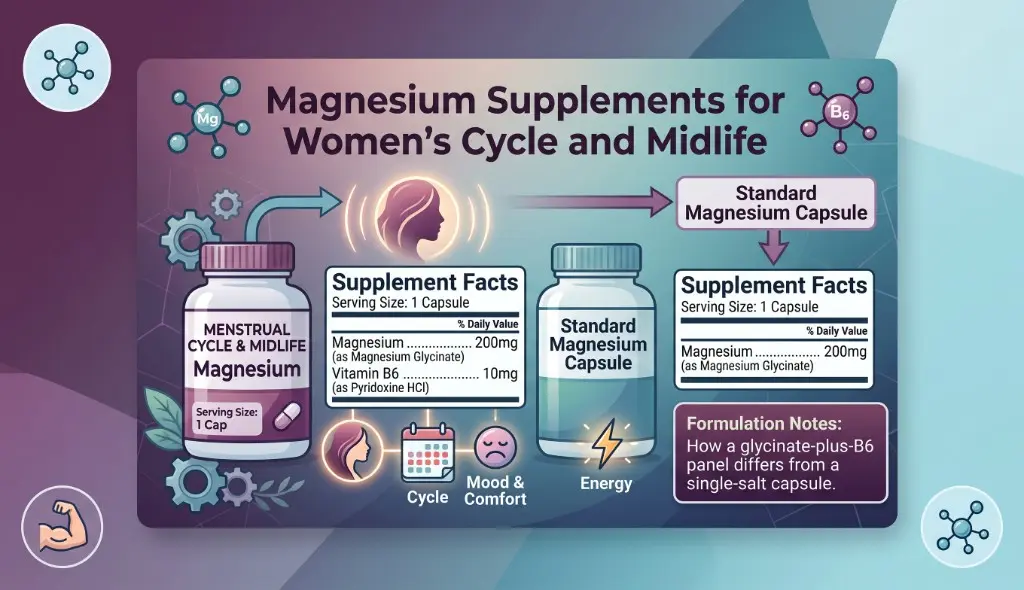
Glycinate / bisglycinate. Magnesium glycinate is commonly used in women’s magnesium products, including products positioned around cycle support, general mineral supplementation, and evening use. Some formulas add vitamin B6, while others remain magnesium-only. See magnesium bisglycinate supplements manufacturing.
Citrate. Magnesium citrate may appear in capsules, powders, or multi-magnesium formulas. Selection depends on the elemental magnesium target, serving size, format, and formulation constraints — not on a PMS- or menopause-specific property of citrate.
Oxide. Magnesium oxide may be used where a higher elemental-magnesium contribution per unit weight is useful, including some tablets and compact capsules. Its inclusion should be evaluated alongside serving size and overall formulation tolerance.
Multi-salt formulas. Some women’s magnesium products combine two or more magnesium sources. Compare the elemental contribution of each source rather than treating the blend as one generic magnesium ingredient — the magnesium complex supplement manufacturer page sets out how that per-salt breakdown is specified.
Glycinate is common in women’s magnesium products. It is not the only form, and it is not “women’s magnesium” by itself.
Why B6 Appears in Some Women’s Magnesium Products
Vitamin B6 is a companion on some women’s magnesium formulas, especially some cycle- and PMS-positioned capsules. It is not a rule that every women’s magnesium product must include B6, and it is not what converts a plain evening glycinate capsule into a cycle product. Magnesium-only formulas are also sold for women’s health, cycle support, and midlife mineral positioning.
When B6 is used, the form still has to be named.
Pyridoxine. Often listed as pyridoxine hydrochloride. A common B6 source on multi-nutrient and cycle-positioned capsules.
Pyridoxal-5-phosphate (P5P). A different B6 form with different label wording and cost. Choosing P5P instead of pyridoxine is a specification decision, not a proof that the product treats PMS or perimenopause.[2]
The B6 form should be specified separately from the magnesium specification. “With B6” does not define whether the formula uses pyridoxine or pyridoxal-5-phosphate. The B6 amount belongs on the Supplement Facts panel with the magnesium amount; neither figure is a recommended intake.
Cycle, PMS, Perimenopause, and Midlife Are Different Product Briefs
Magnesium for women covers several product contexts at once. Those contexts share an audience more often than they share a finished formula.
Product position | Common formulation direction | What changes |
|---|---|---|
| Cycle / PMS | Magnesium ± B6 | Claim language and companion ingredients |
| Menstrual comfort / period cramps | Magnesium ± other nutrients | Positioning and label review |
| Perimenopause / midlife | Magnesium ± B6 or other nutrients | Broader companion architecture |
| General women’s magnesium | Magnesium alone or a multi-nutrient formula | Broader positioning, often without a cycle claim |
These rows describe how products are built. They are not medical stages of the menstrual cycle or of menopause.
Cycle and PMS. Products positioned for PMS often use magnesium glycinate, sometimes with B6. That combination is a frequent formulation direction. It is not evidence that glycinate treats PMS, and it is not a requirement that a cycle product include B6.
Menstrual comfort and period cramps. Magnesium for menstrual cramps, and for period cramps, is often grouped with cycle and PMS products. It is not automatically the same formula as a PMS capsule. Those products typically use the same magnesium forms already used for women — glycinate is common; citrate and blends also appear — rather than a cramp-only salt. Positioning and label language change more than the mineral identity. That is not a statement that magnesium treats menstrual pain.
Perimenopause, menopause, and midlife. A product positioned for perimenopause, menopause, or midlife is a different formula from a cycle or PMS capsule, even when both use glycinate. Companion lists are often broader; some listings stay magnesium-only. Magnesium supplements during menopause remain dietary supplements — midlife mineral products — not menopause hormone products and not a substitute for therapeutic hormone care.
General women’s magnesium. Some products simply say magnesium for women or magnesium for women’s health, without a cycle, PMS, or midlife claim. Those can be magnesium-only, multi-salt, or multi-nutrient formulas. The front panel does not create a separate salt.
Evening-positioned glycinate can overlap this audience. Overlap does not make evening, cycle, and midlife the same product. The salt may match. The companions, serving, and label language may not.
What Changes When the Formula Adds Other Ingredients
Once the magnesium salt is named, added ingredients are what usually separate one women’s listing from another.
Vitamin B6. Present on some cycle and midlife formulas, absent on others. Adding B6 changes the panel and the positioning options. It does not redefine the magnesium salt.
Other nutrients. Calcium, zinc, or B-complex vitamins appear on some women’s mineral formulas. Each nutrient needs its own identity and amount. A “women’s blend” line on the front panel is not a specification of those amounts.
Botanicals. Some cycle-positioned products include botanical companions beside magnesium. Each botanical is a separate ingredient with its own identity, not another magnesium form. Adding a botanical does not make the magnesium salt more specific to PMS or to midlife.
Two products can both be “magnesium glycinate for women” and still disagree on every companion line. That is why comparing front-panel gender language is a weak way to compare the formulas.
What to Define Before Comparing Women’s Magnesium Products
For formulation comparison, “magnesium for women” is not enough information. The salt, elemental magnesium per serving, serving size, dosage form, and companion ingredients all need to be defined before two products can be compared properly.
A useful comparison usually includes:
- Magnesium salt — glycinate, citrate, oxide, a named blend, or another defined source.
- Elemental magnesium per serving — separate from the compound weight.
- Serving size and dosage form — one capsule, two capsules, a tablet, or a powder serving.
- Companion ingredients — including whether B6 is present, and whether that B6 is pyridoxine or P5P; plus any other nutrients or botanicals, each with identity and amount.
- Product position and target market — cycle / PMS, menstrual comfort, perimenopause / midlife, or general women’s magnesium. Destination market drives label format and claim language.
If you are developing a women’s magnesium product, those fields belong on the formula brief before two drafts are compared. Send the formula brief when the salt, elemental magnesium, serving, format, and companions are ready to review.
The U.S. adult tolerable upper intake level for magnesium from supplements and medications is 350 mg/day according to NIH ODS. This is a U.S. nutrition reference, not a universal global regulatory limit or a formulation recommendation.[1]
Frequently Asked Questions
Which magnesium is commonly used in women’s supplements?
Magnesium glycinate is commonly used, including in products positioned for cycle support, general women’s mineral supplementation, and evening use. Citrate, oxide, and multi-salt formulas also appear. No single form is the “best” magnesium for women. The useful comparison is the named salt, the elemental magnesium per serving, the dosage form, and the companion list.
Is magnesium glycinate different for women?
No. Magnesium glycinate does not have a women-only chemical identity. What differs is the product around the salt: positioning (cycle, PMS, perimenopause, midlife, or general women’s health), companions such as B6, serving size, and label language. A glycinate capsule sold as women’s magnesium and a glycinate capsule sold as a general evening mineral can use the same magnesium source.
Why do some women’s magnesium products contain B6?
Vitamin B6 is a frequent companion on cycle- and PMS-positioned magnesium capsules. Some perimenopause and midlife formulas include it as well. Other women’s magnesium products stay magnesium-only. B6 is specified separately from the magnesium salt; “with B6” still has to name pyridoxine or pyridoxal-5-phosphate.
Is magnesium for PMS the same as magnesium for perimenopause?
Not necessarily. They may use the same magnesium salt, but the target positioning, companion ingredients, label language, and market review can differ. A PMS- or cycle-positioned capsule and a perimenopause- or midlife-positioned product are different briefs even when both use glycinate, and neither is a treatment for PMS, perimenopause, or menopause.
Related
- Magnesium Bisglycinate Supplements Manufacturing
- Magnesium Complex Supplement Manufacturer
- Magnesium Citrate Supplement Manufacturer
Technical and Regulatory References
- NIH Office of Dietary Supplements. Magnesium — Health Professional Fact Sheet. https://ods.od.nih.gov/factsheets/Magnesium-HealthProfessional/
- NIH Office of Dietary Supplements. Vitamin B6 — Health Professional Fact Sheet. https://ods.od.nih.gov/factsheets/VitaminB6-HealthProfessional/
Disclaimer: This article discusses adult dietary supplements and commercial formulation considerations. It does not provide dosing advice or treat PMS, menstrual disorders, perimenopause, menopause, or other medical conditions. Pregnancy and therapeutic hormone products require separate clinical and regulatory review. Dietary supplements are not drugs and not hormone therapy. Milligram figures, where mentioned, are not recommended intakes. The U.S. adult tolerable upper intake level for magnesium from supplements and medications is 350 mg/day according to NIH ODS. This is a U.S. nutrition reference, not a universal global regulatory limit or a formulation recommendation. Brand owners remain responsible for finished-label compliance with local counsel.