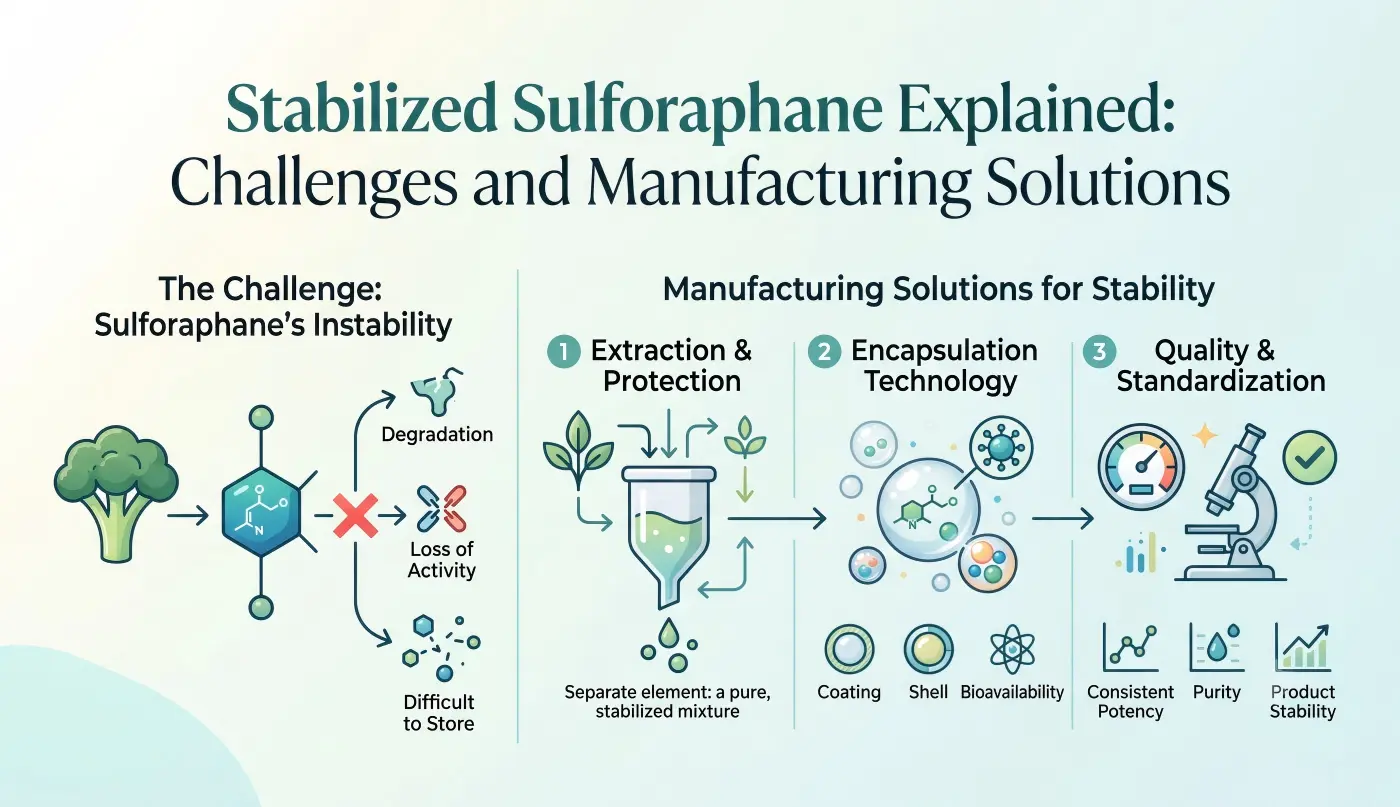
Introduction: What Does “Stabilized Sulforaphane” Mean?
Stabilized sulforaphane is preformed sulforaphane that has been protected through a carrier system, encapsulation technology, controlled manufacturing process, or protective packaging to reduce degradation during production and storage. That single sentence contains more engineering decisions than most ingredient names imply.
In the dietary supplement industry, “stabilized” is often treated as a marketing qualifier rather than a measurable specification. For brands, contract manufacturers, and formulators, this ambiguity creates real commercial risk. The raw material labeled “stabilized sulforaphane” may use cyclodextrin inclusion, spray-dried microencapsulation, or simply a proprietary drying process. Each technology produces a different stability profile, a different release behavior, and a different regulatory footprint.
Three critical limitations must be understood from the outset:
- “Stabilized sulforaphane” is not a unified, legally defined ingredient specification. The term describes an intent, not a monograph.
- Different suppliers may use entirely different stabilization technologies, and those technologies are not interchangeable in formulation.
- Stabilization cannot be proven by the ingredient name alone. It must be demonstrated through analytical data and stability studies on both the raw material and the finished supplement.
A stabilized ingredient is only commercially meaningful if the finished supplement retains its declared sulforaphane content through the intended shelf life. Everything else—encapsulation efficiency, carrier selection, or process claims—is secondary to that single outcome.
Why Is Sulforaphane Difficult to Formulate?
Sulforaphane Is Chemically Reactive
Sulforaphane (SFN; 1-isothiocyanato-4-(methylsulfinyl)butane) is an isothiocyanate. Its central functional group, the –N=C=S moiety, is intrinsically electrophilic. This reactivity is precisely what makes SFN biologically interesting—it can interact with thiol groups on Keap1, triggering the Nrf2 antioxidant response pathway. However, that same chemical appetite creates formulation challenges.
In a multi-ingredient supplement matrix, SFN may react with thiol-containing compounds (such as N-acetylcysteine), amines, or other nucleophiles. These reactions do not merely reduce potency; they can generate unknown degradation products that complicate identity testing and safety assessment. Formulators cannot assume that SFN will remain chemically inert simply because the label lists it at a fixed milligram strength.
Heat Accelerates Degradation
Thermal degradation of sulforaphane follows predictable kinetic patterns. In stability studies, degradation rates increase with temperature, and the relationship is often described by the Arrhenius equation. In one published investigation examining SFN stability under defined pH and solvent conditions, the degradation rate approximately tripled for every 10°C increase in temperature within the studied range.
That figure, however, must be treated with caution. It was derived from a specific experimental matrix—particular pH, buffer composition, and aqueous environment—and cannot be extrapolated as a fixed rule for all commercial formulations. A gummy matrix, a tablet granulation, and a lipid-based softgel will each respond to heat differently. The practical implication is clear: every dosage form requires its own validated temperature limits during manufacturing, and those limits must be confirmed by before-and-after assay data, not by theoretical prediction.
Water and pH Matter
Aqueous environments present one of the most significant stability challenges for sulforaphane. In liquid formulations, functional beverages, and even gummy matrices, water activity creates conditions where hydrolytic and oxidative degradation pathways compete. Alkaline conditions generally accelerate SFN degradation. Acidic conditions, in contrast, can improve thermal stability in certain systems, though the effect is formulation-dependent and cannot be assumed universally.
A common source of confusion in the literature—and in supplier marketing—arises from conflating two distinct pH questions: the pH that favors conversion of glucoraphanin (GR) to sulforaphane, and the pH that best preserves preformed sulforaphane after it has already formed.
The myrosinase-mediated or acid-catalyzed conversion of glucoraphanin to sulforaphane may proceed optimally near pH 5 in certain in vitro models. However, once sulforaphane exists as the preformed molecule, its stability in storage may be favored by different pH conditions. Buffer salts, co-solvents, and the food matrix itself all modify the effective degradation rate. Formulators must therefore distinguish between process chemistry (how SFN is generated) and shelf-life chemistry (how SFN is preserved).
Oxygen, Storage, and Ingredient Interactions
Oxygen participates in the degradation of many isothiocyanates, including sulforaphane, through oxidative pathways that remain incompletely characterized at the commercial formulation level. Beyond direct oxidation, secondary risks compound the problem: hygroscopic powders absorb atmospheric moisture, prolonged storage in non-barrier packaging permits oxygen ingress, and incompatible co-ingredients can catalyze degradation.
Specifically, N-acetylcysteine (NAC), amino acids, proteins, certain minerals, and plant polyphenols have all been shown to interact with isothiocyanate chemistry in experimental settings. In a multi-component supplement, these interactions are not theoretical. They must be evaluated through real compatibility testing—accelerated and real-time—because stability data for sulforaphane alone, or for a single co-ingredient alone, does not predict behavior in a blended matrix.
Stabilized Sulforaphane Is Not the Same as Glucoraphanin
This distinction is non-negotiable for anyone sourcing, formulating, or labeling sulforaphane supplements. The two ingredient categories solve different problems, carry different analytical requirements, and appeal to different mechanistic claims.
| Stabilized Sulforaphane | Glucoraphanin-Based System |
| Preformed SFN is already present in the product; no enzymatic conversion is required before absorption. | Glucoraphanin (GR) is the stable precursor; conversion to SFN requires myrosinase or gut microbiota. |
| The formulation challenge is preserving SFN itself against chemical degradation during manufacturing and shelf life. | GR is generally more chemically stable than SFN, but actual SFN delivery depends on conversion efficiency. |
| Labeling should specify actual SFN content in mg or µmol, and analytical methods must detect preformed SFN. | Labeling may show GR content; any SFN yield claim is theoretical unless supported by human bioavailability data. |
| Stabilization technologies (cyclodextrin, microencapsulation, etc.) are applied directly to the SFN molecule. | Stabilization is less critical for GR itself, though the conversion system (myrosinase co-delivery) may require protection. |
A glucoraphanin supplement may be a stable sulforaphane-delivery strategy, but it should not automatically be described as containing stabilized sulforaphane. Brands that conflate the two risk regulatory scrutiny, consumer confusion, and failed identity testing when a third-party laboratory assays for preformed SFN and finds only GR.
Related reading:
What Should a Stabilization System Accomplish?
A commercially viable stabilization system must satisfy multiple criteria simultaneously. It is not enough to slow degradation in a single accelerated test. The system must perform across the full manufacturing lifecycle:
- Reduce SFN loss during raw material storage, blending, and unit-dose manufacturing.
- Improve active retention during the labeled shelf life under the recommended storage conditions.
- Limit exposure to moisture, oxygen, and chemically incompatible co-ingredients.
- Maintain blend uniformity so that each capsule, tablet, or sachet delivers the declared dose.
- Release SFN at the appropriate gastrointestinal site without compromising absorption kinetics.
- Use excipients and carriers that comply with the regulatory requirements of the target market (e.g., GRAS status in the United States, novel food assessments in the EU).
- Avoid significant reductions in bioavailability that would negate the benefit of chemical stabilization.
- Support a shelf-life claim with data, not with ingredient branding alone.
Higher encapsulation efficiency does not automatically mean higher human bioavailability. Encapsulation efficiency, shelf-life stability, release rate, and human absorption are four independent metrics. A microcapsule with 90% encapsulation efficiency may release SFN too slowly in the gut to achieve therapeutic plasma levels. Conversely, a less efficient system may degrade faster in storage but release more rapidly upon ingestion. Formulation is always a multivariate optimization problem.
Major Sulforaphane Stabilization Technologies
Cyclodextrin Inclusion Complexes
Cyclodextrins are cyclic oligosaccharides with a hydrophobic internal cavity and a hydrophilic external surface. This architecture allows them to host small lipophilic molecules such as sulforaphane within the cavity, reducing direct contact with environmental oxygen, moisture, and reactive matrix components.
Research literature has explored both α-cyclodextrin and hydroxypropyl-β-cyclodextrin (HP-β-CD) for SFN complexation. The potential advantages include solid-state conversion of a volatile liquid compound, improved processing stability during tableting or encapsulation, and, in some systems, favorable human pharmacokinetic data.
However, cyclodextrin complexation is not a plug-and-play solution. Formulators must evaluate:
- The molar ratio of SFN to cyclodextrin, which determines how much SFN is actually complexed versus free.
- The actual inclusion efficiency, not the theoretical maximum.
- The proportion of free (uncomplexed) SFN, which remains susceptible to degradation.
- Regulatory status of the specific cyclodextrin derivative in the target market.
- Release and dissolution behavior under gastrointestinal conditions.
- Intellectual property or licensing restrictions on the specific complexation process.
Spray-Dried Microencapsulation
Spray drying converts liquid or slurry systems into dry powders by atomizing the feed into a heated chamber. For sulforaphane, this means embedding the active molecule within a wall material—commonly maltodextrin, gum arabic, or modified starches—prior to drying. The resulting microcapsules create a physical barrier between SFN and the external environment.
In one published study, researchers used maltodextrin as a wall material at a core-to-wall ratio of 1:20 and observed improved stability compared to free SFN. The study demonstrated that microencapsulated SFN retained more of its initial content under accelerated storage conditions than non-encapsulated controls.
It is important to avoid an oversimplified conclusion: that spray drying at high inlet temperatures is inherently safe for SFN because the residence time is short. The more accurate interpretation is that
the short residence time and protective wall system may permit spray drying under optimized conditions, but actual SFN retention must be measured for each specific formulation and process parameter set. Inlet temperature, feed rate, atomization pressure, and moisture content all interact. What works for one wall material may fail for another.
Oil-in-Water Emulsion Microencapsulation
A 2023 study investigated oil-in-water emulsion microencapsulation of sulforaphane using gum arabic as the wall material. Under optimized conditions, the system achieved an encapsulation efficiency of approximately 65%. Compared to free SFN, the degradation rate constant decreased by roughly a factor of six, and the thermal degradation activation energy increased by approximately 41%.
These are meaningful improvements, but they must be contextualized. The results describe a specific laboratory emulsion system under controlled conditions. They cannot be extrapolated to predict the shelf life of a commercial capsule, tablet, or softgel without additional finished-product stability testing. The gum arabic concentration, oil phase composition, droplet size distribution, and drying parameters all influence the outcome. A brand using this technology must still conduct real-time and accelerated stability studies on the final packaged product.
Protein-Based Encapsulation
Emerging research has explored protein matrices—including whey protein, pea protein, gelatin combined with gum arabic, and gelatin combined with pectin—as encapsulation vehicles for sulforaphane. The proposed mechanisms are straightforward: proteins form physical barriers, improve dispersibility in aqueous systems, and may alter digestive release kinetics through gastric enzyme interactions.
Protein-based systems introduce additional formulation considerations that do not apply to carbohydrate or cyclodextrin carriers:
- Allergen labeling requirements, particularly for dairy (whey) and animal-derived (gelatin) proteins.
- Vegan or vegetarian positioning, which may exclude certain protein sources.
- The potential for protein-SFN chemical interactions, given the reactivity of the isothiocyanate group with amine and thiol side chains.
- The gap between in vitro digestion results and actual human bioavailability, which remains unbridged for most protein-encapsulated SFN systems.
Liposomes and Lipid-Based Carriers
Liposomes, proliposomes, and solid lipid nanoparticles represent a technologically advanced class of delivery systems. By enclosing SFN within phospholipid bilayers or lipid matrices, these systems aim to reduce direct environmental exposure, improve dispersion in aqueous media, and potentially control release through lipid digestion.
Dried proliposome formulations are generally more storage-stable than liquid liposome suspensions, which are prone to oxidation, aggregation, and leakage. Nevertheless, the field remains largely preclinical. Most published studies are in vitro or animal models. Scale-up to commercial batch sizes introduces challenges in particle size control, oxidative stability of the lipid phase, and regulatory classification of nanotechnology-derived ingredients.
Brands should treat liposomal SFN as an emerging technology rather than a mature, default stabilization solution. The word “nanotechnology” does not automatically translate to superior human efficacy.
Protective Coating and Controlled Release
Enteric coating is frequently discussed alongside sulforaphane stabilization, but the two concepts address different problems. Enteric coatings—typically pH-sensitive polymers such as methacrylic acid copolymers—delay release until the dosage form reaches the higher pH of the small intestine. This can be useful for acid-labile actives or for targeting intestinal absorption.
However, enteric coating is not chemical stabilization. If sulforaphane has already degraded during raw material storage, blending, or shelf life, no coating can restore it. The coating controls where release occurs, not whether the active molecule survives to the point of release. A comprehensive stabilization strategy must address原料 stability, production losses, and gastrointestinal release as three separate, sequential requirements.
What Does Human Research Show?
Alpha-Cyclodextrin Stabilized SFN
A 2017 pilot study investigated the pharmacokinetics of sulforaphane complexed with α-cyclodextrin in ten healthy volunteers. Each participant received approximately 200 µmol of SFN-αCD. Over 24 hours, the mean urinary metabolite recovery was approximately 62.3%, though individual variation was substantial. Notably, six of the ten participants reported mild gastric discomfort.
The correct interpretation of this study is limited but important: it demonstrates that the specific α-cyclodextrin inclusion system tested did not prevent SFN absorption. The molecule was bioavailable. However, the small sample size (n=10), the absence of a comparator arm using free SFN at the same dose, and the short observation window mean that the data cannot be generalized to all stabilized SFN products. A different cyclodextrin derivative, a different complexation ratio, or a different dosage form could produce entirely different pharmacokinetics.
Enteric-Coated Stabilized SFN
A 2024 Phase 1 study examined an enteric-coated tablet containing α-cyclodextrin-stabilized synthetic d,l-sulforaphane. Participants received either 46.2 mg or 92.4 mg of SFN per day. Pharmacokinetic profiling showed absorption delays consistent with enteric-release behavior, and adverse events were predominantly mild gastrointestinal symptoms.
Critical limitations apply to any attempt to extrapolate these findings to commercial dietary supplements:
- The formulation was a specific patent-protected drug-development product, not a generic dietary supplement.
- The doses (46.2–92.4 mg/day) exceed those found in many over-the-counter sulforaphane supplements.
- The study duration was only seven days, providing no data on long-term safety or efficacy.
- The synthetic d,l-SFN and α-cyclodextrin combination used may not be identical to the stabilized SFN raw materials available from supplement ingredient suppliers.
Manufacturing Challenges by Dosage Form
Hard Capsules
Hard gelatin or vegetable-derived capsules are generally the most forgiving dosage form for sulforaphane. The manufacturing process involves low moisture, minimal heat exposure, and straightforward handling of dry powders. Stabilized SFN powders—whether cyclodextrin complexes, spray-dried microcapsules, or other solid carriers—can be filled directly into capsules with relatively low process risk.
Critical control points include:
- Powder bulk density and flow properties, which affect fill weight consistency.
- Blend uniformity at low dose strengths, where SFN may represent a small fraction of total blend weight.
- Powder hygroscopicity and moisture uptake during encapsulation.
- Moisture migration from the capsule shell into the powder fill, or vice versa.
- Chemical compatibility with other actives and excipients in the blend.
Tablets
Tablets introduce multiple thermal and mechanical stressors that capsules avoid. Compression generates frictional heat. Wet granulation exposes SFN to water and elevated drying temperatures. Film coating applies additional heat and solvent exposure. Each step is a potential degradation event.
A tablet should not be selected solely for marketing preference; SFN retention must be measured before and after compression and coating.
This is a non-negotiable analytical requirement. A brand cannot assume that a stabilized SFN powder will survive tableting intact. Assay data must be collected at the blend stage, post-compression, and post-coating. If degradation exceeds the acceptable range, the formulation must be revised—lower compression force, alternative binders, or a different stabilization technology.
Gummies
Gummies represent one of the highest-risk dosage forms for preformed sulforaphane. The manufacturing process involves:
- High water activity in the finished matrix.
- Acidic pH (typically from citric acid or similar acidulants) that may or may not favor stability depending on the specific SFN form.
- Elevated temperatures during mixing, cooking, and molding.
- Prolonged exposure to an aqueous environment during processing.
- Moisture migration within the bottle during shelf life.
Unless the sulforaphane is delivered in a rigorously validated protective form—such as a highly stable microencapsulate with demonstrated heat and water resistance—direct addition of free SFN to a gummy base is inadvisable. Even with protected forms, finished-product stability testing is essential.
Powders and Sachets
Single-dose powders and sachets offer consumer convenience but introduce stability risks after the package is opened. Key considerations include:
- Hygroscopicity of the powder after the sachet is torn open.
- Contact with minerals, proteins, or amino acids when the consumer mixes the powder into a beverage or smoothie.
- Time elapsed between mixing and consumption, during which SFN may degrade in the prepared drink.
- Barrier properties of the primary packaging (foil, paper, or multi-layer film).
Single-dose aluminum foil sachets with high moisture and oxygen barrier properties offer the best protection, but they cannot compensate for an unstable powder formulation.
Functional Beverages
Ready-to-drink (RTD) functional beverages are arguably the most challenging delivery system for sulforaphane. The active molecule must remain stable in an aqueous matrix for months, exposed to dissolved oxygen, varying pH, and potential light exposure through transparent packaging.
Two fundamentally different product concepts must not be confused:
- Ready-to-drink products, where SFN must be stable in the liquid for the entire shelf life.
- Mix-before-drinking products, where SFN is stored in a dry compartment and only combined with liquid immediately before consumption.
The latter category—dual-chamber packaging, caps with powder reservoirs, or stick packs paired with bottled water—offers a more realistic path to stability. For true RTD beverages, only heavily protected systems such as validated microemulsions or liposomal dispersions with demonstrated real-time stability data should be considered.
Manufacturing Solutions From KS Nutripharma
KS Nutripharma approaches sulforaphane supplement manufacturing as a multi-step validation process rather than a single ingredient substitution. Our workflow is designed to identify stability risks before they become batch failures.
Step 1: Define the Active Ingredient
The first decision is categorical. Does the product require preformed sulforaphane, stabilized sulforaphane, glucoraphanin precursor, a glucoraphanin-plus-myrosinase conversion system, or a hybrid delivery approach? Each option carries different analytical requirements, stability expectations, and label claim structures. We work with brands to align the ingredient strategy with the intended marketing position, dose target, and dosage form.
Step 2: Qualify the Raw Material
Before any formulation work begins, KS Nutripharma requires comprehensive raw material documentation from the ingredient supplier:
- SFN assay by validated analytical method (typically HPLC-UV or HPLC-MS).
- Source of SFN and stereochemical information (natural vs. synthetic; d,l- vs. l-enantiomer ratio if applicable).
- Stabilization carrier or technology used.
- Encapsulation or inclusion efficiency, with methodology.
- Free SFN content versus complexed or encapsulated SFN.
- Analytical method validation summary.
- Raw material stability data under recommended storage conditions.
- Microbial, heavy metal, pesticide residue, and residual solvent testing.
- Patent, trademark, or licensing restrictions on the stabilization technology.
Step 3: Conduct Compatibility Screening
Sulforaphane does not exist in isolation. In a typical supplement, it shares a matrix with other actives and excipients. KS Nutripharma conducts accelerated compatibility screening against the full intended formulation, including:
- N-acetylcysteine and other sulfur-containing compounds.
- Amino acids and protein sources.
- Minerals (particularly transition metals that may catalyze oxidation).
- Vitamins, especially those with acidic or alkaline properties.
- Plant polyphenols and herbal extracts.
- Lubricants, fillers, and binders.
- Capsule shell compositions and packaging materials.
Step 4: Control Manufacturing Conditions
Once compatibility is established, process parameters are controlled to minimize degradation:
- Temperature limits at each unit operation, with in-process monitoring.
- Environmental humidity controls in blending and encapsulation areas.
- Minimized exposure time between blend completion and packaging sealing.
- Optimized mixing sequence to prevent segregation or localized concentration hotspots.
- Lubrication time and intensity adjusted to avoid excessive heat.
- Granulation method selection (dry granulation preferred over wet when feasible).
- Coating parameters validated for SFN retention.
- Oxygen and light exposure minimized throughout.
Step 5: Select Protective Packaging
Packaging is the final barrier between the finished supplement and environmental degradation. KS Nutripharma evaluates packaging options based on the specific dosage form and stability profile:
- HDPE bottles with induction-sealed closures for standard capsule and tablet products.
- Desiccant canisters or sachets where moisture sensitivity is confirmed.
- Amber or opaque bottles for light-sensitive formulations.
- High-barrier blister films (aluminum-aluminum or aluminum-PVC) for moisture and oxygen protection.
- Single-dose aluminum foil sachets for powders.
- Inert gas flushing (nitrogen) where validated as beneficial, with container-closure integrity verification.
We do not make blanket claims that nitrogen flushing universally stabilizes sulforaphane. The benefit depends on the specific formulation, packaging permeability, and headspace volume. Container-closure integrity testing is required to confirm that the inert atmosphere is maintained.
How Should Stabilized Sulforaphane Be Tested?
Testing must occur at three stages: raw material, in-process, and finished product. No single test proves stability.
Raw-Material Testing
- Identity confirmation by FTIR, NMR, or chromatographic fingerprint.
- Actual SFN assay by validated HPLC method.
- Carrier identification and characterization (e.g., cyclodextrin type, wall material composition).
- Encapsulation or inclusion efficiency, with free versus bound SFN quantification.
- Moisture content or water activity.
- Residual solvents from manufacturing or extraction.
- Contaminant panel: microbial, heavy metals, pesticides.
In-Process Testing
- Blend uniformity (content uniformity of the powder blend).
- SFN retention before and after compression (tablets) or encapsulation.
- Moisture or water activity at critical stages.
- Coating weight gain and uniformity.
- Fill weight variation.
Finished-Product Testing
- Actual SFN content per unit dose.
- Content uniformity across the batch.
- Disintegration and dissolution (or release) profile.
- Degradation product identification and quantification.
- Microbial limits.
- Heavy metals.
- Package integrity (leak testing, seal strength).
Stability Testing
At minimum, a stabilized sulforaphane supplement should be supported by:
- T0 (initial) assay data at the time of release.
- Accelerated stability data (typically 40°C / 75% RH for 6 months) to identify degradation trends.
- Real-time stability data under labeled storage conditions for the full claimed shelf life.
- In-use stability data if the packaging is multi-dose and the product is exposed to air after opening.
Stability endpoints should include SFN assay, degradation product trends, moisture/water activity, sensory changes, and dissolution or release behavior. Microbial testing should be repeated at stability intervals for non-sterile dosage forms.
Testing only the raw material does not prove that the finished supplement remains stabilized. The raw material may be pristine while the finished product, after exposure to heat, moisture, and incompatible co-ingredients, has lost 30% of its activity. Only finished-product stability data under the actual packaging and storage conditions validates the “stabilized” claim.
How to Read a Stabilized Sulforaphane Supplement Label
Both consumers and procurement professionals should scrutinize labels for specificity. The following checklist separates meaningful claims from vague marketing language:
- Does the label specify “sulforaphane” in milligrams, or does it list only “broccoli extract” without standardization?
- Is the SFN content a measured assay value, or a theoretical yield calculated from glucoraphanin conversion?
- Does the label identify the stabilization carrier or technology (e.g., cyclodextrin complex, microencapsulated)?
- Is a shelf-life potency guarantee provided, or does the label remain silent on stability?
- Is glucoraphanin misrepresented as preformed sulforaphane?
- Does the brand provide third-party testing or a batch Certificate of Analysis (CoA)?
- Are human studies cited, and if so, do they use the same raw material and dose as the commercial product?
“Contains broccoli extract” and “delivers stabilized sulforaphane” are not equivalent statements. The former describes a botanical source; the latter implies a specific, measurable chemical entity with demonstrated stability. Brands that blur this distinction risk regulatory challenge and consumer distrust.
Does Stabilized Mean More Bioavailable?
The short answer is: not automatically.
Stabilization technologies are primarily designed to solve manufacturing and shelf-life problems: reducing degradation during production, preventing potency loss during storage, and maintaining label claim through expiry. Bioavailability is a separate, though related, question.
Human bioavailability depends on:
- Release of SFN from its carrier or matrix in the gastrointestinal tract.
- Dissolution or dispersion behavior in gastric and intestinal fluids.
- Dose administered, since absorption kinetics may be non-linear.
- Formulation factors such as co-ingredients, food matrix, and gastric emptying time.
Some stabilized systems—notably certain cyclodextrin complexes—have human pharmacokinetic data. Many others, including novel microencapsulation and protein-based systems, have only in vitro or animal data. Encapsulation efficiency, which measures how much SFN is trapped in a microcapsule, should never be used as a proxy for human absorption. Similarly, urinary metabolite recovery rates, while informative, do not equate to absolute systemic bioavailability. They reflect only the fraction of the dose that was absorbed and subsequently excreted via renal clearance.
Regulatory Considerations for US Supplement Brands
In the United States, dietary supplements are regulated under the Dietary Supplement Health and Education Act of 1994 (DSHEA) and the current Good Manufacturing Practice (cGMP) regulations codified in 21 CFR Part 111. Several regulatory principles are particularly relevant to stabilized sulforaphane products:
- The term “stabilized” is an objective product attribute claim. It must be substantiated by data. A brand cannot use the word simply because the raw material supplier used it in a specification sheet.
- Claims such as “higher bioavailability” or “clinically proven” must be matched to specific product evidence. A study on a patented drug-development formulation does not automatically support claims for a different commercial supplement using a different raw material and dose.
- Finished products must meet identity, purity, strength, composition, and contamination specifications as required by 21 CFR 111.70. Strength, in this context, means the SFN content must meet the label claim at release and through the labeled shelf life.
- Shelf-life claims must be supported by scientifically reasonable stability data. Accelerated studies alone are insufficient for full shelf-life claims; real-time data under the labeled storage conditions is the gold standard.
- Structure/function claims must comply with FDA guidance and must not implicitly or explicitly claim to diagnose, treat, cure, or prevent disease. Claims such as “prevents cancer” or “treats neurological disease” are drug claims and are not permissible for dietary supplements.
Frequently Asked Questions
What is stabilized sulforaphane?
Preformed SFN protected by a verified carrier, encapsulation, formulation, or packaging system intended to reduce degradation during manufacturing and storage.
Is stabilized sulforaphane the same as broccoli seed extract?
No. Broccoli seed extract may contain glucoraphanin, sulforaphane, or both. Its actual composition depends on extraction method, processing conditions, and standardization. A label stating “broccoli seed extract” without specifying SFN content does not guarantee preformed sulforaphane.
Is stabilized sulforaphane better than glucoraphanin?
Not universally. Stabilized SFN provides the active compound directly, which may be preferable for brands seeking immediate delivery claims. Glucoraphanin is generally easier to preserve but requires enzymatic or microbial conversion to SFN, and the efficiency of that conversion varies among individuals and formulations.
Does microencapsulation guarantee absorption?
No. Microencapsulation may improve chemical stability and handling properties, but human absorption depends on release kinetics, dissolution, dose, and individual physiology. Encapsulation efficiency and bioavailability are separate metrics.
Is enteric coating necessary for sulforaphane supplements?
Not always. Enteric coating can modify the release site, but it does not replace chemical stabilization or shelf-life testing. If SFN has already degraded before ingestion, enteric coating cannot restore it.
Can stabilized SFN be used in gummies?
Potentially, but gummies present high water activity and thermal stress. Only heavily protected SFN forms with validated heat and moisture resistance should be considered, and finished-product stability must be demonstrated.
How much SFN remains at the end of shelf life?
This cannot be determined from the ingredient name. It requires actual stability testing under the labeled storage conditions, in the final packaging, with the finished product formulation.
Should labels show SFN in mg or µmol?
Either unit may be informative, but the compound must be clearly identified as sulforaphane. As a reference, approximately 10 mg of sulforaphane equals 56.4 µmol.
Conclusion
Stabilizing sulforaphane requires more than adding a carrier or choosing protective packaging. A commercially reliable product must control degradation during raw-material storage, blending, dosage-form manufacturing, packaging, and the entire labeled shelf life. The word “stabilized” is not a specification; it is a promise that must be kept with data.
Brands should evaluate actual SFN retention, release behavior, and finished-product stability data rather than relying on the word “stabilized” alone. The right stabilization technology depends on the dosage form, the co-ingredient matrix, the packaging format, and the regulatory environment. What works for a hard capsule may fail for a gummy. What works at laboratory scale may fail at commercial batch scale.
The only reliable path to a stable sulforaphane supplement is a systematic, validated manufacturing process that treats stability as a measurable outcome, not a marketing feature.
Partner With KS Nutripharma for Stabilized Sulforaphane Manufacturing
KS Nutripharma supports supplement brands with stabilized sulforaphane ingredient evaluation, formulation development, compatibility testing, dosage-form engineering, protective packaging selection, and commercial-scale manufacturing. Whether your product concept involves hard capsules, tablets, powders, or advanced delivery systems, our team applies validated analytical and process controls to ensure that “stabilized” means something measurable on the Certificate of Analysis.
Learn more about our sulforaphane supplement manufacturing capabilities: https://kssupplements.com/sulforaphane-supplements/
Related Content
- Sulforaphane Supplement Manufacturer — https://kssupplements.com/sulforaphane-supplements/
- Sulforaphane vs Broccoli Sprouts — https://kssupplements.com/sulforaphane-vs-broccoli-sprouts/
- Sulforaphane vs Glucoraphanin — https://kssupplements.com/sulforaphane-vs-glucoraphanin/
References
- Mahn A, Reyes A. An improved method to estimate the percentage of sulforaphane and sulforaphane N-acetyl cysteine from broccoli and broccoli sprouts. J Food Sci. 2012;77(11):C1225-C1230. https://pmc.ncbi.nlm.nih.gov/articles/PMC3884065/
- VanderMolen KM, et al. Sulforaphane glucosinolate and myrosinase content of seeds. J Food Compost Anal. 2014. https://pubmed.ncbi.nlm.nih.gov/24594180/
- Sivakumar G, et al. Stability of sulforaphane in aqueous solutions. Food Chem. 2020. https://www.sciencedirect.com/science/article/abs/pii/S0023643820304321
- Kuang Y, et al. Complexation of sulforaphane with cyclodextrins. Mol Nutr Food Res. 2017. https://onlinelibrary.wiley.com/doi/10.1002/mnfr.201600766
- Calabrò ML, et al. Inclusion complexes of sulforaphane with cyclodextrins. Int J Pharm. 2010. https://www.sciencedirect.com/science/article/abs/pii/S0144861710003954
- Fernandes L, et al. Microencapsulation of sulforaphane. J Food Eng. 2014. https://pubmed.ncbi.nlm.nih.gov/24507311/
- Zhang Y, et al. Oil-in-water emulsion microencapsulation of sulforaphane. Foods. 2023. https://pmc.ncbi.nlm.nih.gov/articles/PMC10606704/
- Roy S, et al. Protein-based encapsulation of sulforaphane. Food Funct. 2025. https://pubs.rsc.org/en/content/articlehtml/2025/fo/d4fo03446e
- Silva HD, et al. Whey protein-based capsules. Food Chem. 2016. https://doi.org/10.1016/j.foodchem.2016.01.087
- Kensler TW, et al. Phase 1 study of d,l-sulforaphane-α-cyclodextrin. Cancer Prev Res. 2024. https://pubmed.ncbi.nlm.nih.gov/39520658/
- Advances in Therapy. Phase 1 study of stabilized sulforaphane. 2024. https://doi.org/10.1007/s12325-024-03018-1
- 21 CFR Part 111 — Current Good Manufacturing Practice in Manufacturing, Packaging, Labeling, and Holding Operations for Dietary Supplements. https://www.govinfo.gov/content/pkg/CFR-2025-title21-vol2/pdf/CFR-2025-title21-vol2-part111.pdf
- 21 CFR 111.70 — Specifications. https://www.law.cornell.edu/cfr/text/21/111.70
- Small Entity Compliance Guide: Structure/Function Claims. https://www.fda.gov/regulatory-information/search-fda-guidance-documents/small-entity-compliance-guide-structurefunction-claims
About This Article
- Author: KS Nutripharma Formulation Team
- Reviewed by: Senior Food Scientist, KS Nutripharma R&D
- First Published: July 2026
- Last Reviewed: July 2026
- Disclosure: KS Nutripharma is a contract manufacturer of dietary supplements. This article is intended for B2B educational purposes and does not constitute medical advice.
Medical Disclaimer: This article is for informational and educational purposes only. It does not intend to diagnose, treat, cure, or prevent any disease. Consult a qualified healthcare provider before using sulforaphane supplements for therapeutic purposes.