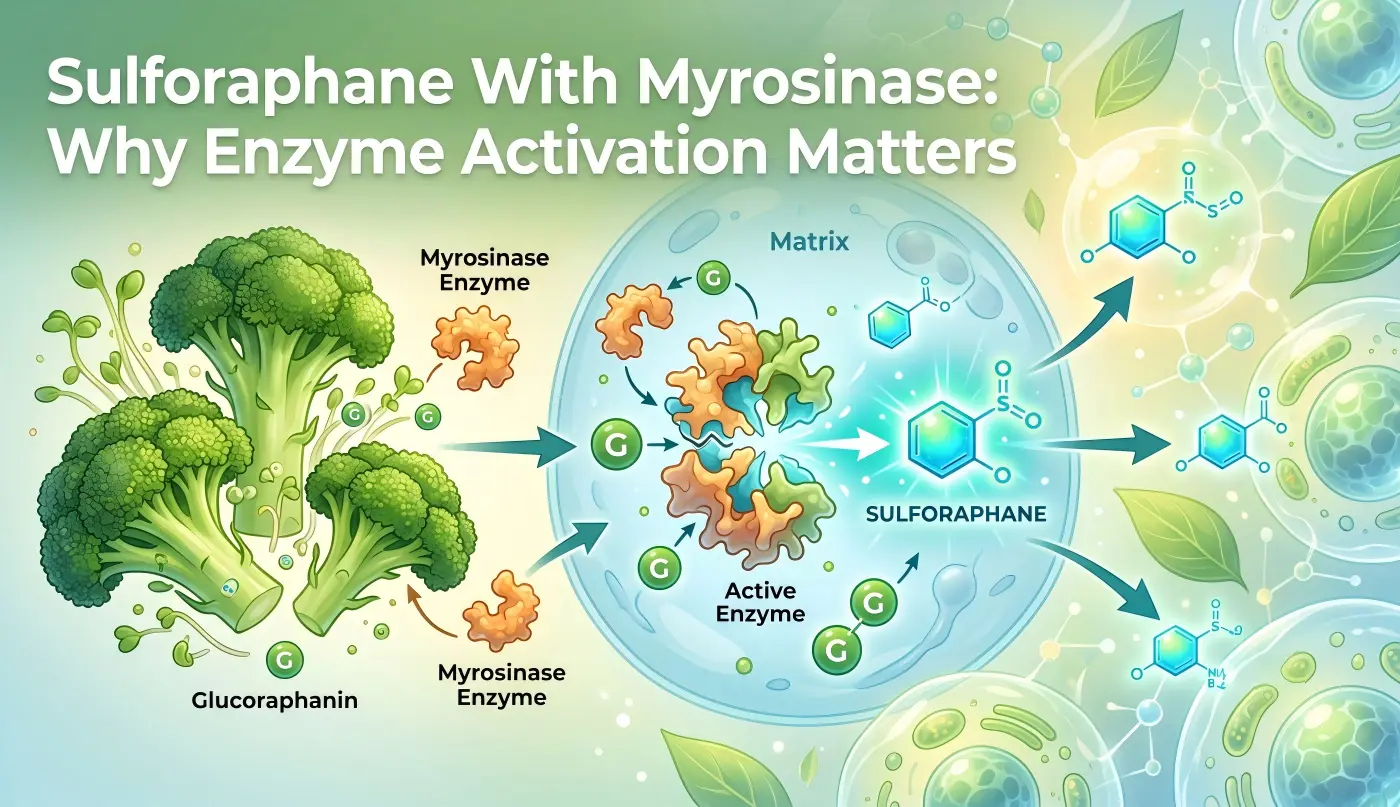
Introduction: Why Myrosinase Changes the Sulforaphane Equation
Myrosinase is the enzyme that converts glucoraphanin into sulforaphane. When the active plant myrosinase is absent, conversion depends more heavily on gut microbial activity and may be lower, slower, and more variable. For supplement manufacturers, adding myrosinase is only useful if the enzyme activity survives processing and remains functional in the finished product.
It is important to clarify a common misconception at the outset. The search phrase “sulforaphane with myrosinase” suggests a combination of the final active compound and the enzyme. However, in most supplement contexts, myrosinase matters when the product supplies glucoraphanin, the precursor of sulforaphane. If a product already contains a verified dose of preformed, stabilized sulforaphane, myrosinase is not required to activate that existing sulforaphane. Therefore, the typical “sulforaphane with myrosinase” product is more accurately described as glucoraphanin-rich broccoli extract plus active myrosinase. This distinction is fundamental to evaluating ingredient quality and formulation strategies. For a deeper comparison of the two compounds, see our analysis of Sulforaphane vs. Glucoraphanin.
This article explains how myrosinase forms sulforaphane, what human studies reveal about bioavailability, which raw materials can supply the enzyme, why enzyme weight does not equal activity, how processing and gastric conditions affect performance, and how brands should review certificates of analysis and finished-product data.
What Is Myrosinase?
Myrosinase is a class of β-thioglucosidase enzymes, commonly classified under EC 3.2.1.147. It occurs naturally in cruciferous plants such as broccoli, mustard, and radish. In intact plant tissue, glucoraphanin and myrosinase are typically stored in separate cellular compartments. When the tissue is chewed, crushed, or processed, the two come into contact and initiate a reaction.
The reaction chain proceeds as follows: glucoraphanin reacts with water in the presence of active myrosinase to form an unstable aglycone intermediate. This intermediate then undergoes molecular rearrangement to yield sulforaphane, along with glucose and sulfate. Without this enzymatic step, glucoraphanin remains a precursor and cannot deliver the bioactive isothiocyanate.
Why Does Myrosinase Matter for Sulforaphane Bioavailability?
Glucoraphanin Is a Precursor, Not the Final Active
Glucoraphanin is relatively stable, but it must be hydrolyzed to form sulforaphane. Simply increasing the glucoraphanin dose does not guarantee a proportional increase in sulforaphane delivery. Product design must account for substrate availability, enzyme activity, reaction environment, and release location. As formulation teams often note: glucoraphanin content defines the theoretical ceiling; myrosinase activity helps determine how much of that potential can become sulforaphane.
Without Plant Myrosinase, Conversion Relies on Gut Microbes
Certain intestinal bacteria possess myrosinase-like activity and can convert glucoraphanin to sulforaphane. However, microbial conversion is generally slower than plant-enzyme conversion, and results vary substantially between individuals. Glucoraphanin may also form sulforaphane nitrile, erucin, and other products depending on gut conditions. At present, standard microbiome testing cannot reliably predict an individual’s sulforaphane production.
In a study of 45 healthy adults summarized by the Linus Pauling Institute, the average conversion rate of glucoraphanin to sulforaphane metabolites was approximately 12%, with individual results ranging from about 1.1% to 40.7%. These figures illustrate variability rather than a fixed absorption rate applicable to all consumers.
What Do Human Studies Show?
Active Myrosinase Can Increase Sulforaphane Delivery
A 2015 human study compared two preparations: a glucoraphanin-rich formulation without active myrosinase, and a glucoraphanin preparation co-delivered with active plant myrosinase. Researchers measured urinary metabolite recovery as a proxy for bioavailability.
The preparation without active myrosinase showed average urinary metabolite recovery of approximately 10%. The preparation containing active myrosinase showed recovery of approximately 34% to 40%, representing roughly a three- to four-fold difference between groups.
Several qualifications apply. “Bioavailability” in this context was estimated primarily from urinary sulforaphane metabolites. Urinary recovery is not equivalent to absolute human absorption. The study used specific raw materials and doses, and results should not be extrapolated directly to all commercial products.
Mustard Seed Can Provide Exogenous Myrosinase
A 2018 randomized crossover study in 12 healthy adults examined the effect of adding brown mustard powder to cooked broccoli. Participants consumed 200 grams of cooked broccoli with or without 1 gram of brown mustard powder. The addition of mustard powder increased urinary excretion of the sulforaphane metabolite SFN-NAC by more than fourfold.
This study was conducted with whole foods rather than commercial supplements, and it measured a specific urinary metabolite. It does not prove that all mustard seed powders have identical enzyme activity, nor can the food-based dosage be translated directly into capsule formulation equivalents.
Recent Evidence From a Standardized Broccoli Seed Extract + Myrosinase Formula
A 2026 randomized, double-blind, crossover study enrolled 16 healthy subjects to evaluate a standardized formula. The glucoraphanin-rich broccoli seed extract combined with mustard seed myrosinase showed an average conversion rate of 39.8%, while the glucoraphanin-rich extract without added myrosinase showed 18.6%. During the first eight hours, conversion rates were approximately 25.4% and 8.0%, respectively.
This study was small, used a single-dose design, included vitamin C in both groups, and relied on specific standardized glucoraphanin and myrosinase raw materials. The results do not support inferences about long-term health outcomes.
Is Myrosinase Always Necessary?
When It Matters
Myrosinase is important for products containing glucoraphanin-rich broccoli seed extract, broccoli sprout extract standardized to glucoraphanin, or broccoli powder with inactive or uncertain native enzyme. It is also relevant for formulations designed to reduce reliance on gut microbial conversion.
When It Is Not Required for Activation
If a product provides measured, preformed sulforaphane or stabilized sulforaphane that maintains the labeled amount throughout shelf life, the existing sulforaphane does not require myrosinase for further activation. Learn more about Stabilized Sulforaphane Explained for products where the active compound is already present.
When Its Value Is Unclear
Myrosinase value is uncertain when a label lists only “broccoli extract” without specifying glucoraphanin content, myrosinase activity, or actual sulforaphane conversion yield. Raw-material data alone, without finished-product verification, do not establish functional performance.
Myrosinase Sources Used in Supplement Formulations
Broccoli Sprouts
Broccoli sprouts can supply both glucoraphanin and natural myrosinase, offering a complete plant-source narrative. However, enzyme activity is influenced by cultivar, growing conditions, drying method, and storage duration. For a broader discussion of whole-food sources versus isolated compounds, see Sulforaphane vs Broccoli Sprouts. Batch-to-batch standardization is challenging.
Broccoli Seeds
Broccoli seeds can provide glucoraphanin or myrosinase, and they are well suited to dry powder capsules. It is essential to distinguish between glucoraphanin-rich and myrosinase-active specifications. The term “broccoli seed powder” alone does not indicate enzyme activity.
Mustard Seed Powder
Mustard seed powder is commonly used to supply exogenous plant myrosinase and is supported by human food-intervention studies. Quality depends on measured activity units. Formulators must also consider odor, pungency, and allergen labeling requirements.
Regulatory note: mustard is not among the nine major food allergens under U.S. FALCPA. However, in the European Union, Canada, and several other markets, mustard is a declarable allergen. Export formulations must be reviewed against target-market regulations.
Purified or Concentrated Myrosinase
Concentrated myrosinase preparations offer potential advantages in activity concentration, smaller dosing weights, and more precise enzyme unit definition. Challenges include source identity, regulatory status, activity stability, cost, supply continuity, and market-specific licensing.
Why Milligrams of Myrosinase Are Not Enough
This section addresses one of the most valuable topics for B2B procurement teams. Enzyme value derives from catalytic activity, not merely weight. Two mustard seed powders of identical weight may contain vastly different myrosinase activity. A certificate of analysis stating “mustard seed powder 100 mg” proves nothing about conversion capacity.
How Myrosinase Activity Is Commonly Measured
Standard assays use a glucosinolate such as sinigrin as substrate. Laboratories monitor substrate disappearance or hydrolysis product formation under defined pH, temperature, and reaction time. One unit of myrosinase activity is commonly defined as the amount of enzyme required to hydrolyze 1 µmol of sinigrin per minute under the specified assay conditions. The phrase “under specified conditions” must be retained, because methods vary between laboratories and may not be directly comparable.
Why “Contains Myrosinase” Is Not a Sufficient Specification
Brands should require suppliers to document:
- Myrosinase source and botanical name
- Enzyme activity units per gram
- Activity units per serving in the finished product
- Test substrate used
- Test pH and temperature
- Analytical method
- Batch-to-batch acceptable range
- Post-manufacturing activity retention
- Minimum activity at end of shelf life
- Actual glucoraphanin-to-sulforaphane conversion testing on the finished product
The phrase “with myrosinase” describes ingredient presence; it does not prove functional enzyme activity.
Factors That Affect Myrosinase Activity
Temperature
Myrosinase is a protein enzyme susceptible to thermal damage. Extended high heat, wet granulation, gummy cooking temperatures, and high-temperature drying may inactivate the enzyme. Heat tolerance varies by plant source, so no single denaturation temperature applies universally.
Moisture
The glucoraphanin-to-sulforaphane reaction requires water, but moisture during storage can initiate premature hydrolysis. Once formed, sulforaphane may degrade during continued storage. Dry powder formulations therefore require controlled moisture content and water activity. This creates a critical formulation tension: water is required for activation at consumption, but premature moisture exposure can reduce shelf-life performance.
pH and Gastric Conditions
Lower pH inhibits some myrosinase activity. A 2025 in vitro dynamic digestion study showed that gastric pH significantly limited glucoraphanin conversion. Enzyme activity may partially recover after pH increases in the intestinal phase, but recovery is not guaranteed. The extent of gastric acid impact depends on enzyme source, dosage form, and exposure duration. In vitro digestion models do not equate to human clinical outcomes.
Ascorbic Acid
Ascorbate can serve as a cofactor in certain myrosinase reactions, but more vitamin C is not automatically better. Formulators must verify pH, compatibility, stability, and final conversion rate rather than assuming that ascorbate addition alone enhances human absorption.
Epithiospecifier Protein and Competing Products
Myrosinase hydrolysis of glucoraphanin does not always yield sulforaphane exclusively. Epithiospecifier protein, iron ions, pH, and other conditions can shift the reaction toward sulforaphane nitrile. Therefore, glucoraphanin disappearance cannot be equated automatically with sulforaphane formation. Direct measurement of final sulforaphane yield is preferable.
Does Enteric Coating Improve Myrosinase Performance?
Enteric protection may help reduce exposure to gastric acid, but it does not consistently guarantee greater total sulforaphane bioavailability. Gastro-resistant capsules can delay release, and in vitro tests show partial protection of myrosinase activity. However, one human study did not observe a significant increase in total isothiocyanate bioavailability with enteric coating.
Enteric coating should be treated as a formulation hypothesis that requires finished-product dissolution and bioavailability validation. It should not be assumed that enteric-coated myrosinase is always superior.
Best Dosage Forms for Glucoraphanin + Myrosinase
Hard Capsules
Hard capsules are usually the first choice for glucoraphanin and myrosinase combinations. They involve low moisture manufacturing, lower thermal exposure, and easier stability maintenance for both substrate and enzyme. Standard or delayed-release capsule options are available.
Tablets
Tablet formulations require evaluation of compression heat, pressure, lubricants, wet granulation, coating, disintegration, and release characteristics. Enzyme activity must be compared before and after tableting.
Gummies
Gummies present significant challenges: high moisture, cooking temperatures, acidic matrices, and risk of premature glucoraphanin hydrolysis during storage. Unprotected and unvalidated myrosinase is generally not recommended for gummy applications.
Powders and Sachets
Powders and single-serve sachets suit immediate-mix products but require high-barrier packaging, moisture protection, and clear instructions to consume promptly after mixing. Formulators should verify sulforaphane formation quantity and time profile in water.
Dual-Chamber Delivery
Dual-chamber systems that separate glucoraphanin and myrosinase until use can reduce premature reaction during shelf life. However, cost, packaging complexity, and consumer operation requirements increase.
Formulation Strategies From KS Nutripharma®
Strategy 1: Standardized Glucoraphanin + Active Myrosinase Capsule
This architecture combines standardized glucoraphanin-rich broccoli seed extract with verified mustard-derived or broccoli-derived myrosinase in a low-moisture excipient system with moisture-protective packaging. It suits botanical positioning, clean-label products, and conversion-focused formulas.
Strategy 2: Glucoraphanin + Myrosinase + Ascorbate System
Development focuses on glucoraphanin dose, enzyme units, substrate-to-enzyme ratio, ascorbate level, pH and storage compatibility, and finished-product in vitro conversion rate. Success depends on validated sulforaphane yield rather than ingredient stacking alone.
Strategy 3: Dual-Delivery Formula
A dual-delivery approach may include a small amount of stabilized preformed sulforaphane alongside glucoraphanin precursor and active myrosinase. The design goal is to provide some direct sulforaphane while preserving the precursor conversion pathway. Any claim that this approach is more effective requires supporting stability, conversion, pharmacokinetic, or clinical data for the finished product.
Manufacturing Controls at KS Nutripharma
Raw-Material Qualification
Incoming materials are tested for glucoraphanin identity and assay, myrosinase source confirmation, enzyme activity, sulforaphane content, microbial limits, heavy metals, pesticides, residual solvents, and allergen documentation.
Process Controls
Manufacturing controls temperature, humidity, mixing sequence, exposure time, granulation method, tableting conditions, and coating conditions to protect enzyme integrity.
Finished-Product Verification
At minimum, finished products are verified for actual glucoraphanin content, myrosinase activity units, in vitro sulforaphane formation, moisture or water activity, disintegration, microbial quality, and packaging integrity.
Stability Program
Stability testing is conducted at release, under accelerated conditions, under real-time conditions, and at end of shelf life. Testing glucoraphanin alone is insufficient, because the persistence of substrate does not prove that myrosinase remains active.
How Brands Should Compare Myrosinase Formulas
Brands should not compare formulas based solely on broccoli extract milligrams, mustard powder milligrams, capsule count, or raw-material price. The relevant comparison points include:
- Glucoraphanin per serving in µmol or mg
- Myrosinase activity per serving
- Test method and substrate
- Finished-product sulforaphane yield
- Batch-to-batch consistency
- End-of-shelf-life enzyme activity
- Dosage-form release behavior
- Match between human evidence and commercial raw materials
The best glucoraphanin-to-myrosinase ratio cannot be determined from ingredient weight alone; it must be developed around measured enzyme activity and conversion yield.
Regulatory and Claims Considerations
“With myrosinase” is a factual ingredient statement. “Enhanced conversion” or “higher bioavailability” are comparative claims that require product-specific substantiation. Brands cannot directly apply cooked-broccoli-plus-mustard-powder food studies to prove performance for all capsule products. Urinary metabolite data must not be translated into disease treatment claims. Phrases such as “prevents cancer” or “treats cognitive decline” are inappropriate for dietary supplement labeling and marketing.
Manufacturers must comply with FDA current Good Manufacturing Practice regulations (21 CFR Part 111) for manufacturing, packaging, labeling, and holding operations. Structure/function claims must be truthful, not misleading, and substantiated. The FTC Health Products Compliance Guidance provides additional framework for advertising claims.
Frequently Asked Questions
- What does myrosinase do in a sulforaphane supplement?It catalyzes the conversion of glucoraphanin into sulforaphane.
- Does sulforaphane itself need myrosinase? Preformed sulforaphane has already passed through the conversion step. Myrosinase is primarily relevant to glucoraphanin-based formulas.
- Can gut bacteria replace myrosinase?Some gut bacteria can convert glucoraphanin, but the amount and timing are more variable than conversion supported by active plant myrosinase.
- Is mustard seed the best myrosinase source?It is a practical and human-studied source, but quality depends on measured activity, processing history, and finished-product stability.
- How much myrosinase should a supplement contain?There is no universal milligram amount. Myrosinase should be specified by activity units and matched with the glucoraphanin dose through conversion testing.
- Does myrosinase survive stomach acid?Activity may be inhibited by low pH and can partially recover after pH increases. Results depend on enzyme source, exposure time, and formulation.
- Is enteric coating necessary?Not always. It may change the release location, but human evidence does not show that it consistently increases total sulforaphane bioavailability.
- How can brands verify that myrosinase is still active?By testing enzyme activity and glucoraphanin-to-sulforaphane conversion in the finished product, including during shelf-life studies.
Conclusion
Myrosinase can materially improve sulforaphane delivery from glucoraphanin-based supplements, but only when the enzyme remains active and the formulation supports conversion. Ingredient weight alone cannot establish performance. Brands should evaluate glucoraphanin content, myrosinase activity, actual sulforaphane formation, processing stability, and finished-product shelf life together.
For brands seeking a sulforaphane supplement manufacturer with ingredient qualification, activity-based formulation, conversion testing, dosage-form development, stability assessment, and commercial-scale manufacturing, KS Nutripharma provides integrated support from raw material through finished product.
References
Linus Pauling Institute. Micronutrient Information Center: Isothiocyanates. Oregon State University. https://lpi.oregonstate.edu/mic/dietary-factors/phytochemicals/isothiocyanates
Linus Pauling Institute. Micronutrient Information Center: Cruciferous Vegetables. Oregon State University. https://lpi.oregonstate.edu/mic/food-beverages/cruciferous-vegetables
Liang H, et al. (2015). Myrosinase-dependent and -independent formation and metabolism of sulforaphane in human subjects. PLOS ONE. https://journals.plos.org/plosone/article?id=10.1371/journal.pone.0140963
DOI: 10.1371/journal.pone.0140963
Okunade O, et al. (2018). Supplementation of cooked broccoli with mustard powder increases sulforaphane bioavailability. Molecular Nutrition & Food Research. https://onlinelibrary.wiley.com/doi/10.1002/mnfr.201700980
DOI: 10.1002/mnfr.201700980
[2026 Study – Nature Scientific Reports]. Standardized broccoli seed extract with mustard seed myrosinase: a randomized controlled trial. https://www.nature.com/articles/s41598-026-39389-4
PMCID: PMC12996352. https://pmc.ncbi.nlm.nih.gov/articles/PMC12996352/
ClinicalTrials.gov. NCT04946526. https://clinicaltrials.gov/study/NCT04946526
[2025 Study – Food & Function]. In vitro dynamic digestion of glucoraphanin and myrosinase. https://pubs.rsc.org/en/content/articlehtml/2025/fo/d4fo04561k
DOI: d4fo04561k
[Epithiospecifier Protein Study]. Molecular Nutrition & Food Research. https://onlinelibrary.wiley.com/doi/10.1002/mnfr.201701069
DOI: 10.1002/mnfr.201701069
[Frontiers in Plant Science]. Epithiospecifier protein in cruciferous plants. https://www.frontiersin.org/journals/plant-science/articles/10.3389/fpls.2015.00831/full
[PMC Study – Enteric Coating]. Gastro-resistant capsules and isothiocyanate bioavailability. https://pmc.ncbi.nlm.nih.gov/articles/PMC6770740/
PMCID: PMC6770740
FDA. Small Entity Compliance Guide: Current Good Manufacturing Practice. 21 CFR Part 111. https://www.fda.gov/regulatory-information/search-fda-guidance-documents/small-entity-compliance-guide-current-good-manufacturing-practice-manufacturing-packaging-labeling
FDA. Small Entity Compliance Guide: Structure/Function Claims. https://www.fda.gov/regulatory-information/search-fda-guidance-documents/small-entity-compliance-guide-structurefunction-claims
FTC. Health Products Compliance Guidance. https://www.ftc.gov/business-guidance/resources/health-products-compliance-guidance
Medical Disclaimer
This article is intended for B2B educational and formulation purposes only. It does not constitute medical advice, diagnosis, or treatment recommendations. The information provided should not be used to make disease prevention, treatment, or cure claims about finished products without appropriate regulatory review and substantiation.
Author & Scientific Review
Author: KS Nutripharma Formulation Team
Scientific Reviewer: Dr. Jane, Ph.D. in Food Chemistry / Nutritional Biochemistry
First Published: July 2026
Last Scientific Review: July 2026
Disclosure
KS Nutripharma is a contract manufacturer and ingredient supplier for dietary supplements. This article discusses formulation strategies and manufacturing services offered by the company. All research interpretations are presented with noted limitations, including sample size, study design, and raw-material specificity. Comparative claims are framed as requiring product-specific validation. This content distinguishes between in vitro studies, animal research, food-intervention trials, and human supplement studies where applicable.