Table of Contents
- Introduction: There Is No Single “Best” Sulforaphane Supplement
- What Does “Best” Mean for a Sulforaphane Supplement in 2026?
- Four Established Sulforaphane Formulation Case Studies
- What Consumer Reviews Really Tell Supplement Brands
- What Supplement Brands Should Verify Before Selecting a Formula
- Three Formulation Directions for Private-Label Brands
- Quality-Control Specifications KSNutripharma Recommends
- Regulatory and YMYL Considerations
- Frequently Asked Questions
- Conclusion
Introduction
The best sulforaphane supplement is not necessarily the product with the largest number on its label. It is the product that reliably delivers a verified amount of sulforaphane—or provides standardized glucoraphanin with active myrosinase—throughout its stated shelf life.
Yet the market remains difficult to navigate for both consumers and procurement teams. Several labeling practices continue to create confusion:
- “Sulforaphane glucosinolate” typically refers to glucoraphanin (GR), not pre-formed sulforaphane (SFN).
- 50 mg glucoraphanin cannot be directly equated to 50 mg sulforaphane.
- The presence of myrosinase on a label does not prove the enzyme remains active through the product’s shelf life.
- Third-party testing, human bioavailability data, and finished-product stability matter more than raw ingredient input weights.
- Consumer star ratings and individual testimonials cannot replace clinical evidence.
This article examines four established product formulations—Avmacol, Jarrow BroccoMax, BrocElite Plus, and BROQ—not to rank them, but to illustrate what procurement and product-development teams should verify before committing to a sulforaphane supplement formula. Brands planning a custom formula can review our capabilities. Sulforaphane Supplements OEM Manufacturing
Research Note: Product formulation, pricing, and review data are current as of July 16, 2026. Amazon review counts indicate market maturity and discussion volume, not confirmed sales. Products discussed are publicly available examples; KSNutripharma has no commercial relationship with the brands listed.
What Does “Best” Mean for a Sulforaphane Supplement in 2026?
Before comparing brands, procurement teams need a clear set of evaluation criteria. The following five standards separate substantiated products from marketing claims.
1. The Label Identifies the Actual Compound
A reliable label clearly distinguishes which compound the consumer will actually ingest or generate. The critical categories are:
- Sulforaphane (SFN) — the active isothiocyanate.
- Glucoraphanin (GR) — the glucosinolate precursor.
- “Sulforaphane glucosinolate” or SGS — industry terminology that usually means glucoraphanin.
- Broccoli seed or sprout powder — unstandardized raw material of variable potency.
- Active myrosinase — the enzyme required to convert GR to SFN.
A label stating “500 mg broccoli extract” tells procurement teams very little unless glucoraphanin, sulforaphane, or conversion yield is quantified. Without such quantification, batch-to-batch consistency cannot be verified.
2. The Dose Can Be Compared in Micromoles
Because GR and SFN have different molecular weights, comparing products only by milligrams can be misleading. Best practice is to state both milligrams and micromoles (µmol):
- SFN molecular weight: ~177.29 g/mol
- GR molecular weight: ~436.5 g/mol
- 10 mg SFN ≈ 56 µmol
- 35 mg GR ≈ 80 µmol
These figures do not mean that 35 mg GR converts to 56 µmol of SFN. Conversion depends on myrosinase activity, gut microbiota, pH, temperature, and co-factors such as vitamin C. A product label should state the actual SFN yield under defined test conditions, not merely the theoretical maximum.
3. Myrosinase Activity Is Verified
For GR-based products, myrosinase is the critical catalyst. Procurement should require:
- Specific source of the enzyme (e.g., broccoli, mustard seed, horseradish).
- Activity units, not merely milligrams of enzyme ingredient.
- Accelerated and real-time stability data showing retained enzyme activity.
- Tested SFN generation when the enzyme is combined with GR under simulated gastric conditions.
A 2026 randomized crossover human trial demonstrated that when GR was co-administered with mustard-seed myrosinase, mean sulforaphane bioavailability increased from 18.6% to 39.8% compared with GR alone.
Source: Li et al., 2026
4. Potency Is Maintained Through Shelf Life
Stability testing should cover the full shelf life and include:
- Initial and end-of-shelf-life GR and/or SFN content.
- Retained myrosinase activity (for GR-based products).
- Water activity (aw) and moisture content.
- Oxidative degradation markers.
- Capsule disintegration and dissolution profile.
- Packaging moisture and oxygen barrier performance.
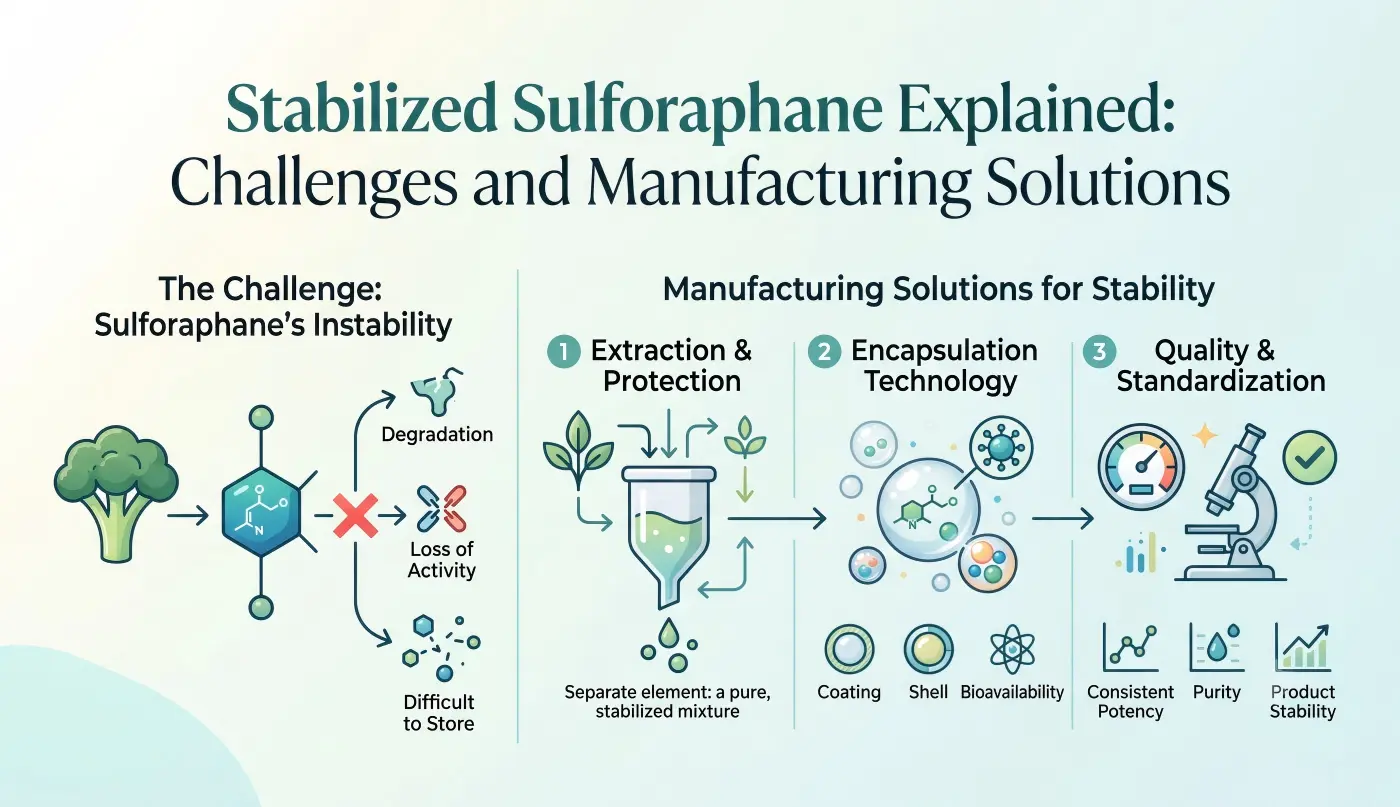
Products that rely on direct stabilized SFN face additional challenges: SFN is volatile and reactive. Without validated barrier packaging and low-water-activity formulation, label claims may not hold through the expiry date.
5. Evidence Matches the Exact Product
Not all “sulforaphane research” applies equally to every product. Procurement teams should distinguish:
- Research on a specific ingredient (e.g., generic glucoraphanin) vs. research on the finished product.
- Studies using an older formulation that may no longer match the current product.
- In vitro SFN generation data vs. human plasma or urinary metabolite measurements.
- Single-dose pharmacokinetic studies vs. long-term clinical outcome trials.
A brand’s clinical dossier is only as valuable as its relevance to the exact SKU currently on the market.
Four Established Sulforaphane Formulation Case Studies
The following case studies examine four products with distinct formulation strategies. The goal is not to declare a winner, but to identify what each approach offers—and what risks it carries—for brands evaluating their own formula development.
Case Study 1—Avmacol: Research-Led GR + Myrosinase Positioning
Formulation Strategy
Avmacol employs a precursor-based system combining:
- Broccoli seed and sprout extract standardized for glucoraphanin.
- Myrosimax® active myrosinase.
- Extra Strength variants add Maitake mushroom and beta-glucan.
Avmacol is not a direct-SFN product. It is positioned as a “Sulforaphane Production System”—a GR + myrosinase combination designed to generate SFN in vivo.
Official product page: Avmacol Extra Strength
Registered clinical trials: and NCT02800265NCT03399656
What Works
- Clear GR + active myrosinase logic that is easy to explain to educated consumers.
- The product itself has been used as the intervention in multiple human studies.
- “Research-selected formula” creates a defensible brand narrative.
- Room-temperature tablet format offers easier stability management than direct-SFN alternatives.
Consumer Feedback: Positive Themes (Amazon)
As of July 2026, Avmacol Regular Strength holds approximately a 4.5/5 star rating with 316 ratings on Amazon. Extra Strength SKUs average approximately 4.6/5. Common positive themes include:
- Trust in the product’s clinical-study background.
- Convenience compared with growing broccoli sprouts at home.
- Appreciation that GR and myrosinase are pre-combined.
- Subjective reports of improved mental clarity or general well-being.
Amazon listing: Avmacol on Amazon
Consumer Feedback: Negative Themes
- Gas, bloating, GERD, or general stomach discomfort.
- Some users report no perceptible effect.
- Long-term cost concerns.
- Different SKUs and label revisions create dose confusion.
- Isolated reports of overstimulation or sleep disruption (causality unconfirmed).
Reddit Discussion
Reddit discussions in r/Supplements show both enthusiasm and caution. Some users consider Extra Strength the most noticeable sulforaphane product they have tried; others argue that home-grown sprouts are more economical. Several threads caution that theoretical SFN yield is often mistaken for actual absorbed dose.
Discussions: | r/Supplements thread 1r/Supplements thread 2
Takeaway for Brands
Avmacol’s success is not attributable to “broccoli extract” alone. It rests on a clearly defined delivery system, product-level human research, an explainable mechanism of action, and documented standardization. Brands entering this category should consider whether their own formula can demonstrate equivalent transparency.
Case Study 2—Jarrow BroccoMax: Accessible Precursor-Based Formula
Formulation Strategy
Current official labeling indicates that each 2-capsule serving provides:
- 35 mg Sulforaphane Glucosinolate (GR/SGS).
- Active myrosinase.
- Delayed-release vegetarian capsules.
Important: 35 mg refers to GR/SGS content, not 35 mg of pre-formed sulforaphane.
Official page: Jarrow BroccoMax
What Works
- Price point typically below premium direct-SFN products.
- GR + myrosinase formulation is clearly communicated.
- Delayed-release capsules provide an intuitive technical selling point.
- Long market history and broad retail distribution.
- Suitable for mass-market, long-term daily use.
Consumer Feedback
Amazon: approximately 4.5/5 with over 2,000 ratings. iHerb: approximately 4.7/5 with over 4,000 ratings for some SKUs. Commonly cited advantages include price, convenience, ease of swallowing, and minimal aftertaste. Some consumers use it as a daily alternative to broccoli sprouts.
Amazon: | iHerb: BroccoMax on AmazonBroccoMax on iHerb
Consumer Feedback: Negative Themes
- No immediately perceptible effect.
- Mild gastrointestinal discomfort in some users.
- Concerns about excipients such as maltodextrin.
- Consumers frequently mistake 35 mg SGS for 35 mg SFN.
- Older reviews criticized the absence of myrosinase, but current labeling includes it.
This illustrates a critical point for brands: formulation versions must be clearly documented. A review from 2015 does not necessarily describe the 2026 product.
Reddit Discussion
BroccoMax is frequently recommended as an economical entry-level option. Users report subjective improvements in mood, energy, and cognitive clarity, though others question precursor conversion rates and express uncertainty about formula changes over time.
Discussions: | r/Nootropics threadr/Supplements thread
Takeaway for Brands
A mass-market product can compete effectively with the right combination: standardized GR, clearly labeled active myrosinase, delayed-release delivery, reasonable daily cost, and honest labeling that does not present GR dose as SFN dose.
Case Study 3—BrocElite Plus: Direct Stabilized Sulforaphane
Formulation Strategy
Current official labeling for each 2-capsule serving states:
- 10 mg stabilized sulforaphane.
- 650 mg Broccoli Seed Complex.
- Other isothiocyanates including PEITC, iberin, BITC, and AITC.
BrocElite is a direct-SFN product. It does not rely on in vivo conversion from glucoraphanin.
Official page: BrocElite Plus
What Works
- Directly states “stabilized sulforaphane” on the label—no conversion ambiguity.
- Does not depend on individual gut microbiota for GR-to-SFN conversion.
- “No glucoraphanin” messaging creates clear differentiation.
- Vegan, no fillers, and third-party testing support premium positioning.
- Appeals to consumers willing to pay a higher price for a direct active compound.
Consumer Feedback
Amazon: approximately 4.4/5 with 614 ratings. Positive themes include appreciation for the direct-SFN concept, clean-label credentials, and subjective reports of improved energy, sleep, focus, or joint comfort.
Amazon: BrocElite on Amazon
Consumer Feedback: Negative Themes
- 60-capsule pricing has been approximately $89.95 USD, creating long-term cost barriers.
- Some consumers report no perceptible change at one capsule per day.
- Two capsules daily shortens bottle duration significantly.
- Sulfur odor or cruciferous aftertaste reported by some users.
- Direct SFN stability claims require robust end-of-shelf-life testing to be credible.
Brand-site reviews also reflect price and efficacy concerns: BrocElite 30-capsule reviews
Reddit Discussion
BrocElite appears regularly in brand recommendation threads and “stabilized SFN” discussions, but verifiable, product-specific long-term experiences are noticeably fewer than those for Avmacol, BroccoMax, and BROQ. Brands should not equate mention frequency with proven efficacy.
Discussion: r/Supplements recommendations
Takeaway for Brands
Direct-SFN products must build trust on: batch-level SFN assay, end-of-shelf-life potency, degradation-product monitoring, moisture/oxygen-barrier packaging, and real stability data—not merely the word “stabilized.”
Case Study 4—BROQ: High Verified Yield and a Critical Formula-Version Lesson
Current Formulation (2026)
BROQ’s current publicly disclosed formula consists of:
- 92% broccoli seed.
- 5% horseradish (myrosinase source).
- 3% organic rice hulls.
- Plant-based delayed-release capsule.
- Brand claims at least 25 mg SFN yield per serving under laboratory test conditions.
Official pages: | | BROQ HomeBROQ ProductBROQ Compare
Critical Formula-Version Change
BROQ’s official documentation states:
From 2021 through November 2024, Original BROQ was associated with Prostaphane technology and used a stabilized direct-SFN approach. The current product has shifted to a broccoli seed + horseradish myrosinase precursor-generation system. This change was made to improve stability, cost structure, and manufacturing feasibility.
Therefore, older Reddit, Quora, and Amazon statements claiming “BROQ contains actual stabilized sulforaphane” describe the previous formulation, not the 2026 product. This is one of the most important accuracy corrections in this article.
What Works
- Publicly available third-party laboratory comparison data.
- Marketing emphasizes “actual SFN generated per serving” rather than raw GR input weight.
- High-dose, solvent-free, minimal-excipient positioning is clearly communicated.
- Delayed-release format addresses gastric irritation and enzyme-release timing.
- Has helped establish premium SFN category awareness among consumers.
Consumer Feedback: Amazon
As of July 2026: approximately 4.2/5 stars; ~563 ratings. Approximately 50 reviews mention gastrointestinal reactions, with positive and negative experiences roughly balanced.
Five-star themes: improved energy, focus, and general well-being; trust in the 25 mg tested yield; clean ingredient list; some users report no stomach issues.
One-star and negative themes: severe nausea, heartburn, stomach pain, or diarrhea; high price; some consumers must take with a large meal or split doses; some cannot tolerate the product at all.
Amazon listing: | Stomach discussion: BROQ on AmazonAmazon Q&A
Reddit Discussion
Positive reports describe BROQ as more noticeable than BroccoMax; some users report reduced brain fog. It is frequently positioned as a premium-tier product. Negative reports include heartburn, dry throat, and stomach discomfort. Many older posts still compare BROQ using the Original direct-SFN formula, which no longer applies.
Discussions: | | r/NootropicsDepotr/StackAdvicer/Supplements
Quora Discussion and Limitations
Quora answers have described BROQ as “the gold standard” and “the only Amazon product with direct SFN.” However, these answers reflect the older formulation and pricing. They should not be cited as 2026 facts. Instead, brands should treat such UGC as a case study in how outdated content can mislead consumers.
Example: Quora discussion
Takeaway for Brands
When a formula undergoes a major change, the brand must synchronously update: labels, Amazon listings, FAQs, clinical-study citations, comparison pages, blog content, and distributor materials. Otherwise, consumers will incorrectly apply old-formula evidence to the new product. This is a compliance and reputation risk, not merely a marketing issue.
What Consumer Reviews Really Tell Supplement Brands
Consumer reviews provide valuable signals, but they are not clinical data. Brands should know how to read them.
Positive Feedback Themes
Across all four products, common positive themes include:
- Convenience: no need to grow sprouts.
- Trust in clinical studies or third-party testing cited by the brand.
- Subjective reports of improved energy, focus, or general well-being.
- Appreciation for clean-label or vegan positioning.
- Preference for GR + myrosinase systems over vague “broccoli extract” labels.
Negative Feedback Themes
The most common complaint categories across all products are:
- Nausea, stomach pain, heartburn, bloating, or diarrhea.
- High price without perceptible effect.
- Sulfur odor or broccoli smell from capsules.
- Labels mixing GR, SGS, and SFN terminology.
- Uncertainty about actual SFN yield.
- Formula changes without updated marketing materials.
- “Third-party tested” claims without disclosed test panels or batch results.
Why Reviews Are Not Clinical Evidence
Brands must understand the limitations of consumer-generated content:
- Reviews cannot control for placebo effects.
- Reviewers’ concurrent medications, diets, and supplement regimens are unknown.
- Amazon star ratings may aggregate different SKUs or old formula versions.
- Reddit and Quora user identities and credentials are typically unverifiable.
- “I felt better” does not prove the product treats, cures, or prevents any disease.
The U.S. Federal Trade Commission (FTC) states that brands cannot use consumer testimonials to promote effects that the brand cannot substantiate with competent and reliable scientific evidence.
Sources: | FTC Health Products Compliance GuidanceFTC Endorsement Guides
What Supplement Brands Should Verify Before Selecting a Formula
The following ten-point checklist is designed for procurement and product-development teams evaluating a sulforaphane supplement formula:
- Does the label state SFN, GR, or both? Are they clearly distinguished?
- Does the label use potentially misleading terms such as SGS without clarification?
- Are doses expressed in both mg and µmol?
- Is myrosinase activity reported in specific units (not just ingredient weight)?
- Has actual SFN generation been measured and reported?
- Under what pH, temperature, and reaction time were tests conducted?
- Does end-of-shelf-life testing confirm label claim retention?
- Are finished-product heavy-metal, microbial, and pesticide reports available?
- Was the human research conducted with the exact same formulation and dose?
- Is there a complaint, adverse-event, and formula-version management system in place?
The NIH Office of Dietary Supplements notes that the term “standardized” alone does not guarantee botanical supplement quality without defined markers and analytical methods.
Source: NIH Botanical Background
Three Formulation Directions for Private-Label Brands
The following concepts are development starting points. They should not be treated as final formulas until stability, human tolerance, and regulatory reviews are completed.
Formula Concept A—Research-Aligned GR + Myrosinase Capsule
Per-Serving Development Targets:
- Standardized broccoli seed extract providing 30–40 mg glucoraphanin.
- Mustard or broccoli-derived active myrosinase with activity-unit specifications.
- Ascorbic acid as a formulation cofactor (optional).
- Delayed-release vegetable capsule.
- Moisture-resistant bottle with desiccant and induction seal.
Suitable For:
- Clinical-science brand positioning.
- Mid-to-premium pricing tier.
- Brands requiring longer ambient shelf life.
Formula Concept B—Premium Stabilized SFN Capsule
Per-Serving Development Targets:
- 5–10 mg verified stabilized sulforaphane.
- Low-water-activity carrier matrix.
- No high-moisture excipients.
- Nitrogen flush or high-barrier packaging.
- Initial, accelerated, and real-time stability testing.
- LC-MS or HPLC finished-product quantification.
Suitable For:
- Premium active-compound positioning.
- Brands seeking to bypass individual GR conversion variability.
Key Risks:
- Higher raw-material cost.
- SFN degradation during processing and storage.
- Sulfur odor challenges.
- Label-claim decline over shelf life.
- Higher finished-product testing complexity.
Formula Concept C—Gentler Entry-Level System
Development Direction:
- Lower single-capsule GR content.
- Active myrosinase included.
- Daily dose can be split (e.g., morning and evening).
- Smaller capsule size.
- Clear instructions: take with food or split dosing.
- Consumer GI tolerance testing as part of development.
Business Rationale:
Many negative reviews are directed not at the product concept but at stomach irritation, excessive single-dose quantity, or unclear dosing instructions. A gentler entry-level system can capture consumers who would otherwise abandon the category.
Quality-Control Specifications KS Nutripharma® Recommends
Raw Material Testing
- Botanical identity verification.
- Glucoraphanin content.
- Pre-formed sulforaphane content (if applicable).
- Myrosinase activity.
- Moisture and water activity.
- Heavy metals (lead, cadmium, arsenic, mercury).
- Pesticide residues.
- Microbiological contamination.
- Residual solvents.
- Adulterant screening.
Finished Product Testing
- SFN or GR label-claim verification.
- Actual SFN generation rate (for GR + myrosinase products).
- Retained myrosinase activity.
- Capsule disintegration time.
- Content uniformity.
- Accelerated stability.
- Real-time stability.
- Packaging compatibility.
cGMP Requirements
21 CFR Part 111 requires dietary supplement manufacturers to establish specifications for identity, purity, strength, composition, and limits on contaminants.
Sources: | FDA Small Entity Compliance Guide21 CFR Part 111
Regulatory and YMYL Considerations
Sulforaphane supplements fall under the U.S. FDA’s structure/function claim framework. Brands must distinguish between permissible and impermissible claims.
Permissible Structure/Function Claims
- Supports cellular antioxidant defenses*
- Supports the body’s natural detoxification processes*
- Supports a healthy response to oxidative stress*
- Supports normal Nrf2-related cellular defense pathways*
Claims to Avoid
- Prevents cancer.
- Treats autism.
- Reverses inflammation.
- Protects against chemotherapy damage.
- Repairs neurological disorders.
- “Clinically proven” unless adequate evidence for the exact product and exact claim exists.
Sources: | | 21 CFR 101.93FTC Health Products GuidanceFDA Adverse Event Guidance
Frequently Asked Questions
Which form of sulforaphane is best?
No single form is universally best. Stabilized SFN provides the active compound directly, while standardized GR with verified active myrosinase may offer better shelf stability and manufacturing economics. The optimal choice depends on brand positioning, target price point, and stability requirements.
Is 35 mg glucoraphanin the same as 35 mg sulforaphane?
No. They are different molecules with different molecular weights. Only a fraction of ingested GR is converted to SFN, and that fraction varies by individual, myrosinase activity, and gut microbiome composition.
Should a product contain myrosinase?
A GR-based product benefits from active myrosinase because human conversion of GR to SFN through gut microbiota alone is highly variable. Myrosinase co-delivery significantly increases SFN bioavailability.
Does “broccoli sprout extract” guarantee sulforaphane?
No. The label must identify glucoraphanin content, sulforaphane content, or verified SFN yield. An unstandardized “broccoli sprout extract” does not guarantee any specific compound level.
Are Amazon reviews reliable for choosing a formula?
Reviews can identify tolerance issues, price concerns, and usability problems, but they cannot establish efficacy, bioavailability, or clinical outcomes.
Why do some consumers experience nausea?
Concentrated isothiocyanates can cause gastrointestinal discomfort in susceptible individuals. Dose amount, delivery system, timing relative to meals, and individual sensitivity all influence tolerance.
Are gummies suitable for sulforaphane delivery?
Gummies are usually not the first choice. Heat, moisture, and extended processing times can degrade SFN stability and reduce myrosinase activity unless protected by validated encapsulation technology.
What documents should a brand request from an OEM?
Request raw-material specifications, batch certificates of analysis (CoAs), analytical methods, myrosinase activity data, finished-product potency assays, contaminant test reports, and shelf-life stability data.
Conclusion
The strongest sulforaphane products in 2026 are not defined by the largest broccoli extract number on the label. They are defined by transparent compound identification, verified conversion or direct SFN content, retained potency through shelf life, consumer tolerance, and product-specific evidence.
The four case studies illustrate distinct commercial positions:
- Avmacol: product-level research credentials and a clearly defined GR + myrosinase system.
- Jarrow BroccoMax: mature, price-accessible precursor-based formula with broad distribution.
- BrocElite Plus: premium direct stabilized SFN for consumers seeking the active compound without conversion uncertainty.
- BROQ: high tested yield and an important lesson in formula-version management and communication.
For brands developing their own sulforaphane supplement, the most valuable investment is not the highest ingredient input dose—it is a quality system that verifies what reaches the consumer, at day one and at expiry.
Develop Your Sulforaphane Supplement with KSNutripharma— Developing a sulforaphane supplement requires more than selecting a broccoli extract. KSNutripharma supports brands with glucoraphanin standardization, myrosinase-compatible formulation, stabilized sulforaphane options, delayed-release capsules, finished-product testing, and regulatory label review.
Explore our or contact our formulation team to discuss a custom private-label formula. Sulforaphane Supplement Manufacturing Services