Quick Answer
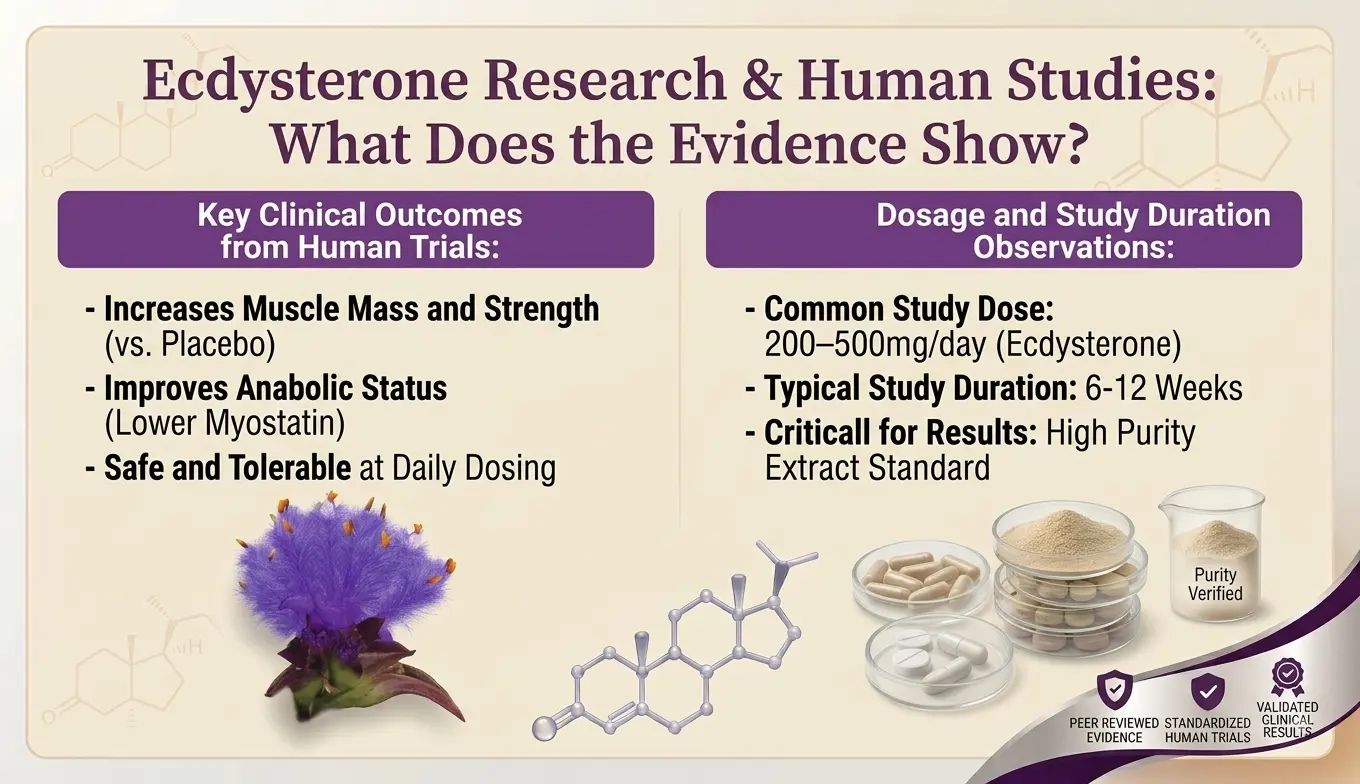
As of 2026, only one peer-reviewed randomized controlled trial (RCT) in healthy humans has investigated ecdysterone for resistance training outcomes. The Isenmann et al. (2019) study found significant increases in bench press strength and lean body mass over 10 weeks at doses of 200 mg/day and 800 mg/day, with no adverse changes in liver or kidney biomarkers [1]. No other independent RCTs of equivalent size and duration have been published. Preclinical studies (cell and animal) suggest anabolic and metabolic effects, but these cannot be extrapolated to human efficacy. Ecdysterone is not FDA approved, is not banned by WADA, and is included in the WADA Monitoring Program for potential misuse in sport [4].
Introduction
Researchers have investigated ecdysterone in several distinct areas, but not all of these have progressed beyond laboratory experiments. Human clinical evidence is concentrated mainly in resistance training, while most work on bone health, metabolism, neuroprotection, and wound healing remains preclinical. For supplement brands, this evidence distribution has a direct commercial consequence: claims must be calibrated to the strength of the underlying data, or the brand risks regulatory enforcement.
This article reviews the peer-reviewed literature on ecdysterone as of 2026, distinguishing between human controlled studies, animal research, cell-based investigations, and mechanistic hypotheses. It is written for regulatory affairs professionals, marketing teams, and product developers who need an evidence-based foundation for positioning decisions and claim development. Whether you are sourcing beta-ecdysterone raw material or working with an ecdysterone supplement manufacturer, understanding what the evidence actually supports—and what it does not—is essential before committing to label claims or marketing copy.
It does not conclude that ecdysterone is proven to build muscle, improve performance, or treat any disease. Instead, it maps what can legitimately be concluded from current evidence and where the boundaries of substantiation lie.
How Many Human Studies Have Been Published?
As of 2026, the peer-reviewed human RCT evidence for ecdysterone consists of one primary study:
• Isenmann et al. (2019): A 10-week randomized controlled trial in 46 young men, comparing 200 mg/day, 800 mg/day, and placebo alongside resistance training [1].
Several smaller or exploratory human studies have been published, including pharmacokinetic work and combined-intervention trials where ecdysterone was administered alongside other ingredients (such as spinach powder), making it impossible to isolate ecdysterone-specific effects. No other independent group has replicated the Isenmann trial in a peer-reviewed publication of equivalent design, sample size, and duration.
This limited volume does not invalidate the existing findings, but it does mean that any claim based on human evidence is currently supported by a single study. Under FDA and FTC substantiation guidelines, a single study can support a structure/function claim if it is well-designed and directly relevant, but the claim must be carefully worded and must not overstate the findings [5].
Human Evidence: What We Know So Far
Among all published human studies, the trial by Isenmann et al. remains the most influential because it combined resistance training with placebo control and objective DXA measurements [1]. Key design parameters:
• Population: 46 healthy young men (mean age ~25 years)
• Intervention: Resistance training 3 days/week
• Dosing: 200 mg/day (n=20), 800 mg/day (n=10), or placebo (n=12)
• Duration: 10 weeks
• Comparator: Placebo control with identical training protocol
• Blinding: Double-blind
• Outcomes: One-repetition maximum bench press, lean body mass (DXA), biomarker panel (liver enzymes, kidney function, steroid hormones)
The study reported significantly greater increases in bench press one-repetition maximum and lean body mass in both ecdysterone groups compared with placebo. No adverse changes in ALT, AST, GGT, creatinine, testosterone, estrogen, or cortisol were documented. The authors noted that the effect sizes were large enough to warrant WADA attention, which subsequently led to ecdysterone’s inclusion in the WADA Monitoring Program [1][4].
Key limitations remain: small sample size, short duration, homogeneous population (healthy young men only), and lack of independent replication.
Preclinical Research: What It Suggests and What It Cannot Prove
Animal and cell-based studies have investigated ecdysterone across a range of models. In C2C12 murine myotubes, ecdysterone increased protein synthesis rates by up to 20% under experimental conditions, with effects mediated through estrogen receptor beta (ERβ) activation and downstream PI3K/Akt signaling [3]. Rodent studies using doses up to 5 mg/kg/day for 21 days reported increased muscle fiber size and elevated serum IGF-1 [2].
Additional preclinical work has explored metabolic outcomes (glucose and lipid profiles), neuroprotection against oxidative stress, bone density, and wound healing. These studies provide mechanistic context and hazard identification data, but they cannot establish human efficacy or optimal dosing. The assumption that greater in vitro potency translates to greater human efficacy remains unproven.
For YMYL compliance, brands must avoid conflating mechanistic or animal data with human clinical outcomes. A cell study showing protein synthesis in a myotube culture does not constitute evidence that ecdysterone builds muscle in humans.
Common Misinterpretations of the Current Evidence
Preclinical studies are frequently misused in supplement marketing to imply human benefits. The following conclusions are not supported by current evidence:
• Ecdysterone has been proven to build muscle in humans. (Only one short-term RCT exists; replication is needed.)
• Ecdysterone improves athletic performance in competitive settings. (No field studies in trained athletes have been published.)
• Ecdysterone treats or prevents any disease. (No clinical trials in disease populations have been conducted.)
• The optimal human dose has been established. (Dose-response data are limited to one trial with two active arms.)
• Turkesterone is more effective than ecdysterone in humans. (No direct comparative human trials exist.)
Marketing claims stating that ecdysterone is clinically proven or guaranteed to produce specific outcomes are difficult to substantiate based on current evidence and expose the brand to FTC enforcement risk [5].
Translating Research into Product Decisions
The 200 mg/day and 800 mg/day doses investigated in the Isenmann study correspond to substantially different raw material inclusion levels depending on whether a manufacturer uses 50%, 95%, or 98% HPLC ecdysterone. For example, a product delivering 200 mg of pure ecdysterone requires approximately:
| Extract Assay | Extract Weight Needed | Practical Implication |
| 50% | 400 mg | Requires 2+ size 00 capsules or tablet reformulation |
| 95% | 211 mg | Fits in one size 00 capsule with room for excipients |
| 98% | 204 mg | Minimal extract weight; maximum formulation flexibility |
If your target formula is based on the 200 mg/day dose investigated in published human research, formulation feasibility depends on the assay of the extract, serving size, dosage form, and target capsule count. During project evaluation, an ecdysterone supplement manufacturer can help determine whether the intended formula can realistically match the studied dose while remaining manufacturable and commercially viable.
This distinction matters because a brand marketing a 400 mg serving of 50% extract cannot legitimately claim it delivers the same active dose as the Isenmann study, even though the total extract weight is higher. The relevant metric is active 20E, not total extract weight.
Is Ecdysterone FDA Approved?
No. The U.S. Food and Drug Administration does not approve dietary supplement ingredients before they are marketed. Under the Dietary Supplement Health and Education Act (DSHEA), dietary supplements are regulated as foods and assumed safe unless FDA has evidence that an ingredient presents a significant or unreasonable risk of illness or injury [5].
Ecdysterone is not on FDA’s list of ingredients with established safety concerns, but this does not constitute FDA approval or endorsement. Brands are responsible for ensuring their products are safe and properly labeled, and for substantiating any claims made. If the specific ecdysterone extract or botanical source was not marketed in the U.S. before October 1994, a New Dietary Ingredient (NDI) notification may be required [5].
Why Is WADA Monitoring Ecdysterone?
Ecdysterone is included in the WADA Monitoring Program under the anabolic agents category [4]. The Monitoring Program tracks substances that are not on the Prohibited List but may have potential for misuse in sport. Data collected through the program helps WADA assess whether a substance should be added to future Prohibited Lists [4].
The Isenmann trial’s findings—significant increases in lean mass and bench press strength—were substantial enough that the authors recommended WADA consider including ecdysterone in the list of prohibited substances [1]. WADA responded by placing ecdysterone on the Monitoring Program rather than the Prohibited List, reflecting a cautious but non-prohibitive stance.
For supplement brands, this status has two practical implications: products containing ecdysterone can be legally sold, but athletes should verify current sport-specific regulations. Marketing claims should not state that ecdysterone is WADA-approved or WADA-certified, because no such certification exists.
Is Ecdysterone Legal?
Yes, ecdysterone is legal as a dietary supplement ingredient in the United States under DSHEA, provided the product is properly labeled, manufactured in accordance with cGMP (21 CFR Part 111), and does not make unsubstantiated disease claims [5].
In the European Union, ecdysterone’s regulatory status varies by member state. Some countries classify it as a food supplement; others may require novel food assessment depending on the source and extraction method. In Canada, ecdysterone products may require Natural Health Product (NHP) registration with evidence supporting safety and efficacy. In Australia, the Therapeutic Goods Administration (TGA) regulates supplements under a different framework.
Brands should verify the regulatory requirements of each target market before distribution, because a product compliant in the U.S. may not automatically comply in the EU, Canada, or Australia.
Evidence-Based Claim Development
Under U.S. DSHEA and FTC regulations, structure/function claims must be truthful, not misleading, and substantiated by competent and reliable scientific evidence [5]. For ecdysterone, the following claim categories are defensible at the current evidence level:
• Supports resistance training goals (when substantiated at the labeled dose)
• Supports exercise performance
• Supports muscle health
The following claim types are not defensible based on current evidence and carry regulatory risk:
• Builds muscle (implies a guaranteed outcome, not supported by one RCT)
• Increases testosterone (no evidence of hormonal changes in humans [1])
• Treats muscle wasting (disease claim, requires drug approval)
• Prevents osteoporosis (disease claim, requires drug approval)
The distinction between a permitted structure/function claim and a prohibited disease claim is the most consequential regulatory boundary in the U.S. supplement market. Cross it and the product becomes an unapproved new drug subject to FDA enforcement [5].
What Brands Should Verify Before Using Research in Marketing
Before citing any study in marketing materials, run through this checklist:
1. Is the study human or preclinical? Human data carries more weight for consumer-facing claims.
2. Was the same ingredient used? A study using pure 20E may not apply to a spinach extract or a low-assay Cyanotis extract.
3. Was the same dose used? Claims must be substantiated at the product’s labeled serving.
4. Was the same duration used? A 10-week study does not support claims about long-term use.
5. Is the outcome relevant to the intended claim? Muscle mass data does not support cognitive function claims.
6. Has the result been replicated? Single-study findings should be presented cautiously.
7. Is the wording appropriate for the target market’s regulatory framework? DSHEA, NHP, EU food supplement rules differ.
If the answer to any of these questions is no, the claim should be revised or the study should not be cited.
From Research Review to Finished Product
Academic research and commercial product development operate on different timelines and success criteria. A study may find a statistically significant effect in a controlled setting while the same effect is undetectable in real-world consumer use. For brands, the relevant question is not whether ecdysterone works in a laboratory, but whether a finished product containing ecdysterone can deliver a consistent, safe, and legally marketable consumer experience.
KS Nutripharma provides standardized beta-ecdysterone raw material with HPLC-verified grades and full documentation packages, plus end-to-end ecdysterone supplement manufacturing across all primary dosage forms: ecdysterone capsule supplement manufacturer, ecdysterone tablet supplement manufacturer, and ecdysterone powder supplement manufacturer. All production runs include in-process blend uniformity testing, finished-product potency verification by HPLC, and full batch documentation.
Frequently Asked Questions
Q: Does ecdysterone actually work?
A: One published human RCT reported significant increases in bench press strength and lean body mass over 10 weeks at doses of 200–800 mg/day [1]. However, this has not been independently replicated, and the evidence remains preliminary. Preclinical studies suggest biological activity, but they cannot confirm human efficacy.
Q: How many human studies have been conducted on ecdysterone?
A: As of 2026, one peer-reviewed RCT of comparable size and duration has been published (Isenmann et al., 2019, n=46) [1]. Several smaller or exploratory studies exist, but no other independent group has replicated the main findings.
Q: Is ecdysterone proven to build muscle?
A: No. One short-term human RCT reported increases in lean mass and strength, but this has not been replicated. The evidence is promising but not conclusive.
Q: How strong is the evidence for ecdysterone?
A: Limited. One human RCT exists, supported by multiple preclinical studies. The evidence is stronger than for many novel botanicals but weaker than established ingredients like creatine or protein.
Q: Are animal studies enough to support supplement claims?
A: No. Under FDA and FTC guidelines, animal and cell studies alone are generally insufficient to substantiate claims about human health benefits. They may support mechanistic hypotheses but not efficacy claims [5].
Q: Can brands use ecdysterone research in product marketing?
A: Yes, but with strict boundaries. Human study data can support carefully worded structure/function claims. Preclinical data should not be used to imply human efficacy. All claims must comply with target-market regulations [5].
Q: Is ecdysterone FDA approved?
A: No. FDA does not approve dietary supplement ingredients before marketing. Ecdysterone is not on FDA’s list of ingredients with established safety concerns, but this does not constitute FDA approval or endorsement [5].
Q: Is ecdysterone banned by WADA?
A: No. Ecdysterone is on the WADA Monitoring Program, not the Prohibited List. The Monitoring Program tracks substances for potential misuse; inclusion does not mean prohibition [4].
Q: Is ecdysterone legal?
A: Yes, in the U.S. under DSHEA, provided the product is properly labeled and manufactured in accordance with cGMP. Regulatory status varies in the EU, Canada, and Australia [5].
Q: Why is WADA monitoring ecdysterone?
A: The Isenmann trial reported significant strength and lean mass gains, leading the authors to recommend WADA consider ecdysterone for the Prohibited List [1]. WADA placed it on the Monitoring Program to collect data on potential misuse in sport [4].
References
[1] Isenmann E, et al. Ecdysteroids as non-conventional anabolic agent: performance enhancement by ecdysterone supplementation in humans. Archives of Toxicology. 2019;93(7):1807-1816. https://pubmed.ncbi.nlm.nih.gov/31123801/
[2] Parr MK, et al. Ecdysterone and Turkesterone—Compounds with Prominent Potential in Sport and Healthy Nutrition. Nutrients. 2024;16(9):1382. https://pmc.ncbi.nlm.nih.gov/articles/PMC11085066/
[3] Parr MK, et al. Estrogen receptor beta activation is responsible for the potent anabolic effects of ecdysterone. Molecular and Cellular Endocrinology. 2014;394(1-2):115-122.
[4] World Anti-Doping Agency (WADA). The 2024 Monitoring Program. https://www.wada-ama.org/en/prohibited-list (see Monitoring Program section)
[5] FDA. New Dietary Ingredient Notification and Dietary Supplement Claims. https://www.fda.gov/food/dietary-supplements