
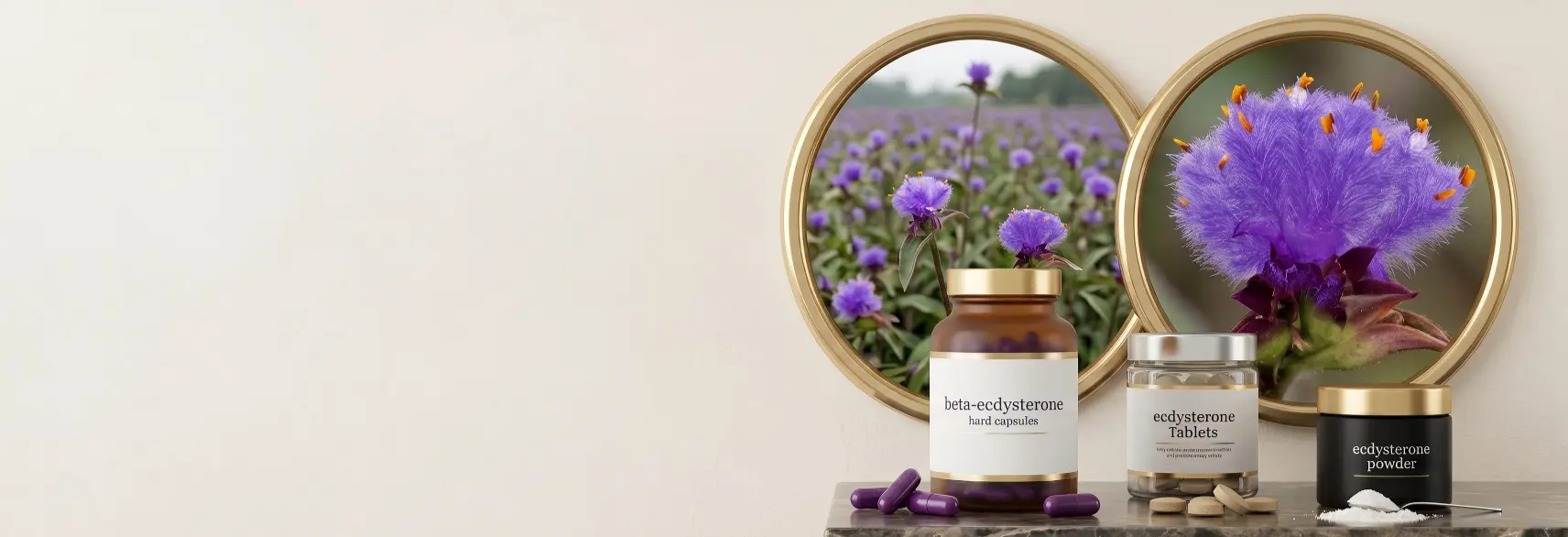
Ecdysterone Capsules- Supplement Manufacturering Solutions
KS Nutripharma® manufactures ecdysterone capsules for supplement brands, distributors, and contract buyers seeking custom capsule supplements, OEM, ODM, and private label capsules. We support HPMC and gelatin capsules in common sizes including #0, #00, and #1, with ecdysterone raw materials available at 50%, 60%, 95%, 98%, and 99% HPLC assay levels.
Our capsule manufacturing process evaluates assay, fill weight, bulk density, capsule size, formula compatibility, and packaging requirements before production to help ensure the selected ecdysterone grade is practical for the target capsule format. With capsule production capacity of 5M+ capsules per day, KS Nutripharma can support both single-ingredient ecdysterone capsule products and multi-ingredient formulations through OEM, ODM, and private-label manufacturing.
From formulation feasibility and capsule selection to bulk production and finished-product delivery, we help brands turn ecdysterone into a production-ready capsule supplement.
Capsule Manufacturing at a Glance
| Manufacturing Item | Available Options |
|---|---|
| Capsule formats | HPMC (vegan) or gelatin |
| Common capsule sizes | #0, #00, #1 |
| Ecdysterone assay options | 50%, 60%, 95%, 98%, 99% HPLC |
| Formula formats | Single-ingredient or multi-ingredient |
| Manufacturing services | OEM, ODM, private label |
| Capsule production capacity | 5M+ capsules/day |
| Sample lead time | Typically 7–15 business days after formula confirmation |
| Production lead time | Typically 4–6 weeks after artwork and specification lock |
| MOQ | From 3,000 capsules, project-dependent |
For raw-material specifications, see the Beta-Ecdysterone Powder Supplier page.
For overall OEM capabilities, see the Ecdysterone Supplement Manufacturer page.
Ecdysterone Capsule Feasibility
Ecdysterone capsule feasibility follows a connected manufacturing chain: target active dose → ecdysterone assay → required raw-material weight → powder bulk density → total fill weight → capsule size → capsules per serving.
The selected assay determines the approximate amount of ecdysterone material required to deliver the target active dose, while bulk density, excipient loading, and total formula weight determine whether that material can be accommodated in the selected capsule. For this reason, capsule size and serving count should be finalized after the formula specifications and filling characteristics have been reviewed.
At KS Nutripharma, capsule configurations are evaluated based on the selected ecdysterone grade, target active level, total fill weight, powder characteristics, capsule size, and formula composition before the final manufacturing specification is locked.
Ecdysterone Assay and Capsule Fill Weight
Ecdysterone assay directly affects the amount of raw material required to deliver a defined active dose. A higher-assay material generally requires less raw material for the same active target, leaving more formulation capacity for excipients or co-ingredients.
The following example shows the approximate raw-material requirement for a 300 mg active ecdysterone serving, calculated from assay alone:
| Ecdysterone Assay (HPLC) | Approx. Raw Material Required | Preliminary Formulation Implication |
|---|---|---|
| 50% | 600 mg | Higher fill weight; may require #00 or a larger format depending on bulk density |
| 60% | 500 mg | Moderate-to-high fill weight; often evaluated around #0–#00 |
| 95% | 316 mg | Lower fill weight; often compatible with #0, subject to density |
| 98% | 306 mg | Lower fill weight; commonly evaluated with #0 |
| 99% | 303 mg | May allow #0 or #1 depending on density and formula composition |
These figures represent assay-based calculations only, not final capsule fill weights. Actual fill weight depends on powder bulk density, excipient requirements, co-ingredients, and capsule-filling characteristics. A higher assay is therefore not automatically the better choice; the appropriate grade depends on the target active dose, total formula weight, capsule configuration, and cost requirements.
Capsule Size Selection
Capsule size should be selected based on the total formulation fill weight and powder characteristics, rather than ecdysterone assay or active dose alone. Bulk density determines how much material occupies a given capsule volume, while excipients and co-ingredients can further change the required fill weight.
The following ranges are indicative starting points for formulation planning, not guaranteed machine-fill specifications:
| Capsule Size | Indicative Fill Range* | Typical Ecdysterone Application |
| #1 | ~250–350 mg | Lower-fill or high-assay single-ingredient formulas |
| #0 | ~350–550 mg | Moderate-fill formulas; commonly evaluated for ecdysterone products |
| #00 | ~550–800 mg | Higher-fill or multi-ingredient formulas |
*Actual fill capacity varies with powder bulk density, particle characteristics, excipient loading, capsule shell, and filling equipment.
At KS Nutripharma, the final capsule configuration is confirmed through formulation review and capsule-filling evaluation. Where the required serving weight exceeds practical single-capsule capacity, the formulation may be configured as a multi-capsule serving or evaluated in another dosage form such as tablets or powder.
Ecdysterone Capsule Formula Options
For brands looking for a practical starting point, the following capsule formulas are designed around manageable fill weights, commonly used capsule configurations, and straightforward manufacturing requirements. These are formulation starting points rather than fixed dosage recommendations; active levels, excipients, and serving size can be adjusted according to the target market, capsule format, and final product specification.
Starting Formula
Beta-Ecdysterone 98% HPLC · 300 mg active ecdysterone per serving · capsule excipients as required for manufacturing
Capsule Format
HPMC or gelatin · typically evaluated in #0 or #00 depending on final fill weight and powder characteristics
Suggested Serving
1–2 capsules per serving
Best For
Ingredient-focused SKUs, simple formulations, and brands looking for a straightforward ecdysterone product.
Why Use This Starting Point
A single-active formula keeps the formulation relatively simple and makes assay, fill-weight, capsule-size, and serving-count decisions easier to manage.
Typical Adjustments
The active ecdysterone level, assay grade, capsule size, and serving count can be adjusted according to the target product specification.
Starting Formula
Beta-Ecdysterone 98% HPLC · 200–300 mg active ecdysterone per serving · Creatine Monohydrate · 1,500–2,500 mg per serving
Capsule Format
HPMC or gelatin · typically evaluated as a multi-capsule serving because of the higher total formula weight
Suggested Serving
Approximately 3–5 capsules per serving, subject to final fill-weight evaluation
Best For
Sports nutrition products combining ecdysterone with a high-load active ingredient.
Why Use This Starting Point
Creatine substantially increases total serving weight, making capsule capacity the primary formulation constraint. A multi-capsule serving is generally more practical than trying to accommodate the full formula in one capsule.
Typical Adjustments
Ecdysterone assay, ecdysterone active level, creatine amount, capsule size, and capsules per serving can be adjusted together to meet the target formula.
Starting Formula
Beta-Ecdysterone 95–98% HPLC · 200–300 mg active ecdysterone per serving
Ashwagandha Extract · 300–600 mg per serving
Black Pepper Extract · 5–10 mg per serving
Capsule Format
HPMC or gelatin · typically #0 or #00 depending on total fill weight and powder characteristics
Suggested Serving
2–3 capsules per serving, subject to final fill-weight evaluation
Best For
Brands developing a multi-ingredient botanical capsule around ecdysterone rather than a single-ingredient SKU.
Why Use This Starting Point
Ashwagandha provides a relatively substantial botanical-extract component, while black pepper extract is typically used at a much lower inclusion level. This creates a more representative multi-ingredient formulation for evaluating total fill weight, blend uniformity, and capsule capacity.
Typical Adjustments
The ashwagandha extract specification, ecdysterone assay, active levels, capsule size, and serving count can be adjusted according to the target formula and market requirements.
Before sample production, KS Nutripharma reviews the formulation against the practical requirements of capsule manufacturing. The purpose is to identify potential fill-weight, blending, powder-handling, and packaging constraints before the commercial specification is finalized.
These checks are used to determine whether the proposed formula can be manufactured at the target active dose, capsule size, serving count, and product specification.
Common Feasibility Checks
Low Bulk Density
What we check: Powder volume relative to the available capsule capacity.
Typical decision: Evaluate a larger capsule size, additional capsules per serving, or formulation adjustment.
High Active or Total Fill Weight
What we check: Total weight of ecdysterone, co-ingredients, and excipients required per serving.
Typical decision: Evaluate #00 capsules, a multi-capsule serving, a higher-assay ecdysterone grade, or another dosage form when appropriate.
Low-Dose Co-Ingredients
What we check: Whether low-inclusion ingredients can be distributed consistently throughout the blend.
Typical decision: Consider pre-blending or geometric dilution and establish appropriate in-process controls.
High-Assay Ecdysterone
What we check: Raw-material inclusion required to deliver the target active dose, together with powder characteristics.
Typical decision: A lower inclusion weight may create additional formulation capacity, but final capsule size remains dependent on bulk density and total formula weight.
Poor Powder Flowability
What we check: Powder handling and the potential effect on capsule filling and fill-weight consistency.
Typical decision: Review excipient selection, flow-aid requirements, particle characteristics, or other formulation adjustments.
Moisture-Sensitive Formulas
What we check: Moisture exposure, material stability considerations, and packaging-barrier requirements.
Typical decision: Evaluate suitable packaging protection, including moisture-barrier materials or desiccant where required.
From Feasibility Review to Production
These checks are performed during the formulation feasibility stage, before sample production. Once the formula and sample are approved, the final manufacturing parameters, capsule specification, packaging configuration, and production requirements are confirmed before commercial manufacturing.
This process helps identify potential manufacturing constraints early, reducing the risk of changing the capsule size, serving count, or formula after the product has entered production.
Both HPMC and gelatin capsules can be used for ecdysterone powder formulations. The shell choice is primarily a procurement, market-positioning, and product-specification decision, rather than a requirement imposed by ecdysterone itself.
HPMC Capsules
- Suitable for vegan and plant-based product positioning
- Available in common sizes such as #1, #0, and #00
- Often selected when vegan or plant-based labeling is part of the product specification
- May carry a higher packaging or manufacturing cost depending on the project
Gelatin Capsules
- Conventional capsule format for supplement products
- Available in common sizes such as #1, #0, and #00
- Often considered when vegan positioning is not required and cost efficiency is a priority
Procurement decision: Final shell selection should consider the target market, labeling requirements, capsule size, formula characteristics, packaging configuration, and project cost target.
Ecdysterone capsule quality control covers the product from blending and filling through finished-product release and packaging. The exact testing program depends on the formula, raw materials, target market, and agreed product specification. For raw-material identity, assay methodology, and incoming-material specifications, see the Beta-Ecdysterone Powder Supplier page.
In-Process Checks
- Capsule fill weight and weight variation
- Blend uniformity where applicable
- Powder or blend moisture where relevant
- Capsule appearance and physical condition
Finished-Product Checks
- Ecdysterone assay against the approved specification
- Weight variation
- Disintegration where specified
- Microbiological testing according to the applicable product specification
Packaging Checks
- Seal integrity
- Container and closure condition
- Desiccant placement where specified
- Label and batch information accuracy
Documentation
- Batch manufacturing and production records
- Finished-product COA
- Approved specifications and test results
- Stability documentation or testing program where required
The final QC specification is agreed before commercial production so that testing requirements, acceptance criteria, and release documentation are aligned with the product and target market.
Ecdysterone capsules can be packaged in bottles or blister packs depending on the target count, market requirements, distribution model, and product stability considerations.
Bottle Packaging
HDPE or PET bottles with suitable closures can be configured for common retail counts such as 60, 90, or 120 capsules.
Blister Packaging
Blister formats can be considered for travel, trial, or unit-dose presentations, with the barrier structure selected according to product requirements.
Moisture Protection
Desiccants and higher-barrier packaging can be evaluated when the formula or stability data indicates a need for additional moisture protection.
Labeling & Sealing
Induction sealing, pressure-sensitive labels, shrink sleeves, and other packaging components can be incorporated according to the final packaging specification.
Final packaging is selected based on formula stability, capsule count, target market, distribution conditions, and packaging requirements.
Once the product concept is defined, an ecdysterone capsule project typically moves through the following development stages. Actual timing depends on formula complexity, raw-material availability, testing requirements, artwork approval, and packaging specifications.
1. Formula Brief
Confirm the target active dose, ecdysterone assay, co-ingredients, capsule shell, serving size, packaging requirements, and target market.
2. Formula & Manufacturing Review
Review total fill weight, powder characteristics, capsule capacity, blend requirements, and other manufacturing constraints identified during feasibility evaluation.
3. Sample Development
Development samples are produced using the agreed formula and capsule configuration.
Typical sample lead time: 7–15 business days after formula confirmation.
4. Sample Approval
Review the sample against the agreed product specification, including applicable quality and physical parameters. Formula, capsule size, serving count, and other specifications are adjusted if required.
5. Production Specification Lock
Finalize the formula, capsule size, serving count, packaging configuration, artwork, and manufacturing requirements before commercial production.
6. Commercial Production
The approved formula proceeds to commercial manufacturing after the specifications and artwork are locked.
Typical production lead time: 4–6 weeks after artwork and specification lock.
Typical Timeline
Formula confirmation → Sample: ~7–15 business days → Sample approval → Specification & artwork lock → Commercial production: ~4–6 weeks
Lead times are indicative and should be confirmed for each project based on formula complexity, raw-material availability, testing requirements, packaging, and production scheduling.
The best dosage form depends on the target active load, total serving weight, formula complexity, taste requirements, and intended product positioning.
Capsules — Best for
- Single-ingredient or moderate-weight formulas
- Products requiring a convenient fixed serving
- HPMC or gelatin product positioning
- Formulas where taste masking is not a priority
Tablets — Best for
- Fixed-dose solid formulations
- Products where compression and tablet customization are suitable
- Formulas that may benefit from coated or shaped tablet formats
- Brands prioritizing tablet-based product positioning
Powders — Best for
- Higher total serving weights
- High-load formulas such as ecdysterone + creatine
- Products where a multi-capsule or multi-tablet serving would become impractical
- Formulas where flexible serving sizes are desirable
Quick Procurement Decision
Choose capsules when the total formula weight fits a practical capsule serving.
Consider tablets when the formula is compatible with compression and a fixed solid-dose format is preferred.
Consider powder when the total serving weight is high or when capsule and tablet capacity would require too many units per serving.
For other dosage-form options, see the Ecdysterone Tablet Supplement Manufacturer and Ecdysterone Powder Supplement Manufacturer pages.
Request an Ecdysterone Capsule Manufacturing Quote
Have an ecdysterone capsule project in development? Send us your target specifications for a formula feasibility review and project-specific quotation. To help us evaluate the project accurately, include:
- Target ecdysterone active dose: mg per serving
- Preferred ecdysterone assay: 50%, 60%, 95%, 98%, or 99% HPLC
- Capsule shell: HPMC or gelatin, if specified
- Formula: Single-ingredient or complete ingredient list for a multi-ingredient formula
- Capsule configuration: Preferred capsule size or target capsules per serving, if known
- Packaging: Bottle, blister, or other preferred format
- Target market: Country or region
- Estimated order volume: Expected capsule quantity or annual volume, if available
What You Receive
Based on the information provided, our team can evaluate:
- Capsule feasibility based on active dose and total fill weight
- Capsule size and serving configuration
- Ecdysterone assay suitability
- Formula and manufacturing considerations
- Estimated MOQ and production requirements
- Project-specific quotation
Typical response time: 24–48 hours after receiving the required project information.
Ready to develop your ecdysterone capsule? Send your formula or target specification to start the feasibility review.
#0 and #00 are commonly evaluated for ecdysterone formulas, but the final size depends on total fill weight, powder bulk density, and formula composition. For a 300 mg active serving using a high-assay ecdysterone grade, #0 may be practical; lower-assay or higher-fill formulas may require #00 or a multi-capsule serving.
Yes. Ecdysterone can be combined with other active ingredients, provided the total formula weight, powder characteristics, and blend requirements are suitable for capsule production. Low-dose ingredients may require additional blending controls to achieve consistent distribution.
Ecdysterone grades from 50% to 99% HPLC can be evaluated for capsule production. Higher assay generally reduces the raw-material quantity required for a defined active dose, which may create more capacity for co-ingredients or allow a smaller capsule configuration. Final selection depends on active dose, fill weight, capsule size, formula composition, and cost requirements.
Yes. HPMC capsules are available for products requiring vegan or plant-based capsule positioning. Gelatin capsules are also available for conventional capsule formulations.
Yes. The main consideration is total serving weight because creatine is typically included at a relatively high amount. Depending on the target formula, a larger capsule or multi-capsule serving may be more practical.
Yes. Existing formulas can be reviewed for capsule feasibility, including active levels, assay specifications, total fill weight, capsule size, and manufacturing requirements. The formula can then be prepared for sample and commercial production subject to feasibility review.
Yes. For brands without a finalized formula, KS Nutripharma can evaluate the target active dose, ingredient list, assay, capsule configuration, and serving size to develop or adjust a production-ready formulation.
The standard MOQ starts from 100,000 capsules, with trial quantities available depending on the project. Typical sample lead time is 7–15 business days after formula confirmation, while commercial production generally takes 4–6 weeks after artwork and specification lock. Actual timing depends on raw-material availability, testing, packaging, and production scheduling.
Yes. Development samples can be produced before commercial manufacturing. Sample requirements and timing depend on the formula and testing specifications. Samples can be reviewed for fill weight, physical characteristics, and applicable quality parameters before the commercial specification is finalized.