
A B2B guide to extract specification, formulation architecture, capsule and softgel development, supplier qualification, and OEM feasibility
Black cohosh product development is rarely just a matter of selecting an extract and putting it into a capsule. For brands developing a commercial black cohosh product, choosing the right Black Cohosh Supplement Manufacturer is only one part of the decision. The more important question is whether the proposed ingredient specification, dosage, formulation and manufacturing process can work together as a commercially viable finished product.
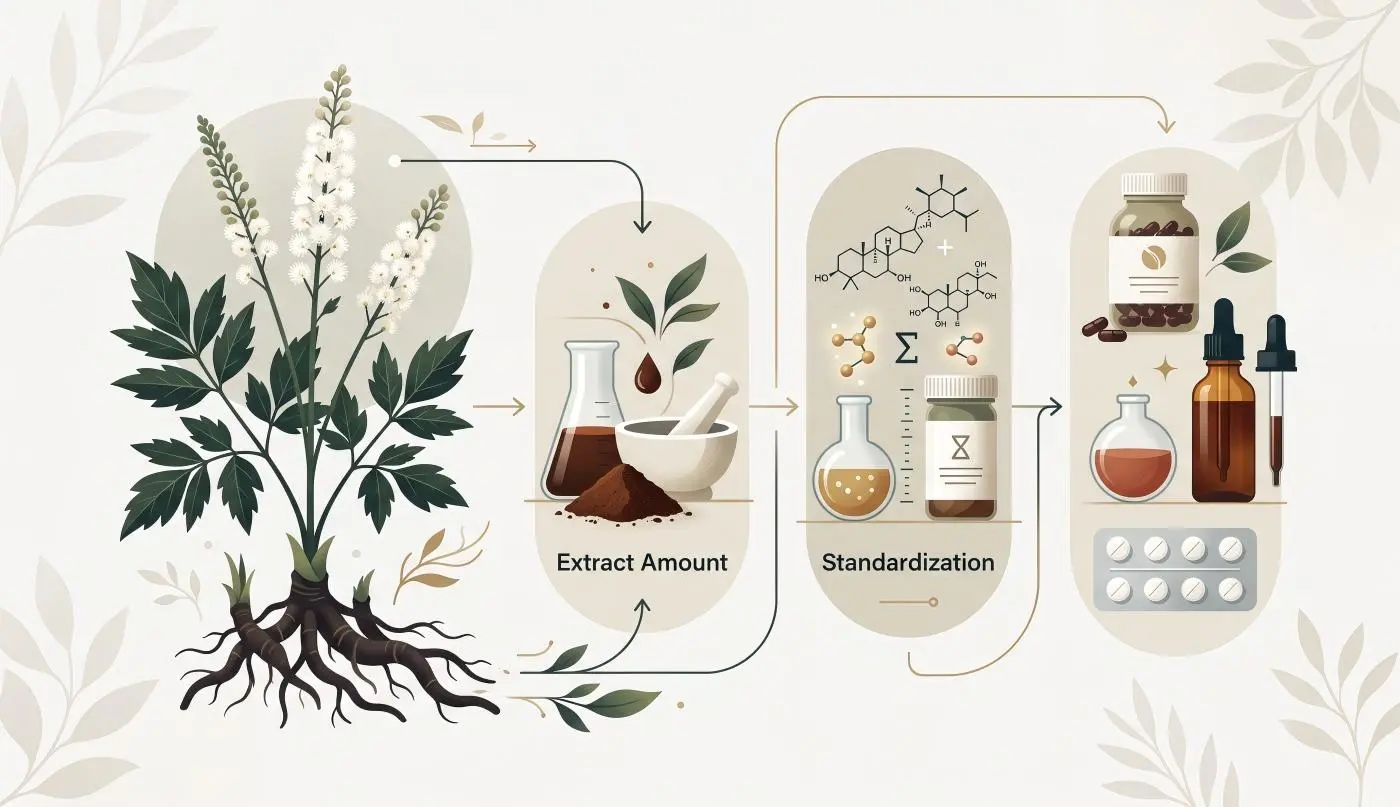
The same botanical ingredient can behave differently depending on its extract specification, carrier system, particle characteristics, bulk density and target dosage. These variables can affect the appropriate dosage form, blending process, fill weight and stability strategy.
For procurement and product-development teams, the more useful question is therefore not simply:
What ingredients can I put into a black cohosh product?
It is:
Can the proposed formula be manufactured consistently, tested against defined specifications and commercialized for my target market?
This guide focuses on that decision.
1. Start With the Product Architecture
Commercial black cohosh products can be developed across several architectures rather than a single standard formula.
| Product Architecture | Example | Main Development Question | Typical Format |
|---|---|---|---|
| Focused Botanical | Black Cohosh Extract | Is the extract specification sufficiently defined? | Capsule / Tablet |
| Botanical Complex | Black Cohosh + Soy / Sage / Red Clover | Can the powders be blended uniformly? | Capsule / Tablet |
| Botanical + Oil | Black Cohosh + EPO | Solution or suspension softgel? | Softgel |
| Botanical + Nutrients | Black Cohosh + Vitamin D / Minerals | Can the total load fit the intended dosage form? | Capsule / Tablet |
| Multi-Active Formula | Botanicals + oils + nutrients | Is the complete system stable and manufacturable? | Capsule / Tablet / Softgel |
The appropriate architecture should be selected before the final ingredient list is locked.
That prevents a common development problem: designing a formula around individual ingredients and discovering later that the total formula is impractical for the intended dosage form.
2. Which Architecture Is Most Appropriate?
A useful first screening is:
Choose a capsule or tablet when:
- the formula is predominantly dry;
- botanical extracts make up most of the active load;
- the formula requires relatively high powder loading;
- multiple minerals are included;
- formulation flexibility is more important than lipid-based positioning.
Consider a softgel when:
- the formula contains substantial oil-phase ingredients;
- a lipid-based delivery format is commercially appropriate;
- the selected botanical can be incorporated into the intended fill system;
- the target fill weight is compatible with the selected softgel size.
Consider a suspension softgel when:
- the botanical is poorly oil-soluble;
- the desired active cannot be adequately dissolved;
- the extract can be dispersed as a controlled particulate phase.
The critical point is that “black cohosh softgel” does not automatically mean dissolved black cohosh extract.
Two extracts carrying the same nominal marker specification may require different softgel strategies because their carrier systems, particle characteristics and physical properties can differ substantially.
3. Formula Concepts That Are Commercially Practical
Formula A — Black Cohosh Focused
Black Cohosh Extract
The development priority is raw-material qualification rather than ingredient interaction.
Key questions include:
- What species and plant part are specified?
- How is the extract standardized?
- What analytical method is used?
- What carrier is present?
- What are the physical characteristics of the powder?
- Does the finished-product assay correspond to the intended specification?
This is generally the simplest architecture for capsule or tablet development.
Formula B — Black Cohosh Botanical Complex
Black Cohosh + Soy Isoflavones / Sage / Red Clover
This architecture increases formulation complexity because different botanical powders can have materially different:
- bulk densities;
- particle-size distributions;
- flow properties;
- moisture characteristics;
- carrier systems.
The manufacturing challenge is therefore not simply “Can these ingredients be mixed?”
It is:
Can the finished blend remain sufficiently uniform through processing, transfer and encapsulation?
A blend that looks homogeneous immediately after laboratory mixing may not behave identically during larger-scale processing.
For soy-containing products, allergen requirements also need to be considered for the target market. FDA identifies soy as one of the major food allergens regulated in the United States.
4. Formula C — Black Cohosh + Evening Primrose Oil Softgel
This is one of the most commercially recognizable routes for combining a botanical extract with an oil ingredient.
The key development decision is:
Solution or suspension?
If the extract is sufficiently compatible with the selected oil system, a solution-based approach may be possible.
If it is not adequately soluble, a suspension approach may be more appropriate.
The latter introduces additional variables:
- particle size;
- sedimentation;
- viscosity;
- dispersion;
- agitation;
- fill uniformity.
This is why the same nominal black cohosh assay does not necessarily predict softgel performance.
The raw material’s physical specification matters as much as the headline marker percentage.
5. Multi-Botanical and Nutrient Formulas
More comprehensive formulas may combine:
- Black Cohosh
- Soy Isoflavones
- Red Clover
- Sage
- Evening Primrose Oil
- Vitamin D
- Calcium
- Magnesium
- other nutritional or botanical ingredients.
These formulas may offer broader product positioning, but there is a clear trade-off:
More ingredients can increase differentiation while simultaneously increasing fill-weight, analytical, compatibility and stability requirements.
This is why a premium formula is not automatically a better manufacturing formula.
The right question is whether the additional ingredients create enough commercial value to justify the additional formulation and QC complexity.
6. Capsule vs Tablet vs Softgel: The Real Trade-Off
| Consideration | Capsule | Tablet | Softgel |
|---|---|---|---|
| Dry botanical flexibility | High | High | Low |
| High powder load | Good | Good | Limited |
| Oil-based formula | Poor | Poor | Excellent |
| Suspension system | Poor | Poor | Possible |
| Mineral-heavy formula | Good | Very good | Poor |
| Development complexity | Lower | Moderate | Higher |
| Lipid-based positioning | Low | Low | High |
| Formula modification flexibility | High | Moderate | Moderate |
The important trade-off
Softgels can provide a more differentiated premium format, particularly for oil-containing formulas.
Capsules, however, generally provide greater flexibility when the formulation contains multiple dry botanical extracts or a high total powder load.
Therefore:
The most marketable dosage form is not necessarily the most technically efficient dosage form.
The dosage form should follow the formula architecture—not the other way around.
7. Black Cohosh Softgel Manufacturing: Where Feasibility Changes
Softgel manufacturing adds a second engineering problem beyond ingredient selection:
the fill system must work with the shell.
A formulation can therefore pass an ingredient-level review and still require adjustment during softgel development.
Typical parameters include:
- fill viscosity;
- density;
- particle size;
- suspension stability;
- fill weight;
- shell compatibility;
- oxidation sensitivity;
- encapsulation performance;
- storage stability.
A practical development principle
Suspension behavior should be assessed before scale-up, because a formulation that appears uniform after manual laboratory mixing may behave differently under continuous production conditions.
That is why pilot encapsulation is not simply a smaller commercial batch.
It is a technical checkpoint.
8. What We Evaluate Before Prototype Production
A practical feasibility review typically starts with five groups of information.
1. Raw Material
- botanical identity;
- plant part;
- extraction process;
- standardization;
- assay method;
- carrier;
- particle size;
- bulk density;
- moisture;
- microbiological profile.
2. Formula
- active dose;
- serving size;
- total fill weight;
- ingredient compatibility;
- target dosage form.
3. Physical Behavior
- flowability;
- dispersion;
- sedimentation;
- powder blending;
- oil compatibility.
4. Manufacturing
- encapsulation;
- filling;
- blending;
- compression where applicable;
- pilot processing.
5. Finished Product
- assay;
- uniformity;
- appearance;
- physical stability;
- packaging compatibility.
The objective is not to generate a longer checklist.
It is to identify which variables are most likely to change the commercial formula.
9. Why Two Suppliers Can Offer “The Same” Black Cohosh Extract
This is an important procurement issue.
Two suppliers may both quote:
Black Cohosh Extract — standardized to the same marker level.
Yet the materials may still behave differently.
Possible differences include:
- extraction process;
- carrier;
- extraction ratio;
- particle size;
- bulk density;
- moisture;
- flow properties;
- analytical method.
Therefore:
Marker percentage alone is not a complete manufacturing specification.
A supplier qualification process should review both the chemical specification and the physical specification.
This becomes especially important when replacing an approved raw-material supplier.
10. COA vs Specification Sheet: Why Both Matter
Not every quality document answers the same question.
COA
A Certificate of Analysis generally describes the analytical results for a particular production lot.
It answers:
Did this lot meet the specified requirements?
Specification Sheet
The specification defines the acceptance criteria against which material is evaluated.
It answers:
What requirements must every acceptable lot meet?
The two documents should therefore be reviewed together during supplier qualification.
A COA showing a satisfactory assay does not, by itself, establish the full long-term specification of the material.
11. Which Supplier Documents Matter Most?
Depending on the project and destination market, procurement teams may request:
- COA;
- specification sheet;
- TDS;
- SDS;
- manufacturing flow chart;
- allergen statement;
- Non-GMO statement;
- heavy-metal report;
- microbiological report;
- pesticide report;
- residual-solvent information;
- origin statement;
- other market-specific documentation.
Why residual-solvent information can matter
Where organic solvents are used during extraction or processing, residual-solvent control can become part of the raw-material qualification process.
The exact testing requirement should be determined from the manufacturing process, specification and target market rather than automatically applied to every botanical extract.
12. Common Reasons Black Cohosh Projects Require Reformulation
This is one of the most useful sections for procurement teams because reformulation is not necessarily a formulation failure.
Sometimes the original concept is commercially attractive but physically impractical.
| Situation | Why It Happens | Typical Development Direction |
|---|---|---|
| Fill weight too high | Too many botanicals/minerals | Increase serving size, redistribute actives or change dosage form |
| Poor powder flow | Extract physical characteristics | Adjust processing or formulation |
| Poor blend uniformity | Density/particle-size differences | Optimize blending or pre-blending |
| Suspension instability | Extract not suited to oil system | Optimize suspension or change formula |
| Oil/powder incompatibility | Different physical systems | Separate dosage forms or redesign fill |
| Raw material substitution | Carrier/particle profile changed | Re-evaluate formulation |
| Stability issue | Ingredient or packaging interaction | Reformulate or modify packaging |
| Market-specific restriction | Target-market requirements | Adjust ingredient or claim strategy |
| Practical serving size too large | Total active load exceeds acceptable dosage form | Rebalance formula or change format |
This is also why a manufacturer may recommend changing the dosage form instead of simply increasing capsule size.
13. Why an OEM Manufacturer May Recommend Reformulation
An experienced manufacturer should not treat every customer formula as fixed.
Reformulation may be recommended when:
The formula exceeds practical capacity
A theoretical dose may fit on paper but create an impractical number of capsules per serving.
The physical system is unstable
A suspension that settles rapidly can create manufacturing and uniformity concerns.
A raw-material substitution changes physical behavior
A replacement extract may have the same nominal assay but different carrier or particle characteristics.
The target market changes
An ingredient or claim strategy suitable for one market may require adjustment for another.
The product requires excessive manufacturing complexity
Sometimes simplifying the formula creates a more robust commercial product without materially changing its positioning.
The purpose of reformulation is therefore not simply to reduce cost.
It is often used to make the product more reproducible, manufacturable and commercially practical.
14. Which Parameters Usually Delay an OEM Project?
Projects are more likely to require additional development when one or more of these remain undefined:
- Raw-material specification
- Target active dose
- Dosage form
- Serving size
- Target market
- Packaging format
- Final formula
- Required analytical specification
By contrast, a project with an established formula, qualified raw materials and finalized packaging can move much more directly toward sampling and production planning.
15. What Should Be Finalized Before Requesting Samples?
Not everything needs to be finalized before the first technical discussion.
Ideally available before prototype development
- target formula or concept;
- preferred dosage form;
- target market;
- target serving size;
- key raw-material specifications;
- expected order quantity.
Can often be finalized later
- final bottle/label design;
- secondary packaging;
- exact flavor/color preferences where applicable;
- some documentation specific to the final market;
- final commercial packaging quantities.
This distinction can prevent unnecessary delays during early-stage development.
16. What Can Still Change After Prototype Approval?
Prototype approval does not always mean every commercial parameter is permanently locked.
Depending on the project, changes may still occur in:
- packaging;
- batch size;
- raw-material lot;
- secondary excipients;
- manufacturing scale;
- shipping configuration.
However, changes to critical ingredients, specifications or formulation parameters may require additional qualification or stability assessment.
For regulated dietary supplements, finished-product specifications and quality controls should be established within the applicable CGMP framework. FDA’s 21 CFR Part 111 provides the relevant U.S. regulatory framework.
17. Manufacturing Capabilities Relevant to Black Cohosh
Black cohosh projects can involve more than standard capsule filling.
Relevant capabilities may include:
- botanical powder blending;
- capsule manufacturing;
- tablet manufacturing;
- oil-based softgel encapsulation;
- suspension softgel development;
- pilot production;
- formulation development;
- analytical testing;
- stability assessment;
- custom packaging;
- private-label manufacturing;
- OEM/ODM development.
KS Nutripharma’s published company information describes its manufacturing infrastructure, R&D resources and production capabilities. KS Nutripharma About Us
For procurement, the more useful question is therefore not:
“Does the factory make capsules?”
but:
“Can the supplier manage the complete path from raw-material qualification to commercial finished product?”
18. Black Cohosh OEM Project Decision Matrix
| Project Situation | Recommended First Step | Why |
|---|---|---|
| Single standardized extract | Direct quotation / sample | Low formulation complexity |
| Existing validated formula | Formula review | Confirm manufacturing fit |
| New botanical combination | Feasibility review | Assess blend compatibility |
| Black Cohosh + oil | Softgel feasibility review | Determine solution vs suspension |
| High-dose multi-active formula | Dosage-form review | Check practical capacity |
| Existing competitor product | Reverse-specification review | Identify formula and manufacturing requirements |
| New export market | Regulatory/formulation review | Requirements may differ by market |
| Raw-material replacement | Requalification review | Physical properties may change |
19. What to Send for a Black Cohosh OEM Feasibility Review
You do not need a finished technical package to start.
Useful information includes:
- existing formula;
- competitor label;
- Supplement Facts panel;
- black cohosh COA;
- raw-material specification;
- desired dosage form;
- target serving size;
- target market;
- estimated order quantity;
- packaging preference.
If the formula is not finalized, a competitor product or concept brief can be used as the starting point.
A useful initial review can then focus on:
Can it be made? → In which dosage form? → What needs to be defined? → What needs to change?
20. Frequently Asked OEM Questions
Can you manufacture my existing formula?
Yes. The formula can first be reviewed against raw-material availability, dosage-form requirements and manufacturing feasibility.
Can you develop a formula from a competitor product?
A competitor label or Supplement Facts panel can be used as a development reference. Exact replication depends on ingredient specifications and applicable requirements.
Can I supply my own black cohosh extract?
Potentially, subject to supplier qualification, documentation and incoming-quality requirements.
Can black cohosh be manufactured as a softgel?
Yes, provided the selected extract is compatible with the intended fill system. Depending on its physical characteristics, a solution or suspension approach may be considered.
Can black cohosh and oil be placed in the same softgel?
Potentially. The key issue is whether the botanical is adequately soluble or can remain uniformly dispersed in the selected fill system.
What is the MOQ?
MOQ depends on dosage form, formula, packaging and production requirements. It should be quoted against the actual project rather than treated as a universal number.
Can you match an existing commercial product?
A label, product specification or sample can be reviewed as a starting point for formulation and manufacturing assessment.
Can you provide an NDA?
NDA requirements can be discussed before proprietary formula or product-development information is exchanged.
21. Start With a Feasibility Review — Not Just a Quotation
For a straightforward, validated formula, requesting a quotation may be the fastest route.
For a new black cohosh product, however, a formula feasibility review can identify problems before they become expensive production changes.
Submit any combination of:
Formula · COA · Competitor Label · Target Market · Dosage Form · Target Quantity
The review can focus on:
- raw-material specification;
- dosage-form suitability;
- capsule/tablet/softgel route;
- oil solution vs suspension;
- practical fill capacity;
- ingredient compatibility;
- manufacturing complexity;
- documentation requirements.
Request a Black Cohosh Formula Feasibility Review
Have a formula, competitor product or raw-material specification? Send it for technical assessment before requesting a final production quotation.
Evidence & Regulatory References
[1] NCCIH — Black Cohosh
Current evidence and safety information on black cohosh.
NCCIH — Black Cohosh
[2] NIH Office of Dietary Supplements — Dietary Supplement Label Database
Useful for reviewing actual commercial supplement labels and formulation architectures.
NIH ODS Dietary Supplement Label Database
[3] U.S. FDA / eCFR — 21 CFR Part 111
Current Good Manufacturing Practice requirements for dietary supplements.
21 CFR Part 111
[4] U.S. FDA — Food Allergies
Regulatory information concerning major food allergens, including soy.
FDA — Food Allergies
[5] KS Nutripharma — About Us
Company and manufacturing information.
KS Nutripharma About Us