An Evidence-Based Guide to Choosing the Best Strategy for Hyperpigmentation Concerns, Uneven Skin Tone, and Beauty-from-Within Products
The higher-value question behind this search is rarely “what is the longest ingredient list?” It is:
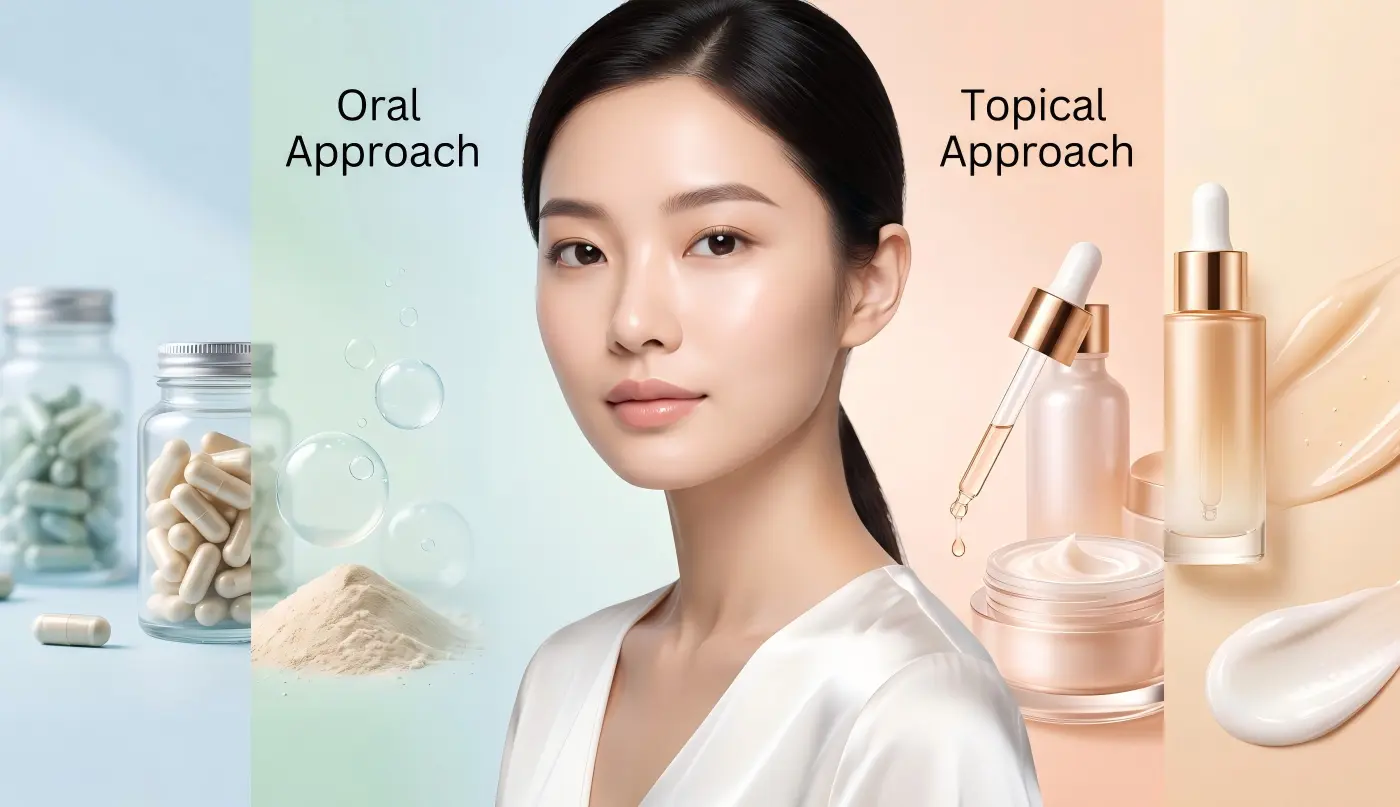
Should I choose oral beauty supplements (beauty from within), topical brightening skincare, or a coordinated combination?
There is no universally “best” approach. The optimal strategy depends on diagnosis (when relevant), skin type, pigmentation pattern, expectations, adherence, UV behavior, and–for brands–regulatory claim boundaries and formulation complexity.
That decision also maps directly to commercial pathways:
- Skin brightening / beauty supplement OEM
- Glabridin, astaxanthin, glutathione, vitamin C stacks
- Cosmetic actives and private-label beauty systems
This page is an evidence-based comparison of oral vs topical strategies–not a hype ranking of “best whitening miracles.”
Explore Beauty Supplement OEM | Glabridin Ingredient Page | Astaxanthin Supplements
Evidence Summary Box
Statement | Confidence |
|---|---|
| Topicals often work faster for localized appearance goals | High |
| Oral supplements support systemic radiance/antioxidant narratives | Moderate |
| Combination often provides complementary–not identical–benefits | Moderate |
| Supplements cannot replace sunscreen | High |
| No ingredient guarantees pigment removal or melasma clearance | High |
| Medical pigment disorders need clinician-directed care | High |
Quick Answer
Oral and topical skin brightening ingredients act through different biological pathways and are often complementary rather than interchangeable.
- Topical ingredients primarily act locally in the epidermis by supporting pathways related to melanogenesis, pigment transfer, turnover, and barrier comfort.
- Oral ingredients provide systemic antioxidant and nutritional support that may help the skin’s response to oxidative stress, photoaging pressure, and overall radiance appearance.
At KS Nutripharma, most beauty brands developing inside-out brightening products do not choose a single ingredient. They usually build multi-ingredient systems that combine oral antioxidants with topical tyrosinase-related inhibitors to balance efficacy narrative, formulation complexity, and regulatory compliance.
Expectations should stay realistic: onset, magnitude, and durability vary by diagnosis, UV exposure, consistency, and product quality. Persistent pigment disorders need clinician guidance. The American Academy of Dermatology (AAD) emphasizes professional evaluation for pigmentary concerns rather than unsupervised self-treatment.[1]
At-a-Glance Comparison
Features | Oral Ingredients | Topical Ingredients |
|---|---|---|
| Primary action | Systemic | Localized |
| Target area | Whole-body support narrative | Specific facial/body sites |
| Typical onset | Slower | Often faster for local appearance goals |
| Precision on one spot | Lower | Higher |
| Daily compliance | Often simple (capsule/gummy) | Moderate (routine steps) |
| UV / photoaging support angle | Strong (selected antioxidants) | Limited unless paired with sunscreen |
| Barrier support | Indirect/nutritional | Direct leave-on care |
| Combination potential | Excellent | Excellent |
Decision Tree: Oral, Topical, or Combination?
Use this as a planning filter–not a diagnosis tool.
Localized dark spots / uneven facial tone?
        -> Yes
   Start topical-first + daily SPF
        ->
Whole-body radiance / beauty-from-within positioning?
        -> Yes
   Oral-first + daily SPF
        ->
Need both precision and systemic support?
        -> Yes
   Coordinated combination (separate oral + topical SKUs)
        ->
Suspected melasma, rapid change, or treatment-resistant pigment?
        -> Yes
   See a dermatologist first -- supplements/cosmetics are adjuncts only
Brand translation: Match the first SKU to the dominant consumer job-to-be-done, then expand into a duo only when claim worlds stay cleanly separated.
Understanding Skin Brightening: Inside-Out vs Outside-In
Visible uneven tone is multi-factorial. Relevant themes include:
- Melanin synthesis and melanocyte activity
- Oxidative stress and reactive oxygen species (ROS)
- Inflammation and barrier disruption
- UV-induced pigmentation pressure
- Melanosome transfer toward keratinocytes
- Epidermal turnover and dermal matrix appearance
That is why a single cream–or a single capsule–cannot address every pathway for every person. Topicals can be precise on the face. Oral strategies may support systemic antioxidant and nutritional context. Sunscreen remains foundational for almost every brightening plan.
How Oral Skin Brightening Ingredients Work
Systemic antioxidant protection
Oral antioxidants are often positioned to help the body manage oxidative stress associated with UV and environmental load. This is supportive biology language–not a license to call a capsule “sunblock.”
Supporting melanin-related appearance pathways
Some nutrients are discussed in relation to pathways that influence how skin looks over time. They should be framed as appearance/wellness support, not as oral drugs for melasma.
Photoprotection support (not sunscreen replacement)
Selected oral antioxidants (for example polypodium- and carotenoid-related research themes) are studied as adjuncts to photoprotection strategies. They do not replace topical SPF.
Supporting skin barrier and dermal appearance
Oral ceramides, collagen peptides, and related beauty nutrients are commonly used for hydration appearance, elasticity narratives, and barrier-support positioning alongside topical care.
How Topical Skin Brightening Ingredients Work
Tyrosinase-related inhibition
Examples often used in cosmetics: glabridin, alpha-arbutin, kojic acid (market rules vary).
Reducing pigment transfer narratives
Example: niacinamide is frequently used in tone-evening cosmetics.
Accelerating epidermal renewal
Examples: retinoids, AHAs, PHAs (irritation and regulatory class differ widely; retinoids may be drug-adjacent depending on market and claim).
Reducing local inflammatory appearance
Examples: azelaic acid, panthenol, licorice-derived actives including glabridin-containing systems.
Deep dive on glabridin vs classic drug depigmenters: Glabridin vs Hydroquinone
Mechanism Strength Ranking
Directional confidence for cosmetic / beauty-education framing–not a medical treatment ranking.
Mechanism | Typical route strength | Human evidence density | Confidence for marketing education |
|---|---|---|---|
| Tyrosinase-related inhibition | Topical >> Oral | Moderate-high for selected topicals; limited oral | 4/5 (topical) |
| Antioxidant/photoaging support | Oral + Topical | Moderate (ingredient-specific) | 4/5 |
| Melanosome transfer narratives | Topical | Moderate (e.g., niacinamide literature) | 4/5 |
| Barrier repair/hydration appearance | Topical + selected oral | High for barrier topicals; moderate for oral ceramides/collagen | 5/5 |
| Systemic nutritional support | Oral | Strong for nutrition endpoints; variable for “brightening” endpoints | 3/5 |
| Medical depigmentation | Clinician-directed topical drugs | High in dermatology contexts | Outside cosmetic self-care |
Best Oral Skin Brightening Ingredients
Directional profiles for brand and consumer education. Not dosing prescriptions.
Glutathione
- Mechanism themes: Antioxidant network / redox support discussions
- Evidence: Mixed for beauty / skin-tone endpoints–see “Why oral glutathione studies disagree” below
- Limitations: Trial heterogeneity; oral bioavailability questions; reduced vs oxidized forms; marketing intensity often exceeds evidence quality
- Safety: Generally food-supplement framed; quality and form matter
- Best combinations: Vitamin C, supportive polyphenols
- OEM angle: Capsules, powders, drinks (taste/stability engineering)
Vitamin C
Vitamin C contributes to normal collagen formation and antioxidant defense according to the NIH Office of Dietary Supplements.[2]
- Mechanism themes: Antioxidant support; collagen-related nutritional roles
- Evidence: Strong nutritional science base; skin-appearance outcomes depend on dose form and study design
- Limitations: Oral dose saturation; GI tolerance; inter-individual response; topical irritation/stability when used on skin
- Best combinations: Oral + topical C strategies (separate irritation management)
- OEM angle: Capsules, gummies, stick packs
Astaxanthin
- Mechanism themes: Lipid-phase antioxidant; photoaging-support research interest
- Evidence: Growing human cosmetic/photobiology literature (study-dependent)
- Limitations: Endpoint definitions vary; softgel oxidation control is a real manufacturing constraint
- Best combinations: Softgel stacks with other carotenoids
- OEM angle: Softgels are a natural fit
Pine bark extract
- Mechanism themes: Polyphenol antioxidant complex
- Evidence: Moderate for selected skin-appearance endpoints in some trials–verify extract standardization
- Limitations: Marker disclosure and botanical identity vary by supplier
- OEM angle: Capsules; marker disclosure important
Polypodium leucotomos
- Mechanism themes: Oral photoprotection-adjunct research tradition
- Evidence: Clinical literature exists for photobiology endpoints; still not a sunscreen substitute
- Limitations: Adjunct only; consumer education must not imply SPF replacement
- OEM angle: Capsules for “sun lifestyle” beauty lines (claim carefully)
Tomato extract/lycopene
- Mechanism themes: Carotenoid antioxidant / photoaging-support narratives
- Evidence: Nutritional and cosmetic-adjacent studies vary by extract
- Limitations: Extract standardization and lipid co-ingestion affect outcomes
- OEM angle: Softgels / oil systems
Grape seed extract
- Mechanism themes: Oligomeric proanthocyanidins / antioxidant support
- Evidence: Moderate / emerging depending on endpoint
- Limitations: Color, astringency, and polyphenol assay consistency in finished goods
- OEM angle: Capsules
Ceramides (oral)
- Mechanism themes: Barrier lipid nutrition / hydration appearance
- Evidence: Supportive human studies for selected ceramide ingredients
- Limitations: Ingredient-specific; not all “ceramide” SKUs are equivalent
- Best for: Dryness + dullness appearance routines
- OEM angle: Softgels/capsules; pair with topical ceramides
Marine collagen
- Mechanism themes: Dermal matrix appearance / beauty protein positioning
- Evidence: Multiple RCTs for selected collagen peptides on skin endpoints (ingredient-specific)
- Limitations: Peptide source, dose, and study endpoints are not interchangeable across brands
- OEM angle: Powders, stick packs, gummies
N-Acetyl Cysteine (NAC)
- Mechanism themes: Glutathione precursor/antioxidant support discussions
- Evidence: Broader clinical use history outside beauty; beauty-specific claims need care
- Limitations: Medical history and drug interactions matter–professional advice recommended
- OEM angle: Capsules; regulatory presentation varies by market
Why Oral Glutathione Studies Report Inconsistent Outcomes
Calling glutathione evidence “mixed” is not a vague hedge–it reflects real study design differences. When trials disagree, experienced formulators usually check:
| Driver of inconsistency | Why it matters |
|---|---|
| Dose and duration | Underpowered short studies rarely match marketing timelines |
| Reduced vs oxidized glutathione | Forms are not automatically interchangeable |
| Oral bioavailability | Absorption and systemic exposure narratives vary |
| Ethnicity/baseline pigmentation | Appearance endpoints are population-sensitive |
| Endpoint definition | Melanin index, visual grading, and “brightness” scores are not identical |
| Placebo/formulation variability | Drink vs capsule vs co-actives change the signal |
| Sample size | Small pilots inflate both positive and negative noise |
Formulator insight: Although oral glutathione receives significant consumer attention, many experienced formulators consider astaxanthin, ceramides, collagen peptides, and vitamin C to provide a stronger evidence base for long-term beauty positioning–especially when claims must survive regulatory review.
Best Topical Skin Brightening Ingredients
Glabridin
Licorice-root flavonoid used in cosmetic brightening systems; research themes include tyrosinase-related and anti-inflammatory models (classic mechanistic work includes Yokota et al., 1998).[3][4]
Form choice: Water-Soluble vs Oil-Soluble Glabridin
Niacinamide
Widely used for tone-evening and barrier-support cosmetics; strong formulary practicality and comparatively dense cosmetic clinical literature.
Tranexamic acid (topical cosmetic use)
Popular in tone-evening serums; local rules and concentrations matter.
Alpha-arbutin
Cosmetic tyrosinase-related brightener; watch impurity / hydroquinone-related regulatory constraints where applicable.
Vitamin C (topical)
Antioxidant brightening staple; stability and irritation are formulation projects.
Azelaic acid
Multi-pathway complexion active; useful in blemish + tone routines (class depends on market).
Kojic acid
Classic brightener; stability and regulatory limits vary.
Retinoids
Powerful renewal tools; irritation risk and drug/cosmetic classification differ by region and molecule.
Ferulic acid
Often paired with vitamin C for antioxidant network design.
Ectoin
Stress-protection/soothing narratives in a sensitive, brightening chassis.
Ingredient Cross-Comparison Matrix
Ingredients | Route | Primary Mechanism Theme | Evidence level* | Typical timeframe language | OEM potential |
|---|---|---|---|---|---|
| Glutathione | Oral | Antioxidant / redox | C-D (beauty endpoints often limited) | Gradual, highly variable | High |
| Vitamin C | Oral / Topical | Antioxidant; topical brightening | B-A depending on endpoint | Weeks for topical appearance; oral slower | Very high |
| Astaxanthin | Oral | Lipid antioxidant/photoaging support | B-C | Gradual with consistent use | High (softgels) |
| Pine bark | Oral | Polyphenol antioxidants | B-C | Gradual | High |
| Polypodium | Oral | Photoprotection adjunct research | B-C | Adjunct to SPF habits | Medium-high |
| Lycopene | Oral | Carotenoid antioxidant | C | Gradual | High |
| Ceramides | Oral / Topical | Barrier/hydration appearance | B-C | Often noticeable with barrier routines | High |
| Collagen peptides | Oral | Dermal appearance support | B (ingredient-specific) | Often discussed over weeks-months | Very high |
| Glabridin | Topical (also oral projects) | Melanogenesis-related + soothing themes | C-D clinical; stronger mechanistic | Gradual cosmetic brightening | High |
| Niacinamide | Topical | Tone + barrier support | B-A for selected endpoints | Often weeks | Very high |
| Tranexamic acid | Topical | Tone-evening cosmetic use | B-C | Gradual | High |
| Alpha-arbutin | Topical | Tyrosinase-related | C-B | Gradual | High |
| Azelaic acid | Topical | Multi-pathway complexion | B | Gradual | High |
| Retinoids | Topical | Renewal | A-B clinically (class-dependent) | Weeks; irritation management critical | High (reg-sensitive) |
Evidence levels defined below. Timeframes are descriptive expectations only–not guarantees.
Evidence Hierarchy
Level | Meaning |
|---|---|
| A | Meta-analysis and/or multiple consistent RCTs for the stated endpoint |
| B | Randomized controlled trials of meaningful quality |
| C | Pilot human studies / open-label / smaller controlled trials |
| D | Mechanistic, in vitro, animal, or early translational data |
How to use this: Prefer Level A/B ingredients when making strong commercial education claims. Use Level C/D ingredients with conservative language and strong quality documentation.
Clinical Evidence Snapshot
| Ingredients | Oral / Topical | Human evidence snapshot | Evidence strength | Typical use lane |
|---|---|---|---|---|
| Hydroquinone (medical) | Topical drug contexts | Extensive clinical tradition for pigmentary disorders | Strong in medicine | Clinician-directed care–not casual cosmetics in many markets |
| Niacinamide | Topical | Multiple cosmetic/clinical studies | Strong-moderate | Daily tone/barrier serums |
| Collagen peptides | Oral | Multiple RCTs for selected brands/doses | Moderate-strong (specific) | Beauty powders/gummies |
| Astaxanthin | Oral | Growing RCTs / controlled studies | Moderate | Softgel photoaging-support |
| Vitamin C | Both | Broad literature; quality varies by form | Moderate-strong | Dual-route staple |
| Polypodium | Oral | Photobiology clinical literature | Moderate | Sun-lifestyle adjunct |
| Glabridin | Topical focus | Stronger mechanistic + limited clinical pilots | Emerging-moderate | Cosmetic brightening |
| Glutathione oral | Oral | Heterogeneous beauty evidence | Emerging | Premium antioxidant SKUs |
| Alpha-arbutin | Topical | Cosmetic and some clinical use data | Emerging-moderate | Spot/tone serums |
How to read this: “Strong” for hydroquinone refers to medical pigment care contexts. Cosmetic ingredients should not borrow drug-level wording.
What We See in Commercial Product Development
This section reflects OEM / private-label patterns–not a clinical guideline.
Combinations brands choose most often
- Oral hero: collagen peptides, ceramides, astaxanthin, vitamin C (+/- glutathione for premium storytelling)
- Topical hero: niacinamide + glabridin / vitamin C / azelaic strategies
- Non-negotiable: SPF education in every launch brief
Why more brands build Inside-Out Beauty
Consumer expectations now span “glow” + localized tone. A single topical cannot own whole-body radiance narratives; a single capsule cannot own spot precision. Duo systems raise AOV and differentiate shelf stories–if claims stay route-specific.
Regional focus differences (directional)
Market tendency | What buyers emphasize |
|---|---|
| North America / EU | Claim compliance, documentation, irritation management |
| East / Southeast Asia | Tone-evening intensity, texture elegance, duo kits |
| Global Amazon / DTC | Simple habit stacks, softgels/gummies, visible “hero active” |
Formulation failure patterns we see repeatedly
- Overloading one serum with acids + retinoids + multiple brighteners -> barrier stress that worsens uneven tone
- Choosing lipophilic actives for clear beverages without solubility engineering
- Marketing oral glutathione like a topical spot corrector
- Launching “melasma kits” without medical-channel governance
Stability and raw-material logic
Oxidation-sensitive oral carotenoids need softgel oxygen control. Topical vitamin C and kojic systems need packaging and pH discipline. Glabridin grade choice (oil-soluble vs water-dispersible) should follow chassis–not brochure purity alone. See: Glabridin Formulation Guide
Expert Perspectives / Formulator Insights
Expert Perspective
High-performing beauty brands rarely ask “which single whitening ingredient wins?” They ask which system can be manufactured reproducibly, claimed legally, and used daily without barrier damage–while matching the consumer’s actual goal (spot vs glow vs photoaging support).
Formulator Insight
Consumer search volume and formulary priority are not the same thing. Build the evidence-strong chassis first; use high-attention actives only when the claim story and quality package can support them.
Commercial Insight
Premium brands rarely rely on one whitening active because regulatory risk, stability, consumer expectations, and differentiated positioning all push toward multi-pathway architectures–not monotherapies.
Why premium beauty brands rarely rely on a single whitening ingredient
Constraint | What it forces in practice |
|---|---|
| Regulatory | One aggressive claim can reclassify a product; multi-active “appearance support” is often safer commercially |
| Stability | Different actives fail for different reasons–systems diversify risk |
| Consumer expectations | Users want glow and tone and comfort |
| Differentiated positioning | Single-ingredient stories are easy to copy; systems are harder |
Pigmentation Pathway Mapping
Biological pathway | Oral ingredients (examples) | Topical ingredients (examples) |
|---|---|---|
| Oxidative stress | Glutathione, astaxanthin, grape seed, lycopene | Vitamin C, ferulic acid |
| Tyrosinase-related activity | Limited oral options with strong cosmetic evidence | Glabridin, alpha-arbutin, kojic acid |
| Melanosome transfer narratives | Limited | Niacinamide |
| Inflammatory appearance | Polyphenol antioxidants (supportive) | Azelaic acid, panthenol, licorice actives |
| Skin barrier | Oral ceramides, collagen support | Ceramides, panthenol, niacinamide |
| Photoaging pressure | Astaxanthin, polypodium, carotenoids + SPF | Antioxidant serums + SPF |
Bioavailability vs. Skin Penetration
Oral bioavailability
Absorption, first-pass metabolism, co-ingestion with fats (for carotenoids), and nutrient-drug interactions all influence outcomes. Softgels often help lipophilic actives (astaxanthin, lycopene).
Topical penetration
Molecular size, lipophilicity, vehicle, and intact barrier status matter. A brilliant active in the wrong vehicle underperforms.
Advanced delivery technologies
Liposomes, nanoemulsions, cyclodextrin inclusion, and microencapsulation can improve handling or deposition narratives for both oral and topical projects. Validate commercially–do not assume “nano” equals proven superiority.
Which Approach Works Faster?
Goal | Often faster route | Notes |
|---|---|---|
| Localized spot appearance | Topical | Still needs SPF and consistency |
| Whole-body radiance support | Oral | Slower, systemic |
| Maintenance after clinical care | Combination | Clinician-guided |
| Long-term photoaging strategy | Combination + SPF | No shortcut without sun behavior |
Avoid promising day-count guarantees. Individual response varies.
Safety Comparison
Topic | Oral | Topical |
|---|---|---|
| Pregnancy/breastfeeding | Consult a clinician before actives | Ingredient-dependent; ask clinician |
| Sensitive skin | Often well tolerated | Patch test; watch acids/retinoids |
| Drug interactions | Possible (supplements/NAC/etc.) | Usually lower systemic interaction risk |
| Irritation | Typically low | Moderate depending on actives |
| Long-term use | Ingredient-specific | Ingredient-specific |
| Liver/kidney disease | Medical advice required | Medical advice if extensive actives used |
| Persistent pigment disorders | See dermatologist | See dermatologist |
U.S. FDA dietary supplement rules require truthful labeling and prohibit disease-treatment claims for supplements;[5] cosmetic products remain appearance-claim domains under separate frameworks. EU CosIng provides cosmetic ingredient regulatory orientation for formulators planning EU launches.[6]
Who Should Choose Oral Ingredients?
Often a strong fit when the priority is:
- Overall radiance / “glow” support
- Beauty-from-within positioning
- Photoaging lifestyle support (with SPF)
- Convenience and habit stacking
- Whole-body skin appearance narratives
Who Should Choose Topical Ingredients?
Often a strong fit when the priority is:
- Localized facial uneven tone
- Spot-focused cosmetic care
- Barrier + brightening leave-on routines
- Precise active layering (niacinamide, glabridin, vitamin C systems)
For melasma and stubborn pigment, prioritize dermatologist-guided care; topicals may be adjunct cosmetic support depending on the plan.
When Combining Oral and Topical Makes Sense
Combination is often the highest-value consumer and brand architecture–if claims stay compliant. Current evidence suggests complementary pathways more often than true interchangeability.
Hyperpigmentation appearance support (cosmetic)
Example architecture: oral vitamin C + antioxidant capsule; topical glabridin + niacinamide; daily SPF.
Not a medical protocol.
Photoaging
Example: oral astaxanthin/lycopene softgel + topical vitamin C / ferulic serum + SPF.
Sensitive skin
Example: oral ceramides/collagen; topical panthenol + ceramide cream; introduce brighteners slowly.
Post-inflammatory marks (cosmetic care)
Example: barrier-first topical routine with glabridin / azelaic strategies as tolerated; oral antioxidant support; strict SPF.
Inflamed or scarring acne needs clinical care.
Formulation Strategies for Beauty Brands (B2B)
Beauty-from-within products
Capsules | softgels | gummies | powders | stick packs | beauty drinks
Quality levers: assay, oxidation control, taste masking, bioavailability design.
Topical brightening products
Serums | creams | essences | masks | ampoules
Quality levers: stability, irritation, packaging (airless/opaque), delivery system.
Inside-out product systems
Coordinate a supplement hero + topical hero under one brand story while keeping:
- Supplement claims vs cosmetic claims separated
- Regional regulatory review
- No implied disease treatment
Product development guide for OEM brands
Strategy | What to launch | Why it converts |
|---|---|---|
| Supplement-only | Astaxanthin softgel or collagen stick | Simple SKU, clear habit |
| Topical-only | Glabridin + niacinamide serum | Fast local appearance story |
| Inside-out duo | Softgel + serum kit | Higher AOV, differentiated brand |
| Clinic-adjacent cosmetics | Barrier + gentle brightening (no drug overclaim) | Professional channel fit |
| Beauty-from-within platform | Collagen + ceramide + antioxidant line architecture | Repeat purchase potential |
Research Timeline (Selected Milestones)
1998
->
Glabridin tyrosinase / inflammation mechanistic work (Yokota et al.)
->
2000s-2010s
->
Niacinamide tone / barrier cosmetic clinical literature expands
->
~2010s
->
Oral astaxanthin / carotenoid photoaging-support trials grow
->
2010s-2020s
->
Collagen peptide RCTs for selected skin-appearance endpoints
->
2020+
->
Inside-out Beauty becomes a mainstream brand architecture
(still limited high-quality oral+topical combination RCTs)
This timeline helps explain why “what works best” depends on whether you mean mechanistic plausibility, cosmetic practicality, or medical pigment care.
Evidence Limitations & Current Research Gaps
What current research still cannot answer cleanly
- Long-term, high-quality RCTs of oral + topical combination systems as a unit
- Standardized brightening endpoints across ethnic populations
- Head-to-head oral glutathione form comparisons with adequate power
- How much of real-world “glow” comes from SPF adherence vs actives
- Translating in vitro tyrosinase inhibition into predictable human spot outcomes for every cosmetic active
Balanced view
Current dermatology patient education prioritizes diagnosis and sun protection for pigment concerns;[1] beauty supplements and cosmetics remain supportive appearance tools. Majority of human beauty studies are ingredient- and endpoint-specific–not universal rankings.
Consumer Decision Matrix
Consumer goal | Recommended starting strategy |
|---|---|
| Overall skin radiance | Oral-first + SPF |
| Localized dark spots | Topical-first + SPF |
| Photoaging support | Combination + SPF |
| Sensitive skin | Barrier-focused combination |
| Daily maintenance | Combination (simple routines) |
| Professional pigment management | Dermatologist-guided care |
Common Myths
- Oral supplements work overnight
- Topicals brighten the entire body equally
- More ingredients always mean better results
- “Natural” always means safer
- Brightening products replace sunscreen
- Oral glutathione always outperforms topical care
- Any cream labeled “melasma treatment” is appropriate without diagnosis
- Combination is automatically best for every person
Regulatory and Claims Considerations
Keep three claim worlds separate:
Claim world | Typical home | Risk if confused |
|---|---|---|
| Dietary supplement structure/function | Oral Products | Disease-treatment language |
| Cosmetic appearance claims | Topicals | Drug classification triggers |
| Drug claims | Prescription pathways | Illegal OTC positioning |
Regional Planning Notes (verify before launch)
Region | Planning reminder |
|---|---|
| United States | DSHEA supplement rules vs. FDA cosmetic vs. drug lines; FTC advertising truth-in-claims |
| European Union | Food supplement notifications/claims (nutrition & health claims regime) vs Cosmetic Regulation |
| Japan | Foods with function claims / quasi-drug pathways can differ sharply by presentation |
| Australia | Listed/registered complementary medicines vs cosmetics split |
| ASEAN | Country-by-country cosmetic notification and supplement rules |
This is orientation–not legal advice.
Frequently Asked Questions
Are oral supplements better than topical creams?
Not universally. Oral supports systemic goals; topicals win for localized precision. There is no single winner for every goal.
Can oral glutathione replace topical brightening products?
Usually no. Different route, different expectations, uneven evidence for beauty endpoints.
Which approach works faster for a dark spot?
Topical routines often show localized appearance changes sooner when consistent–and with SPF.
Can oral and topical ingredients be used together?
Yes, commonly. Keep irritation and claim compliance under control.
Which ingredients have the strongest clinical evidence?
It depends on endpoint. Medical pigment therapy evidence differs from cosmetic radiance evidence. Collagen peptides, niacinamide, and some photobiology actives have comparatively stronger human datasets in their lanes.
Do oral supplements brighten the whole body?
They are positioned for whole-body appearance support. Results vary and are usually gradual.
Which topical ingredient is best for dark spots?
No single winner. Glabridin, niacinamide, arbutin systems, azelaic strategies, and vitamin C are common cosmetic options–match to skin tolerance and market rules.
Are skin brightening supplements safe?
Quality-dependent and person-dependent. Choose tested products; review medications and conditions with a clinician.
Can pregnant women use these ingredients?
Ask an obstetric clinician before using actives orally or topically.
Does sunscreen still matter?
Yes. Brightening without UV management is incomplete.
Which approach is best for melasma?
See a dermatologist. Do not self-treat melasma with supplements or cosmetics alone.
What is the best inside-out beauty routine?
A simple stack: SPF daily + one topical tone serum + one oral beauty habit you can sustain.
Are gummies as good as capsules?
Compliance may be higher; dose, sugar/excipients, and stability differ. Judge by formula–not format fashion.
Can I layer retinol with brightening acids?
Carefully. Irritation can worsen uneven tone. Introduce slowly or seek professional routines.
Is glabridin only topical?
It is prominent in cosmetics; oral/beauty-supplement projects also exist–confirm grade and claims path.
Is astaxanthin a brightener or an antioxidant?
Primarily an antioxidant / photoaging-support oral active in beauty positioning.
Do I need both vitamin C oral and topical?
Optional. They can complement; manage stomach tolerance and topical irritation separately.
How long until I see changes?
Varies widely. Think in sustainable routines, not overnight transformations.
Can OEM brands sell oral + topical kits?
Yes–if regulatory claim boundaries are respected in each SKU and market.
What should brands avoid claiming?
Disease treatment, guaranteed erasure of melasma, “replaces sunscreen,” or unsubstantiated superiority.
Key Takeaways
Goal | Best starting strategy |
|---|---|
| Whole-body skin radiance | Oral ingredients + SPF |
| Localized hyperpigmentation appearance | Topical ingredients + SPF |
| UV / photoaging support | Oral antioxidants + topical SPF/antioxidants |
| Barrier repair | Topical barrier actives (+/- oral ceramides/collagen) |
| Anti-aging appearance | Combined inside-out system (when appropriate) |
| Premium brand architecture | Integrated oral + topical line |
| Medical pigment disorders | Clinician-first–not DIY ingredient stacking |
How KS Nutripharma Helps Brands Build Inside-Out Beauty Systems
- Beauty supplement OEM (capsules, softgels, gummies, stick packs)
- Standardized actives including glabridin and astaxanthin pathways
- Formulation support for oxidation-sensitive and multi-active stacks
- Documentation and pilot pathways for private label launches
Request Beauty OEM Consultation | Request Glabridin Specs | Request Astaxanthin Info | [Book Technical Meeting]
Clinical References & Authoritative Sources
- American Academy of Dermatology. Patient education resources on skin conditions and professional care. https://www.aad.org/
- National Institutes of Health, Office of Dietary Supplements. Vitamin C Fact Sheet for Health Professionals. https://ods.od.nih.gov/factsheets/VitaminC-HealthProfessional/
- Yokota T, et al. Inhibitory effect of glabridin on melanogenesis and inflammation. Pigment Cell Res. 1998. https://pubmed.ncbi.nlm.nih.gov/9870547/
- Simmler C, et al. Phytochemistry and biological properties of glabridin. Planta Med. 2013. https://pmc.ncbi.nlm.nih.gov/articles/PMC3795865/
- U.S. FDA. Dietary supplements overview and responsible claims context. https://www.fda.gov/food/dietary-supplements
- European Commission CosIng (cosmetic ingredient regulatory orientation). https://ec.europa.eu/growth/tools-databases/cosing/
- National Library of Medicine / PubChem. Glabridin (CID 124052). https://pubchem.ncbi.nlm.nih.gov/compound/124052
- Cochrane Library (search pigmentary disorder reviews as applicable to clinical care discussions). https://www.cochranelibrary.com/
Oral and topical brightening are different tools. There is no universal winner. The winning strategy matches the goal, respects evidence tiers and limitations, keeps sunscreen non-negotiable, and sends medical pigment cases to clinicians.