
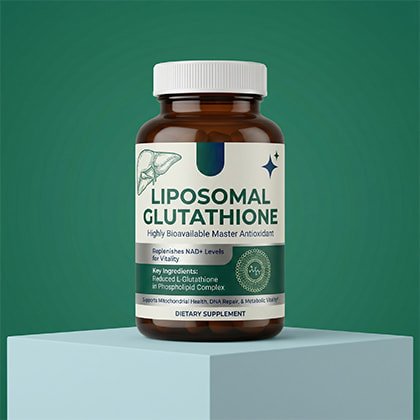
KS Nutripharma is a liposomal glutathione supplement manufacturer for OEM, ODM, and private-label programs. We manufacture finished reduced glutathione (GSH) as liposomal liquids, capsules, softgels, stick packs, and gummies when the label will print liposomal — quoted as the liposomal SKU on a glutathione supplement manufacturer program, with a named phospholipid file, GSH/GSSG retention, and batch documentation.
Encapsulation method and barrier pack decide the quote, not lecithin listed next to glutathione on the formula sheet. Confirm GSH milligrams as reduced GSH, whether encapsulation efficiency is a release field, and which pack the climate lane can actually hold.
Liposomal Glutathione Manufacturing at a Glance
| What we manufacture | Liposomal GSH finished units — liquid first when the artwork will print liposomal |
| Molecule | Reduced GSH in a documented vesicle system. Reduced GSH or S-acetyl with no liposome claim belongs on the glutathione manufacturer page |
| Buyer scan | GSH assay · GSH/GSSG · EE method where claimed · phospholipid source (sunflower vs soy) · barrier pack |
| Formulas | F01–F08 starting concepts, customized per project |
| Formats | Liquids · capsules · softgels when an oil-soluble companion is on the formula · stick packs · gummies after a retention review |
| MOQ / lead time | Pilot often 500–1,000 units; samples typically 7–15 days after the formulation is approved; capsules typically from about 5,000 finished units, first commercial lot often 4–6 weeks after formula, pack, and testing are agreed; softgels, sticks, and gummies often from about 10,000 — confirm at quote |
| Scope | Oral dietary-supplement contract manufacturing. Injectable glutathione and drug-path artwork sit outside this program |
cGMP · ISO 9001 · ISO 22000 · HACCP · FSSC 22000 · Halal · Kosher · In-house lab plus SGS/Eurofins when the RFQ asks for a third-party report · Batch documentation · Traceable release
→ About Us | Manufacturing Capacity | Certifications | Quality Control
If the project is reduced GSH or S-acetyl without a liposome claim, quote on the glutathione supplement manufacturer page.
What to Include in an RFQ
A first quote is usable when the following are named:
- Destination market
- Closest concept (F01–F08) or current formula
- GSH milligrams as reduced GSH, plus serving millilitres if the unit is a liquid
- Phospholipid system, and the encapsulation-efficiency method if the label will say liposomal
- Dosage form, barrier pack, and climate lane
- Intended label positioning (beauty-from-within and liver-wellness copy still need local counsel; skin-bleaching and liver-disease treatment copy sit outside this program)
- Existing certificate of analysis or particle-size file, if you are comparing sources
Custom Liposomal Glutathione Formulation for Private Label SKUs
These are commercially established starting points for a finished liposomal glutathione SKU, including private-label launches. Pick the closest concept or send your current formula. KS formulation team and R&D center match channel and destination market, then confirm GSH milligrams, the phospholipid file, and whether encapsulation efficiency is on release. You receive a SKU-level cost, a feasibility read, and a sample plan. Label claims remain the brand’s responsibility.
If the brief is an antioxidant assortment of several SKUs, start from antioxidant supplements and treat liposomal GSH as one architecture on that line.
Milligram bands below are development examples.
Use when: Beauty-from-within or daily antioxidant positioning, with both actives in an aqueous system.
Specify: GSH milligrams as reduced GSH; vitamin C salt and milligrams; whether vitamin C is a liposomal grade or a conventional salt in the same liquid.
Trade-off: No collagen grams (F02) and no oil-phase CoQ10 (F05). A drink that must carry peptide grams will not stay on this liquid.
Default format: Liquid. Capsule only when a documented liposomal powder grade is on the file.
→ Liposomal Vitamin C
Use when: A beauty drink or stick is the commercial unit, not one swallow.
Specify: Collagen type and grams; hyaluronic acid milligrams if labeled; GSH milligrams as its own line — often a twin SKU.
Trade-off: Two grams of peptide plus a defensible GSH assay rarely share one liquid with a documented vesicle system. This is not F01 with collagen stirred in.
Default format: Stick or drink, with a GSH liquid twin.
→ Collagen supplements
Use when: The panel names finished glutathione and N-acetyl-L-cysteine as separate identities.
Specify: GSH milligrams and NAC milligrams as two lines. Do not co-dissolve two thiols in one unbuffered liquid without a retention study.
Trade-off: NAC-led projects are quoted on the NAC page. Milk thistle (F04) adds a botanical assay instead of a precursor.
Default format: Capsule. Liquid only after a thiol-retention pilot.
→ Liposomal NAC
Use when: Liver-wellness positioning and the formula already names milk thistle.
Specify: Silymarin percentage plus method; artichoke or dandelion only if each assay is named. Keep claim language in structure/function; destination-market counsel owns the finished label.
Trade-off: A dry botanical extract and an aqueous liposomal GSH fill are usually a twin SKU, not one liquid. This is not F03.
Default format: Capsule, or GSH liquid + botanical capsule twin.
Use when: The label lists CoQ10 milligrams next to glutathione.
Specify: Ubiquinone versus ubiquinol; CoQ10 milligrams; oil antioxidant system for the lipid fill.
Trade-off: Aqueous-core GSH and oil-soluble CoQ10 default to a twin SKU unless one fill system is already validated. This is not F01 with CoQ10 added to water.
Default format: CoQ10 softgel + GSH liquid or capsule twin.
→ Liposomal CoQ10
Use when: The destination market allows NMN, and the panel is a longevity conversation — not a beauty-plus-vitamin-C default.
Specify: NMN milligrams; the market file that permits the ingredient.
Trade-off: A regulatory fork, not F01 with an extra powder. Do not copy an NMN SKU into a market that does not list it.
Default format: Capsule or liquid after the market file is named.
→ Liposomal NMN
Use when: A premium oil companion is the commercial story, not collagen grams.
Specify: Natural versus synthetic astaxanthin; milligrams; oil carrier.
Trade-off: Softgel / oil path. Hyaluronic acid or ceramides in the same unit usually split to a second SKU. This is not F02.
Default format: Softgel for the oil phase, with GSH as liquid or capsule twin when the GSH assay cannot live in that oil fill.
→ Astaxanthin
Use when: Sports or post-exercise positioning; the GSH band is often higher than a beauty 500 mg conversation.
Specify: Magnesium salt and elemental milligrams; tart cherry only if it is assayed.
Trade-off: Fill volume versus GSH milligrams. This is not F05 (oil) and not F03 (second thiol).
Default format: Capsule or stick.
→ Magnesium bisglycinate
Liposomal programs across actives: liposomal supplements.
Choose the Liposomal Glutathione Format: Liquids, Capsules, Softgels, Stick Packs or Gummies
Select the dosage form after the vesicle file is on the brief. Liquids are typically the preferred starting format because a liposomal claim is easiest to document in a dispersion you can assay for glutathione, GSH/GSSG, and encapsulation efficiency.
Best for: F01 — the usual first SKU when the artwork will print liposomal.
Why: A liquid dispersion is where vesicle size, encapsulation efficiency, and aqueous GSH can be measured on the same batch. Homogenization, nitrogen or a tighter headspace, and a light-protected barrier belong on this file together.
Recommended concepts: F01; GSH twin on F02 and F05 when the companion cannot share the water phase.
What to finalize: GSH mg/mL and serving millilitres; phospholipid system; EE method if labeled liposomal; aqueous pH / buffer as scoped; bottle barrier; climate lane.
Production consideration: Aqueous reduced GSH still oxidizes. Particle-size drift after homogenization, creaming, and an EE number that does not match the label are release problems — not a pack-only story. GSH/GSSG belongs on this matrix more often than on a dry capsule.
→ Liquids · Advanced Nutraceutical Delivery Systems
Best for: F03, F06, and F08 when a documented liposomal powder grade exists, or when a private-label bottle needs a swallow unit.
Why: A two-piece shell meters a dry fill and limits open-powder handling. It is not a shortcut around the vesicle file: lecithin in a capsule is not a liposomal claim.
Recommended concepts: F03 · F06 · F08
What to finalize: Gelatin versus HPMC; fill weight versus capsule size; humidity during blending; desiccant or blister for the climate lane; finished-unit GSH assay.
Production consideration: Moisture during encapsulating still moves GSH/GSSG. If the powder grade cannot show encapsulation data, quote the SKU as reduced GSH on the glutathione manufacturer file instead of printing liposomal.
→ Hard Capsules · Advanced Hard Capsule Technologies
Best for: F05 and F07 when CoQ10 or astaxanthin needs an oil phase.
Why: Lipid fills run in a softgel. Aqueous-core GSH usually stays a liquid or two-piece capsule unless a combined fill is already validated.
Recommended concepts: F05 · F07
What to finalize: Die size; ubiquinone versus ubiquinol or astaxanthin grade; oil antioxidant system; whether GSH remains a second SKU. Gelatin or starch/carrageenan vegetarian ribbon (HPMC is the two-piece capsule shell).
Shell selection: Vegetarian softgels use a plant-gel ribbon. Confirm shell chemistry on the RFQ so the die and leak review match the pack story.
→ Softgel Solutions · Advanced Softgel Technologies
Best for: F02 collagen drinks and sticks, or F08 when the serving is larger than one capsule.
Why: Peptide grams and some magnesium servings need mass a single capsule will not hold. Barrier laminate is part of GSH retention, not a graphic.
Typical applications: F02 · F08
What to finalize: GSH milligrams per stick, separate from collagen grams or elemental magnesium; laminate; water activity; reconstitution if the stick is a drink.
Packaging priority: Seal integrity belongs in the stability plan. A pinhole is a moisture path into a high-surface fill. Stick-level assay, not only the incoming glutathione drum.
→ Powders and Granules · Functional Beverage & Stick Pack Engineering
Best for: A lifestyle or trial twin after a liquid or capsule SKU has retention data.
Why: Cook heat, water activity, and sugar systems hit both reduced GSH and vesicle integrity, so most first launches stay on liquid.
Typical applications: Selected projects only.
What to finalize: Active overage; pectin versus gelatin; peak process temperature; assay of finished pieces after the commercial cook — not the kettle recipe.
Process implication: If the piece cannot carry the declared GSH or cannot support a liposomal claim after cook, keep glutathione on the liquid or capsule SKU.
→ Gummies · Moisture Control & Stability Engineering
Quality Control and Liposomal GSH Batch Documentation
A dry glutathione drum COA does not prove a liposomal finished unit. Name these fields before comparing suppliers.
Declared strength. Count milligrams as reduced GSH in the finished piece (or as mg/mL × serving mL on a liquid). S-acetyl is a different labeled ingredient and a different quote — not a 1:1 swap onto this milligram line.
Phospholipid system. Sunflower versus soy, phosphatidylcholine percentage, and allergen status belong on the raw-material file. A marketing “liposomal blend” name is not a substitute for that identity.
Encapsulation efficiency. If the artwork will print liposomal, name the EE method and whether EE is a release field. Without a method, do not print liposomal. Incoming premix paperwork from a third party is not automatically the vesicle file for your finished batch.
Particle size. A size range can sit on the project file as a conversation. It is not a site-wide guarantee. Drift after homogenization, fill, or freight is a stability question for that pack and climate.
GSH assay and GSH/GSSG. Release named glutathione content with a named method (HPLC is the usual commercial conversation). In liquids, sticks, and gummies, GSH/GSSG belongs on release more often than on a dry capsule, because the thiol sits in water or sees heat. GSSG is a ratio or oxidation check — not a second labeled glutathione SKU.
Overage. Overage follows stability data for that matrix and pack. It is not a license to skip barrier, headspace, or finished-unit assay.
Finished-unit testing. Assay of finished liquids, capsules, sticks, or gummies in addition to the incoming drum. Metals and microbiology follow the SKU file, same gate as other oral dietary supplements.
Packaging. Name pack with climate, not as a generic bottle line.
- Temperate markets or short distribution: A light-protected bottle plus scoped headspace or nitrogen is a common starting pack for liposomal liquids.
- Humid markets or long ocean freight: A higher-barrier bottle (or equivalent laminate on sticks) is discussed more often than a standard bottle alone. Do not quote “HDPE 60 count” as the whole pack story.
- Nitrogen / headspace: a process option scoped with pack and climate — not a universal line setting.
When two sources disagree, send both documents against the same declared strength, the same method names, and — if the label says liposomal — the same EE method.
Serving Size
Finalize declared strength before ranking quotations. Higher milligrams should be checked against fill volume, vesicle loading, and serving count — they do not automatically improve positioning.
Common conversations: 500 mg or 700 mg reduced GSH per serving as a development band, not a catalog dose. Liquid math is mg/mL × serving mL. Capsule math is milligrams per unit × units per serving. Stick math is glutathione milligrams per stick, separate from collagen grams. Gummy and stick overage follow assay after the commercial process for that pack and climate lane.
MOQ, Samples and Lead Time
Samples typically run 7–15 days after the formulation is approved. Pilot runs often start near 500–1,000 finished units while the vesicle file and pack are still moving. Capsule programs typically start near 5,000 finished units; a standard lot is commonly 4–6 weeks after formula, artwork, and testing are agreed. Softgels, stick packs, and gummies are often quoted from about 10,000, by die, film, or cook. Re-orders on an approved file are shorter than a first commercial run.
This page quotes a vesicle system: phospholipid identity, an encapsulation-efficiency method when the label says liposomal, and GSH/GSSG in a matrix that is often liquid. A reduced-GSH or S-acetyl capsule with no liposome claim is scoped on the glutathione manufacturer page.
Not as a default. Two thiols in one water phase need a retention pilot before the SKU is quoted as a single liquid. The usual first path is a capsule, or two units, until that data exists.
No. Premix identity is not automatically the vesicle file for the filled lot. Encapsulation efficiency, GSH, and GSH/GSSG — when they are release fields — are read on finished units from this run.
No. A size range can sit on the project file. It is not a site-wide guarantee. Drift after homogenization, fill, or freight is scoped with pack and climate, not copied from a brochure.
Only if the finished piece still supports the claim after the commercial cook — EE or an equivalent vesicle check, plus GSH assay of the piece. Heat and water activity work against both the thiol and the vesicle. Most first SKUs stay liquid.
Re-assay finished units on the same GSH, GSH/GSSG, and EE methods named at release. Then look at pack barrier, headspace, climate lane, and overage against the stability data for that matrix — not at a new brochure. Do not treat a yellow tint or a layer in the bottle as the only evidence.
Related
- Liposomal Vitamin C
- Liposomal NAC
- Liposomal CoQ10
- Liposomal NMN
- Astaxanthin
- Collagen supplements
- Magnesium bisglycinate
- Liposomal Curcumin
- Antioxidant supplements
- How to Read a COA
Start a Liposomal Glutathione Project
Send destination market, format, F01–F08 or your current formula, GSH milligrams as reduced GSH, phospholipid system, pack and climate lane, and first-order volume. Typical reply within one business day. A project manager is assigned. NDA available.
Disclaimer: Wholesale / brand manufacturing and product-development reference only. Dietary supplements are not intended to diagnose, treat, cure, or prevent any disease. KS Nutripharma manufactures oral dietary supplements. Injectable glutathione, skin-bleaching drugs, and liver-disease treatment claims sit outside this program. A liposomal claim should be supported by documented formulation and finished-product characterization, rather than by listing lecithin alongside glutathione. Structure/function language varies by country; brand owners remain responsible for finished-label compliance with local counsel. Milligram figures are development examples, not recommended intakes. KS Nutripharma provides manufacturing feasibility and documentation support — not legal approval.
Written by KS Nutripharma Formulation Team | Reviewed by KS Nutripharma Director of R&D (PhD, Food Science | 19+ years nutraceutical development) | Technical review scope: liposomal identity, phospholipid system, encapsulation-efficiency method, aqueous GSH/GSSG retention, and dosage-form feasibility | Updated September 2026