
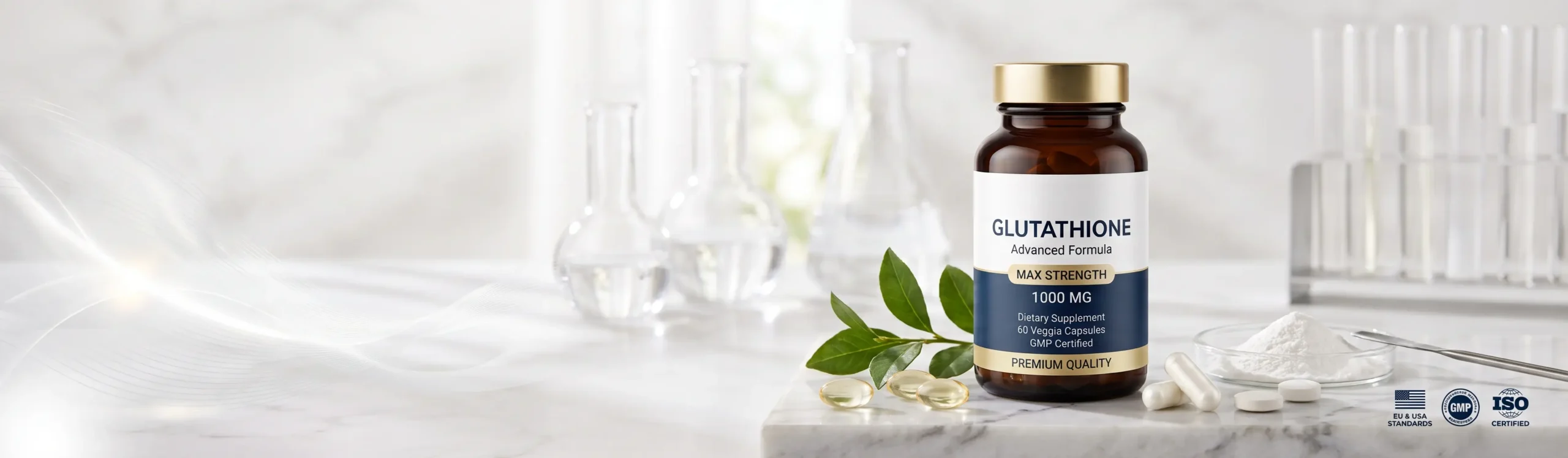
KS Nutripharma is a glutathione supplement manufacturer for OEM, ODM, and private-label glutathione programs. We manufacture finished glutathione dietary supplements for antioxidant assortments — reduced L-glutathione, S-acetyl glutathione, or a liposomal path — with clearly declared strength and supporting documentation.
Decide the glutathione form before comparing prices. Reduced L-glutathione, S-acetyl glutathione, and liposomal glutathione require different product specifications and should be quoted as separate projects. Confirm which name appears on Supplement Facts, how milligrams are declared, and which release tests the destination market expects.
Glutathione Supplement Manufacturing at a Glance
What we manufacture | Oral glutathione capsules, tablets, and glutathione powder or stick packs. Gummies after a retention review. Softgels when an oil-soluble companion is on the formula |
| Glutathione forms | Reduced L-glutathione (typical solid-dose path) · S-acetyl glutathione · liposomal glutathione on the liposomal page · GSSG as a QC ratio |
| Label math | Milligrams as reduced L-glutathione, unless the brief names S-acetyl or a liposomal dispersion |
| Formulas | F01–F08 starting concepts, customized per project |
| Preferred starting format | Hard capsule for dry reduced L-glutathione |
| Documents | Batch certificate of analysis; glutathione assay, with GSH/GSSG when the project file requires it |
| MOQ / lead time | Capsules typically from about 5,000 finished units; samples typically 7–15 days after the formulation is approved; first commercial lot often 4–6 weeks after formula, pack, and testing are agreed |
| Scope | Oral dietary-supplement contract manufacturing. Injectable glutathione and drug-path artwork are handled outside this program |
cGMP · ISO 9001 · ISO 22000 · HACCP · FSSC 22000 · Halal · Kosher · In-house lab plus SGS/Eurofins when the RFQ asks for a third-party report · Batch documentation · Traceable release
→ About Us | Manufacturing Capacity | Certifications | Quality Control
Selecting the Glutathione Form
Start by identifying the glutathione form, then match it to the closest formulation concept or send your existing product specification. This decision drives assay, pack, and whether the quote belongs on this page or on the liposomal program.
Reduced L-glutathione
Reduced glutathione (often labeled reduced L-glutathione or L-glutathione) is a tripeptide of glutamate, cysteine, and glycine. The cysteine thiol is the chemically active handle — and the reason a glutathione powder SKU behaves differently from a generic antioxidant blend. That thiol oxidizes to GSSG in moisture, heat, oxygen, or light. Two quotations that both say “GSH 500 mg” can still describe different products if only one reports GSH/GSSG.
Commercial material is typically fermentation-derived (often discussed as yeast fermentation producing the L-form). Incoming identity and method belong on the raw-material file; a marketing strain name is not a substitute for assay. For most glutathione capsule manufacturer briefs, this is the default solid-dose path: F01–F06.
Form | Typical label language | Preferred format here | Recommended practice | Next step |
|---|---|---|---|---|
| Reduced L-glutathione | Reduced L-glutathione, milligrams as GSH | Capsule, tablet, or powder | Name the assay method; treat GSSG as a QC ratio | F01–F06 |
| GSSG | Reported on the certificate of analysis | — | Use as an oxidation check | QC section |
| S-acetyl glutathione | S-acetyl glutathione, milligrams as S-acetyl | Capsule | Declare milligrams as S-acetyl | F07 |
| Liposomal glutathione | Liposomal, when a vesicle file can be shown | Liquid first | Define encapsulation on the liposomal project | Liposomal glutathione |
Why S-acetyl is specified separately
S-acetyl glutathione is a distinct labeled ingredient. The acetyl group changes molecular weight, so a 500 mg reduced L-glutathione discussion does not transfer 1:1 onto an S-acetyl panel. Use F07 when Supplement Facts will print S-acetyl — not as a “premium story” on the same milligram line as reduced L-glutathione.
When a liposomal claim is appropriate
Adding phospholipids to a formula does not automatically qualify the finished product as liposomal. A liposomal claim requires a validated delivery system and supporting documentation. Those projects are quoted as liposomal glutathione (usually liquid-first), not as a dry capsule with lecithin listed next to glutathione on the formula sheet.
What to Include in an RFQ
A first quote is usable when the following are named:
- Destination market
- Closest concept (F01–F08) or current formula
- Glutathione form: reduced L-glutathione, S-acetyl, or liposomal
- Declared strength, and whether GSH/GSSG is a release field
- Dosage form, packaging, and climate lane
- Target first-order quantity and intended label positioning (beauty-from-within and liver-wellness copy still need local counsel)
- Existing supplier documentation, if you are comparing sources
Custom Glutathione Formulation for Private Label SKUs
These are commercially established starting points for a finished glutathione dietary supplement, including private-label glutathione launches. Pick the closest concept or send your current formula. KS formulation team and R&D center match channel and destination market, then confirm the glutathione form and declared strength. You receive a SKU-level cost, a feasibility read, and a sample plan. Label claims remain the brand’s responsibility.
Milligram bands below are development examples.
Use when: Glutathione is the only active on the panel — typical for mass, private-label, or marketplace launch.
Specify: Reduced L-glutathione milligrams per serving; purity; whether GSH/GSSG is a release field; capsule count.
Suitable because: Fastest to cost and to retailer QA with one assay. Vitamin C (F02) or NAC (F03) add a second identity and usually a larger fill.
Default format: Capsule.
Development conversation: 250 mg or 500 mg reduced L-glutathione per serving.
Use when: The label will name S-acetyl glutathione.
Specify: Milligrams as S-acetyl; identity method on batch documentation.
Commercial consideration: Higher raw-material cost than reduced L-glutathione, and a different milligram line. Liposomal delivery is a separate format and process decision (F08).
Default format: Capsule.
Use when: The label will state liposomal.
Specify: Encapsulation method, phospholipid system, and format on the liposomal project rather than on this solid-dose file.
Development note: Simply blending glutathione with lecithin does not constitute a liposomal delivery system. Expect a liquid-first path and a vesicle file.
Default format: Liquid, on the liposomal page.
→ Liposomal glutathione supplement manufacturer
Use when: Beauty-from-within or daily antioxidant positioning, with vitamin C as the recycling co-nutrient in a dry fill.
Specify: Glutathione milligrams; vitamin C salt and milligrams; selenium only if it will be labeled.
Manufacturing implication: Stays in a capsule. Collagen grams (F05) need a stick or a twin SKU. A liposomal vitamin C liquid is a different format decision.
Default format: Capsule.
→ Liposomal Vitamin C
Use when: The panel lists finished glutathione and N-acetyl-L-cysteine as the cysteine precursor.
Specify: Glutathione milligrams and NAC milligrams as separate identities; selenium salt if labeled. Dry blend is the usual path.
Process implication: This concept is glutathione-led. NAC-led projects are quoted on the NAC page. Milk thistle (F04) adds a botanical assay instead of a precursor. Dual-thiol liquids need a dedicated retention study.
Default format: Capsule.
→ Liposomal NAC
Use when: Liver-wellness positioning and the formula already names milk thistle.
Specify: Silymarin percentage plus method; artichoke or dandelion only if each assay is named.
Commercial consideration: Two identities on the certificate of analysis (thiol plus botanical). F03 stays a precursor stack without silymarin. Keep claim language in wellness positioning; destination-market counsel owns the finished label.
Default format: Capsule.
Use when: A beauty drink or stick is the commercial unit, with glutathione as a second identity.
Specify: Collagen type and grams; hyaluronic acid milligrams if labeled; glutathione milligrams as its own line.
Suitable because: Stick packs or powder blends hold collagen serving weight that a capsule will not. A glutathione-plus-vitamin-C capsule remains F02. Twin SKUs (capsule + collagen powder) are common when both stories matter.
Default format: Powder or stick, with an optional glutathione capsule twin.
→ Collagen supplements
Use when: A longevity or cellular-energy panel lists CoQ10 milligrams next to glutathione.
Specify: Ubiquinone versus ubiquinol; CoQ10 milligrams; oil antioxidant system if a softgel is used.
Manufacturing implication: Oil-soluble CoQ10 typically runs in a softgel beside a dry glutathione capsule, unless one fill system is already proven. F01 stays glutathione-only and cheaper to tool.
Default format: Glutathione capsule + CoQ10 softgel twin.
→ Liposomal CoQ10
Choose the Glutathione Format: Capsules, Tablets, Powder or Gummies
Select the dosage form after the glutathione form is confirmed. Capsules are typically the preferred starting format because reduced glutathione is easier to stabilize in a solid dosage form.
Note:
Aqueous reduced L-glutathione without a documented liposomal system is rarely quoted as a ready-to-drink SKU because the thiol oxidizes quickly in water. Liposomal liquids are scoped on the liposomal project.
Best for: F01, F02, F03, F04, and F07 — the usual glutathione capsule manufacturer path.
Why: A two-piece shell meters a dry fill, limits open-powder handling, and keeps vitamin C or NAC as separate dry identities when they share the blend.
Recommended concepts: F01 · F02 · F03 · F04 · F07
What to finalize: Gelatin versus HPMC; fill weight versus capsule size; desiccant or blister for the humidity lane; finished-product assay when milligrams are declared.
Production consideration: Humidity and oxygen exposure should be controlled during blending and encapsulation so reduced L-glutathione remains within the agreed assay window.
→ Hard Capsules
Best for: Pharmacy-compact F01 or F02 bottles, or high-count packs where compression is acceptable.
Why: Line speed and pack density when hardness and appearance can be held.
Compatible concepts: F01 · F02
What to finalize: Compression aids; film coat if color or dust is an issue; assay of finished units after press.
QC checkpoint: Tablet release testing is separate from the capsule file. Appearance changes (mottling or yellowing) should trigger GSH/GSSG re-assay rather than a pack-only explanation.
→ Tablets
Best for: F05 collagen drinks and sticks, or scoops when the serving is larger than one capsule.
Why: Peptide grams need mass a single capsule will not hold. Glutathione powder in a stick is a different SKU from a capsule fill.
Typical applications: F05
What to finalize: Glutathione milligrams per stick or scoop, separate from collagen grams; barrier laminate; water activity; reconstitution for drink sticks.
Packaging priority: Declare glutathione per stick from the stick fill, with a stick-level assay. Seal integrity belongs in the stability plan because moisture ingress in the pack drives oxidation.
→ Powders and Granules
Best for: A lifestyle or trial twin after a capsule SKU has retention data.
Why: Cook heat, water activity, and sugar systems reduce retention of reduced L-glutathione, so most first launches stay on capsules.
Typical applications: Selected projects only.
What to finalize: Active overage; pectin versus gelatin; peak process temperature; assay of finished units after the commercial cook.
Process implication: If the piece cannot carry the declared glutathione, split the serving or keep glutathione on the capsule SKU.
→ Gummies
Best for: F06 when CoQ10 or another oil-soluble companion is part of the commercial story.
Why: Lipid fills are manufactured in a softgel; dry glutathione usually stays in a two-piece capsule unless a combined fill is already validated.
Recommended concepts: F06
What to finalize: Die size; ubiquinone versus ubiquinol; oil antioxidant system; whether dry glutathione remains a second SKU. Gelatin or starch/carrageenan vegetarian ribbon (HPMC is the two-piece capsule shell).
Shell selection: Vegetarian softgels use a plant-gel ribbon. Confirm shell chemistry on the RFQ so the die and leak review match the pack story.
→ Softgel Solutions
For how the four blocks of a certificate of analysis are read in general, see How to Read a COA. On a glutathione project, name these fields on the SKU file before comparing suppliers:
Declared strength. Reduced L-glutathione is counted as reduced L-glutathione. S-acetyl is counted as S-acetyl. If both names appear on one panel, treat them as two identities.
Typical release conversation (illustration; the SKU file governs):
- Identity of the named form — reduced L-glutathione, S-acetyl, or the liposomal identity on that project. Incoming identity, purity, and method sit on the raw-material file. Trademarked clinical grades appear on pack only when the customer supplies a license; they are not KS catalog defaults.
- Glutathione assay with a named method. HPLC is the usual commercial conversation for the glutathione line.
- GSH/GSSG as a release field when the climate lane is humid, the format is stick, gummy, or liquid, or the label stresses reduced glutathione. Otherwise treat GSSG as an oxidation check on the certificate, not as a second milligram claim.
- Moisture as scoped for dry fills.
- Heavy metals and microbiology per the SKU file — same gate as other oral dietary supplements, not a glutathione-only extra panel.
- Finished-unit assay in addition to the incoming drum file. Declared milligrams are released on finished capsules, tablets, sticks, or gummies.
Packaging. Name pack with climate, not as a generic bottle line.
- Temperate markets or short distribution: HDPE or a similar bottle plus desiccant is a common starting pack.
- Humid markets or long ocean freight: blister (including a higher-barrier or Alu-Alu conversation when the file asks) or a higher-barrier bottle is discussed more often than a standard bottle alone.
- Nitrogen / headspace: a process option scoped with pack and climate — not a universal line setting.
Yellowing is a visual cue; assay confirms whether reduced L-glutathione is still within limits. The longer oxidation and pack walkthrough is on glutathione supplements manufacturing.
When two sources disagree, send both documents against the same declared strength and the same method name.
Finalize declared strength before evaluating quotations. Higher milligrams should be checked against fill volume, stability, and serving count — they do not automatically improve positioning.
Common conversations: 250 mg or 500 mg reduced L-glutathione per serving for capsules; S-acetyl milligrams as S-acetyl on F07; collagen grams plus glutathione milligrams on F05 (usually a stick or twin SKU). Capsule math is milligrams per unit × units per serving. Powder math is glutathione milligrams and scoop weight as two numbers. Overage follows stability data for that pack and climate lane.
Samples typically run 7–15 days after the formulation is approved. Capsule programs often start near 5,000 finished units. Powder sticks, gummies, and oil-phase softgels are quoted by film, cook, or die. A standard dry capsule lot is commonly 4–6 weeks after formula, artwork, and testing are agreed. Re-orders on an approved file are shorter than a first commercial run.
Can reduced L-glutathione and S-acetyl appear on the same panel?
Yes, if both are named identities with separate milligram lines and methods. Treat them as two ingredients, not as one “GSH 500 mg” figure converted by a website factor. Most launches still pick one form for the core SKU to keep cost and QA simple.
Dry reduced L-glutathione is typically filled as a capsule or tablet. Softgels are used when an oil-soluble companion (for example CoQ10 on F06) needs a lipid fill. A combined glutathione-plus-oil softgel is quoted only after fill-system review. Vegetarian shells are starch/carrageenan plant-gel ribbons, not HPMC.
Beauty-from-within and antioxidant positioning are common where the destination market allows structure/function language. Skin-bleaching and whitening-drug copy sit outside this program. Liver-wellness positioning on F04 is available when milk thistle is in the formula, with silymarin specified. Local counsel owns the finished label.
Unbranded fermentation-derived L-glutathione with a named assay is the usual starting specification. Trademarked clinical grades can appear on pack when the customer supplies a license and documentation.
This page covers oral dietary-supplement contract manufacturing: capsules, tablets, powders, gummies after feasibility, and oil-phase softgels when the formula needs them. Injectable or infusion glutathione sits outside this program.
Start a Glutathione Project With KS Nutripharma®
Send destination market, F01–F08 or your current formula, glutathione form (reduced L-glutathione, S-acetyl, or liposomal), declared strength, dosage form, pack and climate lane, and first-order volume. Typical reply within one business day. A project manager is assigned. NDA available.
Related
Disclaimer: Wholesale / brand manufacturing and product-development reference only. Dietary supplements are not intended to diagnose, treat, cure, or prevent any disease. KS Nutripharma manufactures oral dietary supplements. Injectable glutathione, skin-bleaching drugs, and liver-disease treatment claims sit outside this program. Structure/function language varies by country; brand owners remain responsible for finished-label compliance with local counsel. Milligram figures are development examples, not recommended intakes. KS Nutripharma provides manufacturing feasibility and documentation support — not legal approval.
Written by KS Nutripharma Formulation Team | Reviewed by KS Nutripharma Director of R&D (PhD, Food Science | 19+ years nutraceutical development) | Technical review scope: formulation feasibility, dosage-form selection, reduced vs S-acetyl vs liposomal identity, GSH/GSSG documentation, and QC release | Updated September 2026