

Liposomal NAC Supplements Contract Manufacturer
Custom liposomal N-Acetyl-L-Cysteine manufacturing for supplement brands.
Capsules, powders, stick packs, softgels, and liquids
with validated encapsulation efficiency ≥70%,
ICH-compliant stability data,
and full regulatory documentation for the US, EU, and Australia markets.
Why Brands Choose KS NutriPharma® for Liposomal NAC Manufacturing
Develop premium liposomal NAC supplements with a manufacturing partner experienced in formulation development, scalable GMP production, and global regulatory support.
From custom formulations to commercial production, we help supplement brands shorten development timelines while maintaining product quality and regulatory compliance.
| 19+ Years Nutraceutical Manufacturing | 81,000 m² GMP-Compliant Facility | 12 Production Lines |
| 500+ Brands Served Globally | 60+ Export Markets | 2 Dedicated R&D Centers |
| 5 M Capsules / Day | 2M Softgels / Day | 12M Tablets / Day |
| 2 M Gummies / Day | 7 International Certifications | 100% Batch Traceability |
Dedicated Liposome Production Infrastructure
- High-Pressure Homogenization Systems— Industrial-scale homogenizers operating at 100–150 MPa for consistent vesicle formation [1]
- Spray Drying & Freeze Drying Lines— Choice of cost-effective spray-dried powder or premium freeze-dried cake
- Dynamic Light Scattering (DLS)— In-house particle size analysis (target: 80–200 nm, PDI <0.30)
- HPLC Analytical Laboratory— In-house assay verification and encapsulation efficiency quantification
- ICH-Compliant Stability Chambers— Long-term (25°C/60% RH), intermediate (30°C/65% RH), and accelerated (40°C/75% RH) conditions per ICH Q1A(R2) [2]
- Pilot Workshop— Pre-commercial validation batches (1–10 kg powder; 5,000–50,000 finished units)
Liposomal NAC Manufacturing Options
Hard Capsules · Softgels · Stick Packs · Liquid Sachets · Bulk Powders · Functional Beverages · Oral Liquids
HDPE Bottles · Aluminum Laminate Pouches · Blister Packs (Alu-Alu) · Amber Glass · Nitrogen-Flushed Containers
US FDA (21 CFR Part 111) · EU Food Supplements (EC 1925/2006) · TGA Listing · HALAL · KOSHER
Recommended OEM Formulas
Custom multi-active liposomal formulations developed for specific market segments. All formulas are customizable.
- NAC (300–600 mg)
- Vitamin C (250–500 mg)
- Phosphatidylcholine (200–400 mg)
Rationale:
Both hydrophilic actives co-encapsulate in the aqueous core. Vitamin C’s reducing potential supports NAC stability by maintaining the thiol group in its reduced state.
- NAC (300–600 mg)
- Liposomal Glutathione (100–250 mg)
- Selenium (50–100 mcg)
- Vitamin E (15–30 IU)
Rationale:
Addresses glutathione metabolism at multiple levels—NAC supplies the rate-limiting precursor (cysteine), exogenous glutathione delivers the end product directly, selenium activates glutathione peroxidase, and vitamin E protects the lipid bilayer from oxidative stress.
Rationale:
CoQ10 integrates into the lipid bilayer while NAC occupies the aqueous core—natural dual-compartment delivery. PQQ and alpha-lipoic acid distribute across both compartments based on solubility profiles.
Rationale:
Curcumin and resveratrol (lipophilic) integrate into the bilayer; NAC and quercetin distribute between aqueous core and bilayer interface. Synergistic antioxidant positioning through distinct molecular pathways.
Available Dosage Forms & Regional Fit
Liposomal powder in HPMC or gelatin shells.
Best for:
Standard supplement positioning; broad market appeal.
Primary Markets: North America, Europe, Australia
Description:
Liposomal suspension in gelatin/vegetarian shells
Best for:
Premium positioning; enhanced consumer perception
Primary Markets:
Premium US/EU markets
Description:
Single-serve powder sachets
Best for:
Convenience; on-the-go consumption
Primary Markets:
Asia-Pacific, fitness segments
Description:
Ready-to-drink single-serve shots
Best for:
Immediate consumption; functional beverage crossover
Primary Markets:
European premium market
Description:
Liposomal powder in jars/pouches
Best for:
Value positioning; stackable with other powders
Primary Markets:
North American DTC
Description:
Liposomal NAC in RTD beverages
Best for:
Beverage market crossover; novel delivery
Primary Markets:
Innovation-focused markets
Description:
Liposomal suspension in bottles with dosing cap
Best for:
Pediatric/geriatric applications; dose flexibility
Primary Markets:
Pharmacy channel; clinical settings
Why Choose Our Liposomal NAC Manufacturing Platform
Sunflower and soy lecithin with 50–95% phosphatidylcholine content; critical aggregation concentration (CAC) of 10–11 mg/mL for vesicle self-assembly [3]
Benefits:
Superior bilayer integrity; higher encapsulation efficiency; clean-label appeal with non-GMO sunflower options
Spray drying: continuous, cost-effective powder production. Freeze drying: sublimation under vacuum for highest stability [4]
Cost-optimized or premium positioning based on your market strategy
Every batch verified by HPLC after separation (centrifugation/ultrafiltration); target EE% ≥70% [5]
Documented COA for every batch; regulatory defensibility; dose consistency
ICH Q1A(R2)-compliant studies with liposome-specific parameters (particle size, PDI, zeta potential, encapsulation efficiency) [2][6]
24–36 month shelf life claims supported by validated data
Proven compatibility matrix for NAC + glutathione, vitamin C, CoQ10, curcumin, and other actives in single liposomal systems
Broader product portfolio from one manufacturing partner
Phospholipid encapsulation physically masks sulfur odor and reduces surface hygroscopicity [7]
Improved consumer acceptance; reduced returns; premium positioning
Direct R&D collaboration; formula confidentiality under mutual NDA
No third-party bottlenecks; faster development cycles; IP protection
COA, TDS, MSDS, stability summaries, heavy metal reports, microbiology reports, allergen statements, non-GMO statements, BSE/TSE statements
One-stop documentation for product registration and quality audits
End-to-End OEM & Private Label Services
We manage the complete product lifecycle from concept to global shipment.
Targeted to your positioning, dosage, and regulatory requirements
Phospholipids, actives, and excipients with full traceability
Pre-formulation assessment of NAC with co-actives and excipients
Encapsulation efficiency, particle size, and stability tuning
Regulatory review of claims, Supplement Facts, and marketing copy
| Attribute | Conventional NAC | Liposomal NAC (Our Platform) |
| Sulfur Odor | Strong, characteristic sulfurous smell — the most common consumer complaint [7] | Significantly reduced; phospholipid bilayer physically traps volatile thiol compounds |
| Hygroscopicity | High moisture absorption; caking, clumping, and equipment fouling during processing [4] | Encapsulated NAC exhibits improved powder flowability and reduced surface moisture affinity |
| Oxidation Stability | Thiol group oxidizes to disulfide dimers; potency loss and discoloration over time [7] | Lipid bilayer provides oxygen barrier; antioxidant co-formulation protects active content |
| Formulation Flexibility | Limited compatibility with minerals, alkaline ingredients, and reactive excipients | Physical isolation enables combination with zinc, magnesium, CoQ10, curcumin, and other actives |
| Market Positioning | Commodity-grade; minimal differentiation; price-driven competition | Premium delivery technology; supports higher price positioning and brand differentiation |
| Consumer Compliance | Odor and taste issues reduce daily adherence | Improved organoleptic profile supports consistent supplementation |
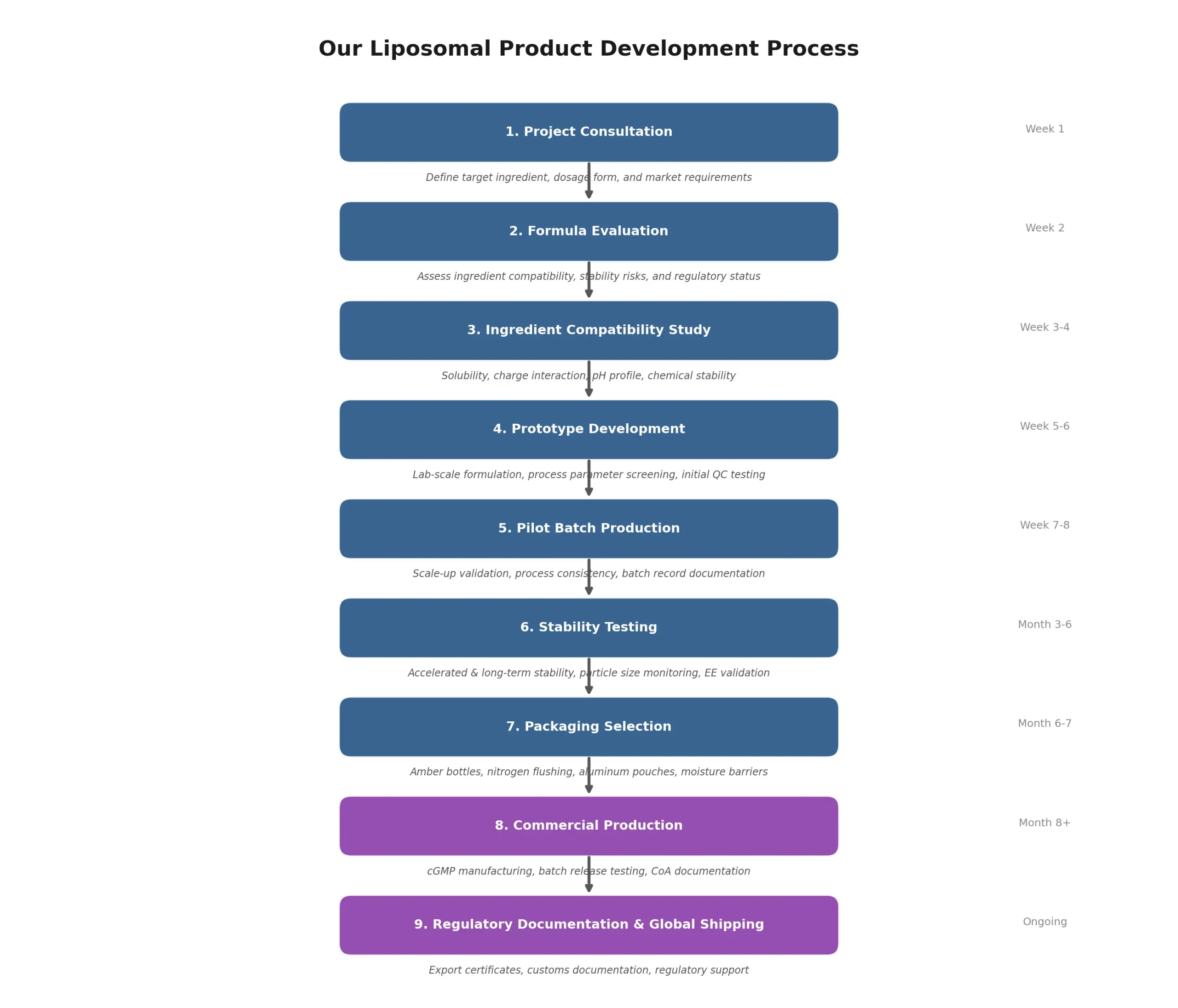
| Stage | Timeline | Key Deliverables |
| 1. Inquiry | 1–3 days | Requirements document; initial feasibility assessment |
| 2. Formula & Quotation | 3–7 days | Custom formula proposal; pricing; regulatory pathway review |
| 3. Sample | 1–2 weeks | Physical sample with COA; organoleptic evaluation |
| 4. Pilot Batch | 2–3 weeks | 1–10 kg powder or 5,000–50,000 units; stability samples retained |
| 5. Scale-Up | 3–4 weeks | Process parameter lock; equivalence data; batch record validation |
| 6. Commercial Production | Per schedule | Full-scale manufacturing; in-process controls; finished product testing |
| 7. QC Release & Delivery | 1–2 weeks | Final COA; regulatory documentation; export logistics |
NAC is one of the most technically demanding nutraceutical actives. Our platform solves these challenges at the manufacturing level.
| Challenge | Root Cause | Liposomal Engineering Solution |
| High Hygroscopicity | NAC absorbs atmospheric moisture readily, causing caking, equipment fouling, and potency loss during storage and processing [4] | Phospholipid bilayer creates moisture barrier; controlled encapsulation reduces surface exposure to ambient humidity |
| Sulfur Odor | Free thiol (-SH) group releases volatile sulfur compounds; the single most common consumer complaint for NAC supplements [7] | Encapsulation within lipid vesicles physically traps NAC; odor release attenuated at product surface |
| Oxidation Sensitivity | Thiol group oxidizes to disulfide dimers (2 R-SH → R-S-S-R + 2H); accelerated by heat, light, and metal ion catalysis [7] | Lipid bilayer acts as oxygen diffusion barrier; antioxidant co-encapsulation protects thiol moiety |
| Poor Compatibility | Reactive thiol interacts with transition metals, amino acids, and alkaline excipients | Liposomal encapsulation isolates NAC from direct contact with incompatible ingredients until consumption |
| Thermal Sensitivity | NAC degrades above 40°C; limits spray drying and tableting parameters | Process temperature optimization during high-pressure homogenization and drying; nitrogen protection throughout |
Commercial Production Overview
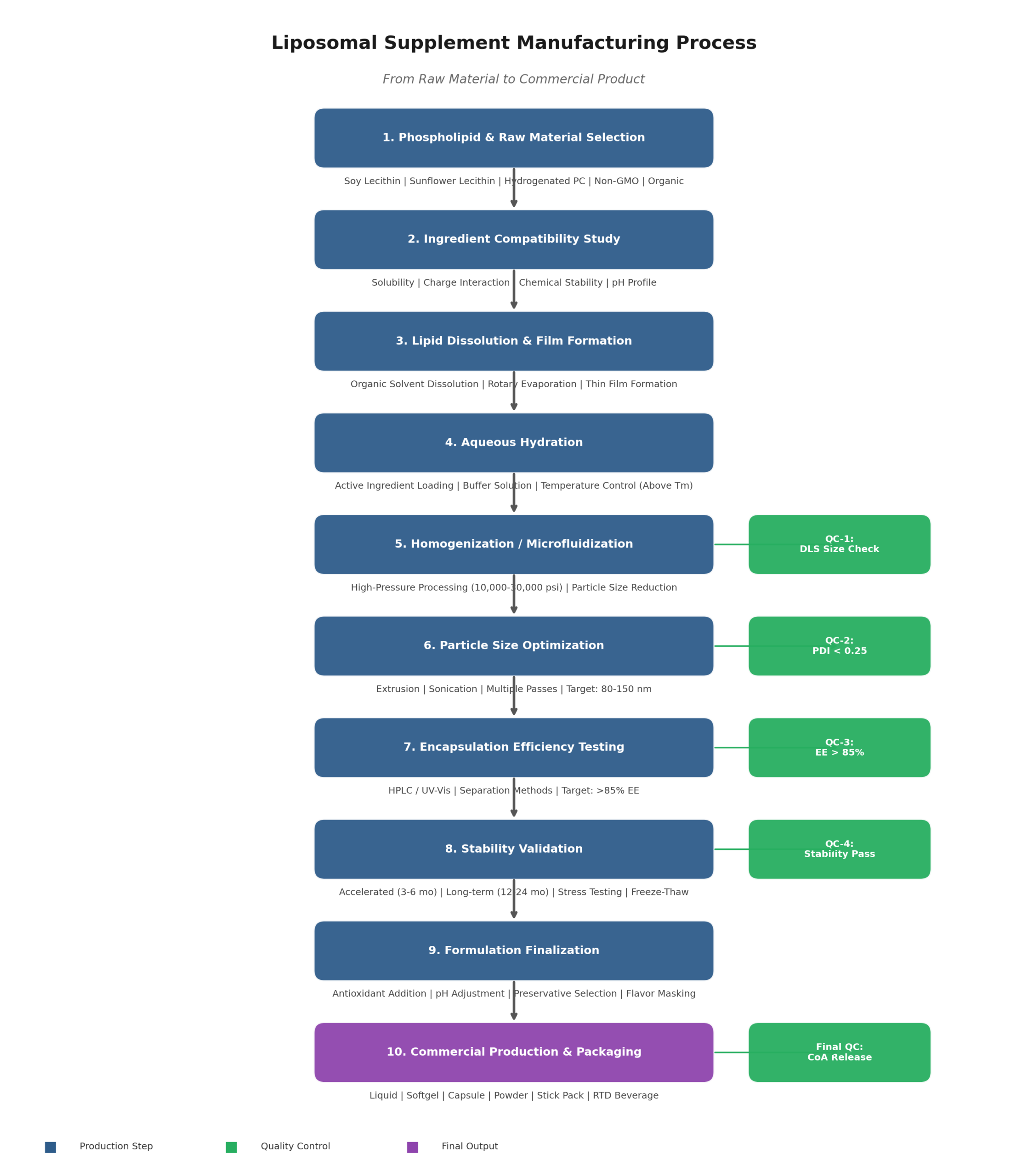
Formula Design → Pilot Batch → Scale-Up Validation → Commercial Production → QC Testing → Global Delivery
Technical Process Parameters
| Step | Operation | Critical Control Point |
| 1. Ingredient Qualification | Raw material testing: identity, purity, moisture, heavy metals; phospholipid PC content and peroxide value | COA verification before release to production |
| 2. Lipid Preparation | Phospholipid hydration in aqueous buffer at 40–60°C; dissolution of lipid-soluble components | Temperature control; complete lipid hydration |
| 3. Active Incorporation | NAC dissolution in aqueous phase (pH 2.5–4.0); addition to hydrated lipid dispersion under nitrogen blanketing | pH control; oxygen exclusion |
| 4. High-Pressure Homogenization | Multiple passes at 100–150 MPa; temperature-monitored throughout | Particle size reduction to unilamellar/oligolamellar vesicles [1] |
| 5. Particle Size Optimization | DLS monitoring during processing; extrusion through polycarbonate membranes if required | Target: Z-average 80–200 nm; PDI <0.30 |
| 6. Encapsulation Verification | Separation of free vs. encapsulated NAC (centrifugation/ultrafiltration); HPLC quantification | Target EE% ≥70%; documented per batch |
| 7. Drying / Filling | Spray drying (continuous, cost-effective) or freeze drying (premium stability) for powders; liquid filling for suspensions | Moisture control; in-process temperature monitoring |
| 8. Finished Product Testing | Active assay; particle size/PDI; microbiology; stability-indicating tests | Batch release per validated specification |
High-pressure homogenization is the preferred industrial-scale liposome production method due to scalability and consistency. Turbulence, cavitation, and shear forces within the homogenization chamber rearrange liposome structure; cycle number and pressure determine final particle size distribution and lamellarity [1].
Incoming Material Testing
- Identity verification (FT-IR or HPLC)
- Purity and assay per USP/NF monographs
- Heavy metals (Pb, Cd, As, Hg) by ICP-MS
- Microbiological screening (TAMC, TYMC, specified organisms)
- Moisture content (Karl Fischer)
- Phospholipid peroxide value and acid value
In-Process Controls
- pH monitoring throughout hydration and homogenization
- Temperature logging (critical for NAC thermal stability)
- Particle size (DLS) during and after homogenization
- Visual inspection for appearance and homogeneity
Finished Product Release Testing
| Parameter | Method | Acceptance Criteria |
| NAC Assay | HPLC (UV 214 nm) | 95.0–105.0% of label claim |
| Encapsulation Efficiency | HPLC after separation (centrifugation/ultrafiltration) | ≥70% |
| Particle Size (Z-average) | Dynamic Light Scattering (DLS) | 80–200 nm |
| PDI | DLS | <0.30 |
| Zeta Potential | Electrophoretic light scattering | ±25 to ±45 mV |
| Moisture | Karl Fischer titration | ≤5.0% (powder) |
| Heavy Metals | ICP-MS | Compliant with CA Prop 65 / EU 1881/2006 |
| Microbiology | USP <61>, <62> | TAMC ≤10³ CFU/g; TYMC ≤10² CFU/g; absence of E. coli, Salmonella |
| Appearance | Visual / organoleptic | Off-white to light yellow; free-flowing; mild characteristic odor |
Batch Traceability & Audit Support
- 100% batch record documentation with electronic weighing and dispensing records
- Supplier COA archive (≥5-year retention)
- Stability data retention per ICH Q1A(R2) guidelines [2]
- On-site audit support for brand partners and regulatory inspections
- Change control and deviation management per cGMP requirements
Compatibility ratings based on laboratory formulation experience and literature review. Specific formulations require validation testing before commercial production.
| Ingredients | Compatibility | Formulation Considerations |
| Vitamin C | Excellent | Both hydrophilic actives co-encapsulate in aqueous core; vitamin C’s reducing potential supports NAC stability |
| Glutathione (reduced) | Excellent | Shared thiol chemistry; suitable for premium liposomal formulations; no significant thiol-disulfide exchange under normal storage |
| Curcumin | Excellent | Lipophilic; integrates into phospholipid bilayer; synergistic antioxidant profile |
| Coenzyme Q10 | Good | Lipid bilayer incorporation; dual-compartment delivery architecture with NAC in aqueous core |
| PQQ | Good | Consider phospholipid ratio adjustments; quinone-thiol interaction mitigated by encapsulation isolation |
| Quercetin | Good | Poor water solubility benefits from liposomal solubilization; pH adjustment may be needed |
| Alpha-Lipoic Acid | Good | Compatible redox partner; disulfide structure complements NAC thiol chemistry |
| Resveratrol | Good | Lipophilic polyphenol; no known chemical incompatibility with NAC |
| Selenium (selenomethionine) | Good | Less reactive than inorganic salts; liposomal separation reduces direct contact |
| Zinc | Moderate | Can catalyze thiol oxidation; chelation and stability assessment required before commercialization |
| Magnesium | Moderate | Alkaline nature may affect liposome charge; pH buffering essential |
| Iron | Limited | Strong oxidation catalyst; strict encapsulation separation and antioxidant protection required if combined |
| Probiotics | Limited | Different moisture, pH, and temperature requirements; separate formulation strategy generally preferred |
| Packaging Format | Barrier Properties | Best For | Shelf Life Support |
| Aluminum Laminate Pouches | Excellent moisture, oxygen, and light barrier | Stick packs; bulk powder; export shipments | 24–36 months |
| HDPE Bottles + Induction Seal | Good moisture barrier; moderate oxygen barrier | Standard retail; North American market | 18–24 months (with desiccant) |
| Blister Packs (Alu-Alu) | Excellent individual dose protection; zero moisture transmission | Pharmacy channel; clinical trials; premium positioning | 24–36 months |
| Amber Glass Bottles | Excellent light protection; good oxygen barrier (with proper seal) | Liquid formulations; premium positioning | 12–18 months (liquid) |
| Nitrogen-Flushed Containers | Displaced oxygen reduces oxidation risk | High-value formulations; extended shelf life targets | +6–12 months extension |
Packaging Components
- Desiccants:Silica gel canisters (1–3 g per bottle, depending on headspace volume) for powder products
- Oxygen Absorbers:Iron-based scavengers for oxygen-sensitive formulations
- Nitrogen Flushing:Applied during filling to reduce headspace oxygen to <3%
- Secondary Packaging:Cartons with UV varnish for light protection; tamper-evident seals
Storage Recommendations
| Product Form | Recommended Storage | Acceptable Range | Critical Warnings |
| Powder (spray-dried) | 15–25°C; <60% RH | 5–30°C; <75% RH | Protect from moisture and direct sunlight |
| Powder (freeze-dried) | 2–8°C preferred; 15–25°C acceptable | 2–30°C; <60% RH | Refrigeration extends shelf life; protect from moisture |
| Liquid suspension | 2–8°C | 2–25°C (short-term) | Shake well before use; do not freeze |
| Capsule / Softgel | 15–25°C; <60% RH | 5–30°C; <75% RH | Protect from heat and humidity |
Standard Batch Documentation
- Certificate of Analysis (COA)— Batch-specific test results for all specification parameters
- Product Specification— Complete quality specification with test methods and acceptance criteria
- Technical Data Sheet (TDS)— Product description, composition, physicochemical properties, handling guidelines
- Material Safety Data Sheet (MSDS)— Safety information, hazard classification, handling precautions, first aid
- Residual Solvent Report— GC-MS analysis confirming compliance with ICH Q3C limits
- Heavy Metal Report— ICP-MS data for Pb, Cd, As, Hg
- Microbiology Report— TAMC, TYMC, specified organism testing per USP <61>, <62>
- Stability Summary— Available stability data with storage conditions and retest period
Regulatory & Compliance Statements
- Allergen Statement— Free from major allergens; customizable per market requirements
- Non-GMO Statement— Available for non-GMO formulations
- BSE/TSE Statement— Free from bovine spongiform encephalopathy / transmissible spongiform encephalopathy risk materials
- Halal Certificate— Available upon request
- Kosher Certificate— Available upon request
- ISO 22000— Certified
- FSSC 22000— Certified
- cGMP Compliance— Per 21 CFR Part 111 (US) and applicable EU regulations
Ready to Develop Your Liposomal NAC Product?
Whether you are launching a new premium liposomal supplement or expanding your existing product portfolio, our formulation scientists and manufacturing team are ready to support every stage of development—from concept and pilot production to full-scale commercial manufacturing.
Let’s Build Your Next Liposomal Supplement Together
✔ Custom Formula Development
✔ OEM & Private Label Manufacturing
✔ Pilot Batch Production
✔ Regulatory Documentation
✔ Global Export Support
Request a Formula Consultation | Request Samples | Get an OEM Quotation
[1] Paliwal R, et al. Liposome-Based Drug Delivery Systems: From Laboratory Research to Industrial Production. Bioengineering. 2025;9(3):56. https://www.mdpi.com/2305-7084/9/3/56
[2] ICH Q1A(R2). Stability Testing of New Drug Substances and Products. International Council for Harmonisation. https://database.ich.org/sites/default/files/Q1A%28R2%29%20Guideline.pdf
[3] de la Cruz-Prado R, et al. Determination of the critical aggregation concentration of phospholipids widely used in nanoliposomal development. Journal of Molecular Liquids. 2024. https://www.sciencedirect.com/science/article/pii/S0167732224027387
[4] Enayati M, et al. Granulation and encapsulation of N-Acetylcysteine (NAC) by internal phase separation. Food Hydrocolloids. 2023. https://www.sciencedirect.com/science/article/abs/pii/S0268005X22002193
[5] Alam MI, et al. Liposomal Drug Delivery against Helicobacter pylori Using Furazolidone and N-Acetyl Cysteine. Pharmaceutics. 2024;16(9):1123. https://www.mdpi.com/1999-4923/16/9/1123
[6] PMDA. Guideline for the Development of Liposome Drug Products. Pharmaceuticals and Medical Devices Agency, Japan. https://www.pmda.go.jp/files/000211460.pdf
[7] Canyonside Labs. NAC (N-Acetylcysteine): A Comprehensive Guide to Sources, Uses, Mechanisms, and Manufacturing. 2025. https://www.canyonsidelabs.com/post/nac-n-acetylcysteine-a-comprehensive-guide-to-sources-uses-mechanisms-and-manufacturing
[8] Joyous Biological. Understanding the 50–150nm Particle Size Advantage. 2026. https://joyousbiological.com/understanding-the-50-150nm-particle-size-advantage/
[9] Samuni AM, et al. Liposomal Antioxidants for Protection against Oxidant-Induced Damage. Oxidative Medicine and Cellular Longevity. 2011;2011:152474. https://www.ncbi.nlm.nih.gov/pmc/articles/PMC3157762/
[10] PMC. Methods of Liposomes Preparation: Formation and Control Factors of Versatile Nanocarriers. Pharmaceutics. 2022;14(2):396. https://pmc.ncbi.nlm.nih.gov/articles/PMC8955843/
[11] BOC Sciences. Liposome Encapsulation Efficiency Measurement. 2020. https://liposomes.bocsci.com/solution/liposome-drug-encapsulation-efficiency-measurement.html
[12] Lababidi N, et al. SPRAY-DRIED solid inhalable N-acetylcysteine microparticles. European Journal of Pharmaceutical Sciences. 2025. https://www.sciencedirect.com/science/article/abs/pii/S1773224725010251
[13] PMC. Solid phase wax coating of N-acetylcysteine (NAC). Food Structure. 2022. https://pmc.ncbi.nlm.nih.gov/articles/PMC9192162/
[14] A Review on Application of Novel Drug Delivery Systems for N-Acetylcysteine. International Journal of Pharmaceutical Sciences. 2025. https://www.ijpsjournal.com/article/a-review-on-application-of-novel-drug-delivery-systems-for-the-n-acetylcysteine
[15] BOC Sciences. Liposomal Supplements Explained. 2025. https://liposomes.bocsci.com/resources/liposomal-supplements-explained.html
[16] InsideTx. LNP characterization guidelines: Size, PDI, Morphology. 2026. https://insidetx.com/resources/reviews/lnp-and-liposomes-characterization-guidelines/
[17] EMA. ICH Q1 Guideline on stability testing of drug substances and drug products. https://www.ema.europa.eu/en/documents/scientific-guideline/draft-ich-q1-guideline-stability-testing-drug-substances-drug-products-step-2b_en.pdf
[18] AMS Biopharma. ICH Guidelines: Drug Stability Testing Essentials. 2025. https://amsbiopharma.com/ich-guidelines-drug-stability-testing/
[19] PMC. Research Progress on the Application of Food Colloids in Precise Targeted Delivery. Foods. 2025. https://pmc.ncbi.nlm.nih.gov/articles/PMC12469821/