Disclaimer: This article addresses ginger supplement ingredients, manufacturing specifications, and quality control for product development professionals. It is not intended as medical advice, treatment recommendations, or consumer dosing guidance. Structure/function claims and regulatory compliance requirements vary by market; brand owners are responsible for final claim substantiation and label compliance.
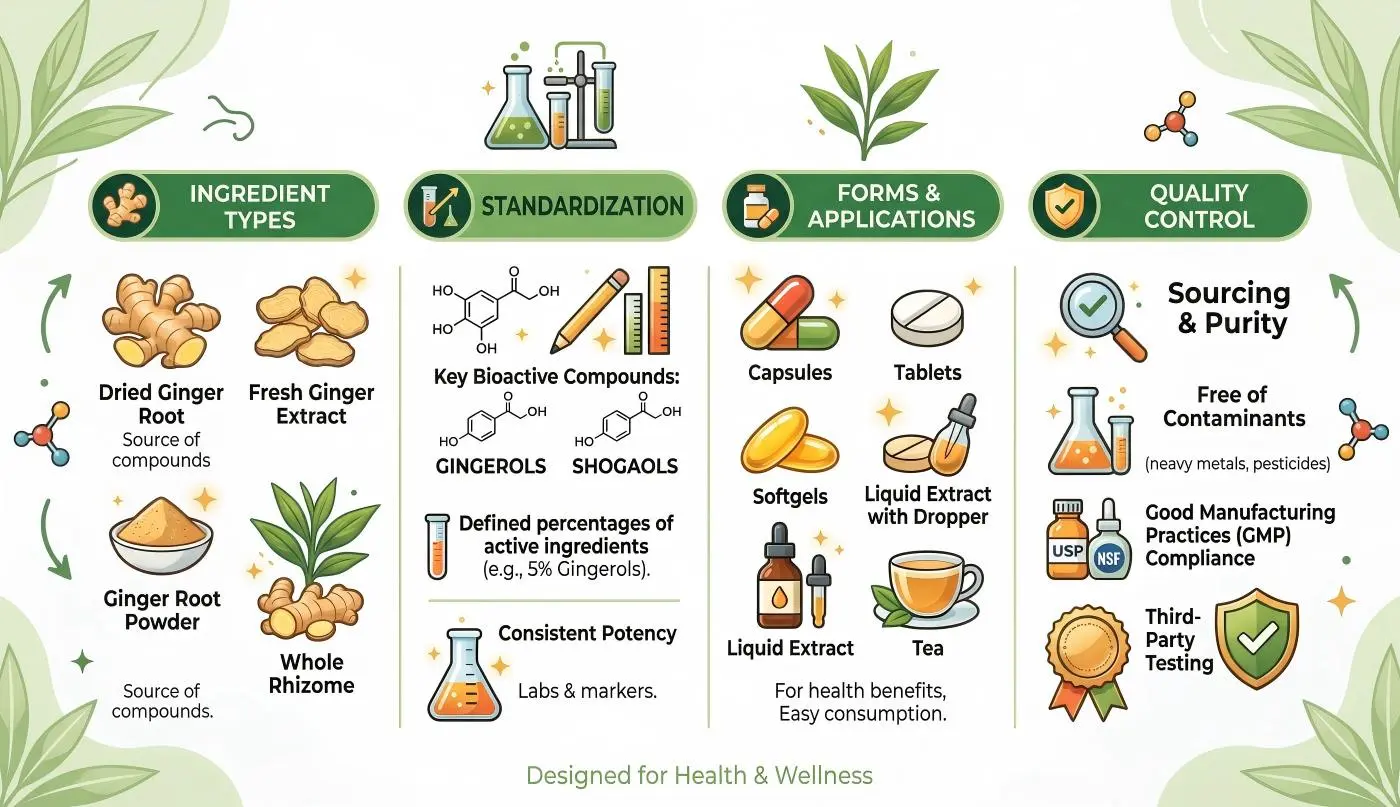
Ginger supplements can be developed from ginger powder, standardized ginger extract, ginger oleoresin, or ginger oil, but these ingredients are not interchangeable. For product development, the key decisions are the raw-material form, marker compounds, standardization level, extraction route, dosage form, and analytical specification. These choices determine how the ingredient can be formulated, tested, and translated into a finished product. When you are ready to move from ingredient evaluation to finished-product manufacturing, explore our ginger extract supplement manufacturing.
Ginger (Zingiber officinale) is a rhizomatous plant in the Zingiberaceae family. The rhizome—commonly called ginger root—is the part used in foods, herbal preparations, and dietary supplements [1].
1. Ginger Supplement Ingredient Types
1.1 Ingredient Categories
These ranges represent common commercial specifications rather than universal industry requirements. Actual specifications vary according to raw material, extraction process, analytical method, target market, and finished-product requirements.
Critical distinction: Ginger powder delivers the whole botanical matrix but with variable active constituent levels. Standardized ginger extract offers higher concentration and enables batch-to-batch consistency through defined marker-compound verification. Ginger extract vs ginger powder is therefore a specification choice—driven by product positioning, serving-size constraints, and the target assay—not an assumption that extract is universally “better.”
2. Gingerols, Shogaols & What “5% Gingerols” Means
2.1 Gingerols
Gingerols are the primary pungent compounds in fresh ginger. The most studied are 6-gingerol, 8-gingerol, and 10-gingerol. 6-Gingerol is typically the most abundant and is the principal marker used in standardized extract specifications [2].
2.2 Shogaols
Gingerols can undergo dehydration during processing, particularly under heat, resulting in the formation of shogaols. The final gingerol/shogaol profile therefore depends on processing and storage conditions—temperature, time, moisture, and extraction parameters all influence the outcome [2].
2.3 Other Constituents
Ginger also contains paradols, zingerone, gingerdiones, and volatile oils (including sesquiterpenes such as α-zingiberene). These contribute to aroma, flavor, and the overall phytochemical profile, though they are not typically the primary standardization targets.
2.4 Why Standardization Matters
A study of ten commercial ginger root dietary supplements found that 6-gingerol concentration ranged from 0.0 to 9.43 mg/g, 6-shogaol from 0.16 to 2.18 mg/g, and 8- and 10-gingerol showed similarly wide variation. Suggested serving sizes across products ranged from 250 mg to 4.77 g per day [3]. This variability means product consistency and batch predictability depend on defined marker specifications and HPLC-based assay against reference standards.
Standardization defines what the extract contains; it does not by itself establish clinical efficacy. A 10% or 20% gingerol specification indicates a defined gingerol content, while clinical relevance depends on the specific ingredient, dosage, formulation, and evidence available for that preparation.
2.5 What Does “5% Gingerols” Actually Mean?
“5% gingerols” and “5% 6-gingerol” are not interchangeable specifications.
For procurement, the COA should state exactly which marker compounds are quantified, the analytical method, specification, and gingerol content result—not simply “ginger extract 5%.”
The AOAC has published SMPR® 2017.012, which provides performance requirements (not a single mandated method) for quantifying selected nonvolatile ginger constituents, including 6-, 8-, and 10-gingerols and 6-shogaol, in ginger raw materials and finished products. This provides a useful analytical framework for supplier qualification and batch verification [4].
3. How Ginger Ingredients Are Produced
3.1 Raw Ginger Selection
Quality begins with incoming raw material qualification:
- Botanical identity: Verified as Zingiber officinale
- Plant part: Rhizome only
- Geographic origin: Traceability field; origin is not a potency guarantee
- Cultivation type: Organic vs. conventional (with corresponding pesticide-residue limits)
- Contaminant screening: Heavy metals, pesticide residues, microbiological quality
- Active constituent profile: HPLC assay to confirm gingerol/shogaol baseline
3.2 Cleaning and Preparation
Cleaning → Sorting → Cutting/Slicing → Drying
Improper drying can increase microbial risk and alter the final gingerol/shogaol profile. Drying conditions should therefore be controlled and validated against the intended specification.
3.3 Ginger Powder Production
Drying → Milling → Sieving → Blending → Packaging
Ginger powder is suitable for ginger capsules, tablets, drink mixes, and whole-botanical positioning. Because powder retains the full botanical matrix, it is cost-effective but requires larger serving sizes to achieve target active-compound doses.
3.4 Ginger Extract Production: Multi-Route Manufacturing
The extraction method should be selected after defining the target marker compounds and finished-product format—not the other way around.
Route A — Hydroalcoholic Extraction
- Target fractions: Gingerols, shogaols, standardized dry extracts
- Typical solvents: Ethanol, ethanol-water mixtures
- Output: Standardized ginger extracts (commercial grades commonly 5%–20% gingerols)
- Applications: Capsules, tablets, standardized formulations
- Considerations: Requires solvent-residue verification; may co-extract chlorophylls and waxes
Route B — Supercritical CO₂ Extraction
- Target fractions: Volatile oils, oleoresin, lipophilic constituents
- Output: Ginger oil, oleoresin, CO₂-derived extract
- Advantages: Can reduce reliance on conventional organic solvents; can be operated under comparatively mild thermal conditions compared to some conventional thermal processes
- Applications: Softgels and lipid-based formulations
- Limitation: Actual pressure and temperature conditions are process-specific and should be validated against the target fraction and yield. Supercritical CO₂ is not automatically the best extraction method for every ginger supplement. The appropriate extraction route depends on the target constituents, standardization requirements, dosage form, and commercial specification [2].
Route C — Combined / Fractionated Approach
- Approach: Separate extraction of volatile and non-volatile fractions, followed by recombination or independent standardization
- Use case: Custom formulations requiring precise control over both aroma and pungency markers
3.5 Common Commercial Ginger Extract Specifications
The final specification should be defined according to the intended use, dosage, extraction route, and available analytical method.
3.6 Quality Control During Ingredient Production
QC is applied at multiple stages rather than only at finished-ingredient release. Incoming material is verified for botanical identity and contaminant compliance; extraction batches are monitored against process and marker specifications; finished extracts are released against the agreed assay, microbiological, contaminant, and residual-solvent requirements.
Detailed release specifications and documentation requirements are summarized in Section 4.
4. Ginger Extract COA & Quality Specifications
4.1 Identity Testing
Botanical identification is established through macroscopic/microscopic examination, supported where applicable by chromatographic fingerprinting. HPLC fingerprinting and marker assay are distinct activities: fingerprinting supports identity confirmation; assay verifies the quantitative specification.
4.2 Marker Assays
HPLC with UV or diode-array detection is the prevailing technique for gingerol and shogaol quantification. The analytical method should meet the applicable performance requirements of AOAC SMPR 2017.012, which covers 6-, 8-, and 10-gingerols and 6-shogaol in matrices including rhizome powder, dry extract, tablets, capsules, softgels, and tinctures [4].
4.3 Contaminants
- Heavy metals / elemental impurities: Limits should be defined according to the target market, applicable supplement requirements, and the agreed product specification.
- Pesticide residues: Per EU Regulation 396/2005 or FDA pesticide residue monitoring.
- Microbiology: Total aerobic count, yeast/mold, Enterobacteriaceae, Salmonella, E. coli.
- Residual solvents: Where solvent extraction is used; per ICH Q3C.
4.4 Stability & Documentation
Accelerated (typically 40°C/75% RH) and real-time stability data should support the claimed shelf life for the specific dosage form and packaging configuration.
5. Ginger Extract Potency: Why Powder and Extract Cannot Be Compared by Weight
5.1 Clinical Studies Use Different Preparations
Human studies have used different ginger preparations, including powdered ginger and standardized extracts. Therefore, the gram weight of the finished ingredient cannot be compared across studies without considering the preparation and marker specification.
5.2 Marker-Based Calculation
5.3 B2B Formulation Example
A theoretical target of 25 mg total gingerols per serving would correspond to approximately:
- 500 mg of a 5% extract
- 250 mg of a 10% extract
- 125 mg of a 20% extract
These are specification calculations, not recommended consumer doses. Clinical evidence should be interpreted according to the exact preparation and dose studied.
Important: Most pregnancy-related nausea studies used dried ginger powder or rhizome preparations, not high-percentage gingerol extracts. The ~1,500 mg/day figure commonly cited refers to powder-equivalent preparations in those trials and cannot be directly extrapolated to concentrated extracts without equivalent safety data [5].
6. Common Ginger Supplement Dosage Forms
6.1 Ginger Capsules
Closed dosage form with low sensory burden. Suitable for ginger powder and standardized dry extracts. For volatile or oxidation-sensitive ingredients, packaging and storage conditions should be evaluated as part of the stability program.
6.2 Ginger Tablets
Appropriate for higher-volume products, multi-ingredient formulas, and cost-sensitive positioning. Tablet development requires control of powder flow, compression behavior, disintegration, and marker stability during processing and storage.
6.3 Ginger Gummies
Gummies present formulation challenges:
- Flavor masking: Ginger’s pungency can overwhelm other flavors
- Extract concentration: The target marker amount must fit within the gummy’s practical active-load capacity; dose density can be a formulation constraint
- Heat exposure: Stability of gingerols during heated gummy-base processing requires validation as a formulation consideration
- Sugar / sugar-free systems: Sugar alcohols may cause GI tolerance issues at high inclusion levels
6.4 Ginger Softgels
Used for oleoresin or ginger oil when the fill is lipid-based. Can be combined with complementary lipid-soluble actives.
6.5 Ginger Powder & Drink Mixes
Includes instant ginger drinks, functional beverages, and stick packs. Water dispersibility of the extract is a key technical parameter.
6.6 Liquid Ginger Supplements
Liquid extracts, ginger shots, and concentrates. Require stability testing for marker compounds in aqueous or hydroalcoholic matrices over the claimed shelf life. Liquid products may contain alcohol or sugar; these should be declared and evaluated for target-market compliance.
7. What Does the Evidence Say?
7.1 Evidence Summary
7.2 Nausea Support
Pregnancy-related nausea: A 2014 systematic review and meta-analysis of 12 randomized controlled trials (n=1,278) found that ginger was associated with improved nausea symptoms in pregnancy. The review did not find a significant reduction in vomiting episodes, and the authors noted limitations in study quality and outcome consistency. A subgroup analysis suggested greater benefit at doses below 1,500 mg/day, but this figure should not be treated as a universal clinical dose or applied directly to concentrated ginger extracts [5].
Most studies used dried ginger powder or rhizome preparations, not concentrated gingerol extracts. The ~1,500 mg/day figure refers to powder-equivalent preparations in those trials and cannot be directly extrapolated to high-percentage extracts without equivalent safety data. Whether to use ginger during pregnancy is a decision for the individual and their healthcare provider; this article does not provide medical guidance.
Postoperative and chemotherapy-related nausea: The NCCIH states it is uncertain whether ginger is a helpful addition to standard treatments [1].
Motion sickness: Most studies of ginger for motion sickness have not shown it to be helpful [1].
7.3 Menstrual Comfort
Research suggests that ginger dietary supplements might be helpful for reducing the severity of menstrual cramps [1].
7.4 Digestive Comfort
Ginger has traditional use for gastrointestinal discomfort. Modern formulations position it for digestive support and occasional GI upset. These are common commercial positioning concepts, not disease-treatment claims, and must be formulated accordingly.
7.5 Joint Comfort
Ginger dietary supplements might be helpful for symptoms of knee osteoarthritis, but the NCCIH notes that much of the research has been of poor quality [1]. Topical ginger has not been shown to be helpful.
Formulation note: If a finished product is specified around a gingerol target, the ingredient should be standardized and analytically verified. This specification decision should not be presented as evidence of clinical efficacy by itself.
8. Ginger Supplement Claims: Why Regulatory Language Matters
Ginger supplements can be marketed as dietary supplements, but product claims must remain within the applicable regulatory framework. In a 2024 warning letter, FDA cited disease-related claims made for ginger-containing products—such as claims that ginger syrup “alleviates digestive inflammation,” “diminishes severe coughing,” and is “as effective as any pharmacy bought medicine”—as regulatory violations that placed the products in drug-claim territory [7].
For brands developing ginger products, formulation and marketing claims should be reviewed together rather than treating regulatory compliance as a labeling step at the end of development. When briefing a manufacturer, do not include disease-treatment language in the product specification; a compliant factory cannot produce a finished product against impermissible claims.
9. Ginger Supplement Safety & Side Effects
9.1 Common Side Effects
Ginger has been used safely in many oral research studies, although safety depends on the preparation, amount, duration of use, and individual factors [1]. Reported side effects are generally mild and include abdominal discomfort, heartburn, diarrhea, and mouth and throat irritation [1].
Some clinical references describe higher oral amounts of ginger root as being more likely to cause gastrointestinal adverse effects, including reflux, heartburn, and diarrhea. These amounts refer to ginger root preparations and should not be converted directly into doses of concentrated gingerol extracts [6].
9.2 Who Should Exercise Caution
Ginger safety considerations may be relevant when a product is intended for users taking anticoagulant or antiplatelet medications, glucose-lowering medications, or other medicines. Evidence for specific ginger–drug interactions varies, and interaction risk may depend on the preparation and dose. These categories should therefore be flagged during product and labeling review rather than presented as established interactions. Consumers taking medication should consult a healthcare professional before use [1][6].
Perioperative use should follow the treating surgeon or healthcare provider’s supplement-hold instructions rather than a fixed manufacturer-defined discontinuation period.
9.3 Safety Depends on Product Quality
Safety is not solely a function of the botanical itself. For B2B buyers, product quality depends on:
- Ingredient identity verification
- Accurate dosing and extract specification
- Contaminant control (heavy metals, pesticides, microbes)
- Manufacturing quality (GMP compliance)
- Label accuracy and stability data
10. How to Specify Ginger for a Finished Product
For brands and product developers, six questions should drive ingredient selection:
- Ingredient form: Powder / dry extract / oleoresin / oil
- Marker specification: Total gingerols / 6-gingerol / gingerols + shogaols
- Target marker per serving: For example, 25 mg total gingerols
- Dosage form: Capsule / tablet / gummy / softgel / powder / liquid
- Analytical requirements: HPLC method / COA / contaminants / residual solvents
- Target market: US / EU / other market-specific requirements
Powder is appropriate when the formulation is based on the whole botanical. A standardized extract is more suitable when the product brief requires a defined gingerol or shogaol specification.
11. From Ginger Specification to Finished Supplement
Once the ginger ingredient, marker specification, extraction route, and dosage form are defined, the next step is translating those specifications into a scalable finished product.
RFQ-ready checklist:
- Botanical identity & plant part
- Extract type & ratio (if applicable)
- Marker compound & specification (e.g., total gingerols %, 6-gingerol %)
- Analytical method reference
- Target marker mg per serving
- Dosage form
- Target market & contaminant limits
- Stability claim duration
Submit your ginger supplement specification for manufacturing →
12. Frequently Asked Questions (FAQ)
Q1: What does 5% ginger extract mean?
It typically means the extract contains 5% of a specified marker compound (commonly total gingerols) by weight. However, “5% gingerols” and “5% 6-gingerol” are not interchangeable—always verify which markers are quantified and by which analytical method.
Q2: Is 5% gingerols the same as 5% 6-gingerol?
No. “5% total gingerols” usually covers 6-, 8-, and 10-gingerol combined. “5% 6-gingerol” specifies only that single compound. The COA should state exactly which markers are reported.
Q3: How much extract is needed to deliver 25 mg gingerols?
Approximately 500 mg of a 5% extract, 250 mg of a 10% extract, or 125 mg of a 20% extract. This is a specification calculation, not a recommended consumer dose.
Q4: Can ginger extract be used in gummies?
Yes, but dose density and heat stability are limiting factors. Gummy matrices have limited active-ingredient capacity, and heated processing may affect gingerol levels. Stability validation is required.
Q5: Is supercritical CO₂ better than ethanol extraction?
Not automatically. CO₂ is well-suited for volatile oils and oleoresins. Hydroalcoholic extraction is typically preferred for gingerol-dominant standardized extracts. The best route depends on the target constituents and finished-product format.
Q6: What should be included on a ginger extract COA?
At minimum: botanical identity, assay result for specified markers (with method), heavy metals, microbiology, pesticide residues, and residual solvents (where applicable). The COA should reference the specific specification version.
Q7: Can ginger powder and ginger extract be substituted gram-for-gram?
No. Ginger powder is whole botanical with variable active levels. Extract is concentrated and standardized. A gram of powder does not deliver the same marker-compound content as a gram of extract.
Q8: What are the side effects of ginger supplements?
Common side effects include abdominal discomfort, heartburn, diarrhea, and mouth and throat irritation [1]. Consumers taking medication should consult a healthcare provider before use [1]. People with conditions affecting bleeding should also seek medical advice before use [6].
Q9: Are ginger supplements safe during pregnancy?
Some research suggests ginger may help with pregnancy-related nausea, but the evidence primarily involves dried ginger powder, not concentrated extracts. As with all herbal supplements during pregnancy, consult a healthcare provider before use [1][5].
Q10: What is the difference between a 5:1 ginger extract and a 5% gingerol extract?
A 5:1 extract ratio describes the amount of raw ginger used relative to the amount of extract produced; it does not define the concentration of gingerols. A 5% gingerol specification, by contrast, defines a marker-compound concentration. Extract ratio and marker standardization therefore should not be treated as interchangeable specifications.
References
[1] National Center for Complementary and Integrative Health (NCCIH). Ginger: Usefulness and Safety. U.S. National Institutes of Health. https://www.nccih.nih.gov/health/ginger
[2] Maghraby, Y.R., Labib, R.M., Sobeh, M., Farag, M.A. Gingerols and shogaols: A multi-faceted review of their extraction, formulation, and analysis in drugs and biofluids to maximize their nutraceutical and pharmaceutical applications. Food Chemistry: X. 2023;20:100947. https://pmc.ncbi.nlm.nih.gov/articles/PMC10739842/
[3] Schwertner, H.A., et al. Variation in concentration and labeling of ginger root dietary supplements. Obstetrics & Gynecology. 2006. https://pubmed.ncbi.nlm.nih.gov/16738161/
[4] AOAC International. SMPR® 2017.012: Standard Method Performance Requirements for Quantitation of Select Nonvolatile Ginger Constituents. https://www.aoac.org/wp-content/uploads/2020/11/SMPR202017_012.pdf
[5] Viljoen, E., et al. A systematic review and meta-analysis of the effect and safety of ginger in the treatment of pregnancy-associated nausea and vomiting. Nutrition Journal. 2014. https://pubmed.ncbi.nlm.nih.gov/24642205/
[6] NCBI StatPearls. Ginger Root. https://www.ncbi.nlm.nih.gov/books/NBK565886/
[7] U.S. Food and Drug Administration. Warning Letter: Natural Ginger, Corp/Jonaus Corp (CMS No. 679765). https://www.fda.gov/inspections-compliance-enforcement-and-criminal-investigations/warning-letters/natural-ginger-corpjonaus-corp-679765-06252024