Market Applications, Commercial Opportunities, and OEM Development Strategy for Supplement Brands
Introduction
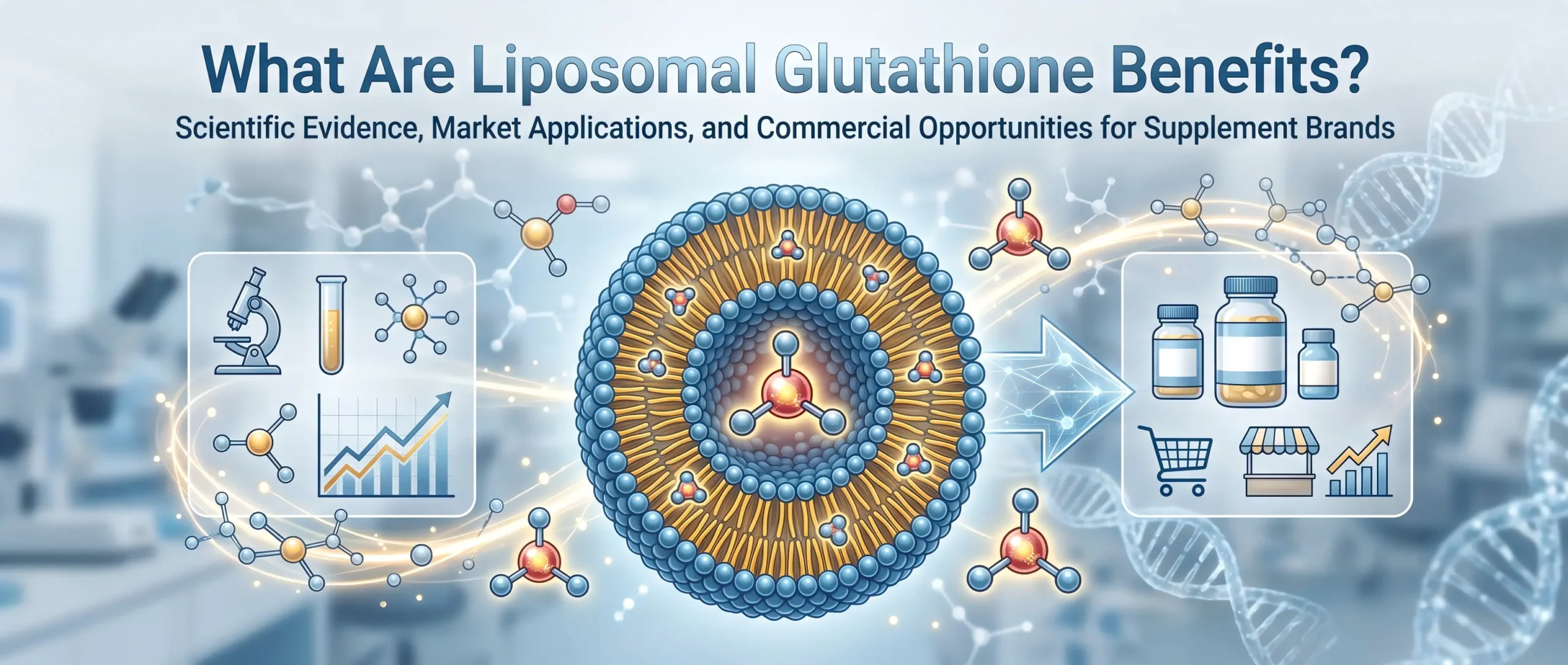
Rather than asking whether liposomal glutathione is beneficial, today’s supplement brands are evaluating how liposomal delivery can create stronger product differentiation, support premium pricing, and align with evolving consumer demand for science-backed wellness solutions.
This article is designed for brand owners, product managers, and procurement professionals who are actively evaluating liposomal glutathione as a commercial opportunity. Instead of repeating generic health claims, we focus on market positioning strategies, formulation decisions, and the practical factors that determine whether a liposomal glutathione product succeeds in the marketplace.
If you are deciding whether to invest in liposomal glutathione development, the following sections provide the market intelligence, strategic frameworks, and decision-making tools you need to move from evaluation to execution.
1. Why Are More Supplement Brands Launching Liposomal Glutathione?
The growth of liposomal glutathione is not a single trend but the convergence of multiple market forces. Understanding these forces helps brands assess timing, positioning, and competitive dynamics before committing to product development.
Consumer Drivers
- Healthy Aging: Aging populations in developed markets are actively seeking premium products that support vitality and cellular wellness. Consumers aged 40+ represent the core demographic for liposomal glutathione and demonstrate strong willingness to invest in advanced delivery technology.
- Beauty-from-Within: The intersection of nutrition and skincare has created a mainstream category where consumers expect clinically positioned ingredients. Glutathione has emerged as a key ingredient in beauty supplement formulations targeting skin radiance and healthy aging appearance.
- Cellular Wellness Awareness: Growing consumer education around cellular health, oxidative stress, and mitochondrial function has created demand for products with credible scientific positioning. Liposomal delivery directly addresses this demand by offering a technology-driven solution.
Retail Trends
- Amazon Premium Supplement Growth: Amazon’s supplement category has seen rapid premiumization, with advanced delivery technology products consistently ranking in top search results. Brands with liposomal positioning benefit from higher perceived value and stronger conversion rates.
- Practitioner Channel Expansion: Healthcare practitioners and wellness professionals increasingly recommend liposomal supplements to clients seeking higher-quality alternatives. This channel values documented specifications and transparent manufacturing.
- Functional Nutrition Movement: The shift from basic supplementation to targeted functional nutrition has elevated consumer expectations for formulation sophistication. Liposomal delivery aligns with this shift by providing a clear technological advantage over conventional formats.
- iHerb and Specialty E-Commerce: Specialized online retailers have become key distribution channels for premium supplement brands. These platforms attract educated consumers who actively compare delivery technologies and ingredient specifications.
Commercial Drivers
- Premium Pricing Potential: Liposomal glutathione products consistently command average selling prices 40-100% higher than conventional alternatives. This margin improvement directly impacts profitability and supports investment in quality manufacturing.
- Technology Differentiation: In a saturated glutathione market, liposomal delivery provides genuine differentiation that is difficult for competitors to replicate without significant manufacturing investment and technical expertise.
- Private Label Demand: Retailers and wellness brands are increasingly requesting liposomal glutathione for their private label programs, recognizing the category’s growth trajectory and premium positioning potential.
- Higher Margins: The combination of premium pricing and strong consumer demand creates margin profiles that are attractive to both established brands and new market entrants.
2. Key Consumer Wellness Positioning
Rather than listing potential benefits, this section presents how brands position liposomal glutathione across major wellness categories. Each positioning includes target consumer profiles, typical formula directions, and market considerations relevant to product development decisions.
Antioxidant Wellness
- Typical Positioning: Foundation-level daily antioxidant support for health-conscious consumers seeking comprehensive wellness coverage.
- Target Consumer: Adults 30-55 who prioritize preventive wellness and understand antioxidant concepts. Often existing supplement users looking to upgrade their regimen.
- Suitable Formula Direction: Liposomal glutathione + Vitamin C. Straightforward, cost-effective, and supported by strong consumer recognition of both ingredients.
- Market Consideration: This is the largest volume segment but also the most competitive. Differentiation requires either superior formulation specifications or strong brand positioning.
Beauty-from-Within
- Typical Positioning: Internal skin wellness support targeting radiance, even tone, and healthy aging appearance.
- Target Consumer: Women 25-50 interested in holistic beauty approaches. This segment is willing to pay premium prices for products with credible skin wellness positioning.
- Suitable Formula Direction: Liposomal glutathione + Astaxanthin + Ceramide or Collagen peptides. Combination formulas create stronger beauty-specific narratives.
- Market Consideration: One of the fastest-growing positioning categories. Premium pricing is well-accepted, and the beauty channel offers strong cross-promotion opportunities.
Healthy Aging
- Typical Positioning: Cellular wellness and vitality support for aging consumers focused on maintaining optimal function.
- Target Consumer: Adults 45+ with disposable income and proactive attitudes toward aging. This demographic values quality over price and responds to science-based messaging.
- Suitable Formula Direction: Liposomal glutathione + CoQ10 + NMN or Spermidine. Longevity-adjacent ingredients create premium combination appeal.
- Market Consideration: High-margin segment with strong customer loyalty. Educational marketing is essential for success.
Cellular Wellness
- Typical Positioning: Advanced cellular support for biohackers, fitness enthusiasts, and wellness optimization seekers.
- Target Consumer: Health-optimized individuals 30-50 who follow wellness trends and are early adopters of new supplement technologies.
- Suitable Formula Direction: Liposomal glutathione + Alpha Lipoic Acid + Selenium. Multi-pathway antioxidant support aligns with sophisticated consumer expectations.
- Market Consideration: Smaller but highly engaged audience. Content marketing and influencer partnerships are effective acquisition channels.
Immune Wellness
- Typical Positioning: Year-round or seasonal immune system support integrated into broader wellness protocols.
- Target Consumer: Families, frequent travelers, and health-conscious consumers seeking comprehensive immune support.
- Suitable Formula Direction: Liposomal glutathione + Vitamin C + Zinc. Classic immune trio with liposomal glutathione as the differentiator.
- Market Consideration: Seasonal demand spikes offer promotional opportunities. Competition is intense but liposomal positioning provides clear differentiation.
Liver Wellness
- Typical Positioning: Support for the body’s natural detoxification processes, often positioned around liver health and metabolic wellness.
- Target Consumer: Consumers interested in cleanse protocols, metabolic health, and those with active lifestyles seeking recovery support.
- Suitable Formula Direction: Liposomal glutathione + NAC + Milk Thistle. NAC serves as a glutathione precursor, creating a dual-action formulation story.
- Market Consideration: Regulatory caution is required in this category. Claims must be carefully formulated to comply with dietary supplement regulations.
3. Why Liposomal Delivery May Offer Advantages
Understanding both the technical and commercial advantages of liposomal delivery enables brands to make informed product development decisions and build compelling market narratives.
Technical Advantages
- Active Ingredient Protection: The phospholipid encapsulation creates a physical barrier that helps protect glutathione from oxidative degradation during storage, distribution, and digestive transit. This protection potential is one of the primary technical rationales for liposomal formulation.
- Formulation Stability: Well-manufactured liposomal dispersions demonstrate favorable stability profiles, supporting shelf lives of 18-24 months under appropriate storage conditions. The stability advantage enables flexible distribution and retail placement.
- Encapsulation Integrity: Quality liposomal formulations achieve encapsulation efficiency rates of 60% or higher, indicating that the majority of active glutathione is incorporated within the protective liposomal structure rather than remaining free in solution.
- Ingredient Compatibility: Liposomal systems can accommodate complementary ingredients such as vitamin C, creating combination products with enhanced market appeal without compromising the liposomal structure.
Commercial Advantages
- Premium Positioning Support: Liposomal technology provides an immediate and credible basis for premium product positioning. The scientific sophistication resonates with quality-conscious consumers and supports price points that deliver superior margins.
- Product Differentiation: In markets saturated with conventional glutathione products, liposomal delivery provides genuine differentiation that competitors cannot easily replicate without significant manufacturing investment.
- Higher Average Selling Price: Brands consistently report that liposomal glutathione products achieve ASPs significantly above conventional alternatives. This pricing power reflects consumer willingness to pay for perceived technological advantages.
- Consumer Education Opportunity: The science behind liposomal delivery creates opportunities for brands to educate consumers through content marketing, building trust and long-term brand loyalty.
- Retail Storytelling: Liposomal technology provides a rich narrative for product pages, packaging copy, and marketing communications. The delivery technology story differentiates brands in both digital and physical retail environments.
4. Liposomal Glutathione Formulation Strategy
Successful product development requires matching formulation complexity to brand positioning, target market, and budget. The following formulation tiers provide a framework for strategic product planning:
Entry-Level Formula
Designed for brands entering the liposomal glutathione market with accessible price points:
- Core Formula: Liposomal glutathione + Vitamin C
- Positioning: Daily antioxidant wellness, foundational health support
- Target Channel: Amazon, mass e-commerce, entry-level premium retail
- Development Advantage: Simplest formulation to develop and manufacture, lowest MOQ, fastest time-to-market
Premium Formula
Designed for brands targeting discerning consumers seeking enhanced formulations:
- Core Formula: Liposomal glutathione + NAC + Alpha Lipoic Acid
- Positioning: Advanced cellular wellness, comprehensive antioxidant support
- Target Channel: Specialty retailers, practitioner channels, premium e-commerce
- Development Advantage: Multi-ingredient story supports higher pricing, appeals to educated consumers
Longevity Formula
Designed for brands targeting the high-growth longevity and healthy aging market:
- Core Formula: Liposomal glutathione + NMN + Spermidine
- Positioning: Healthy aging support, cellular vitality, longevity wellness
- Target Channel: Longevity-focused retailers, high-end wellness platforms, practitioner brands
- Development Advantage: Positions at the cutting edge of wellness trends, attracts early adopters and trend influencers
Beauty Formula
Designed for brands targeting the beauty-from-within category:
- Core Formula:Liposomal glutathione + Collagen Peptides + Ceramide + Astaxanthin
- Positioning: Internal skin radiance support, beauty nutrition
- Target Channel: Beauty retailers, skincare crossover platforms, premium subscription services
- Development Advantage: Highest-margin segment, strongest consumer willingness to pay premium prices
5. Commercial Positioning Opportunities
The following framework helps brands identify their optimal positioning within the liposomal glutathione market ecosystem:
| Brand Category | Positioning Strategy | Formula Direction | Price Tier |
| Mass Market | Accessible wellness for mainstream consumers | Glutathione + Vitamin C, capsule or softgel | $25-40 |
| Premium Retail | Science-backed quality for health-conscious buyers | Glutathione + NAC, liquid or softgel | $45-70 |
| Practitioner Brands | Clinical-grade specifications for professional recommendations | High-EE glutathione, verified particle size, liquid | $60-90 |
| Longevity Brand | Cutting-edge healthy aging support | Glutathione + NMN + Spermidine, premium liquid | $70-120 |
| Beauty Brand | Internal skin wellness for beauty-focused consumers | Glutathione + Astaxanthin + Ceramide, liquid or powder | $50-85 |
| Functional Nutrition | Performance and optimization for active lifestyles | Glutathione + ALA + Selenium, convenient formats | $40-65 |
Successful brands typically select one primary positioning and develop their entire product story around it, rather than attempting to appeal to all segments simultaneously.
6. Which Dosage Forms Are Most Popular?
Understanding the trade-offs between dosage forms is essential for aligning product format with brand positioning and operational capabilities:
| Dosage Form | OEM Difficulty | Premium Index | MOQ | Shelf Life | Best For |
| Liquid | High | 5/5 | Higher | 18-24 months (refrigerated) | Premium wellness, clinical nutrition, beauty brands, subscription models |
| Softgel | Medium | 4/5 | Medium | 24-36 months | Mass retail, Amazon, travel-friendly lines, mainstream premium |
| Capsule | Low | 3/5 | Lower | 24 months | Private label, entry-level premium, cost-sensitive segments |
| Stick Pack | High | 4/5 | Medium | 18-24 months | Travel wellness, sampling, subscription boxes, on-the-go |
| Powder | Medium | 3/5 | Lower | 18-24 months | Sports nutrition, functional food, flexible dosing |
Liquid and softgel formats dominate the premium liposomal glutathione market, with stick packs representing the fastest-growing segment due to convenience trends. Capsule formats suit brands testing the market or targeting price-sensitive segments.
7. Five Ways to Differentiate Beyond Ingredients
In an increasingly competitive liposomal glutathione market, ingredient selection alone is insufficient for sustainable differentiation. Leading brands focus on these five strategic dimensions:
- Delivery Technology Depth —Go beyond simply claiming “liposomal.” Publish your particle size data, encapsulation efficiency rates, and phospholipid specifications. Transparency in delivery technology builds trust and creates defensible differentiation.
- Flavor and Sensory Innovation —For liquid formulations, invest in exceptional flavor systems. Brands that deliver genuinely pleasant-tasting products achieve higher compliance, better reviews, and stronger repeat purchase rates. Natural flavors that complement the wellness positioning (citrus, berry, tropical) are consistently well-received.
- Packaging Innovation —Premium packaging materials, innovative dispensing systems, and sustainable packaging choices contribute significantly to perceived value. Consider amber glass bottles with measured droppers, single-serve sachets with premium finishes, or eco-friendly packaging that aligns with clean-label values.
- Clinical Ingredient Standards —Specify the grade and source of every ingredient. Non-GMO sunflower phospholipids, fermentation-derived glutathione with 98%+ purity, and third-party verified potency create a quality narrative that supports premium positioning.
- Regulatory Documentation —Comprehensive documentation including GMP certificates, stability reports, heavy metal testing, and microbiological screening demonstrates professionalism that resonates with both retail buyers and educated consumers. This documentation also streamlines regulatory approvals in target markets.
8. OEM Considerations Before Launching
Successful commercialization requires attention to both commercial planning and manufacturing execution. The following considerations should be addressed during the pre-launch phase:
Pre-Launch Checklist
- MOQ Alignment:Ensure minimum order quantities match your market testing plans and initial distribution capacity.
- Lead Time Planning:Factor in formulation development, stability testing, regulatory review, and production scheduling when planning launch timelines.
- Stability Requirements:Confirm that your manufacturer has completed appropriate stability studies for your specific formulation and packaging configuration.
- Regulatory Compliance:Verify ingredient compliance in all target markets, including permitted claims, labeling requirements, and import regulations.
- Permitted Claims Review:Work with regulatory consultants to develop compliant marketing language that effectively communicates product benefits without crossing into prohibited disease claim territory.
- Label Review:Have all packaging and marketing materials reviewed for regulatory compliance before production.
- Shelf Life Planning:Establish realistic shelf life claims based on stability data and plan inventory management accordingly.
- Pilot Production:Request pilot batches for market testing, sensory evaluation, and preliminary stability assessment before full-scale commitment.
Typical OEM Development Timeline
Understanding the development timeline helps brands plan realistic launch schedules:
| Stage | Duration | Key Activities |
| Formula Design | 2-4 weeks | Define target specifications, select ingredient suppliers, confirm dosage form |
| Lab Sample Development | 2-3 weeks | Produce initial lab samples for evaluation and preliminary testing |
| Sample Evaluation | 1-2 weeks | Internal evaluation of appearance, taste, stability indicators |
| Pilot Batch Production | 3-4 weeks | Produce pilot batch under scaled manufacturing conditions |
| Pilot Batch Testing | 2-3 weeks | Full quality testing including particle size, EE, stability baseline |
| Stability Study Initiation | 0-1 week | Begin accelerated stability testing; real-time study runs concurrently |
| Packaging Development | 2-4 weeks | Design, source, and validate packaging; can run parallel with stability |
| Regulatory Review | 2-4 weeks | Submit for regulatory review in target markets; timeline varies by country |
| Production Scale-Up | 3-6 weeks | Scale to commercial production volumes; process validation |
| Final Release & Shipment | 1-2 weeks | Final QC, documentation, and logistics coordination |
Total timeline from formula design to first commercial shipment typically ranges from 16 to 28 weeks, depending on formulation complexity, regulatory requirements, and manufacturer capacity. Planning for the longer end of this range reduces risk and ensures thorough validation at each stage.
9. How to Choose the Right Liposomal Glutathione Formula for Your Brand
This decision framework helps brands match formulation strategy to their specific market positioning and business objectives:
| If Your Brand Focuses On… | Choose This Formula Direction | Rationale |
| Beauty & Skin Wellness | Liposomal Glutathione + Vitamin C + Astaxanthin | Vitamin C provides familiar antioxidant support; astaxanthin adds potent carotenoid benefits with visual appeal |
| Healthy Aging & Longevity | Liposomal Glutathione + NMN + Spermidine | Positions at cutting edge of longevity science; appeals to high-income wellness optimizers |
| Professional / Practitioner | Liposomal Glutathione + NAC + Alpha Lipoic Acid | NAC as glutathione precursor creates dual-action story; ALA adds metabolic support |
| Premium General Wellness | Liposomal Glutathione + CoQ10 | CoQ10’s strong consumer recognition complements glutathione; supports cellular energy narrative |
| Sports & Recovery | Liposomal Glutathione + Vitamin C + Zinc | Classic recovery trio; zinc adds immune support relevant to active lifestyles |
| Immune Support | Liposomal Glutathione + Vitamin C + Elderberry | Seasonal immune positioning with elderberry’s established consumer demand |
The optimal formula choice depends on your existing brand equity, target distribution channels, and consumer demographic. Brands should validate formula decisions with pilot batch testing before committing to full production.
10. How Does Liposomal Glutathione Compare with Other Antioxidant Supplements?
Understanding the competitive landscape helps brands position liposomal glutathione effectively within the broader antioxidant supplement category:
| Category | Typical Positioning | Relative to Liposomal Glutathione |
| Liposomal Glutathione | Premium antioxidant with advanced delivery technology | Benchmark product; highest positioning and ASP potential |
| NAC (N-Acetyl Cysteine) | Glutathione precursor; supports body’s natural glutathione production | Complementary ingredients: often combined with glutathione in premium formulas |
| Vitamin C | Daily antioxidant; broad consumer familiarity | Lower price point; commonly combined with glutathione as a complementary ingredient |
| Astaxanthin | Beauty antioxidant; potent carotenoid | Overlapping beauty positioning; can be combined for enhanced skin wellness formulas |
| CoQ10 | Cellular energy support; mitochondrial health | Different primary mechanism; complementary combination for healthy aging formulas |
| Alpha Lipoic Acid | Metabolic antioxidant; water and fat soluble | Often combined with glutathione for comprehensive antioxidant coverage |
| Conventional Glutathione | Basic glutathione supplementation | Lower cost alternative; liposomal provides clear upgrade path |
Liposomal glutathione occupies a unique position at the premium end of the antioxidant category. Rather than competing directly with commodity antioxidants, it serves as a platform technology that can incorporate complementary ingredients to create differentiated, higher-margin products.
11. Frequently Asked Questions
Does liposomal glutathione work better than regular glutathione?
From a formulation perspective, liposomal glutathione offers documented advantages in stability, protection during storage and digestion, and premium market positioning. Individual consumer responses vary based on physiology, dosage, and product quality. For brands, the key consideration is that liposomal delivery provides a credible technological story that supports premium pricing and differentiation.
Who typically purchases liposomal glutathione supplements?
The core demographic includes health-conscious adults aged 35-65 with above-average education and disposable income. This segment actively researches ingredients and delivery technologies, values quality over price, and demonstrates strong brand loyalty when product expectations are met. Additional segments include beauty-from-within consumers, biohackers, and individuals following practitioner-recommended wellness protocols.
Can liposomal glutathione be combined with collagen?
Yes, glutathione and collagen are frequently used together as part of comprehensive beauty-from-within regimens. However, due to formulation compatibility considerations, they are typically developed as separate SKUs rather than combined in a single formula. Many successful brands offer both products as complementary items within a beauty wellness bundle.
What makes a premium liposomal glutathione product?
Premium liposomal glutathione products are characterized by: high-quality phospholipid sources (preferably non-GMO sunflower with 90%+ PC content), demonstrated encapsulation efficiency above 60%, small and uniform particle size with PDI below 0.30, third-party testing verification, clean-label formulations, transparent published specifications, professional packaging, and comprehensive quality documentation.
What is the typical development cost for a liposomal glutathione product?
Development costs vary based on formulation complexity, dosage form, and regulatory requirements. Entry-level formulas (glutathione + vitamin C) typically have lower development costs and faster timelines. Premium combination formulas involving ingredients like NMN or CoQ10 require additional compatibility testing and stability validation, increasing both development investment and timeline. Request detailed quotations from prospective manufacturers that include formulation development, stability testing, and regulatory documentation.
How long does it take to bring a liposomal glutathione product to market?
The typical timeline from formula design to first commercial shipment ranges from 16 to 28 weeks. This includes formulation development, pilot batch production and testing, stability study initiation, packaging development, regulatory review, and production scale-up. Brands targeting seasonal launches should begin development at least 7-8 months before their target market date.
What certifications should I look for in a liposomal glutathione manufacturer?
Essential certifications include GMP compliance relevant to your target market, comprehensive per-batch COA, stability reports, heavy metal and microbiological testing documentation. Additional valuable certifications include NSF registration, ISO 9001, third-party quality audits, and organic certification if relevant to your brand positioning.
Which dosage form offers the best return on investment?
For premium positioning, liquid liposomal glutathione typically delivers the highest perceived value and supports the strongest premium pricing. Softgels offer the best balance of convenience, stability, and manufacturing scalability for brands targeting broader distribution. The optimal choice depends on your target channel, consumer demographic, and brand positioning strategy.
Conclusion
Successful liposomal glutathione products are rarely built on ingredient selection alone. Long-term commercial success depends on selecting the right delivery technology, designing market-oriented formulations, choosing scalable manufacturing partners, validating quality through robust testing, and creating a differentiated brand strategy.
The liposomal glutathione market offers significant opportunities for brands that approach product development strategically. By understanding market dynamics, matching formulation strategy to brand positioning, and partnering with quality-focused manufacturers, supplement companies can capture meaningful share of this growing premium category.
For supplement companies planning to launch liposomal glutathione, evaluating both formulation science and manufacturing capability is essential before commercialization. The brands that succeed will be those that treat liposomal delivery not merely as an ingredient story, but as a comprehensive product strategy that encompasses technology, quality, positioning, and consumer experience.
KSNutripharma® helps supplement brands turn liposomal glutathione market opportunities into commercially successful products. From entry-level formulations to premium combination formulas targeting beauty, longevity, or practitioner channels, we provide tailored OEM and private-label solutions aligned with your positioning strategy. Reach out to explore formulation options, review our development timeline, and receive a customized product proposal for your brand.