Liposomal vs Reduced Glutathione: Formulation, Stability & OEM Guide
Table of Contents
- Introduction
- What Is Reduced Glutathione?
- What Is Liposomal Glutathione?
- Side-by-Side Comparison
- Bioavailability: What Research Suggests
- Manufacturing Considerations for OEM Brands
- Commercial Positioning
- Ingredient Combination Formulas
- Available Dosage Forms
- Decision Framework
- Frequently Asked Questions
- Working with an Experienced Liposomal Manufacturer
1. Introduction
For supplement brand owners, importers, and private label buyers, selecting the right glutathione form is one of the most consequential formulation decisions in product development. The market offers two primary options: Reduced Glutathione (GSH) and Liposomal Glutathione. Yet these are not competing ingredients in the traditional sense. They represent two fundamentally different delivery strategies, each with distinct implications for bioavailability, manufacturing complexity, cost structure, and commercial positioning.
This guide addresses the decision framework that procurement teams and formulation managers need. It examines both forms through the lens of ingredient science, manufacturing feasibility, quality assurance, and market positioning. The analysis draws on peer-reviewed clinical studies, USP quality standards, and current market data to provide an evidence-based foundation for OEM and private label decisions.
The global glutathione market was valued at approximately USD 2.37 billion in 2024 and is projected to reach USD 4.38 billion by 2035, reflecting a compound annual growth rate (CAGR) of 5.71%. Within this expanding market, liposomal formulations represent the fastest-growing segment, driven by increasing demand for enhanced bioavailability products in premium positioning channels.
2. What Is Reduced Glutathione?
Reduced glutathione, commonly designated as GSH (Gamma-Glutamyl-Cysteinyl-Glycine), is the biologically active tripeptide form that occurs naturally in virtually all mammalian cells. It serves as the body’s primary intracellular antioxidant and a critical cofactor in numerous enzymatic reactions involving detoxification and immune regulation.
2.1 Chemical Properties and Specifications
- Molecular Formula: C₁₀H₁⁷N₃O₆S
- Molecular Weight: 307.33 g/mol
- Typical Purity (USP Grade): 98.0% to 101.0% (dried basis)
- Appearance: White crystalline powder
- Solubility: Freely soluble in water; practically insoluble in ethanol and ether
- Optimal pH Stability Range: 5.0 to 7.0 (slightly acidic to neutral)
2.2 Raw Material Forms Available
- L-Glutathione Reduced Powder (most common for bulk purchasing)
- Setria® L-Glutathione (branded, patented fermentation-derived form meeting USP monograph)
- Granulated forms for direct compression
- Pre-mixed blends with excipients
2.3 Common Dosage in Supplement Formulations
Reduced glutathione supplements typically provide 250 mg to 1,000 mg per serving. The 2015 Richie et al. clinical trial evaluated both 250 mg/day and 1,000 mg/day doses over six months, demonstrating dose-dependent increases in body compartment stores of GSH.
2.4 OEM Considerations for Reduced GSH
Reduced glutathione remains the most widely used form in commercial supplements due to its lower raw material cost and simpler manufacturing requirements. However, formulation teams must account for several stability challenges: the thiol (-SH) group is highly susceptible to oxidation, particularly under alkaline conditions, elevated temperatures, and exposure to light or metal ions. Successful formulations require oxygen-barrier packaging, controlled pH environments, and often the inclusion of synergistic antioxidants such as Vitamin C to help regenerate oxidized glutathione.
3. What Is Liposomal Glutathione?
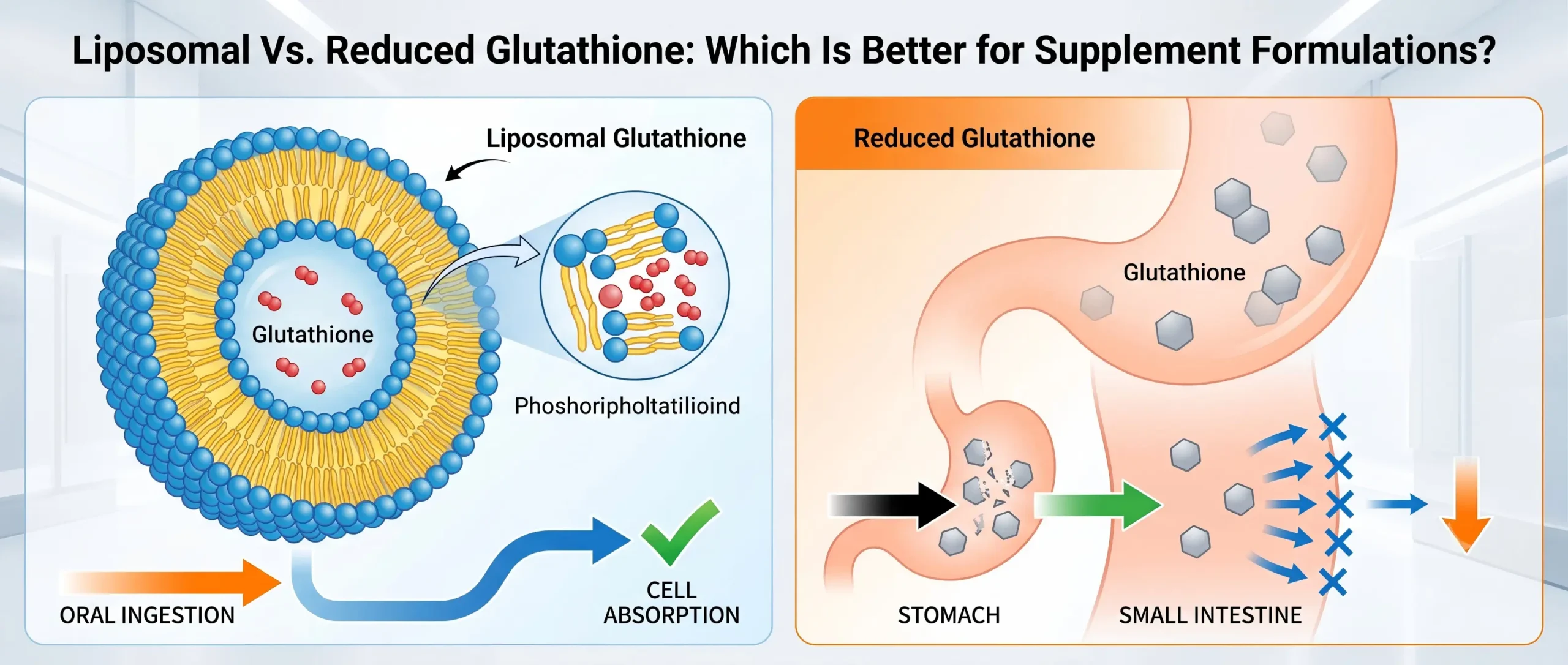
Liposomal glutathione refers to reduced glutathione that has been encapsulated within phospholipid vesicles (liposomes). These microscopic spherical structures, typically composed of phosphatidylcholine derived from sunflower or soy lecithin, create a protective bilayer that shields the glutathione molecule from degradation in the gastrointestinal tract.
3.1 Liposome Delivery Technology
The liposome functions as a nano-delivery system. The phospholipid bilayer structurally resembles cell membranes, which allows the vesicle to merge with intestinal epithelial cells and release its glutathione payload directly into circulation. This mechanism bypasses the enzymatic degradation that significantly limits the bioavailability of unencapsulated oral glutathione.
3.2 Manufacturing Parameters
- Encapsulation Efficiency (EE%): Quality manufacturers achieve 85-94% EE, verified by HPLC analysis
- Particle Size: Optimal range is 100-220 nm for oral absorption; smaller than 100 nm may improve cellular uptake but complicates manufacturing
- Polydispersity Index (PDI): Values below 0.2 indicate uniform particle distribution
- Zeta Potential: Typically -30 to -35 mV for electrostatic stability
- Phospholipid Source: Non-GMO sunflower-derived phosphatidylcholine preferred over soy for allergen and oxidative stability considerations
3.3 Manufacturing Complexity
Liposomal glutathione production requires specialized equipment and controlled processing conditions. The manufacturing workflow typically involves: (1) phospholipid hydration in a nitrogen-purged vessel to prevent oxidation; (2) high-pressure homogenization or extrusion to achieve target particle size; (3) encapsulation efficiency verification via HPLC; and (4) sterility testing and stability validation under ICH Q1A/Q1B protocols. These requirements translate to higher per-unit costs and typically higher minimum order quantities (MOQ) compared to standard reduced glutathione.
4. Liposomal vs. Reduced Glutathione: Side-by-Side Comparison
The following comparison matrix provides procurement teams with a structured framework for evaluating both forms across key technical and commercial parameters.
| Comparison Parameter | Reduced Glutathione (GSH) | Liposomal Glutathione |
| Ingredient Structure | Free tripeptide (L-GSH) | GSH encapsulated in phospholipid vesicles |
| Delivery Technology | Passive diffusion | Phospholipid bilayer fusion / endocytosis |
| Raw Material Cost | $ (Lower) | $$$ (3-5x higher) |
| Manufacturing Complexity | Standard blending/capsuling | Specialized liposome production required |
| Stability (Dry) | 24-36 months at RT | 24 months at RT (powder); 12-18 months (liquid) |
| Typical Taste | Mild sulfur note | Bland to slightly nutty (masked by phospholipids) |
| Typical Dosage | 250-1,000 mg/day | 250-500 mg/day |
| Primary Dosage Forms | Capsules, powder, tablets | Softgels, liquid sachets, dry powder capsules |
| Target Consumer Segment | Mass market, budget-conscious | Premium, practitioner, clinical |
| Retail Positioning | Entry to mid-range | Premium to professional |
| OEM Cost Structure | Lower MOQ, faster turnaround | Higher MOQ, longer lead time |
| Suitable Brand Strategy | Volume, price competitiveness | Differentiation, clinical credibility |
This comparison reflects current industry standards as of 2026. Individual manufacturer specifications may vary. Procurement teams should request Certificates of Analysis (COA) and third-party testing documentation to verify specific parameters.
5. Bioavailability: What Does Current Research Suggest?
The bioavailability of oral glutathione has been a subject of scientific debate for decades. This section reviews the key clinical evidence, with specific attention to study design, limitations, and implications for formulation decisions.
5.1 Landmark Human Studies
Richie et al. (2015) conducted the first long-term randomized controlled trial (RCT) examining oral glutathione supplementation in humans. Published in the European Journal of Nutrition, this six-month, double-blinded, placebo-controlled study administered 250 mg/day or 1,000 mg/day of Setria® L-Glutathione to 54 non-smoking adults. The results showed that GSH levels in blood increased after 1, 3, and 6 months at both doses. At six months, mean GSH levels increased 30-35% in erythrocytes, plasma, and lymphocytes in the high-dose group (P < 0.05). Natural killer cell cytotoxicity increased more than twofold versus placebo (P < 0.05) at three months. These findings established, for the first time, that daily oral GSH supplementation can effectively increase body compartment stores.
Sinha et al. (2018), also published in the European Journal of Clinical Nutrition, compared liposomal glutathione to non-liposomal forms. In this pilot study conducted at Penn State University College of Medicine, participants receiving liposomal GSH showed a 28% increase in erythrocyte glutathione levels, a 400% increase in natural killer cell function, and a 25% reduction in lipid peroxidation markers. Effects were observed as early as one week. This study provided preliminary evidence that liposomal delivery may achieve comparable or enhanced effects at similar or lower doses compared to standard oral GSH.
5.2 Research Limitations and Objectivity
Several important limitations must be acknowledged when interpreting this evidence base:
- The Sinha liposomal study was a pilot trial with a relatively small sample size, requiring larger confirmatory studies
- Direct head-to-head comparisons between liposomal and non-liposomal GSH at equivalent doses in the same study population remain limited
- Bioavailability markers vary across studies (plasma GSH, erythrocyte GSH, lymphocyte GSH, oxidative stress biomarkers), making cross-study comparisons challenging
- Individual variation in absorption is substantial, influenced by age, baseline GSH status, gut microbiome composition, and concurrent health conditions
- Animal study results (e.g., the CD Bioparticles data showing 12.94-fold relative bioavailability in liposomal formulations) may not directly translate to human pharmacokinetics
5.3 Evidence-Based Conclusion
Current peer-reviewed evidence supports the following position: both reduced glutathione and liposomal glutathione can increase body GSH stores when administered orally. Liposomal delivery appears to offer enhanced absorption efficiency based on available pharmacokinetic data, though the magnitude of this advantage varies across studies and depends heavily on liposome quality parameters (encapsulation efficiency, particle size, phospholipid composition). No definitive evidence establishes liposomal glutathione as categorically superior for all applications; rather, the choice should be guided by formulation goals, target dosage, cost parameters, and intended market positioning.
6. Manufacturing Considerations for OEM Brands
For brand owners and procurement managers, manufacturing capability assessment is as critical as ingredient selection. This section outlines the technical requirements, quality benchmarks, and documentation standards that distinguish reliable liposomal glutathione manufacturers.
6.1 Raw Material Sourcing
The glutathione raw material should meet or exceed USP monograph specifications. In 2023-2024, the U.S. Pharmacopeial Convention released the first official monograph for glutathione, establishing standards for identity, strength, quality, and purity. Setria® Glutathione from Kyowa Hakko Bio was among the first branded ingredients to achieve USP monograph compliance, and manufacturers should verify that their raw material supplier provides documentation of compliance.
6.2 Liposome Production Requirements
- Nitrogen-purged production environment to prevent GSH oxidation during encapsulation
- High-pressure homogenization equipment capable of achieving target particle size (100-220 nm) with low PDI
- Cold-process manufacturing to prevent heat-induced peptide bond hydrolysis
- Dissolved oxygen monitoring throughout the production cycle
- ISO-certified cleanroom facilities (Class 100,000 or better)
6.3 Quality Testing Protocol
- Encapsulation Efficiency via HPLC (target: >85%)
- Dynamic Light Scattering (DLS) for particle size and PDI
- Fourier Transform Infrared (FTIR) spectroscopy for structural confirmation
- Differential Scanning Calorimetry (DSC) for thermal stability profiling
- Zeta potential analysis for electrostatic stability assessment
- Microbiological testing per USP <61> and <62>
- Heavy metals screening per USP <231>
6.4 Stability and Shelf-Life Considerations
Reduced glutathione powder typically offers 24-36 months of stability when stored under recommended conditions (cool, dry, protected from light). Liposomal glutathione liquid formulations generally require refrigeration after opening and offer 12-18 months of unopened shelf life. However, advances in dry liposomal powder technology have extended shelf stability to 24 months at room temperature, significantly improving logistics flexibility for international distribution.
6.5 Batch Consistency and Documentation
OEM brands should require batch-specific Certificates of Analysis (COA) documenting all tested parameters. For brands targeting regulated markets (US, EU, Australia), the manufacturer should provide regulatory dossiers compatible with FDA, EMA, TGA, and other relevant authority requirements. Third-party testing verification adds an additional layer of quality assurance that supports label claims and reduces regulatory risk.
7. Commercial Positioning: Which Market Fits Each Product?
The choice between reduced and liposomal glutathione should align with the intended retail positioning, target demographic, and pricing strategy. The following matrix provides a framework for market-fit assessment.
7.1 Reduced Glutathione (GSH) Positioning
- Target Markets: Mass market, cost-sensitive consumers, entry-level wellness brands
- Retail Price Position: $15-35 per month supply
- Primary Channels: Drug stores, general e-commerce, subscription boxes
- Brand Strategy: Volume-driven, competitive pricing, broad appeal
- Typical Claims: Antioxidant support, general wellness, daily detox
- Advantages: Lower COGS, simpler supply chain, wider margin flexibility
7.2 Liposomal Glutathione Positioning
- Target Markets: Premium brands, practitioner lines, anti-aging specialists, beauty-from-within segment
- Retail Price Position: $45-90+ per month supply
- Primary Channels: Professional healthcare practitioners, premium Amazon positioning, DTC premium brands, specialty wellness retailers
- Brand Strategy: Science-backed positioning, enhanced bioavailability messaging, clinical credibility
- Typical Claims: Enhanced absorption, cellular-level antioxidant support, professional-strength formulation
- Advantages: Higher per-unit margins, differentiation in crowded market, practitioner channel access, stronger customer loyalty
7.3 Cross-Border and Regional Considerations
Asia-Pacific accounted for approximately 45% of global glutathione demand in 2024, with particularly strong growth in nutricosmetic applications (skin brightening, anti-aging). North America represents 22-25% of demand, concentrated in immune support and detoxification positioning. European markets favor clean-label, non-GMO formulations with emphasis on regulatory compliance. Formulation and positioning strategies should be adapted to regional regulatory requirements and consumer preferences.
8. Can Liposomal Glutathione Be Combined with Other Ingredients?
One of the most frequent inquiries from product development teams concerns formulation compatibility. The following combination ingredients are commercially viable for co-formulation with liposomal glutathione, with notes on formulation compatibility and commercial positioning considerations.
| Ingredients | Formulation Compatibility | Commercial Positioning | OEM Considerations |
| Vitamin C | Excellent; regenerates oxidized GSH | Core antioxidant stack | Widely available, cost-effective |
| Alpha Lipoic Acid | Good; complementary antioxidant | Advanced metabolic support | pH compatibility testing required |
| NAC | Good; cysteine precursor for GSH synthesis | Detoxification specialist | Sulfur taste management |
| Selenium | Excellent; cofactor for glutathione peroxidase | Thyroid and immune support | Dose precision critical (UL: 400 mcg) |
| Milk Thistle | Good; liver support synergy | Hepatic detoxification | Standardized extract (silymarin) preferred |
| CoQ10 | Good; mitochondrial support | Energy and cardiovascular | Consider ubiquinol form for synergy |
| Hyaluronic Acid | Good; moisture retention | Beauty-from-within | MW selection affects absorption claims |
| Ceramide | Good; skin barrier support | Premium beauty positioning | Higher raw material cost |
| Astaxanthin | Good; potent carotenoid antioxidant | Anti-aging, sports recovery | Natural source preferred; orange color |
| Collagen | Excellent; structural protein synergy | Beauty and joint support | Type I/III vs. Type II selection matters |
Formulation compatibility testing should always be conducted under accelerated stability conditions (ICH Q1A: 25°C/60% RH and ICH Q1B: 40°C/75% RH) before finalizing any combination formula. KSNutripharma’s formulation development team provides pilot batch testing and accelerated stability data for all custom combination requests.
9. Which Dosage Forms Are Available?
Both reduced and liposomal glutathione can be manufactured in multiple dosage forms, each with distinct MOQ requirements, equipment needs, and market positioning implications.
| Dosage Form | Reduced GSH MOQ | Liposomal GSH MOQ | Key Considerations | Market Fit |
| Softgel | 50,000 units | 30,000 units | Most popular liposomal format; liquid fill | Premium supplement, practitioner |
| Hard Capsule | 30,000 units | 20,000 units | Powder or granule fill; two-piece | Broad market acceptance |
| Bulk Powder | 10 kg | 5 kg (dry liposomal) | B2B ingredient sales; repackaging | Contract manufacturers, brands |
| Stick Pack | 50,000 sachets | 50,000 sachets | Single-serve convenience; portability | Asia-Pacific, on-the-go segment |
| Liquid Sachet | N/A (GSH unstable) | 30,000 units | Ready-to-drink; flavor masking critical | Premium convenience, practitioner |
| Oral Liquid (Bottle) | N/A | 5,000 bottles | Stability testing essential; preservative system | Pediatric, senior, clinical |
| Tablet | 100,000 units | Not recommended | Compression may damage liposomes | Economy segment (reduced GSH only) |
Note: MOQ figures are approximate industry benchmarks as of 2026. Actual MOQs vary by manufacturer, capsule/softgel size, and filling specifications. KSNutripharma offers flexible pilot production runs starting at 500 units for softgel and capsule formats, enabling smaller brands to validate market demand before committing to full-scale production.
10. How to Choose Between Liposomal and Reduced Glutathione
The following decision framework provides a structured approach for procurement teams and brand owners evaluating which glutathione form aligns with their specific business parameters.
10.1 Choose Reduced Glutathione (GSH) If:
- Your target retail price point is below $25 for a 30-day supply
- You are entering a price-competitive channel (mass retail, discount e-commerce)
- Your brand positioning emphasizes value and accessibility
- You need the lowest possible MOQ for initial market testing
- You are formulating a multi-ingredient antioxidant blend where GSH is one of several actives
- Your target market is cost-sensitive (developing markets, entry-level wellness consumers)
10.2 Choose Liposomal Glutathione If:
- Your brand targets the premium or professional healthcare segment
- Your retail positioning supports a $45+ price point for 30-day supply
- You require enhanced bioavailability as a key differentiator in your marketing
- You are selling through practitioner channels or premium DTC
- Your brand emphasizes clinical credibility and science-backed formulation
- You are targeting the beauty-from-within or longevity/anti-aging market segments
- You need professional-grade positioning for functional medicine practitioners
10.3 Hybrid Strategy
Some brand owners opt to offer both formats within their portfolio: a reduced GSH product for the entry-level segment and a liposomal version for premium customers. This dual-SKU approach maximizes market coverage while maintaining clear product differentiation. However, it requires careful messaging to avoid cannibalization and ensure each product’s positioning remains distinct.
11. Frequently Asked Questions
Q1: Does liposomal glutathione contain reduced glutathione?
Yes. Liposomal glutathione contains reduced glutathione (GSH) as its active ingredient. The liposome is a delivery vehicle that encapsulates GSH; it does not alter the molecular structure of glutathione itself. The GSH inside the liposome is the same L-glutathione molecule used in standard reduced glutathione supplements.
Q2: Is liposomal glutathione more expensive to manufacture?
Yes. The additional phospholipid raw materials, specialized production equipment, nitrogen-purged manufacturing environment, and extensive quality testing (encapsulation efficiency, particle size analysis, zeta potential) contribute to a manufacturing cost typically 3-5x higher than standard reduced GSH powder processing. However, this higher COGS supports a proportionally higher retail price point and margin structure.
Q3: Can both forms be used together in a formulation?
While technically feasible, combining liposomal and non-liposomal GSH in a single product is generally not recommended from a formulation or commercial perspective. The liposomal form already contains GSH, so adding free GSH would not provide additional bioactive benefit while unnecessarily increasing cost and formulation complexity. Brands seeking different price tiers should develop separate SKUs rather than combining forms.
Q4: Which form has better stability?
Dry reduced GSH powder has longer shelf stability (24-36 months at room temperature in sealed containers) compared to liquid liposomal formulations (12-18 months, refrigeration recommended after opening). However, advances in dry liposomal powder technology have achieved 24-month room temperature stability, narrowing this gap. The key stability variable for liposomal products is the quality of the encapsulation; poor encapsulation leads to premature GSH release and oxidation.
Q5: Which dosage form is most suitable for liposomal GSH?
Softgel capsules are the most common and commercially proven format for liquid liposomal glutathione, offering good consumer acceptance, straightforward manufacturing, and reliable encapsulation integrity. Liquid sachets/stick packs represent the fastest-growing format, particularly in Asian markets and for practitioner-dispensed products. Dry liposomal powders in hard-shell capsules offer the best combination of stability, logistics flexibility, and consumer convenience.
12. Why Work with an Experienced Liposomal Supplement Manufacturer
The technical complexity of liposomal glutathione manufacturing makes supplier selection a critical strategic decision. KSNutripharma® has developed specialized capabilities in liposomal encapsulation through years of pharmaceutical and nutraceutical manufacturing experience.
12.1 KSNutripharma Liposomal Manufacturing Capabilities
- Custom formulation development with in-house R&D laboratory
- OEM and private label manufacturing with flexible MOQ starting at 500 units for capsules/softgels
- Full ODM services from concept to finished product
- Pilot production batches for market validation before full-scale commitment
- Multi-format output: softgels, hard capsules, liquid sachets, powders, and stick packs
- cGMP-certified manufacturing facilities with ISO 9001 and HACCP quality systems
12.2 Quality Assurance Framework
- Raw material qualification with COA verification and vendor auditing
- In-process testing: encapsulation efficiency, particle size, and PDI at production checkpoints
- Finished product testing: potency, microbiological, heavy metals, and stability
- Third-party laboratory verification for label claim substantiation
- Regulatory documentation support: FDA, EMA, TGA, and emerging market dossier preparation
12.3 Global Export and Compliance Support
KSNutripharma provides comprehensive export documentation including Certificates of Origin, Free Sale Certificates, GMP compliance certificates, and product registration support for target markets. Our regulatory affairs team monitors evolving requirements across North America, Europe, Asia-Pacific, and Middle East markets to ensure ongoing compliance for all distributed products.
12.4 Getting Started
For brand owners, importers, and distributors interested in developing a liposomal glutathione product line, KSNutripharma offers a structured product development process beginning with a technical consultation to define formulation objectives, target specifications, and commercial parameters. Sample products are available for evaluation, and our formulation team can develop custom prototypes aligned with your brand positioning and market requirements.
References
- Richie JP Jr, Nichenametla S, Neidig W, et al. Randomized controlled trial of oral glutathione supplementation on body stores of glutathione. European Journal of Nutrition. 2015;54(2):251-263. doi:10.1007/s00394-014-0706-z. Available at: https://pubmed.ncbi.nlm.nih.gov/24791752/
- Sinha R, Sinha I, Calcagnotto A, et al. Oral supplementation with liposomal glutathione elevates body stores of glutathione and markers of immune function. European Journal of Clinical Nutrition. 2018;72(1):105-111. doi:10.1038/ejcn.2017.132.
- Kyowa Hakko USA. Setria® Glutathione Now Meets the New USP Compendia. 2024. Available at: https://kyowa-usa.com/news/post/06-13
- Coherent Market Insights. Glutathione Market Size, Trends and Growth Rate, 2033. 2026. Available at: https://www.coherentmarketinsights.com/market-insight/glutathione-market-4498
- Market Research Future. Glutathione Market Size, Share, Trends, Growth Analysis Report. 2026. Available at: https://www.marketresearchfuture.com/reports/glutathione-market-33198
- CD Bioparticles. Liposomal Glutathione Case Study. 2025. Available at: https://www.cd-bioparticles.net/resources/liposomal-glutathione-case-study
- West Bengal Chemical Industries Limited. Advanced liposomal glutathione strategies for cellular protection. GSC Biological and Pharmaceutical Sciences. 2026. Available at: https://gsconlinepress.com/journals/gscbps/sites/default/files/GSCBPS-2026-0091.pdf
- U.S. Pharmacopeial Convention. Glutathione Monograph. USP-NF 2024. Available at: https://www.usp.org/
- Witschi A, Reddy S, Stofer B, Lauterburg BH. The systemic availability of oral glutathione. European Journal of Clinical Pharmacology. 1992;43(6):667-669.
- Allen J, Bradley RD. Effects of oral glutathione supplementation on systemic oxidative stress biomarkers in human volunteers. Journal of Alternative and Complementary Medicine. 2011;17(9):827-833.
- Schmitt B, Vicenzi M, Garrel C, Denis FM. Effects of N-acetylcysteine, oral glutathione (GSH) and a novel sublingual form of GSH on oxidative stress markers: A comparative crossover study. Redox Biology. 2015;6:198-205.
- Weschawalit S, Thongthip S, Phutrakool P, Asawanonda P. Glutathione and its antiaging and antimelanogenic effects. Clinical, Cosmetic and Investigational Dermatology. 2017;10:147-153.
- Honda Y, Kessoku T, Sumida Y, et al. Efficacy of glutathione for the treatment of nonalcoholic fatty liver disease: an open-label, single-arm, multicenter, pilot study. BMC Gastroenterology. 2017;17(1):96.
- Persistence Market Research. Glutathione Market Size, Share & Forecast Analysis, 2025-2032. 2025. Available at: https://www.persistencemarketresearch.com/market-research/glutathione-market.asp