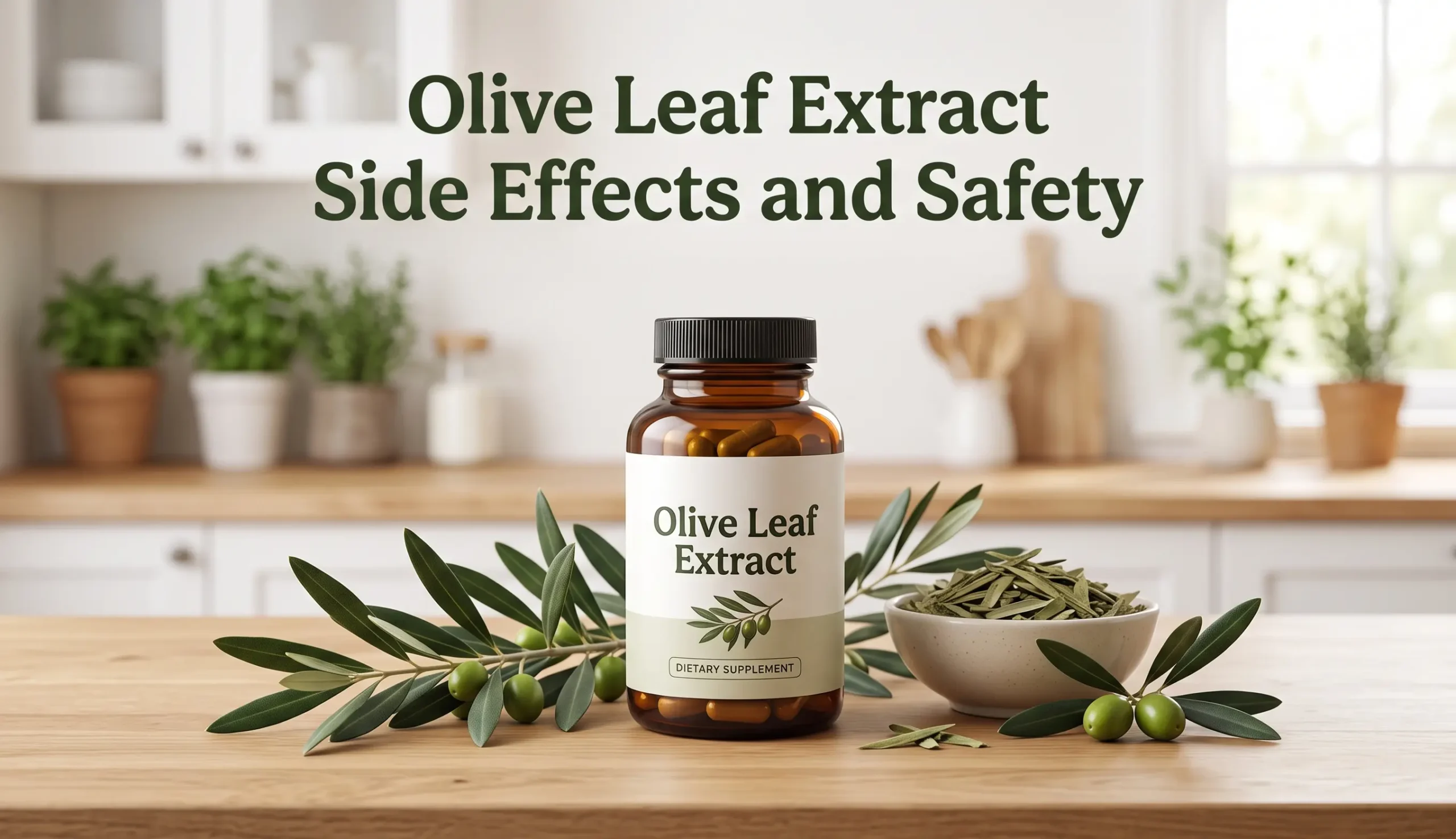
Olive leaf extract side effects in the human trials reviewed here were generally well tolerated, and most recorded adverse events were mild. Those records remain preparation-, dose-, population-, and duration-specific. Gastrointestinal symptoms appear in some studies. Headache, cough, and vertigo appear in one active-controlled hypertension trial, which is not a placebo safety study in healthy adults. A 500 mg label claim does not state how much oleuropein was delivered, or whether that product matches the preparation that was studied.
Oleuropein percent is not a safety guarantee. A higher assay does not, by itself, make an extract safer. There is no universal safe dose that applies to every commercial extract.
Safety Evidence at a Glance
Question | Current evidence | Practical interpretation |
|---|---|---|
| General tolerability | Generally well tolerated; recorded events mostly mild | Applies to the studied preparations, doses, populations, and durations |
| GI symptoms | Reported in some trials and in spontaneous reports | No single incidence rate |
| Headache, cough, vertigo | Recorded in an active-controlled hypertension trial | Do not treat as typical for all adults |
| Blood-pressure effects | Some trials recorded blood-pressure changes | Not proof of a drug interaction |
| Glucose effects | Marker changes in one type 2 diabetes trial | Not a diabetes treatment |
| Allergy | One trial withdrawal; olive pollen can cause respiratory allergy | Pollen allergy and a leaf extract are different exposures |
| Pregnancy / breastfeeding | Supplement-dose data not established | Food use of olive fruit or olive oil is a different exposure |
| Children | Adult trials | Do not extrapolate |
| Long-term use | Several weeks to about 6 months | Does not establish safety for indefinite use |
| Safe dose | No universal safe dose | Depends on preparation, dose, duration, and population |
Are Olive Leaf Extract Side Effects Common?
Safety evidence does not all carry the same weight. Controlled trials can compare adverse-event patterns. Spontaneous reports can flag a possible signal, but they cannot establish how often an effect occurs or prove that the product caused it.
There is no category-wide frequency. The points below come from named trials and from a small set of spontaneous reports.
Gastrointestinal symptoms. GI symptoms have been reported, but controlled scoring has not shown one consistent treatment-related difference. In a 6-month multicentre trial, gastrointestinal disorders, including abdominal pain, nausea, and dyspepsia, were the most frequent adverse-event class in both groups. The authors reported no significant difference between groups in the number of people with at least one adverse event, or in severity. [1] Stevens et al. scored abdominal pain, reflux, diarrhea, indigestion, and constipation over 8 weeks at 500 mg/day aqueous extract and found no significant difference versus placebo. [3]
New Zealand’s medicines-safety centre has published three spontaneous reports of gastrointestinal reactions with olive leaf extract products: nausea, epigastric pain, vomiting, and diarrhea. Spontaneous reports are not an incidence rate. [7]
Headache, vertigo, muscle discomfort. These terms appear in an active-controlled hypertension trial, not a placebo trial in healthy adults. The event shares from that trial are in the next section. [2]
Allergy. Stevens et al. reported one participant who left with suspected olive allergy. [3] People with a known olive or olive-pollen allergy should discuss use with a healthcare professional. Pollen allergy does not by itself establish a leaf-extract allergy.
A 2025 pilot in 31 adults with type 2 diabetes found the extract and placebo well tolerated over 24 weeks, with no severe or serious adverse events and no significant difference in adverse-event frequency. [5] A 2025 trial in 621 adults already treated for hypertension reported no significant adverse events over 12 weeks. [6]
Human studies reviewed here range from several weeks to about six months. That does not establish safety for indefinite use. [1][5]
Who Should Use More Caution?
Situation | Why it matters | What this page can say |
|---|---|---|
| Blood-pressure medicines | Some trials recorded blood-pressure changes | A clinically significant additive effect has not been established. Discuss use with a clinician or pharmacist. Do not stop a prescription, and do not use the extract as a substitute |
| Glucose-lowering medicines | One type 2 diabetes trial reported glycemic-marker changes | A clinically significant additive effect has not been established. Discuss use with a clinician |
| Anticoagulant or antiplatelet medicines | An in vitro study reported less platelet activation when olive leaf extract was added to blood samples | This does not establish a clinically relevant interaction. Evidence is insufficient to quantify the risk. [8] |
| Pregnancy / breastfeeding | No adequate supplement-dose data | Safety during pregnancy and breastfeeding has not been established |
| Children | Trials enrolled adults | A pediatric use needs its own assessment |
| Known olive or olive-pollen allergy | Pollen and a leaf extract are different exposures | Discuss use with a healthcare professional |
| Kidney disease | Human trials do not establish kidney safety in people with kidney disease | Use should be reviewed with a clinician or pharmacist |
This article does not provide a dosing plan.
Active-Controlled Evidence Is Not Placebo Safety Evidence
Susalit et al. compared EFLA®943 with captopril, not with placebo, in adults with stage-1 hypertension, at 500 mg twice daily. [2] Of the adverse events recorded, 99.8% were classified as mild. That is an event-level figure, not the percentage of participants who had a mild event. Cough accounted for 4.6% of recorded events in the olive-leaf group and 7.0% in the captopril group. Vertigo accounted for 5.9% and 6.3%. Cough was judged probably related to captopril. Vertigo, muscle discomfort, and headache were judged possibly related to both treatments. One serious adverse event was judged unrelated to study medication.
The study supports tolerability in that hypertensive population. It does not establish a general safety profile for healthy adults or for other preparations.
Does Olive Leaf Extract Affect the Liver or Kidneys?
In the 8-week placebo-controlled trial by Stevens et al., ALP, GGT, AST, ALT, and bilirubin stayed within normal ranges and did not differ significantly from placebo. [3] Susalit reported selected laboratory shifts that remained within normal ranges and were not judged clinically relevant. [2]
Those results do not establish kidney safety in people with kidney disease.
Animal toxicology can inform a file. It does not replace human tolerability data. [1]
Does a Higher Oleuropein Percent Make It Safer?
No.
500 mg of a 20% oleuropein extract calculates to 100 mg oleuropein. 250 mg of a 40% extract calculates to the same nominal amount. The two materials are not clinically equivalent because the arithmetic matches. Method and basis describe how the marker is measured. Extraction matrix and dosage form can also affect the delivered exposure.
In a small single-dose crossover study (n = 9), a liquid and a capsule of olive leaf extract produced different peak plasma concentrations of oleuropein metabolites. That is a difference in metabolite exposure, not a ranking of which form is safer. [4]
A label that says “500 mg olive leaf extract” does not state the oleuropein amount. Extract weight × stated assay = nominal oleuropein amount. The calculation compares specifications. It is not a recommended intake.
Why the Extract Specification Still Changes the Safety File
Olea europaea leaf is not olive fruit and not olive oil. “Olive tree extract” matches this page only when the plant part is leaf.
A safety comparison with a studied preparation needs four items: botanical identity and plant part; oleuropein assay, method, and basis; the contaminant limits the destination market requires; and finished-product release and stability, including marker retention when oleuropein is on the label.
The incoming COA is not the finished-product specification. A target percent on a supplier sheet is not the released lot. Methods: Quality Control. Field-by-field reading: How to Read a COA.
Botanical identity, marker declaration, dosage form, and required warning language should be reviewed together on the finished product. Start that review from the olive leaf extract supplement manufacturer specification.
Olive Leaf Extract Claims: What Not to Write
Do not turn trial findings into disease-treatment claims, or assume that a generic 500 mg capsule is equivalent to a named clinical preparation.
Olive Leaf Extract Side Effects FAQ
What are olive leaf extract side effects?
In the trials reviewed here, recorded events were mostly mild. Gastrointestinal symptoms appear in some studies. Headache, cough, or vertigo appear in one active-controlled hypertensive trial. There is no single frequency. [1][2][3][7]
Is olive leaf extract safe?
The preparations in these trials were generally well tolerated. That does not create one safe dose for every commercial extract.
Does olive leaf extract cause stomach problems?
Abdominal pain, nausea, dyspepsia, vomiting, and diarrhea have been reported. Controlled trials have not established one incidence rate. [1][3][7]
Can I take olive leaf extract with blood pressure medication?
Olive leaf extract may affect blood pressure. A clinically significant additive effect with blood-pressure medicines has not been established. Discuss use with a clinician or pharmacist. Do not stop a prescription, and do not use the extract as a substitute.
Can I take olive leaf extract with diabetes medication?
A type 2 diabetes trial reported glycemic-marker changes. A clinically significant additive effect with glucose-lowering medicines has not been established. Discuss use with a clinician. [5]
Is olive leaf extract safe in pregnancy or while breastfeeding?
Safety of supplemental olive leaf extract during pregnancy and breastfeeding has not been established.
Can children take olive leaf extract?
The trials cited here enrolled adults. They should not be extrapolated to children.
Can you take olive leaf extract long term?
The trials reviewed here ran for several weeks to about six months. That does not establish indefinite use. [1][5]
Is there a clinically established safe dose of olive leaf extract?
No universal safe dose has been established across commercial preparations. Human studies used different preparations and doses, so those study doses are not general intake recommendations.
Send Your Olive Leaf Extract COA for Safety Review
Send the COA or the raw-material specification. The review can cover botanical identity and plant part, oleuropein assay and method, contaminant tests, lot result versus specification, and whether the finished unit is feasible. Send your olive leaf extract COA for safety review.
Related Resources
Disclaimer: Educational only. Not medical advice. Not a substitute for clinician judgment. Not intended to diagnose, treat, cure, or prevent any disease. Safety depends on dose, formula, population, concomitant products, and market rules. KS Nutripharma provides manufacturing feasibility and documentation support — not legal approval. Serving math in this article is illustration only, not a recommended daily dose.
Technical and Regulatory References
- Horcajada MN, Beaumont M, Sauvageot N, et al. An oleuropein-based dietary supplement may improve joint functional capacity in older people with high knee joint pain: findings from a multicentre-RCT and post hoc analysis. Ther Adv Musculoskelet Dis. 2022;14:1759720X211070205. https://doi.org/10.1177/1759720X211070205 · https://pubmed.ncbi.nlm.nih.gov/35069812/
- Susalit E, Agus N, Effendi I, et al. Olive (Olea europaea) leaf extract effective in patients with stage-1 hypertension: comparison with Captopril. Phytomedicine. 2011;18(4):251-258. https://doi.org/10.1016/j.phymed.2010.08.016 · https://pubmed.ncbi.nlm.nih.gov/21036583/
- Stevens YR, Winkens B, Jonkers D, Masclee A. The effect of olive leaf extract on cardiovascular health markers: a randomized placebo-controlled clinical trial. Eur J Nutr. 2021;60(4):2111-2120. https://doi.org/10.1007/s00394-020-02397-9 · https://pmc.ncbi.nlm.nih.gov/articles/PMC8137474/
- de Bock M, Thorstensen EB, Derraik JGB, Henderson HV, Hofman PL, Cutfield WS. Human absorption and metabolism of oleuropein and hydroxytyrosol ingested as olive (Olea europaea L.) leaf extract. Mol Nutr Food Res. 2013;57(12):2079-2085. https://doi.org/10.1002/mnfr.201200795 · https://pubmed.ncbi.nlm.nih.gov/23766098/
- Leach MJ, Breakspear I. Efficacy and safety of olive leaf extract (Olea europaea L.) for glycaemic control in adults with type 2 diabetes mellitus (ESOLED): a pilot randomised controlled trial. Complement Ther Clin Pract. 2025;59:101949. https://doi.org/10.1016/j.ctcp.2025.101949 · https://pubmed.ncbi.nlm.nih.gov/39818111/
- Lamti F, Trabelsi I, Dhaoui R, et al. Efficacy of olive leaf extracts in controlling blood pressure in hypertensive patients: a double-blind randomized clinical trial. J Hypertens. 2025;43(11):1878-1884. https://doi.org/10.1097/HJH.0000000000004141 · https://pubmed.ncbi.nlm.nih.gov/40990594/
- Medsafe. Complementary Corner — Olive Leaf Extract. Prescriber Update. 2015;36(3):34-35. https://medsafe.govt.nz/profs/PUArticles/Sep2015/OliveLeaf.htm
- Singh I, Mok M, Christensen AM, Turner AH, Hawley JA. The effects of polyphenols in olive leaves on platelet function. Nutr Metab Cardiovasc Dis. 2008;18(2):127-132. https://doi.org/10.1016/j.numecd.2006.09.001