Introduction
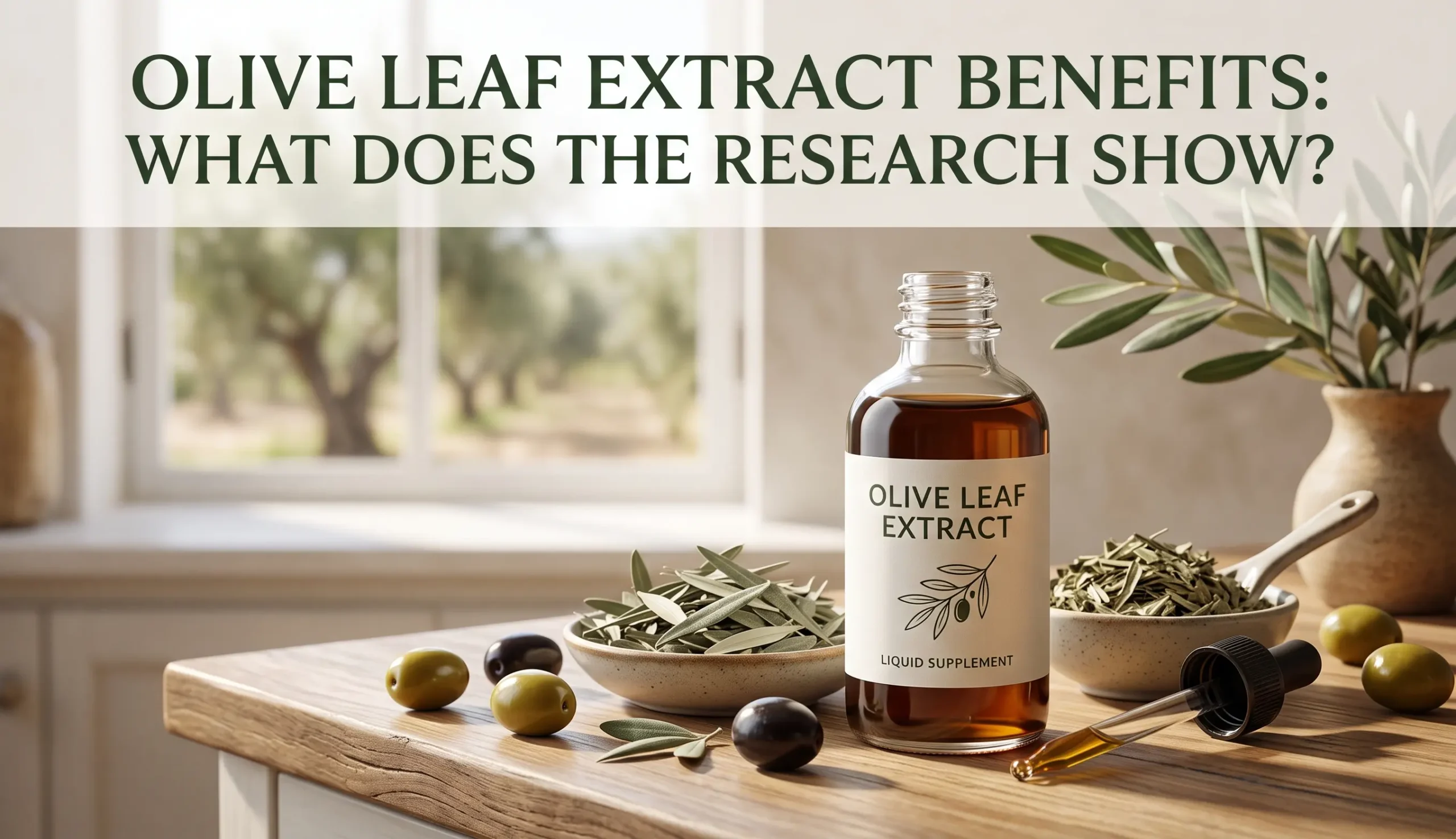
Olive leaf extract benefits in human trials are discussed most often for blood pressure, and less consistently for blood lipids. Two 2026 systematic reviews agree that pooled glycemic effects are not significant, but they reach different conclusions on lipid outcomes. A published result applies to the tested preparation, not automatically to every olive leaf extract sold under the same ingredient name.
Key takeaway: Blood pressure has the most human-trial attention, and that signal is still preparation- and population-specific. The 2026 reviews do not disagree about glucose. They disagree about lipids because they did not analyze the same set of preparations.
What Does the Latest Research Say?
A 2022 meta-analysis is no longer the most recent synthesis. Two 2026 systematic reviews provide a more current view, but they answer somewhat different questions.
Metabolic outcomes. Menezes et al. reviewed olive leaf extract and oleuropein only: 11 randomized trials. In the continuous-intake, parallel-design trials they could pool, they found no statistically or clinically significant effect on glycemic or lipid outcomes. Inflammatory evidence was scarce and low-certainty. Short-term crossover results on glucose and insulin were too heterogeneous to pool. The authors did not support a clinical recommendation for supplementation. [13]
Broader cardiometabolic markers. Mansouri et al. reviewed 30 randomized trials (1,726 participants) of olive leaf or olive pomace, and they analyzed those materials separately. For olive-leaf supplementation they reported improvements in total cholesterol, triglycerides, LDL-C, ApoB, oxidized LDL, and ApoA1, plus reductions in TNF-α, systolic and diastolic blood pressure, body weight, and BMI. They found no significant effect on glycemic markers. Olive pomace did not show a consistent cardiometabolic benefit. Certainty ranged from very low to high. [14]
Why the conclusions differ. The reviews did not ask the same question.
- Intervention. One review asked about olive leaf extract and oleuropein. The other asked about olive leaf or olive pomace, then analyzed those materials separately.
- Which trials could be pooled. One review pooled methodologically similar continuous-intake, parallel-design trials. Short-term crossover glucose and insulin results were left unpooled because they were too heterogeneous.
- Outcomes. One review centered on glycemic, lipid, and inflammatory markers. The other also pooled blood pressure, apolipoproteins, and body weight.
- Leaf versus pomace. Only the broader review separated those two materials. Its lipid and blood-pressure findings are for olive leaf, not for the mixed pool.
- Combination products. A product that combines olive leaf with a second active is not evidence for olive leaf extract alone.
Olive Leaf Extract Benefits — Quick Evidence Map
Human studies have examined named preparations. Blood pressure has the most trial attention. The 2026 reviews agree on a null pooled glycemic result and disagree on lipids.
Evidence status | Human research | How to read it |
|---|---|---|
| Relatively more studied | Blood pressure | Modest and population-specific. A 2022 pool found an SBP signal. [1] A 2025 trial in treated hypertension reported a 24-hour SBP change; the abstract does not give the oleuropein specification. [11] At least one placebo trial was null. [4] |
| Mixed across reviews | Lipid markers | A 2022 pool reported a triglyceride change with high heterogeneity. [1] One 2026 review found no pooled lipid effect in continuous-intake trials. The other reported lipid changes for olive leaf. [13][14] |
| Limited / inconsistent | Glycemic markers; inflammation | Both 2026 reviews found no significant pooled glycemic effect. Individual trials still differ. [5][10][13][14] Inflammatory-marker evidence is low-certainty or marker-specific. [13][14] |
| Not established as a general claim | Immune, infection, cold sores, weight loss, antioxidant benefit | Athlete respiratory data, one knee-pain trial, and in vitro antioxidant activity do not establish a general claim. [8][9][12] |
What Is Olive Leaf Extract?
Olive leaf extract is made from the leaves of Olea europaea L. The phenolic most often named on a specification is oleuropein, usually quantified by HPLC. [2]
Olive tree extract is the same material only when the plant part is leaf. Olive fruit extract and olive oil share the species. They do not share the same marker or the same research file.
Olive Leaf Extract and Blood Pressure
Human studies have examined olive leaf extract in relation to blood pressure.
A 2022 systematic review and meta-analysis of randomized trials (Razmpoosh et al.) pooled systolic blood pressure from six trials (n = 372) and reported a weighted mean difference of −3.86 mmHg (95% CI −6.44 to −1.28). The hypertension subgroup was −4.81 mmHg. The authors excluded an active-controlled antihypertensive trial from that SBP pool. [1]
Susalit et al. (2011) tested a named extract, EFLA®943, in adults with stage-1 hypertension. Blood pressure fell over 8 weeks, but the comparator was captopril rather than placebo, and the between-group difference was not significant. [2] The protocol was 500 mg twice daily; the batch was 19.9% oleuropein. Mean SBP change from baseline was −11.5 mmHg on the extract and −13.7 mmHg on captopril.
A 2025 placebo-controlled trial in 621 adults already treated for hypertension reported a 24-hour SBP change of about −6.4 mmHg on olive leaf extract versus about −1.5 mmHg on placebo over 12 weeks. The PubMed abstract does not report extract weight, oleuropein percent, assay method, or basis. [11]
Other placebo-controlled trials have reported null blood-pressure findings, including an 8-week aqueous extract trial and a 12-week leaf-polyphenol trial. [4][10]
The signal is modest, and it depends on the preparation and the population.
Olive Leaf Extract and Cholesterol / Lipids
The lipid evidence is less consistent than the blood-pressure evidence. Lockyer reported changes in some plasma lipids on a liquid phenolic extract. [3] Razmpoosh pooled a triglyceride reduction (WMD −9.51 mg/dL) with high heterogeneity, and described further lipid signals in a hypertension subgroup. [1] Stevens et al. found no significant differences from placebo in lipids with 500 mg/day aqueous extract for 8 weeks in overweight or obese adults with mildly elevated cholesterol. [4] de Bock et al. found no lipid change at 51.1 mg oleuropein per day. [10]
The 2026 reviews do not agree with each other on lipids. The difference is methodological as well as biological: they included overlapping but non-identical sets of preparations and trial designs. [13][14]
Olive Leaf Extract and Blood Sugar
Wainstein et al. (2012) randomized 79 adults with type 2 diabetes to 500 mg olive leaf extract once daily (tablet) or placebo for 14 weeks and reported lower HbA1c and fasting plasma insulin versus placebo. [5] That result comes from a disease-specific population. It is not a general blood-glucose finding for healthy adults.
de Bock et al. reported about a 15% improvement in insulin sensitivity and about a 28% improvement in beta-cell responsiveness in 46 middle-aged overweight men, using 51.1 mg oleuropein and 9.7 mg hydroxytyrosol per day for 12 weeks. The same trial did not change body composition. [10]
Lockyer’s pre-hypertensive cohort did not show a glycemic benefit. [3] Razmpoosh did not find a meaningful change in glucose measures in its pool. [1] Both 2026 reviews found no significant pooled effect on glycemic-control markers. [13][14] EFSA (2014) concluded that the evidence was insufficient for a cause-and-effect relationship between olive leaf extract and maintenance of normal blood glucose concentrations. [7]
Olive Leaf Extract and Inflammation
Human trials have measured markers such as CRP, IL-6, IL-8, and TNF-α. The results depend on the extract and the population. Lockyer reported a change in IL-8 on a liquid phenolic extract. [3] Razmpoosh found no meaningful change in inflammatory markers in its pool. [1] Menezes et al. (2026) judged the inflammatory evidence scarce and low-certainty. [13] Mansouri et al. (2026) reported a TNF-α reduction for olive-leaf supplementation, and the certainty was not the same for every outcome. [14]
Olive Leaf Extract and Antioxidant Activity
Oleuropein and related leaf phenolics are chemically antioxidant. That chemistry is not a human clinical endpoint. [8] An authorized EU health claim for olive-oil polyphenols should not be transferred to an olive-leaf supplement. [6]
Other Commonly Claimed Benefits
Immune and respiratory symptoms. Somerville et al. studied upper respiratory illness in high-school athletes. That trial does not establish immune support or infection treatment for the general population. [9]
Cold sores and antimicrobial use. The human trials cited here do not establish a general antimicrobial, cold-sore, or infection-treatment benefit.
Weight. Razmpoosh did not establish weight loss. de Bock found no body-composition change. [1][10] The 2025 hypertension trial reported a body-weight change in adults already treated for hypertension. [11]
Joint function. Horcajada et al. reported a joint-function finding in older adults with high knee pain who took an oleuropein-based supplement. That is one population and one preparation. [12]
What the Evidence Does Not Establish
The findings above do not establish olive leaf extract as a treatment for hypertension, high cholesterol, diabetes, infection, or inflammatory disease.
Research finding | What it does not establish |
|---|---|
| Modest SBP changes in selected trials [1][2][11] | Treatment of hypertension |
| Lipid-marker changes that differ across trials and across the 2026 reviews [1][13][14] | Treatment of high cholesterol |
| HbA1c findings in a type 2 diabetes trial [5] | Diabetes treatment |
| Insulin-sensitivity change in overweight men [10] | A glucose benefit for every reader |
| Changes in CRP, IL-6, IL-8, or TNF-α [1][3][13][14] | Treatment of an inflammatory disease |
| Antioxidant activity in vitro [8] | A clinical antioxidant benefit |
| Athlete respiratory trial [9] | Immune-boosting or infection-treatment claims |
| One knee-pain trial [12] | A general joint claim |
| A body-weight change in a 2025 hypertension trial [11] | A general weight-loss indication |
How Much Olive Leaf Extract Was Used in Human Studies?
These protocols are not recommended intakes.
Study / preparation | Extract amount | Marker amount | Duration | Population / outcome |
|---|---|---|---|---|
| EFLA®943 (Susalit 2011) | 500 mg twice daily | Batch 19.9% oleuropein | 8 weeks | Stage-1 hypertension; captopril, no placebo [2] |
| Lockyer 2017 | Liquid extract | ~136 mg oleuropein + 6.4 mg hydroxytyrosol/day | 6 weeks | Prehypertensive men; ambulatory blood pressure [3] |
| de Bock 2013 | Capsules | 51.1 mg oleuropein + 9.7 mg hydroxytyrosol/day | 12 weeks | Overweight men; insulin sensitivity [10] |
| Stevens 2021 | 500 mg/day | Not reported | 8 weeks | Overweight adults; lipids and blood pressure null on primary aims [4] |
| Wainstein 2012 | 500 mg/day | Not named | 14 weeks | Type 2 diabetes; HbA1c [5] |
| Lamti 2025 | Not in the PubMed abstract | Not in the PubMed abstract | 12 weeks | Treated hypertension; 24-hour SBP [11] |
The PubMed abstract for the 2025 trial does not report extract weight, oleuropein percent, method, or basis. This page does not fill that gap from secondary summaries. [11]
Retail capsules are often labeled 250 mg, 500 mg, or 750 mg of extract. That figure is fill weight. It is not the oleuropein amount.
Marker amount = extract weight × stated assay. Example: 500 mg × 20% = 100 mg oleuropein. A 10:1 ratio is a concentration factor, not an oleuropein percent. Two products can calculate to the same oleuropein amount and still be different materials, because extraction process, assay method, basis, and preparation may differ.
These study materials are not interchangeable with a generic 500 mg retail extract. [2][3]
Olive Leaf Extract vs Olive Oil vs Olive Fruit Extract
Leaf extract is specified to oleuropein. Olive oil is primarily a lipid from the fruit. Leaf extract is a preparation made from the leaves. Hydroxytyrosol grades are typically fruit or a processing stream, not “olive leaf extract standardized to hydroxytyrosol.” A hydroxytyrosol number on a leaf COA does not convert the leaf into that specification. [6]
Before Comparing Two Olive Leaf Extracts
- Botanical identity and plant part (leaf)
- Extract ratio or extraction process, where the supplier states one
- Oleuropein assay, method, and basis
- Reference standard
- Extract weight versus the calculated marker amount
- Lot-specific COA, not only the target percent on a supplier sheet
- Dosage form and finished-product assay
Field-by-field reading: How to Read a COA.
For adverse effects, medication overlap, pregnancy, breastfeeding, and long-term safety, see Olive Leaf Extract Side Effects.
From a Study to a Finished Olive Leaf Product
A published study can be translated into a product specification only when botanical identity, plant part, preparation, marker, dose, and dosage form are defined. For development, the assay method and the finished-product release specification also need to be locked.
We can review that specification as part of olive leaf extract supplement manufacturing before formulation and production.
Olive Leaf Extract Benefits FAQ
What are the benefits of olive leaf extract?
Human studies have examined blood pressure most closely. Lipid findings differ across trials and across two 2026 reviews. Pooled glycemic effects in those reviews were not significant. [1][13][14]
Does olive leaf extract lower blood pressure?
Some trials reported modest systolic changes, and at least one placebo trial did not. Results vary by preparation and population. [1][4][11]
Does olive leaf extract help cholesterol?
Lipid findings are mixed. The 2026 reviews do not reach the same lipid conclusion, because they did not pool the same preparations. [4][13][14]
Does olive leaf extract affect blood sugar?
One trial in type 2 diabetes and one insulin-sensitivity trial in overweight men reported marker changes. Both 2026 reviews found no significant pooled glycemic effect, and EFSA found the evidence insufficient for a leaf-extract glucose health claim. [5][7][10][13][14]
How much olive leaf extract was used in human studies?
Protocols differ: 500 mg twice daily of a named capsule grade at 19.9% oleuropein, about 136 mg oleuropein from a liquid, and 51.1 mg oleuropein per day in overweight men. Those figures are not a commercial serving. [2][3][10]
How long does olive leaf extract take to work?
Human trials have generally assessed outcomes after 6–14 weeks, depending on the preparation and the endpoint: about 6 weeks for one liquid extract, 8 weeks for the captopril comparison and the null aqueous trial, 12 weeks for the insulin-sensitivity trial and the 2025 hypertension trial, and 14 weeks for the type 2 diabetes tablet trial. [2][3][4][5][10][11] They do not establish a universal onset time.
What is oleuropein in olive leaf extract?
Oleuropein is the phenolic most often named on a leaf specification, usually quantified by HPLC. It is not total polyphenols, and the percent is not a clinical-equivalence score.
Is higher oleuropein better?
Not as a benefit. A higher percent can mean less powder for the same calculated oleuropein amount.
Send Your Olive Leaf Extract COA for Technical Review
We can check botanical identity, plant part, oleuropein specification, analytical method, and suitability for the dosage form before formulation and production. Send your olive leaf extract COA for technical review.
Related Resources
Disclaimer: Educational and product-development reference only. Not intended to diagnose, treat, cure, or prevent any disease. Dietary supplements are not drugs. Structure/function language and classification rules for Olea europaea leaf products vary by country. Brand owners remain responsible for finished-label compliance with local counsel. KS Nutripharma provides manufacturing feasibility and documentation support — not legal approval. Serving math in this article is illustration only, not a recommended daily dose.
Technical and Regulatory References
How the sources are used: [1][13][14] systematic reviews and meta-analyses; [2][3][4][5][9][10][11][12] randomized trials; [6][7] EFSA scientific opinions; [8] mechanistic review.
- Razmpoosh E, Abdollahi S, Mousavirad M, Clark CCT, Soltani S. The effects of olive leaf extract on cardiovascular risk factors in the general adult population: a systematic review and meta-analysis of randomized controlled trials. Diabetol Metab Syndr. 2022;14:151. https://doi.org/10.1186/s13098-022-00920-y
- Susalit E, Agus N, Effendi I, et al. Olive (Olea europaea) leaf extract effective in patients with stage-1 hypertension: comparison with Captopril. Phytomedicine. 2011;18(4):251-258. https://doi.org/10.1016/j.phymed.2010.08.016
- Lockyer S, Rowland I, Spencer JPE, Yaqoob P, Stonehouse W. Impact of phenolic-rich olive leaf extract on blood pressure, plasma lipids and inflammatory markers: a randomised controlled trial. Eur J Nutr. 2017;56(4):1421-1432. https://doi.org/10.1007/s00394-016-1188-y · https://pmc.ncbi.nlm.nih.gov/articles/PMC5486627/
- Stevens YR, Winkens B, Jonkers D, Masclee A. The effect of olive leaf extract on cardiovascular health markers: a randomized placebo-controlled clinical trial. Eur J Nutr. 2021;60(4):2111-2120. https://doi.org/10.1007/s00394-020-02397-9
- Wainstein J, Ganz T, Boaz M, et al. Olive leaf extract as a hypoglycemic agent in both human diabetic subjects and in rats. J Med Food. 2012;15(7):605-610. https://doi.org/10.1089/jmf.2011.0243
- EFSA Panel on Dietetic Products, Nutrition and Allergies (NDA). Scientific Opinion on the substantiation of health claims related to polyphenols in olive and protection of LDL particles from oxidative damage. EFSA Journal. 2011;9(4):2033. https://doi.org/10.2903/j.efsa.2011.2033
- EFSA Panel on Dietetic Products, Nutrition and Allergies (NDA). Scientific Opinion on the substantiation of a health claim related to olive leaf extract and maintenance of normal blood glucose concentrations. EFSA Journal. 2014;12(5):3655. https://doi.org/10.2903/j.efsa.2014.3655
- Nediani C, Ruzzolini J, Romani A, Calorini L. Oleuropein, a bioactive compound from Olea europaea L., as a potential preventive and therapeutic agent in non-communicable diseases. Antioxidants. 2019;8(12):578. https://doi.org/10.3390/antiox8120578
- Somerville V, Moore R, Braakhuis A. The effect of olive leaf extract on upper respiratory illness in high school athletes: a randomised control trial. Nutrients. 2019;11(2):358. https://doi.org/10.3390/nu11020358
- de Bock M, Derraik JGB, Brennan CM, et al. Olive (Olea europaea L.) leaf polyphenols improve insulin sensitivity in middle-aged overweight men: a randomized, placebo-controlled, crossover trial. PLoS One. 2013;8(3):e57622. https://doi.org/10.1371/journal.pone.0057622
- Lamti F, Trabelsi I, Dhaoui R, et al. Efficacy of olive leaf extracts in controlling blood pressure in hypertensive patients: a double-blind randomized clinical trial. J Hypertens. 2025;43(11):1878-1884. https://doi.org/10.1097/HJH.0000000000004141 · https://pubmed.ncbi.nlm.nih.gov/40990594/
- Horcajada MN, Beaumont M, Sauvageot N, et al. An oleuropein-based dietary supplement may improve joint functional capacity in older people with high knee joint pain: findings from a multicentre-RCT and post hoc analysis. Ther Adv Musculoskelet Dis. 2022;14:1759720X211070205. https://doi.org/10.1177/1759720X211070205
- Menezes RCR, Peres KK, da Mata IR, Dal Bosco SM, Garavaglia J, Dallegrave E. Metabolic and inflammatory effects of oleuropein and olive leaf extract: a systematic review and meta-analysis. Food Funct. 2026. https://doi.org/10.1039/D5FO04235F · https://pubmed.ncbi.nlm.nih.gov/41848522/
- Mansouri F, Mardani M, Rucci C, Bordoni L, Gabbianelli R. A GRADE-assessed systematic review and meta-analysis of randomized controlled trials evaluating the effects of olive leaf or olive pomace supplementation on cardiometabolic and anthropometric health markers. Nutr Metab Cardiovasc Dis. 2026. https://doi.org/10.1016/j.numecd.2026.104821
Written by KS Nutripharma Formulation Team | Reviewed by KS Nutripharma Director of R&D (PhD, Food Science | 19+ years nutraceutical development) | Updated September 2026