Reviewed by: KS Nutripharma R&D Director, PhD (Food Science)
Review scope: ingredient identity, analytical specifications, formulation feasibility, and evidence interpretation
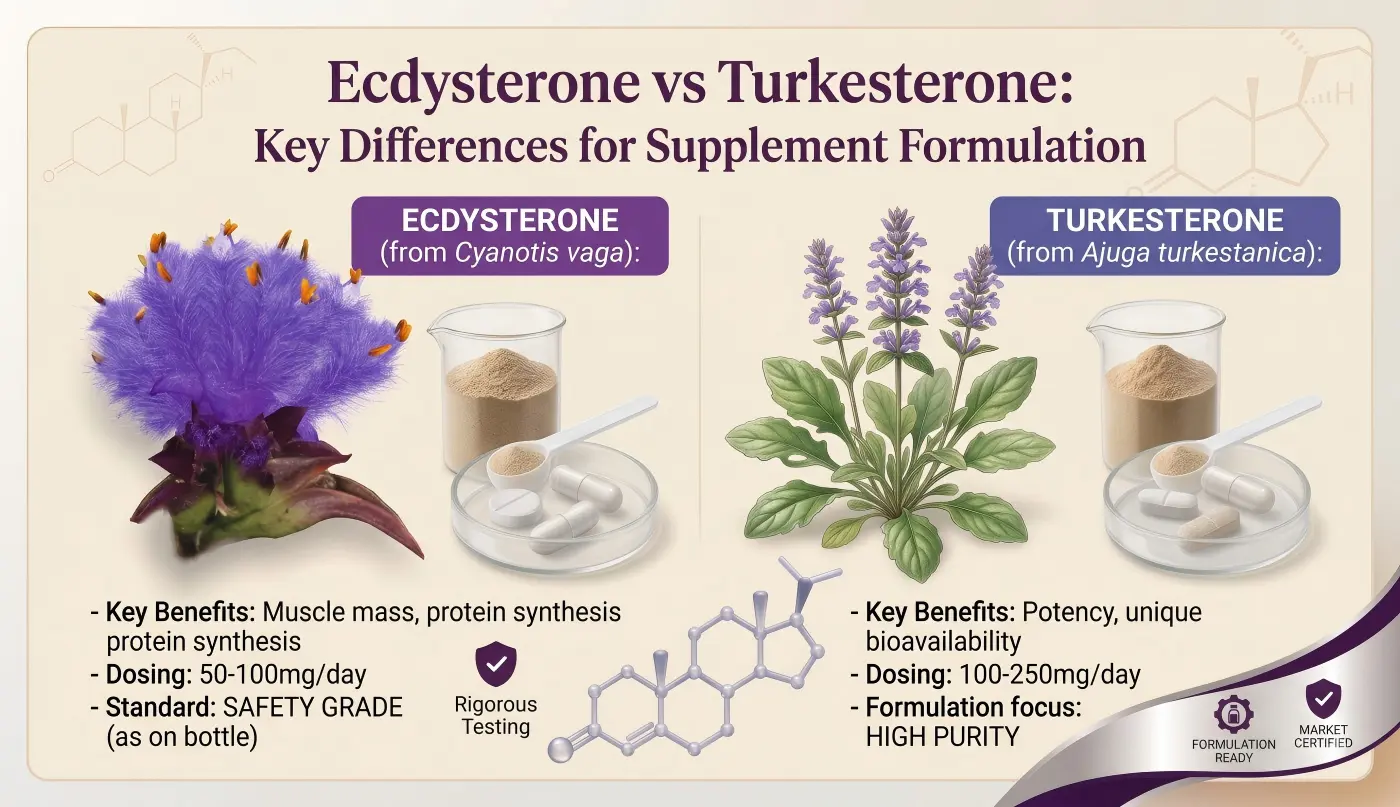
Quick Comparison
If your goal is commercial supplement development rather than ingredient speculation:
• Ecdysterone currently has stronger human evidence.
• Ecdysterone is easier to standardize and verify by HPLC.
• Ecdysterone is easier to formulate into capsules and tablets at typical serving sizes.
• Turkesterone may offer niche marketing appeal but usually carries higher sourcing uncertainty and extract-weight constraints.
Neither ingredient can currently be described as clinically superior, because direct human comparative trials do not exist.
Introduction
During formulation projects, one of the most common issues we encounter is that brands request a specific ingredient without realizing that assay and extract weight fundamentally change capsule feasibility. A client once asked for a single-capsule product delivering 500 mg of turkesterone active, not understanding that a 10% standardized extract would require 5,000 mg of powder—well beyond any standard capsule capacity. This type of mismatch is why a side-by-side comparison must start with manufacturability, not marketing claims.
Whether you are sourcing beta-ecdysterone raw material for a new product line or comparing options through an ecdysterone supplement manufacturer, the practical differences between these two ingredients determine whether a formula can actually reach production. This guide is written for procurement managers, product developers, and brand owners who need to make an ingredient selection decision based on evidence, supply chain reality, and dosage-form constraints—not hype.
It does not declare a winner. Instead, it maps the factors that should drive the choice: evidence volume, supply chain maturity, specification clarity, formulation feasibility, and total landed cost.
What Is the Difference?
Beta-Ecdysterone/20-Hydroxyecdysone
Beta-ecdysterone (CAS 5289-74-7), also known as 20-hydroxyecdysone or 20E, is a C27 steroid with hydroxyl substitutions at positions 2, 3, 14, 20, 22, and 25. It is one of the better-characterized phytoecdysteroids used in commercial supplement ingredients, typically extracted from Cyanotis arachnoidea roots [1].
In the ingredient market, ecdysterone is available in standardized grades ranging from 50% to 98% HPLC assay, with established analytical methods for potency verification.
Turkesterone
Turkesterone (CAS 41451-87-0) is structurally related to ecdysterone but carries an additional 11α-hydroxyl group, which alters its polarity and receptor-binding profile. It is most commonly associated with Ajuga turkestanica, a plant native to Central Asia, though it occurs in smaller quantities in other ecdysteroid-rich species [2].
Commercial turkesterone extracts are typically standardized to 2% or 10% turkesterone content, with the remainder comprising other ecdysteroids and plant matrix. High-assay turkesterone isolate (≥95%) is significantly more expensive and less widely available than comparable ecdysterone grades.
Clinical Evidence and Product Positioning
Why Human Evidence Matters for Product Development
For supplement brands, the volume and quality of human evidence directly affect claim substantiation risk. A brand marketing an ecdysterone product can reference a published human RCT with measured outcomes. A brand marketing a turkesterone product cannot reference equivalent human data and must rely on preclinical or mechanistic claims, which carry higher regulatory scrutiny under FDA and FTC guidelines [3].
Ecdysterone Human Evidence
Ecdysterone has been investigated in at least one peer-reviewed randomized controlled trial in healthy humans. Isenmann et al. (2019) administered 200 mg/day and 800 mg/day for 10 weeks alongside resistance training and reported significant increases in bench press one-repetition maximum and lean body mass compared with placebo, with no adverse effects on liver or kidney biomarkers [4].
While this trial has limitations—small sample size, young male population only, no long-term follow-up—it remains the strongest direct human evidence available for any phytoecdysteroid.
Turkesterone Human Evidence
As of 2026, no peer-reviewed randomized controlled trials of turkesterone in humans have been published. The existing literature consists of in vitro studies (e.g., C2C12 myotube protein synthesis assays), animal models (rat anabolic activity studies), and theoretical mechanism papers [2].
A 2024 review concluded that while in vitro potency appears higher than ecdysterone in some receptor-binding assays, this has not been confirmed in human pharmacodynamic or pharmacokinetic studies. The assumption that greater in vitro potency translates to greater human efficacy remains unproven [2].
What Cannot Be Concluded From Preclinical Data?
Preclinical studies are frequently misused in supplement marketing to imply human benefits. The following conclusions are not supported by current evidence:
• Ecdysterone has been proven to build muscle in humans. (Only one short-term RCT exists; replication is needed.)
• Turkesterone is more effective than ecdysterone in humans. (No direct comparative human trials exist.)
• Either ingredient treats or prevents any disease. (No clinical trials in disease populations have been conducted.)
For YMYL compliance, brands must avoid conflating mechanistic or animal data with human clinical outcomes.
Supply Chain and Ingredient Quality Verification
Why Assay and Standardization Matter
Standardization ensures that the active compound concentration is consistent from batch to batch. For ecdysterone, HPLC assay against a certified reference standard is the commonly used method. A non-specific UV spectrophotometric method may report total ecdysteroid-equivalent absorbance rather than selectively quantifying 20-hydroxyecdysone, so buyers should confirm what the reported assay actually measures [5].
For turkesterone, the analytical landscape is less mature. Certified reference standards are fewer, and many commercial turkesterone extracts are actually complex Ajuga turkestanica extracts with turkesterone as a minor constituent. A brand purchasing turkesterone may receive a material where the declared active represents only a fraction of the total extract weight.
Why Two Extracts With Similar Marketing Names May Not Be Equivalent
A product labeled ecdysterone containing a 95% HPLC-standardized extract from Cyanotis arachnoidea is a well-defined ingredient. A product labeled turkesterone may contain a 10% standardized Ajuga extract, a proprietary blend with undisclosed ratios, or—in some cases—a mislabeled ecdysterone extract [5].
In 2016, investigators analyzing European ecdysteroid supplements found instances where products claimed to contain spinach extract but were actually manufactured from Cyanotis arachnoidea, representing botanical identity substitution [5]. The same risk applies to turkesterone products, where the less standardized supply chain creates greater opportunity for mislabeling.
What Buyers Should Request From Suppliers
Regardless of which ingredient is selected, procurement teams should request:
• Botanical source documentation (Latin name, plant part, country of origin)
• HPLC chromatogram showing the specific active peak
• Certificate of Analysis with assay method clearly stated (HPLC vs. UV)
• Reference standard traceability (manufacturer and lot number)
• Heavy metal, microbial, and pesticide screening results
• Allergen and solvent residue statements
Batch-specific HPLC testing helps verify whether each production lot meets the agreed assay specification. For ecdysterone, this documentation is generally easier to obtain because the supply chain is more mature.
Manufacturing and Formulation
Single-Ingredient Products
Single-ingredient ecdysterone capsules or tablets are straightforward to formulate. A 500 mg serving of 90% HPLC ecdysterone extract delivers 450 mg of active compound, which fits within a size 00 capsule (fill capacity ~735 mg depending on density) or a standard tablet press configuration.
A single-ingredient turkesterone product at equivalent active delivery is more complex. If the extract is 10% standardized, delivering 500 mg of active turkesterone requires 5,000 mg of extract powder per serving—well beyond practical capsule or tablet limits. This forces brands toward either very large serving sizes, multi-capsule servings, or lower effective doses.
Combination Formulas
Both ingredients can be combined with other actives, but the total formula load must be managed. Ecdysterone’s higher assay grades allow more room in the formula for complementary ingredients such as creatine, betaine, or ashwagandha. Turkesterone’s lower assay consumes more of the available fill weight, limiting formula flexibility.
Brands should also consider that combining two unstudied ecdysteroids in a single formula creates a product with no human safety or efficacy data for the specific combination. This increases both regulatory risk and liability exposure.
Capsule and Tablet Applications
Ecdysterone high-purity extracts (≥90%) compress into tablets and flow into capsule-filling equipment with standard excipients. Turkesterone extracts, being lower-concentration botanical powders, may require additional flow agents or binders and can produce larger, harder-to-swallow tablets at equivalent active doses.
For brands manufacturing across multiple dosage forms, an ecdysterone capsule supplement manufacturer can typically accommodate high-assay material in standard capsule sizes, while an ecdysterone tablet supplement manufacturer should evaluate compression behavior during formulation trials because it depends on particle characteristics, moisture, and excipient system.
Powder Formulations
Powder formulations remove fill-weight constraints but introduce blend-uniformity and taste challenges. Ecdysterone has a taste profile that should be evaluated during development, particularly for flavored consumer-facing products. Turkesterone’s lower potency means consumers must use larger scoop sizes or accept lower per-serving active amounts.
An ecdysterone powder supplement manufacturer can produce flavored or unflavored blends with validated mixing equipment, but blend uniformity testing is essential for every batch regardless of the active ingredient.
Commercial Cost and Availability
Typical Commercial Cost Considerations
Turkesterone isolate generally commands a substantially higher cost than standardized ecdysterone extracts due to lower availability and more limited production scale. A 10% turkesterone extract requires roughly nine to ten times the extract weight of a 95% ecdysterone extract to deliver the same active dose. This multiplier affects not only raw material cost but also shipping weight, storage volume, and excipient requirements.
Ecdysterone, by contrast, is produced at metric-ton scale by multiple qualified suppliers. This maturity creates price stability, shorter lead times, and more predictable minimum order quantities (MOQs). For brands planning multi-SKU launches or subscription models, supply consistency can be as important as unit cost.
Supply Stability and Batch Consistency
Ecdysterone has an established supply chain with defined botanical sources (primarily Cyanotis arachnoidea), standardized extraction processes, and widespread HPLC verification. Turkesterone’s supply chain is narrower. Ajuga turkestanica is less widely cultivated, harvest volumes are smaller, and the number of suppliers capable of providing consistent specifications at scale is limited.
In our experience, turkesterone lots show greater batch-to-batch variability in both assay and particle characteristics than ecdysterone lots from established Cyanotis suppliers. This variability requires more intensive incoming QC and can delay production schedules if a lot fails to meet specification.
Stability and Shelf-Life Considerations
Both ecdysterone and turkesterone are relatively stable under standard storage conditions, but finished-product stability depends on the complete formula, not the active alone. Hygroscopicity of the extract, excipient compatibility, packaging barrier properties, and storage temperature all influence shelf life.
High-assay ecdysterone (≥90%) typically presents lower moisture content and less botanical matrix, which can improve stability in capsule and tablet formats. Lower-assay turkesterone extracts contain more plant matrix, which may introduce greater variability in moisture and microbial baseline. Brands should request accelerated stability data from their supplier or contract manufacturer before finalizing packaging specifications.
Which Ingredient Fits Different Product Strategies?
When Ecdysterone May Be More Practical
- The brand needs to reference human clinical data in marketing or regulatory submissions.
• The target serving size must fit within standard capsule or tablet formats.
• Supply chain stability, cost predictability, and shorter lead times are priorities.
• The brand plans to sell into markets with strict ingredient documentation requirements (EU, Canada, Australia).
• The product is intended for competitive athletes, given ecdysterone’s defined WADA monitoring status [6].
• The formula includes multiple actives where fill weight is constrained.
When Turkesterone May Be Considered
- The brand is targeting consumers specifically seeking turkesterone by name (niche demand).
• The product is positioned as a premium, limited-run offering where higher ingredient cost is acceptable.
• The brand is willing to accept higher regulatory and substantiation risk in exchange for market differentiation.
• The formulation team has access to a validated, high-integrity turkesterone supplier with full analytical documentation.
• The product format is powder, where higher extract weight per serving is less constrained.
What Should Determine the Final Choice?
The decision should be driven by a weighted assessment of: evidence base + supply consistency + specification clarity + target dosage + positioning strategy + regulatory market + total formulation cost. Ecdysterone currently scores higher on the first five factors. Turkesterone may offer niche positioning value but requires greater due diligence on the supplier side.
KS Nutripharma can assist with raw material qualification, assay verification, capsule fill-weight evaluation, tablet compression feasibility, and finished product manufacturing for either ingredient.
Why Many Brands Choose Ecdysterone Instead of Turkesterone
Over the past two years, we have observed a steady shift among B2B clients from turkesterone inquiries to ecdysterone projects. The reasons are practical, not ideological:
• Better documentation: Ecdysterone suppliers can generally provide HPLC chromatograms, reference standard traceability, and batch-specific COAs. Turkesterone documentation is often incomplete or relies on UV methods.
• Easier manufacturing: A 95% ecdysterone extract fits into standard capsules and tablets. A 10% turkesterone extract often does not, forcing reformulation or multi-capsule servings.
• Stronger evidence: One published human RCT supports ecdysterone positioning. Turkesterone has no equivalent human data, making claim substantiation more difficult under FDA and FTC guidelines.
• Lower formulation cost: Higher assay means less extract weight, lower excipient load, smaller packaging, and lower shipping cost per unit.
• Supply reliability: Established Cyanotis arachnoidea supply chains produce consistent material at scale. Ajuga turkestanica supply is more variable and subject to harvest fluctuations.
None of this means turkesterone is without value. It means that for most commercial supplement development projects—particularly those with fixed timelines, budget constraints, or multi-market distribution requirements—ecdysterone presents fewer execution risks.
Buyer Decision Checklist
Before placing a raw material order, confirm the following:
1. What is the exact chemical identity and CAS number of the declared active?
2. What is the standardization method (HPLC vs. UV) and the verified assay result?
3. What human evidence supports the intended product positioning?
4. What serving size is required to deliver the target active dose, and does it fit the chosen dosage form?
5. Is the ingredient commercially available at the required scale with consistent specifications?
6. Can the supplier provide batch-specific COAs, chromatograms, and third-party testing?
7. Does the ingredient fit the regulatory requirements of the target market?
8. What is the realistic total cost per finished unit, including extract weight, excipients, packaging, and shipping?
9. Has the supplier provided stability data for the intended storage and distribution conditions?
10. What is the documented lead time and MOQ for the required quantity?
Frequently Asked Questions
Q: Can I replace turkesterone with ecdysterone in an existing formula?
A: Not without reformulating. The two ingredients differ in assay, extract weight, and molecular structure. A direct substitution would change the serving size, active dose, and potentially the label claims. A reformulation review is required.
Q: Does a higher assay always reduce capsule count?
A: Generally yes, but not linearly. A 95% extract requires roughly half the extract weight of a 50% extract for the same active dose. However, excipient requirements, flowability, and compression behavior also influence final capsule or tablet count.
Q: Why do some turkesterone products contain very little actual turkesterone?
A: Many commercial turkesterone products are complex Ajuga turkestanica extracts with turkesterone as a minor constituent, or they rely on UV assay methods that overestimate total ecdysteroid content. Without HPLC verification, the actual turkesterone content may be significantly lower than labeled [5].
Q: Should suppliers provide an HPLC chromatogram?
A: Yes. An HPLC chromatogram showing the specific active peak (20-hydroxyecdysone or turkesterone) is the most reliable way to verify identity and assay. UV spectrophotometry alone is insufficient for selective quantification.
Q: Which ingredient is easier for global regulatory documentation?
A: Ecdysterone. Its supply chain is more mature, HPLC methods are widely established, and reference standards are readily available. Turkesterone often lacks standardized reference material, making analytical method validation and regulatory submissions more complex.
Q: Is ecdysterone the same as turkesterone?
A: No. They are structurally distinct compounds with different CAS numbers, botanical sources, research profiles, and commercial availability. Ecdysterone is 20-hydroxyecdysone (CAS 5289-74-7); turkesterone is 11α-hydroxy-20-hydroxyecdysone (CAS 41451-87-0).
Q: Which has more human research?
A: Ecdysterone. It has been studied in at least one published human RCT. Turkesterone has no published human RCTs as of 2026.
Q: Can ecdysterone and turkesterone be used interchangeably?
A: No. They differ in potency, standardization availability, formulation feasibility, and evidence base. They should not be substituted without reformulating the product.
From Ingredient Selection to Finished Product
Once the ingredient decision is made, the next steps are raw material qualification, formula development, dosage-form selection, and finished-product manufacturing. KS Nutripharma supports this entire pipeline through ecdysterone supplement manufacturing services that include raw material qualification, assay verification, capsule fill-weight evaluation, tablet compression feasibility, and finished product release.
For standardized beta-ecdysterone raw materials with full documentation packages, see Beta-Ecdysterone Raw Material. For dosage-form-specific manufacturing capabilities, see Ecdysterone Capsule Supplement Manufacturer, Ecdysterone Tablet Supplement Manufacturer, and Ecdysterone Powder Supplement Manufacturer.
References
- [1] PubChem. 20-Hydroxyecdysone | C27H44O7 | CID 5459840. National Center for Biotechnology Information, U.S. National Library of Medicine. https://pubchem.ncbi.nlm.nih.gov/compound/20-Hydroxyecdysone
- [2] Parr MK, et al. Ecdysterone and Turkesterone—Compounds with Prominent Potential in Sport and Healthy Nutrition. Nutrients. 2024;16(9):1382. https://pmc.ncbi.nlm.nih.gov/articles/PMC11085066/
- [3] FDA. New Dietary Ingredient Notification Procedures and Timeframes. 2026. https://www.mcdermottlaw.com/insights/fda-releases-final-guidance-on-new-dietary-ingredient-notification-procedures-and-timeframes/
- [4] Isenmann E, et al. Ecdysteroids as non-conventional anabolic agent: performance enhancement by ecdysterone supplementation in humans. Archives of Toxicology. 2019;93(7):1807-1816. https://pubmed.ncbi.nlm.nih.gov/31123801/
- [5] Hunyadi A, et al. Ecdysteroid-containing food supplements from Cyanotis arachnoidea on the European market: evidence for spinach product counterfeiting. Scientific Reports. 2016;6:37322. https://www.nature.com/articles/srep37322.pdf
- [6] World Anti-Doping Agency (WADA). The 2024 Monitoring Program. https://www.wada-ama.org/en/prohibited-list (see Monitoring Program section)