1. Executive Summary (30-Second Answer)
- In commercial dietary-supplement supply, L-Ergothioneine and Ergothioneine refer to the same naturally occurring compound.
- L-Ergothioneine is the stereochemically precise name for the biologically relevant isomer.
- Many suppliers, COAs, and marketing pages shorten the name to Ergothioneine.
- Buyers should specify identity, purity, production method, analytical testing, change control, and regulatory documentation—not the short name alone.
Summary Table
| Question | Short Answer |
|---|---|
| Same ingredient? | Yes |
| Different efficacy? | No |
| Different molecule? | No (same commercial active) |
| Which name is scientifically correct? | L-Ergothioneine |
| Which name appears on labels? | Either, depending on market rules and label policy |
| Should buyers care? | Yes—for documentation and release control, not for biology |
Procurement rule: Treat naming differences as a documentation alignment issue. Treat quality differences (assay, impurities, process, stability, change control, dossier support) as the real purchase risk.
2. What Is Ergothioneine?
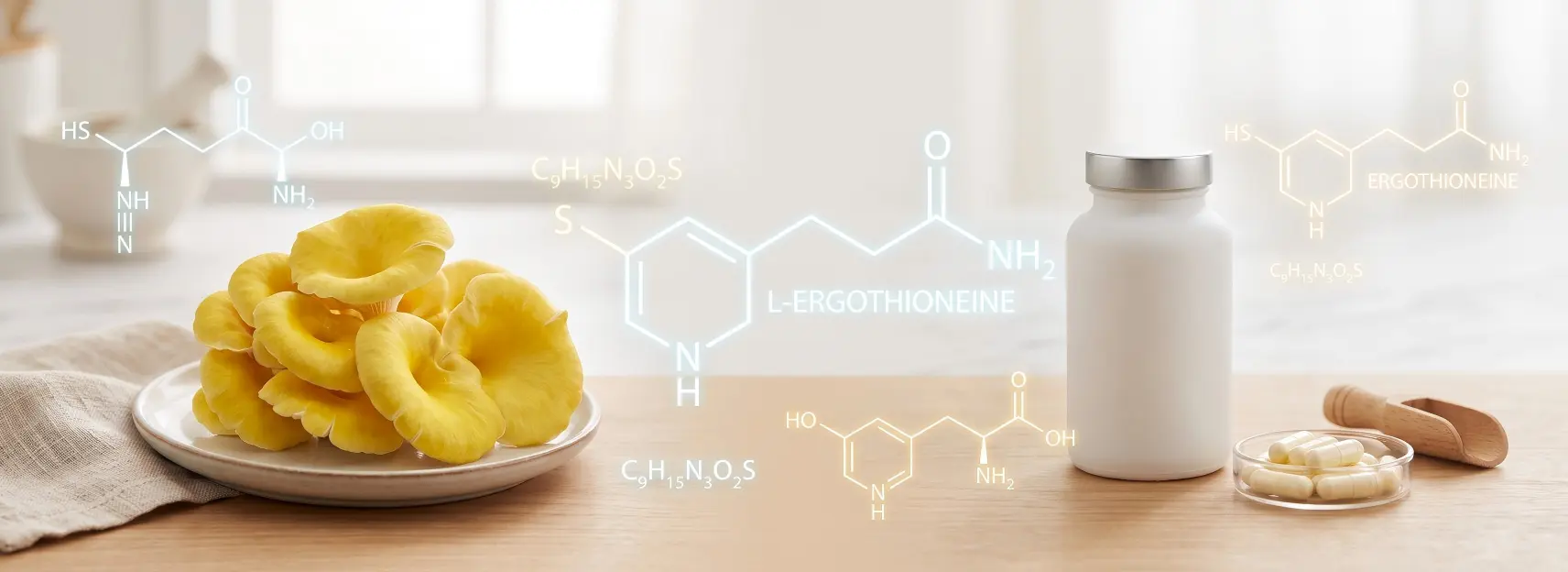
Ergothioneine is a naturally occurring sulfur-containing amino acid derivative first isolated from ergot fungus and later recognized as a dietary micronutrient concentrated in mushrooms and certain microbial sources [1][2][3].
Origin and Biology (Buyer-Relevant Facts)
- Naturally occurring L-histidine derivative
- Produced by fungi and certain bacteria; humans cannot synthesize it
- Accumulated in mushrooms and, through diet, in human tissues
- Selectively transported by OCTN1 (SLC22A4) [4]
- Discussed in the literature as a physiologic cytoprotectant [12]
- Characterized by a thione–thiol tautomerism that supports unusual chemical stability relative to many thiol antioxidants [2][5]
Chemical Identity Snapshot
| Parameter | Value |
|---|---|
| Common name | Ergothioneine |
| Stereochemical name | L-Ergothioneine |
| CAS Number | 497-30-3 |
| Molecular formula | C9H15N3O2S |
| Molecular weight | 229.30 Da |
| PubChem CID | 5351619 |
| IUPAC (representative) | (2S)-3-(2-thioxo-2,3-dihydro-1H-imidazol-4-yl)-2-(trimethylammonio)propanoate |
| Natural occurrence | Mushrooms, selected fermented foods, and microbial biosynthesis pathways |
Chemical Identifiers & Cross-References
| Registry / Identifier | Value |
|---|---|
| CAS | 497-30-3 |
| EC / EINECS | 207-843-5 |
| UNII | BDZ3DQM98W |
| PubChem CID | 5351619 |
| ChEBI | CHEBI:4828 |
| InChIKey | SSISHJJTAXXQAX-ZETCQYMHSA-N |
| InChI | InChI=1S/C9H15N3O2S/c1-12(2,3)7(8(13)14)4-6-5-10-9(15)11-6/h5,7H,4H2,1-3H3,(H2-,10,11,13,14,15)/t7-/m0/s1 |
| SMILES | CN+(C)C@@HC(=O)[O-] |
Common Synonyms Seen on Documents
Ergothioneine · L-Ergothioneine · L(+)-Ergothioneine · Thioneine · Ergothionine · 2-mercaptohistidine trimethylbetaine
Identity catalogs: PubChem CID 5351619 [6]; ChEBI:4828 [7]; UNII BDZ3DQM98W [14]. EU Novel Food specifications use the L-ergothioneine designation with CAS 497-30-3 [8][9].
3. Why Do Some Suppliers Say “L-Ergothioneine”?
Stereochemistry in Plain Procurement Language
Amino-acid-related molecules can exist as optical isomers:
| Prefix | Meaning for buyers |
|---|---|
| L- | The naturally occurring configuration relevant to human biology and commercial food/supplement supply |
| D- | The opposite optical isomer; not a meaningful commercial dietary-supplement grade for this ingredient |
| R/S | Absolute configuration nomenclature used in IUPAC/structure descriptions (L-ergothioneine corresponds to the (2S) configuration in standard descriptions) [8] |
Natural biological systems produce the L-form. OCTN1 recognition and commercial regulatory dossiers are built around L-ergothioneine [4][8][9][10].
Commercial Equivalence Statement
There is no commercially relevant D-Ergothioneine dietary-supplement category in mainstream OEM procurement.
Therefore, in practice:
Natural Ergothioneine
        │
        ▼
 L-Ergothioneine
        │
        ▼
Often abbreviated as
Ergothioneine
L-Ergothioneine = natural ergothioneine = commercial ergothioneine when the COA confirms CAS 497-30-3, L-form identity, and assay method.
Why suppliers still write “L-“:
- Regulatory templates (especially EU Novel Food) use L-ergothioneine [8][9]
- Stereochemical precision reduces dossier ambiguity
- Quality systems prefer explicit isomer language on specifications and COAs
- Marketing teams often shorten to “Ergothioneine” for readability
4. L-Ergothioneine vs. Ergothioneine Comparison Table
| Item | L-Ergothioneine | Ergothioneine |
|---|---|---|
| Chemical identity | Same commercial active | Same commercial active |
| Molecular formula | C9H15N3O2S | C9H15N3O2S |
| CAS | 497-30-3 | 497-30-3 |
| Bioactivity (as used commercially) | Same | Same |
| OCTN1 transport relevance | Same | Same |
| Stability profile | Same | Same |
| Supplement use | Same | Same |
| Regulatory acceptance | Same compound; naming style may differ by document | Same compound; naming style may differ by document |
| Label appearance | May appear as “L-Ergothioneine” | May appear as “Ergothioneine” |
| Procurement concern | Documentation + release consistency | Documentation + release consistency |
Conclusion
No functional difference exists between correctly specified L-Ergothioneine and correctly specified Ergothioneine.
The buyer risk is mismatched paperwork and weak incoming control—not mismatched biology.
5. Why Different Documents Use Different Names
Procurement teams often see one substance written five different ways across the same project file set.
| Document Type | Names You May See | Why It Happens |
|---|---|---|
| COA | L-Ergothioneine or Ergothioneine | Lab template vs commercial catalog name |
| Specification Sheet/TDS | L-Ergothioneine (≥99% HPLC) | Stereochemistry + assay precision preferred |
| SDS/MSDS | Ergothioneine or L-Ergothioneine | SDS authoring conventions vary |
| Supplement Facts | Ergothioneine or L-Ergothioneine | Brand label policy + counsel preference |
| Amazon/DTC listing | Often “Ergothioneine” | Consumer readability |
| USP/FCC style language | May default to common name where referenced | Pharmacopeial naming style |
| EU Novel Foods/EFSA texts | L-ergothioneine | Authorization designation [8][9] |
| FDA GRAS notices | Ergothioneine and/or L-Ergothioneine | Notice-specific wording [10][11] |
| Customs / commercial invoice | Often matches PO short name | Risk if invoice ≠ COA ≠ formula card |
Real Procurement Case
| Field | Supplier A | Supplier B |
|---|---|---|
| Catalog name | L-Ergothioneine | Ergothioneine |
| CAS | 497-30-3 | 497-30-3 |
| Assay | ≥99.0% HPLC | ≥99.0% HPLC |
| Process | Fermentation | Fermentation |
| Actual material | Same identity class | Same identity class |
Lesson: Do not reject or prefer a quote based on the short name alone. Align COA name, purchase order name, formula card, customs docs, and finished label under one identity policy.
Typical COA Example (Illustrative)
Illustrative values for buyer education. Not a lot-specific Certificate of Analysis. Always rely on the supplier’s current lot COA.
| Item | Example Result | Buyer Check |
|---|---|---|
| Product name | L-Ergothioneine | Matches PO / formula card policy |
| CAS | 497-30-3 | Exact match |
| Appearance | White powder | Visual vs. specification |
| Assay (HPLC) | 99.35% | ≥ agreed minimum |
| HPLC method | In-house / USP-adapted (state method ID) | Method available on request |
| Identification | Conforms (HPLC RT / spectral) | Identity gate |
| Loss on drying/moisture | 0.25% | Within limits |
| Pb | <0.05 ppm | Within heavy-metal spec. |
| Cd | ND | Within heavy-metal spec. |
| Hg | ND | Within heavy-metal spec. |
| As | <0.05 ppm | Within heavy-metal spec. |
| Residual solvents | Conforms (USP <467>) | Process-route solvents listed |
| Microbiology | Conforms | Pathogens absent |
| Shelf life/retest | 24–36 months (example) | Supported by stability summary |
| Storage | Cool, dry, sealed | Warehouse instruction matches |
6. What Should Buyers Actually Specify Instead?
This is the decision that protects labels, registrations, and launch timelines.
Identity
Common Specification Comparison: 98% vs 99% vs 99.5%
| Grade (HPLC) | Typical Use Case | Buyer Trade-Off |
|---|---|---|
| ≥98% | Cost-sensitive industrial entry | Confirm impurity profile; may need tighter in-house release rules |
| ≥99% | Most premium supplement projects | Best balance of cost, documentation, and QA acceptance |
| ≥99.5% | High-spec / Novel Food–aligned programs | Higher cost; stronger dossier optics [8] |
Request: assay as % L-ergothioneine, not ambiguous “total related substances only.”
Residual Solvents
Heavy Metals
With method (ICP-MS preferred) and limits stated on COA.
Microbiology
Plus any market-specific pathogens required by your QA matrix.
Physical Parameters
Moisture/Stability/Shelf Life/Storage
Buyer Specification Checklist (Copy Into RFQ)
- L-Ergothioneine, CAS 497-30-3
- Assay ≥XX% by HPLC (state your minimum)
- Production method disclosed
- Residual solvents (USP <467>)
- Heavy metals (Pb, Cd, Hg, As)
- Microbiology panel
- Particle size + bulk density
- Moisture/LOD
- Shelf life + storage
- Full document pack: COA, TDS, SDS, allergen, GMO, process flow, batch traceability
- Change-control commitment + notification timeline
- Destination-market regulatory support letter / notice references as applicable
Serving math after identity lock: Ergothioneine Dosage · Process fit: Formulation Guide.
7. Fermentation vs Synthetic Ergothioneine
Naming (L- vs short form) is not the same question as production route.
| Factor | Fermentation-Derived | Chemical Synthesis |
|---|---|---|
| Output identity | L-Ergothioneine (nature-identical) | Can yield L-Ergothioneine when process-controlled |
| Cost trajectory | Generally improving with scale | Often higher cost/waste burden at scale |
| Purity potential | High HPLC purity common | High purity achievable; solvent/impurity control critical |
| Environmental / ESG narrative | Often preferred by brand sustainability teams | More scrutiny on solvents and step economy |
| Scalability | Strong for supplement volumes | Technically feasible; commercially less common for many SKUs |
| Regulatory history | Multiple U.S. GRAS pathways for fermentation-derived material [10][11]; EU history includes synthetic L-ergothioneine authorization language [8][9] | EU Novel Food pathway historically included synthetic L-ergothioneine (Tetrahedron) [8][9] |
Fermentation-derived ingredients are frequently preferred by supplement brands because of supply scalability and documentation familiarity. However, production route alone should not be interpreted as evidence of superior efficacy. Identity, purity, impurity profile, stability, and regulatory compliance remain the primary purchasing criteria.
8. Regulatory Naming Around the World
Notice: Always verify the current legal text for your SKU class. The table below is a buyer orientation snapshot, not legal advice.
| Market | Naming Tendency | Buyer Implications |
|---|---|---|
| United States | GRAS notices use ergothioneine / L-ergothioneine language depending on notice [10][11] | Align Supplement Facts name with identity docs; keep structure/function claims compliant; match intended use to applicable notice scope where relied upon |
| European Union | Authorization designation: L-ergothioneine [8][9][13] | Label designation and dossier language should follow Novel Food naming; respect maximum use levels for supplements |
| United Kingdom | Novel food framework post-Brexit—confirm continuity for your product | Don’t assume EU wording auto-transfers without UK check |
| Canada | Natural health product/food pathway depends on product class | Confirm monograph/licence naming expectations before artwork freeze |
| Australia / New Zealand | FSANZ / complementary medicine pathway may apply | Local assessment needed; do not copy U.S./EU label names blindly |
| Japan | Food with function claims/food additive pathways differ by category | Case-by-case dossier and naming review |
| China | Health food / novel food-type pathways are category-specific | Require stereochemical identity, process, and local dossier naming consistency through counsel (without assuming one universal English label form) |
What Naming Affects—and What It Does Not
| Topic | Affected by L- vs Ergothioneine wording? |
|---|---|
| Biology/efficacy | No, if same verified substance |
| Patent landscape | Possibly—patent claims may use specific chemical naming; counsel review recommended |
| Registration dossiers | Yes—consistency across forms matters |
| Marketing copy | Yes—claim substantiation files should use one primary identity string |
| Customs/import docs | Yes—PO, invoice, and COA names should match |
9. Labeling Considerations for Supplement Brands
Which Name Goes Where?
| Location | Typical Practice | Recommendation |
|---|---|---|
| Supplement Facts | Ergothioneine or L-Ergothioneine | Pick one primary name and keep it consistent with COA/formula card |
| Ingredient Statement | Same as Supplement Facts policy | Avoid switching mid-SKU family without regulatory review |
| Marketing claims / PDP | Often shortened to Ergothioneine | Allow short name in prose if legal name is locked on facts panel |
| EU packaged foods/supplements | Prefer authorization designation L-ergothioneine where required [8] | Follow local labeling designation rules |
| Private label / OEM formula cards | L-Ergothioneine (CAS 497-30-3) | Best practice for manufacturing clarity |
| Trademarked branded ingredients | Brand + generic identity | Always disclose generic L-ergothioneine/ergothioneine identity beneath trademark |
| Customs declaration | Usually follows commercial invoice / PO name | Force alignment with COA CAS + agreed English identity string |
When to Use INCI vs IUPAC vs Common Name
Name Type | When It Matters |
|---|---|
| Common name (Ergothioneine) | Consumer-facing U.S.-style readability; many DTC listings |
| L-Ergothioneine | Specs, COAs, EU-oriented dossiers, QA systems |
| IUPAC | Full chemical identity in TDS, patents, detailed regulatory annexes |
| INCI | Cosmetic/topical formulas (not a substitute for dietary-supplement facts-panel rules) |
OEM tip: Your contract manufacturer should freeze a Label Identity String before artwork:
Example:
L-Ergothioneine (Ergothioneine), CAS 497-30-3, providing X mg per serving
Finished-SKU support: Ergothioneine Supplements OEM.
10. How to Verify You Are Buying Genuine L-Ergothioneine
Document Pack to Request
Analytical Methods Explained (What Each Test Is For)
| Method | Primary Job | When Buyers Should Require It |
|---|---|---|
| HPLC assay | Quantify % L-ergothioneine for release and label math | Every commercial lot |
| HPLC identity / RT match | Confirm peak identity vs reference | Every commercial lot |
| LC-MS | Orthogonal identity/impurity investigation | Qualification, investigations, high-risk markets |
| NMR | Structural confirmation | Initial supplier qualification/method disputes |
| ICP-MS | Pb, Cd, Hg, As (and other elements as needed) | Every commercial lot or agreed skip-lot program |
| Residual solvents (GC) | Process solvent control vs USP <467> | Every lot for solvent-using routes; verify fermentation residuals as applicable |
| Microbiology | Hygiene/pathogen control | Every commercial lot (or justified reduced testing after history) |
| LOD / Karl Fischer | Moisture control affecting stability and assay | Every commercial lot |
Supplier Evaluation Scorecard
How to use: Score each criterion from 1 (poor) to 5 (excellent). Multiply Score × Weight to get the weighted contribution. Sum all weighted scores for a 0–5 final index.
Qualification rule: Final index ≥ 4.0 = Approved for scale-up · 3.0–3.9 = Conditional · < 3.0 = Do not scale.
# | Criterion | Weight | Score (1–5) | Weighted Score (Score × Weight) | Notes / Evidence |
|---|---|---|---|---|---|
| 1 | Identity clarity (CAS + L-form + method) | 0.15 | |||
| 2 | Assay rigor (HPLC method transparency) | 0.15 | |||
| 3 | Impurity/solvent/metals control | 0.15 | |||
| 4 | Process disclosure (fermentation vs synthesis) | 0.10 | |||
| 5 | Regulatory documentation for target markets | 0.15 | |||
| 6 | Traceability + GMP/ISO evidence | 0.10 | |||
| 7 | Stability + packaging suitability | 0.10 | |||
| 8 | Commercial reliability (lead time, MOQ, change control) | 0.10 | |||
| — | Final index | 1.00 | — | Sum of weighted scores | Target ≥ 4.0 |
Worked example (illustrative only):
Criterion | Weight | Score | Weighted Score |
|---|---|---|---|
| Identity clarity | 0.15 | 5 | 0.75 |
| Assay rigor | 0.15 | 4 | 0.60 |
| Impurity/solvent/metals | 0.15 | 4 | 0.60 |
| Process disclosure | 0.10 | 5 | 0.50 |
| Regulatory documentation | 0.15 | 4 | 0.60 |
| Traceability + GMP/ISO | 0.10 | 4 | 0.40 |
| Stability + packaging | 0.10 | 3 | 0.30 |
| Commercial reliability | 0.10 | 4 | 0.40 |
| Final index | 1.00 | — | 4.15 (Approved) |
11. Inside Our QC Lab
Every incoming batch intended for production is verified before release. First-party testing is how naming debates become controllable quality decisions.
Identity Confirmation Process
- HPLC assay verification against specification
- Reference-standard comparison (retention time/system suitability)
- ICP-MS heavy metals panel
- Microbial testing
- Moisture / loss-on-drying verification
- Packaging integrity inspection (seal, label, lot code, damage)
Evidence Assets to Publish With This Page
Place real media here on the live site (Evidence > Explanation):
[Insert: representative HPLC chromatogram][Insert: ICP-MS instrument / metals bench photo][Insert: QC laboratory overview photo][Insert: retained-sample archive / warehouse sampling photo]
Why this matters for EEAT: Buyers and search engines both reward demonstrable quality systems over generic ingredient descriptions.
12. Incoming Inspection Workflow
If you are spending five- or six-figure purchase orders, the question is not “What is L-Ergothioneine?”—it is “How do we verify this lot before it enters production?”
Supplier ships lot
        ↓
Warehouse receipt (ID, qty, seal, COA present?)
        ↓
Quarantine hold
        ↓
Sampling (statistically justified / SOP-defined)
        ↓
Identity test
        ↓
Assay (HPLC)
        ↓
Heavy metals + micro + moisture (per matrix)
        ↓
QA disposition
        ↓
Release to production inventory
        ↓
Finished-goods manufacturing
Minimum Incoming Gate Checks
Gate | Fail Action |
|---|---|
| COA missing / lot mismatch | Hold; do not sample into production |
| Name/CAS mismatch vs PO | Hold; documentation correction or reject |
| Assay below specification | Deviation / reject |
| Metals or micro OOS | Reject or investigate per SOP |
| Damaged packaging / wet product | Quarantine; may reject without assay |
13. Batch Release Decision Tree
Batch Received
      ↓
Identity Pass?
      ├─ No → Reject / Return-to-Vendor
      └─ Yes
            ↓
      Assay ≥ agreed spec (e.g., ≥99%)?
            ├─ No → Deviation Investigation
            │         ├─ Confirmed OOS → Reject
            │         └─ Lab error proven → Retest per SOP
            └─ Yes
                  ↓
            Heavy Metals Pass?
                  ├─ No → Reject / Investigate
                  └─ Yes
                        ↓
                  Microbiology Pass?
                        ├─ No → Reject / Investigate
                        └─ Yes
                              ↓
                        Moisture / solvents / appearance Pass?
                              ├─ No → Hold / CAPA path
                              └─ Yes → QA RELEASE
Buyer instruction to CMO/OEM: Do not allow “COA only, no incoming assay” for first qualification lots. Skip-lot programs belong after demonstrated supplier history—not on lot #1.
14. Supplier Change Control
In OEM procurement, change control often matters more than a single assay number.
Changes That Should Trigger Customer Notification/Re-approval
Change Type | Why It Matters | Typical Buyer Action |
|---|---|---|
| Production site | Impurity fingerprint, logistics, audit status | Re-qualify / audit |
| Fermentation media / critical process aids | Residual risk, allergen narrative | Document review + may retest |
| HPLC method/reference standard | Assay comparability | Method bridge / parallel testing |
| Particle size/milling | Blend uniformity, capsule fill | Pilot confirmation |
| Primary packaging | Moisture ingress, shelf life | Stability check |
| Specification limits | Label and release impact | Formal approval |
| Sub-supplier of critical intermediates | Traceability break | Risk assessment |
Supplier proposes change
        ↓
Written change notification
        ↓
Buyer QA / Regulatory impact review
        ↓
Need customer approval?
        ├─ Yes → Approve / Conditional approve / Reject
        └─ No (pre-agreed minor) → Notify + file
        ↓
Update specs, COA templates, stability files
        ↓
Resume supply under new controlled state
Require a written change-control commitment in the supply agreement—not only in a sales email.
15. Procurement Risk Matrix
Risk | Probability | Impact | Primary Control |
|---|---|---|---|
| Wrong CAS / wrong identity | Low | High | Incoming identity + CAS lock on PO/COA |
| Label name inconsistency (L- vs short form) | Medium | High | Frozen Label Identity String |
| Moisture pickup | Medium | Medium | Packaging + warehouse humidity control |
| Stability failure in finished format | Medium | High | Format-specific stability + overage policy |
| Undisclosed supplier process change | Low–Medium | High | Contractual change control |
| Assay method drift between labs | Medium | High | Method sharing/bridging studies |
| Customs docs ≠ COA name | Medium | Medium–High | Invoice/COA/PO alignment SOP |
| Trademark vs generic confusion | Medium | Medium | Dual naming on formula card |
16. Supplier Qualification & Audit Checklist
Upgrade from “request a COA” to qualify a quality system.
Supplier Audit / Qualification Scope
Qualification Status Definitions
| Status | Meaning |
|---|---|
| Approved | Cleared for commercial POs |
| Conditional | Limited lots / enhanced testing |
| Disqualified | Do not purchase until CAPA closes |
17. Procurement Timeline & Typical OEM Project Workflow
RFQ
 ↓
NDA
 ↓
Specification alignment (name, CAS, assay, docs)
 ↓
Sample + TDS/COA review
 ↓
Incoming lab confirmation
 ↓
Pilot formula (capsule / powder / gummy / etc.)
 ↓
Stability / process retention check
 ↓
Artwork + Supplement Facts lock
 ↓
Commercial production
 ↓
Shipment / import docs
 ↓
Commercial launch
 ↓
Post-launch skip-lot / annual re-qualification
Stage | Typical Buyer Deliverable |
|---|---|
| RFQ | Target assay, format, annual volume, markets |
| Spec lock | Signed specification + Label Identity String |
| Sample | 50–200 g typical for R&D (project-dependent) |
| Pilot | Soft-tooling / small batch with assay retention |
| Artwork | Facts panel matches released assay math |
| Launch | Lot genealogy filed with finished-goods batch record |
OEM Service Partner: Ergothioneine Supplements OEM.
18. Packaging Compatibility by Dosage Form
Format | Suitability | Buyer Note |
|---|---|---|
| Capsules | Suitable | Highest dose-fidelity path for most brands |
| Tablets | Suitable | Confirm compressibility / content uniformity at low mg loads |
| Powder/stick pack | Suitable | Premix strategy critical for micro-dosing uniformity |
| Sachets | Suitable | Barrier film selection matters for moisture |
| Gummies | Conditional | Need process-loss and shelf assay validation |
| Functional drinks / RTD | Conditional | pH, heat, and light stress require stability proof |
| Softgels | Generally unsuitable without specialized design | Hydrophilic active in oil fill usually needs dual-phase / special delivery rationale |
19. Ingredient Compatibility Matrix (Formulation Stacks)
Compatibility below refers to common commercial co-formulation feasibility, not clinical synergy claims.
Companion Ingredient | Compatibility | Formulation Notes |
|---|---|---|
| Vitamin C | High | Common antioxidant stack; watch total acid load/moisture |
| NAC | High–Moderate | Moisture and odor control recommended |
| CoQ10 | High–Moderate | Different polarity—softgel/oil systems may split from powder EGT |
| NMN | High | Popular longevity stack; humidity control essential |
| PQQ | High | Common cellular/mitochondrial concepts |
| Glutathione | High | Dual-antioxidant positioning; keep identities distinct on label |
| Resveratrol | High | Healthy-aging concept; polyphenol handling differs from EGT |
| Astaxanthin | High–Moderate | Often softgel; may require dual-unit or bilayer strategy |
| Spermidine | High | Longevity positioning; verify each market’s regulatory status |
Stack serving logic: Ergothioneine Dosage · Longevity concepts: Ergothioneine for Longevity Supplements.
20. Stability by Dosage Form
Dosage Form | Primary Stability Risks | Buyer Control |
|---|---|---|
| Capsule | Moisture ingress, blend segregation | Desiccant, barrier bottle/blister, blend validation |
| Tablet | Compression heat/moisture, assay uniformity | Process DOE + content uniformity |
| Powder/stick | Hygroscopicity, dose uniformity | Premix, foil barrier, humidity-mapped fill |
| Gummy | Heat/pH during cook, water activity | Pilot HPLC after process + real-time stability |
| RTD / drink | Thermal process, light, pH | Challenge study before claim lock |
Rule: Bulk powder shelf life ≠ finished-product shelf life. Set expiry from the finished format.
21. Common Non-Conformities & CAPA Examples
Non-Conformity | Likely Root Cause | Example CAPA Direction |
|---|---|---|
| Assay below COA claim on incoming test | Method difference, moisture, wrong dilution, true OOS | Method bridge; retain sample retest; supplier investigation |
| Name on COA ≠ name on label artwork | No frozen identity string | Document control + artwork checklist gate |
| High moisture on receipt | Packaging breach/humidity exposure | Packaging upgrade; warehouse mapping; reject lot |
| Metals near limit | Process contamination / raw input drift | Supplier CAPA; tightened incoming metals frequency |
| Gummy assay drift at 3–6 months | Process loss + water activity | Reformulate; validated overage; barrier pack |
| Undisclosed site change | Weak change control | Contract amendment; re-audit; conditional status |
22. Common Procurement Mistakes
Mistake 1 — Thinking they are different ingredients
Rejecting a qualified supplier because the catalog says “Ergothioneine” instead of “L-Ergothioneine.”
Mistake 2 — Buying based only on purity
A 99.5% claim without method, impurity profile, or solvents data is incomplete.
Mistake 3 — Ignoring production method
Fermentation vs synthesis changes dossier expectations, impurity fingerprints, and brand narrative—even when CAS matches.
Mistake 4 — Ignoring stability and packaging
Assay on receipt is not assay at expiry—especially in humid climates or gummy/drink processes.
Mistake 5 — Ignoring regulatory documentation
Clinical papers and competitor labels are not market authorizations.
Mistake 6 — Confusing trademark ingredients with generic ergothioneine
Branded raw materials can be excellent, but your label and COA must still identify the generic substance and assay-true milligrams.
Mistake 7 — Letting Amazon copy dictate the COA name
Consumer copy can shorten the name; release documents should not become ambiguous.
Mistake 8 — Skipping change control
A process, site, or assay method change can invalidate prior stability and regulatory assumptions.
Mistake 9 — Skipping incoming verification after “nice COA PDF”
Paper conformity is not lot conformity.
Mistake 10 — Freezing artwork before assay math and identity string are locked
Relabeling and Amazon relisting costs exceed the cost of a proper pilot.
23. Frequently Asked Questions
Is L-Ergothioneine better than Ergothioneine?
No—not when both names describe the same verified L-form material (CAS 497-30-3).
Is Ergothioneine naturally the L-form?
Yes. Commercial and biological references center on L-ergothioneine [2][4][7].
Are there D-Ergothioneine supplements?
Not as a meaningful mainstream dietary-supplement category. Buyers should still require L-form identity on documentation.
Which name should appear on Supplement Facts?
Either can appear depending on market and counsel preference. Lock one primary string and keep COA/formula card aligned. EU-facing products should respect the L-ergothioneine designation where required [8].
Can a COA say “Ergothioneine” while the formula card says “L-Ergothioneine”?
Yes, if both clearly refer to CAS 497-30-3 and your identity policy accepts dual naming. Prefer one controlled primary string to reduce release errors.
Does the CAS number change between L-Ergothioneine and Ergothioneine?
No—for the commercial L-form used in food/supplement dossiers, CAS remains 497-30-3 [6][8][10].
Does USP recognize both names?
USP-style references and supplier methods may use the common name; your release specification should still lock CAS, stereochemistry, and assay method. Confirm any monograph language with current pharmacopeial sources and counsel.
What name should appear on a customs declaration?
Use the commercial identity agreed on the PO/invoice and ensure it reconciles to the COA CAS and product code. Inconsistency here creates holds more often than biology debates do.
Can I substitute Ergothioneine for L-Ergothioneine in a formula?
If both lots meet the same identity, assay, and regulatory documentation requirements, they are typically treated as the same active. Update naming consistency across PO, BOM, and label.
Does naming affect efficacy?
No. Quality, dose, delivery format, and compliance affect product performance and risk—not the short vs L- prefix alone. Dose design: Ergothioneine Dosage.
Does EFSA / EU Novel Food use L-Ergothioneine?
Yes. EU authorization language designates L-ergothioneine [8][9].
Is fermentation-derived better?
Fermentation-derived materials are frequently preferred for scalability and documentation familiarity. Production route alone is not evidence of superior efficacy; verify identity, purity, impurities, stability, and compliance.
What purity should brands request?
Many premium projects specify ≥99% HPLC; some high-spec programs target ≥99.5%. Choose based on formula risk, market expectations, and cost—not prestige alone [8].
Can I formulate gummies with L-Ergothioneine?
Yes, with process-loss and stability validation. Format notes: Formulation Guide.
Is 99% always necessary?
Not always. It is a common commercial target. Lower assay grades may be usable if impurity controls and labeled active milligrams remain true—but many brand QA teams standardize at ≥99%.
Do patents care about the name?
Patent claims may use specific chemical language. Naming on a brochure is not a freedom-to-operate opinion—request IP review when launching differentiated processes or branded complexes.
Why do OEM formulas write L-Ergothioneine while the website says Ergothioneine?
Manufacturing documents prefer stereochemical precision; consumer pages prefer readability. Both can be correct if identity is controlled.
What documents prevent the most launch delays?
Lot COA + HPLC method clarity + heavy metals/micro + process declaration + change-control commitment + destination-market regulatory support pack.
Should every lot be re-tested on incoming?
For new suppliers and early commercial lots: yes for identity/assay at minimum. Skip-lot programs are earned by history, not promised in a pitch deck.
24. Related Resources
- What Is Ergothioneine? Sources, Chemistry & Buying Guide
- Ergothioneine Benefits: Antioxidant, Longevity & Cellular Support
- Ergothioneine Dosage: Serving Design for Supplement Brands
- Ergothioneine Formulation Guide: Powder, Capsules & Stacks
- Best Ergothioneine Supplements: How Brands Compare Specs & Formats
- Ergothioneine Supplements OEM
25. Need Pharmaceutical-Grade L-Ergothioneine for Your Next Supplement?
KS Nutripharma supports brand, OEM, and private-label teams with procurement-ready documentation, incoming-quality logic, and finished-SKU manufacturing.
- Fermentation-derived L-Ergothioneine (≥99% HPLC options; higher assay grades on request)
- OEM/ODM support for capsules, tablets, gummies, powders, and sachets
- Documentation pack: COA, TDS, SDS, allergen statement, GMO statement, stability summary
- Incoming inspection support and batch-release documentation discipline
- Pilot batches and commercial-scale production
- Regulatory support orientation for global market projects
- Custom formulation and packaging services
KS Nutripharma — L-Ergothioneine specification alignment, QC-backed supply, and OEM manufacturing
Ingredient Manufacturer · Ergothioneine Supplements OEM
References
In-text citations use square brackets corresponding to the numbered list below.
- Kalaras M. D., Richie J. P., Calcagnotto A., Beelman R. B. (2017). Mushrooms: A rich source of the antioxidants ergothioneine and glutathione. Food Chemistry, 233, 429–433. https://doi.org/10.1016/j.foodchem.2017.04.109
- Cheah I. K., Halliwell B. (2021). Ergothioneine, recent developments. Redox Biology, 42, 101868. https://doi.org/10.1016/j.redox.2021.101868
- Borodina I., et al. (2020). The biology of ergothioneine, an antioxidant nutraceutical. Nutrition Research Reviews. https://doi.org/10.1017/S0954422419000301
- Gründemann D., Harlfinger S., Golz S., et al. (2005). Discovery of the ergothioneine transporter. PNAS, 102(14), 5256–5261. https://doi.org/10.1073/pnas.0408624102
- Halliwell B., Cheah I. K., Tang R. M. Y. (2018). Ergothioneine – A diet-derived antioxidant with therapeutic potential. FEBS Letters, 592(20), 3357–3366. https://doi.org/10.1002/1873-3468.13123
- PubChem. Ergothioneine (CID 5351619). National Library of Medicine. https://pubchem.ncbi.nlm.nih.gov/compound/5351619
- ChEBI. ergothioneine (CHEBI:4828). https://www.ebi.ac.uk/chebi/CHEBI:4828
- European Commission. Commission Implementing Regulation (EU) 2018/462 (L-ergothioneine as a novel food). https://eur-lex.europa.eu/eli/reg_impl/2018/462/oj
- Commission Implementing Decision (EU) 2017/1281 authorising L-ergothioneine as a novel food ingredient. https://www.legislation.gov.uk/eudn/2017/1281
- U.S. FDA. GRAS Notice Inventory — GRN 734 (Ergothioneine, Blue California). https://hfpappexternal.fda.gov/scripts/fdcc/index.cfm?id=734&set=GRASNotices
- U.S. FDA. GRAS Notice Inventory — GRN 1270 (L-ergothioneine, Gene III Biotechnology). https://hfpappexternal.fda.gov/scripts/fdcc/index.cfm?id=1270&set=GRASNotices
- Paul B. D., Snyder S. H. (2010). The unusual amino acid L-ergothioneine is a physiologic cytoprotectant. Cell Death & Differentiation, 17, 1134–1140. https://doi.org/10.1038/cdd.2009.163
- EFSA NDA Panel (2016). Safety of synthetic l-ergothioneine (Ergoneine®) as a novel food pursuant to Regulation (EC) No 258/97. EFSA Journal. https://doi.org/10.2903/j.efsa.2016.4629
- U.S. FDA / NCATS. UNII BDZ3DQM98W (Ergothioneine). https://precision.fda.gov/uniisearch/srs/unii/BDZ3DQM98W
Educational content for supplement buyers, formulators, and regulatory teams. Not medical advice. Confirm identity statements, label copy, and market authorizations with qualified counsel before commercialization.