

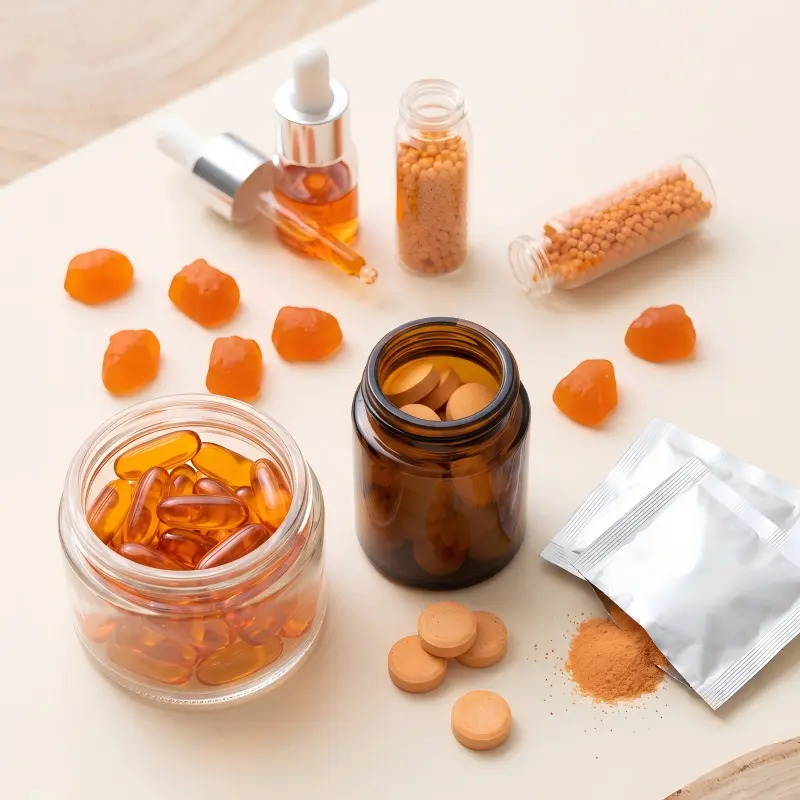
Beta Carotene Tablets & Capsules Contract Manufacturing
KS Nutripharma® manufactures custom beta carotene tablets and capsules for supplement brands, with additional options for softgels, gummies, powders, sachets and liquid formats. The finished product is developed from the beta carotene ingredient specification, rather than selecting a dosage form first and fitting the ingredient afterward.
For each project, the formulation review can consider:
- Beta carotene source and assay
- Powder, beadlet, CWS or oil-based ingredient system
- Target beta carotene amount per serving
- Total formula weight
- Bulk density and flow properties
- Number of active ingredients
- Tablet or capsule feasibility
- Packaging and light protection
- Testing and documentation requirements
- Target market and labeling requirements
This approach is particularly important for beta carotene because the raw material concentration and delivery system can substantially affect the amount of ingredient required in each finished unit.
Beta Carotene Project Snapshot
- OEM / ODM / Private Label
Tablets & Capsules · Softgels · Gummies · Powders · Sachets · Liquids - MOQ: 3,000–5,000 units/SKU for tablets & capsules · 1,000–3,000 for powders/sachets
- Sample: 7–15 days · Pilot: 15–25 days · Production: 30–45 days
- cGMP Manufacturing · ISO 9001 · ISO 22000 · FSSC 22000 · HACCP · Halal · Kosher
- Initial Response: Within 1 business day
- MOQ, lead time and capacity are project-dependent and confirmed after reviewing the formula, specifications, raw materials and production requirements.
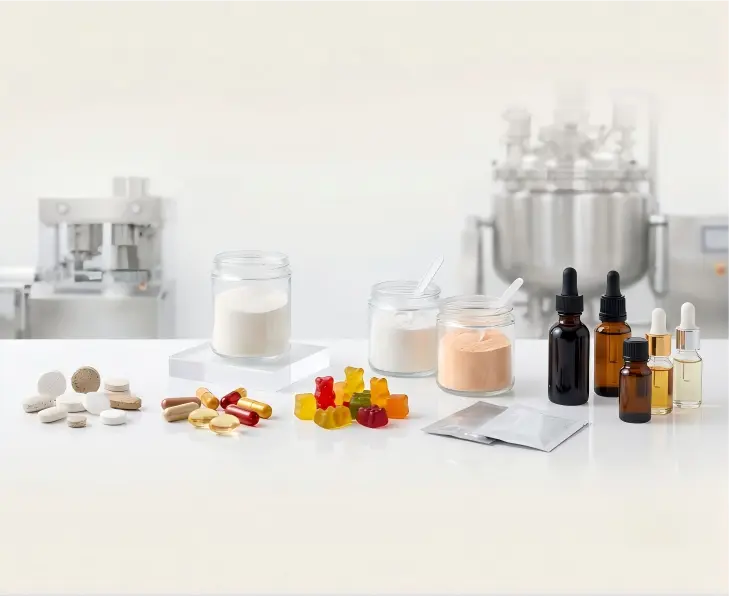
Beta Carotene Ingredient Systems
The choice of beta carotene ingredient affects the required inclusion level, handling characteristics and suitable dosage forms.
KS Nutripharma can evaluate different beta carotene ingredient systems according to the target finished product.
| Ingredient System | Typical Strength | Main Formulation Characteristics | Potential Applications |
|---|---|---|---|
| Standard beta carotene powder | 5%–96% | High active concentration; specification-dependent handling characteristics | Tablets, capsules, powders |
| Beta carotene beadlets | 1%–10% | Carrier-based system designed for powder handling and formulation | Tablets, capsules, gummies |
| CWS microencapsulated beta carotene | 1%–10% | Water-dispersible system for selected applications | Powders, gummies, beverage concepts |
| Beta carotene oil suspension | 10%–30% | Oil-based delivery system | Softgels, oil-based liquids |
Available strength, carrier system and source must be confirmed against the specific ingredient specification and product requirements.
| Product | Typical strength |
| Beta Carotene Softgel | 10,000 IU (≈6 mg beta-carotene, ≈3,000 mcg RAE) |
| Beta Carotene Softgel | 25,000 IU (≈15 mg beta-carotene, ≈7,500 mcg RAE) |
| Beta Carotene Capsule / Tablet | 15 mg |
| Mixed Carotenoid Formula | Custom |
Reference strengths commonly seen on retail products; IU appears on legacy labels or in specific markets — current US labels declare vitamin A activity in mcg RAE (1 mcg RAE = 2 mcg supplemental beta-carotene). Reference amounts only: Final potency and vitamin A declarations are confirmed during destination-market regulatory review; high-dose products require additional safety assessment.
Natural vs. Synthetic Beta Carotene
Beta carotene can be sourced from different production systems. The appropriate choice depends on the target market, labeling position, raw-material specification, cost target and documentation requirements.
| Source | Considerations | Typical Commercial Positioning |
|---|---|---|
| Blakeslea trispora fermentation | Fermentation-derived beta carotene; source and production documentation should be available for applicable claims | Natural-origin positioning where permitted |
| Synthetic beta carotene | Consistent standardized material and generally cost-efficient | Standardized / mainstream formulations |
| Dunaliella salina algae | Algal source with a carotenoid profile defined by the ingredient specification | Premium natural-origin positioning |
A natural-origin claim should not be based on the ingredient name alone. Source, manufacturing process and destination-market requirements must support the claim.
Beta Carotene Ingredient-to-Format Matching
| Ingredient System | Typical Strength | Main Characteristics | Potential Formats |
|---|---|---|---|
| Standard beta carotene powder | 5–96% | High active concentration; handling and flow characteristics depend on the specification | Tablets, capsules, powders |
| Beta carotene beadlets | 1–10% | Carrier-based system; handling and flow characteristics depend on the beadlet specification | Tablets, capsules, gummies |
| CWS microencapsulated beta carotene | 1–10% | Designed for water-dispersible applications; final dispersion and stability depend on the finished formula | Powders, gummies, beverages |
| Beta carotene oil suspension | 10–30% | Oil-based delivery system typically evaluated for softgels or oil-based liquid formulations | Softgels, oil-based liquids |
Formulation & Sourcing Considerations
Ingredient concentration should be evaluated together with dosage form and delivery system. Higher-assay powders may reduce raw-material inclusion, while lower-assay beadlets can increase total fill weight. CWS and oil-based systems require different formulation approaches for dispersion, processing and stability. Final potency, source, availability and documentation are confirmed for each project, with natural-origin claims subject to destination-market requirements.
Tablet vs. Capsule: Which Format Should You Choose?
| Considerations | Beta Carotene Tablets | Beta Carotene Capsules |
| Low-dose beta carotene | Suitable | Suitable |
| Single-ingredient formula | Suitable | Very suitable |
| Multi-ingredient formula | Suitable | Suitable |
| Higher total fill weight | Generally more flexible | May require larger capsule or multiple units |
| Vegan positioning | Suitable (tablet core can be vegetarian) | HPMC capsule required |
| Custom appearance | High flexibility — shape, size, color, coating | More limited — shell color and imprint |
| Film coating | Available (recommended for light protection) | Not applicable to standard hard capsules |
| Powder / beadlet systems | Depends on formulation and compressibility | Often suitable |
| Best suited for | Multivitamins, combination formulas, high-volume products | Simple formulas, powder/beadlet systems, oil-free concepts |
The choice between tablets and capsules should be based on the complete formula rather than beta carotene dosage alone. Raw-material potency, bulk density, total blend weight, flowability, number of active ingredients and target serving size all affect the final dosage-form design. These parameters are reviewed before the final tablet or capsule specification is confirmed.
Beta Carotene Formulation & Manufacturing Experience
From ingredient selection to commercial production, KS Nutripharma evaluates beta carotene projects based on the complete formula rather than the active dosage alone.
What we look at
- Assay
- Ingredient format
- Carrier system
- Bulk density
- Inclusion level
Why it matters
The same beta carotene target can require very different amounts of raw material depending on assay and ingredient format.
KS Nutripharma experience
We review the beta carotene specification together with the complete formula before locking the dosage form. This helps avoid selecting a high-inclusion ingredient that creates unnecessary fill-weight or manufacturing constraints.
What we look at
- Total formula weight
- Number of active ingredients
- Capsule size or tablet weight
- Serving configuration
Why it matters
Beta carotene itself may require only a small amount of raw material, but lower-assay beadlets or combination formulas can increase total fill weight significantly.
KS Nutripharma experience
For capsule and tablet projects, we evaluate the complete blend before confirming the unit specification. If the proposed fill becomes impractical, the solution may be a different ingredient grade, dosage form or serving configuration—not simply a larger unit.
What we look at
- Powder flow
- Blend uniformity
- Compression behavior
- Capsule filling
- Content uniformity
- Finished-product specifications
Why it matters
A formula that works in a laboratory or sample batch does not automatically mean it is suitable for consistent commercial production.
KS Nutripharma experience
During scale-up, we review how the selected beta carotene system behaves in the complete blend and on the intended production process. Formula adjustments are made before commercial specifications are locked when flow, filling, compression or uniformity presents a production constraint.
What we look at
- Light exposure
- Oxygen
- Moisture
- Heat
- Packaging barrier
- Target shelf life
Why it matters
Beta carotene stability cannot be considered independently from the ingredient system and finished-product packaging.
KS Nutripharma experience
We consider packaging requirements during formulation development rather than after production specifications are finalized. The appropriate packaging approach depends on the beta carotene system, dosage form, distribution conditions and intended shelf life.
Beta Carotene Tablet and Capsule Manufacturing Options
KS Nutripharma develops beta carotene tablets and capsules using different dosage-form technologies according to the formula, ingredient system, target release profile and product positioning.
Available Dosage-Form Technologies
| Technology | Tablet | Capsule | Potential Beta Carotene Application |
|---|---|---|---|
| Film coating | ✓ | — | Appearance / protection considerations |
| Bilayer | ✓ | — | Multi-ingredient or separated formulations |
| Chewable | ✓ | — | Consumer-friendly formats |
| Effervescent | ✓ | — | Water-dispersible concepts |
| Sustained release | ✓ | ✓ | Selected controlled-release concepts |
| Delayed / enteric release | ✓ | ✓ | Selected release-profile requirements |
| Capsule-in-Capsule | — | ✓ | Multi-component or ingredient separation |
| Powder-in-Capsule | — | ✓ | Powder / beadlet systems |
| Dual-phase capsule | — | ✓ | Selected mixed delivery systems |
Technology availability depends on the formulation, ingredient properties, target release profile, manufacturing process and destination-market requirements.
- Film-coated tablets — for appearance, swallowability and additional protection considerations
- Bilayer tablets — for selected multi-ingredient formulas or ingredient separation requirements
- Chewable tablets — for products where a chewable delivery format is appropriate
- Effervescent tablets — for water-dispersible drink applications, subject to beta carotene ingredient suitability
- Extended-release / sustained-release tablets — available for formulations where a controlled-release profile is technically justified
- Special coating systems — evaluated according to release, stability and product requirements
Beta carotene is not automatically suitable for every tablet technology. The selected beta carotene grade, inclusion level, other active ingredients, compression behavior and intended release profile are reviewed before a technology is specified.
Depending on formula feasibility, available formats may include:
- Single-ingredient and combination formulas
- Round, oval and oblong formats
- Coated or uncoated tablets
- Customized tablet weight and dimensions
Film coating may be evaluated where it is appropriate for the product specification and packaging system.
- Capsule-in-Capsule — useful for selected multi-component or multi-phase delivery concepts where ingredients need to be physically separated
- Delayed-release / enteric capsules — for formulations requiring release beyond the stomach, subject to ingredient and regulatory suitability
- Extended-release capsules — for products requiring a controlled-release approach
- Dual-phase capsule systems — for selected combinations of different ingredient forms
- Powder-in-capsule systems — for beta carotene powder or beadlet formulations
- Custom capsule color and imprint — for brand differentiation
Capsule technology is selected according to the complete formulation rather than the beta carotene ingredient alone. Fill weight, bulk density, flowability, release requirements, ingredient compatibility and stability are reviewed during development.
- Gelatin or HPMC capsules
- #00, #0 and #1 sizes, subject to fill feasibility
- Powder, beadlet and premixed carotenoid systems
- Single-ingredient and combination formulas
Other Beta Carotene Dosage Forms
While this page focuses on tablets and capsules, the following formats may be evaluated when your project concept, ingredient system or target consumer requires an alternative delivery form. Each format carries distinct technical requirements that affect ingredient selection, process design and stability strategy.
- Oil suspension compatibility — 10%, 20% or 30% beta carotene oil suspensions are evaluated against carrier-oil viscosity, sedimentation behavior and fill compatibility before production.
- Shell engineering — Color, opacity and size are customized; shell composition affects oxygen permeability and shelf-life performance.
- Stability validation — Oil-based carotenoid systems require pre-production review of oxidative stability and light protection through shell and packaging combined.
- Combination formulas — Often evaluated for carotenoid + vitamin E or CoQ10 oil-soluble blends.
- Heat sensitivity — Beta carotene degrades under elevated processing temperatures; CWS microencapsulated grades may be evaluated to improve dispersibility and active retention in the gummy matrix.
- System selection — Pectin or gelatin base, sweetener profile and sugar-free concepts are confirmed per project.
- Pilot validation required — Active retention, color stability and texture must be confirmed through pilot production and accelerated stability testing before commercial scale-up.
- Packaging barrier — Oxygen and moisture barrier packaging is required to support target shelf life.
- Dispersibility first — CWS microencapsulated grades are designed for water-dispersible applications; dispersibility, color and flavor compatibility are verified in the finished matrix.
- Oxygen and light exposure — Opaque or metallized sachet material is recommended for carotenoid protection; bulk powder packaging requires equivalent barrier properties.
- Combination flexibility — Carotenoid combination powders and multivitamin premixes are supported, with blend uniformity verified for low-inclusion actives.
- Single-serve engineering — Stick packs and sachets are configured to serving-size precision and moisture protection.
- System selection — Oil-based drops use diluted and validated beta carotene oil systems; emulsion or dispersed formats require carrier and stabilizer review.
- Sedimentation control — Concentration, homogeneity and dose delivery must be confirmed; viscosity and suspension stability are critical quality attributes.
- Closure and packaging — Dropper or measured-dose closure is selected against dose precision; amber or opaque bottles with tight closures provide light and oxygen protection.
- Feasibility gating — Final approval depends on dispersibility, pH, temperature tolerance, packaging compatibility and proposed shelf life.
Popular Beta Carotene Formula Concepts
The concepts below are development directions, not finished formulas with fixed doses or health claims. Final composition and potency are confirmed through feasibility review and destination-market regulatory assessment. For complete reference formulations with composition tables, see our natural beta carotene supplements page
- Total carotenoid loading — combined active level affects capsule fill weight or tablet size.
- Powder / beadlet compatibility — not all carotenoid sources share the same carrier or particle properties.
- Stability — multiple carotenoids in one matrix require verified compatibility and protective packaging.
- Oil-soluble ingredient system — all actives are lipophilic, making softgel a natural first evaluation.
- Carrier selection — oil suspension or emulsion system must accommodate total active loading.
- Oxidative stability — multiple unsaturated compounds in one formula increase antioxidant protection requirements.
- Total formula weight — mineral content can significantly increase tablet weight.
- Tablet size and compression — mineral hardness and carotenoid compressibility must be balanced.
- Color and appearance — beta carotene contributes orange tones; final color is affected by mineral and vitamin interactions.
- Compatibility — certain minerals can affect carotenoid stability; this is reviewed during feasibility.
- Beta carotene vs. preformed vitamin A — beta carotene is used differently from retinol or retinyl esters; the final vitamin A declaration depends on source, market requirements and applicable conversion / labeling rules.
- Regulatory review — prenatal products are subject to destination-market upper limits and warning requirements.
- Format flexibility — softgel, capsule or gummy may be evaluated depending on DHA source and iron compatibility.
Beta carotene formulas require responsible dose, target-population and claim assessment. High-dose beta carotene supplementation has been associated with increased risk in current smokers, former smokers and people exposed to asbestos. Accordingly:
- High-dose concepts require additional review
- Risk populations must be considered
- Food intake and supplement evidence should not be treated as equivalent
- Disease-prevention or treatment claims must not be used
- Tanning supplements must not be presented as a replacement for sunscreen
- Final claims must be supported and reviewed for the target market
The brand owner remains responsible for final legal approval of the product and label.
| Product Parameter | Available Customization |
|---|---|
| Beta carotene source | Natural / synthetic according to specification |
| Ingredient system | Powder / beadlet / CWS / oil |
| Active potency | Based on selected ingredient |
| Beta carotene amount | Customized according to formula |
| Formula | Single-ingredient / combination |
| Dosage form | Tablet / capsule / softgel / gummy / powder / liquid |
| Capsule | Gelatin / HPMC |
| Capsule size | #00 / #0 / #1, subject to fill feasibility |
| Tablet | Weight / shape / coating |
| Serving size | Customized |
| Packaging | Bottle / blister / sachet / other applicable formats |
| Label | Private label / custom artwork |
| Testing | Product-specific testing plan |
Not every combination is technically or commercially suitable. Final specifications are confirmed during formulation review.
Ingredient
- Source (synthetic, fermentation-derived or algal)
- Assay and specification
- Ingredient form (powder, beadlet, CWS, oil suspension)
- Supplier documentation and COA availability
Formula
- Target beta carotene dose per serving
- Other active ingredients and their compatibility
- Excipient requirements
- Target serving size and daily intake
Dosage Form
- Tablet or capsule (or other format)
- Target unit weight or fill weight
- Capsule size (if applicable)
- Coating requirement (if tablet)
Stability & Packaging
- Intended shelf life
- Packaging format
- Light protection
- Moisture and oxygen requirements
- Storage conditions
Commercial Requirements
- Target MOQ
- Target cost
- Target market
- Required certifications
- Launch schedule
If you already have a formula, send the ingredient list and target dosage. Our technical team can review the formulation before production.
Key Stability Factors
- Light — Beta carotene is sensitive to light exposure; photodegradation can affect both potency and color value.
- Oxygen — Oxidative exposure can degrade carotenoid structure; oil-based systems are particularly vulnerable.
- Heat — Processing and storage temperature should be controlled, especially during softgel manufacturing and gummy production.
- Moisture — Relevant to powder and solid-dose systems; can affect flow, compressibility and chemical stability.
- Formula Matrix — Other ingredients, carriers and mineral content can accelerate or mitigate degradation.
Packaging Selection by Product Type
| Product | Packaging Considerations |
|---|---|
| Tablets | Opaque / light-protective bottle where appropriate; desiccant and induction seal recommended |
| Capsules | Light-protective packaging depending on formula; gelatin and HPMC shells may have different moisture sensitivity |
| Gummies | Barrier packaging + stability validation; oxygen and moisture barrier required |
| Powders | Moisture and oxygen barrier; opaque or metallized sachets recommended |
| Sachets | Metallized / high-barrier packaging may be considered for carotenoid protection |
| Oil systems | Oxygen and light protection; amber bottles, nitrogen flush and tight closures |
1. Market and Product Brief
Define the target market, consumer group, positioning, dosage form, serving size and price range.
2. Ingredient Verification
Confirm source, potency, carrier, certifications and supporting documentation.
3. Safety and Regulatory Review
Assess target population, total vitamin A contribution, claims, warnings and market-specific requirements.
4. Formulation Feasibility
Review ingredient compatibility, serving size, processing conditions and packaging.
5. Sample Development
Prepare a laboratory sample for appearance, taste, handling and preliminary technical evaluation.
6. Pilot Production
Confirm process transfer, uniformity, physical performance and packaging compatibility.
7. Stability Program
Establish applicable assay, appearance, microbiological, physical and packaging requirements.
8. Commercial Production
Manufacture and release the finished product according to the approved specification and quality plan.
KS Nutripharma combines scalable production capacity with flexible entry quantities.
Factory Infrastructure
- 19+ years of manufacturing experience
- 81,000+ m² GMP-compliant facility
- 2 dedicated R&D centers
- 12 automated production lines
- 260+ professionals
- 7 international certifications
- 500+ brands served
- Products supplied to 60+ export markets
Daily Production Capacity
| Dosage form | Daily capacity |
| Tablets | 12+ million units |
| Capsules | 5+ million units |
| Softgels | 2+ million units |
| Gummies | 2+ million units |
| Powders | Bulk blending supported |
| Liquids | High-volume filling supported |
Actual output and lead time depend on formula complexity, packaging, material availability and production scheduling.
Our facility operates under an international quality and food-safety framework covering the following certification programs:
- cGMP— dietary supplement GMP compliance (21 CFR Part 111 framework)
- ISO 9001— quality management
- ISO 22000 / FSSC 22000— food safety management
- HACCP— hazard analysis and critical control points
- Halalcertification
- Koshercertification
- FDA facility registration(United States)
Certificate scope, registration numbers and validity dates are provided on request and can be shared under NDA during project evaluation.
Market compliance support:
- United States:beta-carotene is a color additive exempt from certification (21 CFR 73.95) and a lawful dietary ingredient under DSHEA; labels declare vitamin A activity in mcg RAE.
- European Union:beta-carotene is an approved food additive (E 160a); vitamin A claims follow the NRV of 800 mcg RE under Regulation (EU) No 1169/2011.
- Label conversion guidance:1 mcg RAE = 2 mcg supplemental beta-carotene; 15 mg beta-carotene ≈ 25,000 IU provitamin A.
- Cautionary labeling:high-dose beta-carotene supplements (≥20 mg/day) are not recommended for smokers; we support appropriate warning statements for affected markets.
Documentation Available
- Product Specification
- Typical COA
- Batch COA
- TDS
- SDS (where applicable)
- Allergen Statement
- Stability Summary (where available)
- Manufacturing Certifications
Quality Testing
Testing is defined according to the agreed product specification and may include:
Raw Material
- Identity
- Assay
- Heavy metals
- Microbiology
In-Process Controls
- Tablet weight / capsule fill weight
- Appearance
- Tablet hardness and friability (where applicable)
Finished Product
- Identity
- Assay
- Microbiology
- Heavy metals
- Packaging inspection
Oil-based formulations
- Acid value
- Peroxide value (where applicable)
Third-Party Testing
Third-party laboratory testing can be arranged upon request according to customer or market requirements.
Documentation Support
Typical documentation available includes:
- Product Specification
- Certificate of Analysis
- Batch Records (where applicable)
- Export Documentation
- Regulatory Support Documents
Documentation availability depends on the product type, target market, and agreed project requirements.
Providing a few key project details at the beginning allows the formulation and manufacturing team to assess technical feasibility more efficiently. Even if some specifications have not yet been finalized, the information below helps identify suitable ingredient systems, dosage forms and manufacturing options.
| Information | Why It Matters |
|---|---|
| Target market | Determines applicable labeling requirements, ingredient options and documentation needs. |
| Preferred dosage form | Helps determine the most suitable manufacturing process and raw-material system. |
| Target beta carotene content | Used to evaluate ingredient grade, assay and formulation feasibility. |
| Target unit size | Affects tablet dimensions, capsule size and total fill weight. |
| Additional active ingredients | Determines compatibility, total formula weight and manufacturing complexity. |
| Ingredient source preference | Whether synthetic, fermentation-derived or Dunaliella salina influences positioning, cost and documentation. |
| Packaging preference | Bottle, blister, sachet or stick pack selection affects stability planning and production. |
| Expected order quantity | Determines manufacturing route, packaging configuration and commercial feasibility. |
| Target launch timeline | Helps coordinate sampling, raw-material preparation and production scheduling. |
Projects That Typically Require Additional Technical Review
Most beta carotene products follow standard development procedures. However, the following project types often require additional formulation review before commercial production.
| Project Type | Typical Technical Consideration |
|---|---|
| High-potency products | Review ingredient assay, total inclusion level and dosage-form feasibility. |
| Multi-ingredient antioxidant formulas | Evaluate compatibility, blend uniformity and total fill weight. |
| Softgel formulations | Assess oil system, fill formulation and oxidation control. |
| Gummies | Review ingredient stability during processing and color retention. |
| Children’s products | Consider serving size, dosage form and labeling requirements for the target market. |
| Natural-source positioning | Confirm ingredient source documentation and applicable market claims. |
Questions We Typically Discuss During Project Evaluation
Early technical discussions often focus on practical manufacturing questions rather than only product specifications.
Typical topics include:
- Which beta carotene ingredient system is most appropriate for the intended dosage form?
- Is the proposed tablet weight or capsule size practical for the complete formulation?
- Would a beadlet, powder or oil-based system provide better manufacturing suitability?
- Does the planned packaging provide adequate protection for the selected ingredient system?
- Can the project be scaled from sampling to commercial production without reformulation?
- Which technical documents will be required before launch in the destination market?
Why This Information Is Requested Early
Many development delays are not caused by beta carotene itself, but by incomplete project information during the early planning stage.
Reviewing the intended dosage form, ingredient system, packaging and target market together allows potential manufacturing or formulation constraints to be identified before sampling and commercial production begin. This typically reduces unnecessary reformulation, packaging changes and production delays later in the project.
Request a Beta Carotene Manufacturing Quote
Have a beta carotene formula ready? Send us the specification for technical review.
Still deciding between tablets, capsules or another format? Send us your target dosage, formula concept and market, and we can evaluate the appropriate manufacturing route.
Recommended RFQ fields:
- Name and business email
- Company and website
- Country and target market
- Preferred dosage form
- Formula concept
- Beta carotene source preference
- Target serving amount
- Additional ingredients
- Initial order quantity
- Packaging requirements
- Required certifications
- Target launch date
It depends on your full formula. Tablets offer more flexibility for multi-ingredient products, custom shapes and film coating. Capsules are often preferred for simple formulas, powder or beadlet systems and oil-free concepts. The decision should be based on total fill weight, ingredient flowability, target serving size and cost structure — not beta carotene dosage alone.
Standard beta carotene powder and beadlets are commonly used in hard capsules. The suitability depends on potency, bulk density, flow properties and the presence of other actives. High-assay powders may reduce fill volume, while beadlets can improve handling. Final selection is confirmed during feasibility review.
Assay selection depends on your target active dose, dosage form and total formula design. A 1% beadlet requires a higher inclusion rate than a 96% powder, which affects capsule size, tablet weight and cost. We evaluate assay options against your technical and commercial requirements during the initial review.
Higher potency reduces the raw-material inclusion needed to reach the target dose, which can reduce tablet weight or capsule fill volume. However, potency must be balanced against flowability, compressibility and content uniformity. A high-assay powder does not automatically mean a smaller tablet if the formula contains multiple actives.
Yes. Low-dose formulations are common in multivitamins and prenatal products. The technical challenge is content uniformity — ensuring consistent distribution of a small inclusion rate throughout the blend. Our development process includes blend verification and, where appropriate, in-process testing.
We assess particle characteristics, blending behavior and flowability during development. For low-inclusion formulas, we verify blend uniformity before production and apply in-process controls during manufacturing. Finished-product assay is confirmed per batch by HPLC or UV-Vis against the agreed specification.
Opaque or amber bottles with desiccant and induction seal are commonly used for tablets and capsules. The exact configuration depends on the formula, shell material (for capsules), target shelf life and market requirements. Blister packs with light-protective foil may also be evaluated.
Yes. These are oil-soluble actives often evaluated for softgel or emulsion systems. Compatibility, total active loading, carrier selection and oxidative stability must be reviewed. The final formula is confirmed through feasibility assessment and stability testing.
Yes. We work from market briefs, competitor references or technical targets. Our process moves from concept review to ingredient verification, feasibility assessment, sample development and stability validation. You do not need a finished formula to start the conversation.
Yes, provided the specification is technically compatible with the target dosage form and available from our qualified supplier base. We review your spec for potency, carrier system, flowability and certification requirements before confirming feasibility.
The most useful information includes: target market, preferred dosage form, target beta carotene dose, other active ingredients, serving size, packaging concept, estimated order quantity, required certifications and target launch date. The more detail you provide, the more accurate our initial assessment.
Synthetic beta carotene is a nature-identical all-trans molecule — cost-efficient and highly consistent. Natural-source options include Blakeslea trispora fermentation-derived beta carotene and Dunaliella salina algal extract, which support natural-origin positioning where source and process documentation is provided and market rules allow.
Softgels protect oil-based systems inside a sealed shell; beadlets and CWS microencapsulated powders protect dry formats through their wall systems. Final stability is verified per formula and packaging through stability evaluation.
The appropriate format depends on the ingredient system, potency, combination ingredients, consumer preference, cost and target market. Softgels are often evaluated for oil systems, while capsules and tablets may use powders or beadlets.
Yes — this is a common eye-nutrition combination. Compatibility, serving size, stability and destination-market rules are reviewed per project. See our natural beta carotene supplements page for complete reference formulations.
Yes. AREDS2-pattern-inspired concepts can be developed and adapted to destination-market rules, including beta-carotene-free versions for products that may be used by smokers. Such products are positioned as nutritional support and must not be marketed as treating or preventing age-related eye disease.
The United States declares vitamin A activity in mcg RAE on Nutrition and Supplement Facts labels; the European Union uses mcg RE. Other markets vary. Our team supports compliant conversion and declaration for your destination market.
Light- and oxygen-protective packaging: amber or opaque bottles with desiccant and induction seal, high-barrier blister packs, metallized sachets and secondary cartons. The final configuration is confirmed with the formula and stability plan.
Yes, at appropriate potencies. Children’s products are subject to stricter, market-specific upper levels for vitamin A; age-band potency is set during regulatory review.
- NIH Office of Dietary Supplements. Vitamin A and Carotenoids — Fact Sheet for Health Professionals.https://ods.od.nih.gov/factsheets/VitaminA-HealthProfessional/
- EFSA Panel on Food Additives and Nutrient Sources. Scientific Opinion on the re-evaluation of mixed carotenes (E 160a (i)) and beta-carotene (E 160a (ii)) as food additives.EFSA Journal 2012;10(3):2593.
- US Food and Drug Administration. Guidance for Industry: Converting Units of Measure for Folate, Niacin, and Vitamins A, D, and E on the Nutrition and Supplement Facts Labels.August 2019.
- Linus Pauling Institute, Oregon State University. Carotenoids — Micronutrient Information Center.https://lpi.oregonstate.edu/mic/dietary-factors/phytochemicals/carotenoids
- The Alpha-Tocopherol, Beta-Carotene Cancer Prevention Study Group. The effect of vitamin E and beta carotene on the incidence of lung cancer and other cancers in male smokers.New England Journal of Medicine 1994;330:1029–1035.
- Omenn GS, et al. Effects of a combination of beta carotene and vitamin A on lung cancer and cardiovascular disease (CARET).New England Journal of Medicine 1996;334:1150–1155.
- Age-Related Eye Disease Study 2 (AREDS2) Research Group. Lutein + zeaxanthin and omega-3 fatty acids for age-related macular degeneration: the AREDS2 randomized clinical trial.JAMA 2013;309(19):2005–2015.
- US Code of Federal Regulations. 21 CFR 73.95 — β-Carotene; color additives exempt from batch certification.