
Beta Carotene Powder and Bulk Ingredient Supply For Supplement Brands
KS Nutripharma formulates and supplies beta-carotene delivery systems — standard powders, microencapsulated CWS powders, beadlets and oil suspensions — in fermentation-derived and synthetic-source options, with specification selection, application assessment and quality documentation support.
Manufacturing Capacity At a Glance
- ✓ OEM Available— bulk supply & custom specifications; four delivery systems from one supplier, with specification and color-shade customization per application
- ✓ MOQ: from 25 kg by grade — evaluation samples available for qualified projects; MOQ and packaging confirmed with your quotation
- ✓ Lead Time: samples in [3–5] working days; bulk delivery typically [7–15] days, confirmed per grade, volume and destination
- ✓ Certifications: cGMP, ISO 9001, ISO 22000, FSSC 22000, HACCP, Halal, Kosher, FDA facility registration (subject to current verification)
- ✓ 4 Dosage Forms + Daily Capacity 200MT — powder 5%–96%, CWS 1%/10%, beadlets 1%/10%, oil suspension 10%/20%/30%
- ✓ Request a Quote: technical response within 24 hours with grade recommendation, typical COA, and documentation package
Beta Carotene Ingredient Portfolio
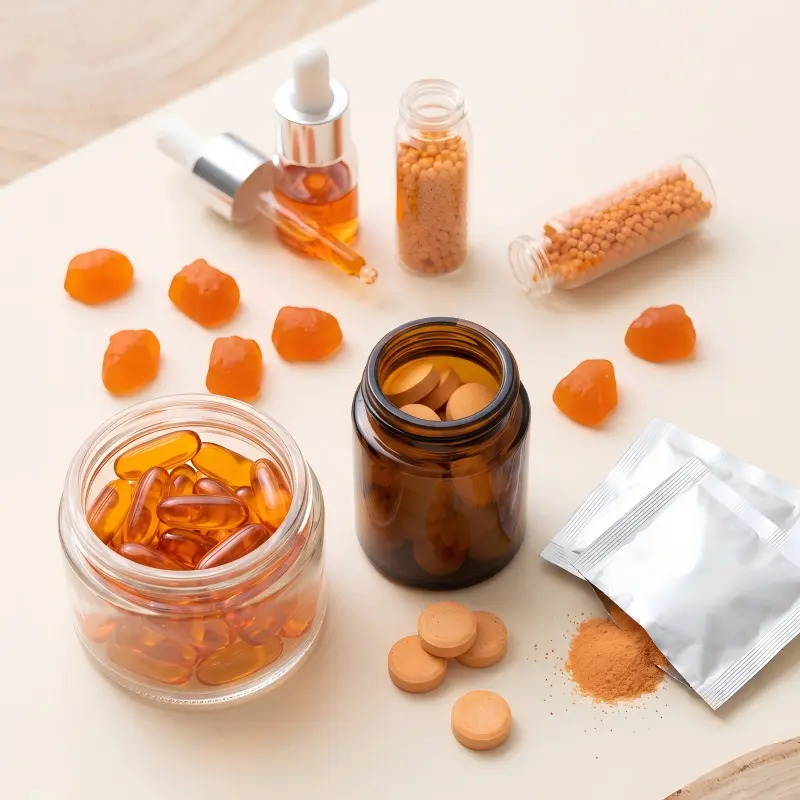
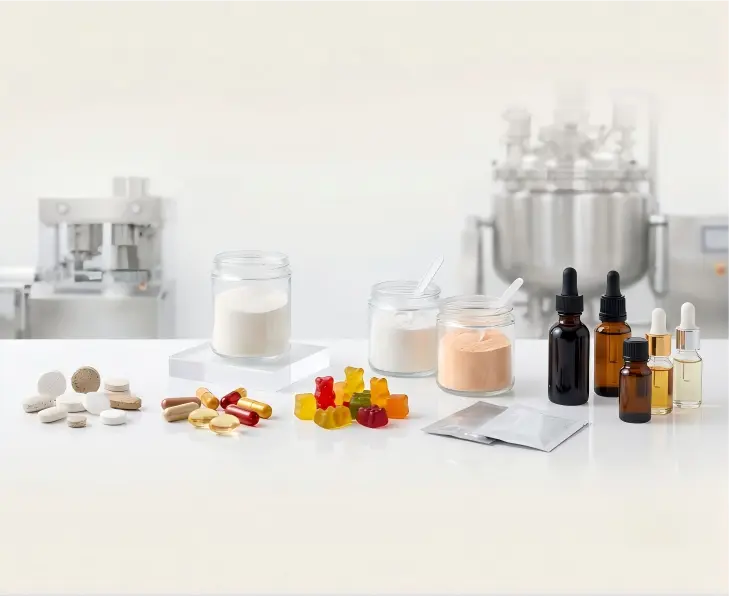
Different beta carotene products are designed for different processing environments. The appropriate specification depends on potency, dispersibility, dosage form, color target, processing conditions and stability requirements.
| Product form | Available potency | Typical physical form | Typical applications |
| Beta carotene powder | 5%–96% | Orange-red to reddish-brown powder, 80 mesh | Tablets, hard capsules, gummies, premixes; raw material for encapsulated products |
| CWS microencapsulated powder | 1%, 10% | Free-flowing, water-dispersible powder; 95% through 60 mesh | Solid beverages, gummies, sachets, premixes |
| Beta carotene beadlets | 1%, 10% | Microencapsulated granules | Solid beverages, gummies, premixes, tablets, hard capsules |
| Beta carotene oil suspension | 10%, 20%, 30% | Oil-based suspension | Softgels; natural color applications |
*Available potency depends on source and current specification. Confirm the exact assay before ordering.
Formulation Note (Expert Insight): For gummies and beverage powders, 1% or 10% CWS grades are generally preferred — concentrated powders may exhibit poor dispersion and increased oxidation risk in water-based systems. For oil-based softgels, a ready-to-use oil suspension avoids in-house dissolution and reduces processing loss.
Beta-carotene is available from several production routes. The source you choose determines cost, label positioning and documentation requirements.
| Source | Characteristics |
| Blakeslea trispora fermentation | Natural-source beta carotene produced by fermentation; supports natural-origin positioning in markets that recognize fermented carotenoids as natural, with source and process documentation |
| Synthetic beta carotene | Nature-identical all-trans molecule; cost-efficient, highly consistent in assay and color value; the global market mainstream |
| Dunaliella salina algae | Natural premium source; algal extract with a carotenoid profile defined by the ingredient specification; available on request |
Source availability must be confirmed by product code. A “natural” claim requires source and production-process documentation, and the rules differ between destination markets.
Popular Commercial Strengths
| Product | Typical strength |
| Beta Carotene Softgel | 10,000 IU (≈6 mg beta-carotene, ≈3,000 mcg RAE) |
| Beta Carotene Softgel | 25,000 IU (≈15 mg beta-carotene, ≈7,500 mcg RAE) |
| Beta Carotene Capsule / Tablet | 15 mg |
| Mixed Carotenoid Formula | Custom |
Reference strengths commonly seen on retail products; IU appears on legacy labels or in specific markets — current US labels declare vitamin A activity in mcg RAE (1 mcg RAE = 2 mcg supplemental beta-carotene). Reference amounts only: final dosage depends on destination-market regulations, and higher-potency products require additional safety and label review.
Beta Carotene Powder
Beta carotene powder is suitable for customers requiring a concentrated ingredient for dry blending, tableting, capsule filling, gummy production or premix development.
Available specifications — fermentation-derived and synthetic-source options: – 5%–96% beta carotene – Orange-red to reddish-brown powder – Typical particle size: 80 mesh – Specification-dependent carrier system – Supporting source documentation available according to specification
Potential applications: tablets and hard capsules · gummies · nutritional premixes · encapsulated product systems · fortified powder products
Fermentation-derived does not automatically mean that a product can be labeled “natural” in every market. Natural-origin claims require review of the source, manufacturing process and applicable regulations.
Beta Carotene CWS (Microencapsulated) Powder
Because beta carotene is naturally oil-soluble, poorly dispersible in water and sensitive to light and oxygen, a microencapsulated delivery system improves handling and application stability in water-based products.
Available specifications:
- – 1% beta carotene CWS / 10% beta carotene CWS
- – Fermentation-derived or synthetic-source options
- – Free-flowing powder;
- Typical particle size: 95% passing 60 mesh
- Typical applications: solid beverages and drink powders · sachets and stick packs · gummies · nutritional premixes · water-based product systems
Typical Quality Profile — 1% Beta Carotene CWS (for reference)
| Test | Specifications | Typical result |
| Appearance | Orange-yellow to orange-red free-flowing powder | Complies |
| Odor / Taste | Characteristic | Complies |
| Beta carotene content (HPLC) | ≥1.0% | 1.39% |
| E (1%, 1 cm) | ≥25 | 34.7 |
| Loss on drying | ≤8.0% | 3.28% |
| Arsenic (As) | ≤2 ppm | Complies |
| Lead (Pb) | ≤2 ppm | Complies |
| Total plate count | ≤1,000 CFU/g | Complies |
| Yeast and mold | ≤100 CFU/g | Complies |
| E. coli | Negative | Complies |
| Salmonella | Negative | Complies |
Based on a representative Certificate of Analysis. Typical COA for reference only; batch results may vary. A batch-specific COA is issued with every production lot. Public versions mask the batch number, signatories, and quality seal.
Beta Carotene Beadlets
Beta carotene beadlets are microencapsulated granules developed for controlled handling, improved protection and compatibility with selected solid dosage forms.
Available specifications:
– 1% / 10% beta carotene beadlets
– Fermentation-derived or synthetic-source options
– Orange-red to reddish-brown granules
Typical particle distribution: 100% passing 20 mesh · 85% passing 40 mesh · 15% passing 100 mesh. Final particle-size requirements should be confirmed against the selected product specification.
Potential applications: solid beverages · gummies · nutritional premixes · tablets and hard capsules · fortified food systems
Beta Carotene Oil Suspension
For oil-based formulations, KS Nutripharma supplies beta carotene oil suspensions in multiple potencies.
Available specifications: 10% / 20% / 30% beta carotene oil suspension · fermentation-derived and synthetic-source options
Potential applications: softgel supplements · oil-based nutritional products · liquid premixes · natural color applications
The carrier oil, viscosity, sedimentation behavior and compatibility should be reviewed before commercial use.
One of the most common sourcing decisions. Both routes are available across our product forms; the comparison below supports specification selection. Final claims depend on documentation and target-market regulations.
| Item | Fermentation-derived | Synthetic |
| Label appeal | High — supports natural-positioned brands (subject to market review) | Medium |
| Cost position | Higher | Lower |
| Organic / natural-claim potential | Possible, with source and process documentation | No |
| Stability in delivery systems | Similar | Similar |
| Typical brand fit | Natural and premium brands | Mass-market and cost-driven products |
| Documentation | Source and manufacturing-route statement available | Full specification documentation available |
| Your situation | Recommended form | Why |
| High active concentration, dry blending, tablets or capsules | Standard powder 5%–96% | Highest assay per kilogram; 80-mesh powder for blending and compression |
| Water-based drinks, sachets, gummies | CWS powder 1% / 10% | Microencapsulated for cold-water dispersibility; designed for aqueous systems |
| Premixes and solid formulations needing a protected granule | Beadlets 1% / 10% | Granular microencapsulation with controlled particle distribution for uniform blending |
| Softgels or oil-based systems | Oil suspension 10% / 20% / 30% | Fat-soluble active in its native carrier; ready for encapsulation |
- Choose standard powderwhen you need: higher active concentration · dry blending · tablet or capsule manufacturing · a flexible premix ingredient.
- Choose CWS powderwhen you need: better dispersibility in water · solid beverages or drink mixes · sachets and stick packs.
- Choose beadletswhen you need: a protected granular delivery system · improved handling in solid formulations · controlled particle-size distribution.
- Choose oil suspensionwhen you need: an oil-based formulation · softgel production · a liquid carrier system.
| Form | Relative stability in typical use | Notes |
| Standard powder | Moderate | Highest assay; protection depends on blending and packaging |
| CWS powder | Good | Microencapsulated matrix reduces oxygen and light exposure |
| Beadlets | High | Granular microencapsulation with the strongest handling protection |
| Oil suspension | Moderate–good | Protected in oil phase; sensitive to heat and prolonged air exposure |
Pure beta carotene is sensitive to light, oxygen, temperature, pH, minerals, enzymes and packaging conditions. Our delivery systems address these risks through process design:
| Stability risk | Our approach |
| Light and oxygen exposure | Microencapsulation wall-material selection; nitrogen-flushed packaging available |
| Poor water dispersibility | CWS microencapsulation technology for cold-water systems |
| Oxidation during processing | Protected beadlet granulation; antioxidant systems per specification |
| Shelf-life degradation | Stability-chamber testing per product code; storage guidance on every TDS |
| Color inconsistency | Custom shade control across orange, pink and red tones, verified per batch |
Our technical team reviews your intended application and recommends an appropriate specification. Final performance must be verified in your actual formula and production process.
Every commercial batch is released against the product specification. Representative in-house and partner-lab capabilities:
| Method / Equipment | Purpose |
| HPLC | Beta carotene assay and isomer profile |
| UV-Vis spectrophotometry | Color value (E 1%, 1 cm) |
| ICP-MS | Heavy metals (As, Pb and related elements) |
| Microbiological testing | Total plate count, yeast & mold, pathogens |
| Loss-on-drying / gravimetric | Moisture control |
| Stability chambers | Accelerated and long-term shelf-life studies |
Standard packaging options (by grade): – 1 kg aluminum foil bag (evaluation and small-batch orders) – 5 kg aluminum foil bag – 25 kg fiber drum with inner liner – Nitrogen flushing available for oxidation-sensitive grades – Palletized export packaging; pallet configuration confirmed per order
Storage (representative CWS products): – Store sealed in a cool, dry place; protect from strong light – Minimize unnecessary exposure to heat and oxygen; use promptly after opening – Shelf life up to 24 months under specified storage conditions
Storage conditions and shelf life vary by product form and specification. Always follow the product-specific TDS and batch documentation.
- Annual carotenoid delivery capacity:200 MT
- Monthly output:16 MT
- Safety stock:maintained for regular commercial grades 2 MT
- Typical lead time:samples 3–5 working days; bulk 7–15 days by grade and destination
Bulk ingredient requirements are evaluated according to: required product form and target potency · source preference (fermentation-derived or synthetic) · annual and initial order volume · packaging size · target application and destination market · required certifications and documentation · sampling and delivery schedule.
- Requirement Confirmation— application, potency, source preference, quantity, target market. (Day 0)
- Grade Recommendation— our team identifies the appropriate powder, CWS, beadlet or oil-suspension option. (within [24–48] h)
- Documentation Review— you receive the specification, typical COA and supporting documents. (with recommendation)
- Sample Evaluation— sample supplied for formulation, dispersibility, color or stability assessment. ([3–5] working days dispatch)
- Commercial Quotation— pricing, MOQ, packaging, lead time and shipping terms confirmed.
- Order and Batch Documentation— commercial batch supplied with agreed documentation and batch-specific COA.
Our R&D team evaluates each project according to formula compatibility, manufacturing feasibility and target-market requirements. Customization may include:
- Beta carotene source: synthetic or fermentation-derived; specialty natural sources (e.g., Dunaliella salina) on request
- Product form matched to your application:emulsion, oil suspension, crystal / high-content powder, standard powder, microcapsule CWS powder or beadlets
- Powder color customization: orange, pink, red and other shades adjusted to your application, dosage form and brand color system
- Target potency:1–15 mg beta-carotene per serving (≈1,670–25,000 IU provitamin A), assessed against destination-market limits
- Dosage form: tablets, capsules, softgels, gummies, powders or liquids
- Combination formulas: vitamin A, vitamin C, vitamin E, lutein, zeaxanthin, lycopene, astaxanthin or bilberry — subject to compatibility and stability assessment
- Capsule shell, carrier oil and excipient selection
- Flavor, color and sweetener options
- Vegetarian, vegan, non-GMO or allergen-free requirements
- Bottle, blister, pouch, sachet and bulk packaging
- Label and packaging review support
- Market-specific documentation
Application-based form and color customization: the product form — emulsion, oil suspension, crystal, standard powder, microcapsule powder or beadlets — is selected or developed around your application (tablets, softgels, gummies, beverages or premixes), and the powder shade can be customized across orange, pink and red tones to match your brand’s color system. Custom emulsions and color shades are confirmed during formula feasibility review.
Final ingredient options depend on availability, technical assessment and applicable regulations.
1. Market and Product Brief
Define the target market, consumer group, positioning, dosage form, serving size and price range.
2. Ingredient Verification
Confirm source, potency, carrier, certifications and supporting documentation.
3. Safety and Regulatory Review
Assess target population, total vitamin A contribution, claims, warnings and market-specific requirements.
4. Formulation Feasibility
Review ingredient compatibility, serving size, processing conditions and packaging.
5. Sample Development
Prepare a laboratory sample for appearance, taste, handling and preliminary technical evaluation.
6. Pilot Production
Confirm process transfer, uniformity, physical performance and packaging compatibility.
7. Stability Program
Establish applicable assay, appearance, microbiological, physical and packaging requirements.
8. Commercial Production
Manufacture and release the finished product according to the approved specification and quality plan.
- ✓ 500+ brands servedacross 60+ export markets
- ✓ Multiple delivery systems— powders, CWS, beadlets and oil suspensions from one supplier
- ✓ Custom color shades— orange, pink and red tones customized per application
- ✓ Technical formulation support— application-oriented specification selection, not only active content
- ✓ Complete documentation package— specifications, COAs and source-related documents per selected product
- ✓ Pilot-scale evaluation— samples and evaluation quantities for qualified projects
- ✓ In-house microencapsulation— microencapsulation, emulsion and color customization handled in-house
- ✓ cGMP quality management— established cGMP and food-safety-management systems
Depending on product code and project requirements, available documents may include:
- Product specification (TDS)
- Certificate of Analysis (typical + batch-specific)
- Safety Data Sheet (SDS)
- Source and manufacturing-route statement
- Allergen statement · GMO / Non-GMO statement
- Residual solvent statement · Heavy metal statement
- BSE/TSE statement
- Ingredient composition · Carrier and excipient information
- Halal certificate · Kosher certificate
- Certificate of Free Sale · Country-of-origin documentation
- Storage and shelf-life information · Traceability documentation
- Export-related documents
Document availability must be confirmed for the selected specification.
KS Nutripharma operates under established quality- and food-safety-management systems: cGMP · HACCP · ISO 22000 · ISO 9001 · FSSC 22000 · Halal · Kosher · FDA facility registration.
Certificates can be provided with their applicable scope, issuing organization and validity period. FDA registration is not FDA certification or product approval.
Dietary Supplements — delivery systems evaluated for tablets, hard capsules, softgels, gummies, powders, sachets and liquid supplements. For finished-dose contract manufacturing, see our supplement manufacturing page.
Solid Beverages and Premixes — CWS powders and beadlets for drink powders, sachets, nutritional premixes and fortified beverage bases.
Food and Beverage Color Applications — selected powder and emulsion systems provide yellow, orange, pink or red color effects depending on concentration, matrix, pH, processing temperature and storage. Color performance should be tested in the final application.
Beta carotene is a provitamin A ingredient. Finished-product dosage, target populations and regulatory compliance should be assessed individually for each market and product.
Certain populations — including smokers, pregnant women and individuals with high vitamin A intake — may require professional assessment before high-dose beta carotene supplementation, as reflected in published clinical research (see References).
This page describes bulk ingredient supply for business customers. It is not intended as consumer health advice; finished-product labeling and claims remain the responsibility of the brand owner and must comply with destination-market regulations.
- NIH Office of Dietary Supplements — Vitamin A and Carotenoids: Fact Sheet for Health Professionals.
- S. FDA — 21 CFR §73.95, Beta-carotene(color additive listing).
- EFSA Panel on Food Additives — Scientific Opinion on the re-evaluation of mixed carotenes (E 160a (i)) and beta-carotene (E 160a (ii)) as food additives, EFSA Journal.
- Codex Alimentarius — General Standard for Food Additives (GSFA), INS 160a(ii).
- USP–NF — Beta Carotene
Request Beta Carotene Specifications and Pricing
Tell us your target consumers, desired formula, dosage form, order quantity and launch market. Our team will evaluate appropriate ingredient systems and recommend a manufacturing path, with an initial project response within one business day.
Recommended RFQ fields:
- Name and business email
- Company and website
- Country and target market
- Preferred dosage form
- Formula concept
- Beta carotene source preference
- Target serving amount
- Additional ingredients
- Initial order quantity
- Packaging requirements
- Required certifications
- Target launch date
From 1% microencapsulated products to concentrated powder specifications up to 96%, depending on source and delivery system.
Fermentation-derived material offers higher label appeal and potential natural-positioning support (subject to market review), at a higher cost; synthetic material offers a cost advantage for mass-market products. Stability performance is comparable in equivalent delivery systems. See the comparison table above.
Fermentation-derived options are available according to the supplied specification list, with source and manufacturing-route documentation. Whether a product qualifies for a “natural” claim must be confirmed through target-market regulatory review.
A microencapsulated delivery system designed to improve the dispersibility of oil-soluble beta carotene in water-based applications.
CWS powder is generally selected for water dispersibility; beadlets provide a granular microencapsulated system with stronger handling protection, suited to selected solid formulations and premixes.
Standard powders or beadlets, depending on potency, compressibility, particle size, stability and the complete tablet formula.
Beta carotene oil suspensions (10%, 20% or 30%) are commonly evaluated for oil-based softgel formulations.
CWS or emulsion-based products are generally more appropriate than untreated concentrated powder for water-based beverages. Application testing is required.
Yes. For color-critical applications, the shade can be customized across orange, pink and red tones; final color performance is confirmed in your application testing.
MOQ starts from [25] kg depending on grade; standard packaging includes 1 kg foil bags, 5 kg aluminum bags and 25 kg fiber drums with nitrogen flushing available. Samples dispatch in [3–5] working days; bulk lead time is typically [7–15] days, confirmed per grade, volume and destination.