Introduction
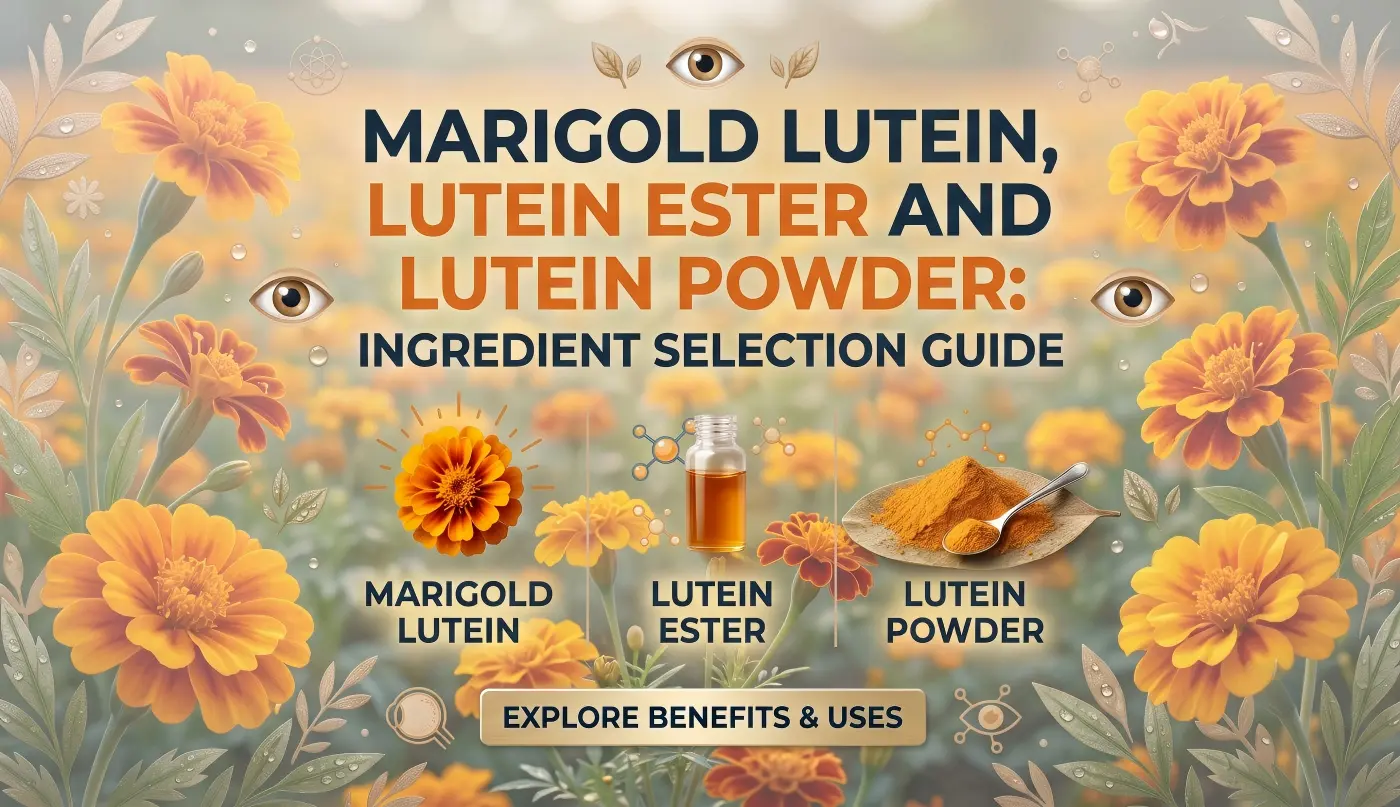
If you source lutein for supplements, gummies, or functional beverages, the name on a quotation sheet tells you very little about what you are actually buying. Most commercial lutein begins in marigold flowers (Tagetes erecta), where the carotenoid occurs naturally in esterified form, bound to fatty acids. Extraction, optional saponification, purification, and standardization then convert that flower into either free lutein or lutein ester raw materials. The same active can further be delivered as an oil suspension, a standard lutein powder, a cold-water-dispersible (CWS) microencapsulated powder, or protective beadlets.
Marigold lutein is available in several chemical and delivery forms. Lutein esters, free lutein, oil suspensions, standard powders, CWS powders, and beadlets differ in active concentration, dispersibility, processing behavior, and dosage-form compatibility.
That is why comparing lutein ingredients on price and label percentage alone can lead to expensive mistakes. A sound selection also weighs the dosage form, the actual active content per serving, stability, carriers, analytical methods, and target-market regulations. This guide walks through each of those decisions, so the specifications on your next purchase order matches the product you actually intend to build.
What Is Marigold Lutein?
Marigolds as a Commercial Source
Marigold lutein is lutein obtained from the petals of the marigold flower, typically Tagetes erecta. The petals are naturally rich in yellow-to-orange carotenoids, and lutein is usually the primary target compound in commercial marigold extract lutein production, accompanied by smaller amounts of zeaxanthin and related carotenoids.
One point deserves emphasis: raw marigold extract is not pure lutein. The initial extract — an oleoresin — contains lutein esters together with other carotenoids, plant waxes, and residual oils. As a result, the weight of a marigold extract cannot be read as its lutein active content. One hundred milligrams of a marigold extract may deliver anywhere from a few milligrams to 80 mg of lutein actives, depending entirely on how the material was standardized.
From Marigold Flower to Standardized Lutein
Although each manufacturer protects its own process parameters, the commercial pathway from flower to finished ingredient follows the same general sequence:
- Cultivation and harvest— marigold is grown, often under contract, and the flower heads are collected at peak carotenoid content.
- Drying or pelleting— petals are dried and frequently pelleted to stabilize the crop for storage and transport.
- Extraction— carotenoids are extracted from the petal meal to produce marigold oleoresin, a concentrated oily extract.
- Saponification or ester retention— the oleoresin is either saponified to release free lutein or processed to retain the natural lutein ester form, depending on the target product.
- Purification and concentration— waxes and non-target compounds are removed and the active fraction is concentrated.
- Standardization— the material is adjusted to a declared active content, for example 5%, 10%, 20%, or 80%.
- Delivery-form conversion— the standardized lutein is formulated into oil suspensions, standard powders, CWS microencapsulated powders, or beadlets.
What Does “Natural Lutein” Mean?
In commercial language, natural lutein means lutein derived from a botanical source — in practice, almost always marigold — rather than produced synthetically. The term carries several practical caveats for brand owners:
- A “natural” claim should be supported by documentation of the botanical source and the production process.
- Natural origin does not exempt the material from purity, contaminant, and stability testing.
- Natural sourcing alone does not make an ingredient safer or more effective, and it should not be marketed that way.
- The interpretation of “natural” on labels differs between markets; wording that is acceptable in one country may be challenged in another.
Free Lutein vs. Lutein Ester
What Is Free Lutein?
Free lutein is the unesterified form of the carotenoid — the lutein molecule without a fatty acid attached. Commercially, it is usually produced by saponifying marigold oleoresin and then purifying the released lutein. Free lutein is the form most often used in the standardized powders, beadlets, and oil suspensions sold to supplement brands.
It is also the form behind the best-known clinical dosing reference: the AREDS2 trial used 10 mg of lutein plus 2 mg of zeaxanthin per day, and those figures refer to actual lutein content, not to 10 mg of marigold raw material. Brands working on AREDS-style eye vitamin formulations should remember that AREDS2 was a specific, complete formula — a lutein ingredient alone, or any 10-plus-2 combination, should not be marketed as “AREDS2.”
What Are Lutein Esters?
Lutein esters are lutein molecules chemically bound to fatty acids, most commonly palmitic, myristic, and lauric acids. This is the form in which lutein predominantly occurs in the marigold flower itself. After ingestion, lutein esters must be hydrolyzed during digestion before the lutein can be absorbed. Because the fatty acid fraction contributes to the ingredient’s weight, the declared weight of a lutein ester raw material cannot be read directly as a free lutein equivalent.
Chemical Weight and Lutein Equivalents
The fatty acid moiety makes an ester heavier than the lutein it carries. As a rule of thumb, common marigold lutein esters deliver roughly 50–55% free lutein equivalent by weight, depending on the fatty acid profile; the exact factor should come from the supplier’s specification and assay, not from an assumption.
Label design therefore needs to distinguish clearly between four different numbers:
- the weight of the lutein ester raw material itself;
- total lutein esters;
- lutein equivalents — the free lutein content the ester represents;
- declared free lutein content.
Twenty milligrams of a lutein ester ingredient must not be declared as 20 mg of active lutein unless the conversion and the test results support it.
Bioavailability Evidence
Because lutein esters are generally hydrolyzed before absorption, the two forms have been compared in several human studies — and the results are not perfectly consistent. Bowen and colleagues reported in 2002 that esterification did not impair lutein bioavailability, while a four-week trial published in 2010 by Norkus and colleagues found a greater serum lutein response from free lutein than from esterified lutein at the same lutein dose. A separate crossover study by Evans and colleagues showed that the formulation itself can shift lutein and zeaxanthin bioavailability substantially, and earlier work demonstrated that the amount of fat in a meal influences the bioavailability of lutein esters.
In practice, absorption is shaped by more than chemical form:
- the formulation matrix (oil vs. powder vs. emulsion);
- fat consumed with the same meal;
- ingredient particle size;
- emulsification and microencapsulation technology;
- the subject’s baseline lutein status.
The defensible position is simple: do not claim that one form is always absorbed better, and support any “better absorbed” message with human data on that specific ingredient, in that specific formula, at that specific dose.
Stability Differences
Lutein esters can show better stability than free lutein under some processing and storage conditions, which is one reason ester ingredients remain popular in oil-based products. But real-world stability still depends on the ingredient’s purity, its carrier, the antioxidant system, and the packaging. Free lutein, in turn, can achieve strong protection through microencapsulation and beadlet technology. Chemical form alone — “free” or “ester” — does not determine the shelf life of a finished product.
Selection Summary
Free lutein often makes sense for:
- products that need a clearly declared active lutein content per serving;
- formulas designed to reference studies that used free lutein;
- powders, beadlets, and multi-ingredient blends.
Lutein esters often make sense for:
- oil-based softgels;
- products positioned around the natural esterified form found in marigold;
- premium formulas built on a lipid matrix and a botanical-origin story.
Either way, the final decision should rest on the actual specification and on finished-product testing — not on the chemical form printed on the label.
Understanding Lutein Specifications
What Do 5%, 10%, 20%, and 80% Mean?
The percentage on a lutein ingredient indicates the share of declared active compounds in the raw material. What that share refers to is not universal. Before comparing two quotes, confirm whether the percentage means:
- free lutein;
- total lutein;
- lutein esters;
- lutein equivalents;
- or total carotenoids.
Suppliers use these definitions differently, and a 20% “lutein esters” powder and a 20% “free lutein” powder are not the same ingredient at the same strength.
Active Ingredient Calculation
The theoretical raw-material need for a 20 mg active lutein serving is easy to estimate:
- 5% material → about 400 mg per serving;
- 10% material → about 200 mg per serving;
- 20% material → about 100 mg per serving;
- 80% material → about 25 mg per serving.
These are theoretical figures only. A production formula must also account for the actual assay value on the certificate of analysis (COA), moisture, carriers, processing losses, stability over shelf life, and any data-supported overage.
Why Higher Concentration Is Not Always Better
High-potency materials offer real advantages:
- smaller inclusion volumes, which helps small capsules and crowded multi-ingredient formulas;
- less carrier material entering the blend;
- lower shipping and warehousing volume per unit of active.
They also carry limits:
- dispersion can be more difficult at high potency;
- cost per kilogram is higher even when cost per active unit is similar;
- weighing accuracy becomes critical at very low inclusion rates;
- high-purity materials are not designed to go directly into beverages or gummies;
- unprotected high-purity lutein remains vulnerable to oxidation.
Standardization and Batch Consistency
Whatever the potency, confirm with the supplier:
- the standardization range, not just the nominal value;
- the analytical method behind the assay;
- batch release criteria;
- actual measured values, not theoretical input values;
- how content drifts during storage;
- batch-to-batch variation in color, particle size, and flow.
Available Marigold Lutein Ingredient Formats
Marigold Oleoresin
Marigold oleoresin is the concentrated oily extract obtained from marigold petals. It contains lutein esters alongside other carotenoids, waxes, and lipids, and it is most often an intermediate raw material for further processing rather than a finished supplement ingredient. Do not assume an oleoresin can be dosed directly into any finished product as a standardized active.
When purchasing oleoresin, confirm:
- total carotenoids and lutein ester content;
- residual solvents;
- carrier composition;
- storage conditions and shelf life;
- intended use and regulatory status in the destination market.
Lutein Oil Suspension
A lutein oil suspension disperses standardized lutein — free or esterified — in an edible oil, such as sunflower oil or another compliant carrier. It is the classic format for lipid-based products.
Advantages:
- naturally suited to softgels;
- good dispersion for a fat-soluble active;
- easy to combine with zeaxanthin, astaxanthin, or vitamin E in the same fill.
Challenges:
- sedimentation of the active over time;
- oxidation of both the lutein and the carrier oil;
- fill-weight and content uniformity during encapsulation;
- oil odor;
- compatibility with the softgel shell.
Standard Lutein Powder
Standard lutein powder is a standardized, free-flowing material designed for solid dosage forms — typically capsules, tablets, or premixes. Specifications and carriers vary widely between suppliers.
Advantages:
- flexible use across most solid forms;
- generally competitive cost per active unit;
- straightforward handling in conventional powder blending.
Challenges:
- limited dispersibility in water;
- possible agglomeration in humid conditions;
- sensitivity to light, heat, and oxygen when insufficiently protected;
- particle size and flowability directly affect content uniformity.
CWS Microencapsulated Lutein Powder
CWS stands for cold-water-dispersible. A more accurate description is water-dispersible rather than truly water-soluble: the lutein itself does not dissolve, but the microcapsule structure and carrier system allow it to disperse evenly through an aqueous system.
Typical applications:
- gummies;
- drink powders and stick packs;
- sachets;
- functional beverages;
- water-based premixes.
Advantages:
- much improved dispersion in water-based systems;
- reduced visible oil droplets and sedimentation;
- a degree of protection against heat, light, and oxidation;
- easier handling in aqueous processing.
Before specifying a CWS material, confirm:
- wall material and full carrier composition;
- particle size;
- the pH range in which the dispersion remains stable;
- recommended addition temperature;
- suspension behavior in the actual beverage — haze, ringing, or sediment.
Lutein Beadlets
Beadlets are small, engineered granules built around a protective microencapsulation matrix. They differ from standard powders in particle size, flow, and the integrity of their protective shell. Note that beadlet and CWS technologies can overlap, and not every supplier uses these terms the same way.
Typical applications:
- tablets;
- hard capsules;
- gummies;
- premixes;
- selected beverages and powdered drinks.
Advantages:
- strong oxidative protection;
- excellent flowability;
- reduced direct contact with reactive formula partners;
- some grades are designed for direct compression.
Challenges:
- oversized particles can affect gummy texture or appear as visible specks;
- compression force during tableting can rupture the protective layer;
- the grade must be verified against the specific manufacturing process.
Do Not Treat Delivery-Form Names as Universal Standards
CWS, beadlet, and microencapsulated powder are commercial format descriptions, not harmonized specifications. Two materials carrying the same format name from two suppliers can behave very differently in the same product. Purchasing decisions should always rest on documents, not on the trade name:
- Technical Data Sheet (TDS);
- particle-size data;
- dispersibility data;
- stability data;
- application recommendations;
- complete carrier composition.
Which Lutein Format Fits Each Dosage Form?
The right delivery form follows from the dosage form, not the other way around. The overview below summarizes the usual starting points for custom eye health supplements; each option still needs confirmation in pilot trials.
Softgels
First choice: oil suspensions, oleoresin-based systems, and oil-compatible free lutein or lutein esters. Evaluate sedimentation rate, oil-phase compatibility, shell compatibility, fill uniformity, and oxidative protection. Brands developing oil-based products can explore our lutein supplement manufacturing capabilities for softgel and oil-suspension projects.
Hard Capsules
Candidate formats: standard lutein powder, microencapsulated powder, or beadlets. Evaluate flowability, blend uniformity, capsule-size constraints, the volume the ingredient occupies in the formula, and compatibility with botanical co-ingredients.
Tablets
Candidate formats: beadlets, compression-ready microencapsulated powders, or high-potency standardized powders. Evaluate compression force versus protective-layer integrity, tablet hardness, disintegration, active release, and color distribution.
Gummies
Candidate formats: CWS microencapsulated powder or gummy-compatible beadlets. Evaluate heating temperature during cooking and depositing, the acidic environment, dispersion, particle mouthfeel, color, and content uniformity across the batch.
Powders and Stick Packs
Candidate formats: CWS powder or water-dispersible microencapsulated lutein. Evaluate clumping, reconstitution behavior, flavor contribution, powder flow, moisture stability, and dose uniformity in single-serve packs.
Functional Beverages
Candidate formats: CWS lutein or purpose-built water-dispersible systems. Evaluate dispersion — remember, the lutein is dispersed, not dissolved — plus haze, sedimentation, color ringing at the fill line, light protection in the chosen package, beverage pH, and the impact of any thermal processing.
Stability Challenges of Marigold Lutein
Oxidation
Lutein is an unsaturated carotenoid and oxidizes readily. Risk sources include:
- air exposure during storage and blending;
- headspace oxygen in the final package;
- packaging materials with high oxygen transmission;
- oxidation of the carrier oil in suspensions.
Mitigation options include microencapsulation, antioxidant systems, minimized exposure time during processing, nitrogen flushing or oxygen control, and high-barrier packaging.
Light Exposure
Light accelerates lutein degradation at every stage: raw-material storage, transparent or translucent packaging, the production environment, and retail display. Countermeasures include protected storage, opaque or tinted packaging, aluminum-aluminum or aluminum-plastic blisters, and a light-stability evaluation of the final package.
Heat and Processing
Thermal stress comes from gummy cooking and depositing, beverage heat treatment, prolonged mixing, and localized heat during compression. Practical responses:
- choose an ingredient grade rated for the intended process temperature;
- add the lutein within the lowest reasonable temperature window;
- minimize the time spent at elevated temperature;
- assay the active before and after processing.
There is no single universal “safe temperature” that applies to every lutein ingredient — verify against the supplier’s data for the specific grade.
Moisture and pH
Moisture can compromise microcapsule wall materials and promote clumping or degradation. Acidic environments — gummies and fruit-flavored beverages — can shift both color and stability. A CWS material is not automatically stable at every pH, so the final formulation, at its real pH and water activity, is the only valid test system.
Stability Data Must Match the Final Product
A stable ingredient does not guarantee a stable finished product. Shelf-life claims need data generated in:
- the actual formula;
- the actual processing conditions;
- the actual packaging;
- the intended storage conditions;
- across the full claimed shelf life.
Raw Material Testing and Quality Documents
Documentation is where ingredient selection becomes verifiable. For multi-ingredient products, apply the same discipline to every active — our portfolio of eye health ingredients is supported by the same document set described below.
Certificate of Analysis
A COA should be checked line by line and should cover at minimum:
- product name and grade;
- batch number;
- manufacturing date;
- retest or expiry date;
- lutein assay, with the basis clearly stated;
- zeaxanthin and other carotenoids where relevant;
- moisture;
- microbiology;
- heavy metals;
- residual solvents;
- the analytical methods used.
Identity and Assay Testing
Use appropriate chromatographic methods — HPLC is the industry norm — to confirm both identity and content. The method should distinguish free lutein from lutein esters and from total carotenoids, and the COA should state whether results are reported as-is or on a dry basis. Color and UV absorbance alone are not identity confirmation. Finished products should also be assayed for active content; relying on the raw-material COA alone is a common and avoidable compliance gap.
Contaminant Testing
The routine contaminant panel includes:
- lead, arsenic, cadmium, and mercury;
- pesticide residues;
- residual solvents;
- microbial limits;
- mycotoxins, where the raw material and the risk assessment call for it.
Technical Documents
Beyond the COA, request:
- Technical Data Sheet;
- Safety Data Sheet;
- a manufacturing flow summary;
- full ingredient and carrier declaration;
- allergen statement;
- GMO statement;
- country of origin;
- vegan or vegetarian statement;
- Halal/Kosher certificates where needed;
- stability data;
- packaging specification and storage conditions.
Supply-Chain Documents
For B2B procurement, the commercial file should also cover:
- supplier audit information;
- batch traceability;
- origin documentation;
- a change-notification policy;
- evidence of continuous supply capacity;
- a backup-source strategy;
- complaint and recall procedures.
Regulatory and Labeling Considerations
Name the Ingredient Accurately
Labels should state what the ingredient actually is — lutein, lutein esters, or marigold extract — plus the botanical source and the active content. The three declarations are not interchangeable:
- 100 mg marigold extract;
- 20 mg lutein esters;
- 10 mg free lutein.
Treating them as equivalents is one of the most frequent labeling errors in this category.
Verify Target-Market Status
Before locking a specification, confirm in the destination market:
- the permitted ingredient source and production process;
- carriers and excipients;
- maximum use levels;
- target populations;
- Whether the material is regulated as a supplement ingredient or a food additive.
Requirements differ between the United States, the European Union, the United Kingdom, Australia, and other markets, and the differences extend to both regulatory status and labeling conventions.
Avoid Unsupported Superiority Claims
The following statements should not appear in marketing without ingredient- and product-specific evidence:
- “Free lutein is always better absorbed.”
- “Lutein esters are always more stable.”
- “Natural lutein is safer”
- “CWS lutein is completely water-soluble.”
- “Microencapsulation guarantees higher bioavailability.”
Eye-Health Claims
Lower-risk claim structures include:
- “supports eye health”;
- “supports normal visual function”;
- “helps maintain macular pigment”;
- “provides antioxidant support.”
Avoid disease claims such as “treats macular degeneration,” “prevents cataracts,” “reverses vision loss,” or “repairs retinal damage.” These cross regulatory lines in essentially every major market.
Choosing a Lutein Ingredient for Your Product
The sequence below keeps selection decisions in the right order — product first, ingredient second.
- Define the product format— softgel, capsule, tablet, gummy, powder, or beverage. The dosage form drives everything that follows.
- Define the active dose— milligrams of lutein per unit and per serving, servings per day, and whether zeaxanthin or other actives join the formula. Lutein-plus-zeaxanthin combinations are the backbone of many blue light support formulations, and marigold lutein can also be paired with standardized bilberry extract supplements for premium botanical positioning.
- Confirm the chemical form— free lutein, lutein ester, or marigold oleoresin — based on the dose declaration and the product story.
- Select the delivery system— oil suspension, standard powder, CWS powder, or beadlets — matched to the dosage form and the process.
- Review carrier and processing compatibility— wall materials, oils, starches, sugars, antioxidants, allergens, processing temperature, and pH.
- Compare total formulation cost— cost per serving of active lutein, not cost per kilogram. Include dosage-form cost, stability losses, packaging, testing, minimum order quantities, and the risk of rejected batches.
- Complete the regulatory and stability review— ingredient legality, label naming, claims, finished-product assay, packaging, and shelf-life substantiation.
Marigold Lutein OEM Development Process
For brands outsourcing development, a structured OEM workflow compresses timelines and prevents specification drift between brief and batch.
Product Brief
The customer defines the target market, dosage form, lutein content per serving, preference for free lutein or lutein esters, companion ingredients, packaging format, expected volumes, and target cost.
Ingredient Screening
The manufacturer compares candidate materials on specifications, carriers, dispersibility, stability, documentation, supply capacity, and cost — and shortlists grades that fit both the formula and the process.
Prototype and Compatibility Testing
Pilot batches confirm color, flowability, sedimentation, taste, content uniformity, dosage-form size, and processing losses before anything scales.
Finished Product Testing
Release testing covers identity, lutein assay, zeaxanthin assay, uniformity of dosage units, heavy metals, microbiology, stability, and packaging compatibility.
Scale-Up and Commercial Production
Commercial production locks the process with batch records, quality release, COA issuance, packaging, export documentation, and monitoring of batch-to-batch consistency over time.
Ready to specify your next lutein product? As a marigold lutein supplement manufacturer, KS Nutripharma® supports every format covered in this guide — oil suspensions, standard powders, CWS microencapsulated powders, and beadlets — across softgels, capsules, tablets, gummies, powders, and beverages. Share your target lutein form, active dosage, delivery format, packaging, and destination market to receive a customized ingredient and manufacturing proposal. OEM and ODM services are available; ask for current MOQ, lead time, certification scope, dosage-form capabilities, and daily production capacity when you request a quote.
Frequently Asked Questions About Marigold Lutein
Is lutein made from marigold flowers?
Yes — marigold (Tagetes erecta) petals are the most common commercial source of lutein. The final ingredient, however, is a refined material: the flower’s carotenoids are extracted, purified, and standardized before they reach a supplement formula.
What is the difference between lutein and lutein ester?
Free lutein is the unbound carotenoid; lutein esters are lutein bound to fatty acids, the form found naturally in the flower. Esters are heavier per unit of lutein, must be hydrolyzed during digestion, and behave differently in some formulations, so the two are specified and labeled differently.
Is free lutein better than lutein ester?
Not categorically. Human studies report different outcomes depending on formulation and study design, so the better choice depends on the ingredient data, the dosage form, the supporting research, and the product’s goals.
What does 20% lutein powder mean?
It usually means the raw material contains 20% of a declared active fraction — but confirm on the specification sheet whether that figure refers to free lutein, total lutein, lutein esters, or total carotenoids, because suppliers use the terms differently.
Is CWS lutein water-soluble?
Strictly speaking, no. CWS lutein is water-dispersible: it spreads evenly through an aqueous system, but the lutein itself does not dissolve.
What is the difference between CWS lutein and beadlets?
CWS materials are engineered for dispersion in water-based systems, while beadlets are engineered primarily for particle protection and processing performance. The categories overlap, and supplier definitions vary, so compare technical documents rather than names.
Which lutein is best for softgels?
Oil suspensions and oil-compatible forms of free lutein or lutein esters are usually the best fit, subject to sedimentation and stability testing in the actual fill.
Which lutein is best for gummies?
CWS microencapsulated powders or gummy-compatible beadlets are the usual starting points, evaluated against the product’s heat, acidity, and texture requirements.
What documents should a lutein supplier provide?
At minimum: a COA with the assay basis stated, a Technical Data Sheet, an SDS, identity and contaminant test results, allergen and GMO statements, stability data, country-of-origin information, and traceability records.
Related Resources
- Lutein Ester vs. Free Lutein: How to Choose for Your Formula
- Eye Health Supplement Formulation Guide
- Lutein Gummies: Ingredients, Dosage and Manufacturing Challenges
- Lutein and Zeaxanthin Supplements Formulation Guide for Eye-Health Brands
- Lutein 10 mg vs 20 mg vs 40 mg: How Brands Choose a Formula
References
- Bowen, P. E., Herbst-Espinosa, S. M., Hussain, E. A., & Stacewicz-Sapuntzakis, M. (2002). Esterification does not impair lutein bioavailability in humans. The Journal of Nutrition, 132(12), 3668–3673. https://doi.org/10.1093/jn/132.12.3668
- Norkus, E. P., Norkus, K. L., Dharmarajan, T. S., Schierle, J., & Schalch, W. (2010). Serum lutein response is greater from free lutein than from esterified lutein during 4 weeks of supplementation in healthy adults. Journal of the American College of Nutrition, 29(6), 575–585. https://doi.org/10.1080/07315724.2010.10719896
- Evans, M., Beck, M., Elliott, J., Etheve, S., Roberts, R., & Schalch, W. (2013). Effects of formulation on the bioavailability of lutein and zeaxanthin: A randomized, double-blind, cross-over, comparative, single-dose study in healthy subjects. European Journal of Nutrition, 52(4), 1381–1391. https://doi.org/10.1007/s00394-012-0402-5
- Roodenburg, A. J., Leenen, R., van het Hof, K. H., Weststrate, J. A., & Tijburg, L. B. (2000). Amount of fat in the diet affects bioavailability of lutein esters but not of alpha-carotene, beta-carotene, and vitamin E in humans. The American Journal of Clinical Nutrition, 71(5), 1187–1193. https://doi.org/10.1093/ajcn/71.5.1187
- Olmedilla-Alonso, B., et al. (2024). Bioavailability of lutein from marigold flowers (free vs. ester forms). Nutrients, 16(1), 127. https://doi.org/10.3390/nu16010127
- The Age-Related Eye Disease Study 2 (AREDS2) Research Group. (2013). Lutein + zeaxanthin and omega-3 fatty acids for age-related macular degeneration: The Age-Related Eye Disease Study 2 (AREDS2) randomized clinical trial. JAMA, 309(19), 2005–2015. https://doi.org/10.1001/jama.2013.4997
- EFSA Panel on Food Additives and Nutrient Sources added to Food (ANS). (2010). Scientific Opinion on the re-evaluation of lutein (E 161b) as a food additive. EFSA Journal, 8(7), 1678. https://doi.org/10.2903/j.efsa.2010.1678
- EFSA Panel on Food Additives and Nutrient Sources added to Food (ANS). (2011). Scientific Opinion on the re-evaluation of lutein preparations other than lutein with high concentrations of total saponified carotenoids at levels of at least 80%. EFSA Journal, 9(5), 2144. https://doi.org/10.2903/j.efsa.2011.2144
- Kuang, P., Zhang, H., Bajaj, P. R., Yuan, Q., Tang, J., Chen, S., & Sablani, S. S. (2015). Physicochemical properties and storage stability of lutein microcapsules prepared with maltodextrins and sucrose by spray drying. Journal of Food Science, 80(2), E359–E369.
- S. Food and Drug Administration. (2007). Current Good Manufacturing Practice in Manufacturing, Packaging, Labeling, or Holding Operations for Dietary Supplements; Final Rule (21 CFR Part 111). Federal Register, 72(124), 34752–34958.