




Advanced Ingredients for Vision, Dry Eye & Digital Eye Support Formulas
KS Nutripharma supplies eye health supplement ingredients for supplement brands and manufacturers, including carotenoids, algal DHA, taurine and selected botanical extracts.
Browse grades by source, active content, assay and delivery form. For a quotation, send the ingredient, the target active content per serving, the dosage form, the destination market and an estimated quantity.
A finalized formula is not required to begin an ingredient sourcing inquiry.
How Buyers Compare Ingredient Specifications
Two quotations that both read “10% lutein” can still be different materials. The specification sheet is what makes the percentage usable: identity, source, assay basis, carrier and form.
| Field | Buyer should confirm | Document |
|---|---|---|
| Identity | Ingredient name and plant, algal or chemical source | Specification sheet |
| Source route | Botanical, algal, fermentation-derived or synthetic, using the source document for that grade | Specification sheet |
| Active content | Marker, concentration and assay basis | Specification sheet and COA |
| Form | Crystal, powder, oil suspension, beadlet, CWS, cold-water-soluble, cold-water-dispersible or extract | Specification sheet |
| Carrier | Carrier identity and composition when the grade is not the neat active | Specification sheet |
| Application | Intended dosage form and processing conditions | Project brief |
| Documentation | Specification sheet and batch COA for the named grade | Quotation file |
Use the name printed on that grade. Cold-water-soluble, cold-water-dispersible and CWS are separate descriptions. A quotation keeps the term on the specification sheet.
Branded and non-branded grades
Named branded ingredients are sourced through commercial supply channels. State the trademark in the inquiry. The quotation follows that supplier’s specification and batch documents.
Non-branded grades are the concentrations and forms listed below. A brief can require a branded grade, accept a non-branded grade, or leave the choice open.
Ingredient Forms and Dosage-Form Fit
The form decides how the active is filled, dispersed or compressed. The grade name states the form. It does not state an absorption result.
| Form | What the brief settles |
|---|---|
| Standardized powder | Active percentage, assay basis, flow and blend uniformity |
| Oil suspension | Oil identity, active percentage in that oil, settling and softgel fill |
| CWS powder | The CWS grade as named, its carrier, dispersion and processing conditions |
| Cold-water-soluble or cold-water-dispersible grade | The exact term on the sheet, the carrier and the process |
| Beadlets | Matrix or coat, particle size when the sheet states it, flow and the target solid dose |
| Liposomal liquid or powder | The listed carrier and the batch file for that grade |
| Botanical extract | Plant, part, marker, method, and extract versus whole-plant powder |
- Best for: lutein oil, astaxanthin oil, algal DHA, beta-carotene oil and lycopene oil.
- What to lock: oil identity, active percentage in the oil, fill weight, shell and oxidation control.
- Manufacturing note: oil carotenoids and DHA can be assessed for one softgel once the fill, the shell and the stability plan are named.
- Best for: lutein or zeaxanthin powders and beadlets, botanical powders, taurine, grape seed and lycopene beadlets.
- What to lock: powder or beadlet, flow, blend uniformity and capsule size.
- Manufacturing note: dry actives can share a capsule when their carriers suit the same blend.
- Best for: compact dry doses of lutein beadlets, botanical extracts and other powders suited to compression.
- What to lock: flow, compressibility, moisture sensitivity and active content after excipients.
- Manufacturing note: the grade is selected for compression as well as for the label content.
- Best for: carotenoid grades already named as CWS, cold-water-dispersible or microencapsulated.
- What to lock: the dispersibility term on the sheet, carrier, color, taste, cook temperature and finished active content.
- Manufacturing note: those grades can be assessed for a gummy after dispersion, carrier compatibility, processing temperature and stability are reviewed for that recipe.
- Best for: instant taurine, dispersible carotenoid grades and botanical drink powders.
- What to lock: bulk density, flow, moisture and dispersion.
- Manufacturing note: the pack format is part of the grade decision, including appearance in a stick pack.
Advanced Processing & Stability Technology for Eye Health Ingredients
Carotenoid ingredients such as lutein, zeaxanthin, and astaxanthin are highly sensitive to oxygen, light, and heat exposure. KS Nutripharma applies microencapsulation technology, low-temperature processing systems, and nitrogen-protected production environments to improve ingredient stability during manufacturing and shelf life.
Fat-soluble eye health nutrients including DHA, omega-3 oils, lutein esters, and astaxanthin require specialized oil-phase delivery systems for optimal dispersion and absorption. Our manufacturing capabilities support oil suspension systems, softgel filling technologies, and emulsification processes for advanced bioavailability.
Eye health gummies containing carotenoids and botanical extracts often face challenges related to oxidation, color instability, bitterness, and oil-water separation. KS Nutripharma utilizes emulsification systems, flavor masking technologies, and controlled moisture processing to improve gummy stability and sensory performance.
For stick packs, powders, and functional beverages, water-dispersible carotenoid and omega ingredient systems are critical for product appearance and consumer experience. Our formulation technologies support improved dispersibility, suspension stability, and reduced sedimentation in beverage applications.
KS Nutripharma provides customized eye health supplement development services covering ingredient selection, formulation optimization, dosage form adaptation, flavor systems, stability evaluation, and scalable manufacturing for global supplement brands.
Formula Sourcing Directions
These directions describe how briefs usually group ingredients. Amounts are set in the project brief. They are development routes, and they are separate from a validated clinical formula.
Lutein and zeaxanthin. Source the two carotenoids as separate lines for a capsule or tablet, or for a softgel when the chosen grade is an oil. The brief needs free lutein or ester, the zeaxanthin grade, and the target active content of each per serving.
Carotenoid with algal DHA. Pair a carotenoid oil, or a separate dry carotenoid, with algal DHA. Name the DHA percentage in the oil, the molecular form, and whether both actives share one oil fill. A shared oil fill needs the fill composition and oxidation control in the brief.
Botanical-led formula. Lead with bilberry, saffron, maqui, black currant or another listed extract, and add carotenoids as further lines. Specify the marker, the method and the extract form. Cassia seed and chrysanthemum stay on their own assays when they are included.
Multi-carotenoid formula. Combine lutein and zeaxanthin with astaxanthin, beta-carotene or lycopene when the label needs more than one carotenoid. Each carotenoid keeps its own source route and physical form. An oil grade moves the dosage form toward a softgel. Dry powders and beadlets can stay in a capsule.
Three Ingredient Sourcing Categories
The groups below are a purchasing order. They are a way to find a grade, and they are separate from any clinical ranking.
Core carotenoids. Lutein, zeaxanthin, astaxanthin, beta-carotene and lycopene.
Omega-3, nutrients and additional actives. Algal DHA, taurine and coenzyme Q10, with a marine oil when the brief asks for one.
Botanical extracts. Bilberry, saffron, maqui, black currant, grape seed and goji, plus cassia seed and chrysanthemum as additional botanical ingredients. Specify the botanical identity, the extract marker and the assay.

Powder: 5%–80%.
Lutein ester powder: 5%–60%.
Oil suspension: about 5%–20% lutein.
CWS powder: 5%, 10%, 20%.
Beadlets: 5%, 10%, 20%.
Also listed: liposomal lutein as a liquid and as a powder.
Source: marigold flower, Tagetes erecta.
Powder and ester powder are separate listings. The specification sheet states whether the percentage is free lutein or lutein ester, and whether that percentage is the active or the active in a carrier. Liposomal lutein is quoted as the liquid or powder grade listed here, with its carrier and batch file.- Zeaxanthin
grades: 5% and 10%.
The specification sheet for the 5% or 10% grade states the source, the physical form and the assay basis. Put zeaxanthin on its own line, with its own percentage. A lutein percentage does not state the zeaxanthin content. When the label names a trademarked zeaxanthin grade, put that trademark in the inquiry. Labels often print both carotenoids. Purchasing still uses two lines: lutein form and percentage, zeaxanthin 5% or 10% unless another grade is confirmed, and the milligrams of each active per serving. The ratio comes from the finished-product brief.
For the longer comparison of the three carotenoids, use the Lutein, Zeaxanthin and Astaxanthin Formulation Guide.
Powder: 1%, 2%, 2.5%, 3%, 5%.
Oil suspension: 5%, 10%.
Cold-water-dispersible powder: 1%, 2%, 2.5%.
Beadlets: 1%, 2%, 2.5%.
Oleoresin: listed as an additional form.
Source: Haematococcus pluvialis.
Choose powder, oil suspension, cold-water-dispersible powder, beadlet or oleoresin. Oil and powder fill different dosage forms.
Powder: 5%–96%.
Oil suspension: 10%, 20%, 30%.
CWS microcapsule powder: 1%, 10%.
Beadlets: 1%, 10%.
Sources: fermentation-derived and synthetic.
Also listed: a custom emulsion for beverages and other liquids.
Name fermentation-derived or synthetic, then powder, oil, CWS microcapsule or beadlet. These grades are the listed beta-carotene materials. Beta-carotene sits outside the AREDS2 formula.
Crystal: above 90%.
Powder: 5%, 6%, 10%, 20%.
Oil suspension: 5%, 6%, 10%, 20%.
Cold-water-soluble powder: 5%, 10%.
Beadlets: 5%, 10%.
Also listed: a cold-water-dispersible liquid.
Specify the source route and the physical form separately. Tomato-derived lycopene and the fermentation-derived or synthetic grades below are different routes. Lycopene, Fermentation-Derived and Synthetic
Crystal: 96%.
Oil suspension: 5%, 6%, 10%.
Cold-water-soluble beadlets: 1%, 5%.
Beadlets: 10%, 20%.
Microencapsulated powder: 5%, 10%, 20%.
Synthetic crystal: at least 96%, supplied in a matrix or an oily dispersion.
Crystal, oil, beadlet and microencapsulated powder stay separate lines. Cold-water-soluble beadlets keep that name from the grade.
Algal DHA oil: DHA 35%, 40%, 50%, 60%.
Molecular forms: TG, rTG and EE.
Algal source: Schizochytrium sp.
Additional marine option: fish oil at about 18% EPA and 12% DHA by weight of the oil, plus high-DHA marine oil and EPA/DHA concentrates.
The algal percentages are DHA content of the oil. Name TG, rTG or EE. For an eye-health brief, name algal DHA when that is the oil required. The 18/12 fish oil is quoted when the brief asks for that marine grade. Taurine
Grade: taurine 98%.
Form: instant powder.
Quote the 98% instant powder and the milligrams per serving. Coenzyme Q10
CoQ10 is an additional active for multi-antioxidant formulas.
Ubiquinone (oxidized)
Crystalline powder: 98%, 99%.
Oil suspension: 10%, with further grades in the 10%–20% range.
Water-dispersible powder or beadlets: 10%, 20%, 40%.
Ubiquinol (reduced)
Crystalline powder: 98%, nitrogen-packed.
Microencapsulated powder: 30%.
Oil dispersion: 20%–30%.
Other delivery form: liposomal CoQ10, quoted on that grade’s specification.
Choose ubiquinone or ubiquinol, then crystal, oil, water-dispersible powder or beadlet. Water-dispersible is the term used on these CoQ10 grades. Maqui Berry Extract
Grade: anthocyanins 25%.
Form: spray-dried extract powder.
The purchasing marker is anthocyanins at 25%.
Crocin: at least 2%, 3% or 5%.
Safranal: 0.3%.
Also listed: a crocin plus safranal grade, and a custom assay.
Source: Crocus sativus L., stigma.
Crocin and safranal are separate markers. The extract milligrams on a label still need the marker and the percentage inside that extract.
HPLC grade: anthocyanins above 36.0%.
UV grade: anthocyanidins above 25.0%.
Other extract grades: 1%, 5%, 10%, 15%.
Forms: fruit extract powder and whole-fruit powder.
Source: European bilberry, Vaccinium myrtillus L., fruit.
Anthocyanins by HPLC and anthocyanidins by UV are different markers and different methods. Whole-fruit powder is a separate form from the HPLC extract. This card is Vaccinium myrtillus fruit.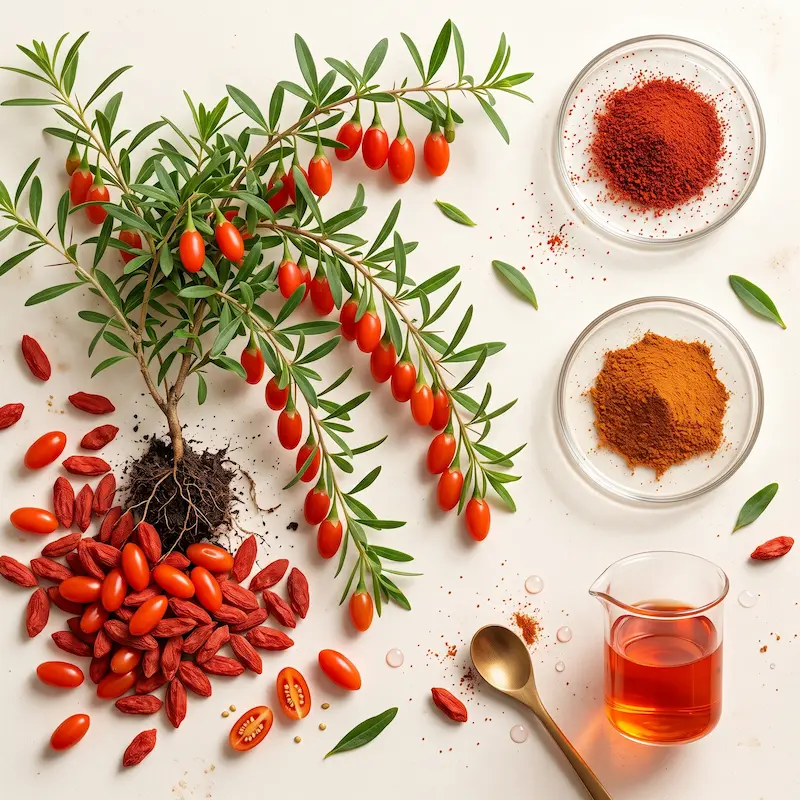 Goji Berry Extract
Polysaccharides: 20%–50%.
UV grade: polysaccharides at least 50%.
Forms: juice powder, spray-dried powder and water-soluble extract.
Source: Lycium barbarum L., fruit.
The marker is polysaccharides. A carotenoid in the same capsule is specified on the lutein or zeaxanthin line. Black Currant Extract
Anthocyanins: 25% and 35%.
Forms: juice powder and spray-dried extract powder.
Name the anthocyanin percentage and whether the solid is juice powder or spray-dried extract. Grape Seed Extract
OPC: 95%.
Polyphenols: 90%.
Forms: seed powder and water-soluble extract.
OPC and polyphenols are different assays. The label line should name the assay it is printing. Cassia Seed Extract
Anthraquinones: 2% and 4%.
Ratio extract: 10:1.
Forms: seed powder, water-extract powder and spray-dried extract.
Method named for the standardized grades: TLC/UV.
Source: Cassia obtusifolia L. or Cassia tora L., mature seed.
Anthraquinones at 2% or 4% and a 10:1 ratio extract are different purchasing lines. Chrysanthemum Extract
Chrysanthemum flavonoids: 3%.
Flavones: 8%.
Ratio extract: 10:1.
Forms: flower powder, water-soluble extract and spray-dried powder.
Source: Chrysanthemum morifolium Ramat., flower.
Flavonoids at 3% and flavones at 8% are separate assays. A 10:1 powder is that ratio extract unless the sheet also states a standardized assay.
Our Proven Eye Health Formulas
Below are selected examples of custom eye health formulations we have successfully developed and manufactured for clients in the past. Each formula was tailored to specific product positioning, target markets, and regulatory requirements.
If you have a similar concept—or would like to explore your own unique eye health formula—we invite you to get in touch. Our team will review your requirements and work with you to design, optimize, and produce a formulation that is exclusive to your brand.


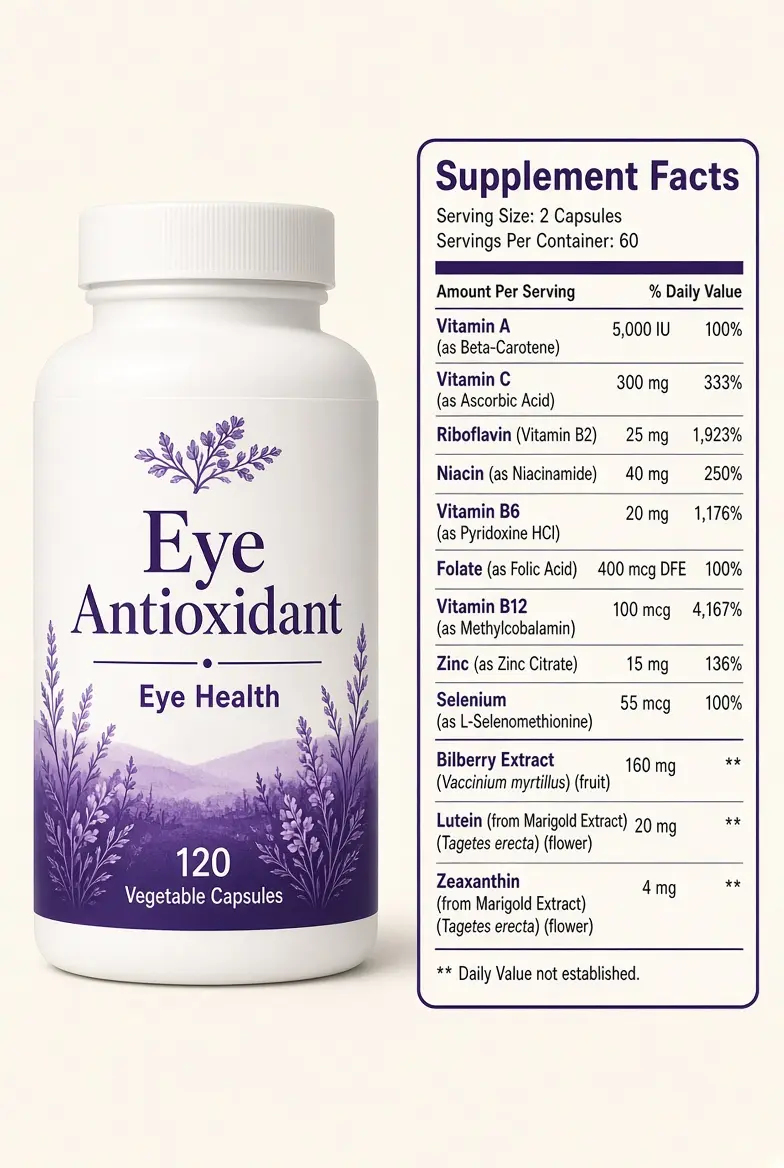


AREDS2 is a specific research formula, separate from a general eye-health supplement range.
KS Nutripharma quotes the lutein and zeaxanthin grades on this page for AREDS2-related projects. The studied formula also includes vitamin C, vitamin E, zinc and copper. Those four nutrients are outside this ingredient catalog. Beta-carotene is outside that studied formula.
For an AREDS2-related inquiry, send the full nutrient panel, the ingredient forms, the target market and the finished-product requirements. The National Eye Institute describes the research formula and the population studied. (National Eye Institute AREDS/AREDS2 FAQ)
| Document | Buyer should confirm |
|---|---|
| Specification sheet | Identity, source, active, assay, carrier and storage |
| Batch COA | Lot-specific assay and the test results reported for that lot |
| Traceability | Batch identification and the source records that apply to the grade |
| Additional testing | Heavy metals, residual solvents, microbiology or oxidation parameters when they apply to that material |
| Market documentation | Allergen, GMO, vegan, origin and other declarations that apply to the grade |
| Finished-product testing | Finished-product assay, stability and release, scoped with the manufacturing brief |
A raw-material COA supports ingredient qualification. Finished-product testing and release remain separate project requirements. Third-party tests are arranged for the project. A cGMP quality agreement is the manufacturing-quality framework. It is separate from an FDA approval of a finished supplement.
Final label claims and market compliance should be reviewed against the destination-market requirements, using the applicable ingredient documentation and product specifications.
Ingredient quotations use the grades on this page, including branded grades named in the inquiry. Finished eye supplements, from pilot through packaging and finished-product tests, are handled as Eye Health Supplement Manufacturing.
Mark the project as ingredient supply, OEM/ODM manufacturing, or both. The specification, sample, test plan and pack are agreed before a production quantity.
Request Eye Health Ingredient Specifications
Send the ingredient and the target active content per serving, or describe the label panel. Add the market, the dosage form and a quantity.
Minimum order quantity, sample size and lead time are quoted for the named grade, pack and destination.
- Name
- Company
- Business Email
- Project Type: Ingredient Supply / OEM/ODM Manufacturing / Both
- Ingredient Name
- Target Specification / Active Content
- Preferred Ingredient Brand / Grade: Branded ingredient required / Non-branded ingredient acceptable / No preference / Specific brand or trademark
- Source / Production Route: Botanical-derived / Algal-derived / Fermentation-derived / Synthetic / Other or customer-specified
- Destination Market
- Estimated Order Quantity
- Dosage Form, if applicable
- Documentation Requirements
- Project Notes
- Attachment: formula, specification or label panel
You do not need a finalized formula to start the inquiry. If the grade is still open, describe the label panel in Project Notes and name any trademark the label will carry.
Request Specifications & Quote⇒
These specifications support ingredient sourcing and product development. They are not medical advice, and they do not mean a supplement prevents or treats age-related macular degeneration or any other condition.
Frequently Asked Questions About Eye Health Supplements
We quote the carotenoids, algal DHA, taurine, CoQ10 and botanical extracts listed above, as non-branded grades or as a trademarked grade named in the inquiry.
A trademarked grade is quoted when the inquiry names it. Vitamin C, vitamin E, zinc and copper are outside this catalog.
Lutein and zeaxanthin are both carotenoids that accumulate in the retina and macula. Zeaxanthin is more concentrated in the center of the macula, while lutein is distributed more broadly across retinal tissues. Many eye health formulas combine both ingredients using the clinically recognized AREDS2 ratio of 10 mg lutein and 2 mg zeaxanthin.
Specify two purchasing lines, each with its marker, percentage, form and target active content per serving. The serving ratio comes from your label brief.
A lutein listing does not already include a zeaxanthin percentage. Lutein powder and lutein ester powder are quoted as separate grades.
Digital eye strain formulas commonly include lutein, zeaxanthin, astaxanthin, bilberry extract, and taurine. Community discussions frequently associate astaxanthin and lutein with reduced screen-related eye fatigue and blue light exposure support.
Dry eye supplements commonly include omega-3 fatty acids, DHA, maqui berry extract, vitamin D, and taurine. Consumer discussions often mention omega-3s and maqui berry extract for tear support and ocular hydration.
The AREDS2 formula is a clinically studied nutrient combination developed from the National Eye Institute Age-Related Eye Disease Study. It commonly includes lutein, zeaxanthin, vitamin C, vitamin E, zinc, and copper for macular health support.
Yes. Astaxanthin is increasingly used in eye fatigue, digital eye strain, and antioxidant eye support formulas. Discussions across supplement communities frequently reference astaxanthin for screen-related visual fatigue and dry eye discomfort.
Yes. Eye health supplements can be formulated into gummies, capsules, softgels, powders, sachets, and functional beverages. Gummies containing lutein, zeaxanthin, and astaxanthin require specialized emulsification and carotenoid stabilization technologies to maintain product stability and appearance.
Softgels are commonly preferred for fat-soluble nutrients such as lutein esters, DHA, omega-3 oils, and astaxanthin because they support oil-based nutrient delivery and ingredient stability. Gummies and capsules are also widely used depending on market positioning and consumer preferences.
Omega-3 fatty acids, particularly DHA, are structural components of retinal tissue and are commonly used in dry eye and visual support formulas. Omega-3 ingredients are frequently discussed in eye health communities for tear film and ocular comfort support.
Current market trends include digital eye strain support, blue light protection, dry eye formulas, eye and brain combination products, premium carotenoid blends, and gummy delivery systems. Astaxanthin, maqui berry, saffron, and vegan DHA ingredients are seeing increasing demand in modern eye health formulations.
Ingredients frequently used in supplements targeting light sensitivity and digital eye strain include lutein, zeaxanthin, astaxanthin, bilberry extract, omega-3 fatty acids, and maqui berry extract. These ingredients are commonly incorporated into formulations designed to support visual comfort, blue light protection, retinal antioxidant defense, and screen-related eye fatigue management.
Lutein, zeaxanthin, astaxanthin, bilberry extract, and taurine are among the most commonly used ingredients in screen-related eye fatigue supplements. These ingredients are frequently incorporated into digital eye strain and blue light support formulas.
Eye gummies commonly contain lutein, zeaxanthin, beta-carotene, vitamin A, DHA, goji berry, and black currant extract. Gummy formulations require specialized emulsification and carotenoid stabilization technologies for optimal appearance and shelf-life.
Popular botanical ingredients for eye health supplements include goji berry, bilberry, cassia seed, chrysanthemum, maqui berry, and black currant extract. These ingredients are commonly used in herbal eye wellness and visual comfort formulations.
Yes. Many eye health ingredients can be incorporated into stick packs, sachets, and functional beverage systems. Water-dispersible carotenoids, botanical extracts, and instant powder technologies are commonly used in eye wellness drink formulations.
Children’s eye health products commonly include lutein, zeaxanthin, beta-carotene, DHA, vitamin A, and goji berry ingredients targeting visual wellness and digital lifestyle support.
Natural beta-carotene is typically derived from algae, fungi, or plant sources, while synthetic beta-carotene is chemically produced. Natural beta-carotene is commonly preferred in clean-label and premium eye health supplements.
Many eye health ingredients including DHA, omega-3 oils, lutein esters, astaxanthin, and lycopene are fat-soluble nutrients. Softgel delivery systems help improve ingredient dispersion, oxidation protection, and oil-based nutrient delivery.
Current market trends include digital eye strain support, eye gummies, dry eye formulas, eye and brain combination products, botanical eye wellness beverages, and premium antioxidant carotenoid blends.