

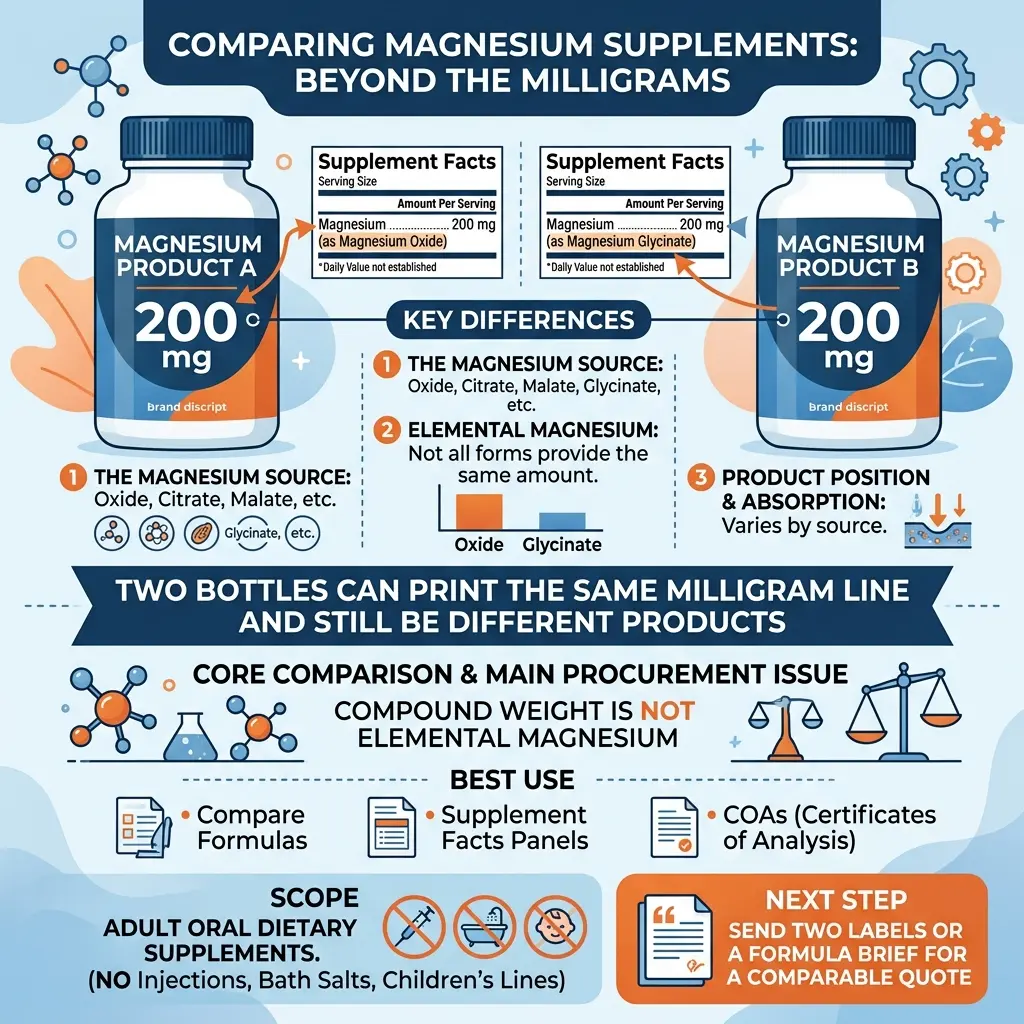
Magnesium supplements are finished oral products that deliver magnesium through a specified magnesium source — such as glycinate, citrate, malate, taurate, L-threonate, or oxide — not as a generic “200 mg magnesium” story. Two bottles can print the same milligram line and still be different products — the source, the elemental magnesium line, and the product position all change what the finished unit actually is. Send a brief or two labels when the next step is a comparable quote.
This page covers adult oral dietary supplements — not injections, not bath salts, not children’s lines.
Field | Detail |
|---|---|
| Page role | Category map: salt × elemental magnesium × serving × format |
| Core decision | Define the salt, elemental amount, serving basis, and format before comparing products |
| Main procurement issue | Compound weight is not elemental magnesium |
| Best use | Compare formulas, Supplement Facts panels, and COAs |
| Next step | Send two labels or a formula brief |
What Is a Magnesium Supplement?
A magnesium supplement is a finished oral unit — capsule, tablet, powder sachet, gummy, or liquid — whose label declares magnesium from a specified source. The panel may say magnesium (as magnesium bisglycinate), magnesium (as magnesium citrate), or magnesium with the source named in the ingredient statement. How that line is written depends on the destination market and the label file.
Four specification layers define the SKU. If any one changes, you may no longer be comparing the same product:
- Source salt — glycinate, citrate, malate, taurate, L-threonate, oxide, or another named salt. Each is a different material, with a different ligand and a different elemental percentage.
- Elemental magnesium — the magnesium mineral content delivered per serving, regardless of which salt carries it.
- Serving architecture — single salt, multi-salt complex, magnesium plus a companion, or a mineral / electrolyte system.
- Dosage form — capsule, tablet, powder, liquid, or gummy.
The milligram line may be elemental magnesium, compound (salt) weight, or a combined elemental total from several salts. How much material that number requires is in the next section.
Compound Weight vs Elemental Magnesium
Required compound weight = elemental magnesium target ÷ elemental magnesium fraction of the salt
For illustration only — not a standard value for any named salt — if a raw-material specification gives an elemental magnesium fraction of about 14%, a 200 mg elemental target requires roughly 1,430 mg of compound:
200 mg elemental Mg ÷ 0.14 ≈ 1,430 mg compound
That 1,430 mg is what has to fit into the capsule, the tablet, or the scoop. A salt with a higher elemental percentage reaches the same elemental target with less compound weight, which may make a lower unit count possible depending on fill capacity and the rest of the formula. Oxide provides a relatively high elemental magnesium fraction, while glycinate and L-threonate require substantially more compound weight to deliver the same elemental target. Percentage tables sit on the individual salt pages.
Use the incoming raw-material assay or declared specification, not a generic theoretical percentage. Fractions differ by supplier, hydration state (citrate), fully reacted vs buffered status (glycinate), and assay method.
Common Magnesium Forms and Their Specifications
Magnesium supplements commonly use glycinate / bisglycinate, citrate, malate, taurate, L-threonate, oxide, and multi-salt complexes. The procurement variables are not only the form name, but also elemental magnesium percentage, compound weight, specification basis, and dosage form. The table maps forms named on retail briefs to the architecture they usually enter — as specification and positioning examples, not as fixed properties of the salt.
Form | Architecture it usually enters | Specification task | Default format | Do not confuse with |
|---|---|---|---|---|
| Glycinate / bisglycinate | Single-salt capsule; often evening-positioned briefs | Compound-heavy; declare elemental mg separately; confirm whether the supplied grade is fully reacted, buffered, or otherwise specified | Capsule | Citrate or another salt with the same elemental Mg target |
| Citrate | Powder / drink-mix when the brief names citrate | Hydration state; acidity, taste, and serving load confirmed in formulation | Powder / tablet | Glycinate with the same elemental Mg target |
| Malate | When the brief specifies malate rather than glycinate or citrate | Compound mg and elemental mg; capsule vs powder fit | Capsule / powder | Glycinate with the same elemental Mg target |
| Taurate | Specialty brief that names magnesium taurate | Magnesium taurate ≠ magnesium plus free taurine | Capsule | Magnesium plus free taurine |
| L-threonate | Product positioned around magnesium L-threonate as the named source | Compound often in grams vs the elemental line | Capsule (split serving) | Glycinate with the same elemental Mg target |
| Complex / triple / full spectrum | Multi-salt bottle | Each salt plus each salt’s elemental contribution | Capsule | One salt delivering the entire elemental Mg line |
| Oxide | Cost-driven, high elemental ratio | Inexpensive elemental line; swallowable tablet weight | Tablet | A high-load chelated magnesium formula |
| Gluconate / aspartate / lactate / orotate / chloride | Inquiry row | Named on the RFQ when the brief requires that salt | — | An unspecified “magnesium” source |
In supplement labeling and commercial specifications, “magnesium glycinate” and “magnesium bisglycinate” are often used for the same chelated form. Confirm the exact specification from the supplier file and the destination-market label. Vegan positioning is a shell and excipient question, not a new salt.
Two of the rows above carry a material question the name does not settle, and each has its own specification page: a quoted magnesium taurate may be a reacted salt or a buffered composition, and magnesium L-threonate is authorised and supplied under conditions that vary by destination market.
How Do Magnesium Product Architectures Differ?
Magnesium products on retail shelves fall into four architectures. Each card is a shelf-real example with a different trade-off.
A. Single-salt magnesium-F01,02,03
One named magnesium salt per unit. The salt identity and the elemental line are the entire specification.
B. Multi-salt magnesium-F04
A blend of two or more magnesium salts in one finished unit. The composition — not a single combined number — is the specification.
C. Magnesium plus a companion-F05,06
Magnesium shares the unit with a vitamin, an amino acid, or a botanical. Each ingredient has its own identity and assay. Two representative architectures are enough on this hub.
D. Mineral / electrolyte systems-F07,08
Magnesium is one of several minerals in a multi-mineral or electrolyte unit. Mineral load, salt forms, solubility, taste system, serving volume, and moisture plan are the formulation constraints.
Companions that appear on briefs but do not need their own cards here: ashwagandha-plus-magnesium, D3-plus-magnesium, D3-plus-K2-plus-magnesium, creatine-plus-magnesium, and melatonin-plus-magnesium. Each is a separate identity and assay.

Use when: The brief is a single-mineral capsule, often evening-positioned, and names glycinate or bisglycinate.
Specify: Salt identity (glycinate / bisglycinate — often the same chelated form, but confirm the supplier specification); compound mg and elemental mg on separate lines; fully reacted vs buffered status on the raw-material specification; HPMC vs gelatin for the channel. If a brief requires a fully reacted glycinate / bisglycinate grade, lock that status in the specification rather than inferring it from the ingredient name.
Trade-off: Not F02 (malate) or F03 (citrate powder). Occasion, companion list, and claim language differ when the salt changes.
Default format: Hard capsules. See magnesium bisglycinate supplements manufacturing for this salt’s specification, MOQ, and COA framework.

Use when: The brief specifies magnesium malate rather than glycinate or citrate. Daytime or active-lifestyle positioning is a common brief, not a property of the salt.
Specify: Magnesium malate identity; compound mg and elemental mg; capsule vs powder fit; one-a-day vs split serving.
Trade-off: Not F01. A malate file and a glycinate file differ in occasion, companions, and claim language.Specification detail: magnesium malate supplement manufacturer.
Default format: Capsules or powder.

Use when: The brief is a drink-mix or powder and names citrate. Solubility, acidity, taste, and serving load have to be evaluated together.
Specify: Hydrated vs anhydrous citrate; acid and flavor system; compound and elemental magnesium per scoop or sachet; moisture plan.
Trade-off: Not F01. A citrate powder and a glycinate capsule are different serving and taste problems. Specification detail: magnesium citrate supplement manufacturer.
Default format: Powder or tablets.

Use when: The product is a “full-spectrum,” “triple,” or “complex” magnesium bottle.
Specify: Each salt in the blend, each salt’s compound mg, and each salt’s elemental magnesium contribution; whether oxide is part of the declared composition; one bottle vs two SKUs when the salts serve different occasions.
Trade-off: One bottle with several salts is not a higher-elemental product. “Seven magnesiums” does not mean seven full doses. Per-salt specification detail: magnesium complex supplement manufacturer.
Default format: Capsules.

Use when: The product carries an amino-acid task (theanine) and a mineral task (magnesium) in the same unit.
Specify: L-theanine mg and assay; magnesium salt identity and elemental magnesium; caffeine yes / no; calm-focus vs evening positioning.
Trade-off: Not F01. A single-salt glycinate capsule is a mineral file; this is a two-ingredient file. See L-theanine plus magnesium supplement manufacturer.
Default format: Hard capsules.

Use when: The companion is B6 — often a cycle-adjacent or midlife-positioned panel.
Specify: B6 form (pyridoxine vs P5P); magnesium salt and elemental magnesium; the claim file for that panel.
Trade-off: Not F01. B6 changes the claim file and the companion cost.
Default format: Hard capsules.

Use when: The product is a three-mineral daily unit.
Specify: Three separate elemental lines (calcium, magnesium, zinc); tablet weight and compression; whether magnesium is glycinate or oxide inside the blend; coating and swallow size.
Trade-off: Not F01. Fill weight and the tablet press are the constraints. See calcium supplements for the multi-mineral architecture.
Default format: Tablets.

Use when: The product is an electrolyte or training-day powder.
Specify: Potassium salt and elemental potassium; magnesium salt and elemental magnesium; sodium inclusion; flavor and mixability; stick-pack moisture plan.
Trade-off: Not F01. A potassium-plus-magnesium stick is a sports electrolyte file.
Default format: Stick packs or powder.
Which Dosage Forms Fit Different Magnesium Loads?
The same magnesium formula usually cannot be moved from a capsule to a tablet to a powder without changing the fill, the moisture plan, or the serving. Each format changes what the formula can physically hold.

Best for: F01 (glycinate), F04 (complex), F05 (theanine plus magnesium). Capsules fit chelated salts, multi-salt blends, and split servings.
Why: As a working range, size 0 may accommodate roughly 350–450 mg and size 00 roughly 500–650 mg; actual fill depends on tap density and formulation characteristics. HPMC vs gelatin is a channel and claim decision.
Default path: Hard capsules.
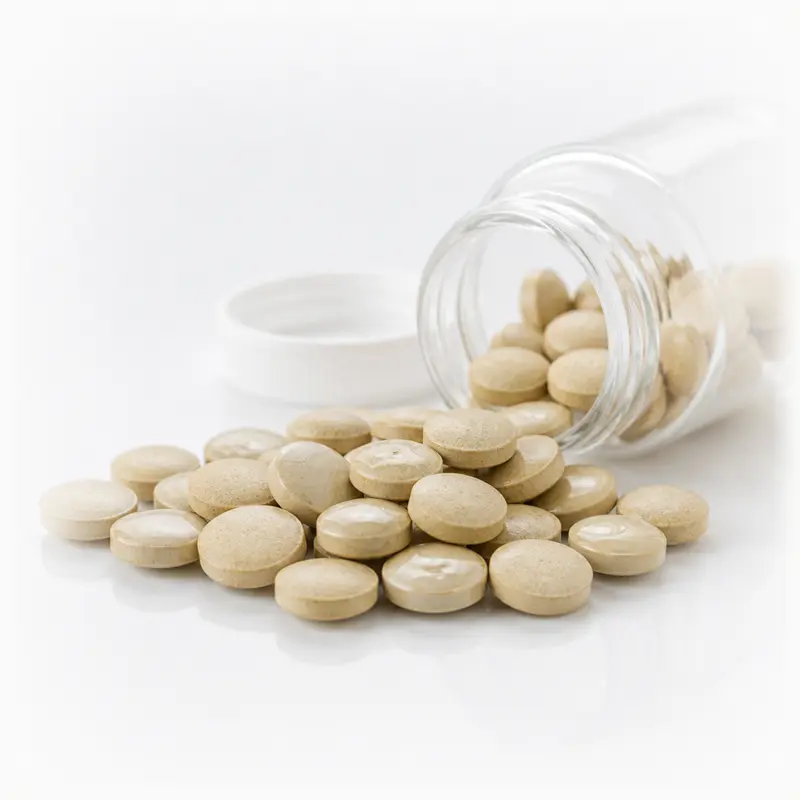
Best for: F07 (calcium-magnesium-zinc), oxide-driven cost tablets, pharmacy-channel high-count bottles.
Why: Compression changes how the salt behaves. High-elemental tablet formulas often favor higher-density mineral sources or blends to keep tablet weight and swallow size within a practical range.
Default path: Tablets.
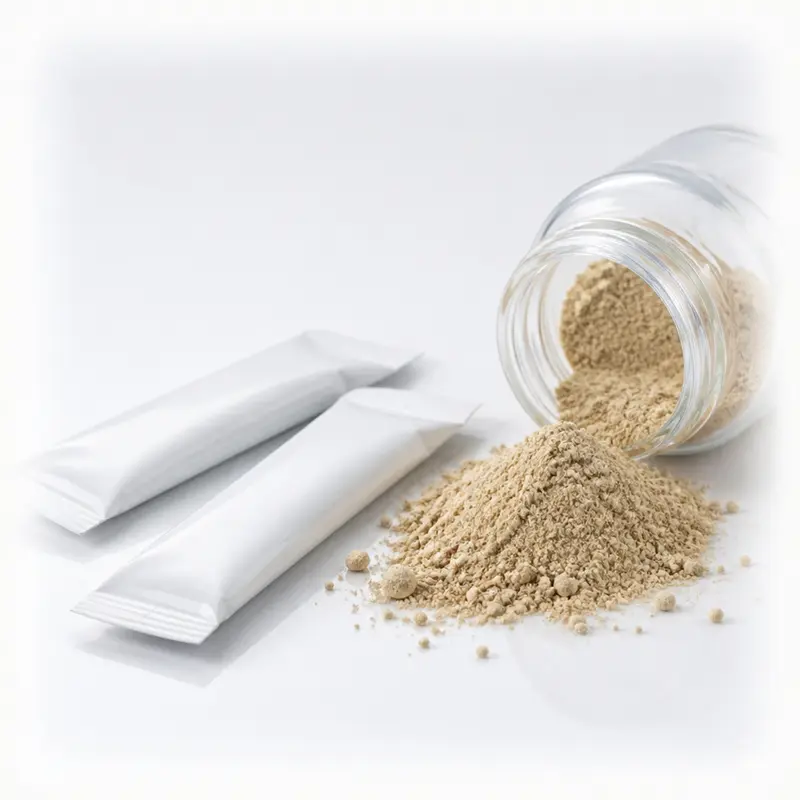
Best for: F03 (citrate drink mix), F08 (electrolyte), and any architecture where the compound load makes a multi-capsule serving impractical. A ~2 g L-threonate compound serving may fit a stick or powder better than three capsules.
Why: Powder carries flavor, acid, and moisture constraints. Declare elemental magnesium per scoop alongside compound weight.
Default path: Powders and granules.
 Other Formats
Liquid magnesium declares mg per mL with both compound and elemental lines — see liquids. Liposomal magnesium is a delivery system, not a ninth salt — the salt inside the phospholipid envelope still has to be named; see liposomal supplements. Gummy manufacturing constrains dose load and cook loss — see gummies. Softgels require a compatible fill system and are generally less suitable for high-load magnesium-only formulas. Topical and transdermal magnesium are outside the default oral OEM scope.
Go Deeper — Magnesium Procurement
 Why Two Magnesium Supplements With the Same Label Are Not Comparable
Click here 👉: Raw-material definitions and supplier documentation before a glycinate grade is locked.
 Buffered vs Fully Reacted Magnesium
Click here 👉: Which tests run on incoming drums, which run on finished capsules, and which document confirms the label claim.
 How Finished-Product Magnesium Is Tested
Click here 👉: The layers that have to sit beside the elemental line before two quotes describe the same product.
 Why Elemental Magnesium Is Not a Manufacturing Specification
 How Fill Weight Limits Capsule Count
 How Magnesium Stability Changes Shelf Life
A single “magnesium 200 mg” line is a front label, not a specification. When Quote A and Quote B disagree, these are the usual gaps.
1. Compound mg vs elemental mg. One quote may be pricing 1,000 mg of bisglycinate compound; the other may be pricing 1,000 mg elemental. Same number, different basis.
2. Combined elemental on a complex. A “magnesium 200 mg” line may be the sum of three or four salts. Compare each salt and each salt’s elemental contribution, not the single total.
3. Glycinate name vs raw-material grade. Fully reacted and buffered material can produce different specifications under similar front-label wording. Confirm the grade on the supplier COA.
4. Incoming drum assay vs finished-unit claim. The raw-material COA describes the drum that entered the factory. The finished product should be evaluated against its declared finished-product specification. How to read either file: How to Read a COA.
Send two labels for a side-by-side comparison.
Formula
| RFQ field | What to specify |
|---|---|
| Magnesium source salt | Glycinate / citrate / malate / taurate / L-threonate / oxide / other |
| Elemental magnesium | mg per serving |
| Compound weight basis | Compound mg or elemental mg — state which the target refers to |
| Serving basis | 1 / 2 / 3 capsules, tablets, scoops, sticks, or mL |
| Companion ingredients | B6 / theanine / potassium / calcium / zinc / other — each with identity and assay |
Incoming raw material
RFQ field | What to specify |
|---|---|
| Salt specification | Fully reacted / buffered / other |
| Elemental magnesium percentage | From the incoming specification or assay |
| Incoming assay and supplier COA | Identity, assay, heavy metals, microbiology, and other customer-required parameters |
Finished product
| RFQ field | What to specify |
|---|---|
| Dosage form | Capsule / tablet / powder / liquid |
| Capsule shell | HPMC / gelatin (if capsule) |
| Finished-unit assay | Finished-product testing against the declared elemental magnesium specification |
| Target market | US / EU / UK / other — label format and claim file |
| Label basis | Supplement Facts / local equivalent |
| Pack | Bottle / sachet / stick pack / pouch |
| Sample request | Formula sample or finished-product sample |
Send Your Magnesium Formula Brief with these fields locked, or compare two magnesium labels when existing quotes disagree.
GI response can differ by form, serving, formulation, and the individual. Review the form and the serving, not a fixed tolerance rule. On a complex, use the combined elemental magnesium per serving.
Pediatric, pregnancy, renal-impairment, and interaction-related claims need destination-market label review with local counsel.
For U.S. labeling and formulation review, NIH ODS reports a Tolerable Upper Intake Level of 350 mg/day for magnesium from dietary supplements and medications for adults. That UL does not include magnesium naturally present in food and beverages. It is a regulatory / nutrition reference, not a formulation target. See the NIH ODS magnesium fact sheet in the references.
What is elemental magnesium?
The magnesium mineral content delivered per serving, regardless of which salt carries it. “Magnesium bisglycinate 1,000 mg” on a panel is usually compound weight.
Is magnesium glycinate the same as magnesium bisglycinate?
In commercial specifications the two names often refer to the same chelated form. Confirm the supplier file and the destination-market label. Naming comparison: magnesium bisglycinate vs magnesium glycinate.
Can magnesium glycinate and magnesium citrate use the same formula?
Not without a formulation review. Changing the salt can change compound weight, fill, taste, moisture, and other formulation parameters. A glycinate capsule and a citrate powder are different architectures (F01 vs F03).
Can a magnesium complex be quoted from one combined elemental number?
Not as a comparable quote. Name each salt and each salt’s elemental contribution. See F04.
Does changing the magnesium salt require a new formulation review?
Changing the magnesium salt generally requires a formulation review. Compound load, tap density, format, and finished-unit assay may all need to be re-checked. It is not a label swap.
Magnesium salt manufacturing pages
- Magnesium Bisglycinate Supplements Manufacturing
- Magnesium Malate Supplement Manufacturer
- Magnesium Complex Supplement Manufacturer
- Magnesium Citrate Supplement Manufacturer
- Magnesium Taurate Supplement Manufacturer
- Magnesium L-Threonate Supplement Manufacturer
Application pages
Format pages
Adjacent category pages
Magnesium Guides By Topic

Formulation notes for muscle-comfort-positioned briefs — not a treatment claim.
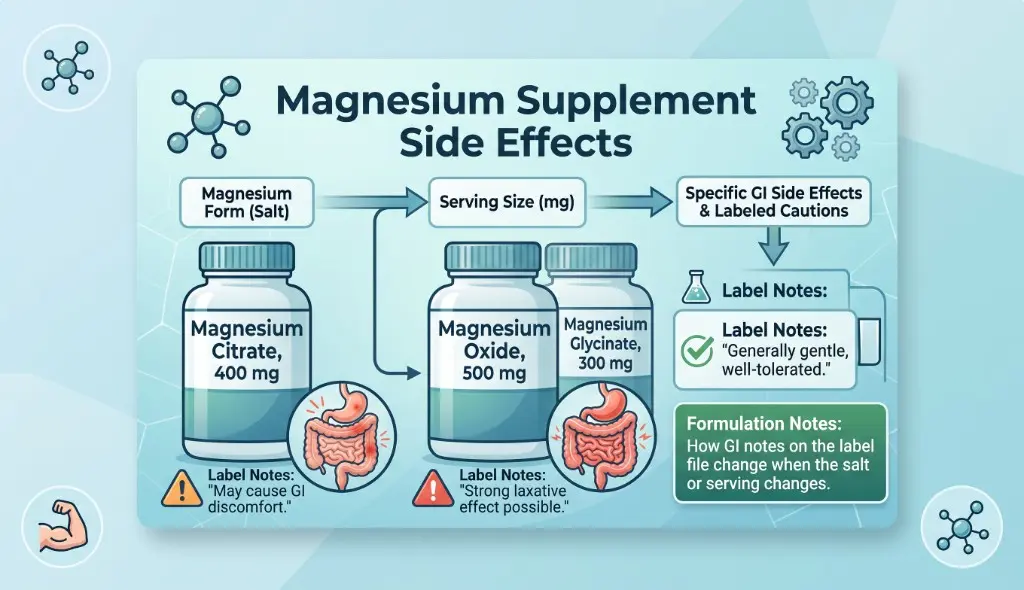
How GI notes on the label file change when the salt or serving changes.
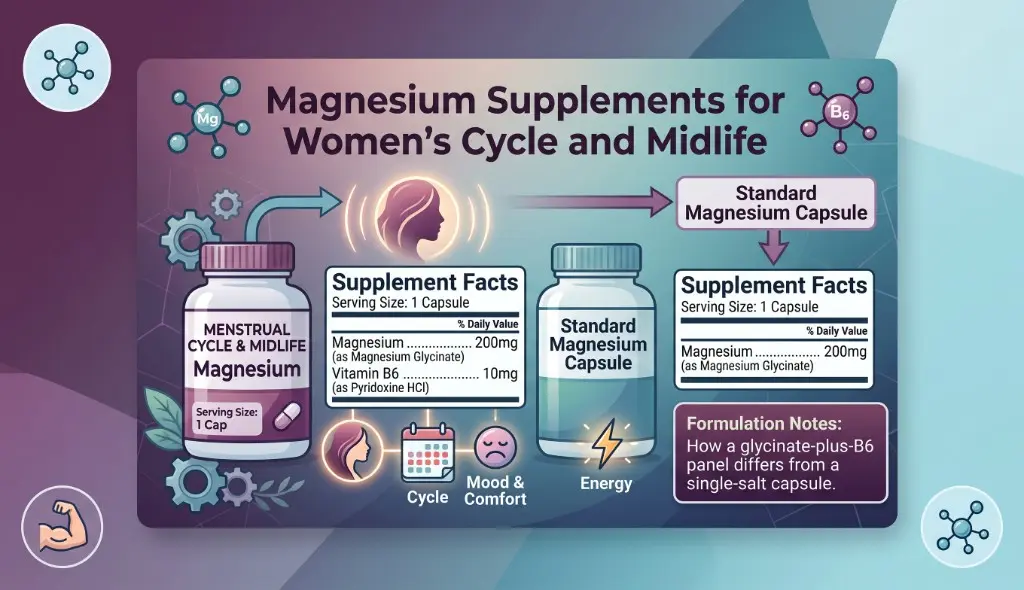
How a glycinate-plus-B6 panel differs from a single-salt capsule.

Timing language follows the product position, not a universal clock rule.
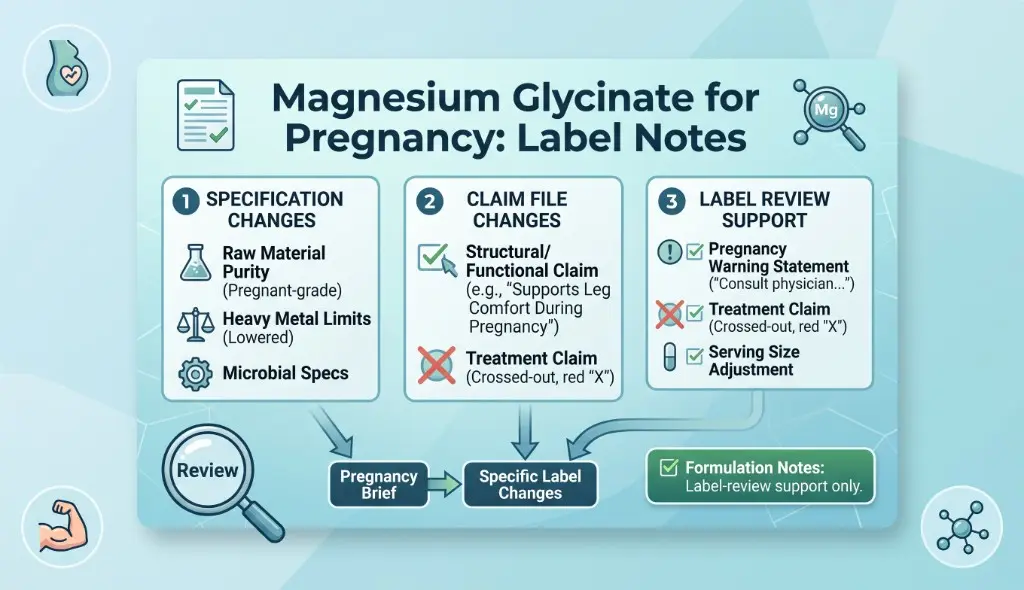
What changes on the specification and claim file when a brief names pregnancy. Label-review support only.
References
- NIH Office of Dietary Supplements. Magnesium — Health Professional Fact Sheet. https://ods.od.nih.gov/factsheets/Magnesium-HealthProfessional/
Disclaimer: Wholesale and brand-manufacturing reference only. Dietary supplements are not intended to diagnose, treat, cure, or prevent any disease. Milligram figures are development examples, not recommended intakes. The U.S. adult UL of 350 mg/day from supplements and medications (NIH ODS) is a protective reference, not a dose this page prescribes. Brand owners remain responsible for finished-label compliance with local counsel. Magtein®, TRAACS®, and other branded grades appear only as customer-licensed options.