Introduction
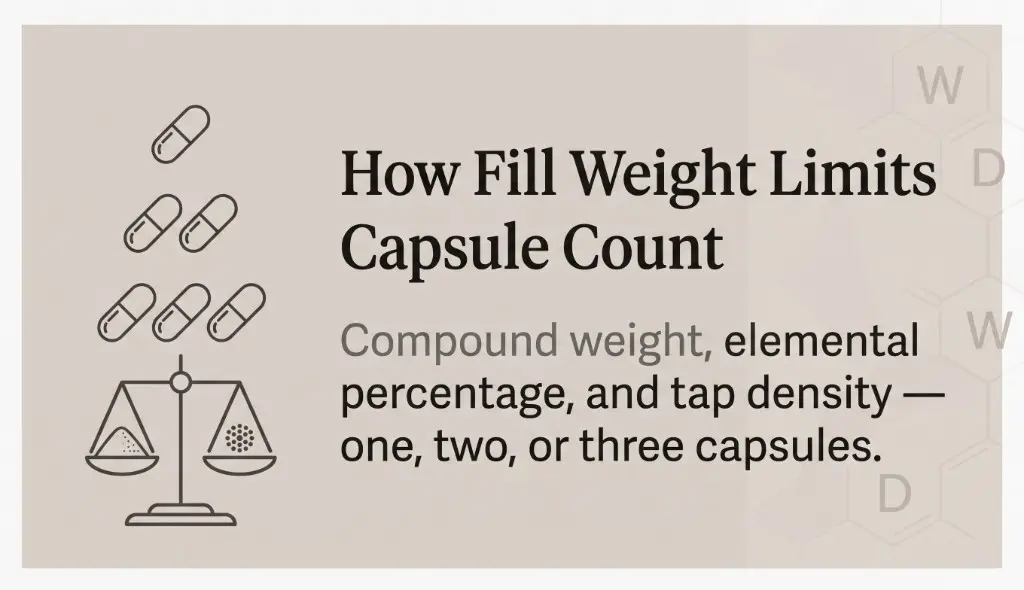
The same elemental magnesium target does not mean the same raw-material weight, and the same raw-material weight does not mean the same capsule count. Hard-capsule capacity is a volume constraint, not a fixed milligram limit. For development purposes, a size 0 or size 00 shell may accommodate several hundred milligrams of a magnesium blend, but the actual fill weight depends on the blend’s tapped density, particle characteristics, excipient system, and encapsulation setup. The same capsule shell can therefore hold different weights of different magnesium blends. That is why two OEM quotations can both print 200 mg elemental magnesium and still quote one capsule versus two or three. The Magnesium Supplements page covers the broader product and formulation architecture.
The question here is hard-capsule serving architecture for adult oral dietary supplements. Injections, bath salts, and children’s lines sit outside. Powder, stick pack, and tablet appear only when the capsule load is no longer practical.
What Determines How Much a Capsule Can Hold
Three manufacturing variables set how much magnesium blend a two-piece hard capsule can hold.
Capsule volume. Shell size is a volume, not a milligram rating. A size 0 shell is smaller than a size 00; a size 00 is smaller than a size 000. Larger shells hold more blend by volume and are often harder to swallow. Retail channels frequently cap the acceptable size — a size 000 is not automatically available just because the math prefers it.
Blend density. Tapped density is measured on the specific blend, not inferred from the salt name. Particle size, particle shape, excipients, flow aids, and companion ingredients all change how the powder packs in the shell. Two glycinate blends can fill different weights in the same size 00.
Practical fill weight. Fill weight is volume × the density that the encapsulation setup actually achieves, inside a working window. That window also has to leave room for blend uniformity, minimum and maximum fill-weight control, machine dosing range, flow, segregation risk, and the lock characteristics of the shell. Illustrative development ranges sometimes used in early screening — on the order of several hundred milligrams for a size 0, and a higher several-hundred-milligram band for a size 00 — are starting points, not catalog capacities. Confirm capacity against the blend that will run.
Elemental magnesium is a labeling and formulation calculation.[1][2] It should not be used on its own to infer comparative product quality, efficacy, or tolerability.
How to Calculate Magnesium Raw-Material Weight
The elemental target is not the weigh-up.
Required raw-material weight = elemental magnesium target ÷ actual elemental magnesium fraction of the specified raw material
Estimated capsule count = required raw-material weight ÷ practical fill capacity per capsule
Use the elemental assay or declared specification of the incoming raw material, not a generic theoretical percentage for “the salt.” Fractions differ by supplier, hydration state, fully reacted versus buffered status, and assay method. The elemental number is a comparison basis, not a complete manufacturing specification — see why elemental magnesium is not a manufacturing specification.
A label stating 200 mg elemental magnesium from magnesium glycinate is not equivalent, from a manufacturing-load perspective, to 200 mg elemental magnesium from magnesium oxide. The elemental target is the same; the amount of raw material needed to achieve it is not.
Illustrative development example — not a named commercial grade, not a recommended intake, and not a finished-product specification. If the elemental target is 200 mg and the specified raw material is 14% elemental magnesium, the raw-material weight is about 1,430 mg before overage and excipients. If practical fill capacity on the chosen shell is about 550 mg for that blend, 1,430 ÷ 550 ≈ 2.6, so the estimated serving is three capsules. A different grade specified at 40% elemental magnesium would need about 500 mg of raw material for the same 200 mg elemental target and may fit a single capsule of the same size if the blend actually packs to that fill.
Estimated capsule count is a screening number. It is not the production specification. Excipient load, flow, segregation, fill-weight limits, and the encapsulator’s dosing range can move the serving from the mathematical result. Fill-weight consistency, where it sits on the finished-product file, is a release question — see how finished-product magnesium is tested.
Why Magnesium Forms Can Require Different Capsule Counts
Different magnesium compounds provide different elemental magnesium fractions. Magnesium oxide provides a much higher elemental fraction than many chelated or organic magnesium compounds, while the low-fraction forms require substantially more raw material to reach the same elemental magnesium target — magnesium taurate and magnesium L-threonate are the two where that gap most often decides the serving architecture rather than merely influencing it. The calculation should use the specification of the selected commercial raw material rather than a generic form-level percentage.
That is the manufacturing reason a 200 mg elemental glycinate serving and a 200 mg elemental oxide serving can have different capsule counts. The glycinate serving may need two or three capsules; the oxide serving may fit one. The products differ in fill weight, raw-material cost, and serving architecture even when the elemental line matches.
For a multi-salt complex, each source has its own specified fraction and its own compound milligrams. The capsule load is the sum of those weigh-ups, plus excipients — not the combined elemental total divided once. A blend that includes a high-fraction salt will usually occupy less shell volume than a no-oxide chelate blend at the same combined elemental number. Capsule count follows composition, not the front-label total — the per-salt arithmetic is worked through on the magnesium complex supplement manufacturer page.
Why Two Magnesium OEM Quotes Can Have Different Capsule Counts
Two quotations that both say “magnesium 200 mg, 60 capsules” are not yet the same product. The 200 mg has to be elemental magnesium, not 200 mg of raw material, and the 60 count has to be read against capsules per serving.
Illustrative quote pair — development screening only, not catalog grades.
Quote item | Quote A | Quote B | Why it matters |
|---|---|---|---|
| Elemental Mg | 200 mg | 200 mg | Same target |
| Magnesium source | Glycinate, as specified | Oxide, as specified | Different raw-material loading |
| Raw-material assay | Named % on that COA | Named % on that COA | Sets compound weight |
| Capsule size | 00 | 0 | Different shell volume |
| Fill weight | Set by that blend’s packing | Set by that blend’s packing | Practical loading, not a size chart |
| Capsules / serving | 2 | 1 | Different serving architecture |
| Capsules / bottle | 60 | 60 | Different days per bottle |
A 60-count bottle at two capsules per serving is a 30-day pack if the serving is daily; a 60-count bottle at one capsule per serving is a 60-day pack. Unit price per bottle is then not a magnesium-per-day comparison.
Quotes also diverge when one uses a different excipient system, particle-size distribution, or flow aid, changing the blend’s packing and fill characteristics — not because an excipient automatically “increases” tap density.
When the Capsule Load Becomes a Format Problem
When the required raw-material load becomes impractical for a two- or three-capsule serving, the manufacturer may evaluate a powder, stick pack, or tablet format instead. The decision depends on total fill weight, powder properties, target serving size, swallowability, and the required product architecture. Capsules are not automatically the premium path, and a request for one capsule at a low-fraction elemental target may simply exceed what that shell can hold.
What to Specify in a Magnesium Capsule RFQ
Brands typically put these lines on a capsule quotation before two factories are asked to match capsule count:
- elemental magnesium target, in mg per serving, stated as elemental;
- magnesium source — each salt named, including each salt in a blend;
- raw-material specification — elemental fraction, assay method, and fully reacted or buffered basis where it applies;
- preferred shell — HPMC or gelatin, and a target size;
- preferred serving architecture — one, two, or three capsules — treated as a constraint to test, not as a label decision made in isolation;
- bottle count — total capsules, which only becomes days-per-bottle after capsules per serving is known.
When capsule count is the disagreement, send the formula brief with the elemental target, the salt specification, and the preferred shell size. The fill calculation shows whether a one-capsule serving is feasible or whether the serving has to split. Typical reply is within one business day; a project manager is assigned; NDA is available on request.
Capsule Count Is a Formulation Constraint, Not a Quality Score
A one-capsule magnesium product is not automatically better than a two- or three-capsule product. Fewer capsules may reflect a higher-elemental raw material, a different magnesium source, a larger shell, a higher-density blend, or a different serving target. Capsule count should therefore be evaluated together with magnesium form, elemental specification, fill weight, and serving architecture.
Frequently Asked Questions
Does capsule size determine the magnesium dose?
No. Capsule size determines available volume. The magnesium amount on the serving depends on the elemental target and the elemental fraction of the selected raw material. A larger shell can hold more blend by volume; it does not, by itself, set a 200 mg elemental line.
Should the capsule count be specified before formulation?
Treat it as a formulation constraint rather than an independent label decision. The manufacturer needs the elemental target, magnesium source, raw-material specification, blend composition, and preferred shell size before a workable serving architecture exists. Locking “one capsule” first can force a different salt, a larger shell, or a format change.
Can two suppliers use the same magnesium salt but quote different capsule counts?
Yes. Differences in raw-material assay, blend composition, excipients, capsule size, and practical fill-weight limits can change the final capsule count. The salt name is not a fill-weight specification.
Why can two 60-capsule bottles offer different days of servings?
Because bottle count is total shells, not servings. Divide the bottle count by capsules per serving. Two capsules per serving in a 60-count bottle is not the same commercial pack as one capsule per serving in a 60-count bottle, even when both labels print 200 mg elemental magnesium.
Related
- Magnesium L-Threonate Supplement Manufacturer
- Magnesium Taurate Supplement Manufacturer
- Hard Capsules
- Powders and Granules
- Tablets
Technical and Regulatory References
- U.S. Food and Drug Administration. 21 CFR 101.36 — Nutrition labeling of dietary supplements. https://www.ecfr.gov/current/title-21/chapter-I/subchapter-B/part-101/section-101.36
- NIH Office of Dietary Supplements. Magnesium — Health Professional Fact Sheet. https://ods.od.nih.gov/factsheets/Magnesium-HealthProfessional/
Disclaimer: Wholesale and brand-manufacturing reference only. Not intended to diagnose, treat, cure, or prevent any disease. Dietary supplements are not drugs. Capsule fill is a volume-and-density manufacturing constraint. Milligram bands, elemental percentages, and capsule-count calculations are development examples confirmed against the specific blend — they are not catalog capacities, not recommended intakes, and not quality scores. Elemental magnesium is a labeling and formulation calculation, not a basis for inferring efficacy or tolerability. Brand owners remain responsible for finished-label compliance with local counsel.
Written by KS Nutripharma Formulation Team | Reviewed by KS Nutripharma Director of R&D (PhD, Food Science | 19+ years nutraceutical development) | Technical review scope: capsule volume versus fill weight, tap density, raw-material assay basis, estimated versus practical capsule count, and serving architecture | Updated September 2026