

Magnesium L-Threonate Supplement OEM, ODM & Private Label Service
KS Nutripharma is a magnesium L-threonate supplement manufacturer for OEM, ODM, and private-label programs, producing finished capsules, tablets, and powders for cognitive-positioned assortments with the material identity, compound weight, elemental magnesium line, and batch COA locked before quoting.
This salt is not a commodity mineral, and the first decision on a threonate brief is not price. It is which material you are entitled to sell in your destination market. Unbranded magnesium L-threonate is widely offered; the branded ingredient is patent-protected; and in the European Union and Great Britain the substance is authorised under conditions that include a hard maximum level, mandatory on-pack wording, and — until November 2029 — a market exclusivity that decides the question for you. The compound weight then decides the format, because a meaningful serving is measured in grams rather than milligrams.
Already have a formula? Send your BOM — we review the material identity against the published composition, the elemental magnesium line, and whether the stated capsule count can carry the compound weight.
Comparing two quotes? Send both COAs — with the destination market named, we will tell you whether they are the same material on the same basis.
Selling into the EU or UK? Send your target market and serving — the authorised maximum and the mandatory label statement are settled before artwork, not after.
cGMP | ISO 9001 | ISO 22000 | HACCP | FSSC 22000 | Halal | Kosher | In-house lab + SGS/Eurofins pathways | Batch COA
12 production lines · 81,000+ m² · 260+ professionals · since 2007 · 500+ brands · 60+ markets
Typical first reply is within one business day on a complete brief. Project manager assigned. NDA available.
Magnesium L-Threonate Supplement Manufacturing at a Glance
| What we manufacture | Oral magnesium L-threonate capsules, tablets, and powders. Gummies and liquids after feasibility |
| Identity | Magnesium L-threonate monohydrate, CAS 500304-76-7. Not glycinate, citrate, malate, taurate, or oxide |
| Material fork | Branded patent-licensed ingredient or unbranded material — decided by destination market before it is decided by cost |
| Compound versus elemental | A gram-scale compound line is not the magnesium line. Both belong on the specification |
| EU and GB | Authorised with a maximum level, mandatory label wording, and market exclusivity running to 7 November 2029 |
| Default format | Hard capsules across two or three units; powder sticks where the brand will not ask for three capsules |
| Scope | Oral dietary supplements for adults. Not injections, infant, or pet products. Not transdermal magnesium |
| Documents | Batch COA against the approved specification; SGS/Eurofins pathways where the RFQ requires it |
Magnesium L-Threonate Formula Architectures
Five architectures cover almost every threonate brief. Each is adjusted against your elemental target, destination, and acceptable unit count rather than sold as a fixed item.
Other companions are quoted from your brief with their own identity and assay — phosphatidylserine, lion’s mane, bacopa, ginkgo, and Alpha-GPC as a distinct choline source. Melatonin makes the product a separate finished specification with its own market-by-market restrictions rather than a variant of a threonate capsule.
Use when: The panel will lead with magnesium L-threonate at the gram-scale serving the retail category has established, and the brand accepts a split serving.
Specify: Material identity and hydrate; branded or unbranded basis with authorisation status if the trademark will print; compound mg and elemental mg on separate lines; units per serving; gelatin or HPMC shell.
Trade-off: Against F02, this is the architecture that keeps the compound line intact and pays for it in swallow count. A gram-scale serving does not fit one standard hard capsule, so two or three units is the format, not a compromise.
Default format: Hard capsules, two or three per serving.
Use when: The brand wants a specified threonate identity in fewer units per day and is prepared to declare a lower magnesium line for it.
Specify: The target compound weight and the elemental magnesium it actually yields from the qualified lot’s assay; units per serving; whether the panel will state the reduced line plainly.
Trade-off: Fewer capsules means a smaller compound line, not the same serving in a smaller bottle. Elemental magnesium cannot be restated upward, and a reduced-compound unit should not be marketed as equivalent to a gram-scale panel.
Default format: Hard capsules, one or two per serving.
Use when: The assortment wants a cognitive-positioned magnesium and a second, body-comfort magnesium, and the brand is weighing one unit against two SKUs.
Specify: Each salt by name with its own compound weight and its own elemental contribution; the combined elemental magnesium against the destination market’s limits; one bottle or two.
Trade-off: One capsule cannot carry a gram-scale threonate serving plus a meaningful bisglycinate fill, so a single-unit version means cutting one of the two lines — usually the threonate. Two SKUs keep both lines whole. The second salt is quoted on the magnesium bisglycinate specification, and a single declared “magnesium 200 mg” blend figure is not a specification for either.
Default format: Capsules, or a twin-SKU pack.
Use when: A calm-focus companion is wanted without changing the unit count.
Specify: L-theanine amount and assay; the threonate compound and elemental lines; caffeine in or out.
Trade-off: Theanine is the one common companion light enough to ride along on a shell that is already mostly full, which is exactly why it needs a claim review rather than a fill review. Anything heavier changes the unit count before it changes the positioning. Where theanine leads the concept rather than accompanying the threonate, the pairing is quoted on the L-theanine and magnesium program instead.
Default format: Hard capsules.
Use when: The brief names a choline donor on the same panel and the brand accepts the resulting unit count.
Specify: Citicoline identity and amount — not interchangeable with Alpha-GPC or choline bitartrate — with its own assay; licensed choline grades only where authorised; the threonate compound and elemental lines.
Trade-off: This is the card where the shell runs out. Two gram-adjacent actives and two assays push the serving to three capsules or to a powder, and a reduced-compound threonate base (F02) is usually the honest way to keep the count down. Phosphatidylserine and lion’s mane briefs behave the same way and are quoted on the same basis.
Default format: Hard capsules, or a stick.
Choose the Magnesium L-Threonate Format: Capsules, Tablets or Powder
The architecture settles the composition. These cards cover what a gram-scale compound weight does to the process.
Gummies and liquids are project-scoped rather than default formats here. A gummy has to survive heat and water-activity review and carry a per-piece assay, and the piece count needed to reach a credible compound line is usually what rules it out; a liquid declares magnesium per millilitre on both a compound and an elemental basis and adds preservation, pH stability, and shelf-life testing. Softgels apply only where an oil-phase companion is on the brief.
Best for: Compact bottles and reduced-compound architectures where compression and per-piece assay are acceptable.
Why: A tablet carries more mass per swallowable unit than a capsule, which is the usual reason a threonate brief moves here. Compressibility, tablet weight, hardness and friability, disintegration, and coating are confirmed on trial, and coating earns its cost where dust or odor is a factor. A tablet specification and a capsule specification are two separate release documents even at the same declared magnesium.
Default path: Tablets.

Best for: Most threonate programs, including all five architectures above.
Why: At gram-scale compound loads, capsule count and total fill weight become the primary feasibility constraints, ahead of taste or appearance. As a planning range, size 0 may take roughly 350 to 450 mg and size 00 roughly 500 to 650 mg of a powder blend, with actual capacity following the finished blend’s bulk and tapped density and confirmed by fill trial. Working from the elemental target through the qualified lot’s assay to the compound weight gives the unit count, and for a full-compound serving that answer is two or three. The arithmetic behind that, and why it cannot be argued down, is worked through in how fill weight limits capsule count.
Default path: Hard capsules.
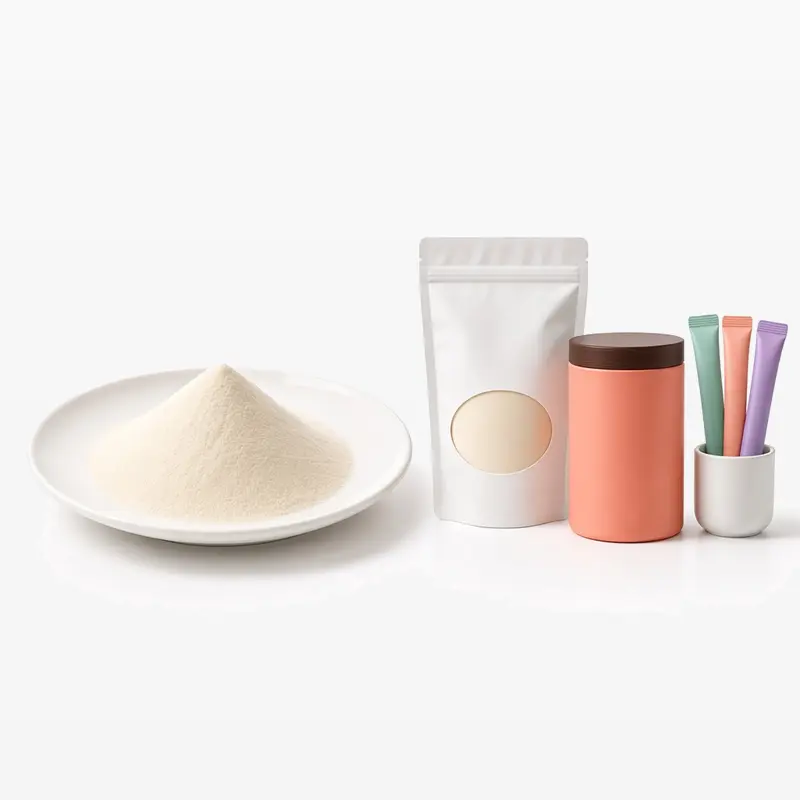
Best for: Delivering a full-compound serving in one unit the customer consumes rather than swallows.
Why: A stick accommodates a gram-scale compound load without increasing capsule count, which is the single strongest argument for this format on this salt. Taste, moisture control, flowability, and per-stick assay all have to be evaluated at the target magnesium level, and the material’s cost density means overfill tolerance is a commercial line item and not just a process setting.
Default path: Powders and granules.
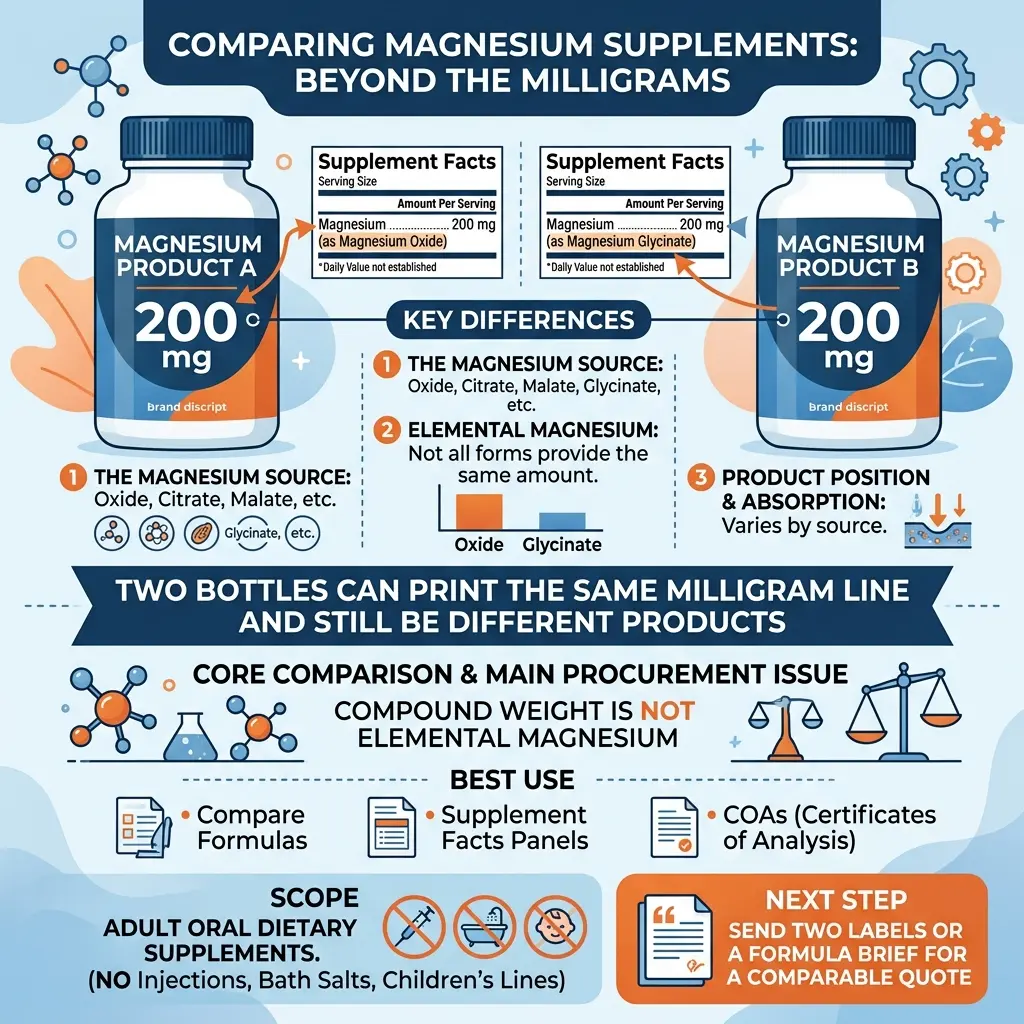
Two factories can both print “magnesium L-threonate 2,000 mg” and be quoting different projects. Unusually for a mineral salt, most of what separates them is published rather than proprietary.
The published specification
Because the material was authorised as a novel food in the EU, its composition is set out in the Union list [2]. That gives a buyer something no supplier letter can: a regulator-published window to hold any COA against.
| Field | Published specification |
|---|---|
| Chemical name | Magnesium (2R,3S)-2,3,4-trihydroxybutanoate monohydrate |
| Molecular formula / CAS / MW | C8H16MgO11 / 500304-76-7 / 312.5 Da |
| Production route | Chemical synthesis |
| Magnesium L-threonate monohydrate | 98%–102% |
| Magnesium | 7.2%–8.3% |
| L-threonate | 82%–91% |
| Oxalic acid | ≤ 1% |
| Ethanol | ≤ 5,000 ppm |
| Loss on drying | ≤ 5.0% |
Two of those fields separate a qualified supplier from an unqualified one faster than assay does. Oxalic acid is capped at 1% because it is a synthesis-related residue, and EFSA’s assessment rested on additional oxalic acid exposure staying below roughly 30 mg per day at the maximum intake [4]. Ethanol is a residual solvent from the same route. A COA that reports magnesium and nothing else has not demonstrated that the material meets the authorised composition, and a supplier who has never been asked for oxalic acid usually cannot produce a historical result for it.
Identity is also more specific than the trade name suggests. The authorised substance is the L-isomer as the monohydrate. A specification or COA reading only “magnesium threonate” has not named the isomer or the hydrate state, and neither has been established by the product name.
Branded versus unbranded material, and why that is not only a trademark question
The branded ingredient sits on patents held by Neurocentria, Inc. and is supplied under exclusive licence by ThreoTech, LLC, which states publicly that magnesium L-threonate sold without the brand name is not produced under its patented process and is not authorised. Unbranded material is nevertheless offered by other suppliers, and we manufacture from either one when the brand has qualified it.
What we cannot do is clear it for you. Whether a specific unbranded material, and the use you intend for it, are free of third-party patent and trademark rights in your destination market is a question for the brand owner’s counsel. A contract manufacturer can verify that a drum matches an approved specification; it cannot certify freedom to operate, and any factory that tells you otherwise is selling you a risk it does not carry. Printing the trademark on Supplement Facts is the separate, simpler question: that requires authorisation and the licensor’s specification.
The EU and GB position, which settles the fork for you
For a European launch this stops being a preference. Magnesium L-threonate was authorised as a novel food on 7 November 2024 [2] and added to the list of permitted magnesium sources in Annex II of the food supplements directive, usable in EU food supplement manufacture from 26 November 2025 [3].
The authorisation carries five-year data protection. Until 7 November 2029, magnesium L-threonate may be placed on the EU market only by the applicant, AIDP Inc. — in practice through it and its licensee — unless a later applicant obtains its own authorisation without relying on the protected data, or the applicant agrees [2]. An unbranded drum bought elsewhere does not open an EU route on its own, however good its COA is.
Three conditions travel with the authorisation, and all three land on artwork:
- Use is limited to food supplements for adults, excluding pregnant and lactating women.
- The maximum level is 250 mg of magnesium per day — expressed as magnesium, not as the compound [2].
- The label must designate the ingredient “Magnesium L-threonate”, and the supplement must carry a statement that it should be consumed by adults only, excluding pregnant and lactating women [2].
Great Britain authorised the material separately, with the same 250 mg magnesium per day maximum, but with mandatory wording drafted differently — it addresses persons under 18 rather than adults only [5]. Two markets, two label versions, one material.
Compound weight versus elemental magnesium
The number a consumer reads as “2,000 mg” is compound weight. At the published 7.2%–8.3% magnesium, the elemental line inside a 2,000 mg serving is roughly 145 to 165 mg, and a published US label pattern for the branded ingredient declares 2,000 mg of the ingredient alongside 144 mg of magnesium across three capsules [6].
The regulatory cap and the arithmetic meet at the same point: 250 mg of magnesium is about 3,000 mg of material, which is also the daily intake EFSA assessed [4]. So the EU ceiling is, in practical terms, a three-gram serving — and everything downstream on this page is a consequence of carrying grams rather than milligrams. An elemental figure by itself is not something a factory can produce against, for this salt or any other: what a magnesium specification has to carry beyond it sets out the rest of the fields. Our general approach to supplier documentation is set out in how to read a COA.
Two threonate quotes are comparable when the material identity and hydrate, the branded or unbranded basis, the destination market, the compound weight, the elemental magnesium with its method, and the units per serving line up together. Any one of those missing, and you are comparing numbers rather than products. The general version of this problem, across all magnesium salts, is set out in why two magnesium labels are not comparable.
An incoming COA establishes what arrived at the door. It does not establish what a serving of the finished product delivers. How finished-product magnesium is tested covers the release side in more detail than a product page can.
Four stages close it. Raw-material qualification confirms identity and hydrate, magnesium and L-threonate content, oxalic acid and residual ethanol, loss on drying, contaminants, and — where the destination requires it — the authorisation status of the material itself. Formula calculation converts the elemental target to compound weight, compound weight to total fill weight, and fill weight to capsule size and count, tablet weight, or grams per stick. Dosage-form confirmation proves it on trial: fill weight consistency across a split serving, compression and disintegration for tablets, dispersion and taste for a stick. Finished-product release covers the finished specification, batch COA, and finished-unit assay where the market or the retailer requires it.
Results outside the agreed specification go on hold for investigation, and a batch is released only after the deviation is closed under a documented QA procedure. In-house laboratory work is supported by SGS or Eurofins pathways where the RFQ calls for a third-party report; our general approach is set out under quality control.
One limitation is worth stating, because it decides how much the paperwork matters. A finished-unit magnesium assay measures elemental magnesium; it does not identify which magnesium source delivered it, and it cannot distinguish branded from unbranded material. On a dual-salt architecture it cannot separate the two contributions either. The material basis is therefore established in writing at qualification, not inferred from a release result afterwards.
To get a quote that survives contact with production, send the destination market, the closest architecture or the full BOM, whether the panel will print the trademark and whether authorisation is in hand, the compound weight per serving and per unit, the elemental magnesium target with the method you want on the COA, the format and the unit count your customer will accept, shell preference, any companion actives, and the existing COA if a supplier is already selected. Where a field is missing on one side of a comparison, we will tell you which question to put back to that supplier instead of estimating around it.
Serving size is built from the elemental magnesium target, the qualified lot’s assay, the fill capacity of the format, and the destination market’s requirements — in that order. Both the elemental magnesium per serving and the number of units per serving are declared on the panel, and on this salt the unit count is the figure that gets negotiated. Percentage daily value follows the destination label rules and the elemental line, and overage follows stability data for that material and pack rather than a default allowance.
For a European or UK product, the authorised maximum of 250 mg of magnesium per day, the adults-only restriction, and the mandatory on-pack statement are formulation inputs, not late label additions — they constrain the serving before artwork begins [2][5]. For US formulation review, NIH lists a tolerable upper intake level of 350 mg/day for magnesium from dietary supplements and medications for adults, which excludes magnesium naturally present in food [1]. These are regulatory and nutrition references used in safety and label review, not recommended intakes, and milligram figures on this page are development and specification examples.
Positioning stays inside the structure/function framework, with substantiation held by the marketer, FDA notification within 30 days of marketing, and the required disclaimer on the label [7]. Three boundaries carry real artwork risk on this ingredient: research conducted on the branded material does not transfer to an unbranded drum; blood-brain-barrier language is a substantiation question for the brand’s counsel rather than a factory specification; and dementia, Alzheimer’s disease, ADHD, and insomnia treatment language is outside the supplement framework in any market. Gastrointestinal discomfort can occur with oral magnesium, and destination-market warnings, drug-timing statements, and population exclusions are reviewed against the finished formula rather than copied between SKUs.
Packaging is specified for moisture protection first, then for the unit count the serving requires, then for a panel that has to carry two magnesium figures and, in the EU or UK, a mandatory statement. HDPE or PET bottles with induction sealing are a common starting point, with desiccant where the formula and lane call for it, and bottle counts follow the serving: a three-capsule serving and a one-capsule serving do not share a count. Shelf life comes from the formulation, pack, storage conditions, and stability data for that material.
Minimum order quantities depend on the dosage form, the packaging format, the material basis, and how much custom work the formula needs, so they are confirmed against your brief rather than published as a single figure. Sampling follows specification approval, because a sample made from an unqualified material tells you very little about the product you would receive — particularly here, where the material’s authorisation status can decide whether the SKU is sellable at all. Bulk kilogram quantities and finished-unit quantities are quoted separately, and where a branded material is specified, lead time follows authorisation and drum availability rather than our production calendar.
Is the branded ingredient the same thing as magnesium L-threonate?
The branded ingredient is a patented, licensed magnesium L-threonate; magnesium L-threonate is the substance. Unbranded material exists and can be manufactured from, but the two are not commercially interchangeable: printing the trademark requires authorisation and the licensor’s specification, the underlying patents are held and enforced by third parties, and in the EU the authorisation holder controls market entry until November 2029. Which of those applies to you depends on your destination market.
Can we sell an unbranded magnesium L-threonate product in the EU?
Not on the strength of a supplier COA alone, at least until 7 November 2029. The novel food authorisation carries data protection that limits EU market placement to the applicant, unless a later applicant obtains an independent authorisation without relying on the protected data or the applicant agrees [2]. For an EU launch inside that window, the route runs through the authorisation holder and its licensee. We will build the product either way; the market-access position is the brand owner’s to establish with counsel.
Why does a bottle show 2,000 mg but only about 144 mg of magnesium?
The larger figure is compound weight and the smaller one is elemental magnesium. The published composition puts magnesium at 7.2% to 8.3% of the material [2], so a 2,000 mg serving yields roughly 145 to 165 mg, and one published US label declares 2,000 mg of the branded ingredient with 144 mg of magnesium across three capsules [6]. A quote that prices “2,000 mg magnesium” without saying which basis it means is not ready to compare.
Why does this salt need two or three capsules?
Because a useful magnesium line requires gram-scale compound weight. Reaching 250 mg of magnesium takes around 3,000 mg of material, and a standard hard capsule holds a few hundred milligrams of powder blend, so the serving is split across units or moved into a stick. Fewer capsules is achievable, but only by declaring less magnesium.
What should the raw-material COA show?
Identity as the L-isomer monohydrate with the method, magnesium and L-threonate content, oxalic acid, residual ethanol, loss on drying, heavy metals and microbiology to the approved specification, and the material’s authorisation status where the destination requires it. Hold the results against the published composition window rather than against a percentage quoted on a website. A COA reporting only “magnesium L-threonate, conforms” has told you nothing you can formulate against.
Can you manufacture from our existing BOM?
Yes. We review the material identity and basis, the elemental magnesium target against the stated unit count, the destination market’s maximum level and mandatory label wording, companion actives and their assays, dosage-form feasibility, and packaging before quoting. Where the BOM declares a magnesium line the specified material cannot deliver in the specified number of units, or a serving that exceeds the destination’s authorised maximum, we raise it at review rather than at first production.
Request a Magnesium L-Threonate Manufacturing Quote
Already have a formula → Send your BOM
Comparing suppliers → Send two COAs
Selling into the EU or UK → Send your target market and serving
Technical and Regulatory References
- NIH Office of Dietary Supplements. Magnesium — Health Professional Fact Sheet. https://ods.od.nih.gov/factsheets/Magnesium-HealthProfessional/
- Commission Implementing Regulation (EU) 2024/2694 authorising the placing on the market of magnesium L-threonate as a novel food and amending Implementing Regulation (EU) 2017/2470 — Union list entry, specification, maximum level, labelling requirements, and data protection. https://eur-lex.europa.eu/eli/reg_impl/2024/2694/oj/eng
- Commission Regulation (EU) 2025/2225 amending Annex II to Directive 2002/46/EC as regards magnesium L-threonate as a source of magnesium used in the manufacture of food supplements. https://eur-lex.europa.eu/eli/reg/2025/2225/oj/eng
- EFSA NDA Panel. Safety of magnesium l-threonate as a novel food pursuant to Regulation (EU) 2015/2283 and bioavailability of magnesium from this source. EFSA Journal. 2024;22(4):8656. https://doi.org/10.2903/j.efsa.2024.8656
- UK Food Standards Agency. Authorised novel food NOVEL-166 — magnesium L-threonate monohydrate. https://data.food.gov.uk/regulated-products/novel_authorisations/novel-166
- NIH Office of Dietary Supplements, Dietary Supplement Label Database. Example label declaring 2,000 mg of the branded ingredient and 144 mg magnesium. https://dsld.od.nih.gov/label/58963
- US FDA. Structure/Function Claims. https://www.fda.gov/food/nutrition-food-labeling-and-critical-foods/structurefunction-claims
Related
- Magnesium Supplements
- Magnesium Bisglycinate Supplements Manufacturing
- Magnesium Taurate Supplement Manufacturer
- Magnesium Complex Supplement Manufacturer
- L-Theanine + Magnesium Supplement Manufacturer
- Hard Capsules
- How to Read a COA
Disclaimer: Wholesale and brand-manufacturing reference only. Not intended to diagnose, treat, cure, or prevent any disease. Dietary supplements are not drugs. Magnesium L-threonate is a specified magnesium source for finished-product OEM — not a treatment for dementia, Alzheimer’s disease, ADHD, insomnia, or any medical condition. Magtein® is a trademark of its respective owner and use on a finished label requires authorisation; the underlying patents are held by third parties. Compound weight and elemental magnesium are different fields. Milligram and percentage figures on this page are development and specification examples, not recommended intakes; the batch COA governs. Regulatory maximum levels, mandatory label statements, and upper intake levels cited here are destination-market requirements and safety references, not doses recommended by KS Nutripharma. KS Nutripharma provides manufacturing feasibility and documentation support and does not provide legal clearance of finished labels, market access, or third-party intellectual property. Brand owners remain responsible for finished-label compliance, claim substantiation, and freedom to operate with local counsel.