- OEM Formulation Guide for Supplement Brands
- A Technical Comparison for Private Label Decision-Makers
Table of Contents
- Why Brands Compare Liposomal Vitamin C with Regular Vitamin C
- What Is Regular Vitamin C?
- What Is Liposomal Vitamin C?
- Liposomal Vitamin C vs Regular Vitamin C
- Bioavailability: What Does Scientific Evidence Say?
- Manufacturing Challenges
- Which Vitamin C Formulation Fits Different Market Segments?
- Popular Combination Formulas
- Available Dosage Forms for OEM Manufacturing
- How to Decide Which Vitamin C Is Right for Your Brand
- Frequently Asked Questions
- Choosing an OEM Manufacturer for Liposomal Vitamin C
- References and Data Sources
1. Why Brands Compare Liposomal Vitamin C with Regular Vitamin C
The global vitamin C supplements market is projected to reach US$3.1 billion by 2034, growing at a CAGR of 6.02% from 2026 to 2034, according to market research from The Insight Partners [1]. Within this expanding market, liposomal vitamin C represents the fastest-growing premium segment, with the Asia Pacific liposomal vitamin C market alone valued at USD 1.2 billion in 2024 and expected to reach USD 2.9 billion by 2033 at a CAGR of 9.1% [2].
However, not every brand should automatically choose liposomal vitamin C. The decision involves multiple business and technical factors that directly impact profitability, market positioning, and long-term brand success.
Market Trends Driving Comparison
Several key trends are pushing brands to evaluate both forms: consumer education about bioavailability is increasing demand for advanced delivery systems; premium positioning in the immune health and beauty categories favors liposomal technology; and competitive pressure on Amazon and DTC channels requires clear differentiation.
What Procurement Teams Actually Need to Evaluate
- Cost: Liposomal formulations typically cost 3-10x more per unit than regular vitamin C
- Target Consumers: Premium health-conscious consumers vs. mass-market price-sensitive buyers
- Manufacturing: Complex encapsulation requirements vs. straightforward powder processing
- Pricing Strategy: Retail price points from $15-70+ for liposomal vs. $5-20 for regular
- Differentiation: Science-backed premium positioning vs. commodity competition
2. What Is Regular Vitamin C?
Regular vitamin C refers to conventional ascorbic acid and its buffered derivatives, the most widely used forms in dietary supplements for decades. These ingredients rely on the body’s natural absorption mechanisms, primarily sodium-dependent vitamin C transporters (SVCT1 and SVCT2) in the intestinal tract.
Common Ingredient Forms
- Ascorbic Acid: The pure, most bioactive form of vitamin C. Cost-effective but potentially harsh on sensitive stomachs at high doses
- Sodium Ascorbate: A buffered, pH-neutral form created by combining ascorbic acid with sodium bicarbonate. Gentler on the digestive system
- Calcium Ascorbate: Another buffered form that provides both vitamin C and calcium. Popular for mineral-combination products
- Buffered Vitamin C Blends: Mixtures of mineral ascorbates designed to reduce gastric irritation while maintaining potency
Manufacturing Advantages of Regular Vitamin C
The primary advantage of regular vitamin C is cost. Conventional ascorbic acid powder costs significantly less than liposomal-encapsulated alternatives, making it accessible for mass-market products. Manufacturing is straightforward: standard mixing, tableting, encapsulation, or powder blending equipment is sufficient. The global supply chain is mature, with consistent availability from multiple certified suppliers.
From a regulatory perspective, vitamin C (ascorbic acid) is listed as GRAS (Generally Recognized As Safe) under 21 CFR Section 182.3013, with no usage limits other than current Good Manufacturing Practices [3]. The FDA has established a Tolerable Upper Intake Level (UL) of 2,000 mg/day for adults, with the Philippines FDA setting a maximum level of 1,000 mg/day for dietary supplement classification [4].
3. What Is Liposomal Vitamin C?
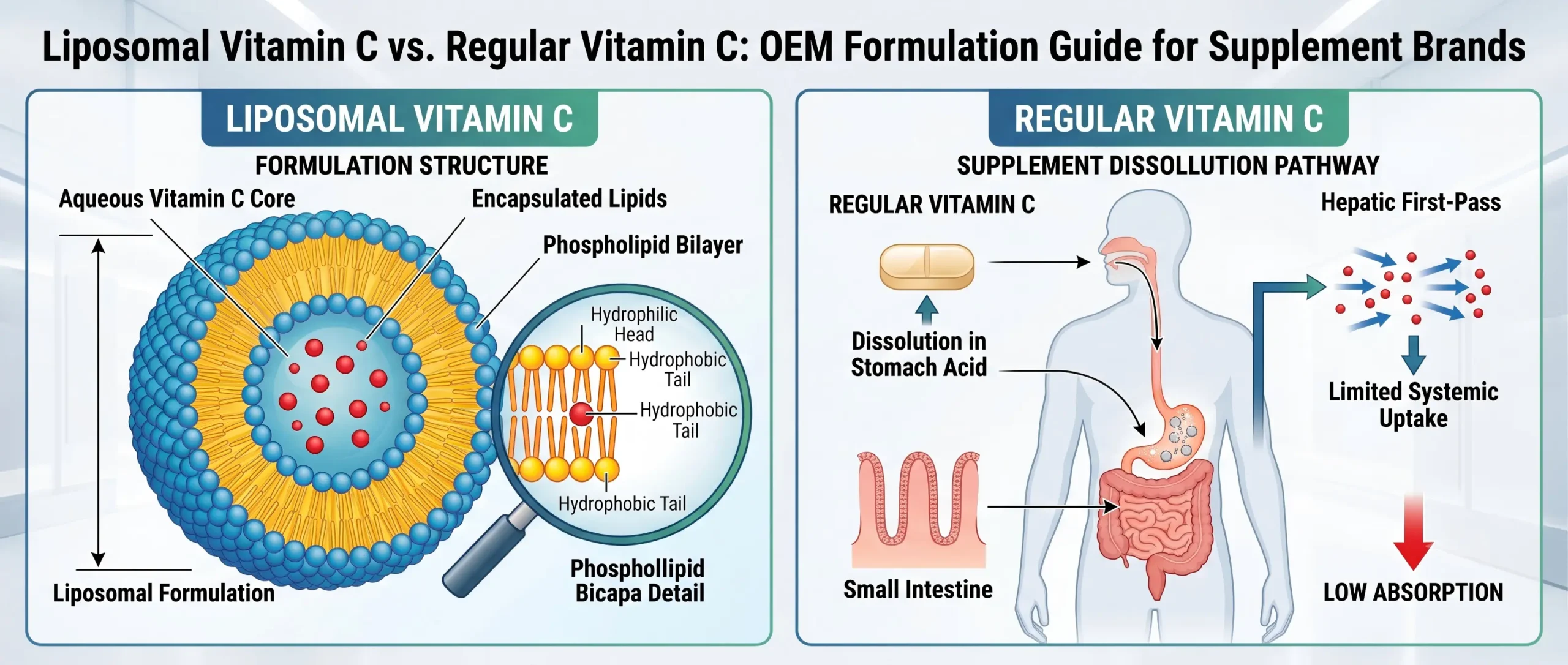
Liposomal vitamin C represents an advanced delivery technology that encapsulates ascorbic acid within microscopic lipid vesicles called liposomes. These vesicles are composed primarily of phospholipids — typically phosphatidylcholine derived from sunflower or soy lecithin — arranged in bilayer structures that mimic cell membranes.
Liposome Technology Fundamentals
Liposomes were first discovered in the 1960s and have been extensively studied for pharmaceutical and nutraceutical applications. The encapsulation process protects vitamin C from degradation in the digestive tract and facilitates absorption through mechanisms beyond the saturable SVCT transporters. Key technical parameters include:
- Phospholipid Composition: High-quality liposomes use >90% phosphatidylcholine from non-GMO sunflower lecithin, compared to 40-70% in conventional preparations
- Particle Size: Optimal liposomes range from 100-220 nm with controlled distribution. Particles above 300 nm show reduced bioavailability
- Encapsulation Efficiency: Premium manufacturers achieve >90% encapsulation efficiency, while industry averages hover around 50-70%
- Zeta Potential: A zeta potential of >|30| mV indicates excellent colloidal stability, preventing particle aggregation
Manufacturing Process
The production of liposomal vitamin C involves several critical steps: hydration of phospholipids to form multilamellar vesicles, homogenization or sonication to reduce particle size, encapsulation of ascorbic acid within the aqueous core, and stabilization through pH adjustment and antioxidant addition. Advanced manufacturers use solvent-free processes to eliminate residual organic solvents [5].
4. Liposomal Vitamin C vs. Regular Vitamin C
This section provides a comprehensive technical and commercial comparison to guide procurement decisions.
| Parameter | Regular Vitamin C | Liposomal Vitamin C |
| Bioavailability | Standard; limited by SVCT transporter saturation | Enhanced; 1.5-2x higher plasma levels per clinical studies |
| Raw Material Cost | Low (ascorbic acid powder) | High (phospholipids + ascorbic acid) |
| Manufacturing | Standard powder processing | Specialized encapsulation required |
| Taste | Tart, acidic at high doses | Milder; slight phospholipid note |
| GI Tolerance | Can cause digestive upset at >500mg | Gentler on stomach |
| Shelf Stability | Moderate; degrades with heat/moisture | Superior; protected from oxidation |
| MOQ | Low (1,000-2,500 units typical) | Higher (2,500-5,000+ units) |
| Retail Price | $5-20 per bottle | $30-70+ per bottle |
| Target Market | Mass market, economy | Premium, professional |
Key Differentiators
Raw Material Costs
Liposomal vitamin C raw materials cost 3-10 times more than conventional ascorbic acid. Phospholipids (especially high-purity phosphatidylcholine) are expensive, and the encapsulation process adds manufacturing overhead. However, the enhanced bioavailability may allow lower effective doses, partially offsetting the cost difference.
Manufacturing Complexity
Regular vitamin C uses standard powder processing equipment. Liposomal production requires specialized homogenizers or sonicators, particle size analyzers (DLS), and encapsulation efficiency testing (HPLC). These requirements limit the number of qualified manufacturers and increase lead times.
Taste and Consumer Experience
High-dose regular vitamin C has a characteristically tart, acidic taste that can be unpleasant in liquid or powder forms. Liposomal vitamin C has a milder taste due to the lipid coating, though some consumers detect a slight phospholipid aftertaste. This difference is significant for liquid products and stick packs.
Stability Considerations
Free ascorbic acid is notoriously unstable, degrading rapidly when exposed to oxygen, light, heat, moisture, and trace metal ions. A 2024 study found that microencapsulated vitamin C in gummies retained 92% potency during accelerated testing, compared to only 79% for unencapsulated vitamin C [6]. Liposomal encapsulation provides superior protection, with documented stability at 40 degrees C for 36 months [7].
5. Bioavailability: What Does Scientific Evidence Say?
Bioavailability claims are central to liposomal vitamin C marketing. It is essential to examine the evidence objectively and understand both the strengths and limitations of current research.
Clinical Evidence Summary
A 2024 double-blind, placebo-controlled, randomized trial published in the European Journal of Nutrition found that liposomal vitamin C (500 mg dose) resulted in 27% greater concentrations in blood plasma and 20% greater concentrations in leukocytes (white blood cells) compared to standard vitamin C [8].
A 2020 study by Gopi and Balakrishnan reported that liposomal vitamin C was absorbed 1.77 times better than non-liposomal ascorbic acid [9]. A 2024 randomized, double-blind, cross-over trial published in Applied Sciences demonstrated that liposomal vitamin C powder increased plasma vitamin C levels by up to 30% in AUC (area under the curve) compared to conventional formulations [10].
A 2024 human clinical study on Lipomac liposomal vitamin C confirmed significantly higher systemic exposure compared to conventional non-liposomal vitamin C in 12 healthy adult subjects [11].
Important Limitations
Despite promising results, several limitations must be acknowledged: sample sizes are typically small (12-27 participants), long-term clinical outcome data is limited, and not all liposomal formulations perform equally. As noted in Pharmacy Times, manufacturing quality matters enormously — particle size, phospholipid composition, and encapsulation efficiency all influence bioavailability [12].
Critically, the clinical significance of enhanced bioavailability for specific health outcomes (better immune response, lower infection rates, faster wound healing) remains under investigation. The enhanced absorption is well-documented, but whether this translates to proportionally greater clinical benefits is not yet firmly established.
6. Manufacturing Challenges
Liposomal vitamin C manufacturing presents unique technical challenges that brands must understand when evaluating OEM partners.
Critical Manufacturing Parameters
- Oxidation Control: Ascorbic acid oxidizes rapidly during processing. Manufacturing must minimize exposure to oxygen, light, and metal ions. Nitrogen blanketing and antioxidant addition are standard practices
- Encapsulation Efficiency: Target >80-90% EE. Low EE means most vitamin C remains unencapsulated and will degrade like conventional forms
- Particle Size Distribution: Mean size should be <200 nm with polydispersity index (PDI) <0.25 for uniform distribution
- Spray Drying for Powders: Converting liquid liposomes to stable powder form without compromising vesicle integrity requires maltodextrin coating and controlled temperature parameters
- Moisture Control: Even trace moisture accelerates vitamin C degradation. Manufacturing environments require strict humidity control
- Packaging Requirements: Amber glass bottles or opaque blister packs protect against light and oxidation. Liquid forms may require nitrogen flushing
Quality Testing Requirements
Qualified manufacturers should validate each batch using: HPLC for vitamin C content, Dynamic Light Scattering (DLS) for particle size distribution, Zeta potential analysis for colloidal stability, and FTIR for phospholipid identification. Accelerated stability testing at 40 degrees C/75% RH is essential for shelf-life validation.
7. Which Vitamin C Formulation Fits Different Market Segments?
Different market segments have distinct requirements that favor one vitamin C form over another.
Regular Vitamin C — Best For:
- Mass Market Products: Economical daily immune support tablets and capsules competing on price
- Children’s Formulations: Lower-cost gummies and chewables where parents prioritize affordability
- Entry-Level Supplements: First-time supplement users testing vitamin C benefits
- High-Dose Therapeutic Use: Practitioners recommending 2,000-3,000 mg/day divided doses where cost is a consideration
Liposomal Vitamin C — Best For:
- Premium and Luxury Brands: Positioning at $40-70+ retail price points with science-backed differentiation
- Beauty and Anti-Aging: Collagen support, skin brightening, and antioxidant formulations targeting affluent consumers
- Immune Defense Products: Premium immune formulas where enhanced absorption justifies higher pricing
- Sports Nutrition: Athletes requiring efficient nutrient delivery with minimal digestive stress
- Healthy Aging: Middle-aged and senior consumers seeking maximum efficacy from their supplements
- Professional Clinics: Functional medicine and integrative health practitioners recommending therapeutic-grade supplements
- Amazon Premium Segments: Competing in the $30-60 price tier where liposomal delivery commands a significant premium per 1,000 mg dose
8. Popular Combination Formulas
Strategic ingredient combinations can significantly enhance product differentiation and market appeal. The following combinations are supported by scientific rationale for synergistic effects.
Established Combinations with Strong Evidence
| Combination | Key Benefits | Target Segment |
| Vitamin C + Zinc | Synergistic immune cell function support; enhanced antioxidant defense | Immune support |
| Vitamin C + Vitamin D3 | Dual immune modulation; seasonal wellness positioning | Immune/seasonal |
| Vitamin C + Quercetin | Enhanced antioxidant recycling; bioflavonoid synergy for histamine balance | Immune/allergy |
| Vitamin C + Glutathione | Master antioxidant regeneration; cellular detoxification support | Detox/anti-aging |
| Vitamin C + Collagen | Essential cofactor for collagen synthesis; skin elasticity support | Beauty/skin |
| Vitamin C + Hyaluronic Acid | Collagen synthesis + moisture retention for skin plumping | Beauty/anti-aging |
| Vitamin C + Citrus Bioflavonoids | Natural synergy as found in whole foods; enhanced absorption | General wellness |
| Vitamin C + Elderberry | Dual immune support with antiviral properties | Immune/seasonal |
| Vitamin C + NAC | Glutathione precursor support; respiratory health | Detox/respiratory |
| Vitamin C + Astaxanthin | Vitamin C regenerates astaxanthin; comprehensive antioxidant coverage | Anti-aging/sports |
Why Brands Choose These Combinations
The rationale behind combination formulas extends beyond additive effects. Vitamin C and zinc work synergistically for immune cell function. Vitamin C enhances non-heme iron absorption — a significant benefit for plant-based diets. When combined with quercetin, vitamin C helps regenerate the antioxidant form of quercetin, extending its activity. Collagen synthesis requires vitamin C as an essential cofactor for prolyl and lysyl hydroxylases, making this combination scientifically sound for beauty applications [13].
Emerging Trend Formulas
Forward-looking brands are exploring next-generation combinations: Vitamin C + NMN for NAD+ support and cellular energy; Vitamin C + PQQ for mitochondrial biogenesis; Vitamin C + CoQ10 for comprehensive antioxidant protection; Vitamin C + Ceramide for advanced skin barrier support; and Vitamin C + Curcumin (with piperine) for enhanced anti-inflammatory effects. These combinations target the growing healthy aging and longevity market segments.
9. Available Dosage Forms for OEM Manufacturing
Both regular and liposomal vitamin C can be manufactured in multiple dosage forms, each with distinct advantages, MOQs, and cost structures.
| Dosage Form | Advantages | MOQ (units) | Relative Cost | Best For |
| Capsules | High consumer acceptance; precise dosing; good stability | 2,500-5,000 | Medium | General wellness |
| Softgels | Professional appearance; liquid fill capability | 5,000-10,000 | High | Premium positioning |
| Stick Packs | Convenient; travel-friendly; good for powders | 5,000-10,000 | Medium | Active lifestyle |
| Powders | Flexible dosing; high-dose capability; cost-effective | 500-1,000 kg | Low-Medium | Sports/beauty |
| Oral Liquids | Fast absorption; customizable dosing; senior-friendly | 3,000-5,000 | High | Children/seniors |
| Sachets | Single-serve convenience; premium feel | 10,000+ | Medium | Premium travel |
| Effervescent | Fast absorption; pleasant taste; hydration benefit | 5,000+ | Medium | Lifestyle/immune |
| Liquid Suspension | Adjustable dosing; easy to swallow | 3,000+ | High | Pediatric use |
ODM Recommendations by Brand Strategy
For brands targeting the Amazon premium segment, liposomal capsules (1,000-1,700 mg servings) and liquid liposomal vitamin C offer the highest perceived value. For mass-market entry, regular vitamin C tablets or capsules at 500-1,000 mg provide the best cost-positioning balance. For beauty-focused brands, powder stick packs combining vitamin C with collagen and hyaluronic acid are trending strongly in 2024-2025.
10. How to Decide Which Vitamin C Is Right for Your Brand
Use this decision matrix to systematically evaluate which vitamin C form aligns with your brand strategy.
| Decision Factor | Choose Regular Vitamin C If… | Choose Liposomal Vitamin C If… |
| Budget | Tight margins; cost-first strategy | Premium positioning; margin flexibility |
| Retail Price Target | $5-15 price point | $30-70+ price point |
| Brand Positioning | Value brand; mass market | Premium science-backed brand |
| Consumer Demographics | Price-sensitive; entry-level | Health-enthusiast; affluent |
| Manufacturing Cost | Minimize per-unit production cost | Accept 3-5x higher ingredient cost |
| Differentiation | Compete on price/volume | Compete on science/absorption |
| Time to Market | Fastest launch (simpler sourcing) | Longer development but higher barrier to copy |
| Expected Margins | Volume-driven profitability | Premium margin per unit |
Recommendation: If your brand targets the premium segment with a retail price above $30, liposomal vitamin C provides credible scientific differentiation that justifies the price premium. For brands competing below $15 retail, regular vitamin C in an optimized formulation (buffered forms, effervescent delivery, or strategic combinations) offers better unit economics.
11. Frequently Asked Questions
Is liposomal vitamin C always better than regular vitamin C?
Not necessarily. Liposomal vitamin C shows enhanced bioavailability in clinical studies, but the magnitude varies by formulation quality. For general wellness at moderate doses (200-500 mg), regular vitamin C provides excellent value. Liposomal delivery becomes more meaningful at higher doses or when targeting specific therapeutic applications.
Why is liposomal vitamin C significantly more expensive?
The cost reflects multiple factors: high-purity phospholipids (phosphatidylcholine) are expensive raw materials, the encapsulation process requires specialized equipment and expertise, quality control testing (DLS, HPLC, zeta potential) adds analytical costs, and lower production volumes compared to conventional vitamin C limit economies of scale.
Can regular vitamin C be combined with liposomal ingredients in one formula?
Technically possible but generally not recommended for marketing clarity. Consumers may be confused by a product containing both forms. Most brands choose one primary delivery technology to maintain clear positioning.
Which dosage form offers the best stability for liposomal vitamin C?
Spray-dried liposomal powders typically offer the best shelf stability, with documented stability at room temperature for 24+ months. Liquid liposomal vitamin C generally requires refrigeration after opening and has shorter shelf life (12-18 months unopened).
Is liposomal vitamin C suitable for gummy formulations?
Liposomal vitamin C is generally not suitable for gummies. The heat involved in gummy manufacturing (85-95 degrees C) can disrupt liposomal vesicles, negating the encapsulation benefits. For gummy products, microencapsulated regular vitamin C is the preferred technology.
What MOQ should brands expect for liposomal vitamin C OEM?
MOQs vary by dosage form: capsules typically start at 2,500-5,000 units; powders at 500-1,000 kg; liquids at 1,000-3,000 units. Custom liposomal formulations may require higher minimums (5,000-10,000 units) due to the setup complexity. Some manufacturers offer pilot batch programs at lower volumes for brand testing.
12. Choosing an OEM Manufacturer for Liposomal Vitamin C
Selecting the right manufacturing partner is critical for liposomal vitamin C success. Not all contract manufacturers have genuine liposomal expertise — some simply mix ascorbic acid with lecithin without creating proper vesicle structures.
Essential Supplier Capabilities
- Liposome Formulation Expertise: Proven track record with phospholipid encapsulation, documented encapsulation efficiency >80%, and particle size <200 nm
- Stable Encapsulation Technology: Solvent-free manufacturing processes with validated stability data
- Multiple Dosage Form Capabilities: Capsules, softgels, powders, liquids, and sachets from a single partner
- Pilot Batch Support: Low-volume production runs (500-1,000 units) for market testing before full-scale launch
- Regulatory Documentation: Complete CoAs, stability data, SDS files, and regulatory support for FDA, EFSA, and other markets
- Quality Management System: GMP certification, ISO 9001, HACCP, and third-party audit compliance
- Scalable Manufacturing Capacity: Ability to grow from pilot batches to 100,000+ units monthly
- Private Label and Custom Formulation Services: Flexible formulation development with experienced R&D teams
Red Flags to Avoid
Be cautious of manufacturers who: cannot provide particle size distribution data (DLS reports); have no encapsulation efficiency testing (HPLC); use ‘liposomal’ marketing without actual vesicle formation; lack accelerated stability testing data; or quote prices significantly below market rates (may indicate inferior phospholipids or fake liposomal products).
Why KSNutripharma® for Your Liposomal Vitamin C Line?
References and Data Sources
- The Insight Partners. Vitamin C Supplements Market Size, Trends & Growth by 2034. April 2026. Available at: https://www.theinsightpartners.com/reports/vitamin-c-supplements-market
- Verified Market Reports. Global Liposomal Vitamin C Market Size, Growth Analysis & Forecast 2026-2034. May 2026. Available at: https://verifiedmarketreports.com/product/liposomal-vitamin-c-market
- U.S. Food and Drug Administration. GRAS Notice 769 for Vitamin C (fruit and vegetable derived). March 2018. Available at: https://www.fda.gov/media/127844/download
- Philippines Food and Drug Administration. FDA Circular No.2025-001: Guidelines on the Classification of Vitamins and Minerals for Food/Dietary Supplements. 2025. Available at: https://www.fda.gov.ph/fda-circular-no-2025-0001/
- AronPharma. Liposomal Vitamin C in Powder Form Study Published in Applied Sciences. September 2024. Available at: https://aronpharma.pl/study-on-liposomal-vitamin-c-in-powder-form/
- Jutkus et al. Effect of Temperature and Initial Moisture Content on Chemical Stability of Vitamin C. ResearchGate, 2025. Available at: https://www.researchgate.net/publication/263806720/
- WBCIL. Liposomal Vitamin C Stability Data. 2026. Available at: https://www.wbcil.com/blog/bioavailability-breached-the-therapeutic-efficacy-of-liposomal-vitamin-c/
- Purpura M, Jager R, et al. Liposomal delivery enhances absorption of vitamin C into plasma and leukocytes. European Journal of Nutrition, 2024;63(8):3037-3046. Available at: https://pubmed.ncbi.nlm.nih.gov/31264495/
- Gopi S, Balakrishnan P. Evaluation and clinical comparison studies on liposomal and non-liposomal ascorbic acid. J Liposome Res, 2021;31(4):356-364.
- Zmuda P, Khaidakov B, et al. Bioavailability of liposomal vitamin C in powder form: a randomized, double-blind, cross-over trial. Applied Sciences, 2024;14(17):7718.
- Botanic Healthcare. Human Clinical Data Confirming Enhanced Bioavailability of Lipomac Liposomal Vitamin C. June 2026. Available at: https://nutraceuticalbusinessreview.com/botanic-healthcare-publishes-human-clinical-data/
- Pharmacy Times. Liposomal Delivery: A New Paradigm for Vitamin C Supplementation. July 2026. Available at: https://www.pharmacytimes.com/view/liposomal-delivery-a-new-paradigm-for-vitamin-c-supplementation
- Supplements Studio. Immune Boosting Formulas With Quercetin: Smart Guide. 2025. Available at: https://supplementsstudio.com/blogs/blog/immune-boosting-formulas-with-quercetin