
Magnesium Malate Supplement OEM, ODM & Private Label Service
KS Nutripharma is a magnesium malate supplement manufacturer for OEM, ODM, and private-label programs. We develop finished magnesium malate supplements — capsules, tablets, and drink powders — for daytime, training, and active-lifestyle assortments, with the material specified before anything is priced. If the salt is still open, the magnesium supplements category page maps malate against the other magnesium salts.
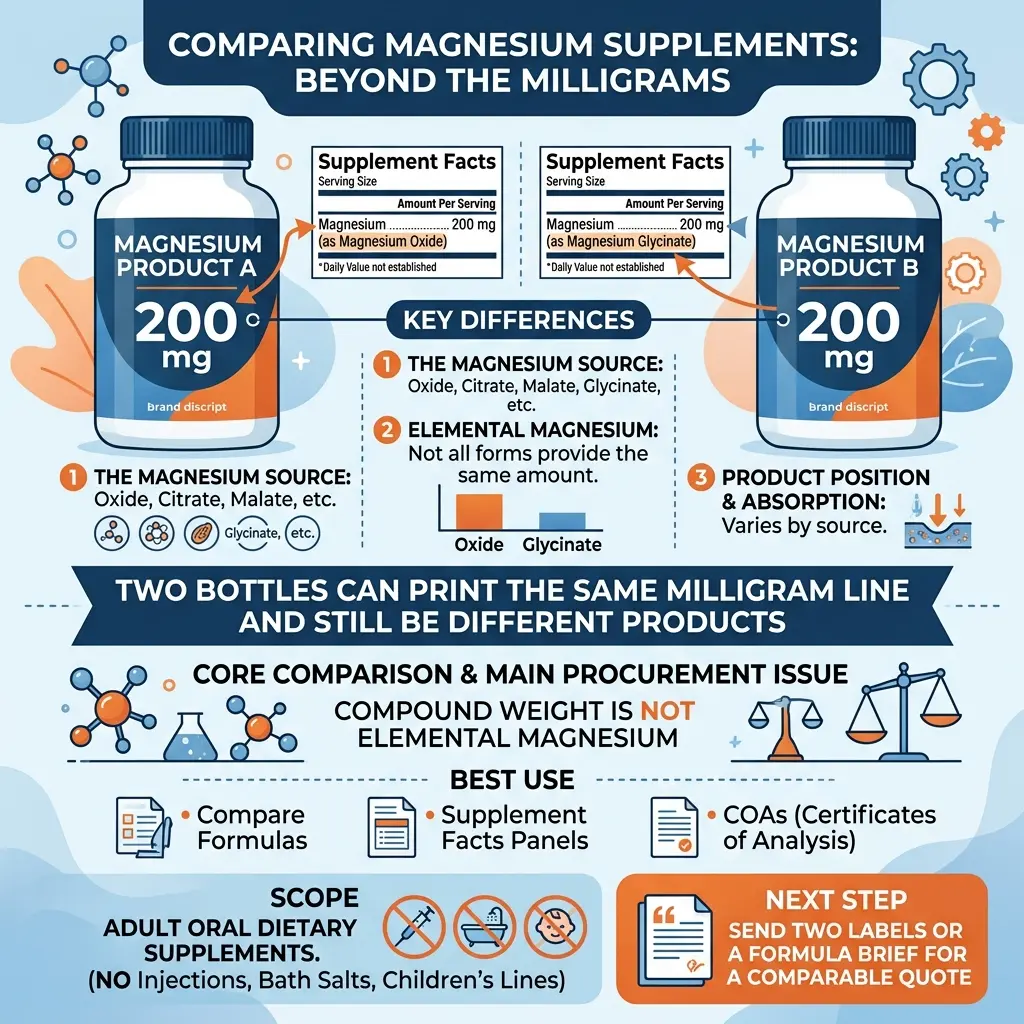
Magnesium malate supplement and magnesium malate dietary supplement are both used for products built on this salt, but neither term defines the raw material. Two suppliers can write “magnesium malate” and ship materials with different magnesium-to-malate ratios, different hydrate states, and materially different elemental magnesium — and one of them may not be a reacted salt at all. A quote only becomes comparable once those lines are fixed.
Already have a formula? Send Your BOM — we check the ratio against your fill weight and tell you how many capsules the elemental target actually needs.
Comparing two suppliers? Send two COAs — we read the identity method, the loss-on-drying line, and whether the elemental figure is a batch result or a specification minimum.
Building a drink mix? Request Formula Support — the solubility grade decides whether the serving disperses or settles.
cGMP | ISO 9001 | ISO 22000 | HACCP | FSSC 22000 | Halal | Kosher | In-house lab + SGS/Eurofins pathways | Batch COA
Typical first reply is within one business day on a complete brief. Project manager assigned. NDA available.
Magnesium Malate Supplement Manufacturing at a Glance
| What we manufacture | Capsules, tablets, and drink powders. Gummies when the formula is designed around the mineral load |
| What must be locked before a quote | Salt identity and ratio, hydrate state, elemental magnesium target, dosage form, serving size, destination market |
| Key quantity | Elemental magnesium per unit — the figure that sets capsule count, tablet weight, or scoop size |
| Reacted or blended | We qualify reacted malate and require identity confirmation. An oxide-plus-malic-acid dry blend is a different material |
| Primary QC variables | FTIR identity, elemental magnesium assay, loss on drying, malic acid, particle size and density, heavy metals, microbiology |
| Drink-mix gate | Solubility and dispersion, confirmed on the actual grade rather than the salt name |
| Positioning | Daytime and active-lifestyle assortments; glycinate carries the evening occasion |
| Scope | Adult oral dietary supplements. No injections, no infant or pet SKUs |
| Documents | Batch COA; SGS/Eurofins when the RFQ requires it |
Daytime Positioning Is a Merchandising Choice, Not a Property of the Salt
Magnesium malate is the salt most brands reach for when the product has to sit on a daytime or training shelf, and glycinate is the one they reach for at the other end of the day. That convention is useful, and it is worth being clear about what it is: a positioning decision expressed through the occasion on the artwork, the companions in the blend, and market-compliant copy — not a stimulant property of the material.
The distinction matters commercially because malate’s ligand has a recognised role in the citric acid cycle, and category marketing drifts toward energy language on the strength of it. That drift is where claim problems start. We build malate into daytime assortments and will not write a panel that reads as a fatigue or energy treatment; substantiation for whatever positioning you choose stays with you and your local counsel.
Malate and glycinate are also not substitutes at the bench. The compound weight, elemental percentage, taste, and fill behavior all differ, so a brand that wants both occasions quotes two products rather than one hybrid capsule.
Magnesium Malate Product Architectures
Ratio, hydrate state, and elemental magnesium per unit are locked on all eight architectures below. Each card names what changes beyond them.
Besides the following, other companions come out of your brief with their own identity and assay — ashwagandha, vitamin D3, creatine for training assortments, and D3 with K2. Each is developed on its own ingredient program, and where a companion is better sold as a separate SKU than folded into the malate unit, we will say so before it is quoted.
Use when: The product is a daytime or daily-wellness magnesium capsule for an active-lifestyle assortment. The default private-label malate SKU.
Specify: HPMC vs gelatin; elemental magnesium per serving; one-a-day or split serving; bulk density of the incoming grade.
Trade-off: Not F02. The capsule is the cleaner start and the format most exposed to a low elemental percentage — a one-a-day brief removes any flexibility on the grade.
Default format: Hard capsules.
Use when: The assortment needs a pharmacy or club-channel bottle at a low cost per serving, or malate is one mineral inside a multi-mineral tablet.
Specify: Granular or reactive-granulated grade rather than fine powder; bulk density and particle-size distribution; coating; tablet weight and swallow size; tablets per serving.
Trade-off: Not F01. A tablet reaches a higher elemental line in one unit at a lower cost per bottle, but it needs a compression-ready grade and a humidity-controlled room — a different incoming specification, not a format swap.
Default format: Tablets.
Use when: The serving is a flavored drink or a scoop in a shaker rather than a swallowed unit.
Specify: A soluble grade confirmed by dispersion trial; flavor system and sweetener; mixability and mouthfeel; particle size; stick pack or tub moisture plan.
Trade-off: Not F02. A drink carries a larger compound load than any tablet, which is exactly why the low-solubility 1:1 grade fails here — it reads gritty and settles. Solubility, not milligrams, qualifies a malate for this format.
Default format: Powder or stick packs.
Use when: The product is a hydration or electrolyte stick pairing magnesium with potassium and usually sodium.
Specify: Potassium salt and elemental potassium; sodium inclusion; acidulant load; osmolarity; foil barrier and desiccant strategy.
Trade-off: Not F03. A single-mineral drink can be flavored around the salt; an electrolyte stick cannot. An alkaline 2:1 malate shifts the pH of an acid system, so the acidulant is recalculated rather than carried over from an existing electrolyte formula.
Default format: Stick packs.
Use when: The brief names taurine alongside magnesium for a recovery unit.
Specify: Taurine milligrams and assay; whether the position is training recovery or daily wellness; blend uniformity given the density gap between a free amino acid and a mineral salt.
Trade-off: Not F04. Potassium is an electrolyte measured as an elemental mineral; taurine is an amino acid on its own assay. Two assays on release, and a segregation risk in the blender that a two-mineral stick does not have.
Default format: Hard capsules or powder.
Use when: The panel pairs a daytime mineral with vitamin B6.
Specify: B6 form — pyridoxine hydrochloride or P5P; target dose; overage against the shelf-life claim; finished-product assay requirement.
Trade-off: Not F05. Both add one companion to a malate capsule, but a gram-scale amino acid and a milligram-scale vitamin create opposite problems. Taurine competes for fill volume; B6 competes for none and instead controls blend uniformity and vitamin stability.
Default format: Hard capsules.
Use when: The brand wants a morning and an evening magnesium sold together or as a subscription pair.
Specify: Each salt’s identity and elemental line separately; shared or distinct artwork; matched serving architecture so the pair reads as a system. Glycinate is quoted from our magnesium bisglycinate program.
Trade-off: Not one capsule. A hybrid unit splits its serving between two occasions and leaves the consumer without a clear time to take it. Two bottles also let each salt use its own grade and capsule size instead of compromising both.
Default format: Two capsule SKUs, or one capsule plus one powder.
Use when: The product is a magnesium complex that leads with malate and adds citrate or another salt for a broader daytime position.
Specify: Each salt with its own compound weight and its own elemental contribution; whether oxide is part of the declared composition; flavor system if the format is a powder.
Trade-off: Not F01. A complex can cover more of an assortment in one bottle, but it makes each salt’s elemental contribution harder to evaluate unless the specification separates compound weight and elemental magnesium by source. Without that breakdown, nobody can see whether malate is carrying the total or present as a label line.
Default format: Capsules or powder.
Choose the Magnesium Malate Format: Capsules, Tablets, Powder or Gummies
The architectures above settle what goes in the formula. These cards cover what the process does with it.
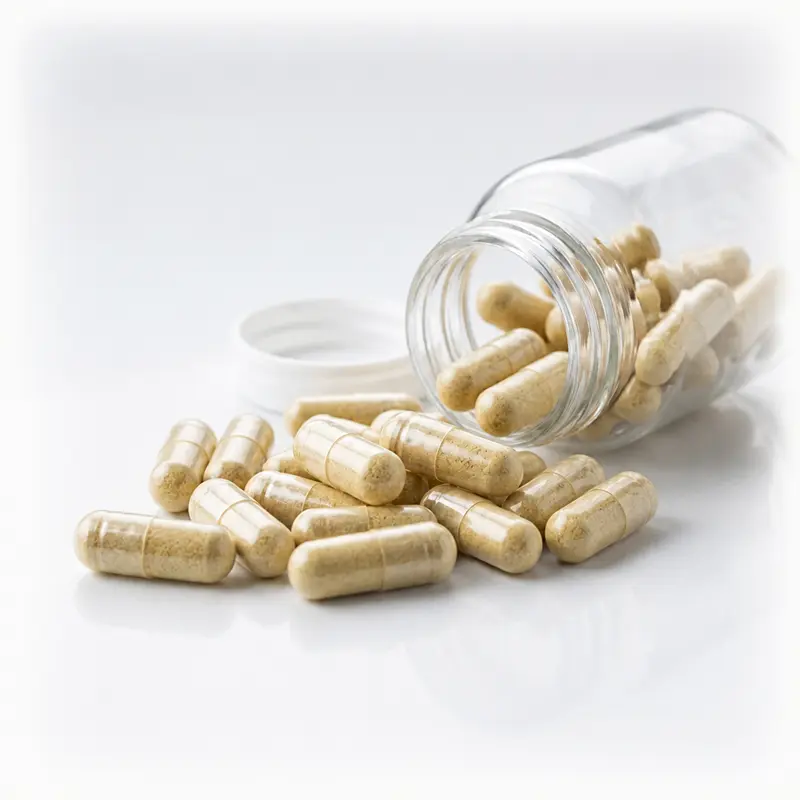
Best for: Single-salt daytime malate and two-ingredient stacks, where a precise fixed serving matters more than cost per bottle.
Why: A size 0 shell typically holds ~350–450 mg and a size 00 ~500–650 mg. Capsule size and count are calculated from the qualified lot’s elemental magnesium and tapped density, not from the ingredient name — which is why the grade is qualified before the label is fixed.
Default path: Hard capsules.
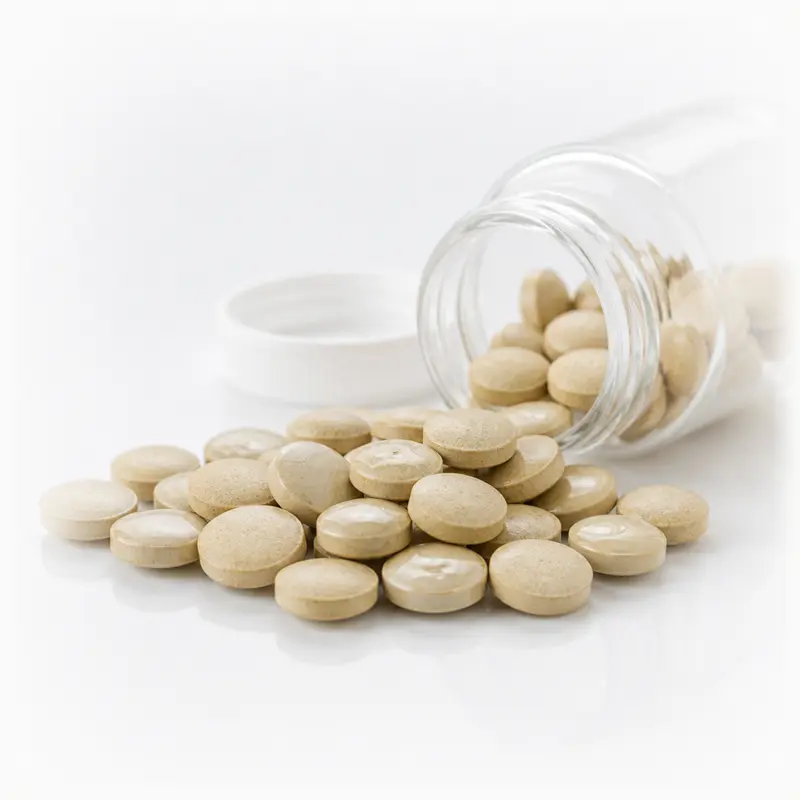
Best for: High-count bottles, cost-driven daytime SKUs, and multi-mineral tablets where malate is one component.
Why: Compression is where malate’s hygroscopicity shows up. Fine, moisture-hungry powder sticks to tooling and caps; over-dried material generates fines and compacts poorly. The route through is a granulated grade with bulk density and particle size specified, room humidity controlled, and lubricant tuned rather than increased — over-lubricating a mineral tablet trades sticking for slow disintegration.
Default path: Tablets.
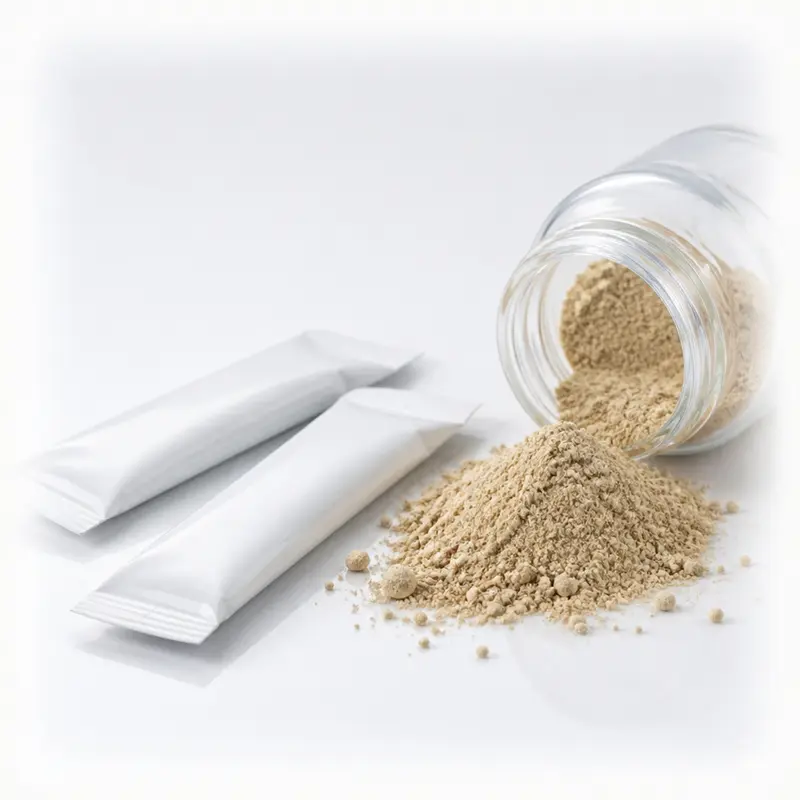
Best for: Training drinks, electrolyte sticks, and malate-led complexes consumed in water.
Why: Because the salt is hygroscopic, blending happens under controlled low humidity — commonly held below about 45% RH — and the pack is specified as a moisture barrier with a desiccant plan rather than a simple sachet. Taste is a second gate: the 2:1 salt is alkaline and carries its own mild tartness, so the acid and flavor system is balanced at the target magnesium level rather than at a placeholder. High concentrations can read slightly cloudy in a clear beverage, managed with pH control when optical clarity is part of the brief.
Default path: Powders and granules.
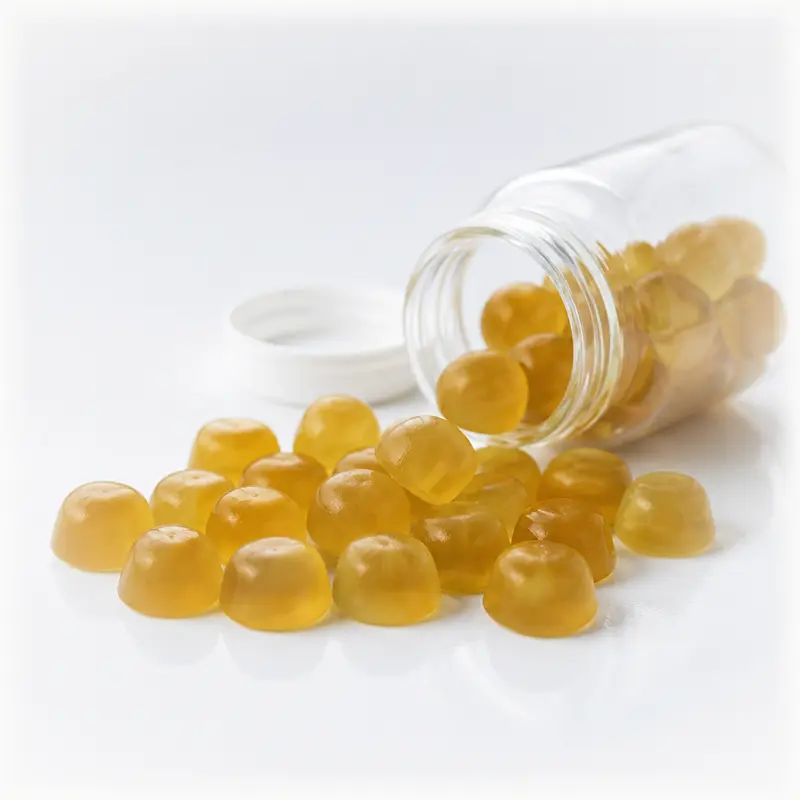 Gummies and chews — conditional
Best for: Assortments where the format sells the product and a modest magnesium line is acceptable and honestly declared.
Why: Mineral loading works against gelation, texture, and storage stability, so the elemental figure a gummy carries is a fraction of a capsule’s — a full daily serving is not available in this format at a credible declared level. Malate goes in during cool-down after the cook rather than into the hot slurry, and its tartness means the acidulant is recalculated. Feasible when the formula is designed around the mineral, not swapped from a capsule brief. Softgels stay off the list, since a dry malate salt provides no oil phase.
Default path: Quoted from the brief.
This is the fork that decides the cost, the capsule count, and whether a drink mix is possible at all.
The ratio: di-magnesium malate (2:1) versus magnesium malate (1:1)
Di-magnesium malate binds two magnesium ions to one malic acid backbone — CAS 671197-50-5, Mg₂(OH)₂C₄H₄O₅, molecular weight 171.44. The specification filed in the EFSA evaluation of this material describes a free-flowing, hygroscopic white powder, soluble to freely soluble in water and distinctly alkaline at pH 10–11, with magnesium not less than 20% and malic acid not less than 52% [1]. Those figures are a published reference specification, not our release specification.
Magnesium DL-malate at a 1:1 ratio, frequently supplied as a hydrate, behaves differently on every axis that matters: a lower elemental percentage, a near-neutral pH, and water solubility below 1 g/L at 20 °C on published powder grades — effectively a solid-dosage material rather than a beverage one [3].
Both are sold as “magnesium malate.” Only one of them will disperse in a stick pack.
The hydrate state, and why a specification minimum is not a batch value
Anhydrous material carries the highest magnesium percentage and the smallest fill volume per milligram of magnesium; a hydrate carries water where you wanted mineral. Loss on drying is how you tell them apart, and the reference specification above permits up to 12% moisture — so two lots inside one specification can differ measurably in yield.
There is a second trap in the same document. It sets minimums for magnesium and malic acid with no maximums, and the reviewing panel said so [1]. A COA reporting “Mg ≥ 20%” has restated a specification, not measured your lot. Ask for the batch figure and the method, since ICP-AES and titration are both in commercial use and should be named.
Reacted salt versus a dry blend of oxide and malic acid
Magnesium oxide is inexpensive and roughly 60% elemental magnesium; malic acid is inexpensive. Ribbon-blending the two produces a powder that can be presented against an attractive elemental number without ever forming a malate. Reacted material is made the other way — a magnesium base and malic acid taken to completion, commonly finished by reactive granulation so the granules compress [4]. The same distinction runs through the other magnesium salts, and how to read it off a supplier document is set out in buffered versus fully reacted magnesium.
Three questions separate them on paper: identity by FTIR rather than calculated back from the elemental result; the route of manufacture, reaction to completion or blending of two purchased powders; and an elemental figure that is arithmetically possible for the declared ratio. Reacted grades in commerce sit roughly between 11% and 20% depending on ratio and hydrate. A “pure malate” quoted well above that range deserves a direct question before it becomes your label.
What the elemental line does to the finished unit
Here the paper fork becomes a manufacturing one. Retail tablets printing a 1,000 mg malate compound line commonly declare around 110–115 mg of elemental magnesium; a high-percentage anhydrous 2:1 grade approaches 200 mg from the same compound weight. Both declarations are accurate for their material.
Carry that through to a serving. A 300–400 mg elemental target on a low-percentage grade needs well over 2,000 mg of powder — three or four capsules, or a change of format. The same target on a dense anhydrous grade can be a one- or two-capsule serving. So the elemental percentage decides capsule count, bottle size, tablet weight, and cost per unit long before it decides the label — the arithmetic is worked through in how fill weight limits capsule count.
One further limit is worth stating, because it shapes how a malate program is controlled: a raw-material COA establishes what arrived, not what the finished serving delivers. The finished specification has to reconcile the incoming compound weight and elemental percentage against the serving size, the fill weight, and finished-unit assay where the market or the retailer requires it. What release testing does and does not settle is covered in how finished-product magnesium is tested.
In practice, five lines have to be settled before a price means anything: the ratio, the hydrate state, the batch elemental magnesium with its method, whether the material is reacted or blended, and the dosage form the resulting fill weight can actually support.
Identity, ratio, and hydrate state
The incoming specification names the salt precisely — di-magnesium malate or magnesium DL-malate — with the CAS number, the magnesium-to-malate ratio, and the hydrate or anhydrous state. Identity is confirmed by FTIR. Loss on drying establishes the hydrate state and, with it, the fill volume your format has to accommodate.
Elemental magnesium and assay method
Elemental magnesium sits on its own line with the method named, reported as the batch result rather than the specification floor, and the compound weight sits on a separate line. Keeping the two apart is what makes two quotes comparable, and it is the most common omission on incoming paperwork — why two magnesium labels are not comparable works through the general case. Our general framework for reading supplier documentation is set out in how to read a COA.
Malic acid content and process markers
Malic acid content is the other half of the identity. Two impurity lines from the published reference specification are more useful than they look — fumaric acid not more than 1.0% and maleic acid not more than 0.05% [1]. These are process-related markers from how the malic acid was made and reacted, and a physically blended material has no reason to control them. Requesting them is a low-cost way to see whether a supplier knows its own route.
Physical properties that decide the format
Particle size or mesh, bulk and tapped density, water solubility, and pH belong on the specification rather than in a phone call, because each one closes off a format. Solubility decides drink mixes. Density decides capsule size and tablet weight. Alkaline pH decides how a flavored acid system is balanced. An elemental figure alone leaves all of that open, and what a magnesium specification has to carry beyond it applies to every salt in the range.
Heavy metals and microbiology
Testing scope and COA fields follow the locked product specification, the destination market’s finished-product requirements, and the release criteria agreed at the start of the program — heavy metals including lead, arsenic, cadmium, and mercury, plus microbiology, identity, and assay as applicable. US retail programs frequently apply tighter lead thresholds than an ingredient specification does, and premium retail and marketplace onboarding increasingly expect independent verification alongside the batch COA.
Four stages turn the paperwork above into a sellable SKU. Most malate projects that stall have skipped straight from stage one to a price.
1. Raw-material qualification. Identity, ratio, hydrate state, batch elemental magnesium with its method, malic acid, process markers, and the physical properties that decide the format.
2. Formula calculation. Elemental magnesium target to compound weight, compound weight to fill weight, fill weight to capsule size or tablet weight or scoop volume, and finally to units per serving.
3. Dosage-form feasibility. Confirmed on trial rather than on paper — capsule fill and flow, compression behavior and disintegration, dispersion and taste for a drink, mineral load and texture for a gummy.
4. Finished-product release. Finished specification, batch COA, packaging matched to the salt’s hygroscopicity and the shipping lane, and the documentation each destination market expects. How magnesium stability changes shelf life covers the pack and storage side that a hygroscopic salt makes decisive.
Serving size follows the product position and the qualified grade rather than a universal rule. A daytime capsule may be one or two units; a training powder is a scoop or a stick. Both the elemental magnesium per serving and the number of units per serving have to appear, because a panel printing only the compound weight cannot be compared to anything.
Regulatory status is confirmed before artwork approval and is separate from manufacturing feasibility. Magnesium malate is already listed as a permitted source of magnesium for food supplements in Annex II to Directive 2002/46/EC [2], which matters for EU programs; applicable intake references and market-specific labeling requirements are reviewed with your regulatory counsel at the same stage [5]. Milligram and percentage figures on this page are development examples.
How do I tell a reacted magnesium malate from an oxide-and-malic-acid dry blend?
Ask for FTIR identity on the batch rather than an elemental result with malate inferred by arithmetic, ask how the material was manufactured, and check that the elemental figure is possible for the declared ratio. Requesting the fumaric and maleic acid lines adds a third filter, since a blender has no process reason to control them.
Why does the same 1,000 mg declaration give different magnesium on two labels?
Because 1,000 mg is compound weight and the name does not fix the ratio. The elemental percentage changes with the magnesium-to-malate ratio and the hydrate state, so the same compound line can resolve to roughly 110 mg or close to 200 mg of magnesium.
Is magnesium malate a permitted magnesium source for EU food supplements?
Magnesium malate appears in the list of permitted mineral sources in Annex II to Directive 2002/46/EC [2]. Separately, when di-magnesium malate was submitted as a novel food ingredient, the reviewing panel concluded the dossier had not established it as different from the magnesium malate already authorised under that Annex [1]. Treat it as a documentation question to close with your regulatory counsel, not a manufacturing obstacle.
My malate powder caked in the stick pack. What went wrong?
Almost always moisture rather than formula. The salt is hygroscopic, so the two usual causes are blending in ambient humidity and a pack without a real moisture barrier. Blending under controlled low humidity and a foil laminate with a desiccant plan for tubs fixes it; reformulating rarely does.
Can a magnesium malate drink mix be clear?
Only with a soluble grade and pH control. Di-magnesium malate is soluble to freely soluble in water, while 1:1 DL-malate powder grades are published below 1 g/L at 20 °C and will settle. Even on a soluble grade, high concentrations can read slightly cloudy, which is held back by keeping the beverage slightly acidic. Confirm it by dispersion trial on the actual lot before the flavor system is approved.
Why did my malate tablet stick to the punch?
Fine hygroscopic powder picks up moisture and adheres to tooling, and drying it aggressively swaps sticking for fines and capping. The working answer is a granular or reactive-granulated grade with bulk density specified, humidity control in the compression room, and lubricant tuned rather than increased.
How many capsules will my elemental magnesium target need?
That depends on the grade, which is why the grade is qualified first. Against a size 00 shell holding roughly 500–650 mg confirmed on tapped density, a dense anhydrous 2:1 grade can bring a 200 mg elemental serving into one or two capsules, while a hydrate at half the percentage pushes the same target toward three or four.
What should I send for a comparable malate quote?
The target market and dosage form, the target elemental magnesium per serving, and for each supplier: the specification with ratio and hydrate state named, the batch COA with the elemental result and its method, and the identity confirmation. Send a reference panel if you have one. A line reading “magnesium malate 200 mg, please quote” leaves the most expensive variable unresolved.
Related
- Magnesium Bisglycinate Supplements Manufacturing
- Magnesium Complex Supplement Manufacturer
- Magnesium Citrate Supplement Manufacturer
- Hard Capsules
- Tablets
- Powders and Granules
References
- EFSA Panel on Nutrition, Novel Foods and Food Allergens. Evaluation of di-magnesium malate, used as a novel food ingredient and as a source of magnesium in foods. EFSA Journal, 2018. https://doi.org/10.2903/j.efsa.2018.5292
- European Union. Directive 2002/46/EC on food supplements, Annex II (permitted mineral sources). https://eur-lex.europa.eu/legal-content/EN/TXT/?uri=celex%3A32002L0046
- Dr. Paul Lohmann. Magnesium DL-Malate product data. https://www.lohmann-minerals.com/products/product-finder/magnesium-dl-malate/
- WO2023220606A1. Reactive granulation of calcium citrate malate, dicalcium malate, and dimagnesium malate. https://patents.google.com/patent/WO2023220606A1/en
- NIH Office of Dietary Supplements. Magnesium — Health Professional Fact Sheet. https://ods.od.nih.gov/factsheets/Magnesium-HealthProfessional/
Disclaimer: Wholesale and brand-manufacturing reference only. Not intended to diagnose, treat, cure, or prevent any disease. Dietary supplements are not drugs. Magnesium malate is a specified magnesium salt for finished-product OEM — not a treatment for fatigue, energy disorders, fibromyalgia, or any medical condition. Milligram and percentage figures on this page are development and specification examples, not recommended intakes; specification values cited from published dossiers are reference points rather than our guaranteed release limits, and nominal elemental percentages vary by grade, hydrate state, and lot. The U.S. adult tolerable upper intake level for magnesium from dietary supplements and medications (often discussed as 350 mg/day, per NIH ODS) is a safety reference used in formulation review, not a food-magnesium upper limit and not a dose prescribed here. Positioning language referenced on this page is market convention, not claim substantiation. Brand owners remain responsible for finished-label compliance and claim substantiation with local counsel.