Reviewed by KS Nutripharma Director of R&D (PhD, Food Science | 19+ years nutraceutical development) | Technical review scope: milligram basis, salt identity, buffered vs fully reacted composition, blend totals, incoming vs finished-product COA, and quote comparison | Updated September 2026
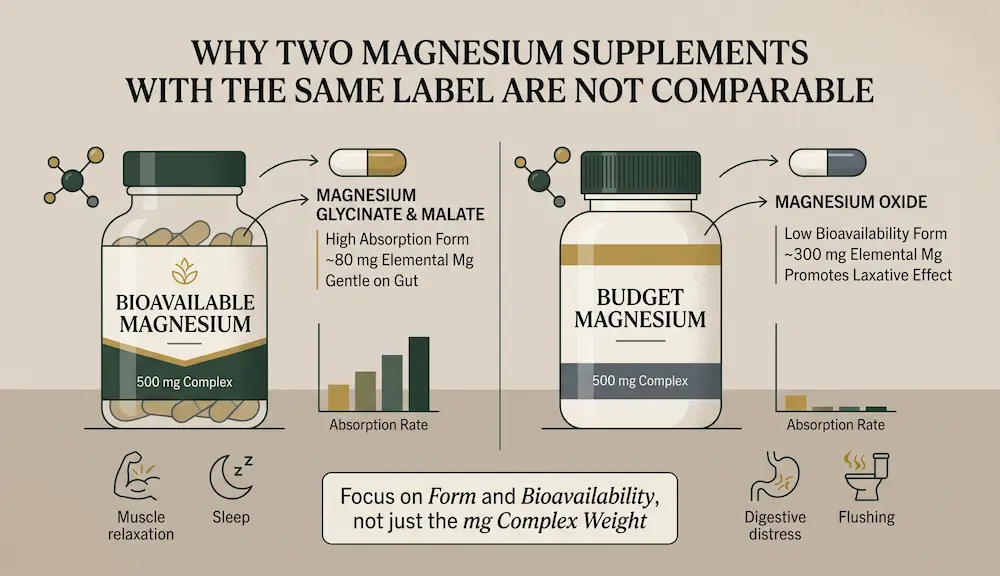
Two magnesium supplements can print the same milligram line and still not be comparable products. The number may be compound weight, elemental magnesium, or a combined total from several salts — and that difference changes fill, serving architecture, raw-material cost, and whether two OEM quotations describe the same SKU. Oral dietary supplements are the scope here — injections, bath salts, and children’s lines sit outside this comparison.
What the Milligram Line Represents
In OEM projects, buyers often align price before they align the milligram basis. Three quotations can all say “magnesium 200 mg” or “magnesium 1,000 mg” and still describe three different purchase orders.[1][2]
Milligram line | What it may represent | Why the quote can diverge |
|---|---|---|
| Magnesium 200 mg | elemental magnesium, depending on the declared basis | the salt source and required fill are still unresolved |
| Magnesium (as glycinate) 1,000 mg | compound / salt weight rather than 1,000 mg elemental magnesium | elemental magnesium delivered may be much lower |
| Magnesium 200 mg from multiple salts | combined elemental magnesium from several sources | no single salt necessarily supplies the full amount |
U.S. Supplement Facts rules treat the mineral amount as the declared dietary ingredient — for magnesium, that is the mineral, not automatically the salt weight.[1][2] Other markets use their own label format.
Required compound weight = elemental magnesium target ÷ verified elemental contribution of the raw material
Glycinate, bisglycinate, and L-threonate are compound-heavy; oxide generally carries a much higher elemental fraction. A 200 mg elemental target may need a large glycinate fill or a much smaller oxide fill. For the glycinate specification path, see magnesium bisglycinate supplements manufacturing.
A magnesium L-threonate panel may declare around 2,000 mg of magnesium L-threonate while providing around 144 mg of elemental magnesium. That pair is an illustration of two different fields — compound line versus elemental line — not a recommended intake and not a conversion to copy into a brief. Use the supplier’s current specification or assay.
When the Magnesium Source Changes the Quote
“Magnesium glycinate” and “magnesium bisglycinate” are often used for the same chelated form. Confirm the ingredient specification from the supplier documentation and the destination-market label — naming detail: magnesium bisglycinate vs magnesium glycinate.
The name still does not settle the drum. Brands typically confirm three lines before two glycinate quotes are treated as the same material:
- Is the grade fully reacted, or buffered?
- Is magnesium oxide — or another buffering salt — part of the declared composition?
- What elemental magnesium comes from the chelate fraction, as distinct from any other magnesium source in the grade?
A buffered grade may contain magnesium oxide or another magnesium source in addition to the chelated fraction. Confirm the declared composition and the elemental contribution from each component. The two materials are not compositionally equivalent: fill, capsule count, raw-material cost, and “gentle chelate” positioning can all diverge between two fronts that both read “glycinate.”
Normalize a Blend Per Salt
A multi-magnesium blend is a composition, not a single magnesium number. “Seven magnesiums” means seven salts are present; the elemental line on the front is the sum of their contributions, which may or may not be a meaningful per-salt amount.
To compare a complex with a single-salt product, brands typically request each salt’s compound milligrams, each salt’s elemental contribution, and whether a high-yield salt such as oxide is part of the declared composition.
Illustrative commercial-specification example — not a formula to copy, not a recommended intake, and not a standard conversion for any named salt:
Source | Compound mg | Elemental Mg | Share of elemental |
|---|---|---|---|
| Glycinate | 500 | 70 | 35% |
| Malate | 400 | 60 | 30% |
| Citrate | 250 | 40 | 20% |
| Oxide | 50 | 30 | 15% |
| Total | — | 200 mg | 100% |
A blend that lists seven salts but delivers most of the elemental line from oxide is a different architecture from one that distributes the target across chelated salts. A daytime salt and an evening salt in one unit is also a different architecture from two SKUs that each carry their own occasion.
Raw-Material COA vs Finished-Product COA
The elemental magnesium and identity on a raw-material COA describe the batch that entered the factory. The finished-product COA describes the batch that left as capsules, tablets, powder, or liquid. Those are different documents. For the framework behind reading either one, see how to read a COA.
Compare | Raw-material COA | Finished-product COA |
|---|---|---|
| What it describes | Incoming drum, bag, or container | Released finished units |
| Identity | Salt / chelate / blend as purchased | Finished-formula identity against the label |
| Assay | Incoming assay or elemental contribution of the grade | Finished-product assay against the declared serving claim |
| Other typical fields | Contaminants, specification, lot | Serving-level claim; dosage-unit uniformity where applicable; release specification |
| Market file | Supplier specification | Destination-market label and release panel |
Incoming COA verifies the raw material; finished-product testing verifies the released SKU against its specification.
Example: Two Quotes That Look Identical
Illustrative quote-normalization example — not a standard conversion for any named grade, and not a recommended intake. Both quotations print 200 mg elemental magnesium per serving in HPMC capsules.
Quote A — fully reacted magnesium bisglycinate; about 1,400 mg compound; 200 mg elemental magnesium; two capsules per serving.
Quote B — buffered magnesium glycinate; about 500 mg compound; 200 mg elemental magnesium; one capsule per serving.
Field | Quote A | Quote B | Same basis? |
|---|---|---|---|
| Salt identity | Fully reacted bisglycinate | Buffered glycinate | No |
| Buffered | No | Yes | No |
| Elemental Mg per serving | 200 mg | 200 mg | Yes |
| Compound loading | ~1,400 mg | ~500 mg | No |
| Units per serving | 2 capsules | 1 capsule | No |
| Finished SKU | Two-capsule chelate serving | One-capsule buffered serving | No |
The elemental target matches. Identity, composition, fill, and unit count do not. Unit price cannot be compared until those rows are aligned — or until the brief accepts that the two SKUs are different products.
What Has to Match Before Price Is Comparable
Elemental magnesium normalizes the mineral amount. It does not, by itself, make two quotations the same product.
Procurement question | What to compare | Why it changes the quote |
|---|---|---|
| What magnesium source is being purchased? | Exact salt / ingredient identity | Different salts require different compound loads for the same elemental target |
| How much magnesium is actually delivered? | Elemental Mg per serving + declared basis | Salt weight alone cannot normalize the quote |
| Is the material buffered? | Raw-material composition / specification | A second magnesium source in the grade can change elemental loading and whether the material matches a fully reacted chelate |
| Is this a blend? | Each salt + compound amount + elemental contribution | One combined number can hide different formula architectures |
| What is being sold? | Dosage form + units per serving | Fill weight and unit count affect manufacturing cost and feasibility |
| Which market governs? | Destination market | Ingredient status and labeling requirements can differ by region |
If the magnesium source has not yet been selected, the magnesium supplements category map frames the salt and formula routes before supplier quotations are lined up.
Same formula and same ingredient do not necessarily produce the same manufacturing quote if target markets differ. Magnesium L-threonate, for example, is used as a dietary-supplement mineral source in the United States, while in the European Union it is an authorised novel food supplied under conditions that include a maximum level, mandatory label wording, and a market exclusivity that runs to November 2029 [4]. Cost and lead time can still diverge after salt, elemental magnesium, and dosage form already match.
What to Send for a Comparable Quote
For a comparable OEM quote, send:
- Two Supplement Facts panels or finished labels
- Two supplier COAs or raw-material specifications
- Target market
- Dosage form
- Target serving size
A single milligram line is not a specification. Include a licensed grade name only if the panel will print one. Note whether the comparison is between two existing products the brand wants to match, or between two supplier specifications for a new formula. The first asks whether the SKUs are the same; the second asks which specification to build.
Send the comparison package to start. Typical reply is within one business day; a project manager is assigned; NDA is available on request.
Frequently Asked Questions
Does 200 mg of magnesium mean 200 mg of elemental magnesium?
Do not infer the basis from the number alone. Check the panel structure and the applicable labeling rules.[1][2] A mineral line with the salt named in parentheses may be elemental; a large milligram figure attached to the salt name may be compound weight. Unless that structure is confirmed, two “200 mg” quotes are not yet the same commercial unit.
Why can two magnesium glycinate products have different fill weights?
Three drivers usually sit behind the gap: whether the grade is buffered, the elemental contribution of that grade, and tap density versus capsule volume. A fully reacted chelate and a buffered glycinate can both say “glycinate” and still need different compound weights — and different capsule counts — to reach the same elemental target.
How do I compare buffered and fully reacted glycinate?
Ask for the specification sheet and the incoming COA, not only the front name. If the elemental percentage is higher than the chelate’s expected stoichiometric yield, the grade is often buffered, and the buffering salt should be named. Compare chelate fraction, any additional magnesium source, and elemental magnesium from each — then compare fill.
How should I compare a magnesium blend with a single-salt formula?
Column by column per salt: identity, compound milligrams, elemental contribution, and whether a high-yield salt is in the declared composition. A seven-salt list with most of the elemental line from oxide is not the same architecture as a single fully reacted glycinate at the same combined elemental number.
What should I send an OEM manufacturer for a comparable magnesium quote?
Two labels or Supplement Facts panels, two supplier COAs or specifications, the target market, the dosage form, and the target serving size. That package is what lets a factory confirm whether two quotations describe the same product.
Related
- Magnesium Bisglycinate Supplements Manufacturing
- Magnesium Malate Supplement Manufacturer
- Magnesium Complex Supplement Manufacturer
- Magnesium Citrate Supplement Manufacturer
- Magnesium Taurate Supplement Manufacturer
- Magnesium L-Threonate Supplement Manufacturer
- How to Read a COA
Technical and Regulatory References
- U.S. Food and Drug Administration. 21 CFR 101.36 — Nutrition labeling of dietary supplements. https://www.accessdata.fda.gov/scripts/cdrh/cfdocs/cfcfr/CFRSearch.cfm?fr=101.36
- U.S. Food and Drug Administration. Dietary Supplement Labeling Guide. https://www.fda.gov/regulatory-information/search-fda-guidance-documents/dietary-supplement-labeling-guide
- NIH Office of Dietary Supplements. Magnesium — Health Professional Fact Sheet. https://ods.od.nih.gov/factsheets/Magnesium-HealthProfessional/
- Commission Implementing Regulation (EU) 2024/2694 authorising the placing on the market of magnesium L-threonate as a novel food — Union list entry, maximum level, labelling requirements, and data protection. https://eur-lex.europa.eu/eli/reg_impl/2024/2694/oj/eng
Disclaimer: Wholesale and brand-manufacturing reference only. Not intended to diagnose, treat, cure, or prevent any disease. Dietary supplements are not drugs. The comparison is for OEM quotation of oral magnesium supplements — it does not recommend intakes, does not rank salts as “best,” and does not treat any condition. Milligram figures, blend splits, and quote pairs are development and artwork examples, not recommended servings and not catalog guarantees. Brand owners remain responsible for finished-label compliance with local counsel.