
- Reviewed by KS Nutripharma Director of R&D (PhD, Food Science
- 19+ years nutraceutical development)
- Technical review scope: elemental magnesium as a comparison basis, specification dimensions beside the elemental line, raw-material load calculation, and quote normalization
- Updated September 2026
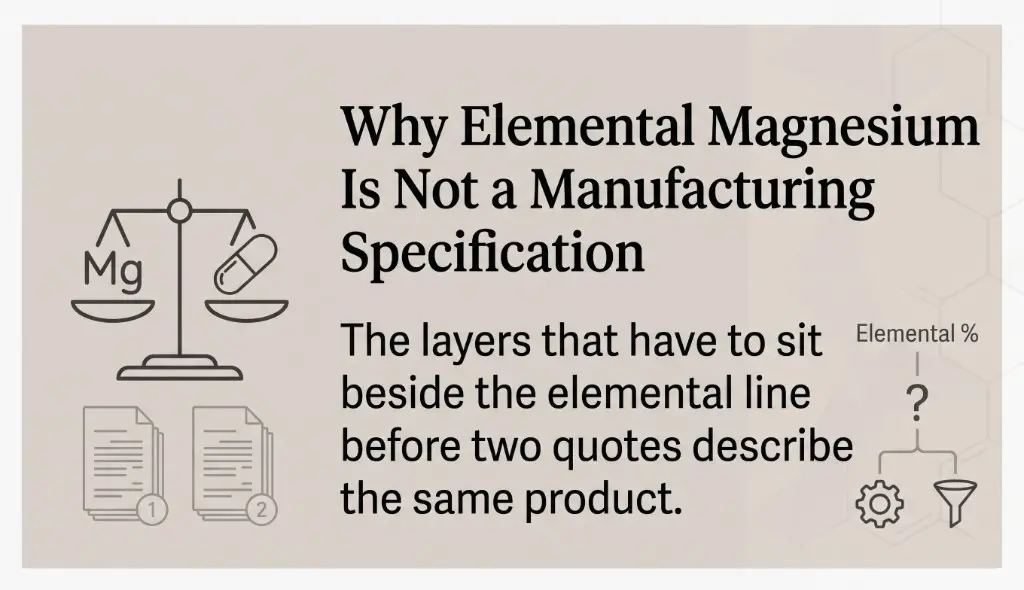
Elemental magnesium is the number that lets you compare two magnesium supplements on the same basis. It is not, by itself, a manufacturing specification. A buyer who sends “magnesium 200 mg, please quote” to two manufacturers may receive two quotations for different products — because the elemental line is the normalization field, and the five specification dimensions beside it are what the factory is actually quoting. On a U.S. Supplement Facts panel the mineral amount is the declared dietary ingredient; that is magnesium itself, not automatically the weight of the magnesium compound.[1][2] Other markets use their own label format.
Adult oral dietary supplements are the scope. Injections, bath salts, and children’s lines sit outside this comparison.
Why the Elemental Number Is Necessary — But Not Enough
Elemental magnesium expresses how much magnesium itself is present in the declared serving, independent of the weight of the magnesium compound used to supply it.[3]
That is why the elemental line is necessary. A 1,000 mg compound line from magnesium oxide and a 1,000 mg compound line from magnesium glycinate are not the same amount of magnesium. Without an elemental basis, those two compound weights cannot be compared.
It is not enough, because 200 mg elemental magnesium is not 200 mg of magnesium raw material. The compound load required to reach that target depends on the approved raw-material elemental fraction. Different salts, and different grades of the same salt name, carry different fractions. That difference moves fill weight, capsule or tablet count, blend capacity, raw-material cost, and the manufacturing quote.
The elemental line answers one procurement question: what magnesium amount is being compared? A manufacturing specification still has to answer what material supplies it, on what basis, in what serving and dosage form, and against which finished-product requirements.
The Five Specification Dimensions Beside Elemental Magnesium
Elemental magnesium is the normalization field. The following five specification dimensions determine what is actually being quoted.
1. Magnesium source / salt identity. The named magnesium compound — glycinate, citrate, malate, taurate, L-threonate, oxide, or a defined blend — is the first dimension. Two products with the same elemental target and different sources are different products. The source changes compound weight, fill behavior, powder or liquid handling, and raw-material cost. For procurement, the ingredient name on the label is not enough to normalize a quote. The raw-material specification must also define the elemental percentage and material basis. “Magnesium glycinate” on a panel does not, by itself, identify the drum.
2. Raw-material basis. For a chelate sold under a glycinate or bisglycinate name, the purchased grade may be specified as a fully reacted chelate or as a buffered material that includes another magnesium source. A fully reacted chelate and a buffered material can differ in composition, elemental magnesium percentage, specification, raw-material cost, and the amount of magnesium compound required to reach the same elemental target. Any tolerance or performance comparison should be evaluated against the actual raw-material composition and available technical documentation rather than inferred from the ingredient name alone. The basis is confirmed on the supplier specification and COA, not on the front name. See buffered vs fully reacted magnesium.
3. Elemental assay and raw-material specification. The load calculation uses the elemental magnesium fraction on the approved raw-material specification — typically a percentage or mg/g figure, with a named assay method. Quote normalization usually needs the raw-material name as sold, compound identity, elemental magnesium percentage, assay method, reacted or buffered basis where it applies, the supplier specification, and a batch COA. Two grades that share a salt name and a 200 mg elemental target are still not the same input if those assay fields differ.
4. Serving architecture and dosage form. The same elemental target may sit in one capsule, two capsules, one tablet, one scoop, or a stated mL. Unit count changes fill weight per unit and whether the serving fits the chosen dosage form. A capsule, tablet, powder, and liquid can share an elemental target and still be different manufacturing files — fill, moisture plan, flavor system, stability, and cost move with the form. Two quotes that match on milligrams per serving and diverge on units or form are not the same SKU.
5. Finished-product specification and release testing. Specification is what the finished SKU is required to meet. Testing is how compliance with that requirement is verified. The incoming raw-material COA verifies the supplied material against its raw-material specification. The finished-product specification and release testing address the manufactured SKU itself. Release typically includes finished identity and assay, plus other tests appropriate to the dosage form and specification — dosage-unit uniformity where applicable, microbiological testing, and contaminant testing. Powder, liquid, and bulk fills do not automatically use the same dosage-unit uniformity framework as capsules or tablets. A buyer who compares two quotes using only the incoming drum assay is comparing the starting material, not the released product. See how finished-product magnesium is tested.
How the Elemental Target Changes Raw-Material Load
Required magnesium compound weight ≈ elemental magnesium target ÷ raw-material elemental magnesium fraction
That relationship is the manufacturing reason two “200 mg magnesium” briefs produce different fills.
If a raw material is specified at 20% elemental magnesium, a 200 mg elemental target would require approximately 1,000 mg of that raw material before accounting for formulation overage or manufacturing-specific adjustments.
This is a calculation example, not a finished-product specification. Actual formulation quantities should be based on the approved raw-material specification and the finished-product target.
Example: same elemental target, different compound load
A 200 mg elemental magnesium target does not mean 200 mg of magnesium compound.
Development example — not a named commercial grade, not a recommended intake | Grade specified at 20% elemental Mg | Grade specified at 60% elemental Mg |
|---|---|---|
| Elemental target | 200 mg | 200 mg |
| Approximate compound required (200 mg ÷ specified fraction) | ~1,000 mg | ~333 mg |
A raw material with a different elemental percentage requires a different compound load to reach the same 200 mg elemental target. That difference affects capsule or tablet count, fill weight, blend capacity, and the manufacturing quote. Glycinate, bisglycinate, magnesium taurate, and magnesium L-threonate grades are often compound-heavy relative to oxide — the last two markedly so, which is why they are the salts where an elemental target most often turns into a serving-count problem. The approved specification still governs the percentage used in the calculation. Do not substitute a textbook fraction for the COA in front of you.
Overage, excipients, capsule volume, and in-process loss sit after this step. They change the finished fill; they do not replace the need to start from the specified elemental fraction.
In a multi-salt formula the same relationship applies per source. Each salt has its own specified elemental fraction and its own compound milligrams. The finished elemental target is the sum of those contributions — not one compound weight divided once. A combined 200 mg elemental line does not tell the factory how much of each drum to weigh.
Why This Matters When Comparing OEM Quotes
Two quotations can both print “magnesium 200 mg, 60 count” and still describe different purchase orders when:
- the magnesium source is not the same salt, or not the same defined blend;
- the raw-material elemental percentage differs, so the compound load — and the fill — differ;
- one grade is fully reacted and the other is buffered, even under the same front name;
- one serving is one unit and the other is two;
- one quote is a capsule file and the other is a tablet, powder, or liquid file;
- one file includes a finished-product specification and release testing appropriate to that form, and the other supplies only an incoming drum COA.
The elemental number can match in every row above. The specification does not. Price is then comparing different SKUs.
The milligram line on a finished label can also be compound weight, elemental magnesium, or a blend total — a separate comparison problem from whether the elemental target is a complete manufacturing specification. See why two magnesium supplements with the same label are not comparable.
What to Put in a Magnesium OEM RFQ
In OEM projects, brands typically put these lines on the request before asking two factories to price the same product:
- elemental magnesium target, in mg per serving, stated as elemental;
- magnesium source — each salt named, including each salt in a blend;
- raw-material basis — fully reacted, buffered, or another specified basis, with the supplier specification;
- elemental assay on that grade — percentage or mg/g, with the method named;
- serving architecture — units per serving and what the unit is;
- dosage form — capsule, tablet, powder, or liquid;
- finished-product specification — assay basis plus the release tests that apply to that form;
- pack — count, fill, and pack format.
A single milligram line is not that package. When two quotations already disagree, send both quotes or labels with the specification sheets attached.
Send two magnesium quotes or labels. The comparison can be normalized by elemental target, salt identity, raw-material basis, serving architecture, dosage form, and finished-product specification. Typical reply is within one business day; a project manager is assigned; NDA is available on request.
Magnesium Quote Normalization Checklist
Quote field | What to lock |
|---|---|
| Elemental magnesium | mg per serving, stated as elemental |
| Magnesium source | Exact salt or defined blend, each compound named |
| Raw-material basis | Fully reacted / buffered / other specified basis |
| Elemental assay | % Mg (or mg/g) on the raw-material specification and COA, with method |
| Serving | Units per serving |
| Dosage form | Capsule / tablet / powder / liquid |
| Finished specification | Assay plus release tests appropriate to the form |
| Packaging | Count / fill / pack format |
If a row is blank, the two prices are not yet on the same product.
Frequently Asked Questions
What is elemental magnesium?
Elemental magnesium expresses how much magnesium itself is present in the declared serving, independent of the weight of the magnesium compound used to supply it. Compound weight is the mass of the salt material. The elemental figure is a fraction of that mass, set by the approved raw-material specification. It is a labeling and comparison basis, not a statement of absorption.
Does the same elemental magnesium mean the same product?
No. The same elemental target can be supplied by different salts, different raw-material bases, different assay percentages, different unit counts, and different dosage forms, then released against different finished-product specifications. Those dimensions define the SKU. The elemental number only puts the magnesium amount on one scale.
Why can two magnesium quotes with the same elemental target have different prices?
Because the compound load required to reach that target depends on the specified elemental fraction, and because serving architecture, dosage form, and release testing each carry their own cost. A grade specified at 20% elemental magnesium needs a much larger compound weight for 200 mg elemental than a grade specified at 60%. Fill, capsule count, and raw-material cost move with that load. Matching 200 mg elemental does not make the quotations the same product.
Related
- Magnesium Malate Supplement Manufacturer
- Magnesium Citrate Supplement Manufacturer
- Why Two Magnesium Supplements With the Same Label Are Not Comparable
- Buffered vs Fully Reacted Magnesium
- How Finished-Product Magnesium Is Tested
Technical and Regulatory References
- U.S. Food and Drug Administration. 21 CFR 101.36 — Nutrition labeling of dietary supplements. https://www.ecfr.gov/current/title-21/chapter-I/subchapter-B/part-101/section-101.36
- U.S. Food and Drug Administration. Dietary Supplement Labeling Guide. https://www.fda.gov/regulatory-information/search-fda-guidance-documents/dietary-supplement-labeling-guide
- NIH Office of Dietary Supplements. Magnesium — Health Professional Fact Sheet. https://ods.od.nih.gov/factsheets/Magnesium-HealthProfessional/
Disclaimer: Wholesale and brand-manufacturing reference only. Not intended to diagnose, treat, cure, or prevent any disease. Dietary supplements are not drugs. Elemental magnesium is a labeling and comparison basis — not a dosing recommendation and not a bioavailability claim. Milligram figures, percentages, and compound-load calculations are development examples, not recommended intakes and not values for any named commercial grade. Actual formulation quantities follow the approved raw-material specification and the finished-product target. Brand owners remain responsible for finished-label compliance with local counsel.