
Five-HTP Supplements Manufacturing At a Glance
KS Nutripharma® is a 5-HTP supplement manufacturer for OEM, ODM, and private-label programs. We develop finished 5-HTP dietary supplements from Griffonia simplicifolia seed material—capsules, tablets, and powder, as single-ingredient or combination formulas—for sleep-support assortments, with a locked 5-HTP assay, market file, and batch COA.
Two “100 mg 5-HTP” quotations may represent completely different manufacturing costs—if the grade, assay basis, or market file differs, the capsule size, fill aid, and unit cost move with it.
Why Buyers Choose KS Nutripharma
- Dietary supplement OEM since 2007 — 500+ brand projects across 60+ markets
- cGMP manufacturing with ISO 9001, ISO 22000, HACCP, FSSC 22000, Halal and Kosher pathways
- 12 production lines · 81,000+ m² · 260+ professionals · in-house lab plus SGS / Eurofins as scoped
- COA-based specification review before sampling — HPLC assay confirmation, not catalog % guesses
- Capsule MOQ typically from about 3,000–5,000 units; first reply within one business day; NDA available
Buyer-at-a-glance
Lock point | Typical project answer |
|---|---|
| Botanical source | Griffonia simplicifolia seed |
| Assay basis | HPLC 5-HTP %, locked to project COA |
| Market grade | Confirmed per intended market before material is reserved |
| Default format | Hard capsule (HPMC or gelatin) |
| Safety review | Serotonergic interactions reviewed for the finished label |
| First reply | Typically within one business day |
5-HTP Supplement Formulation Options
These are development frameworks around your BOM—not frozen catalog SKUs and not copies of named consumer brands. Milligrams are fill windows, not dosing advice. Pick the closest architecture or send a BOM.
Project example — one capsule became two bottles. A private-label team wanted 5-HTP + GABA + valerian in a single evening capsule for Amazon photography. Fill mass and odor both failed the first pilot. Final commercial decision: 5-HTP + GABA stayed in the evening capsule; valerian moved to a companion bottle with its own COA and claim file. Compatible on a mood board is not the same as feasible in one unit.
Melatonin joins only if the BOM names it, it is measured, and the destination allows it. Jujube seed as an evening companion: jujube seed supplement manufacturer.
Use when: The panel wants only 5-HTP mg; fastest private-label path.
Specify: 5-HTP mg per serving; grade per market file; HPMC or gelatin shell; P-5-P / B6 only if the BOM names them. Back-calculate powder mass from the HPLC % so labeled milligrams and fill mass stay aligned.
Trade-off: Clear unit cost and simple fill. Little differentiation on a sleep-stack shelf; higher servings may need two capsules.
Default format: Hard capsule.
Use when: Evening two-active amino stack—the most requested combination after single-ingredient. See GABA.
Specify: 5-HTP mg + GABA mg; GABA grade (fermentation 99%; a branded GABA grade only with a license); 5-HTP grade; total fill and capsule size. Dual assay, dual files.
Trade-off: Reads as a sleep stack, against shell size, extra testing, and slower sampling. GABA does not soften 5-HTP warning language.
Default format: Hard capsule.
Use when: Evening calm line without valerian odor. See L-theanine supplements.
Specify: L-theanine mg + 5-HTP mg; typically evening. Branded theanine only if the grade is authorized.
Trade-off: Cleaner sensory than a botanical stack. Serotonergic warning still applies. Not GABA fill and not a valerian odor file.
Default format: Hard capsule.
Use when: The evening SKU needs a mineral companion, not a second amino or a second root. See magnesium bisglycinate.
Specify: 5-HTP mg + salt and elemental Mg. “200 mg bisglycinate” is not 200 mg magnesium. Capsule count often moves.
Trade-off: Mineral bulk versus a compact amino pair. Not a sleep-drug mineral.
Default format: Hard capsule or tablet.
Use when: The brief already wants a European-style evening pair: 5-HTP plus valerian root. See valerian supplement manufacturer.
Specify: 5-HTP HPLC file + V. officinalis root / rhizome + named valerenic acids. Odor sits on the valerian side—hard capsule, not an open powder.
Trade-off: Herbal sleep story against odor, residual-drowsiness copy, and fill. One-shell 5-HTP + GABA + valerian usually fails fill and odor together; that stack typically splits into two bottles.
Default format: Hard capsule, or dual pack.
Use when: Herbal evening adjacency without valerian odor. See passionflower supplement manufacturer.
Specify: 5-HTP assay + passionflower identity, plant part, and named flavonoid method if printed. Lemon balm is a second botanical option with its own marker file: lemon balm.
Trade-off: Two botanicals, two COAs. Not valerian odor and not saffron’s mood-aisle cost.
Default format: Hard capsule.
Use when: The SKU sits on a mood assortment, not the default evening sleep SKU. See saffron supplement manufacturer.
Specify: 5-HTP mg + saffron stigmas identity; crocin / safranal only if claimed and method-locked. St. John’s wort is not a default partner.
Trade-off: Mood-aisle differentiation against cost, dual assay, and a tighter claim file. Not a depression-treatment SKU.
Default format: Hard capsule.
Use when: The buyer insists on a daytime amino plus evening 5-HTP.
Specify: Each mg; daytime tyrosine vs evening 5-HTP—prefer a split SKU over one capsule. GABA as a third active needs its own milligram line and warning review, not an unnamed add-on.
Trade-off: Quotable, not the default launch. Clock conflict, fill, and heavier claim review. Not a three-active gummy.
Default format: Capsule or split SKU.
Choose the 5-HTP Format: Capsules, Tablets, Gummies or Powder
High-purity isolate is compact but can still bridge on the line. Seed extract reaching the same 5-HTP mg is bulkier and often needs a larger shell, two capsules, or a tablet.
Best for: Default OEM; vegetarian path via HPMC. The usual 5-HTP capsule manufacturer start when the serving fits one dry shell.
Why: Controllable fill; odor stays in the shell; compact isolate servings.
Typical formula cards: 5-HTP-Only; +GABA; +L-Theanine; +Valerian; +Passionflower; +Saffron.
What to lock: Capsule size; HPMC vs gelatin; capsules per day; 5-HTP mg per serving; whether a documented flow aid is allowed if isolate bridges.
Manufacturing note: A US brief locked 100 mg from ≥98% isolate. Assay math fit a compact capsule; the first pilot bridged in the hopper and missed fill-weight. A “zero flow aids” rewrite failed the same way. The commercial SKU kept the labeled milligrams and accepted a minimal flow system. High purity is not easy encapsulation. Capsule planning typically starts around 3,000–5,000 units.
Best for: Extract bulk or magnesium salt that will not fit one capsule, or when a film coat is needed for odor.
Why: Count and a moisture- or odor-masking coat when capsule serving grows.
Typical formula cards: +Magnesium bisglycinate; seed-extract loadings that miss size 0.
What to lock: Tablet weight; coating; friability; content uniformity.
Manufacturing note: Compressibility and tooling are project items. A capsule BOM is not a tablet BOM. Tablet planning typically starts around 5,000–10,000 units.
→ Tablets
Best for: A retail channel that already requires a gummy, after a heat-and-assay review.
Why: Bitterness, water activity, and pieces-per-serving decide whether capsule-equivalent milligrams survive the cook.
Typical formula cards: Low-load 5-HTP-Only after a pilot. Evening amino or valerian stacks are not the default gummy BOM.
What to lock: Active per piece; bitterness; Aw; sugar vs sugar-free; assay uniformity in the gummy matrix.
Manufacturing note: A capsule BOM is a different file from a gummy cook. Incoming HPLC % does not prove a cooked piece.
→ Gummies
Best for: Two different POs—bulk kilograms of 5-HTP / Griffonia extract for incoming fill, or a finished stick or tub with a labeled serving.
Why: A kg quote and a flavored consumer powder are not the same SKU. Mixing them on one RFQ produces two incomparable prices.
Typical formula cards: None of the evening capsule stacks as open powder.
What to lock: Bulk kg versus finished stick or tub; mesh and LOD on bulk; flavor, uniformity, and moisture on a finished stick. Finished-powder planning often starts around 10,000 units after film and flavor lock.
Manufacturing note: Open powder is a poor home for valerian odor. Bulk kg is quoted separately from bottle MOQ.
5-HTP Ingredient Supply
We supply 5-HTP as a finished-ingredient input and as a bottled or bulk finished supplement. The botanical identity is Griffonia simplicifolia, plant part: seed. The active marker is 5-Hydroxytryptophan (5-HTP). Material arrives as standardized extract or purified powder—the exact percentage is locked to the intended market and confirmed on the project COA.
Bulk 5-HTP is available by the kilogram for clients who manage their own encapsulation or compounding, with a batch COA covering identity, assay, and release tests. Kilogram MOQ is quoted separately from finished-unit MOQ.
The grade you buy is a market-and-specification decision, not a slogan.
Custom 5-HTP Supplement Manufacturing
We manufacture 5-HTP as a single-ingredient SKU or within combination formulas. Development covers assay confirmation, excipient selection, capsule or tablet engineering, packaging format, and artwork adaptation. Constraints we flag early: total capsule fill versus 5-HTP mg target; whether the positioning is evening-only or crosses into daytime stacks; and whether any serotonergic co-ingredients are compatible under the same label warning.
Our R&D center reviews the BOM for flow, compressibility, moisture sensitivity, and label claim math before any sample run is scheduled.
Private Label 5-HTP Supplements
Private-label, OEM, and ODM programs are available for finished units in bottles, blister packs, or bulk bags. We assign a project manager after specification lock, and NDA coverage is available.
| Item | Typical project planning range |
|---|---|
| Capsule MOQ | About 3,000–5,000 units |
| Tablet MOQ | About 5,000–10,000 units |
| Powder / stick | Often from about 10,000 units or as quoted after film/flavor lock |
| Gummies | After feasibility review |
| Bulk 5-HTP | Project-dependent kg quote; separate from bottle MOQ |
| Sample | 7–15 days after spec and material confirmation |
| Mass production | 30–45 days after formula, artwork, pack, and schedule lock |
| First reply | Typically one business day |
What we lock before quotation
- Source and assay confirmed against the market file
- Finished-unit potency checked against the agreed specification
- Capsule-fill and extract-loading feasibility reviewed before sampling
- Single-ingredient and combination BOMs
- COA review and regional documentation coordination
- Private-label packaging and artwork support
5-HTP = 5-Hydroxytryptophan. It is an amino-acid derivative and an intermediate in the biosynthesis of serotonin. It is not a vitamin, not a “serotonin pill,” and not a standardized drug entity.
Commercial supplement 5-HTP is derived almost entirely from the seeds of Griffonia simplicifolia, a leguminous plant native to West and Central Africa. Natural seed content and a ≥98% isolate are different statements; the isolate is a purified specification, not the seed as harvested.
Pathway: L-Tryptophan → 5-HTP → Serotonin → Melatonin
This pathway explains why 5-HTP appears in sleep-support and mood-support assortments. It is a biochemical positioning statement, not a guarantee that oral 5-HTP will raise serum or CNS serotonin in any specific individual. Finished-product claims are reviewed per intended market.
| 5-HTP | L-Tryptophan | |
|---|---|---|
| Pathway position | Intermediate (after the usual rate-limiting step) | Dietary amino-acid precursor |
| Common source | Griffonia seed extract / purified 5-HTP | Amino-acid specification |
| PO lock | 5-HTP % by HPLC + plant part + market grade | Identity / assay / form |
| Development | Compact mg; tighter market file | Different dose band and claim file |
OEM buyers usually lock grade, format, and label file first. Sleep and mood language is assortment placement—not disease treatment.
Sleep & Evening Positioning
Evening assortment positioning—not an insomnia drug. Typical architectures: single-ingredient, +GABA, or +L-theanine in capsule; melatonin only if the BOM names it, testing confirms it, and the market file allows it. Do not print “treats insomnia” or “melatonin replacement.” Sleep structure/function language is reviewed per market authorization.
Mood-Support Positioning
Mood-category shelf placement—not a depression or anxiety treatment page. Typical architectures: single-ingredient or +L-theanine; do not default St. John’s wort into the same SKU. Supplement positioning is not treatment of depression or anxiety disorders. Structure/function vs unauthorized disease-claim review applies. See mood support supplements.
Appetite & Weight-Management Positioning
Some brands explore 5-HTP in appetite or weight-management products, but this requires separate evidence and market-specific claim review. It is not a weight-loss claim and not the default use case for a 5-HTP SKU.
Evidence Boundary
Common shelf positioning exists. Human evidence has been published, but doses, formulations, and endpoints vary. Limitations include heterogeneous endpoints, exclusion of concomitant medication users, and inconsistent assay reporting across trials. Finished-product claims must be reviewed per regional requirements. Identity, assay, and warning language support a SKU; they do not create an authorized claim.
Brands keep launching 5-HTP because the commercial brief is mature—not because the molecule is new.
- Mature ingredient — buyers and retailers already recognize the name on a panel
- Global consumer awareness — sleep and mood assortments already carry the search language
- Capsule-friendly — compact servings when the assay grade matches the fill target
- Easy to combine with evening companions such as GABA or L-theanine when the label file allows
- Multiple price points — high-purity isolate vs lower-assay seed extract create different cost and capsule architectures for the same labeled 5-HTP mg
Typical brand positioning (where the SKU sits)
Positioning | What the shelf usually expects | Spec / format tendency |
|---|---|---|
| Premium sleep | Clean panel, compact capsule, evening language | Often high-purity isolate; single or +L-theanine |
| Value sleep | Aggressive unit cost, higher bottle count | Seed-extract math must be honest on 5-HTP mg |
| Stress support | Day-to-evening calm adjacency | Watch clock conflicts if stacking daytime actives |
| Mood bundle | Multi-SKU kit or shared mood aisle | Mood Hub adjacency; disease claims stay off |
| Retail drug store | Conservative claims, blister or bottle | Stronger label-file and interaction warnings |
| Amazon / DTC | Conversion copy + reviews pressure | Still needs real assay; do not copy competitor panels |
| Clinic / practitioner | Tighter documentation, NDA common | COA depth and impurity scope often higher |
Match the channel before you freeze grade. A premium-sleep capsule and a value seed-extract bottle are different POs even when both print 100 mg 5-HTP.
5-HTP commercial grade is not “higher purity = better.” It is locked by market path + HPLC method + material form. In one line:
5-HTP specification = Griffonia simplicifolia seed identity + HPLC assay % + process route + impurity / Peak X method (if scoped) + intended-market file.
Commercial conversation usually centers on ≥98% isolate and ≤30% seed extract. Exact % is confirmed on the project COA—not printed as a catalog guarantee.
Grade decision tree
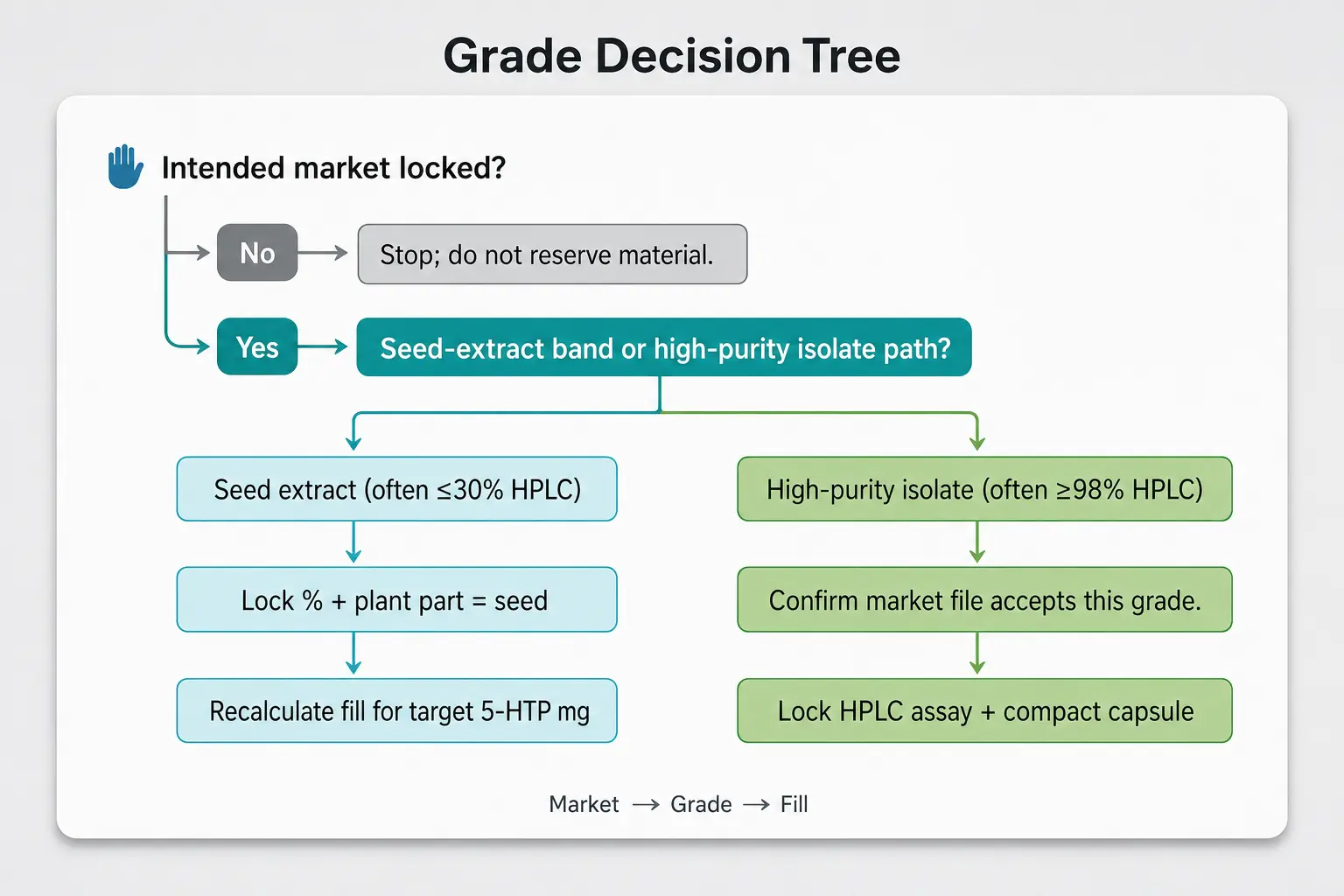
Assay grades by HPLC
Grade | Typical HPLC band | Common market / use | Procurement note |
|---|---|---|---|
| High-purity isolate | ≥98% (often 98–99%) | US DSHEA and many export capsules | Purified material—not natural seed content; compact fill for hard capsules |
| Seed extract | ≤30% (often 20–30%) | Some EU food-supplement paths | Confirm the exact %; same mg 5-HTP needs more powder → capsule size |
| Intermediate | e.g. 50% | Only when the supply file lists it | Confirm on the project COA; a 50% band is not a default catalog grade |
| Custom | Buyer-named | Special projects | Separate inquiry; lock HPLC method and reference standard |
98% is a purified specification, not the natural content of the seed. Seed dry-basis content and isolate purity are different statements. Intermediate bands appear only when the supply file exists.
EU-market note: Some EU food-supplement paths treat high-purity isolate differently from seed extract. EU projects need a separate regulatory assessment of source, extraction profile, concentration, and intended use. Do not transfer a U.S.-oriented ≥98% file into an EU brief by default.
Source, form, and method
Dimension | Typical options | What to lock |
|---|---|---|
| Botanical source | Griffonia simplicifolia seed | Latin name + plant part (seed, not leaf) |
| Process route | Seed extraction (default) | Fermentation / synthesis only if the brief names them—impurity profiles differ |
| Material form | Standardized extract / purified powder | Extract includes matrix; purified powder approaches the monomer |
| Assay method | HPLC for content | Do not use TLC as a quantitative proxy; lock the reference standard |
A leaf extract with a high secondary-metabolite profile is not interchangeable with seed-derived 5-HTP. Origin may sit on the COA for traceability; origin does not replace HPLC.
Cost drivers on a 5-HTP PO
Cost driver | What moves the unit price |
|---|---|
| Assay grade | Isolate vs seed extract changes kg cost and fill mass |
| Capsules per serving | One compact capsule vs size 00 / two capsules |
| Combination actives | Dual assay, dual files, larger shell |
| Format | Capsule default; tablet coating; gummy matrix after feasibility |
| Testing scope | Finished-unit potency, impurity method if scoped, third-party as required |
| Packaging | Bottle vs blister vs stick film |
Same label claim, different manufacturing cost — why quote A can sit ~30% above quote B even when both say “100 mg 5-HTP”:
Same label | Supplier A path | Supplier B path |
|---|---|---|
| Labeled 5-HTP | 100 mg | 100 mg |
| Material | ~98% isolate | ~20% seed extract |
| Approx. fill mass | ~105 mg powder | ~520 mg extract |
| Typical capsule | Size 0 | Size 00 (or two capsules) |
| Bottle count | 60 | 60 |
| Where cost rises | Higher raw $/kg | Higher fill mass, shell, labor, freight per active mg |
Neither path is automatically “better.” The cheaper raw material can still lose on unit economics once fill and capsule count move. Compare 5-HTP mg + assay + capsule architecture, not headline purity alone.
Common procurement mistakes
“100 mg 5-HTP” is not “100 mg raw material.”
- From ~98% material ≈ 102 mg powder
- From 20% extract ≈ 500 mg extract
If the label writes only “500 mg Griffonia extract” without 5-HTP mg, two quotes are not comparable. Chain: grade → loading → format → economics.
“98% = better” is wrong. ≥98% and ≤30% are a market / specification decision, not a quality ladder.
Do not assume one grade travels to every market. Lock the intended market before you reserve material.
Project example — the brand insisted on 20% for three weeks
A US export brief wanted 100 mg 5-HTP and insisted on a 20% Griffonia seed extract because a previous supplier had quoted that grade as “more natural.” Week one: fill calculation already showed the powder mass would miss the target capsule. The brand kept the 20% file anyway. Week three: sample shells were size 00, the bottle looked oversized next to competing 60-count SKUs, and freight per active milligram had climbed. After market-file review confirmed a high-purity path was allowed, we switched the material to a ≥98% isolate delivering the same 100 mg 5-HTP. The label claim did not change. Capsule size came down, and finished-unit cost landed below the stuck-on-20% path—even though raw $/kg looked higher on paper.
COA fields required for a usable quote
Field | Buyer mistake we see | What a usable COA usually shows |
|---|---|---|
| Identity + plant part | Leaf or unnamed “Griffonia extract” | Griffonia simplicifolia, seed; identity test |
| 5-HTP assay + method | Two “100 mg” quotes without HPLC method | HPLC %, spec limit, reference standard |
| Moisture / LOD | Ignored until sample day | LOD / moisture — fill and stability |
| Related impurities / Peak X if scoped | Asking for “ND” when never tested | Named method; no ND claim unless actually tested |
| Residual solvents | Skipped on extracted material | Listed when the route is extraction |
| Micro + heavy metals | Assuming raw COA covers finished units | As scoped for the intended market |
| Batch / mfg / retest | No dates → no release clock | Dates, batch number |
Common Serving Sizes
| Serving architecture | Application |
|---|---|
| Lower-load | Combination formula; 5-HTP shares the capsule |
| Moderate-load | Single-ingredient; commercial conversation often 50–100 mg 5-HTP |
| Higher-load | 100–200 mg class — custom; destination upper-level review |
Milligrams are illustrative examples, not dosing advice.
Serving Size and Capsule Development
Active loading → excipients → capsule size → servings per day → cost → compliance.
Lower-assay extract to reach the same 5-HTP mg → larger volume → size 00 or two capsules or shift to tablet. The 20% seed-extract brief that later moved to ≥98% isolate was this fill problem in real time: the label milligrams stayed the same; the shell and freight did not.
When to Take 5-HTP
Timing depends on intended product positioning, formulation, serving size, and label directions.
Commonly Reported Side Effects
Gastrointestinal discomfort and nausea are commonly reported in public safety summaries. Relationship to serving size and dosage form can be flagged during formula review.
Serotonergic Medication Interactions
5-HTP can interact with medicines or supplements that affect serotonin pathways. Categories to flag on finished-label review include: antidepressants, other serotonergic medicines, MAO-related substances, and other serotonin-affecting compounds.
St. John’s wort supplement manufacturer is an interaction flag, not a default stack partner.
Serotonin Syndrome Considerations
Combining 5-HTP with serotonergic drugs may increase the risk of excessive serotonergic activity, and consumers should seek qualified medical advice before combining them.
Pregnancy & Breastfeeding
Safety during pregnancy or breastfeeding has not been adequately established; use should be discussed with a qualified healthcare professional. We do not develop pregnancy or breastfeeding SKUs.
Supplement Labeling & Market Requirements
Finished labels must carry use directions, interaction warnings, serotonergic cautions, and alignment with the market file. UK, CA, AU, and other markets require independent files; we do not operate country sub-sites. The label must match the locked grade.
Development timeline
| Stage | Typical clock |
|---|---|
| Spec + market file lock | Before material is reserved |
| Formula feasibility | After BOM and COA review |
| Sample | 7–15 days after spec and material confirmation |
| Artwork + pack lock | Parallel with sample approval |
| Mass production | 30–45 days after formula, artwork, pack, and schedule lock |
How we turn that specification into your SKU:
- Ingredient & specification confirmation — Source, assay, intended market, serving target, and format.
- Formula development — BOM, fill volume, clock positioning (evening vs daytime), and whether warnings live on the same label.
- Sample production — 7–15 days after specification and material confirmation.
- Testing & COA review — Incoming raw material COA does not replace finished-unit testing. If potency is sold, the finished unit is tested.
- Packaging & label development — Moisture protection, artwork, market warnings; bottle or blister.
- Pilot / mass production — Capsule planning typically starts around 3,000–5,000 units; tablet around 5,000–10,000.
RFQ Checklist
| RFQ item | Buyer should provide |
|---|---|
| Intended market | US / EU / UK / etc. |
| 5-HTP target | mg 5-HTP per serving |
| Material | Purified 5-HTP / Griffonia extract |
| Assay | Target % by HPLC |
| Format | Capsule / tablet / powder / gummy |
| Combination | GABA / L-theanine / magnesium / valerian / passionflower / saffron / none |
| Pack | Bottle / blister / bulk |
| Quantity | Target units / kg |
| COA | Existing supplier COA if available |
| Label | Existing artwork or new development |
Example RFQ wording
We are developing a private-label 5-HTP supplement for [intended market]. Format [capsule/tablet/powder]. Target [X mg 5-HTP] using [Griffonia seed extract at Y% / purified 5-HTP]. Combinations: [none / GABA / L-theanine / …]. Please review the attached COA for identity, 5-HTP assay, method, impurity/Peak X if listed, micro, metals, residual solvents, then quote feasibility, packaging, planning MOQ, and lead time. NDA: [yes/no].
Request RFQ worksheet · Send this brief for feasibility review
What is a 5-HTP supplement?
A finished dietary supplement containing 5-Hydroxytryptophan from Griffonia simplicifolia seed, sold by the milligram of 5-HTP—not as a serotonin tablet. “Daily 5” multivitamin searches are usually a different product.
What is 5-HTP used for in supplements?
Shelf positioning is commonly evening sleep support and mood support—not a depression treatment.
What are the benefits of 5-HTP supplements?
Positioning is not the same as an authorized claim or a treatment. Benefits are bounded by market-specific claim review.
What are the side effects of 5-HTP supplements?
GI upset and nausea are commonly reported. Medication interactions are flagged on the label file.
Are 5-HTP supplements safe?
Safety depends on population, concomitant medications, serving size, and market file. Risks concentrate in drug interactions and unsupported disease claims.
What is the best 5-HTP supplement?
There is no universal “best.” For product development, evaluate source, assay, specification, COA, serving strength, dosage form, and regional requirements.
What dosage of 5-HTP is commonly used in supplements?
Commercial architectures often discuss 50–200 mg 5-HTP ranges. These are illustrative examples, not medical dosing advice.
Can 5-HTP be combined with GABA?
Yes, as a custom development. Lock dual milligrams, fill volume, and label warnings.
What 5-HTP specifications can you provide?
Griffonia simplicifolia seed identity + HPLC assay % + process route + impurity / Peak X method if scoped + intended-market file. Commercial conversation usually centers on ≥98% isolate and ≤30% seed extract; exact % is confirmed on the project COA, not as a catalog guarantee.
Can you manufacture private-label 5-HTP supplements?
Yes. Capsule planning typically starts around 3,000–5,000 units; samples 7–15 days after spec and material confirmation; mass production 30–45 days after formula, artwork, pack, and schedule lock.
Can you match my current supplier specification?
Yes—send the current COA and label target. We map identity, HPLC assay, method, and fill feasibility before quoting a matching or improved file.
Can you manufacture from my existing COA?
Yes. An existing supplier COA is often enough to start feasibility. We still confirm whether the grade fits the intended market and whether finished-unit potency must be retested.
Can you sign an NDA?
Yes. NDA coverage is available before you send a full BOM or artwork.
Can you source branded ingredients?
Only when the BOM names the brand and authorization is in place. Unnamed branded grades are not assumed.
Can you help with regulatory documentation?
We coordinate COA, specification, and label-file inputs for the market you sell into. Brand owners remain responsible for finished-label compliance.
What should I include in a 5-HTP RFQ?
Intended market, 5-HTP mg/serving, source/grade, dosage form, combination ingredients, packaging, target MOQ, and any existing COA.
Ready to Manufacture Your 5-HTP Supplement?
Send the intended market, labeled 5-HTP milligrams, Griffonia seed identity, HPLC assay path (isolate vs seed extract), and format. A finished formula is not required to start. If two supplier sheets both print 100 mg 5-HTP, send both—we check method, fill mass, and whether the grade fits the market file before sampling. Typical first reply is one business day on a complete brief. An NDA is available.
Have two COAs? Compare two 5-HTP COAs
Have a BOM or panel? Send BOM for feasibility
Related
- GABA
- L-Theanine Supplements
- Magnesium Bisglycinate Supplements Manufacturing
- Valerian Supplement Manufacturer
- Passionflower Supplement Manufacturer
- Lemon Balm Supplement Manufacturer
- Saffron Supplement Manufacturer
- Jujube Seed Supplement Manufacturer
- Mood Support Supplements
- How to Read a COA
Disclaimer: Wholesale / brand manufacturing reference. Not intended to diagnose, treat, cure, or prevent any disease. 5-HTP can interact with serotonergic medicines. Brand owners own finished-label compliance for the intended market. Milligrams are illustrative examples, not dosing advice.
Written by KS Nutripharma Formulation Team | Reviewed by KS Nutripharma Director of R&D (PhD, Food Science | 19+ years nutraceutical development) | Updated September 2026