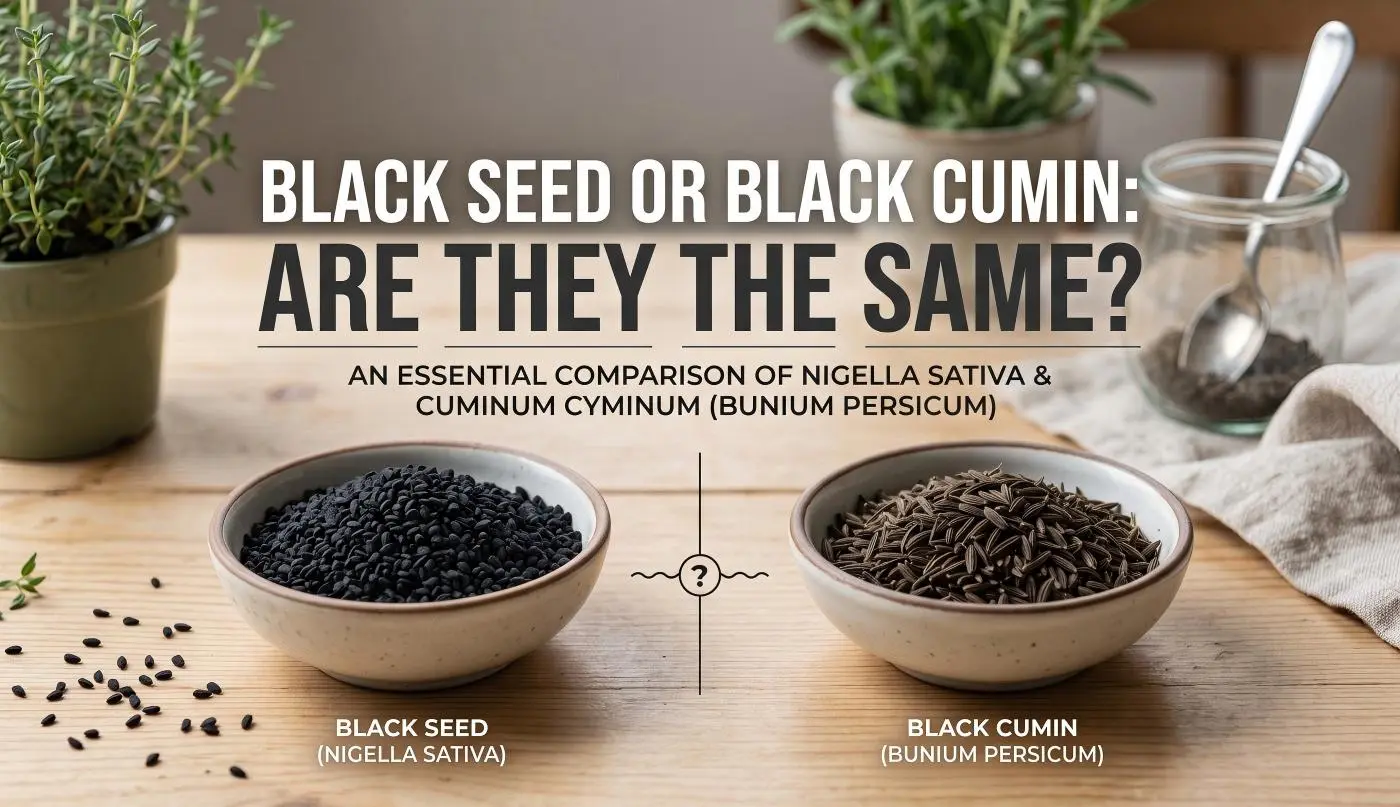
Introduction
If you source ingredients for a dietary supplement, you will see black seed and black cumin on the same RFQs. In most commercial files they name the same seed: Nigella sativa L. For a finished SKU, start from that binomial — then a black seed supplement manufacturer path — not from a regional common name.
The ABC-AHP-NCNPR Botanical Adulterants Prevention Program states that nigella is “also referred to in commerce as ‘black seed’ or ‘black cumin.'” [1] The same program notes that, “although sometimes called ‘black cumin,’ nigella is not related to the popular spice cumin (Cuminum cyminum).” [1] Common names are trade language. The Latin binomial is the purchase specification.
Is Black Seed the Same as Black Cumin?
In dietary-supplement procurement, usually yes — when the specification names Nigella sativa L., seed.
Royal Botanic Gardens, Kew accepts Nigella sativa L. as a distinct species in Ranunculaceae. [2] USDA GRIN records the same taxon and cites U.S. herbal-commerce usage of the English name nigella. [3] The ABC-AHP-NCNPR bulletin adds that “Nigella is the preferred standardized common name for the plant in the United States according to the second edition of the American Herbal Products Association’s Herbs of Commerce.” [1]
U.S. food-additive listings make the mapping explicit. Under 21 CFR 182.10, FDA lists both “Caraway, black (black cumin)” and “Cumin, black (black caraway)” as Nigella sativa L., while “Cumin (cummin)” is Cuminum cyminum L. and “Caraway” is Carum carvi L. [4] That is why an RFQ that only says “black cumin” is incomplete: the same English string is used for N. sativa in supplement and U.S. spice listings, and in some culinary markets it is also used for other dark-seed spices.
McCormick Science Institute puts the naming trap in one sentence: black seed “is commonly referred to as black cumin or black caraway, potentially misleading terms since the seeds are neither true cumin (Cuminum cyminum) nor true caraway (Carum carvi).” [5]
Procurement rule: “Black cumin” is a common trade descriptor. Nigella sativa L., seed, is the required technical identity.
Black Seed vs True Cumin: What Is the Difference?
True cumin is Cuminum cyminum L. (Apiaceae), an accepted species on Kew’s Plants of the World Online. [6] It is not a drop-in substitute for N. sativa.
Parameter | Black seed / black cumin (N. sativa) | True cumin (C. cyminum) |
|---|---|---|
| Botanical name | Nigella sativa L. [2] | Cuminum cyminum L. [6] |
| Plant family | Ranunculaceae [2] | Apiaceae [6] |
| Typical commercial use | Seed oil, dry extracts, milled seed for supplements | Culinary spice and flavoring [4] |
| Characteristic marker | Thymoquinone (TQ) [7][8][9] | Cuminaldehyde and related volatiles — not TQ as a defining identity marker |
| Common physical formats | Pressed oil, dry extract, milled seed | Whole or ground seed; cumin essential oil |
Thymoquinone is a characteristic constituent of N. sativa seed oil and phytopharmaceuticals. [8][9] If the formula depends on a named TQ assay, Nigella sativa L. is the required starting material.
Identity risk does not stop at true cumin.
- The BAPP bulletin documents adulteration of nigella seed with other Nigella species, “particularly N. damascena,” and adulteration of nigella seed oil with undisclosed lower-cost vegetable oils. [1] Name the species. Then test the material you will actually fill.
- In some culinary markets, “black cumin” is also applied to Elwendia persica (syn. Bunium persicum), an accepted Apiaceae species on Kew — a different plant from N. sativa. [10]
- Black ginger (Kaempferia parviflora) and black sesame are different plants. They do not belong on a Nigella sativa purchase order.
Terminology at a Glance
Trade / regional name | Typical botanical reference | Specification note |
|---|---|---|
| Black seed | Nigella sativa L. | Common supplement-label name in North America and Europe [1] |
| Black cumin | Usually N. sativa L. in supplement files | Confirm the Latin binomial; do not treat the English string as a complete PO [1][4] |
| Nigella | Nigella sativa L. | Preferred U.S. standardized common name in AHPA Herbs of Commerce, as cited by BAPP [1][3] |
| Kalonji | Nigella sativa L. | South Asian food and herbal trade name for the seed [1][11] |
| Black cumin seed oil (USP-NF title) | Oil of N. sativa L. seed | Pharmacopeial title for a named N. sativa oil grade — not a substitute for a project specification [7] |
| True cumin | Cuminum cyminum L. | Separate species; FDA lists it as “Cumin (cummin)” [4][6] |
| Black caraway / caraway, black | N. sativa L. in 21 CFR 182.10 | Not Carum carvi (caraway) [4][5] |
| Kala zeera / some “black cumin” spice lots | Elwendia persica (syn. Bunium persicum) | Confirm the binomial; this is not N. sativa [10] |
How to Specify Black Seed for Manufacturing
A usable RFQ has four checkpoints. Dosage-form and TQ math belong on the finished-product file, not on a common-name line.
1. Binomial and plant part. Mandate Nigella sativa L., seed. Kew treats the name as accepted. [2]
2. Material type. Oil, TQ-specified oil, ratio extract, TQ-standardized extract, or milled seed powder. These are different purchase lines.
3. Marker and method. If the label will state thymoquinone, name a minimum or as-is result and a validated method. Hadad et al. described an HPLC method “suitable for quality control of the marker substances” in N. sativa phytopharmaceuticals. [8] A percentage without a method is not comparable.
4. Release tests. Identity, contaminants, and — for oils — oxidation parameters. Align residual-solvent testing with ICH Q3C when the extraction path uses solvents. [12] Read the COA against the same fields: How to Read a COA.
Oil, Extract, or Seed Powder?
The naming question is settled only when the material type is named.
USP-NF defines Black Cumin Seed Oil as “the oil obtained from the seeds of Nigella sativa L. (Fam. Ranunculaceae) by cold press processing.” [7] That title is further evidence that pharmacopeial English uses “black cumin” for N. sativa. It is not a license to copy a monograph TQ window onto every cold-pressed drum, and it is not a dry-extract specification. USP-NF also maintains a separate Black Cumin Seed Thymoquinone Oil monograph — a different named grade, not a catalog default. [13]
Lutterodt et al. reported that six commercial cold-pressed black cumin seed oils contained “about 3.48–8.73 mg/g thymoquinone,” with linoleic, oleic, and palmitic acids as the major fatty acids, and a roughly two-fold spread in oxidative stability. [9] A later HPLC screen of commercial black seed oils and oil-containing capsules found that “the TQ content varied from 3.08 to 809.4 mg/100 g (mean).” [14] “Cold-pressed” describes process. It does not freeze TQ % or peroxide value.
Pressed / cold-pressed oil
Best for: Oil-identity or TQ-specified softgel SKUs.
Why: A lipid fill, not a dry extract.
What to confirm: Species, process, TQ if the label will state it, peroxide / acid value.
Manufacturing note: Two-piece dry capsules are the wrong default for a bulk oil fill.
→ Softgel Solutions
Dry extract
Best for: Capsules and tablets that need a defined dry fill.
Why: Ratio (DER) describes input-to-output; it does not by itself establish TQ potency.
What to confirm: DER or TQ % + method, carrier, moisture, bulk density.
Manufacturing note: Standardized extract pathways: Standard Extracts.
→ Hard Capsules
Milled seed powder
Best for: Identity-led capsules or powder SKUs that will not state a numbered TQ milligram.
Why: Whole-seed powder is not a concentrate and not an oil.
What to confirm: Identity, particle size, serving mass.
Manufacturing note: Residual oil in milled seed still affects odor and fill.
Specification Checklist
Frequently Asked Questions
Is black seed the same as black cumin?
In supplement trade, both names usually refer to Nigella sativa when the specification says so. [1][4] Contracts should require the Latin binomial.
Is black cumin the same as regular cumin?
No. Regular cumin is Cuminum cyminum. [4][6] It does not share N. sativa identity or a TQ-led specification.
Is kalonji identical to black seed?
Yes, when the material is Nigella sativa seed. [1][11]
What should the RFQ include?
Species, plant part, material type, TQ and method or “not specified,” dosage form, and destination market. A common name alone is not an RFQ.
Source Nigella sativa for a Finished SKU
KS Nutripharma manufactures finished black seed supplements from a named N. sativa oil, extract, or seed-powder specification — with batch COA release.
Request a Black Seed Quote · Get a Spec Recommendation · Send Your CoA for Review
Technical and Regulatory References
- Orhan N. Adulteration of nigella (Nigella sativa) seed and seed oil. Botanical Adulterants Prevention Bulletin. Austin, TX: ABC-AHP-NCNPR Botanical Adulterants Prevention Program; 2022. https://doi.org/10.59520/BAPP.BAPB/VPNM5432 · PDF: https://umb.herbalgram.org/media/eumlq52p/bapp-babs-nigella-09302022-v2.pdf · Program notice: https://www.herbalgram.org/news/press-releases/2022/new-bapp-bulletin-on-nigella-seed-and-seed-oil-adulteration/
- Royal Botanic Gardens, Kew. Nigella sativa L. Plants of the World Online. https://powo.science.kew.org/taxon/urn:lsid:ipni.org:names:711687-1
- USDA, Agricultural Research Service, National Plant Germplasm System. Nigella sativa L. GRIN Taxonomy. https://npgsweb.ars-grin.gov/gringlobal/taxon/taxonomydetail?id=25337
- U.S. Food and Drug Administration. 21 CFR 182.10 — Spices and other natural seasonings and flavorings. https://www.ecfr.gov/current/title-21/chapter-I/subchapter-B/part-182/subpart-A/section-182.10
- McCormick Science Institute. Black Seed. https://www.mccormickscienceinstitute.com/resources/culinary-spices/herbs-spices/black-seed
- Royal Botanic Gardens, Kew. Cuminum cyminum L. Plants of the World Online. https://powo.science.kew.org/taxon/urn:lsid:ipni.org:names:840882-1
- United States Pharmacopeial Convention. Black Cumin Seed Oil. USP-NF. https://doi.usp.org/USPNF/USPNF_M15915_10101_01.html
- Hadad GM, Abdel Salam RA, Soliman RM, Mesbah MK. High-performance liquid chromatography quantification of principal antioxidants in black seed (Nigella sativa L.) phytopharmaceuticals. J AOAC Int. 2012;95(4):1043-1047. https://doi.org/10.5740/jaoacint.11-207
- Lutterodt H, Luther M, Slavin M, Yin JJ, Parry J, Gao JM, Yu LL. Fatty acid profile, thymoquinone content, oxidative stability, and antioxidant properties of cold-pressed black cumin seed oils. LWT – Food Science and Technology. 2010;43(9):1409-1413. https://doi.org/10.1016/j.lwt.2010.04.009
- Royal Botanic Gardens, Kew. Elwendia persica (Boiss.) Pimenov & Kljuykov. Plants of the World Online. https://powo.science.kew.org/taxon/urn:lsid:ipni.org:names:77128917-1
- Encyclopaedia Britannica. Black cumin. https://www.britannica.com/plant/black-cumin
- International Council for Harmonisation. ICH Q3C (R8) Impurities: Guideline for Residual Solvents. https://www.ich.org/page/quality-guidelines
- United States Pharmacopeial Convention. Black Cumin Seed Thymoquinone Oil. USP-NF. https://doi.usp.org/USPNF/USPNF_M12915_30101_01.html
- Khaikin E, Chrubasik-Hausmann S, Kaya S, Zimmermann BF. Screening of thymoquinone content in commercial Nigella sativa products to identify a promising and safe study medication. Nutrients. 2022;14(17):3501. https://doi.org/10.3390/nu14173501 · https://pubmed.ncbi.nlm.nih.gov/36079777/